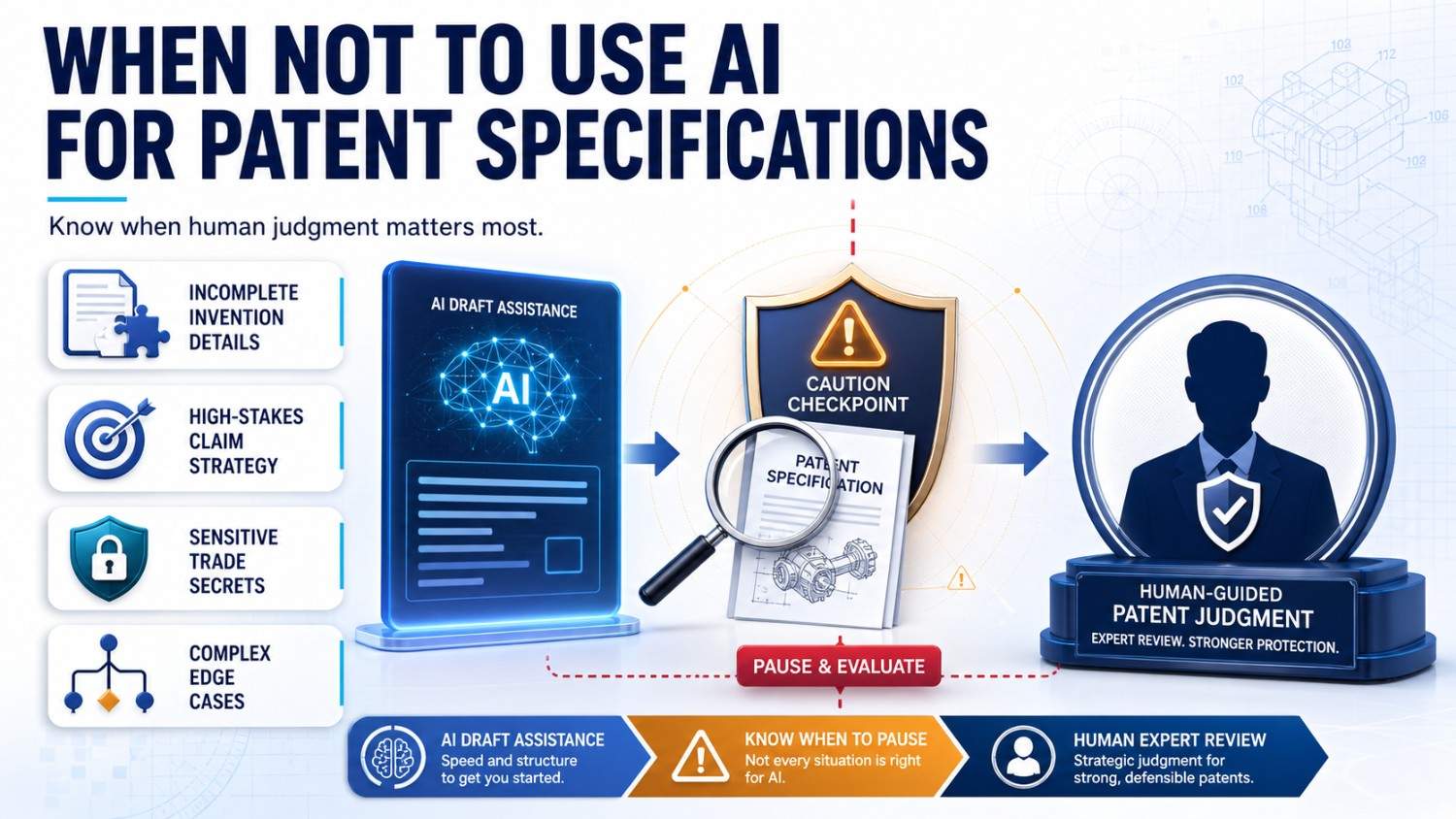
AI can help founders move faster. It can turn rough notes into cleaner text. It can make patent work feel less heavy. But AI is not always the right tool for every part of a patent specification.
This guide explains when not to use AI, when to slow down, and how to protect your invention without giving up speed.
When you want a smarter way to use software and real attorney oversight together, see how PowerPatent works here: https://powerpatent.com/how-it-works
Why This Topic Matters Now
Founders are using AI for almost everything.
They use it to write emails. They use it to draft pitch decks. They use it to summarize customer calls. They use it to plan product launches. They use it to clean up technical notes.
So it makes sense that founders also want to use AI for patent specifications.
A patent specification can feel like a hard document to write. It needs detail. It needs structure. It needs examples. It needs to explain the invention clearly. It needs to show how the system works. For a busy founder, AI looks like a simple answer.
And sometimes, AI is very helpful.
It can help you organize notes. It can help you turn engineer comments into plain words. It can help you find gaps. It can help you make a first outline. It can help you ask better questions.
But here is the part many founders miss.
A patent specification is not just another document.
It is a legal and business asset. It may protect the core value of your company. It may describe the thing that makes your product hard to copy. It may contain details your team has spent months or years building.
That means AI should not be used casually.
You should not paste your most private invention details into random tools. You should not trust a smooth AI draft just because it sounds smart. You should not let AI guess technical facts. You should not use AI to replace attorney judgment.
The right question is not, “Can AI write this?”
The better question is, “Where does AI help, and where does it create risk?”
That question can save your startup from weak filings, lost secrets, wasted time, and false confidence.
PowerPatent was built around this balance. It helps founders use smart software to move faster, while keeping real patent attorneys involved where judgment matters. You can learn more here: https://powerpatent.com/how-it-works
What a Patent Specification Actually Does
Before we talk about when not to use AI, it helps to understand what a patent specification is supposed to do.
A patent specification explains the invention.
It is not only a product description. It is not only a marketing page. It is not only a technical memo. It is not only a list of features.
It should explain the problem your invention solves. It should explain why older ways were not enough. It should explain the parts of the system. It should explain how those parts work together. It should describe the steps. It should give examples. It should show different versions. It should support the claims that may later define the legal protection.
That is a lot of work.
A strong specification needs real technical truth.
If the invention is an AI model routing method, the specification may need to explain the inputs, the routing rules, the confidence checks, the fallback steps, and the result.
If the invention is a robotic control method, the specification may need to explain the sensors, the feedback loop, the motion plan, the error handling, and the real-world setting.
If the invention is a climate hardware system, the specification may need to explain the device parts, the control steps, the operating states, the energy flow, and the improved result.
If the invention is a biotech workflow, the specification may need to explain sample handling, data steps, test conditions, system outputs, and useful variations.
In each case, a weak specification can hurt.
It may leave out the real invention. It may describe only one narrow version. It may use broad words without support. It may include guesses. It may fail to explain how the system works. It may disclose secrets that should have stayed private.
This is why AI needs limits.
AI can help with text. But the specification needs more than text. It needs judgment, accuracy, strategy, and care.
When the Invention Is Not Yet Clear
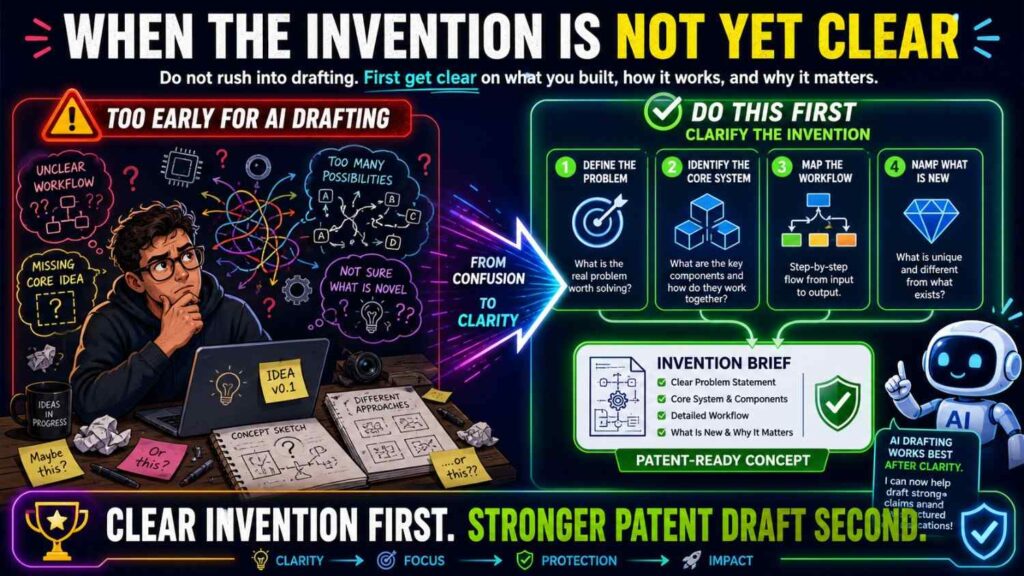
Do not use AI to write a full patent specification when your team does not yet understand the invention.
This sounds obvious, but it happens often.
A founder has a rough idea. The team has built part of a product. There are some notes, maybe a few diagrams, maybe a demo. The founder asks AI to write a patent specification.
The AI produces a long draft.
It looks official. It has sections. It uses technical words. It may even sound like a patent.
But if the invention was not clear going in, the draft will not magically fix that.
AI can organize confusion. It cannot turn confusion into truth.
If the team has not answered the core questions, slow down.
What is new?
What problem does it solve?
What did older methods fail to do?
What are the key steps?
What parts are required?
What parts can change?
What result improves?
What would a competitor want to copy?
Until those answers are clear, AI should not be asked to create a full specification.
Use AI for questions instead.
Ask it to review a clean summary and list missing details. Ask it to help create an inventor interview outline. Ask it to turn rough notes into a clearer set of open questions.
That is a safer use.
The human team still has to define the invention.
A patent attorney should help shape that invention into a filing.
PowerPatent helps founders avoid the blank-page problem without pretending AI can replace clear invention capture. The platform helps organize technical details and brings in real attorney oversight. You can see how it works here: https://powerpatent.com/how-it-works
When AI Would Have to Guess
Do not use AI for patent specification writing when it must guess key facts.
AI tools are good at creating fluent text. That can be useful. It can also be dangerous.
If the input is thin, AI may fill in gaps with details that sound reasonable. It may add a step your system does not use. It may include a sensor your device does not have. It may describe a training method your team never built. It may invent a fallback process. It may assume a database structure. It may describe a benefit you have not tested.
These guesses can be hard to spot because the writing sounds confident.
In normal writing, a small guess may be annoying.
In a patent specification, a guess can create real problems.
It can make the draft inaccurate. It can confuse the attorney. It can send engineers on a review chase. It can create a filing that does not match the real invention. It can make your company feel protected when the document is not grounded in actual work.
A simple rule helps:
If AI would need to invent facts to complete the section, do not ask it to complete the section.
Ask it to mark the gap instead.
A strong prompt might say: “Do not add facts. If a detail is missing, ask a question.”
That prompt keeps AI in a safer role.
The goal is not to make the draft look done. The goal is to make the invention clear and correct.
Smooth text is not the same as strong protection.
When the Details Are Highly Confidential
Do not use general AI tools when the patent material includes highly confidential details.
Patent specifications often contain the deepest secrets in a startup.
They may include code logic, model pipelines, data methods, manufacturing steps, hardware layouts, lab results, customer pilot details, security controls, and future product plans.
That information should not be pasted into tools your company has not approved.
The risk is not always that someone will steal it tomorrow. The risk is loss of control.
Where is the data stored?
Who can access it?
Is it used to train models?
Can it be deleted?
Is it tied to a personal account?
Is it mixed with other projects?
Does the provider allow human review?
Does your company have a contract with the provider?
If you cannot answer those questions, you should not upload your crown jewels.
This is especially true before filing.
Before a patent application is filed, your invention details may be very sensitive. A casual disclosure may create legal and business risk. Even when a disclosure is not public, it can still weaken trust, create confusion, or violate internal policy.
Use approved tools only.
Use a patent-focused workflow.
Limit what you share.
Remove customer names, source code, personal data, security keys, and private business plans when they are not needed.
For important inventions, use a process with real attorney oversight.
PowerPatent gives founders a more controlled path than pasting private invention notes into random tools. It combines smart software with real patent attorneys so teams can move fast while keeping quality and care in the process. Learn more here: https://powerpatent.com/how-it-works
When Customer Data Is Involved
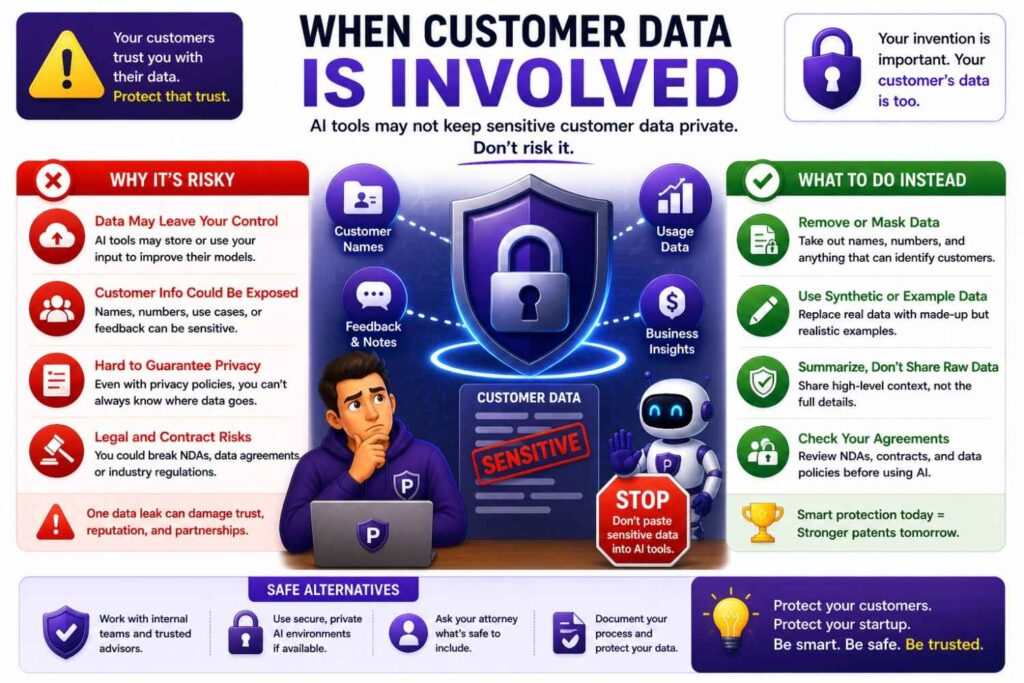
Do not use AI casually for patent specifications when customer data is mixed into the invention story.
Many startups create inventions during customer pilots.
A customer has a hard problem. Your team builds a new method. The pilot produces data. The data helps prove the method works. The customer gives feedback. The team improves the system.
That is a normal path to invention.
But it creates a risk when writing patent materials.
The invention may be tied to customer logs, workflows, reports, screenshots, messages, or private results. If those materials are uploaded into a general AI tool, you may expose information that does not belong there.
This can hurt customer trust. It may also violate contracts or privacy rules.
Even if you think the data is harmless, ask whether the patent draft actually needs it.
Often, it does not.
A patent specification can usually describe the technical method using generic examples.
Instead of naming the customer, say “an enterprise system.”
Instead of uploading raw user messages, describe the kind of input.
Instead of using real transaction logs, use fake records with the same structure.
Instead of including a customer report, summarize the technical result.
This keeps the focus where it belongs: on the invention.
If customer data is truly needed, handle it in an approved workflow with legal review.
Do not let AI drafting become a back door for exposing customer information.
When Health, Financial, or Personal Data Appears
Do not use AI casually when the patent material includes health data, financial data, personal data, or other sensitive records.
This is a major issue for health tech, biotech, fintech, insurance, HR tech, edtech, security, and enterprise SaaS companies.
Your invention may process sensitive data. But that does not mean the patent drafting process should include raw sensitive data.
A health tech company may have patient messages.
A fintech company may have transaction details.
An HR platform may have employee records.
An education product may have student information.
A security company may have customer logs.
These details can be risky to share.
Before using AI, remove personal identifiers. Use synthetic examples. Describe data fields in general terms. Share the method, not the private records.
For example, instead of pasting a real patient note, say: “The system receives a user message that includes symptoms and timing information.”
Instead of uploading a bank transaction log, say: “The system receives transaction records with merchant type, amount, location, and time.”
Instead of sharing employee records, say: “The system receives profile attributes and role history.”
This gives enough structure to explain the method without exposing private data.
For regulated or sensitive information, do not improvise. Use approved systems and legal guidance.
When Source Code Is the Main Input
Do not use AI to write a patent specification by uploading a full codebase.
This is one of the most common mistakes technical founders make.
They think, “The invention is in the code, so I will give AI the code.”
But a patent specification usually does not need full production code. It needs a clear explanation of the method, system, and result.
Source code can include many things that do not belong in a patent drafting tool.
It can include credentials by mistake. It can include internal comments. It can include customer-specific logic. It can include security details. It can include open-source dependencies. It can include workarounds that are not part of the invention. It can include trade secrets that should stay private.
It can also overwhelm the drafting process.
AI may focus on the wrong function. It may summarize implementation details instead of the inventive method. It may miss the business edge. It may turn code into generic text that sounds technical but fails to protect the right thing.
A better path is to translate the code into an invention story.
What problem does the code solve?
What inputs does it receive?
What steps does it perform?
What decision does it make?
What output does it produce?
What improves because of this method?
What parts can vary?
That story is much more useful for patent work.
An attorney may still need to understand technical detail, but that should happen through a controlled process.
Do not use AI as a dumping ground for source code.
Use it to support clean explanations, inside an approved workflow.
When the Draft Includes Attorney Advice
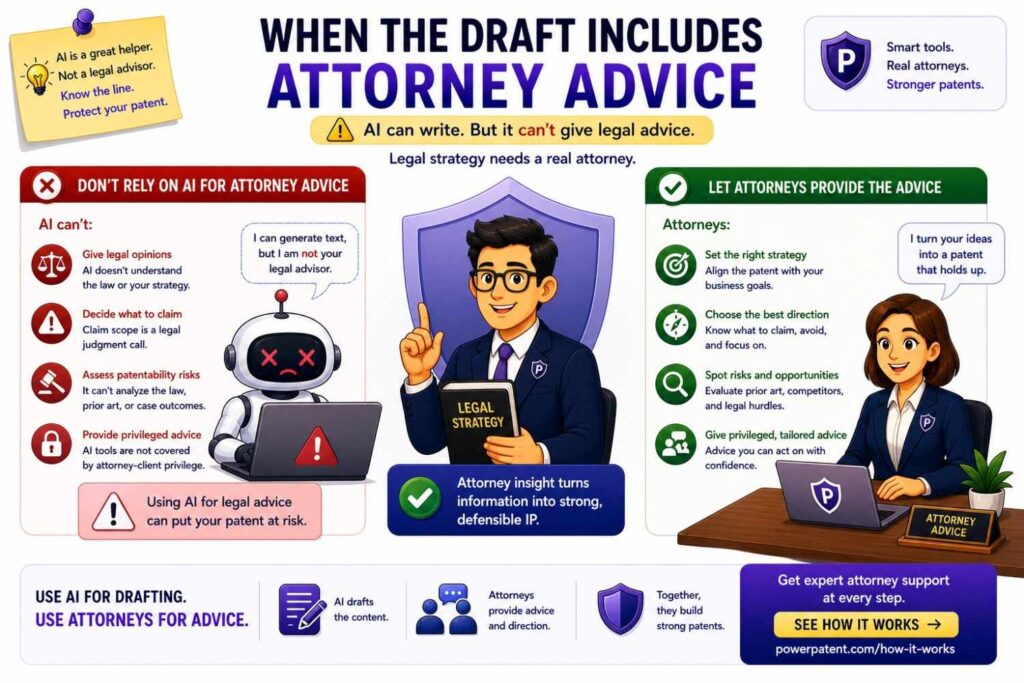
Do not paste attorney advice into general AI tools.
This includes claim strategy, filing strategy, office action responses, legal opinions, attorney comments, draft claims, or emails from counsel.
A founder may do this with good intent.
They may want a simpler explanation. They may want a second opinion. They may want help summarizing. They may want to compare options.
But attorney communications are sensitive.
They may be protected. They may include strategy. They may include legal risk analysis. They may include views that should not be spread outside approved channels.
Putting that material into an unapproved AI tool can create confidentiality concerns.
It can also lead to bad advice.
A general AI tool is not your patent attorney. It does not know the full facts. It may not understand your filing strategy. It may give broad suggestions that sound useful but do not fit your case.
Keep attorney communications inside approved legal workflows.
If you need a plain-language explanation, ask your attorney. If AI is used, make sure your legal team knows and approves the tool and process.
PowerPatent’s model is built to keep real patent attorneys in the loop, so founders are not left trying to decode or second-guess patent work with random tools. See the workflow here: https://powerpatent.com/how-it-works
When Trade Secrets May Be the Better Choice
Do not use AI to draft everything into a patent specification before deciding what should stay secret.
Not every valuable detail should be patented.
Some details may be better kept as trade secrets.
A patent filing usually becomes public. That means the information in the filing may one day be seen by competitors, customers, partners, investors, and the public.
That can be fine when disclosure supports strong patent rights. But it can be harmful when the detail was not needed.
For example, your company may choose to patent a broad model routing method but keep exact threshold values secret.
You may patent a manufacturing process but keep supplier settings private.
You may patent a data cleaning workflow but keep specific data sources and labels confidential.
You may patent a robotics control method but keep internal tuning values private.
AI can make over-disclosure easier because it tends to include whatever you provide.
If you feed it every secret, it may place those secrets into the draft.
That does not mean they belong there.
Before drafting, decide what the patent should teach and what the company should protect as internal know-how.
This is a business and legal decision.
A real patent attorney can help you find the right line.
Do not let AI make that choice for you.
When the Invention Has Not Been Reviewed by the Technical Team
Do not use AI output as a patent specification until the technical team has reviewed it.
AI can misunderstand systems.
It may reorder steps. It may remove a key condition. It may use the wrong term. It may assume a part is required when it is optional. It may describe a result too strongly. It may merge two separate inventions. It may leave out a failure mode that matters.
The engineers or scientists who built the invention need to check the draft.
They should read it for truth.
Does the system really work this way?
Are the steps in the right order?
Are the inputs correct?
Are the outputs correct?
Are the examples real or at least accurate?
Are any details missing?
Are any parts overstated?
Does the draft describe only the first version when the invention works more broadly?
This review is not busywork.
It is quality control.
A patent specification built on wrong technical facts can create long-term problems.
AI can make a draft faster. It cannot replace the people who know what was built.
When the Founder Has Not Mapped the Business Value
Do not rely on AI to choose what matters most to the business.
AI can help organize technical information, but it does not know your strategy the way you do.
It may treat every feature as equally important. It may focus on a visible interface instead of a hidden method. It may write about the easiest thing to explain, not the thing that makes the company hard to copy.
Founders need to map the business value before the specification is shaped.
What part of the invention drives the product edge?
What would a competitor copy?
What supports the next fundraise?
What matters most to customers?
What is tied to the roadmap?
What is hard to replace?
What makes the company more valuable?
These answers help decide what to emphasize.
A patent specification is not just a technical record. It should support the company’s IP strategy.
If AI drafts without this context, it may produce a document that is long but not strategic.
PowerPatent helps founders connect invention capture with real business goals, while attorney oversight helps shape the filing. Learn more here: https://powerpatent.com/how-it-works
When the Patent Claims Need Judgment
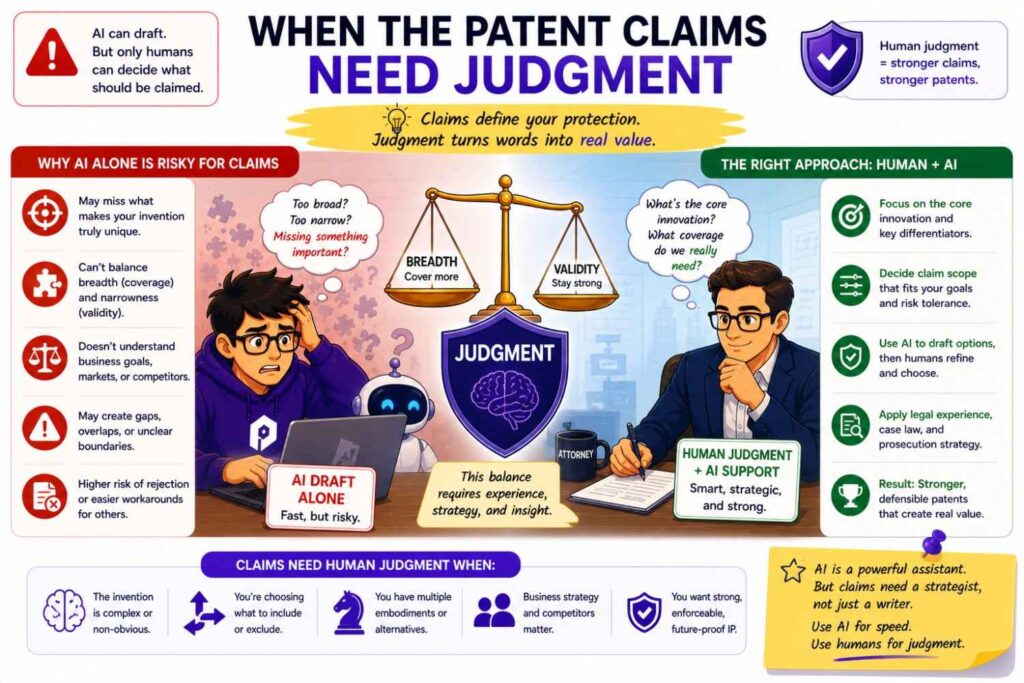
Do not use AI alone to write or finalize patent claims.
Claims are the part of a patent that define the legal boundary of the invention. They are not just a summary. They require skill and judgment.
A claim that is too narrow may be easy to design around.
A claim that is too broad may not be supported.
A claim that uses the wrong words may miss the real invention.
A claim that copies common patterns may fail to capture your edge.
AI can draft claim-like text, but that does not mean the claims are good.
It may use generic language. It may include unnecessary limits. It may leave out a key step. It may fail to support the business goal. It may sound official while being weak.
Patent claims should be handled by a patent attorney.
AI may help create a starting point or organize ideas, but it should not be the final decision-maker.
For founders, the safe rule is clear:
Use AI to assist. Use attorneys to judge.
When the Specification Must Support Future Variations
Do not use AI alone when the invention has many possible versions and future paths.
Startups change quickly.
Your current product may use one model, one sensor, one material, one database, one workflow, or one interface. But the invention may work in many forms.
A good specification should often describe more than the first version.
It may need to cover variations.
It may need to explain alternatives.
It may need to show optional steps.
It may need to describe different environments.
It may need to support future claim scope.
AI may not know which variations are real, reasonable, or important.
It may invent variations that do not work. Or it may describe only the current version and miss the broader idea.
Both can hurt.
This is where human judgment matters.
The technical team knows what can change while the invention still works.
The founder knows where the product may go.
The attorney knows how to support useful scope.
AI can help ask variation questions, but it should not decide the answer alone.
When the Specification Could Affect a Fundraise
Do not rush an AI-written patent specification right before a fundraise without proper review.
Fundraising creates pressure.
Investors ask about IP. The founder realizes the company needs a filing. The team wants something done quickly. AI looks like a shortcut.
But a weak rush filing can create false comfort.
It may not protect the real edge. It may include wrong details. It may fail to support claims. It may disclose secrets. It may look thin during diligence.
Investors do not need a giant portfolio on day one, but they do care about whether the company is thoughtful.
A strong IP story is simple:
“We identified the core technical method. We captured it clearly. We filed with attorney review. We have a plan for follow-on improvements.”
A raw AI draft does not create that story by itself.
Before using patent filings in a fundraise, make sure they have been reviewed by technical leads and patent counsel.
If timing is tight, use a process built for speed and quality.
PowerPatent helps founders move quickly before key business moments while keeping real patent attorneys involved. You can see how it works here: https://powerpatent.com/how-it-works
When a Public Launch Is Close
Do not use AI casually when a public launch is close and the invention has not been filed.
Launch materials can reveal a lot.
Your website may explain the system. Your blog may describe the method. Your docs may show workflows. Your demo video may reveal the key steps. Your API guide may expose technical design.
If you use AI to create those materials from confidential invention notes, you may expose more than intended.
You may also publish before filing.
That can create serious risk.
Before launch, review what will be shared.
Does the content teach the invention?
Does it include diagrams?
Does it show data flows?
Does it reveal model or system behavior?
Does it include benchmark results that explain how the method works?
Does it include screenshots with private details?
If the answer is yes, involve your patent team before publishing.
AI can help write launch content, but it should not turn private invention details into public marketing copy without review.
Protect first. Promote second.
When Open Source Is Involved
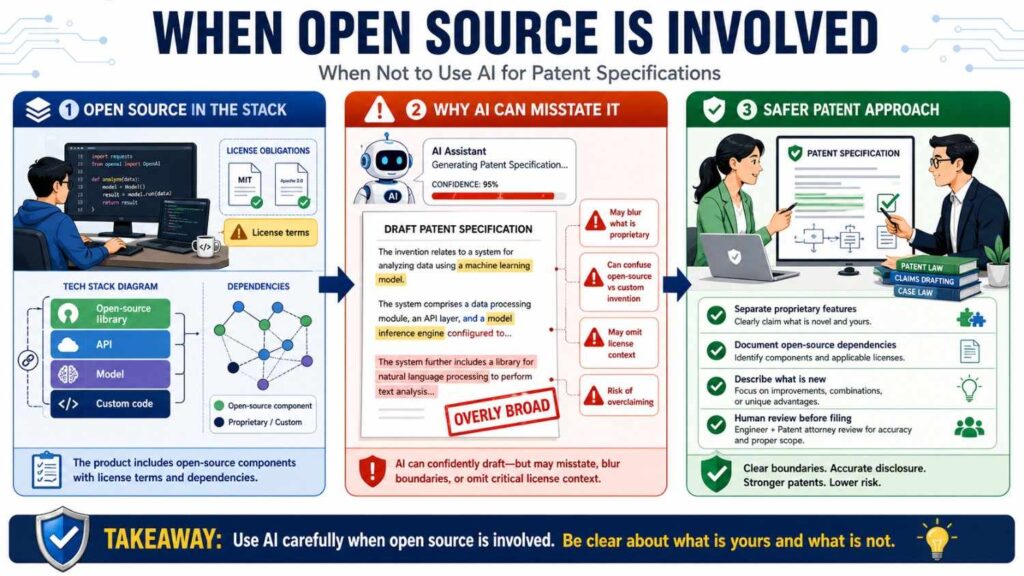
Do not use AI to prepare patent specifications or public docs from open-source materials without checking what is being revealed.
Open source can be a great growth strategy. It can build trust, attract developers, and help users adopt your product.
But open source can also reveal how your system works.
If your repository includes the core method, model routing logic, data cleaning flow, safety check, control loop, or hardware interface, it may disclose the invention.
AI can make this worse by summarizing the code into a clean public explanation.
Before releasing open-source code or AI-generated docs, ask whether the invention should be filed first.
Also clean the repository.
Remove secrets.
Remove internal comments.
Remove customer-specific logic.
Remove credentials.
Remove files that do not belong.
If AI is used to draft patent material based on the code, use approved tools and avoid uploading the full repository unless truly needed.
Open source and patent protection can work together, but timing matters.
When a Research Paper Is In Progress
Do not use AI casually when writing a research paper that overlaps with a patentable invention.
This matters for AI labs, robotics teams, biotech startups, climate tech founders, university spinouts, and deep tech companies.
A paper may describe the method in detail. It may include diagrams. It may include results. It may teach others how to reproduce the work.
That can be great for credibility.
But it can also disclose the invention before filing.
AI tools may help polish the paper, but if you upload the full draft into an unapproved tool, you may create confidentiality risk.
Before submitting or publishing the paper, run an IP check.
What new method does the paper teach?
Has a patent filing been made?
Does the paper include private data?
Does it name partners or customers?
Does it reveal future product plans?
Can sensitive details be removed without hurting the paper?
Publishing and patenting can work together. But the order matters.
Do not let AI speed you into a public disclosure before the patent plan is ready.
When the Team Is Using Personal AI Accounts
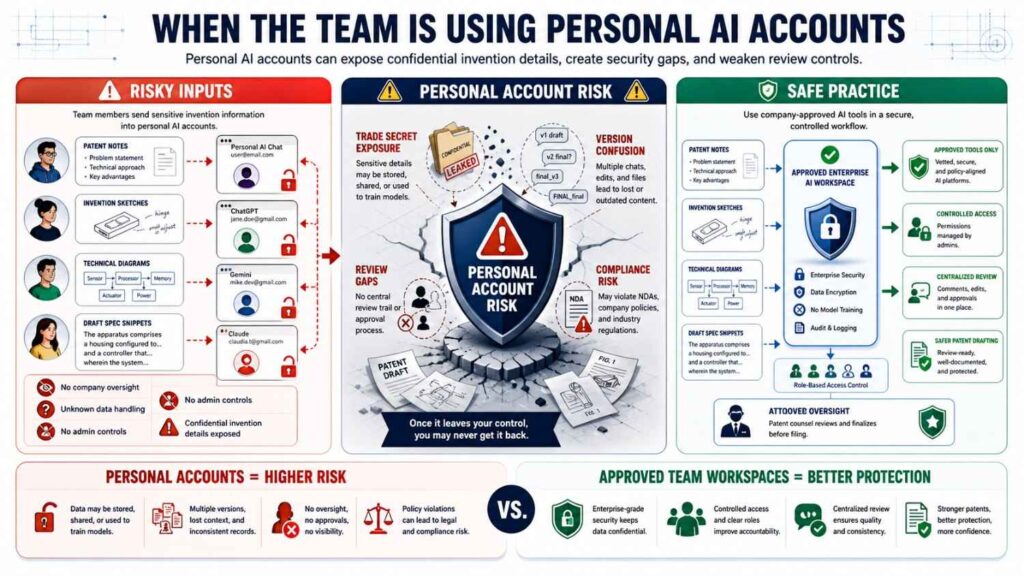
Do not use personal AI accounts for patent specification work.
This is a simple rule, but many startups break it.
A founder uses a personal account because it is already open. An engineer pastes notes into a personal chatbot. A contractor uses their own AI tool. A product manager summarizes invention notes through a browser extension tied to a personal login.
Now confidential invention material lives outside company control.
The company may not know what was shared. It may not know the data settings. It may not be able to delete the content. It may not have access logs. It may not have a contract with the provider.
That is not a good setup for patent work.
Use company-approved tools.
Use accounts under company control.
Keep invention materials in approved systems.
Make the safe path easy so people do not reach for shortcuts.
When Tool Terms Are Unclear
Do not use AI for patent specification writing when you do not understand the tool’s terms for data use.
You do not need to become a contract lawyer, but your company should know the basics.
Can the provider use your inputs to train models?
Can humans review the data?
Where is the data stored?
How long is it kept?
Can you delete it?
Who owns the output?
Can the tool be used for confidential business information?
Are file uploads covered by the same terms as chat inputs?
Is the tool approved by your company?
If these answers are unclear, do not put patent-sensitive material into the tool.
For low-risk writing, unclear terms may be annoying.
For invention details, unclear terms can be dangerous.
Choose tools and workflows built for confidential work.
When the AI Tool Has Memory Turned On
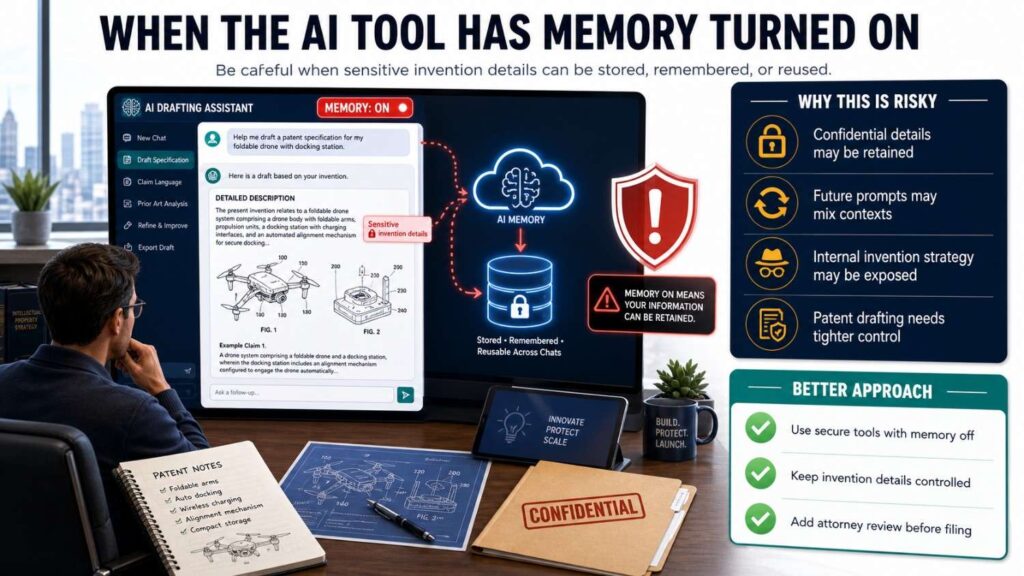
Do not use AI memory features casually for patent specification work.
Some tools can remember prior chats or user preferences. That may be useful for daily tasks. It can be risky for confidential inventions.
If the tool remembers an invention from one chat, it may bring that context into another task. If a contractor uses one account for several clients, memory can create cross-client risk. If a founder uses a personal account for both company and personal tasks, sensitive context may mix.
Before using AI for patent work, check memory settings.
Use approved company accounts.
Keep projects separate.
Turn off memory if your policy requires it.
Do not rely on memory as a storage system for invention details.
Patent materials should live in controlled company workflows, not in a chatbot’s memory.
When Browser Extensions Can Read the Page
Do not use AI browser extensions on patent drafts unless they are approved.
Some extensions can read page content. Some can summarize documents. Some can rewrite text in the browser. Some can interact with email, docs, tickets, code, or internal tools.
That can be useful.
It can also expose sensitive invention material without the team noticing.
A founder may think they are just improving wording. But the extension may be sending page text to a third-party service.
For patent work, review extension permissions.
Do not let unapproved tools read patent drafts, source code, invention notes, customer data, or legal emails.
This is a quiet risk because it does not feel like uploading a file.
But from a confidentiality point of view, it may be similar.
When the Output Sounds Too Perfect
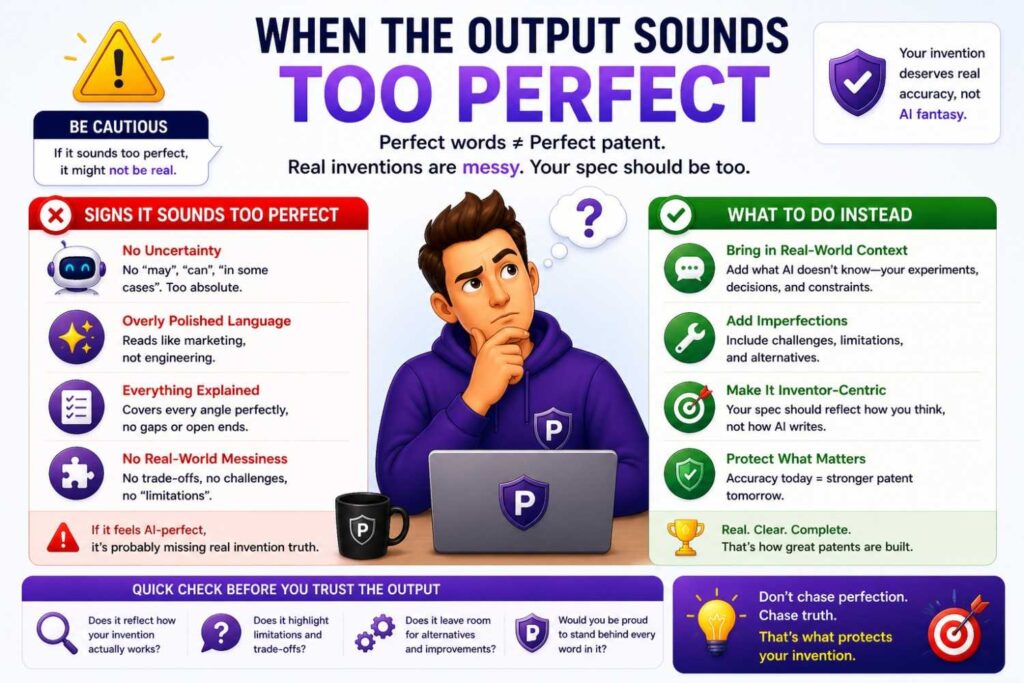
Do not trust an AI-generated specification just because it sounds polished.
This is one of the biggest traps.
AI can produce text that looks complete. It can use formal words. It can structure sections. It can make a messy idea sound official.
But patent quality is not measured by polish.
A draft may sound strong while missing the key invention.
It may be clear but too narrow.
It may be broad but unsupported.
It may include wrong examples.
It may avoid the hard technical details.
It may repeat generic language that could apply to any company.
It may fail to explain why the invention is different.
A founder should not ask, “Does this sound like a patent?”
A founder should ask, “Does this explain our actual invention in a way that supports useful protection?”
That is a harder question.
It requires technical review and attorney judgment.
PowerPatent helps founders move beyond polished but risky drafts by pairing smart drafting tools with real patent attorney oversight. See how it works here: https://powerpatent.com/how-it-works
When AI Uses Generic Patent Language
Do not rely on AI when it fills your specification with generic patent language that does not add real value.
You may see phrases like “in some embodiments,” “a system may comprise,” “one or more processors,” and other patent-style wording.
Those words are not bad by themselves.
But they can hide weak content.
A strong specification is not strong because it sounds patent-like. It is strong because it teaches the invention with enough detail.
If the draft could describe any software tool, any AI system, or any device, it is probably too generic.
Look for concrete detail.
What input is received?
What decision is made?
What step changes the result?
What part improves speed, cost, accuracy, safety, stability, or reliability?
What are examples of use?
What are real variations?
If the draft does not answer those questions, do not treat it as ready.
AI can help format. It cannot replace substance.
When the Invention Is Easy to Over-Broaden
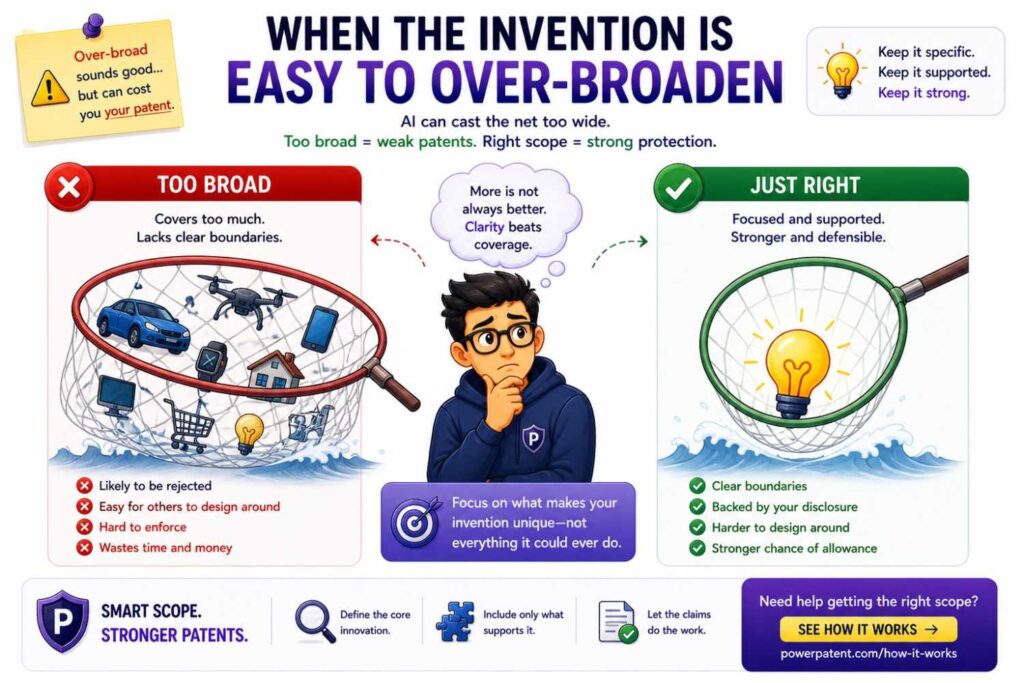
Do not use AI alone when the invention sounds broad but depends on a narrow technical insight.
This happens often with AI, software, and platform products.
A founder may say, “We use AI to automate compliance.”
That is broad.
The real invention may be much more specific.
It may be a method for extracting obligations from a document, scoring risk based on changing rules, routing uncertain cases to review, and updating a knowledge base from outcomes.
If AI drafts from the broad idea, it may produce a vague specification.
It may talk about automation in general.
It may miss the actual technical method.
Broad concepts need careful grounding.
A patent attorney can help shape the invention into something concrete enough to support protection.
AI can help after the core has been defined, but it should not be asked to turn a vague business idea into a patent strategy by itself.
When the Invention Is Easy to Over-Narrow
Do not use AI alone when the invention may be broader than the current product version.
AI may draft around the exact details you provide.
If you tell it your system uses a specific database, a specific model, a specific sensor, or a specific workflow, it may make that detail sound required.
But the invention may work without that exact part.
This can create a narrow draft.
A narrow draft may let competitors design around you.
For example, your current system may use a transformer model, but the invention may work with other model types.
Your current device may use one sensor type, but the method may work with other sensors.
Your current workflow may have four steps, but one step may be optional.
Your current product may run in the cloud, but the method may also work on-device.
AI may not know which details are essential and which are only current choices.
The technical team and attorney need to decide that.
AI can help create variation prompts, but it should not define scope alone.
When the Invention Is in a Fast-Moving Field
Do not use AI alone when the field is moving fast and the patent strategy needs current judgment.
AI, chips, robotics, quantum, biotech, cybersecurity, climate systems, and advanced materials all move quickly.
The way inventions are described can matter a lot. The prior art landscape may be crowded. The product may evolve fast. Competitors may be filing too. Rules and practices may shift.
A generic AI draft may not reflect the strategic needs of the field.
It may not know what is common. It may not know what details will matter. It may not know how to position the invention against known approaches. It may not know where the market is going.
For fast-moving fields, use AI carefully.
Let it help with organization and drafting support.
But do not let it replace expert review.
A strong patent process for deep tech needs technical understanding, legal skill, and business context.
PowerPatent is designed for deep tech founders who need to move quickly without losing the attorney guidance that complex inventions require. Learn more here: https://powerpatent.com/how-it-works
When Prior Art Needs Careful Review
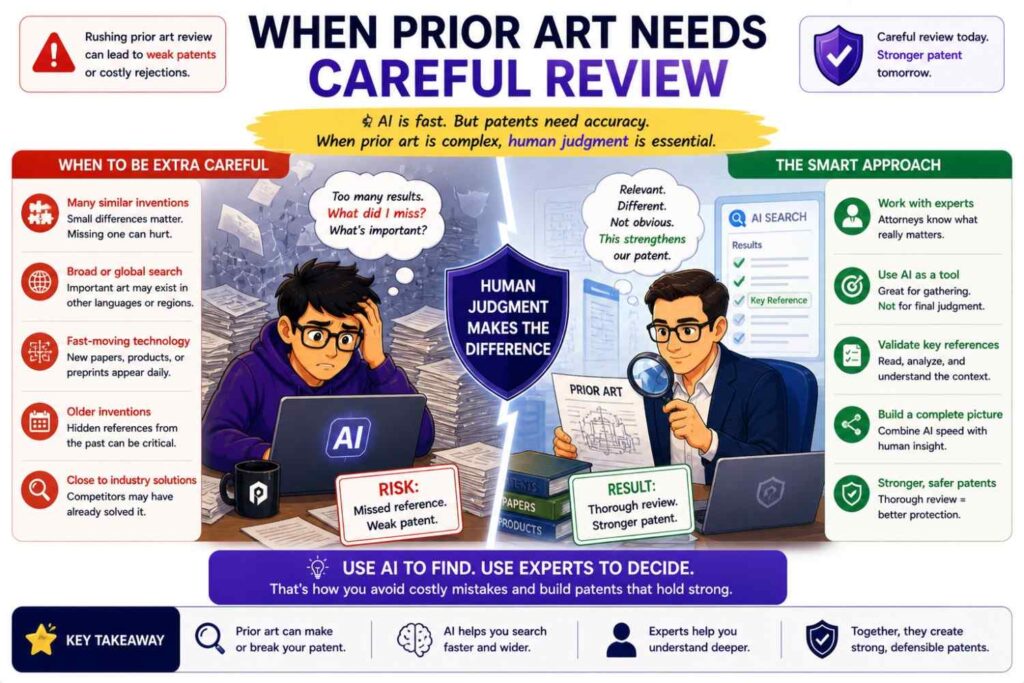
Do not rely on AI alone for prior art analysis tied to a patent specification.
Prior art means earlier work that may affect whether your invention can be patented. It can include patents, papers, products, public talks, open-source code, standards, and other disclosures.
AI may help search or summarize, but it can miss important sources. It can misunderstand documents. It can confuse dates. It can make unsupported claims. It can fail to compare the right technical features.
A patent specification should be drafted with awareness of the field.
If the area is crowded, the drafting strategy may need to emphasize the real technical difference.
That takes judgment.
Do not ask AI to “check if this is patentable” and treat the answer as final.
Use attorneys and proper search methods when prior art matters.
AI can support the process, but it should not be the final gatekeeper.
When the Draft May Be Used in Diligence
Do not use unreviewed AI patent drafts in investor, buyer, or partner diligence.
Diligence is when people look closely.
They may ask what you filed, what it covers, who invented it, when it was disclosed, whether it matches the product, and how it supports the business.
A weak AI draft can create problems.
It may reveal that the company rushed. It may include errors. It may not match the product. It may expose customer data. It may show unclear ownership. It may raise questions about confidentiality.
If a filing is going to be part of your company story, treat it like a serious asset.
Have it reviewed.
Keep records.
Know what it covers.
Know what it does not cover.
Know how it maps to the product.
AI can help prepare summaries for diligence, but those summaries should be accurate and checked.
When Inventorship Is Unclear
Do not use AI to paper over unclear inventorship.
Patent filings need correct inventor information.
If your invention was created by founders, employees, contractors, university researchers, advisors, partner engineers, or customer-side contributors, you need to understand who actually contributed to the inventive ideas.
AI cannot solve that by writing a nice draft.
In fact, AI may make confusion worse if it blends notes from many people and hides who contributed what.
Before filing, clarify inventorship with counsel.
Know who developed the key method.
Know whether contractors assigned rights.
Know whether university or employer obligations exist.
Know whether a partner contributed.
This is a legal issue and should not be guessed by AI.
When Ownership Is Unclear
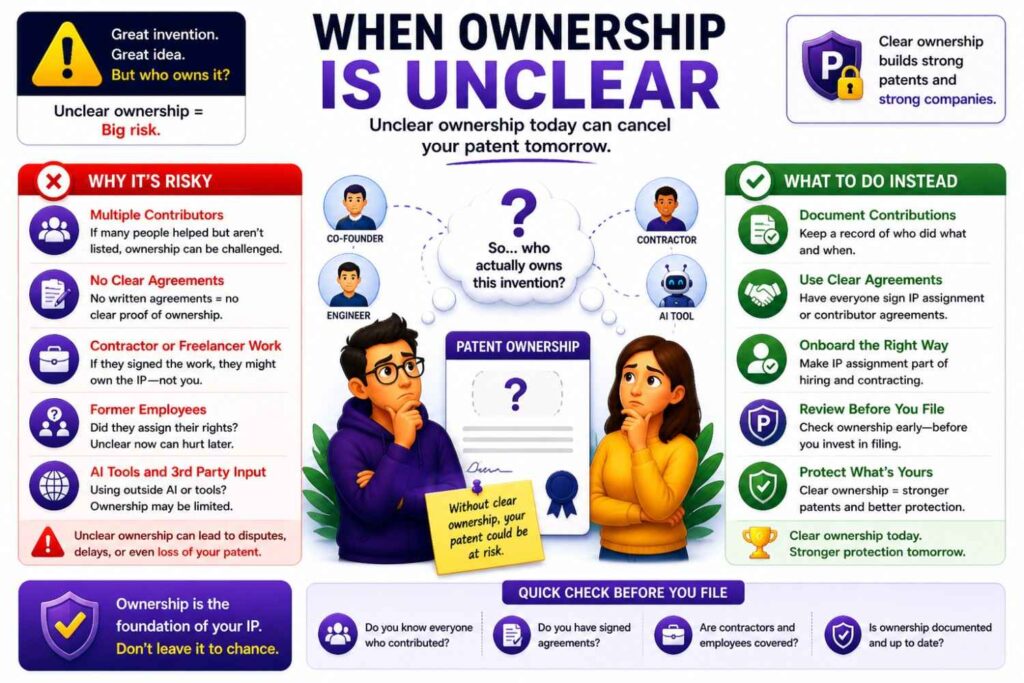
Do not use AI drafting as a substitute for cleaning up IP ownership.
A startup may have code from contractors. A founder may have worked on the idea while employed elsewhere. A university lab may have created early work. A vendor may have built a prototype. A customer may have helped define the solution.
These facts matter.
A patent specification does not fix ownership issues.
Before filing, make sure the company has the rights it needs.
This may involve employment agreements, contractor assignments, university licenses, partner terms, or other legal documents.
AI cannot make those rights appear.
It can help organize facts, but counsel must review the ownership picture.
For founders, the key habit is simple:
Do not wait until diligence to clean up ownership.
When Foreign Filing Strategy Matters
Do not use AI alone when the patent strategy may involve multiple countries.
Different countries can have different rules, timing issues, filing paths, and disclosure concerns.
A public disclosure, a conference talk, a product launch, or a research paper may affect options in different places.
AI may give general information, but it should not be your final guide for global strategy.
If your startup may file outside the United States, talk to counsel early.
This is especially important for deep tech companies with global markets, hardware supply chains, international investors, or public research plans.
AI can help prepare clean invention summaries, but filing strategy belongs with patent professionals.
When Standards or Open Protocols Are Involved
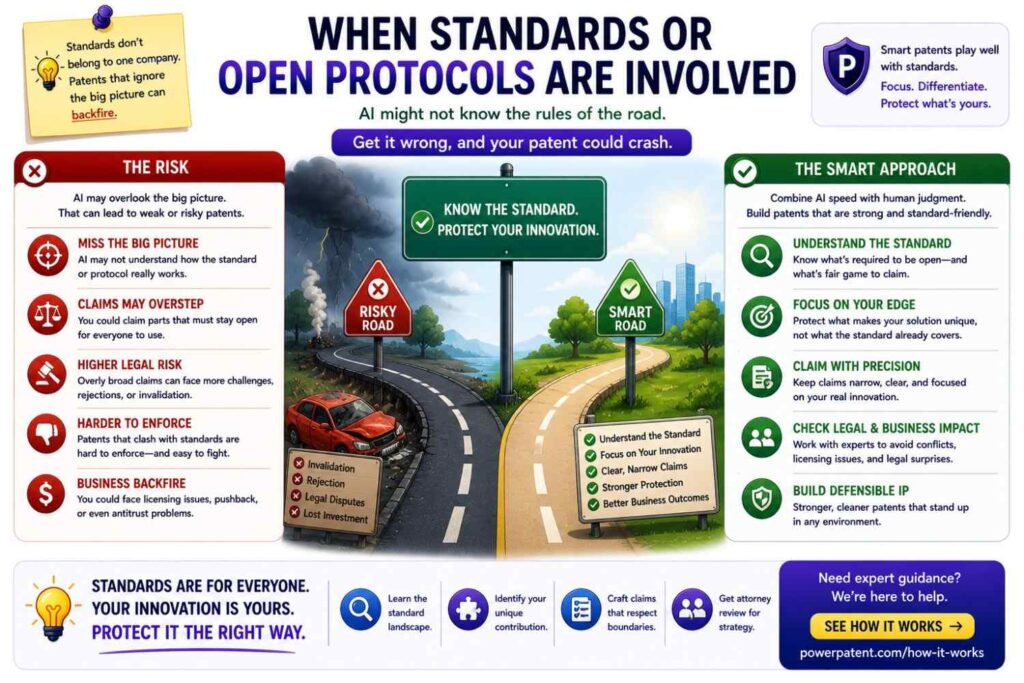
Do not use AI alone when your invention relates to standards, open protocols, or shared technical ecosystems.
This can happen in networking, chips, wireless systems, security, AI infrastructure, developer tools, robotics, climate systems, and healthcare data.
Standards can create special issues.
There may be disclosure duties. There may be licensing concerns. There may be public working group materials. There may be technical documents that affect strategy.
AI may not understand those duties or the business impact.
If your invention may become part of a standard or interface with one, get legal guidance before drafting and sharing widely.
When the Specification Needs Precise Definitions
Do not rely on AI alone when key terms need precise meaning.
Some inventions turn on specific words.
What does “confidence score” mean?
What does “risk level” mean?
What does “real-time” mean?
What does “adaptive” mean?
What does “secure channel” mean?
What does “training sample quality” mean?
AI may use these terms loosely.
Loose terms can create confusion.
A strong specification should explain important terms in the context of the invention.
The technical team should define them accurately.
The attorney should decide how to phrase them.
AI can suggest draft language, but it should not decide key definitions alone.
When Numbers Matter
Do not let AI invent numbers.
Patent specifications sometimes include ranges, thresholds, test results, performance gains, timings, sample sizes, temperatures, pressures, voltages, dimensions, model scores, cost reductions, or accuracy values.
AI may create numbers if asked to make examples.
That can be risky.
If a number is real, confirm it.
If it is an example, label it properly.
If a range is important, have the technical team and attorney review it.
If exact values are trade secrets, decide whether they belong in the filing.
Do not let AI make up data to make the invention sound better.
A patent specification should be grounded in truth.
When Test Results Are Limited
Do not use AI to overstate results.
Startups often have early test data.
A model improved accuracy in one dataset. A device worked in one lab condition. A method reduced cost in one pilot. A workflow improved speed for one customer.
These results may be useful, but they should be described carefully.
AI may turn limited results into broad claims.
It may say “the system improves accuracy” when the honest statement is “in one test, the system improved accuracy under these conditions.”
Overstating results can hurt trust and create problems later.
Use clear, honest language.
Have technical people review performance statements.
Have counsel decide how results should appear in the specification.
When Safety-Critical Systems Are Involved
Do not use AI casually for patent specifications involving safety-critical systems.
This includes medical devices, autonomous vehicles, industrial robots, aviation systems, energy infrastructure, security systems, defense-related tools, and other systems where failure can cause serious harm.
The details matter.
A wrong step, missing limit, or invented safety check can create confusion.
The specification may also include sensitive operational details.
Use AI only inside a controlled process.
Have subject matter experts review every technical statement.
Have patent counsel review scope and disclosure.
Do not let AI smooth over uncertainty.
For safety-critical inventions, accuracy is not optional.
When Security Details Could Be Misused
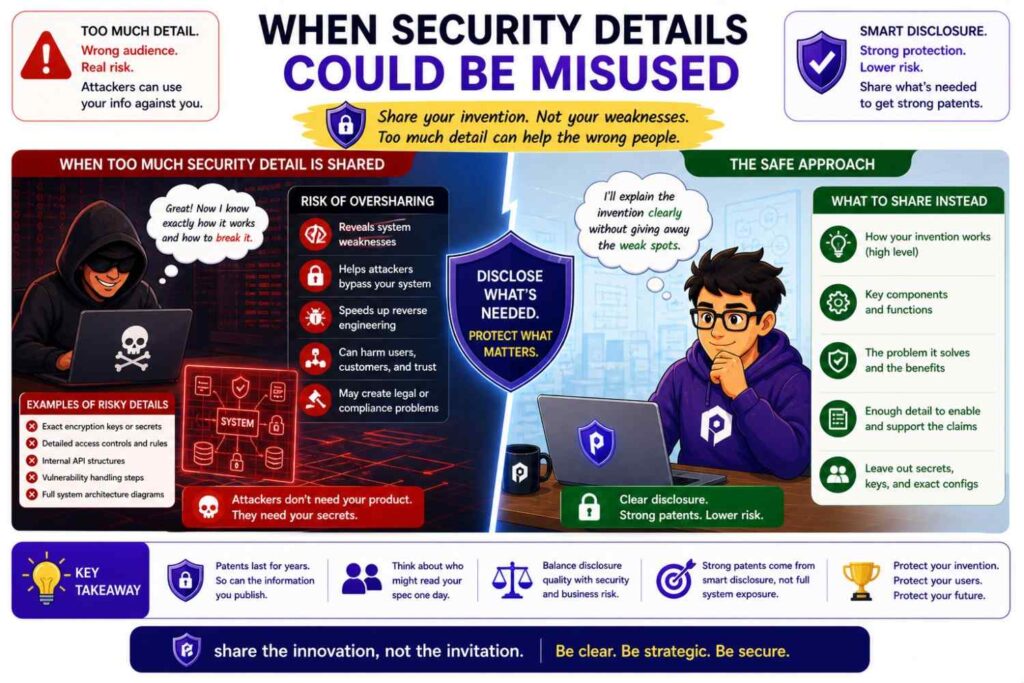
Do not use AI casually when the specification involves cybersecurity vulnerabilities, exploit paths, detection logic, access control, authentication, encryption, or threat response.
Security inventions can be patent-worthy, but they can also include details that attackers may misuse.
A patent filing must disclose the invention enough to support protection. But you should avoid exposing unrelated operational secrets.
Do not upload real customer logs, live vulnerability details, keys, secrets, internal detection rules, or attack paths into unapproved AI tools.
Use generic examples when possible.
Keep sensitive operational data separate.
Have security leaders and counsel review the draft.
In security, a careless AI workflow can create real-world risk.
When the Invention Depends on Licensed Data or Third-Party Material
Do not use AI casually when the invention uses licensed data, third-party datasets, partner documents, vendor materials, or content with usage limits.
You may not have the right to upload that material into an AI tool.
Even if the data helped create the invention, it may not belong in the patent drafting input.
Check contracts.
Use summaries.
Use synthetic examples.
Remove third-party confidential content unless sharing is allowed and needed.
This is especially important for AI companies that train or evaluate systems using licensed content.
The patent should protect your invention, not create a side issue about data misuse.
When the AI Tool Is Connected to External Sources
Do not use AI agents or tools connected to external systems without strong controls.
Some AI tools can read files, browse internal folders, query databases, search tickets, access email, or call APIs.
That can be powerful.
It can also be risky for patent work.
The tool may pull in documents that were not meant for patent drafting. It may mix customer data with invention notes. It may include old versions. It may access legal emails. It may gather more than needed.
Before using connected AI tools, limit access.
Point the tool only at approved materials.
Review outputs carefully.
Do not allow automatic sharing or filing.
Keep human approval at key steps.
For patent specifications, controlled input is better than broad access.
When Prompt Injection Is Possible
Do not use AI blindly on untrusted documents when writing patent specifications.
Some documents may contain hidden or visible instructions that try to manipulate the AI. This is often called prompt injection.
For example, a customer ticket, web page, or external file could include text that tells the AI to ignore prior instructions or reveal hidden data.
This may sound strange, but it matters when AI tools can read many sources.
For patent work, use trusted inputs.
Do not mix confidential invention material with untrusted web content in the same AI workflow.
Review outputs.
Do not let AI send messages, upload files, or change documents without human approval.
The safest patent workflows keep sensitive drafting separate from untrusted content.
When the Team Does Not Have an AI Policy
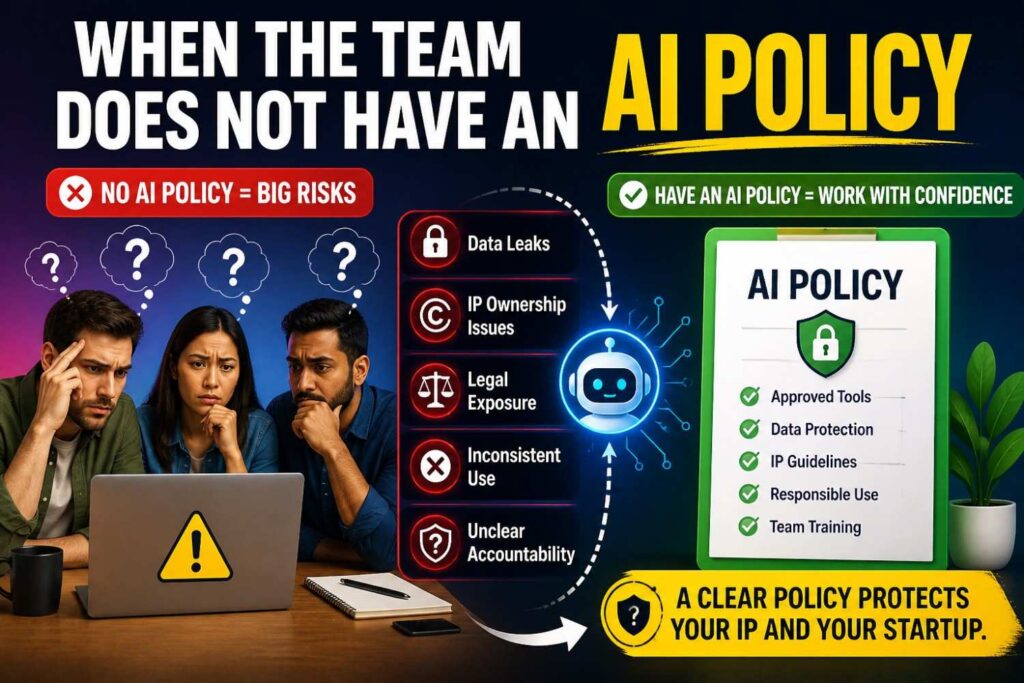
Do not scale AI patent drafting across your team before you have basic rules.
You do not need a long policy.
You need clear guardrails.
Which AI tools are approved?
What information cannot be pasted into unapproved tools?
How should customer data be handled?
Can source code be uploaded?
Can attorney emails be uploaded?
Who reviews AI-generated drafts?
Who approves public disclosure?
Who should team members ask when unsure?
Without these answers, each person will make their own choices.
That creates risk.
A simple policy can prevent many problems.
Even better, give the team a safe workflow so they do not need shortcuts.
PowerPatent gives founders a structured way to move from invention capture to attorney-backed patent filing. That makes it easier to use AI with more control. See how it works here: https://powerpatent.com/how-it-works
When the Safe Path Is Harder Than the Risky Path
Do not be surprised if team members use risky AI shortcuts when the safe process is slow or confusing.
People usually choose the easiest path.
If the approved process requires long forms, unclear steps, delayed feedback, and endless calls, team members may paste notes into a public AI tool just to get moving.
The solution is not only more warnings.
The solution is a better workflow.
The safe path should be fast.
It should be clear.
It should ask useful questions.
It should respect engineer time.
It should help founders see progress.
It should include attorney review without old-school drag.
That is the modern way to reduce risk.
Make the right way easier than the wrong way.
When AI Is Being Used to Avoid Talking to Inventors
Do not use AI as a replacement for inventor interviews.
The people who built the invention know things that are not in the documents.
They know why old methods failed. They know which tradeoffs mattered. They know what almost worked. They know why the final method is better. They know which parts are essential. They know which parts can change.
AI cannot know that unless humans explain it.
If you skip inventor interviews, the specification may miss the best details.
Use AI to prepare questions. Use it to organize notes. Use it to clean up the transcript if the tool is approved.
But still talk to the inventors.
A good patent specification often depends on the story behind the solution.
That story comes from people.
When AI Is Being Used to Avoid Attorney Costs Entirely
Do not use AI as a way to avoid attorney review for important patent filings.
It is smart to control costs. Startups must be careful with cash.
But skipping attorney review on a core invention can be an expensive mistake.
A cheap weak filing may cost less today and cost more later.
It may fail during diligence. It may not protect the true edge. It may disclose secrets without useful claim support. It may create false confidence. It may need expensive repair work.
AI can reduce friction and speed up the process.
It can help attorneys work from better inputs.
It can help founders avoid blank-page time.
But for serious inventions, attorney oversight is not a luxury.
It is part of building a real asset.
PowerPatent helps founders get a more efficient process without giving up real patent attorney involvement. Learn more here: https://powerpatent.com/how-it-works
When the Draft Has Not Been Checked for Public Disclosure Risk
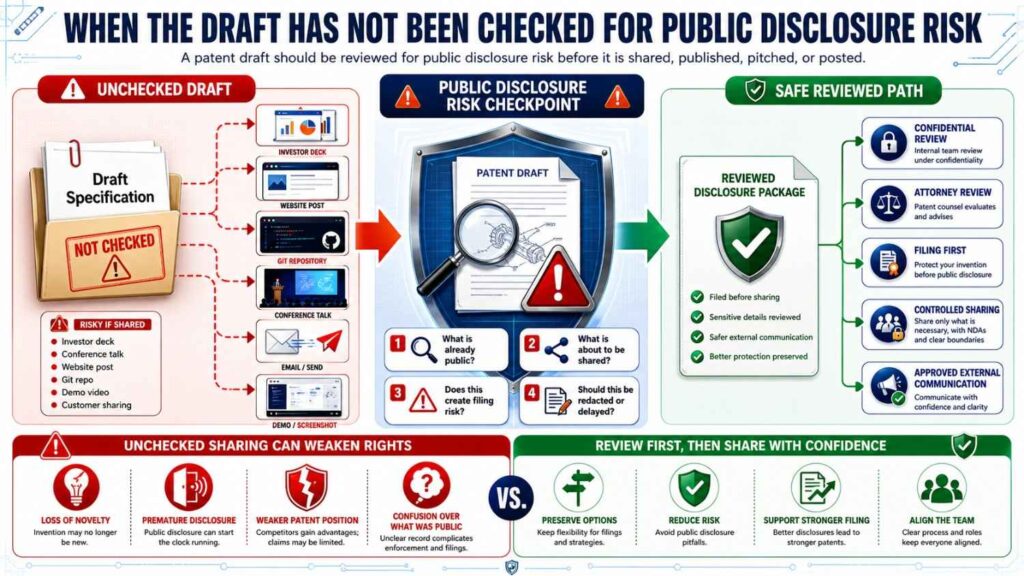
Do not use or share an AI-generated specification draft without checking disclosure risk.
A draft may include details that should not be shared broadly.
If you send it to investors, advisors, contractors, or partners, you may reveal more than intended.
Before sharing, ask what the reader needs to know.
Does the person need the full draft?
Would a summary work?
Should the person be under confidentiality duties?
Does the draft include customer data?
Does it include trade secrets that are not needed?
Does it include attorney advice?
Does it include future filing plans?
Do not treat patent drafts like normal docs.
They may contain the core of your moat.
Share carefully.
When the Draft Is Being Used for Marketing
Do not use a patent specification draft as raw marketing copy.
A patent draft and a marketing page have different jobs.
A patent draft may need technical depth. A marketing page needs clear value. A patent draft may include alternative versions. Marketing should not reveal every version. A patent draft may discuss implementation details. Marketing should avoid exposing secrets.
AI can turn patent text into marketing text very quickly.
That can be helpful.
It can also reveal too much.
Before using patent material for public content, review it.
Remove sensitive details.
Make sure the invention has been filed if the content teaches it.
Make sure customer data is gone.
Make sure claims about patent pending status are accurate.
Protect first, then tell the story.
When Patent Pending Language Is Not Accurate
Do not use AI to create patent pending claims unless a filing actually exists and the language is accurate.
AI may write strong-sounding lines like “our patented system” or “patent-pending technology” because it thinks that sounds good.
But those phrases have meaning.
Do not say “patented” if the patent has not issued.
Do not say “patent pending” if no application has been filed.
Do not imply that a filing covers features it does not cover.
This matters in decks, websites, sales material, and investor updates.
AI-generated copy should be checked by a human who knows the filing status.
When Multiple Inventions Are Mixed Together
Do not ask AI to write one patent specification from a messy pile of unrelated inventions.
Startups often build many new things at once.
An AI product may have a data cleaning invention, a model routing invention, a user feedback invention, and a deployment invention.
A hardware product may have a sensor layout, a control method, a manufacturing process, and a maintenance tool.
If you dump all of that into one AI prompt, the result may blur the inventions together.
That can create confusion.
It may also make it harder to decide what to file first.
Separate the inventions.
Give each one a plain title.
Write a short summary for each.
Decide which inventions belong together and which need separate treatment.
AI can help organize the set, but it should not merge everything without human review.
When the Invention Is Only a Business Idea
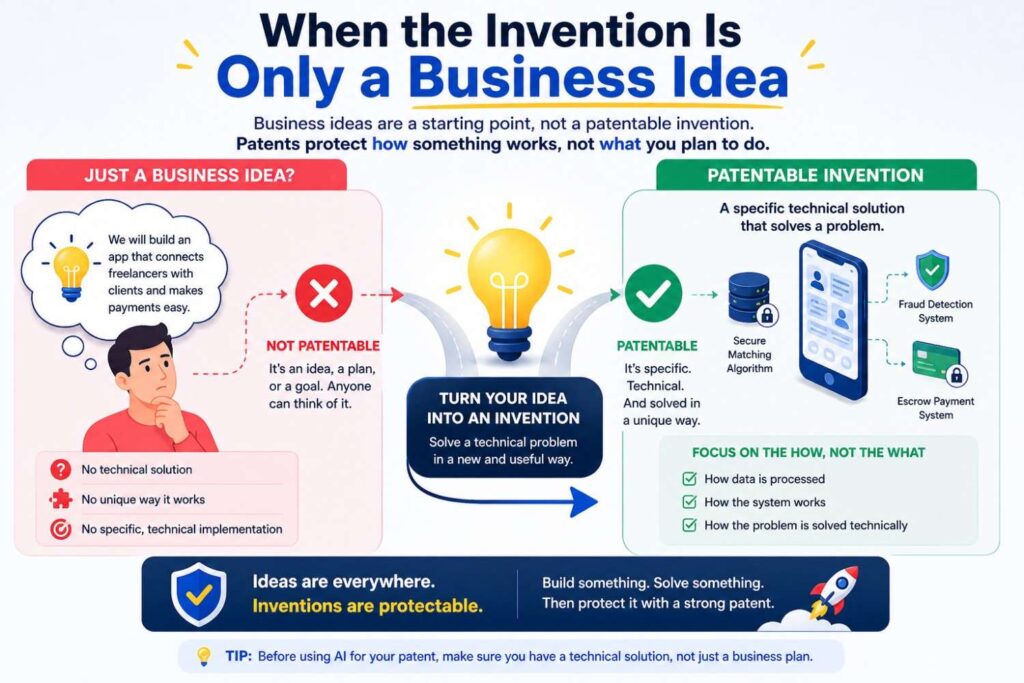
Do not use AI to turn a pure business idea into a patent specification without a real technical invention.
A patent is not just protection for a plan, market, or goal.
You need a new and useful way to solve a problem.
For technical startups, that often means a method, system, device, process, architecture, workflow, data flow, model flow, control method, or hardware design.
If the idea is only “sell this service to this market” or “use AI for this industry,” AI may produce patent-like text, but that does not mean there is a strong invention.
Before drafting, find the technical edge.
What did your team build that is different?
How does it work?
Why is it better?
What would others copy?
If you cannot answer that, keep working on invention capture.
When the Invention Is Only a Feature Name
Do not use AI to draft from feature names alone.
Feature names are not inventions.
“Smart match,” “auto review,” “risk score,” “adaptive control,” “AI assistant,” and “secure sync” may sound useful, but they do not explain how the invention works.
AI can turn feature names into long descriptions, but those descriptions may be generic.
A strong patent specification needs the method behind the feature.
How is the match made?
How is review automated?
How is the risk score created?
How does control adapt?
How does the assistant choose what to do?
How does sync stay secure?
Do not let AI hide vague thinking under polished words.
Get the mechanism clear first.
When the Company Has Not Decided What It Wants to Protect
Do not use AI to draft a patent specification before deciding what the company actually wants to protect.
The current product may have many parts.
Some are common.
Some are new but not central.
Some are valuable but easy to keep secret.
Some are core and likely to be copied.
The patent plan should focus on the most important parts first.
AI cannot decide your company priorities.
It can help analyze notes, but founders need to set direction.
What is the moat?
What supports the roadmap?
What matters to investors?
What matters to customers?
What would hurt if copied?
What needs protection before launch?
Once the priority is clear, AI can help support the process inside the right workflow.
PowerPatent helps founders turn this kind of thinking into action, with software that organizes invention details and attorneys who help shape filings. Start here: https://powerpatent.com/how-it-works
When There Is No Human Review Plan
Do not use AI for patent specification work if no one is assigned to review the output.
AI output must be checked.
A technical reviewer should check facts.
A founder should check business fit.
An attorney should check legal quality.
Without review, AI can create a false sense of progress.
The draft exists, but no one knows if it is right.
That is not progress.
Real progress means the invention is captured, checked, shaped, and filed with care.
Before using AI, decide who reviews what.
This simple step can prevent many mistakes.
When the Team Cannot Explain the Draft Back
Do not file or rely on an AI-generated specification if your team cannot explain it back in simple words.
This is a powerful test.
Ask the founder or engineer to explain the draft without reading it.
What is the invention?
What problem does it solve?
What are the key steps?
What makes it different?
What examples are included?
What parts can vary?
What does it not cover?
If the team cannot answer, the draft may not be understood.
That is risky.
A patent specification should not be a mystery to the company that owns it.
It should be clear enough that founders can connect it to product strategy.
When AI Creates Fake Confidence
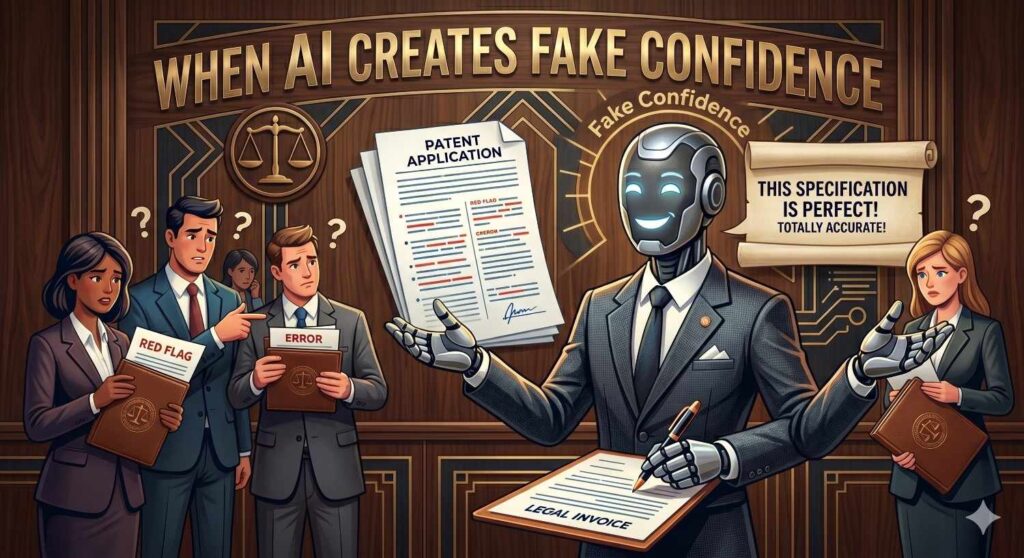
Do not use AI in a way that makes your team feel protected before you really are.
A long draft is not a filed application.
A filed provisional is not a granted patent.
A patent pending label is not a guarantee of protection.
A broad title is not a strong claim.
A polished paragraph is not legal judgment.
AI can make early patent work feel more complete than it is.
Founders should stay clear-eyed.
What has actually been filed?
What does it cover?
Was it reviewed by an attorney?
Does it support the claims you care about?
What remains private?
What still needs follow-on work?
Confidence should come from process, not polish.
When the Company Needs a Filing Fast
This may sound surprising, but do not use raw AI alone just because you need a filing fast.
Fast situations are exactly when mistakes happen.
A launch is near. A pitch is tomorrow. A paper is due. A partner meeting is scheduled. A demo will reveal the system.
The pressure is real.
But rushing into a weak AI draft can create long-term risk.
What you need is a faster proper process, not a careless shortcut.
Use structured invention capture.
Focus on the core method.
Remove unnecessary secrets.
Get technical review.
Get attorney review.
File the right material before public disclosure when needed.
PowerPatent is designed for this kind of startup pressure. It helps founders move quickly while still involving real patent attorneys, so speed does not mean guessing. See how it works here: https://powerpatent.com/how-it-works
When the AI Draft Is Based on Old Product Details
Do not use AI to draft from outdated notes without checking the current product.
Startups change fast.
A design doc from two months ago may be wrong now. A model pipeline may have changed. A device part may have been replaced. A workflow may have been simplified. A feature may have been removed.
AI will not know what changed unless you tell it.
If the input is old, the draft may protect the wrong version.
Before drafting, check the current state.
What is live now?
What changed?
What is still planned?
What was abandoned?
What was learned from testing?
What is the real invention today?
Use AI only after the source material is current.
When the Draft Ignores Failed Attempts
Do not use AI in a way that removes the story of failure.
Failed attempts can be valuable.
They show why the problem was hard. They show what did not work. They show why the final method matters. They can help explain the technical improvement.
AI may clean up notes so much that failures disappear.
That can weaken the invention story.
For example, if your team tried a single-model approach and it failed due to cost, that helps explain why model routing matters.
If a fixed calibration method failed in real-world conditions, that helps explain why adaptive calibration matters.
If a rule-based triage flow created too many false positives, that helps explain why your scoring method matters.
Do not hide useful failure history.
Capture it clearly.
Let the attorney decide how to use it.
When the Draft Leaves Out Alternatives
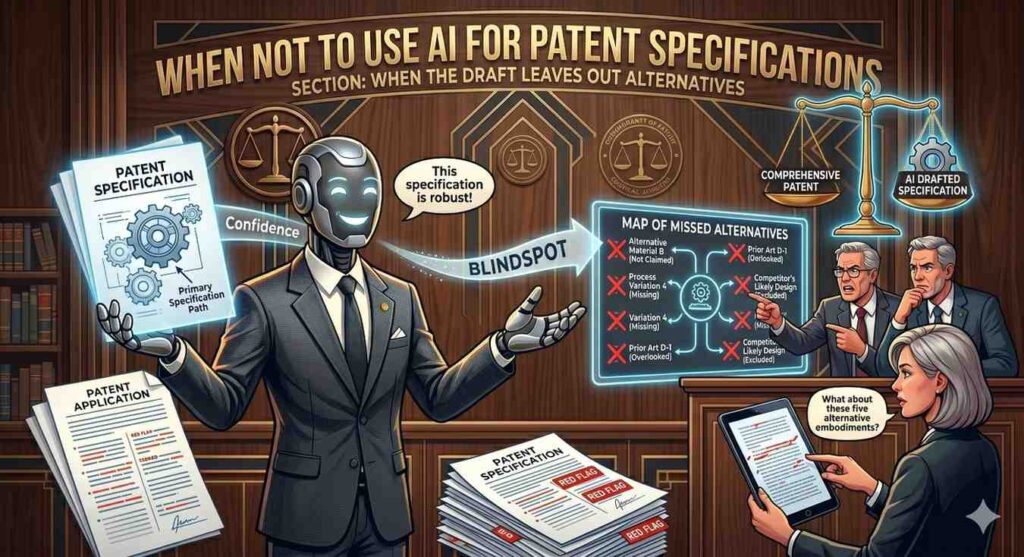
Do not use AI output that describes only one exact version when the invention has useful alternatives.
A patent specification often benefits from alternatives.
Different inputs.
Different models.
Different sensors.
Different devices.
Different data stores.
Different control modes.
Different user workflows.
Different deployment settings.
AI may not include these unless prompted. Or it may invent alternatives that do not work.
The right process is to ask the inventors.
What else could be used?
What parts are optional?
What can be swapped?
What settings can vary?
Where else can the method work?
Then have the attorney decide how to include those variations.
When the Draft Includes Too Many Alternatives
Do not use AI output that adds endless alternatives with no real support.
Some AI drafts try to cover everything.
They may say the system can use any model, any sensor, any database, any network, any device, any input, and any output.
That may sound broad, but it can become meaningless.
A good specification should include useful, believable, supported variations.
Not random filler.
Too many unsupported alternatives can make the draft harder to read and less focused.
Ask whether each alternative helps.
Is it real?
Does it support the invention?
Could the system actually work that way?
Does it matter to the business?
If not, cut it or revise it.
When the Specification Needs Drawings
Do not rely on AI text alone when drawings are needed to explain the invention.
Some inventions are much easier to understand with diagrams.
A system architecture diagram can show how parts connect.
A flowchart can show method steps.
A device drawing can show hardware layout.
A data flow diagram can show how information moves.
A timing diagram can show how signals interact.
AI can describe diagrams, but the technical team should verify them.
Do not let AI create a diagram that looks clean but shows the wrong system.
For patent work, drawings should teach the invention.
Use them carefully.
When the Specification Needs Examples
Do not let AI create fake examples without review.
Examples can make a patent specification stronger. They show how the invention works in real settings.
But examples should be accurate.
AI may create examples that sound good but do not match your product.
It may use customer-like facts that should not be included.
It may create results that were never tested.
It may choose examples that narrow the invention in a bad way.
Use AI to draft example formats, but fill them with real or carefully designed facts.
Review examples with technical and legal teams.
When Internal Names Could Leak Strategy
Do not use AI drafts that include internal project names, customer code names, service names, feature flags, or roadmap labels.
These names can reveal more than you think.
A project name may reveal a target market. A service name may reveal architecture. A feature flag may reveal future plans. A customer code name may identify a partner. An internal label may show strategy.
Before using AI or sharing drafts, replace internal names with generic terms.
Use “routing module,” “data store,” “client device,” “control system,” or “enterprise user” instead.
Keep the method clear.
Remove the inside baseball.
When Legal or Technical Terms Are Used Incorrectly
Do not rely on AI when it uses terms your team does not understand.
AI may include legal phrases or technical labels that sound impressive.
If they are wrong, they can hurt clarity.
For example, it may call something a neural network when it is not. It may call a process encryption when it is only obfuscation. It may call a device autonomous when it still requires human control. It may use “real-time” when the system is near-real-time. It may use legal terms that do not fit.
Every important term should be checked.
Use plain words where possible.
If a technical term is needed, define it accurately.
Do not let AI dress up uncertainty with jargon.
When the Patent Specification Should Stay Narrowly Shared
Do not send an AI-generated patent specification to a wide group just to get comments.
More reviewers are not always better.
Patent drafts can include confidential details.
Share with people who need to know.
That may include founders, inventors, technical leads, and patent counsel.
It may not include every advisor, investor, contractor, or employee.
Use access controls.
Avoid open links.
Do not paste drafts into public channels.
Keep version control.
Remove access when people no longer need it.
AI can help create drafts faster, but faster drafts still need careful sharing.
When the Company Is Not Ready to Disclose the Invention

Do not use AI to push your team into a patent filing before deciding whether disclosure is right.
A patent application may become public. That means your competitors may eventually learn from it.
This can be worth it if the patent gives useful protection.
But it is a strategic choice.
Some inventions are better kept secret.
Some should be filed now.
Some should be filed after more testing.
Some should be split into different filings.
Some should be abandoned.
AI can make drafting feel easy, but ease should not decide strategy.
Before filing, ask whether patent protection is the right path for this invention.
Get attorney guidance.
When the Invention Is Still Changing Daily
Do not rush to use AI for a full specification when the invention is changing every day and the core has not settled.
Startups iterate.
That is normal.
But if the core method keeps changing, a full draft may become outdated quickly.
In this stage, use AI for invention tracking instead.
Keep notes.
Summarize versions.
Track what changed.
Capture test results.
Record failed attempts.
Ask AI to organize questions, not finalize the filing.
Once the core technical method is clear enough, move toward drafting and attorney review.
This avoids wasting time on a specification for an invention that no longer exists.
When the Invention Has Already Been Publicly Shared
Do not assume AI can fix a public disclosure problem.
If the invention has already been shown in a blog, demo, paper, pitch, GitHub repo, video, product doc, or customer presentation, timing may matter.
AI cannot undo that disclosure.
If you are in this situation, gather the facts.
What was shared?
When was it shared?
Who saw it?
Was there confidentiality?
What details were included?
Was the invention fully taught?
Then talk to counsel.
Do not rely on AI for legal conclusions about deadlines or rights.
AI can help organize the timeline, but legal judgment is needed.
When You Need to Decide Between Provisional and Non-Provisional
Do not use AI alone to decide what type of patent application to file.
A provisional filing can be useful for startups because it can secure an early filing date and give time to refine. A non-provisional application starts the formal examination path.
Which path makes sense depends on timing, budget, public disclosure, business goals, invention maturity, and filing strategy.
AI can explain the concepts at a high level, but it should not make the decision for your company.
Talk to a patent attorney.
PowerPatent helps founders move through these decisions with attorney-backed guidance and a modern workflow. Learn more here: https://powerpatent.com/how-it-works
When You Need to Respond to a Patent Office
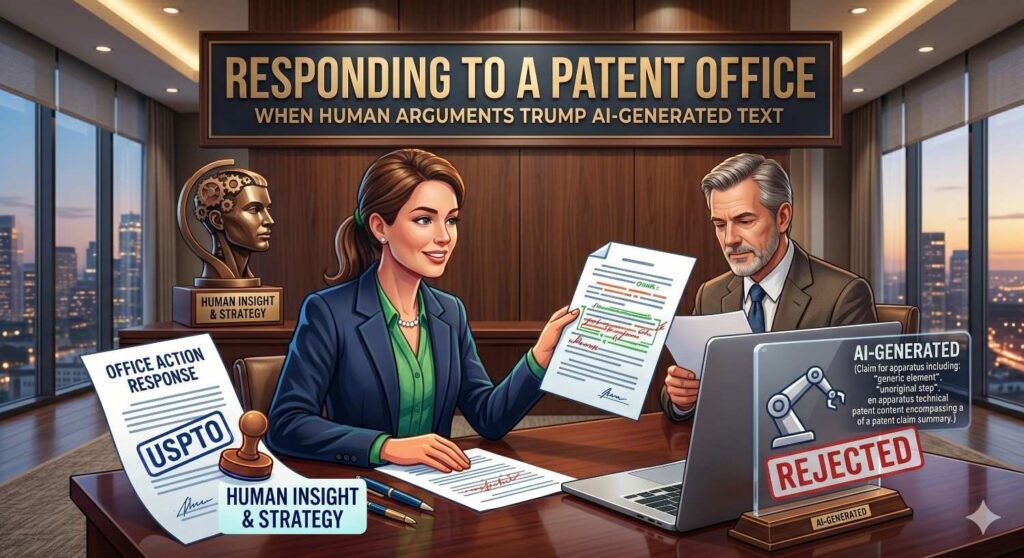
Do not use AI alone to respond to a patent office action.
An office action is not just an editing task.
It requires legal and technical strategy.
You may need to amend claims, argue differences, explain the invention, avoid narrowing too much, and protect long-term value.
AI can help summarize documents or draft rough language inside an approved workflow, but the response should be handled by a patent attorney.
This is not the place for DIY guessing.
When You Need to Make a Statement About Competitors
Do not use AI to make unsupported claims about competitors or prior products in a patent specification.
AI may write broad statements like “existing systems cannot do X” or “no prior method solves Y.”
Those statements need care.
If they are too broad or wrong, they can create issues.
A specification can explain the problem and limits of known approaches, but it should do so thoughtfully.
Do not let AI make sweeping claims without review.
Use accurate, measured language.
When the Specification May Mention Standards, Regulations, or Compliance
Do not rely on AI alone when the invention touches regulated areas or technical standards.
This includes medical, finance, energy, aviation, automotive, telecom, privacy, cybersecurity, and other rule-heavy sectors.
AI may use outdated or wrong terms. It may overstate compliance. It may imply approvals that do not exist. It may include language that creates business risk.
Patent specifications usually do not need marketing-style compliance claims.
Keep the focus on the invention.
Have legal and technical experts review any regulatory or standards-related language.
When the AI Draft Does Not Match the Product Roadmap
Do not use a specification draft that protects yesterday’s product while the company is moving elsewhere.
A startup’s patent plan should match the roadmap.
If the company is moving from a web app to an API platform, from cloud to edge, from one use case to another, or from prototype to hardware, the patent strategy should account for that.
AI will draft from the material you provide.
If that material is not tied to the roadmap, the draft may miss future value.
Founders need to bring strategy into the process.
What will matter six months from now?
What will customers pay for?
What will competitors copy?
What will investors ask about?
What improvements are coming?
A good patent process looks forward, not only backward.
When the Draft Is Too Long to Review
Do not use AI to create a massive specification that no one on the team will read.
Long is not always strong.
AI can generate pages and pages of text. Some of it may be useful. Some may be filler.
If the draft is too long, reviewers may skim it. Mistakes may slip through. The core invention may get buried.
A better draft is clear, structured, and focused.
It can be detailed without being bloated.
Ask AI to organize, not inflate.
Ask for missing questions, not endless paragraphs.
Ask for clear sections tied to the invention.
Then review section by section.
When the Draft Is Too Short to Support the Invention
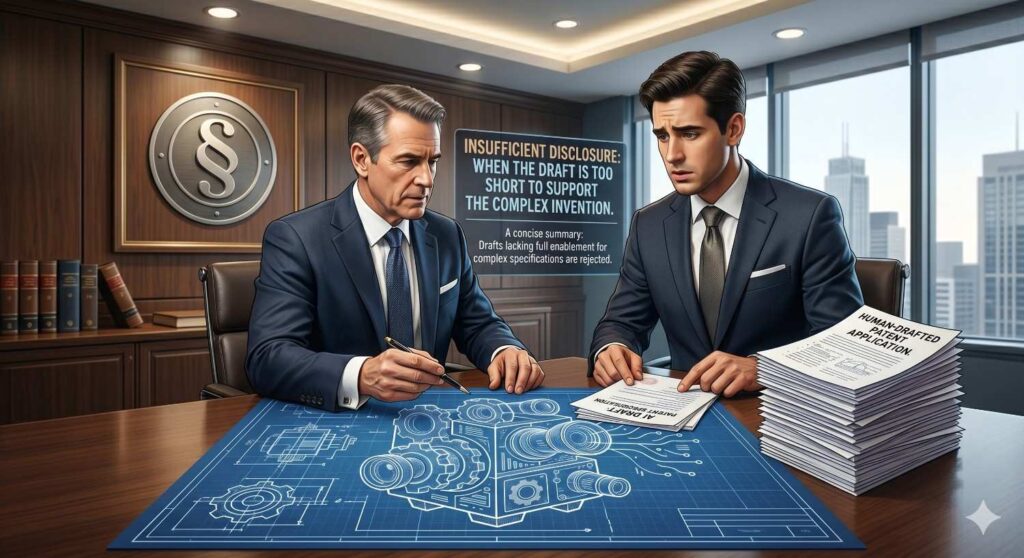
Do not use AI to create a thin specification and assume it is enough.
A short draft may feel efficient.
But if it lacks detail, it may not support useful claims later.
A thin specification may fail to explain the steps. It may lack examples. It may omit variations. It may not show how the invention works. It may describe only the result, not the method.
AI can make thin drafts look clean.
That does not make them strong.
The right length depends on the invention.
Use enough detail to teach the invention well.
Do not confuse short with simple.
Simple language can still be detailed.
When the Team Is Trying to Patent Everything
Do not use AI to mass-produce patent specifications for every small idea without strategy.
AI can make drafting cheaper and faster. That can tempt teams to file on everything.
But more filings are not always better.
A strong patent portfolio is focused.
It protects important inventions tied to business value.
It supports the product roadmap.
It covers what competitors may copy.
It fits the budget.
It is maintained over time.
Filing on every small feature can waste money and attention.
Use AI to help capture ideas, then rank them.
Which ideas matter most?
Which are new?
Which are core?
Which are likely to be copied?
Which are about to be disclosed?
Focus there.
When the Team Is Trying to Avoid Filing Anything
Do not use AI as an excuse to keep drafting forever and never file.
The opposite problem also happens.
AI makes it easy to keep improving the draft. Add more sections. Add more examples. Add more variations. Rewrite again. Ask another prompt. Polish another paragraph.
At some point, drafting becomes delay.
If a public disclosure is coming, delay can create risk.
The goal is not a perfect draft that lives forever in a folder.
The goal is a strong enough filing at the right time, reviewed by the right people.
Use AI to move forward, not to circle endlessly.
When You Are Not Sure What Was Shared Before
Do not use AI to guess your disclosure history.
Before filing, it may matter what was publicly shared and when.
This can include website pages, demos, papers, talks, pitch decks, product docs, app store listings, GitHub commits, blog posts, videos, and customer materials.
AI can help organize a timeline if you provide records.
But it cannot know your full history unless you gather it.
If timing may matter, talk to counsel.
Do not rely on AI to decide whether a past disclosure creates a problem.
When You Need Clean Records for Diligence
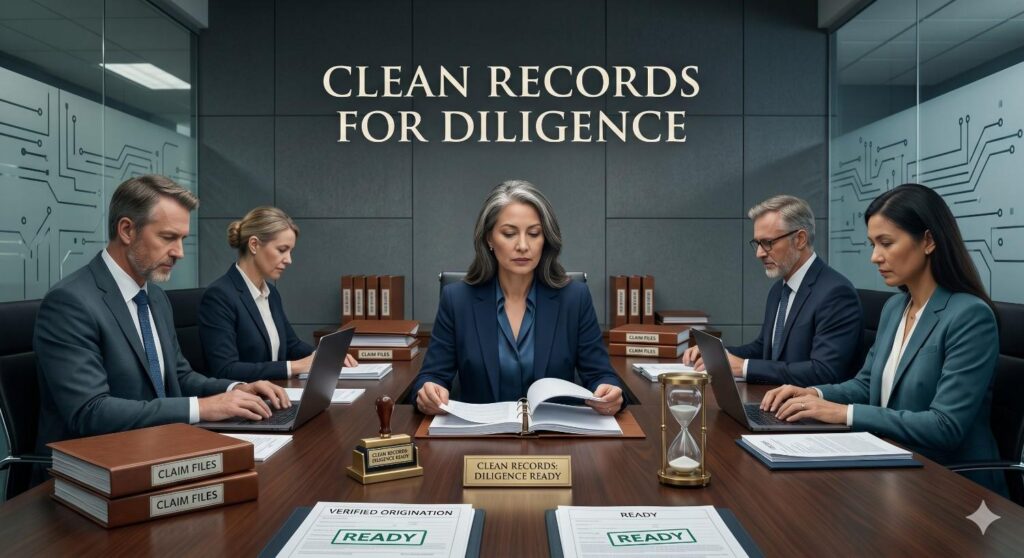
Do not rely on scattered AI chats as your invention record.
Investors and buyers may ask for clean IP records.
They may want to know who invented what, when it was captured, when it was filed, what public disclosures happened, and how filings map to products.
Random AI chats are not a good system of record.
Use an organized workflow.
Keep invention notes.
Track versions.
Store filings.
Record review steps.
Keep attorney communications in approved channels.
PowerPatent helps founders create a cleaner path from invention capture to patent filing, which can make later diligence easier. See how it works here: https://powerpatent.com/how-it-works
When the AI Tool Cannot Explain Its Sources
Do not rely on AI-generated technical or legal statements if the source is unclear.
AI may say something that sounds true. But for patent work, you need accuracy.
If a statement concerns your invention, the source should be your team’s actual knowledge.
If a statement concerns legal strategy, the source should be counsel.
If a statement concerns prior art, the source should be checked documents.
If a statement concerns test results, the source should be real data.
Do not build a patent specification on vague AI confidence.
Ground every important statement.
When the AI Draft Changes the Invention Story
Do not accept AI edits that change meaning.
AI may rewrite a sentence to make it clearer but shift the technical point.
For example, it may change “the system may select a model based on confidence and cost” to “the system selects the most accurate model.”
That is not the same.
It may change “a user may approve the output” to “the system automatically approves the output.”
That is not the same.
It may change “under certain conditions” to “in all cases.”
That is not the same.
When editing, ask AI to preserve meaning.
Then check carefully.
Small wording changes can matter.
When the Draft Uses Words Like Always, Never, Required, or Must
Do not let AI add absolute words unless they are true.
Words like “always,” “never,” “required,” “must,” “only,” and “all” can narrow or distort the invention.
Sometimes they are correct.
Often, they are too strong.
If a step is optional, say so.
If there are alternatives, say so.
If the method works in some cases, do not say it works in all cases.
AI often writes with confidence.
Patent drafting needs care.
Review absolute words closely.
When the Draft Hides Assumptions
Do not use AI output that hides assumptions.
A good AI-assisted workflow should label uncertainty.
If a step is inferred, mark it.
If a part is assumed, mark it.
If a result is guessed, remove it or verify it.
If a variation is possible but not confirmed, ask the inventor.
Hidden assumptions are dangerous because they look like facts.
Make uncertainty visible.
Then resolve it with humans.
When You Need a Strategy, Not Just a Draft
Do not use AI when the real need is patent strategy.
A specification is one part of a larger plan.
You may need to decide what to file first. Whether to file a provisional. Whether to file in other countries. Whether to keep some details secret. How to handle public disclosures. How to support fundraising. How to build a portfolio over time.
AI can help summarize options, but it should not set strategy.
Strategy needs business context and legal judgment.
This is where PowerPatent’s attorney-backed process is useful. It helps founders move from raw invention details to a filing path that makes sense for the company. Learn more here: https://powerpatent.com/how-it-works
When the Invention Is Core to Company Value
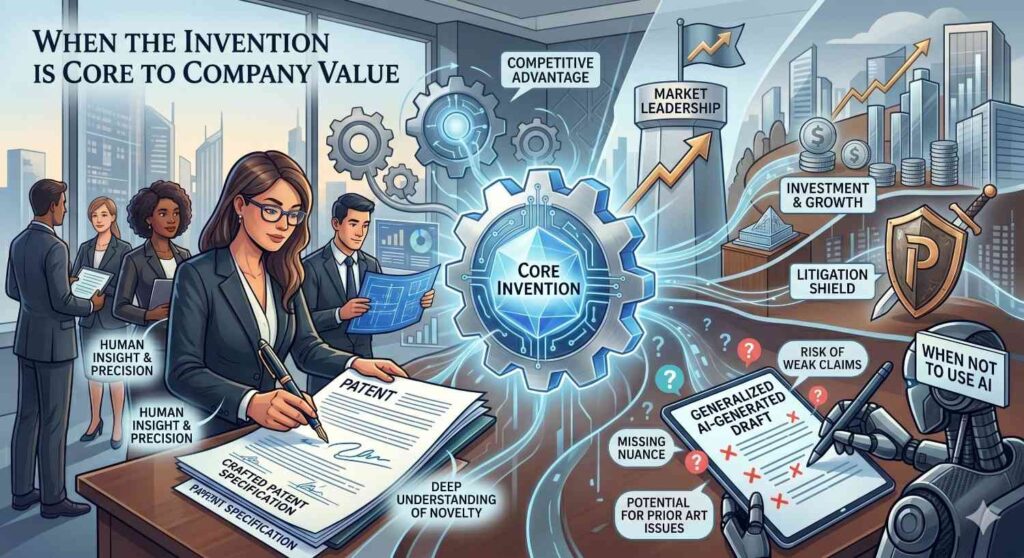
Do not rely on AI alone for the invention that makes your company valuable.
If the invention is central to your moat, treat it with care.
This may be the thing investors care about most. It may be the thing customers cannot get elsewhere. It may be the thing a big company would copy. It may be the reason your startup exists.
That kind of invention deserves more than a quick AI draft.
Use AI to support the process.
But bring in technical review.
Bring in founder judgment.
Bring in patent attorney oversight.
The more important the invention, the less you should rely on AI alone.
When It Is Safe to Use AI
After all these warnings, it is worth saying this clearly.
AI can be very useful for patent specifications when used the right way.
It can help organize invention notes.
It can help turn rough engineer language into clearer text.
It can help create outlines.
It can help list missing questions.
It can help explain diagrams.
It can help rewrite sections in simple language.
It can help compare versions.
It can help prepare inventor interviews.
It can help reduce the time between idea capture and attorney review.
The key is control.
Use approved tools.
Share only what is needed.
Remove sensitive data.
Do not let AI add facts.
Have humans review the output.
Use attorneys for judgment.
That is the healthy role for AI.
A Better Way to Think About AI in Patent Work
Think of AI as a drafting assistant, not a patent owner.
AI can help with speed.
It can help with structure.
It can help reduce blank-page pain.
It can help founders and engineers explain hard ideas more clearly.
But the invention belongs to your team.
The business strategy belongs to the founders.
The legal judgment belongs with patent attorneys.
When each part stays in its proper role, the process gets better.
When AI is asked to do everything, risk grows.
PowerPatent is built around the better model: smart software plus real attorney oversight, designed for founders who need strong IP without the old-school headache. See how it works here: https://powerpatent.com/how-it-works
The Founder’s Red Flag Test
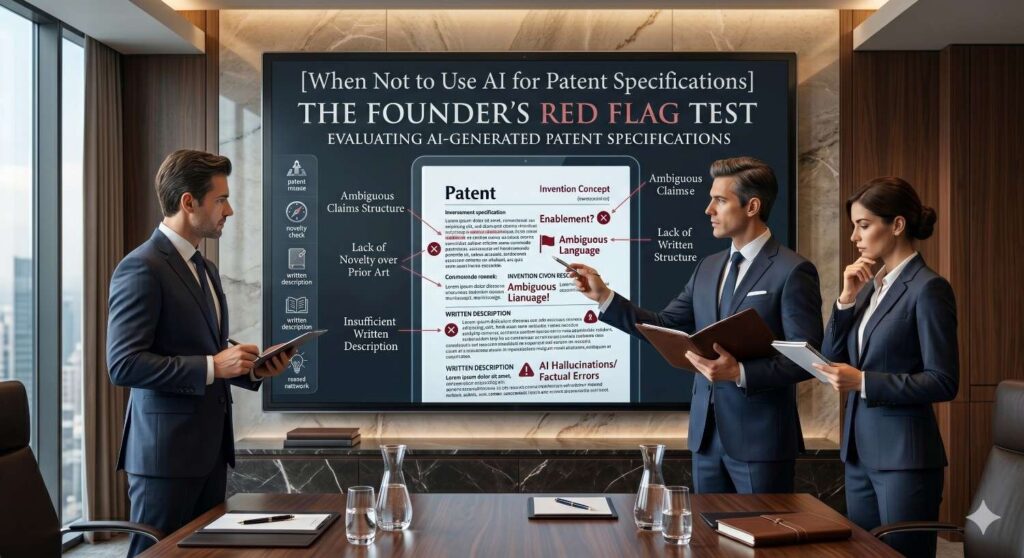
Before using AI for a patent specification, pause and ask a few red-flag questions.
Would we be worried if this input left our company?
Does this include customer data?
Does this include source code?
Does this include attorney advice?
Does this include trade secrets that may not belong in a patent?
Does the AI need to guess key facts?
Is the invention still unclear?
Has the technical team reviewed the draft?
Has a patent attorney reviewed it?
Is a launch, paper, pitch, demo, or open-source release coming soon?
If any answer raises concern, slow down and use a safer process.
The Safe Use Test
AI is more appropriate when the input is clean, the task is narrow, and the output will be reviewed.
A clean input means you removed customer data, personal data, source code, secrets, and legal advice that the AI does not need.
A narrow task means you ask AI to outline, rewrite, find gaps, or organize, not decide strategy.
A reviewed output means technical people and patent counsel check the work.
If all three are true, AI can be helpful.
If any one is missing, be careful.
What to Do Instead of Using AI Alone
When AI is not the right tool by itself, do not stop the patent process.
Use a better process.
Start with invention capture.
Write the problem in plain words.
Write what old methods failed to do.
Write the new method.
Write the main steps.
Write the result.
Write what can vary.
Write what should stay private.
Add diagrams if helpful.
Then use approved software to organize the material.
Use AI where it helps, such as finding gaps or improving clarity.
Have the technical team review accuracy.
Have a patent attorney shape the filing.
This approach gives you speed and care.
It avoids the false choice between old-school slowness and risky AI shortcuts.
Why PowerPatent Is Different
PowerPatent helps founders turn technical work into stronger patent filings faster.
It is built for startups that move quickly and need to protect real inventions without wasting weeks in a slow process.
The platform uses smart software to help capture, organize, and draft invention material.
But it does not leave founders alone with raw AI output.
Real patent attorneys review and guide the work.
That matters.
AI can help you move faster. Attorneys help protect quality. The right workflow helps your team stay in control.
For founders, this means less blank-page stress, fewer scattered notes, better invention capture, and a clearer path from idea to filing.
If your startup is building something hard to copy, PowerPatent can help you protect it with more speed and confidence.
Start here: https://powerpatent.com/how-it-works
A Practical Action Plan for This Week
You can improve your patent process this week.
Start by naming your most important current invention.
Write one plain sentence that explains it:
“Our system solves [problem] by [method], which improves [result].”
Then gather the key facts.
What problem did the team face?
What did old methods fail to do?
What did your team build?
What are the main steps?
What improves?
What details are confidential?
What data should not be shared?
What public event is coming?
Then decide where AI can help safely.
Maybe it can help turn notes into questions.
Maybe it can help create an outline.
Maybe it can help rewrite a section in simple words.
Maybe it should not be used yet because the invention is too unclear or too sensitive.
Then bring in the right review.
Have the technical team check the facts.
Have a patent attorney guide the filing.
This is how you use AI without letting AI run the process.
The Bottom Line
AI is a powerful tool for patent specification writing.
But it is not the right tool for every moment.
Do not use AI casually when the invention is unclear, the facts are missing, the details are confidential, customer data is involved, source code is exposed, attorney advice is included, trade secret choices have not been made, or no human review is planned.
Use AI where it helps.
Use humans where judgment matters.
Use attorneys where legal quality matters.
That is the smart path.
Your invention may be one of your startup’s most valuable assets. Treat it that way.
When you want a faster, clearer, attorney-backed patent process that uses smart software without leaving your IP to chance, explore PowerPatent here: https://powerpatent.com/how-it-works