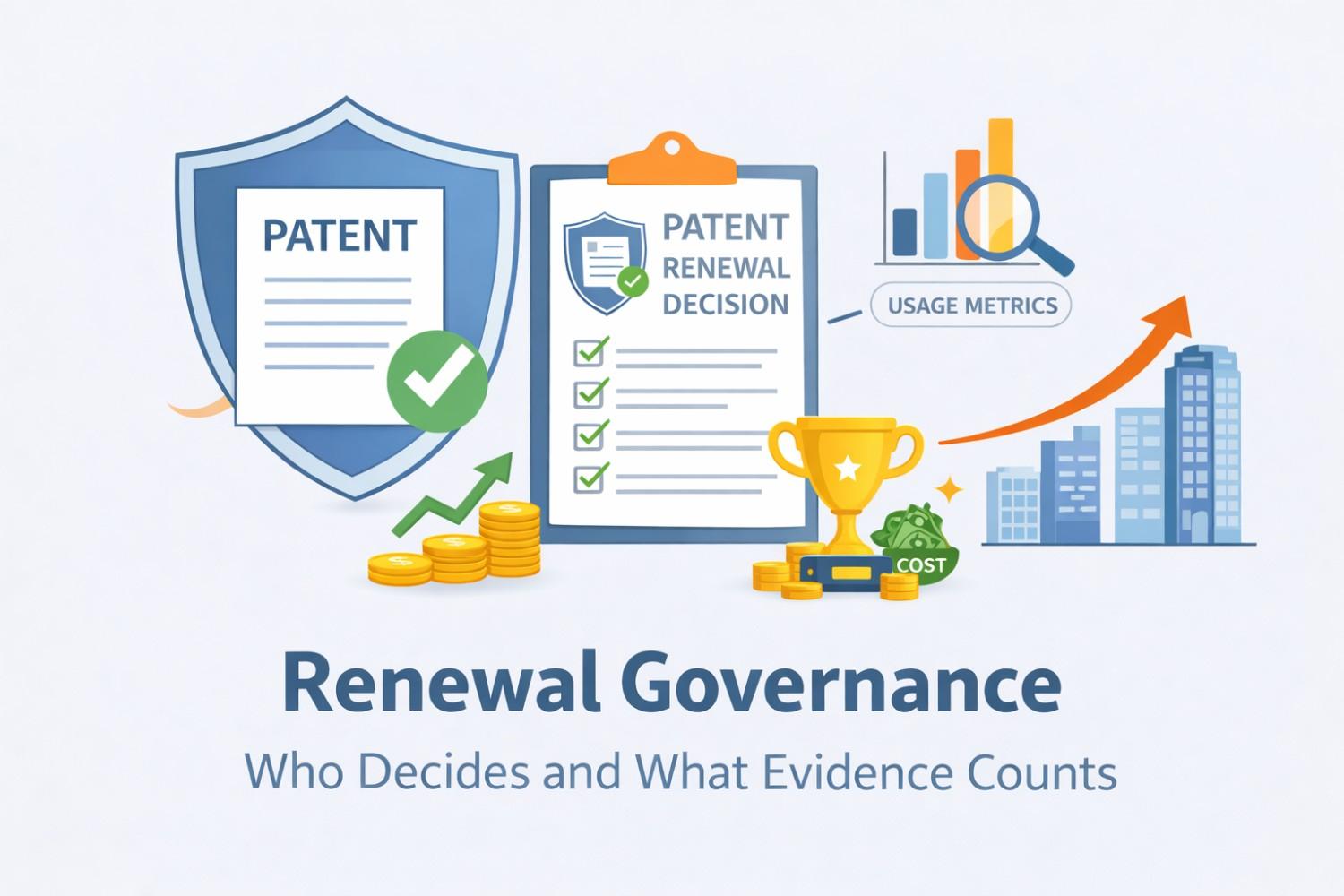
Every patent you own is a living asset. It needs care. It needs money. And at key moments, someone has to decide: do we renew this patent or let it go? That choice can shape the future of your company. Renewal governance is about who makes that call and what proof they use to make it. If you get this wrong, you burn cash or lose protection. If you get it right, you protect what matters and stay lean. Let’s break down how smart founders handle renewal decisions without slowing down their build.
Who Should Control Renewal Decisions Inside a Startup?
Renewal decisions are not paperwork. They are capital allocation decisions. Every time you renew a patent, you are choosing to invest more money into that idea.
Inside a startup, where every dollar has a job, that choice must be owned by the right person and shaped by the right structure.
If renewal control is vague, the company drifts. If renewal control is clear, the company sharpens its edge.
The Founder’s Role in Early-Stage Companies
In the earliest days, the founder must own renewal decisions. Not because they love legal work, but because patents at this stage are tightly linked to vision.
No one understands the long-term direction of the company better than the founder.
At the seed stage, your patents usually protect the core idea that got you funded. Letting one lapse without founder oversight can weaken your story with investors or partners.
At the same time, blindly renewing everything can eat runway.
The founder’s job is to connect the patent to the mission. If the invention still reflects the company you are building, renewal makes sense.
If the company has shifted and the patent reflects an old direction, the founder must be honest enough to cut it.
Actionable advice here is simple but powerful. Schedule a renewal review once per quarter, even if no payment is due yet.

Tie it to your roadmap review. Ask yourself how each patent fits into the next 18 months of product development. This keeps renewal thinking proactive instead of reactive.
If you want a system that makes this review clean and structured, you can see how PowerPatent keeps patents connected to real product strategy here: https://powerpatent.com/how-it-works
When the CTO Should Take the Lead
As the company grows, the CTO often becomes the best person to guide renewal choices. This is especially true in deep tech startups where the value of the patent sits inside complex systems, models, or hardware designs.
The CTO understands which technical layers still matter. They know which components are being rewritten and which are becoming central to the stack. That insight is critical during renewal time.
But the CTO should not make renewal decisions in isolation. Technical value and business value are not always the same. A beautiful piece of engineering may no longer support the main product. The CTO’s input must be paired with business context.
A strong practice is to require a short written summary from the CTO before each renewal decision.
Not a long memo. Just a simple explanation of how the patent maps to the current architecture and future builds. This forces clarity. If the link cannot be explained in plain words, that is a warning sign.
The CEO’s Strategic Filter
Even when the CTO provides technical input, the CEO should apply the final strategic filter. The CEO sees the bigger picture. They understand fundraising timelines, market positioning, and long-term exit goals.
Renewing a patent can send a signal. It signals commitment to a space. It signals confidence in a technology. It signals long-term planning.
If you are preparing for a funding round, renewal decisions should be aligned with the story you plan to tell. Investors often ask about intellectual property. If you let a core patent expire right before a raise, that can create friction.
The CEO must weigh these signals carefully. This does not mean renew everything for optics. It means renewal should support your narrative.
An actionable move is to align patent renewal reviews with major company milestones.
Before a raise, before entering a new market, before launching a new product line. This ensures your patent portfolio matches your public strategy.
Creating a Small, Focused IP Committee
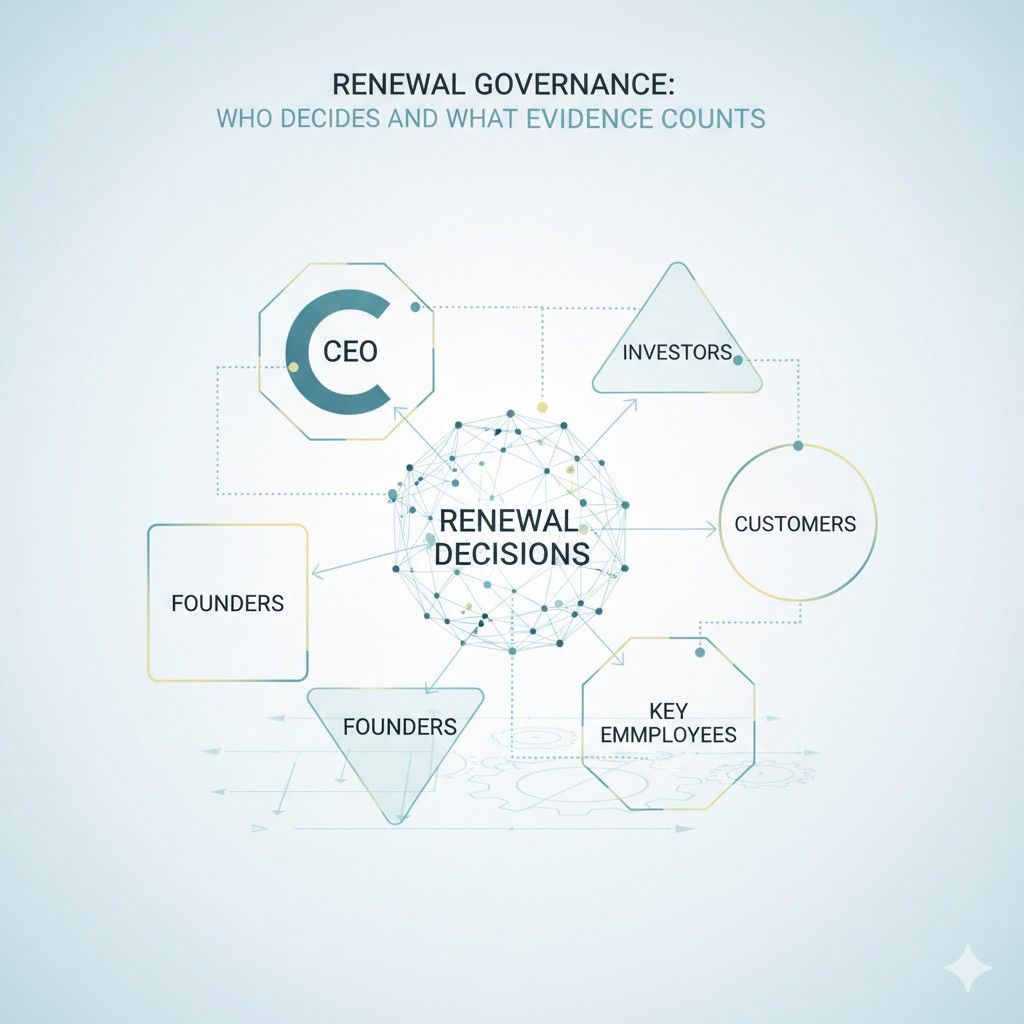
As startups move past early growth, renewal governance should not rest on one person alone. A small IP committee can bring balance and reduce bias.
This committee should stay lean. Three people is often enough. For example, the CEO, CTO, and a head of product or operations. The goal is not to create bureaucracy.
The goal is to blend technical, strategic, and financial perspectives.
Each renewal decision should be discussed briefly with structured input. The CTO explains technical relevance. The product leader explains roadmap alignment. The CEO connects it to long-term direction.
Keep meetings short. Focus on value. Avoid abstract legal debates.
One practical method is to assign a simple internal score before discussion. Each member privately rates the patent’s relevance to the next two years. Then compare scores.
If there is strong disagreement, that signals deeper discussion is needed.
This process reduces emotional decisions. It brings discipline without slowing down the company.
The Role of Finance in Renewal Control
Finance should not control renewal decisions, but finance must inform them. Patent renewals are recurring costs. They affect cash flow and runway.
A common mistake is allowing renewal invoices to hit accounting without prior review. By the time finance flags the cost, it may be too late for thoughtful analysis.
Instead, finance should maintain a clear forecast of upcoming renewal fees across all jurisdictions. This forecast should be shared at least twice a year with leadership. Seeing the total future cost often changes behavior.
When founders see the long-term renewal burden across multiple patents and countries, they become more selective. This visibility creates better governance.
A strong tactical move is to build a simple renewal dashboard. It should show each patent, its next renewal date, and projected cost over the next five years. This shifts thinking from single payments to long-term investment.
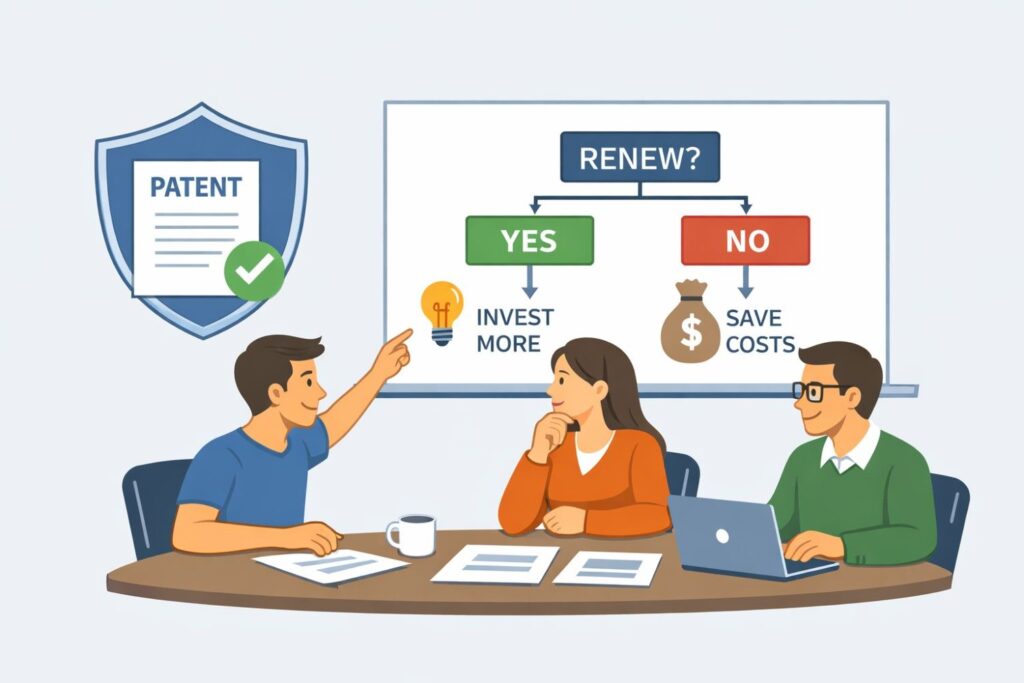
PowerPatent helps founders keep this level of clarity without drowning in spreadsheets. If you want to understand how organized patent management reduces renewal chaos, explore it here: https://powerpatent.com/how-it-works
Avoiding Founder Attachment Bias
One hidden risk in renewal governance is emotional attachment. Founders often feel personal pride in early patents. That is natural. Those inventions represent long nights and bold bets.
But attachment can cloud judgment. A patent is not a trophy. It is a tool.
Governance must separate identity from asset value. This requires discipline. One way to do this is to imagine you are evaluating another company’s portfolio.
Would you pay to renew this patent if it were not yours? Would it impress you as an investor?
Creating this mental distance helps reduce bias.
Another helpful practice is to bring in outside perspective occasionally. A patent attorney or advisor who understands your business can provide a neutral view. They are less emotionally tied and can assess strength and scope more objectively.
Deciding Between Centralized and Distributed Control
Some startups try to decentralize renewal decisions across teams. For example, allowing each product team to decide whether “their” patent should be renewed.
This can work in large organizations, but in most startups it creates fragmentation.
Distributed control often leads to uneven standards. One team renews aggressively. Another cuts too quickly. Over time, the portfolio loses coherence.
Centralized oversight with structured input works better. It ensures all renewal decisions follow the same criteria and align with the same company goals.
That does not mean ignoring team input. It means input flows into a central decision point. This keeps the portfolio aligned with the overall strategy.
Embedding Renewal Thinking Into Filing Decisions
The best renewal governance starts before the patent is even filed. When deciding to file, ask who will own renewal decisions later. Ask how this patent will be evaluated three or five years from now.
If you file with clarity about long-term ownership and value, renewal becomes easier.
For example, document the core business objective behind each filing. Is it defensive protection? Is it future licensing leverage? Is it investor signaling? That original intent becomes a benchmark during renewal review.
If the original objective no longer exists, renewal should be questioned.
This creates a full lifecycle mindset. Filing is not a one-time act. It is the beginning of a long-term investment that must be reviewed with discipline.
Building a Culture of Strategic IP Ownership
At its core, renewal governance reflects culture. Do you treat patents as strategic assets or as legal paperwork?
When leadership openly discusses patent value during roadmap meetings and strategic reviews, the team learns that intellectual property matters. It becomes part of company thinking, not an afterthought.
Make renewal decisions transparent within leadership. Share reasoning. Explain why certain patents are kept and others are allowed to expire. This builds shared understanding.
Over time, this culture leads to better filings. Engineers start thinking about long-term value before drafting an invention. Product teams consider defensibility early.
That is how renewal governance transforms from a reactive process into a proactive advantage.
If you want a platform that supports this kind of disciplined, strategic ownership, where software and real patent attorneys work together to keep your IP aligned with your growth, you can learn more here: https://powerpatent.com/how-it-works
Strong renewal governance is not about saving pennies. It is about protecting your future with intention.
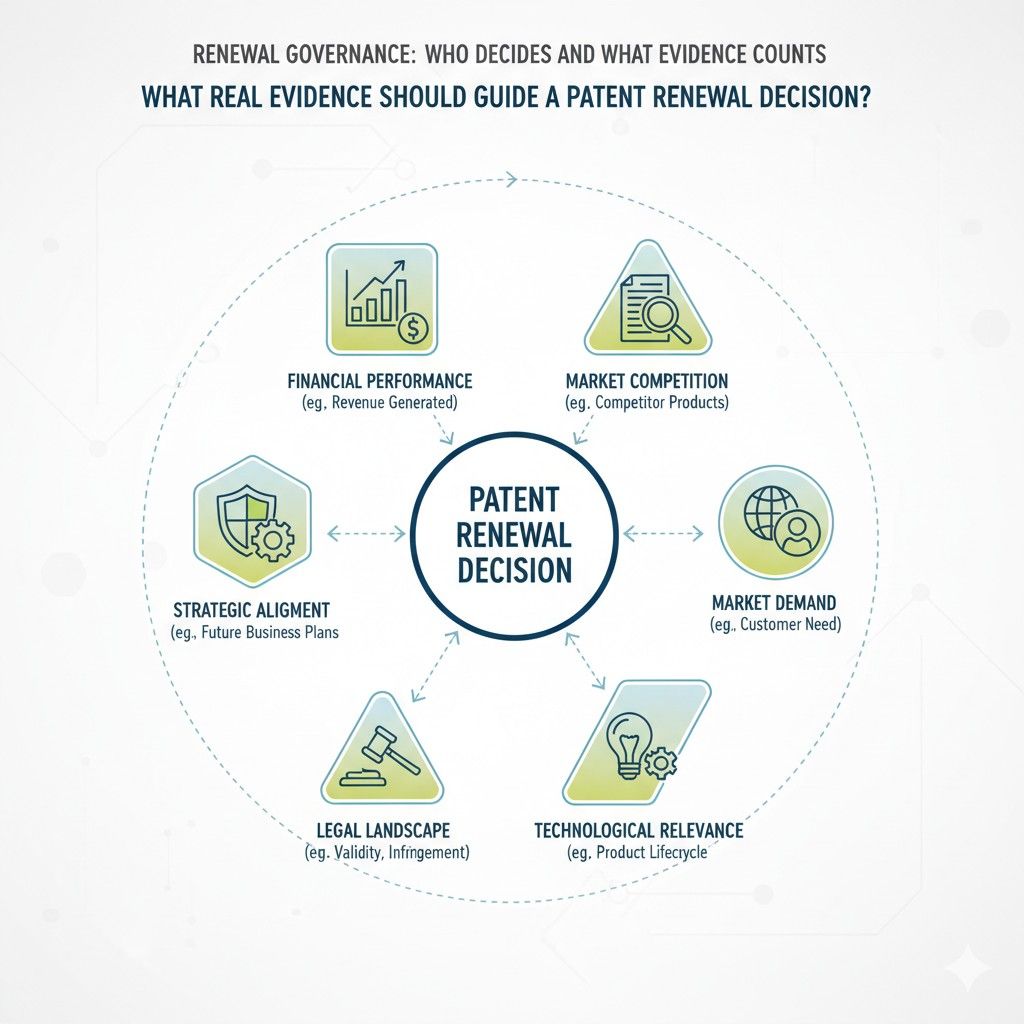
What Real Evidence Should Guide a Patent Renewal Decision?
Renewal decisions should never run on fear. They should never run on habit. And they should never run on the simple fact that you already spent money. A patent renewal is an investment decision.
Smart companies demand proof before they invest again.
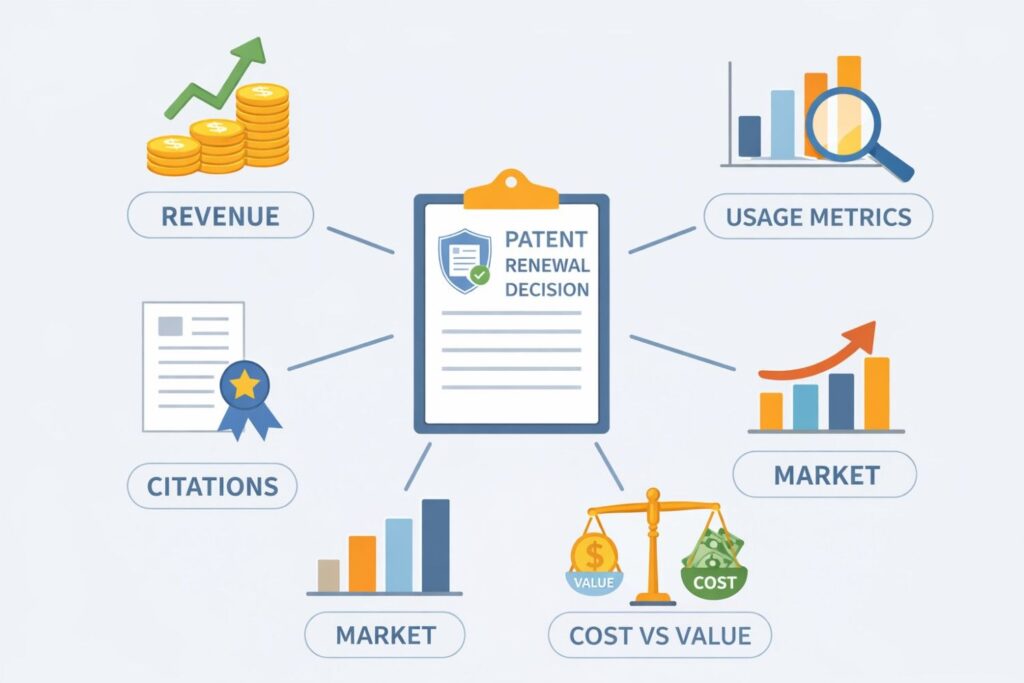
Evidence is what protects you from wasting cash. It also protects you from accidentally killing something valuable. The right evidence brings calm, clarity, and confidence to the table.
Start With Product Reality
The first and most powerful source of evidence is your live product. Not your old pitch deck. Not your original patent filing story. Your current product.
A patent that maps directly to a feature customers use today carries weight. A patent that protects the engine behind your main revenue stream deserves serious attention.
But you must be precise. Do not say, “It kind of relates.” Instead, ask your engineering lead to point to the exact component, model, or system that is covered.
Can they show it? Can they explain how the patent claims still wrap around that part of the stack?
If the link is vague, the value is likely weak.
A useful practice is to run a short internal technical check before renewal. Pull the patent claims.
Sit down with your lead engineer. Ask them to mark which parts of the current system still fall under those claims. This exercise forces clarity. It often reveals surprises.
Sometimes you discover the patent is broader than you remembered. Other times you realize the product evolved beyond it. Both outcomes are useful.

When patents are created through a structured system that keeps them closely tied to real code and real models, this review becomes easier. That is one of the reasons founders use PowerPatent.
It helps keep inventions connected to what you are actually building, not just what you once imagined. You can see how that works here: https://powerpatent.com/how-it-works
Look at Revenue Signals
Revenue is strong evidence. If a patent protects something that directly drives sales, subscriptions, or licensing income, that is a powerful reason to renew.
But revenue evidence must be specific. It is not enough to say the patent supports the “overall platform.” You want to know if customers would still buy your product if that protected feature disappeared.
If the answer is yes, the patent may not be central. If the answer is no, it likely deserves renewal.
For SaaS companies, examine which modules drive retention and upsells. For hardware startups, examine which technical differentiators close deals.
If those elements are protected by the patent, you are looking at meaningful evidence.
You can also review customer feedback. Do customers highlight the unique capability that your patent protects? If your differentiation is visible and valued, that strengthens the case.
Revenue evidence turns renewal from an abstract legal question into a business one.
Examine Competitive Pressure
Another critical source of evidence is the competitive landscape. Patents gain strength when the field gets crowded.
If competitors are entering your space and building similar features, your patent may become more important than when you first filed it.
The question to ask is simple. Would this patent help you block a competitor, slow them down, or gain leverage in a negotiation?
Look at competitor product releases. Study their technical blogs. Watch their hiring patterns. If you see signs that others are moving toward your protected area, renewal becomes a defensive shield.
You should also monitor patent filings from competitors. If they are filing aggressively in your niche, that signals the space is heating up. Holding onto your position may matter more now than before.
This does not require complex legal analysis. It requires awareness. Assign someone on your team to scan industry news and competitor moves at least once per quarter. Feed that insight into renewal reviews.
Strong governance connects competitive signals to renewal decisions in real time.
Use Fundraising and Exit Strategy as Evidence
Your capital strategy provides another layer of proof. If you are preparing for a funding round, investors will likely examine your intellectual property.
A patent that protects your core technical moat can increase confidence. Letting it lapse before a major raise can raise questions.
At the same time, investors respect discipline. If you can explain clearly why certain patents were allowed to expire and how that sharpened focus on core assets, that signals maturity.
The key is alignment. Renewal decisions should match your next 12 to 24 months of strategic moves.
If you are exploring acquisition conversations, examine what buyers in your space value. Do they acquire for talent, product, data, or defensible technology?
If defensible technology plays a role, patents tied to that story carry weight.
You should review past diligence questions from investors or partners. Did they ask about specific patents? Did any particular filing create interest or discussion? That historical signal can guide renewal choices.
Analyze Geographic Relevance
Many startups file patents in multiple countries. Renewal fees often increase significantly as you maintain protection across jurisdictions.
Geographic evidence matters. Are you actively selling in that country? Do you plan to expand there? Is manufacturing happening there? Are competitors based there?
If you hold a patent in a country where you have no business activity and no clear expansion plan, renewal may not make sense.
On the other hand, if a key competitor operates heavily in a specific region, maintaining protection there could provide leverage.
Review your revenue by region. Compare it to your patent coverage map. If there is a mismatch, that signals an opportunity to trim or adjust.
This geographic review should happen well before renewal deadlines. It is easier to make calm decisions months in advance.
Consider Enforcement Realism
A patent only holds value if you are willing and able to enforce it. This is uncomfortable but important.
Ask yourself honestly. If a competitor infringed this patent, would we act? Do we have the financial strength or strategic partners to support enforcement?
If enforcement is unrealistic and the patent does not serve strong defensive or signaling value, renewal may not justify its cost.
This does not mean startups should be litigious. It means you should understand the practical weight of your protection.
Sometimes the mere existence of a patent deters competitors. Other times, in highly aggressive markets, competitors will not be deterred unless you are prepared to act.
This evidence shapes renewal thinking.
Evaluate Claim Breadth and Strength
Not all patents are equal. Some have broad claims that cover wide territory. Others are narrow and easy to design around.
Before renewing, review the granted claims carefully. Have an attorney give a simple, honest assessment of strength and scope.
Is the patent broad enough to matter? Or is it limited to a very specific implementation that competitors can avoid?
If the claims are strong and well positioned around your core innovation, renewal is more compelling.
At PowerPatent, real patent attorneys review and refine claims during drafting. This increases the chance that what you renew years later is truly valuable, not just a framed certificate.
If you want to understand how attorney-backed drafting strengthens long-term value, you can explore it here: https://powerpatent.com/how-it-works
Measure Strategic Optionality
Some patents do not drive current revenue but create future options. They may cover technology that is not yet commercialized but could become important.
In these cases, the evidence lies in roadmap exploration. Are you experimenting in that space? Is the industry trending in that direction? Do analysts predict growth there?
Optionality has value, but it must be grounded in real signals. If you have not touched that technical area in two years and have no plan to return, optionality may be an illusion.
A practical approach is to tie each patent to a named future initiative. If no initiative can be named, renewal should be questioned.
Document the Evidence Every Time
Strong renewal governance requires documentation. Each time you decide to renew or let go, record the reasoning.
Write down the product link. Write down the competitive signal. Write down the revenue tie or strategic alignment.
This creates institutional memory. When new leaders join, they understand past choices. When investors ask, you show disciplined thinking.
Over time, these records also improve future filings. You learn what types of patents proved valuable and which did not.
Evidence-driven renewal decisions turn intellectual property into a managed portfolio, not a random collection.
The goal is not to keep every patent alive. The goal is to keep the right ones alive for the right reasons.
In the next section, we will explore how to build a renewal framework that scales as your company grows, so you are not reinventing the process every year.
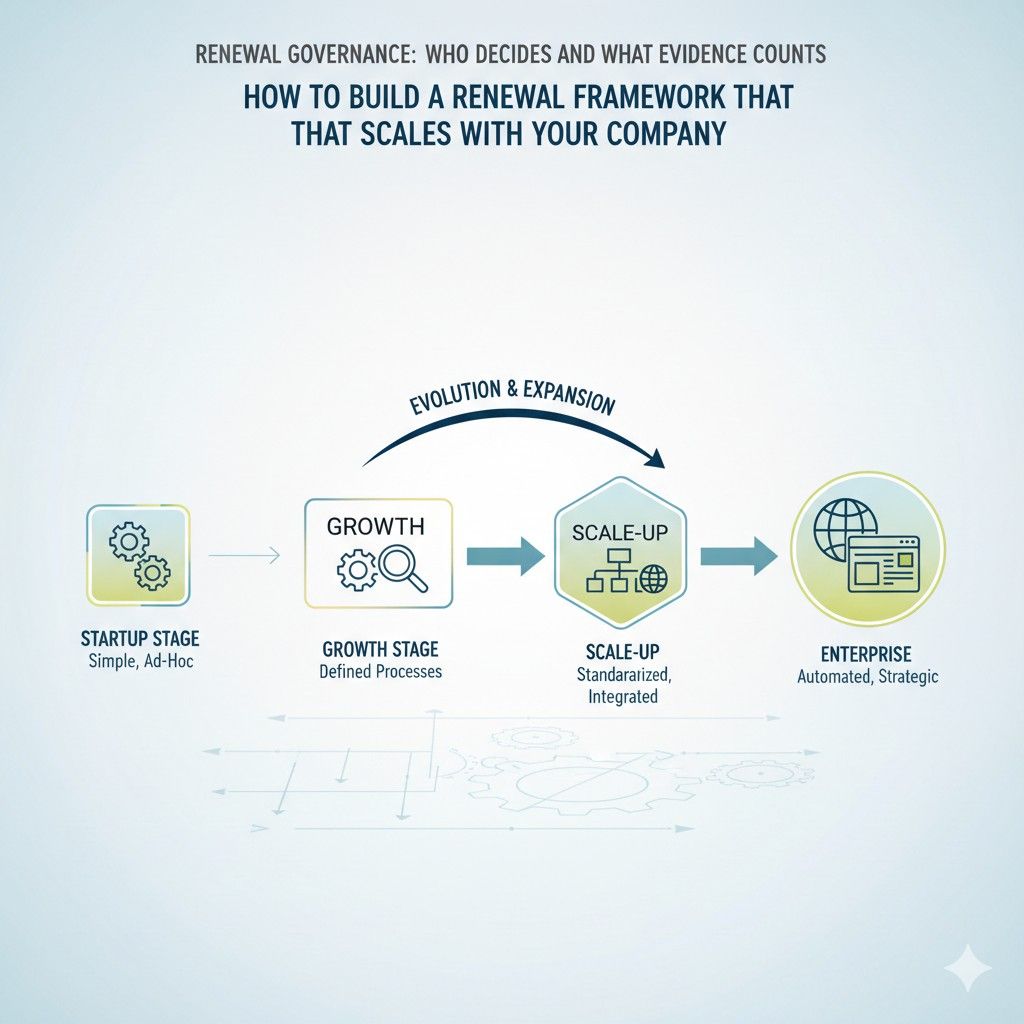
How to Build a Renewal Framework That Scales With Your Company
Renewal governance cannot depend on memory. It cannot depend on who happens to be in the room that week. If your company is growing, your patent portfolio will grow with it.
What feels manageable at three patents becomes messy at fifteen. At thirty, it becomes expensive chaos.
A scalable renewal framework keeps you in control as you expand. It turns renewal from a stressful deadline into a steady system that runs in the background of your business.
Start With a Clear Renewal Calendar
Every scalable system begins with visibility. You must know what is coming before it arrives.
A proper renewal framework includes a forward-looking calendar that stretches at least three years ahead. Not just the next payment. The next wave.
When you see future obligations clearly, you think differently. You stop reacting and start planning.
This calendar should not live in one person’s inbox. It should be accessible to leadership. It should show upcoming deadlines, projected fees, and jurisdictions.
When renewal dates are visible early, decisions become thoughtful instead of rushed.
As your portfolio grows, the cost curve becomes clearer. You can see how early filing decisions create long-term financial commitments. That visibility changes behavior.
Teams become more selective about what they file, knowing renewal will follow.

Modern platforms make this easier by organizing your filings and renewal timelines in one place. When patents are tracked properly from day one, scaling the system does not create friction.
You can explore how PowerPatent keeps everything structured and visible here: https://powerpatent.com/how-it-works
Tie Renewal Reviews to Strategic Planning Cycles
Scaling companies already have planning rhythms. Annual planning. Quarterly reviews. Budget cycles. Renewal governance should plug directly into those rhythms.
If renewal reviews happen randomly, they feel like interruptions. If they align with strategy meetings, they become natural extensions of business planning.
For example, during annual planning, leadership can review all patents that renew in the next 12 to 18 months. This allows decisions to reflect the upcoming roadmap, not the past one.
When renewal becomes part of planning, patents stop feeling separate from the business. They become integrated assets.
This integration is critical as headcount increases. New leaders join. New product lines launch. Without alignment to planning cycles, renewal decisions become fragmented across departments.
Create a Standard Evaluation Template
Scaling requires consistency. As more patents enter the portfolio, you cannot rely on free-form discussions for each one. A standard evaluation template keeps decisions structured.
This does not mean a heavy document. It means a short, repeatable framework applied to every renewal review.
The template should capture how the patent maps to current products, how it supports future strategy, what competitive signals exist, and what the financial commitment looks like over time.
When every patent is reviewed through the same lens, comparisons become easier. You can see which assets stand out and which are fading.
Over time, this template also becomes a training tool. New executives can step into the process quickly because the rules are clear.
Consistency is what allows governance to scale without losing quality.
Assign a Portfolio Owner
As companies grow, responsibility must be formalized. Someone should own the patent portfolio at a high level. This does not mean they make every technical judgment. It means they are accountable for the process.
This person ensures renewal deadlines are flagged early. They coordinate reviews. They gather input. They document decisions.
Without a portfolio owner, renewal governance slowly drifts. Tasks get delayed. Context is lost. Decisions are made without full information.
The portfolio owner could be a general counsel, a head of strategy, or even a senior operations leader in earlier stages. What matters is clarity.
The owner should also report periodically to the executive team. A simple summary of upcoming renewals, projected costs, and key decisions keeps IP visible at the top level.
When renewal oversight has a clear champion, scaling becomes far smoother.
Integrate Attorney Input at the Right Moments
As your patent portfolio grows, attorney guidance becomes more important. But it must be integrated wisely.
Attorneys should not drive renewal decisions alone. They provide legal insight. They assess claim strength. They evaluate risk.
Your internal team connects that legal insight to business strategy.
A scalable framework includes periodic legal reviews, especially for older patents where scope and relevance may have shifted.
For example, before renewing an expensive international patent, you might request a short legal assessment of claim strength and enforceability. That input becomes part of the evidence, not the final word.
The combination of internal strategy and external legal review strengthens decision quality.
PowerPatent was built around this blend. Smart software organizes your portfolio while real patent attorneys provide oversight.
This hybrid model keeps governance efficient without sacrificing legal depth. You can see how it works here: https://powerpatent.com/how-it-works
Build Feedback Loops Into Filing Strategy
A scalable renewal framework does more than manage existing patents. It shapes future filings.
After each renewal cycle, review which patents were allowed to expire and why. Were they tied to abandoned features? Were they too narrow? Did market demand shift?
These insights should inform new filings.
If you notice that patents tied to experimental side projects rarely survive renewal, that may signal a need for more selective filing. If patents connected to core architecture consistently remain valuable, that reinforces focusing filings there.
Scaling governance means creating learning loops. Each renewal decision improves the next filing decision.
Over time, your portfolio becomes tighter and more strategic. Fewer weak assets. More high-leverage protection.
Use Data to Drive Long-Term Portfolio Design
As your company matures, data becomes your ally. You can analyze how many patents directly support revenue-generating products. You can measure how many filings align with your current strategic pillars.
This portfolio-level view is powerful.
Instead of looking at patents one by one, you begin to see patterns. Perhaps most of your renewals cluster around one technology area. Perhaps some regions consistently provide little value.
Data-driven insights allow leadership to redesign the portfolio intentionally.
You might choose to double down in one jurisdiction and scale back in another. You might decide to consolidate around fewer, stronger patent families.
This long-term design mindset separates disciplined companies from reactive ones.
Maintain Simplicity Even as You Grow
Scaling does not mean adding complexity for its own sake. The most effective renewal frameworks remain simple at their core.
Clear ownership. Early visibility. Structured evaluation. Documented decisions.
As headcount grows, resist the urge to create heavy committees or endless approval layers. Bureaucracy slows innovation.
Your framework should support speed, not hinder it. Renewal reviews should be efficient conversations grounded in real evidence.
When the system is simple and consistent, leadership trusts it. Decisions move quickly. Costs stay controlled.
That simplicity also protects culture. Teams continue building without feeling weighed down by legal processes.
Make Renewal Governance Part of Company Discipline
Ultimately, a scalable renewal framework reflects company discipline. It signals that you treat intellectual property with the same care as product development and financial management.
When investors see organized renewal governance, they see maturity. When acquirers review your portfolio and find documented decisions tied to strategy, they see professionalism.
Renewal governance becomes part of your operational excellence.
It shows that you are not just inventing. You are managing your inventions with intention.
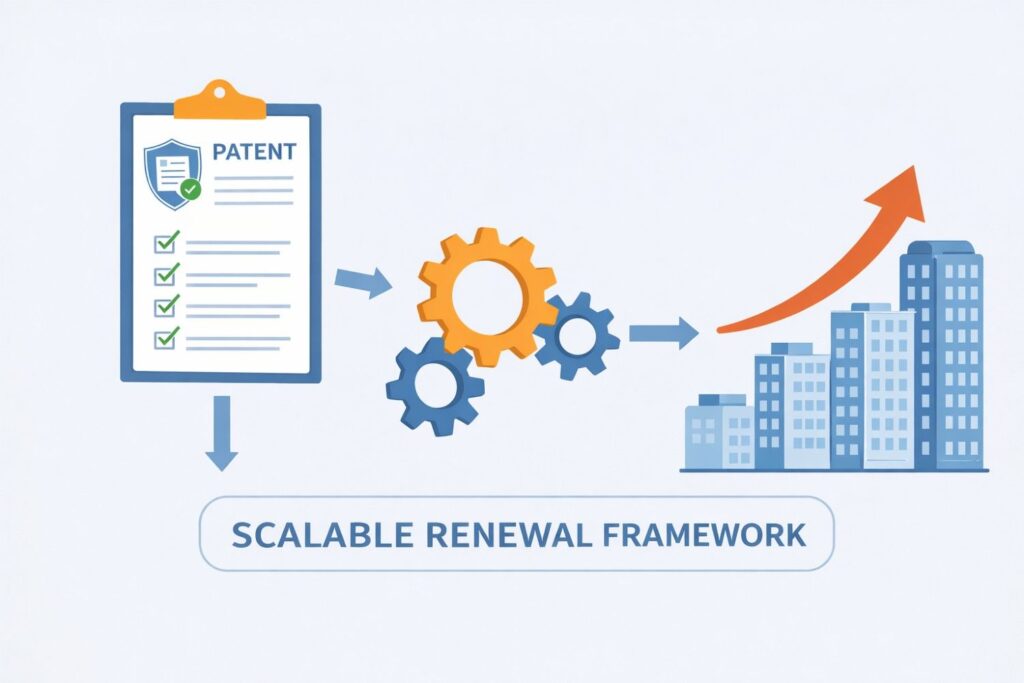
And when your patent system is built on software that keeps everything connected to real technical work, scaling becomes natural instead of painful.
In the next section, we will explore how renewal governance can move beyond cost control and become a true competitive advantage that strengthens your market position.
Turning Renewal Governance Into a Competitive Advantage
Most startups treat renewal as maintenance. The smartest ones treat it as positioning.
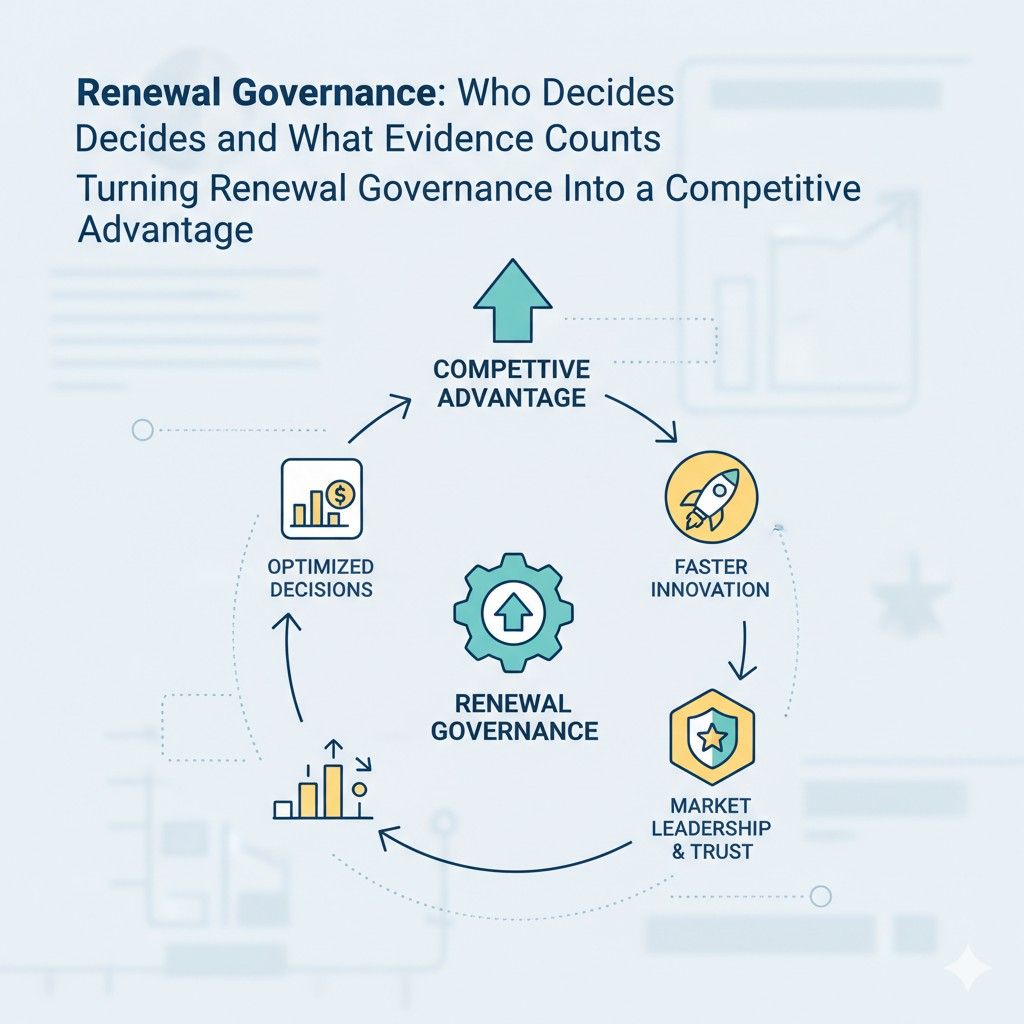
When renewal governance is tight, aligned, and evidence-driven, it does more than save money. It sharpens your moat. It strengthens your negotiation power. It sends a signal to the market that you are serious about what you build.
This is where renewal shifts from defense to advantage.
Using Renewal to Clarify Your Core
Every time you decide to renew a patent, you are saying, “This still defines us.” That clarity has power.
Over time, your renewed patents reveal your true core. They show where you are doubling down. They show what you believe will matter long term.
If someone mapped your active patents today, would they see a clear theme? Or would they see scattered ideas from past experiments?
Tight renewal governance removes noise. It trims inventions that no longer serve the mission. What remains is a focused wall of protection around your most valuable work.

That focus becomes visible during due diligence. Investors and acquirers look for coherence. A clean, aligned portfolio tells a simple story: this company knows what it is protecting and why.
That story builds trust.
Strengthening Negotiation Leverage
Patents are not only about lawsuits. They are negotiation tools.
When you enter partnership talks, licensing discussions, or acquisition conversations, your active patents shape the tone.
If your portfolio reflects your current product and future direction, it strengthens your position. You are not just offering a product. You are offering protected technology.
Renewal governance plays a direct role here. A patent that quietly expired last year cannot support a negotiation today.
This is why renewal reviews should consider upcoming strategic moves. If you know you will approach enterprise partners in the next year, make sure the patents covering your differentiators remain active.
The timing matters.
Renewal is not only about whether a patent is valuable in theory. It is about whether it will matter in the next negotiation cycle.
Creating Psychological Barriers for Competitors
Strong renewal discipline sends signals beyond your company.
Competitors pay attention to active patents. They monitor what you maintain. They observe where you continue investing.
When you consistently renew patents around a specific technical area, you communicate commitment. You show that you plan to defend that territory.
This creates hesitation. It forces competitors to think twice before entering your space.
On the other hand, if you let key patents lapse, that signal travels too. It may open the door for others to move in.
Renewal governance is quiet, but it shapes perception.
You do not need to announce every decision. The public record speaks for itself.
Supporting Premium Valuation
Valuation is driven by future potential. Intellectual property supports that potential when it is aligned and credible.
During diligence, buyers often examine which patents are active, where they are filed, and how recently they were renewed. A pattern of disciplined renewals tied to core products increases confidence.
It shows that you did not treat patents as decoration. You treated them as assets.
Buyers also look at geographic coverage. If your revenue is global but your patents were allowed to expire in key regions, that mismatch weakens the story.
Renewal governance ensures that coverage matches ambition.
When your portfolio mirrors your market footprint, it strengthens valuation arguments.
Freeing Capital for High-Impact Filings
Competitive advantage is not only about what you keep. It is also about what you choose not to keep.
Every patent you let expire frees capital. That capital can fund new filings around emerging innovations.
If you are building in AI, biotech, robotics, or advanced hardware, your technology likely evolves quickly. Protecting yesterday’s version may matter less than protecting tomorrow’s breakthrough.
Disciplined renewal decisions allow you to redirect resources into fresh protection that reflects your current edge.
This creates a dynamic portfolio. One that evolves with your product instead of lagging behind it.
Instead of being weighed down by legacy filings, you stay sharp.
Platforms that make filing fast and organized help you move in this direction. When turning new code or models into strong patent drafts is efficient, you can reallocate renewal savings into high-impact protection.
That is part of the advantage of using a modern system like PowerPatent, where software and real attorneys work together to keep filings strong and aligned. You can learn more here: https://powerpatent.com/how-it-works
Turning Governance Into a Sign of Leadership Discipline
Inside the company, renewal governance reflects leadership quality.
When executives review patents with the same rigor as budgets and hiring plans, it signals seriousness. It shows that long-term assets matter.
This discipline shapes culture. Engineers understand that inventions are strategic, not casual. Product leaders understand that defensibility is part of roadmap thinking.
Over time, teams begin to think about renewal at the moment of invention. They ask whether a new idea is central enough to justify years of protection costs.
That mindset improves the quality of filings from the start.
Renewal governance becomes a filter that sharpens innovation.
Preparing for Regulatory and Market Shifts
Markets change. Regulations shift. Technologies move fast.
A patent that feels minor today can become critical if regulation tightens or standards evolve.
Strong renewal governance monitors these shifts. It does not look only at internal plans. It scans the broader environment.
For example, if regulators begin focusing on data privacy or AI transparency, patents covering technical safeguards may increase in value.
If industry standards emerge in your sector, patents aligned with those standards may gain leverage.
Renewal reviews should consider these external shifts. This forward-looking mindset turns governance into strategy.
It ensures that your portfolio stays aligned with where the world is moving, not just where you have been.
Building Long-Term Confidence
At the highest level, renewal governance builds confidence.
Confidence for founders who know they are protecting the right assets.
Confidence for investors who see disciplined management.
Confidence for partners who engage with a company that takes its technology seriously.
Renewal is not glamorous. It does not make headlines. But behind the scenes, it shapes the strength of your intellectual foundation.
When done well, it becomes invisible in the best way. There are no last-minute scrambles. No surprise lapses. No wasted renewals.

Just clear, intentional decisions that support growth.
That is the difference between treating patents as paperwork and treating them as power.
Wrapping It Up
Renewal governance is not about paying invoices. It is about choosing your future. Every patent you keep alive is a signal. It says this technology still matters. It says this space is still worth defending. It says this is part of who we are building to become. Every patent you let go is also a signal. It says we are focused. It says we are disciplined. It says we are not afraid to cut what no longer serves us. That is leadership.