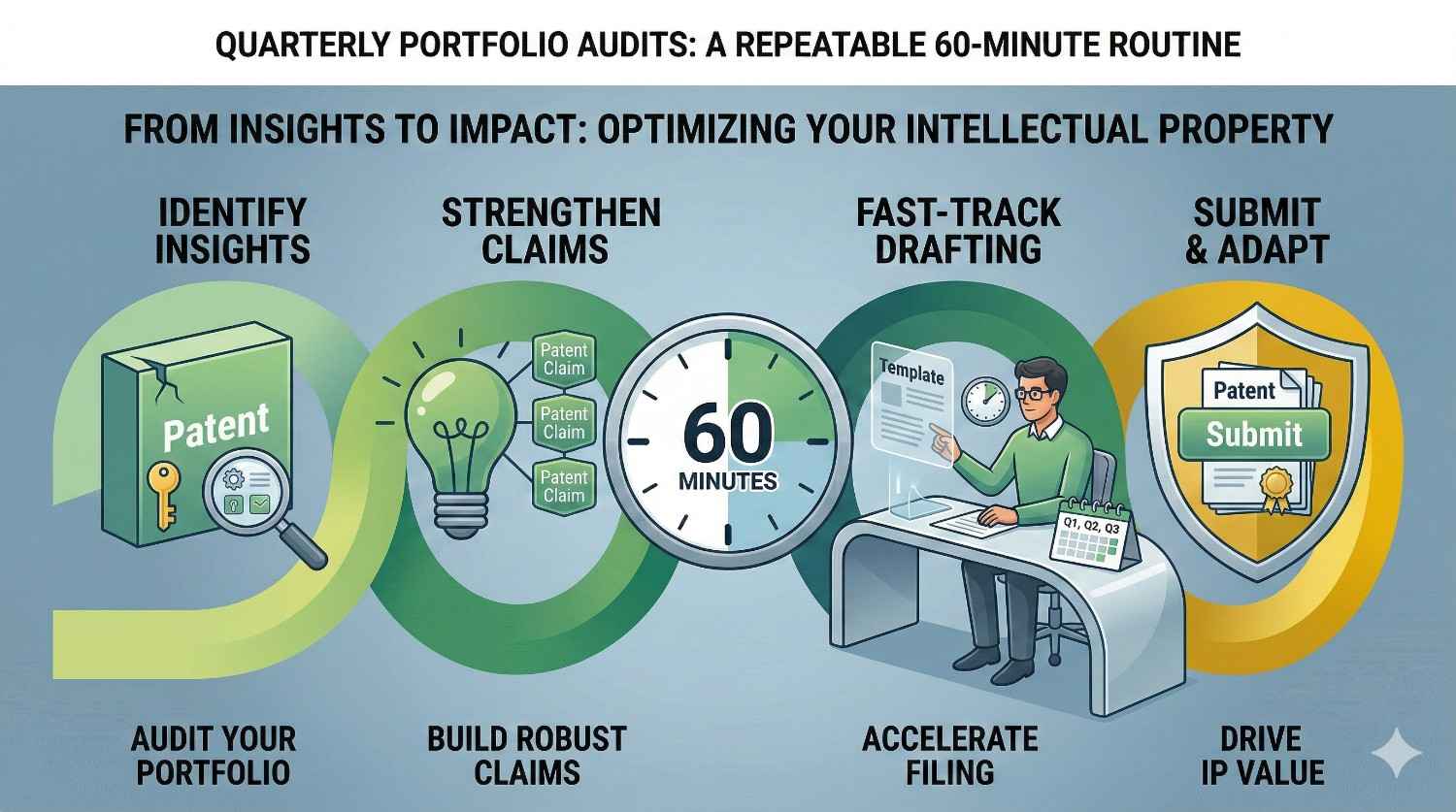
Your startup moves fast. Your product changes every week. Your code evolves daily. But your patents? Most founders file once… and then forget. That is how strong ideas slowly turn into weak protection. A quarterly portfolio audit fixes that. In just 60 minutes, once every three months, you can check, clean, and strengthen your patent position before small gaps turn into big risks. This simple habit can protect years of work. In this guide, I will show you exactly how to run a repeatable 60-minute patent portfolio audit that keeps you in control—without slowing down your build. And if you want a faster way to do this with software and real patent attorneys backing you up, you can see how PowerPatent works here: https://powerpatent.com/how-it-works
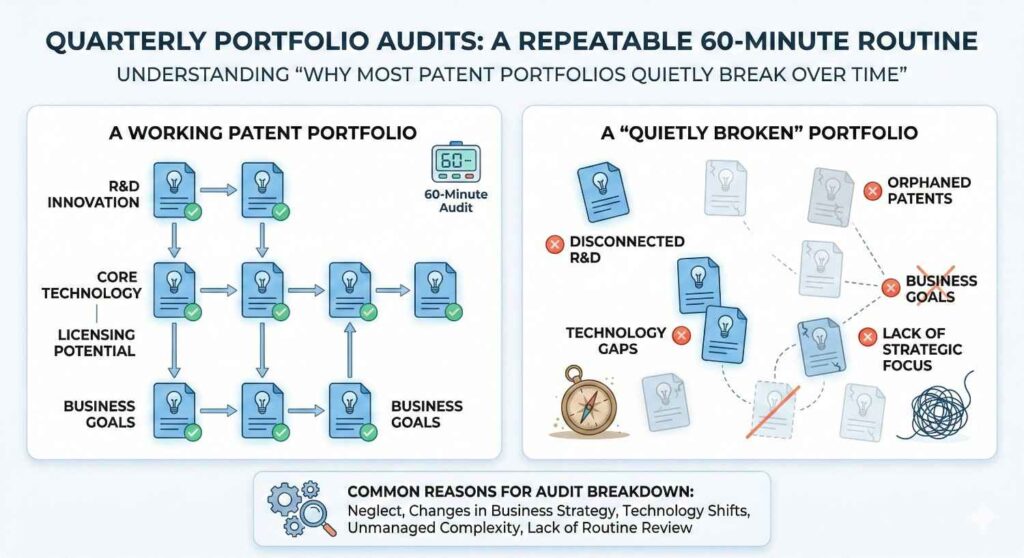
Why Most Patent Portfolios Quietly Break Over Time
Most founders believe their patent portfolio is safe once a filing receipt comes in. There is a sense of relief. A box feels checked. But patents are not a one-time task.
They are living assets tied to a product that keeps changing. When your code shifts, your models improve, and your roadmap expands, your protection must move with it.
If it does not, gaps form. These gaps are quiet. They do not send alerts. They do not show up in your sprint board. But they grow over time.
What breaks a portfolio is rarely one big mistake. It is small drift. It is delay. It is assuming yesterday’s filing still matches today’s product.
Over a year or two, this drift can weaken your leverage with investors, reduce your defensive strength against competitors, and make future filings harder and more expensive.
Let’s look at why this happens and what you can do about it.
The Product Moves Faster Than the Patent
Your engineering team ships weekly. Sometimes daily. Features expand. Architecture shifts.
You might start with a basic model and end up with a multi-layer system with custom training pipelines and edge deployment. But your patent may still describe version one.
This mismatch creates exposure. If your current value comes from a new optimization layer or a unique data processing step, but your filing never mentioned it, you may not be protected where it matters most.
To avoid this slow decay, align your patent review cycle with your product release cycle.
Every quarter, sit down with your lead engineer and ask a simple question: “If we had to describe our secret sauce today, would our patent reflect it?” If the answer is unclear, that is your signal.
This does not mean you need a new filing every month. It means you need awareness. When you spot a major technical shift, capture it in writing right away.
Even a short internal memo explaining what changed and why it matters gives you material for future filings. The goal is to reduce the gap between innovation and documentation.
If you want help capturing those changes without slowing your team, PowerPatent makes it easy to turn product updates into structured patent drafts backed by real attorneys. You can see how it works here: https://powerpatent.com/how-it-works
Roadmaps Change, But Filings Stay Frozen
Startups pivot. Markets shift. What looked like your core feature six months ago might now be secondary. You may have filed patents around an early use case that is no longer central to your growth.
This creates a portfolio that reflects your past, not your future.
A strong patent strategy follows the direction of the company. During your quarterly audit, review your roadmap. Compare it to your filed applications. Ask whether your protection supports where you are going, not just where you have been.
If you are moving into enterprise sales, are your claims broad enough to cover enterprise-scale implementations? If you are adding hardware integration, have you protected those system-level interactions?
Being strategic here can increase valuation. Investors look for patents that align with future revenue streams. When your filings mirror your growth path, they tell a clear story. When they do not, they look random.
One simple action you can take is to map each patent or application to a specific business goal. If you cannot clearly link a filing to current or planned revenue, that is a signal to rethink your direction.
You might need to adjust claim scope in pending applications or plan a new filing focused on your new core.
Teams Change and Knowledge Walks Out the Door
Startups hire fast. People leave. Founders step back from technical details. When key engineers move on, they take deep system knowledge with them. If that knowledge was never captured in your filings, it may be gone for good.
This is one of the most overlooked risks.
Your patents are not just legal tools. They are records of how your system works at its core. If you do not update them as your team evolves, you risk losing insight into why certain design choices were made.
During your quarterly review, identify recent hires and departures. Ask whether any major system changes were driven by those team members. If so, make sure the innovation is documented and, if valuable, protected.
Encourage engineers to treat patent capture as part of their exit checklist. Before someone leaves, schedule a short technical debrief focused on unique solutions they helped build. This does not need to be formal. A focused conversation can surface protectable ideas that would otherwise disappear.
With a platform like PowerPatent, founders can quickly turn those insights into filings without weeks of back-and-forth. That speed matters when team transitions happen. Learn more here: https://powerpatent.com/how-it-works
Competitive Pressure Increases Over Time
In the early days, you may be one of the only players in your niche. But success attracts competition. New startups enter. Larger companies notice your traction. They begin filing patents in your space.
If you are not watching the landscape, your portfolio may become boxed in.
A quiet risk happens when competitors file around you. They might patent adjacent methods, integrations, or improvements. If your original filing was narrow, their claims may cover areas you plan to expand into.
During each quarterly audit, spend a few minutes reviewing new filings in your technical space. You do not need a full legal search every time. Even a simple review of recent public filings in your area can reveal trends.
Ask yourself whether your pending applications need adjustment. If you see competitors claiming certain workflows or system pieces, consider whether your filings should be broadened while still pending.

Timing matters. Once an application is granted, your ability to adjust scope becomes limited.
Staying proactive keeps your portfolio flexible. Waiting too long reduces your options.
Founders Get Busy and IP Slips Down the List
The biggest reason portfolios weaken is simple. Founders are busy. Fundraising, hiring, shipping, customer calls. Patents feel slow compared to product work. So they get pushed to next quarter. Then the next.
This delay compounds.
A missed quarter turns into a missed year. By then, multiple product shifts have occurred. Filing becomes harder because you have to reconstruct past decisions.
You may even face public disclosure risks if features were launched without proper timing.
The fix is to treat your patent audit like a board meeting. It happens on schedule, no matter what. Block 60 minutes every three months. Keep it sacred.
Even if you decide no action is needed, the act of reviewing keeps you aware. It builds discipline. Over time, this habit turns your patent portfolio into a strategic asset rather than a forgotten folder.
If you prefer structure and guidance so you do not have to manage this alone, PowerPatent blends smart software with real attorney oversight to help founders stay on track without heavy effort.
You can explore the process here: https://powerpatent.com/how-it-works
Early Filings Often Lack Depth
Many startups rush their first patent. They want to file quickly before a demo day or investor pitch. Speed is good. But sometimes early filings lack detailed technical layers that become important later.
For example, your first filing might describe a general system. But as you scale, you develop performance improvements, data filtering techniques, or custom hardware optimizations.
If those details were not captured, your protection may be thinner than you think.
During your audit, re-read your earliest filings with fresh eyes. Look at them as if you were a competitor trying to design around them. Would it be easy to avoid infringement by changing a small step?
If yes, you may need continuation filings that add depth.
Think of it like reinforcing a foundation. The original filing gives you priority. Follow-up filings strengthen coverage around your core idea. This layered approach is far more powerful than a single document filed years ago.
Internal Communication Breakdowns
In many startups, the product team and legal support rarely talk. Engineers focus on shipping. Outside counsel may only get involved when asked. This creates blind spots.
A quarterly audit is not just about documents. It is about conversation.
Bring your technical lead, product lead, and whoever manages legal strategy into one short session.
Discuss what has changed, what is planned, and what worries you about competitors. This cross-team alignment can surface insights no single person sees alone.
Even a simple shared document tracking potential new inventions can make a big difference. Encourage team members to add short notes when they solve hard technical problems. These notes become raw material for future filings.
With the right system in place, capturing and converting these ideas becomes easy instead of disruptive. That is exactly what modern tools are built for.
Small Gaps Turn Into Big Risks
At first, a missed update seems minor. A new feature is not included in the patent. A claim is narrower than ideal. A competitor filing is ignored. None of this feels urgent.
But over time, these small gaps stack up.
When you finally need to enforce your rights, raise funding, or negotiate an acquisition, weaknesses become visible. Investors and acquirers look closely at alignment between product and protection. If they see drift, they discount value.
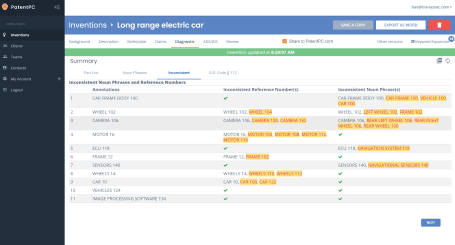
The good news is that preventing this is not complex. It requires rhythm. It requires 60 focused minutes every quarter. It requires asking honest questions about where your protection stands.
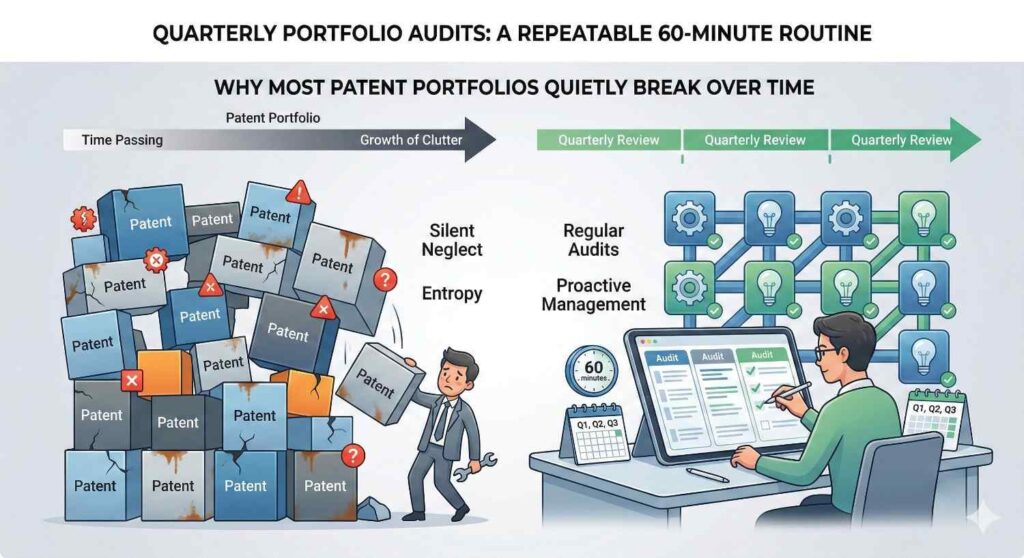
Patent portfolios do not collapse overnight. They fade quietly. A repeatable audit routine stops that fade. It keeps your protection sharp, aligned, and ready to support growth.
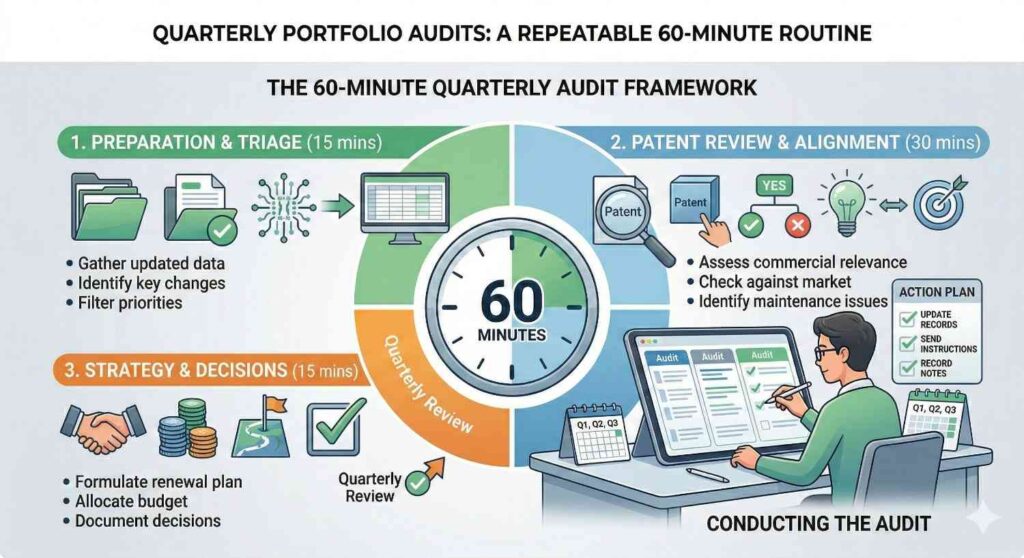
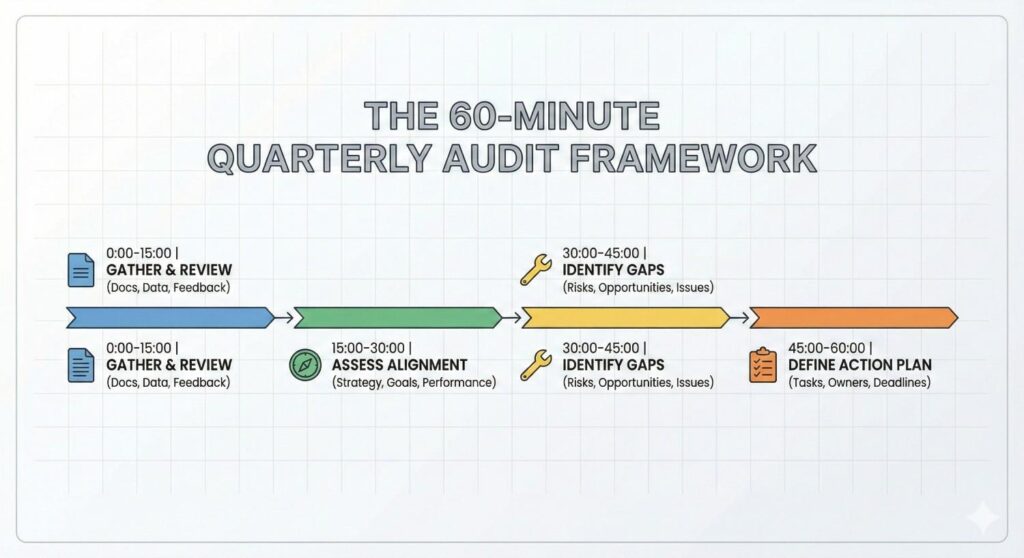
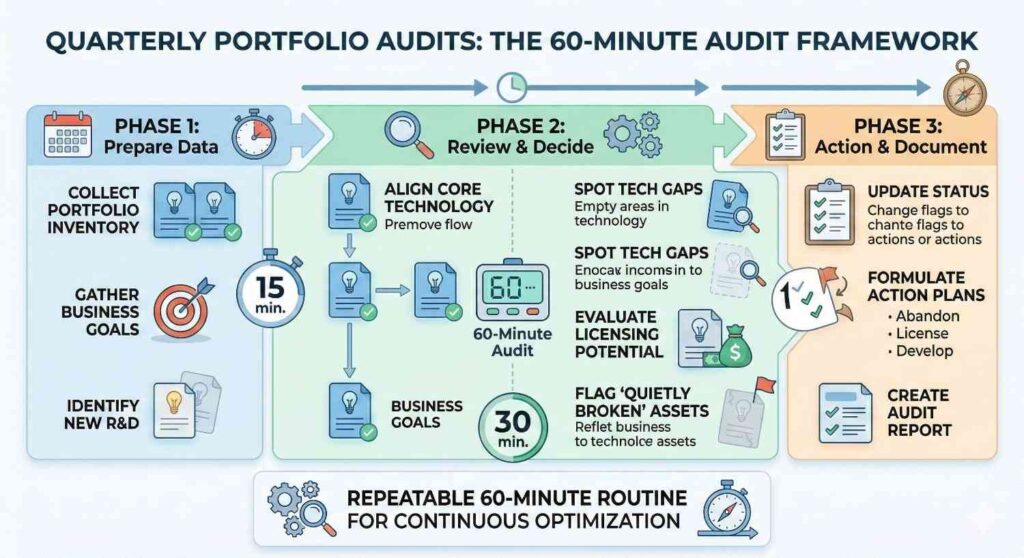
The 60-Minute Quarterly Audit Framework
A strong patent portfolio does not require endless meetings or complex systems. It requires rhythm and focus. Sixty minutes, once every three months, is enough to stay in control if you use that time well.
The goal of this framework is simple. You walk in with uncertainty and walk out with clarity. You know what is protected, what is drifting, and what needs action.
This is not a legal exercise. It is a business exercise. You are protecting leverage.
You are protecting future pricing power. You are protecting your right to build without fear. When you treat the audit as part of company strategy instead of paperwork, it becomes far more powerful.
Here is how to structure that one focused hour so it produces real outcomes.
Start With the Current Product, Not the Patents
Most founders make one mistake. They open their patent documents first. That is backward. Your product is the source of value. The patents exist to protect that value.
Begin the session by reviewing what your product looks like today. Pull up your live architecture diagram. Open your latest product roadmap. Ask your lead engineer to explain what has materially changed in the last quarter.
Do not get lost in small UI tweaks. Focus on technical shifts. New models. New pipelines. New integrations. Performance breakthroughs. Security layers. Hardware updates.
When you ground the discussion in today’s system, you anchor the audit in reality. You are not reviewing words on paper. You are reviewing the engine that drives your company.
As you listen, pay attention to phrases like “we rebuilt this,” “we optimized that,” or “we added a new layer.” These moments often signal protectable improvements.
If you are using a modern system like PowerPatent, this step becomes easier because your technical details can already be structured in a way that connects directly to filings.
That saves time and keeps the conversation focused. You can see how that works here: https://powerpatent.com/how-it-works
Re-Read Claims With a Builder’s Mindset
Once you understand the current product, then turn to your existing filings. Focus on the claims. These define what is protected. Read them slowly. Not as a lawyer. As a builder.
Ask yourself a direct question. If a competitor copied our current product exactly, would this claim cover it?
Be honest. If your system now depends on a new data filtering method but your claims only describe a general data processing step, there may be a gap.
If you now rely on distributed edge devices but your filing only describes a centralized system, that is another gap.
This exercise is not about panic. It is about awareness. Many times, you will find that your original filing still provides strong coverage. Other times, you will see room for expansion while your application is still pending.
If you have pending applications, you often have the chance to adjust claim scope or file continuation applications that extend protection. That window does not stay open forever. A quarterly review ensures you use it wisely.
Evaluate Business Alignment, Not Just Technical Coverage
Protection is only valuable if it supports your business goals. During the audit, step back and look at your revenue model. How do you make money today? How do you expect to make money in the next 12 to 24 months?
If enterprise licensing is your growth path, your patents should support enterprise deployment. If you plan to embed your technology into third-party platforms, your filings should cover integration scenarios.
Look at each active filing and connect it to a revenue stream or strategic goal. If you cannot clearly explain how a patent supports your growth plan, that is a signal to rethink future filings.
This does not mean every patent must tie to current revenue. Some filings are defensive. Some protect long-term bets. But you should be able to articulate the reason each asset exists.
That clarity becomes powerful during fundraising. Investors gain confidence when they see a tight link between innovation, protection, and growth. A clean quarterly audit makes that story easy to tell.
Check Timing Risks Before They Become Problems
Timing matters more than most founders realize. Public launches, conference talks, blog posts, and product demos can all impact patent rights if filings are not handled properly.
During your audit, review what was publicly disclosed in the last quarter. Did you announce a major feature? Publish technical details? Release open-source components tied to core systems?
Make sure those disclosures are aligned with your filing strategy. If you plan to file on a new innovation, do it before widely sharing detailed technical information.
This part of the audit protects future flexibility. It ensures you are not accidentally limiting your options.
When you work with a system that blends smart software and real attorney oversight, these timing issues are easier to manage because filings can move quickly without long delays.
That speed can protect you from costly mistakes. You can learn more here: https://powerpatent.com/how-it-works
Review Competitive Movement Briefly but Intentionally
You do not need hours of research. But you should dedicate a few focused minutes to competitor movement.
Look at major players in your space. Have they announced new patents? Have they expanded into areas close to your roadmap? Even a light review of public patent databases can reveal patterns.
If you notice a competitor filing around a workflow you plan to build, consider accelerating your own filing.
If they seem to be claiming improvements on top of a general idea, assess whether your protection is strong enough to block design-arounds.
The purpose here is not fear. It is positioning. Patents are part of competitive strategy. A short, regular review keeps you from being surprised later.
Capture New Ideas Immediately
At the end of the hour, focus on forward motion. Ask your team one simple question. What did we build this quarter that felt hard or unique?
Do not overthink it. Encourage short explanations. Even rough notes are fine. The goal is to identify innovations worth documenting.
If something stands out, assign a clear next step. That might mean drafting a new filing. It might mean expanding an existing one. It might mean scheduling a deeper technical session.
The key is to leave the audit with defined actions, not vague awareness.
With tools built for founders, capturing these ideas can take minutes instead of weeks. You can input technical details, generate structured drafts, and have real patent attorneys review them without slowing your roadmap.
That combination of speed and oversight is what keeps the 60-minute routine realistic. Explore it here: https://powerpatent.com/how-it-works
End With a Simple Portfolio Snapshot
Before closing the session, summarize your current position. How many active filings do you have? How many are pending? How many are granted? Are there any deadlines coming up?
This snapshot gives you control. It prevents surprises. It also builds confidence when speaking with investors or board members.
You do not need complex dashboards. A simple internal summary document updated each quarter is enough. Over time, this becomes a clear record of disciplined IP management.
That discipline sends a signal. It shows that you treat your technology as a serious asset.
Make It a Calendar Habit, Not a Reactive Task
The power of this framework lies in repetition. Once every three months. Same format. Same focused energy.
When the audit becomes routine, stress drops. You are no longer scrambling before fundraising or reacting to competitor moves. You are steadily strengthening your position.
Set the next audit date before you end the current one. Protect that time. Treat it as part of your growth system.
If you want a structure that supports this habit without adding heavy process, modern patent platforms can integrate directly into your workflow.
They combine automation with real legal review so you do not trade speed for quality. See how that works here: https://powerpatent.com/how-it-works
This 60-minute framework is simple by design. It keeps your protection aligned with your innovation. It turns patents from static documents into active strategic tools.
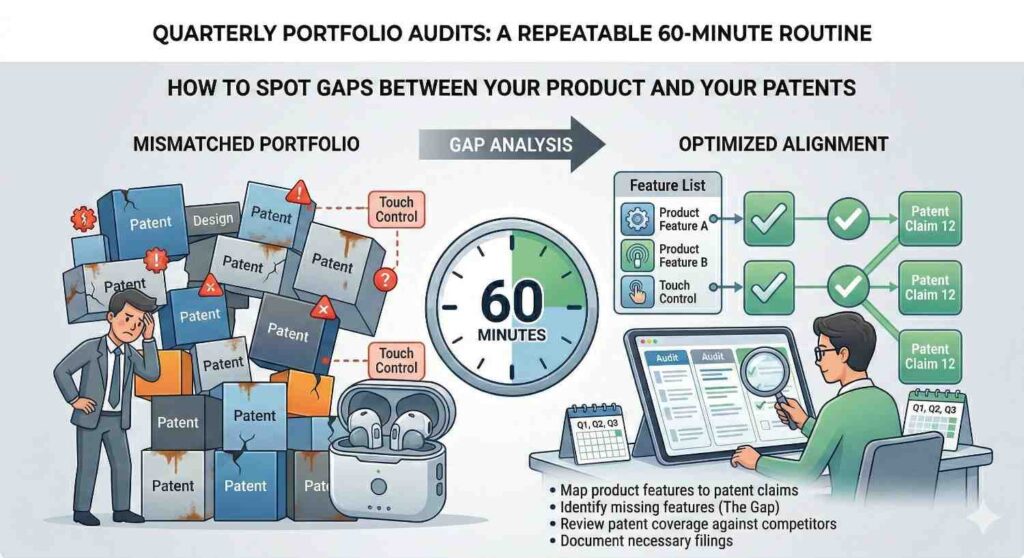
How to Spot Gaps Between Your Product and Your Patents
A patent portfolio rarely fails because nothing was filed. It fails because what was filed no longer matches what creates value. The danger is not always obvious.
On paper, you may have multiple applications pending. You may even have issued patents. Yet the real edge in your product could be sitting outside the fence.
This section is about sharpening your eye. You need to see misalignment early, while you still have options.
When you can spot gaps quickly, you can fix them while applications are pending, before competitors move in, and before investors start asking hard questions.
Gap detection is a skill. Once you train yourself to look at your system through a protection lens, you start seeing risk and opportunity everywhere.
Look at Where Revenue Actually Comes From
Every product has many features, but only a few truly drive revenue. Some parts attract users. Others convert them. Others keep them locked in. Your strongest protection should sit around the parts that create pricing power and retention.
During your audit, trace your revenue back to specific technical components. If customers pay for speed, what makes you fast? If they pay for accuracy, what part of your system improves accuracy?
If they value integration, what technical bridge enables that integration?
Now compare those components to your patent claims.
If your filings mostly describe a broad system but do not clearly capture the mechanism behind your revenue engine, you have a strategic gap. Investors and acquirers care about defensible revenue.
A patent that protects a side feature is far less valuable than one that protects your core driver.
This does not mean rewriting everything. It means being intentional about where your strongest claim coverage sits. If you discover that your monetization layer is lightly protected, prioritize reinforcing that area while you still can.
When you use a system that helps map technical features directly into structured filings, this alignment becomes much easier to maintain.
That is one of the key advantages of modern tools supported by real attorneys. You can explore that process here: https://powerpatent.com/how-it-works
Compare Architecture Diagrams to Claim Language
One of the simplest and most powerful exercises is visual. Pull up your latest architecture diagram. Then place your patent claims next to it.
Go component by component.
If your system now includes modules, pipelines, or processing stages that did not exist when you filed, circle them.
Ask whether those components are described anywhere in your pending applications. If not, you may be building valuable improvements without protection.
Sometimes the gap is not a missing component, but a deeper layer.
Your patent may describe a “processing engine,” but your actual system now includes a novel training loop, a feedback mechanism, or a resource optimization technique inside that engine.
If those inner workings are not captured, competitors might copy your improvements while avoiding your broader claims.
This visual comparison removes guesswork. It forces clarity. If a major box on your diagram has no clear protection story, you have found a gap.
Identify What Competitors Would Copy First
Another way to uncover weaknesses is to think like a rival. Imagine a well-funded competitor studying your product. They are not trying to copy everything.
They are looking for the smallest set of technical elements that recreate your advantage.
What would they copy first?
Would they replicate your data processing sequence? Your ranking logic? Your hardware configuration? Your distributed update model?
Now ask whether your claims clearly cover that minimal winning set.
If a competitor could change one small detail and avoid infringement, your coverage might be too narrow. If they would have to redesign their entire system to avoid your claims, your position is much stronger.
This mental exercise helps you see around corners. It also prepares you for investor diligence questions. Sophisticated investors often think in exactly this way.
When you have already pressure-tested your portfolio against competitive design-around attempts, you walk into those conversations with confidence.
Examine Features Added Under Time Pressure
Some of the most valuable innovations happen during crunch time. A customer demands performance improvements. A security issue forces a new solution. A scaling challenge requires creative engineering.
These fixes often create protectable breakthroughs. Yet because they were built under pressure, they may never have been documented with protection in mind.
During your review, look back at urgent engineering sprints from the last quarter.
What problems did you solve that felt painful? Did you create new algorithms, caching systems, data compression methods, or hardware tweaks to handle the pressure?
These moments often contain hidden IP value.
Do not assume that because something feels incremental, it is not protectable. Many strong patents protect improvements rather than original base ideas.
What matters is whether the improvement provides a unique technical advantage.
Capturing these improvements quickly keeps your portfolio layered and resilient.
Platforms that streamline idea capture into structured drafts make it realistic to protect even fast-moving improvements without slowing your team. You can see how that works here: https://powerpatent.com/how-it-works
Watch for Expansion Into New Markets
When startups expand into new verticals or geographies, technical adjustments usually follow. You may need compliance layers, localization logic, or new hardware configurations.
These shifts often introduce new technical elements.
If your original filings were built around one market use case, expansion may create unprotected areas.
During the audit, review any planned or recent market expansion. Identify technical changes made to support that move. Then assess whether those changes are covered.
This is especially important when entering regulated industries. If you add audit logging, encryption methods, or monitoring systems tailored to specific rules, those implementations can be valuable IP assets.
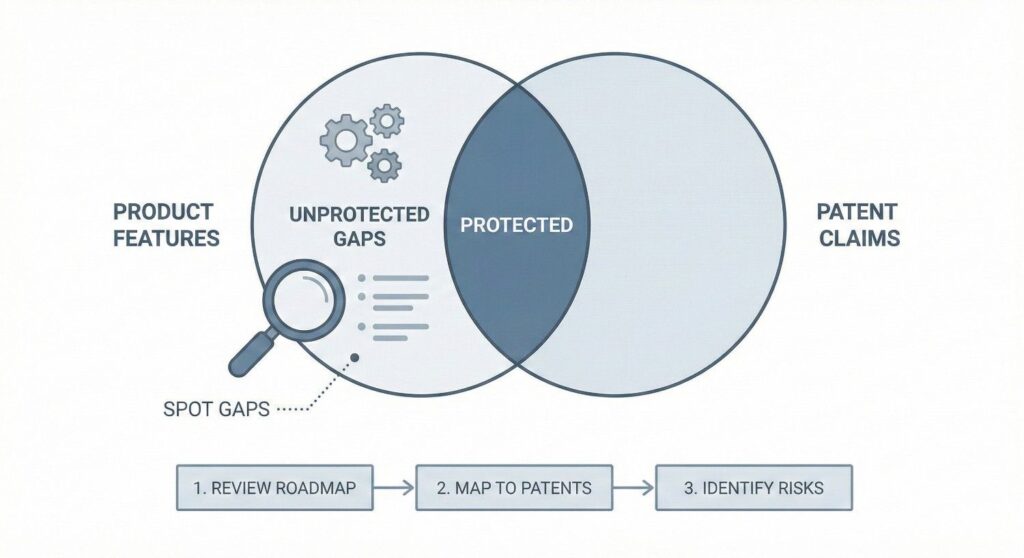
Protection should grow with your footprint. If your business scope expands but your patent scope stays narrow, misalignment increases.
Check for Over-Concentration in One Area
Some startups unintentionally overprotect one technical theme while ignoring others. For example, you might have several filings focused on model training but none focused on deployment or user interaction layers.
This creates imbalance.
If your value chain includes data ingestion, model building, real-time inference, user feedback, and integration APIs, but your filings cluster heavily around only one stage, competitors may attack the weaker stages.
During your review, mentally walk through your entire system from input to output. Ask whether each stage has at least some level of protection. You do not need equal depth everywhere, but you should avoid leaving major parts completely exposed.
A balanced portfolio makes it harder for competitors to carve out safe zones.
Look at What Is Still Pending and Adjustable
Pending applications are opportunities. Once granted, options narrow. During your quarterly check, identify which filings are still pending. These are your most flexible assets.
Review whether the original description supports broader or alternative claim angles.
If you have additional embodiments or variations described in the specification, you may be able to adjust claim scope or file continuation applications to expand coverage.
Many founders forget that a pending application is not fixed in stone. There may be room to adapt it as your product evolves.
This is where working with real patent attorneys matters. Adjusting claim scope requires careful strategy. With the right guidance and the right software tools, you can make smart adjustments without heavy delays.
PowerPatent blends automation with attorney review so founders can move quickly while still protecting long-term strength. You can learn more here: https://powerpatent.com/how-it-works
Pay Attention to What You Are Afraid to Share
There is one more powerful signal. Notice what parts of your system you hesitate to describe publicly. The components you guard most closely often represent your true advantage.
If you are careful about explaining a certain optimization method or system workflow, ask yourself whether it is fully protected. If not, that hesitation may be telling you something important.
Your strongest secrets should not rely only on secrecy. Where possible, they should be reinforced with formal protection.
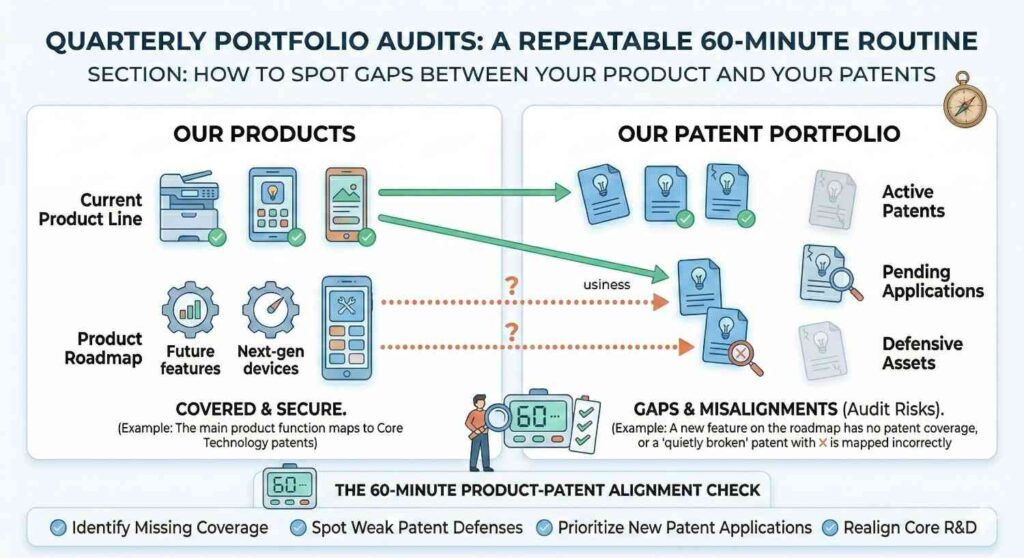
When you consistently ask these questions every quarter, gap spotting becomes natural. You move from reactive filing to strategic protection. You stop hoping your portfolio is strong and start knowing where it stands.
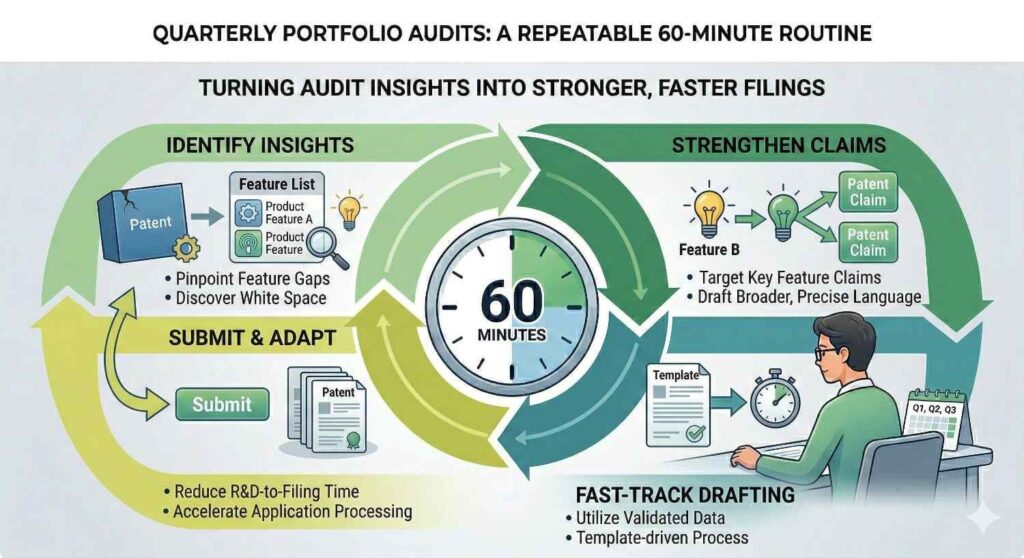
Turning Audit Insights Into Stronger, Faster Filings
A quarterly audit only creates value if it leads to action. Insight without execution is just awareness. The real advantage comes from moving quickly once you see a gap or opportunity.
This is where many startups stall. They complete the review, identify areas that need protection, and then delay filing because the process feels heavy. Weeks pass. Product changes again. The window narrows.
The goal of this final step is simple. Convert what you learned in that 60-minute session into concrete protection while the ideas are fresh and the timing is right.
Move From Notes to Structured Invention Summaries
Right after the audit, capture what you found in plain language. Do not wait for perfect wording. Describe the problem your system solves. Explain how your solution works. Clarify what makes it different from typical approaches.
Focus on technical cause and effect. What input enters the system? What transformation happens? What output is produced? Why is this sequence better?
This short summary becomes the bridge between engineering insight and formal protection. If you delay writing it down, small details fade. Those small details often carry the strongest protection potential.
Speed matters here. The faster you translate your internal notes into a structured invention summary, the less likely you are to lose nuance.
Modern tools make this process far easier. Instead of drafting from scratch or sending scattered emails to outside counsel, you can input your technical explanation into a guided system that structures it correctly from the start.
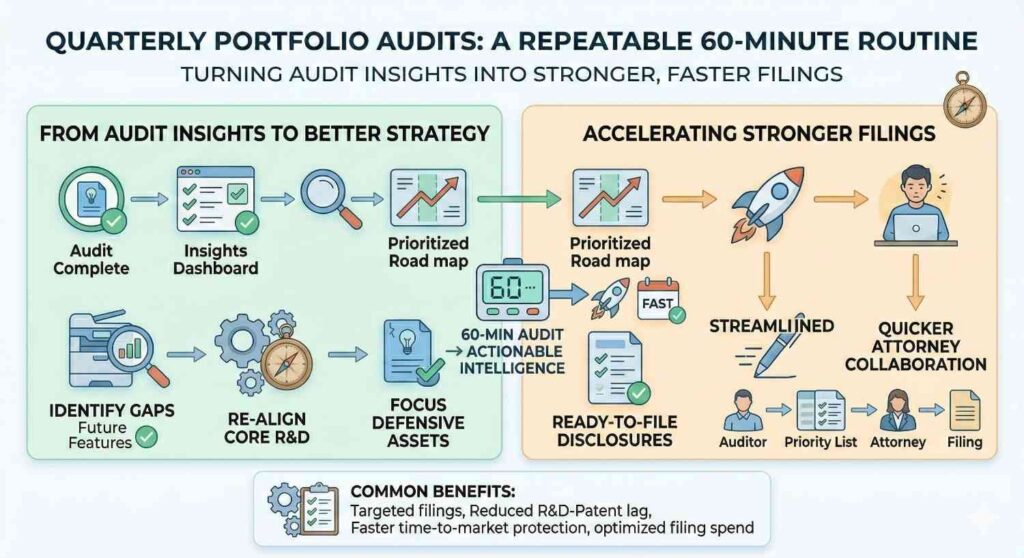
That structure reduces back-and-forth and speeds up filing without lowering quality. You can see how that works here: https://powerpatent.com/how-it-works
Prioritize Based on Strategic Impact
Not every idea needs immediate filing. The audit may surface multiple improvements. Some protect core revenue drivers. Others are defensive layers. Others are long-term bets.
Decide which ones tie directly to your current growth engine. Those should move first. If a feature drives customer retention or just closed a major deal, protecting it quickly strengthens your position.
At the same time, do not ignore defensive filings entirely. If a competitor could easily replicate a new optimization and use it to undercut your pricing, that improvement may deserve fast action.
This is not about filing everything. It is about filing what matters most right now.
When you treat your patent budget as strategic capital rather than a fixed expense, you make sharper decisions. Each filing should serve a clear business purpose.
Use Pending Applications to Expand Coverage
One of the smartest moves after an audit is to revisit pending applications with fresh eyes. If your original filing described multiple variations or embodiments, you may have room to expand claim coverage without starting from zero.
For example, if your specification includes different system configurations but your initial claims focused on one version, you may be able to pursue additional claims that cover alternative implementations.
This layered approach strengthens your position over time. Instead of relying on a single set of claims, you build a family of protection around your core idea.
Timing is critical. Once a patent is granted and deadlines pass, flexibility decreases. Quarterly audits help you act while flexibility still exists.
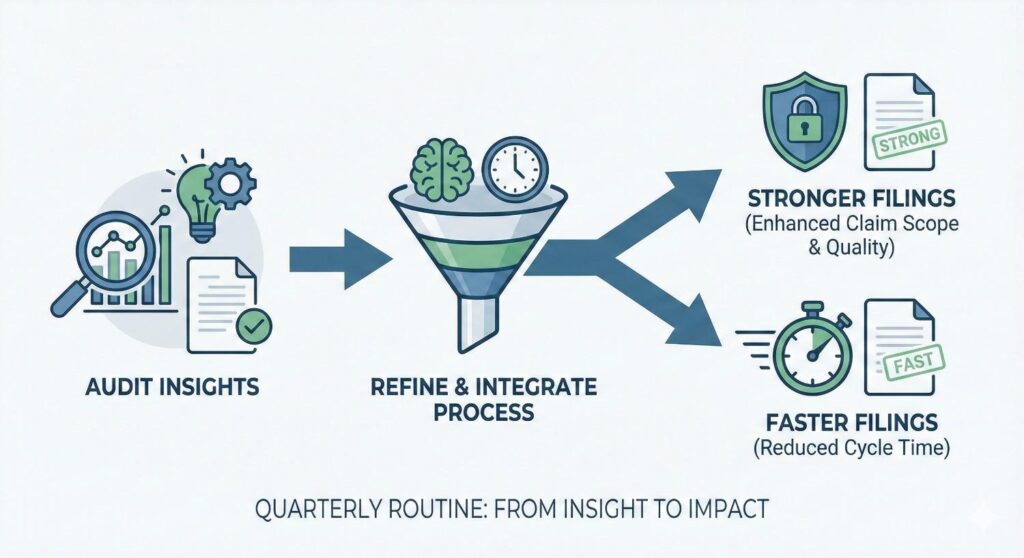
Working with real patent attorneys during this stage ensures adjustments are strategic rather than reactive. Combining that legal oversight with software that organizes your technical details creates both speed and strength.
Shorten the Gap Between Build and File
The strongest portfolios share one trait. The gap between innovation and filing is short.
If you build something unique in January but wait until October to file, you increase risk. Public disclosures may occur. Competitors may move first. Internal details may blur.
After each audit, aim to reduce this gap. Set a target window for moving from invention summary to draft to filing. Treat it like a product release timeline.
When your team sees that protection follows innovation quickly, they begin to think about patents as part of the build process rather than an afterthought.
This cultural shift is powerful. Engineers start flagging protectable ideas earlier. Product leaders begin aligning launches with filing strategy. Protection becomes proactive instead of reactive.
Platforms designed for founders help enable this shift. By reducing friction in drafting and review, they allow you to move at startup speed while still benefiting from attorney oversight. You can explore that model here: https://powerpatent.com/how-it-works
Strengthen Your Investor Narrative
Every audit and follow-up filing also strengthens your story.
When investors ask about your IP strategy, you can explain your routine clearly. You review quarterly. You align filings with product evolution. You monitor competitors. You expand pending claims strategically.
This disciplined approach signals maturity. It shows that you understand patents are not trophies. They are leverage tools.
When your portfolio clearly maps to revenue drivers and roadmap milestones, it increases perceived defensibility. That perception can influence valuation discussions.
Execution after each audit ensures your story is backed by real assets, not vague intentions.
Build a Repeatable System, Not a One-Time Push
The final step is to turn this into habit. After you complete one full cycle of audit and action, document your process. Note what worked well. Note where you felt friction.
Refine the routine for next quarter. Perhaps you need a clearer internal template for invention summaries.
Perhaps you want a standing meeting with both your technical lead and your legal partner. Perhaps you want automated reminders tied to product release cycles.
Small refinements compound over time.
The goal is not complexity. It is consistency.
When you run this 60-minute audit every quarter and convert insights into filings quickly, your portfolio evolves in step with your product. Protection becomes dynamic. It grows as you grow.
And you do not have to manage this alone. With the right platform, you can combine intelligent software that understands technical input with real patent attorneys who ensure quality and strength.
That balance gives you speed without sacrificing defensibility. If you want to see how that works in practice, visit https://powerpatent.com/how-it-works
Quarterly portfolio audits are not about paperwork. They are about control. They ensure that the value you build stays yours. They transform patents from static documents into active strategic assets.
Wrapping It Up
A patent portfolio does not stay strong by accident. It stays strong because you pay attention to it with the same discipline you apply to product, revenue, and hiring. Sixty minutes every quarter is not a heavy lift. But done consistently, it changes everything. When you review your product first, then your claims, then your roadmap, you create alignment. When you spot gaps early, you preserve flexibility. When you act quickly on new ideas, you shorten the distance between innovation and protection. Over time, this rhythm compounds. Your filings become sharper. Your coverage becomes layered. Your confidence grows.