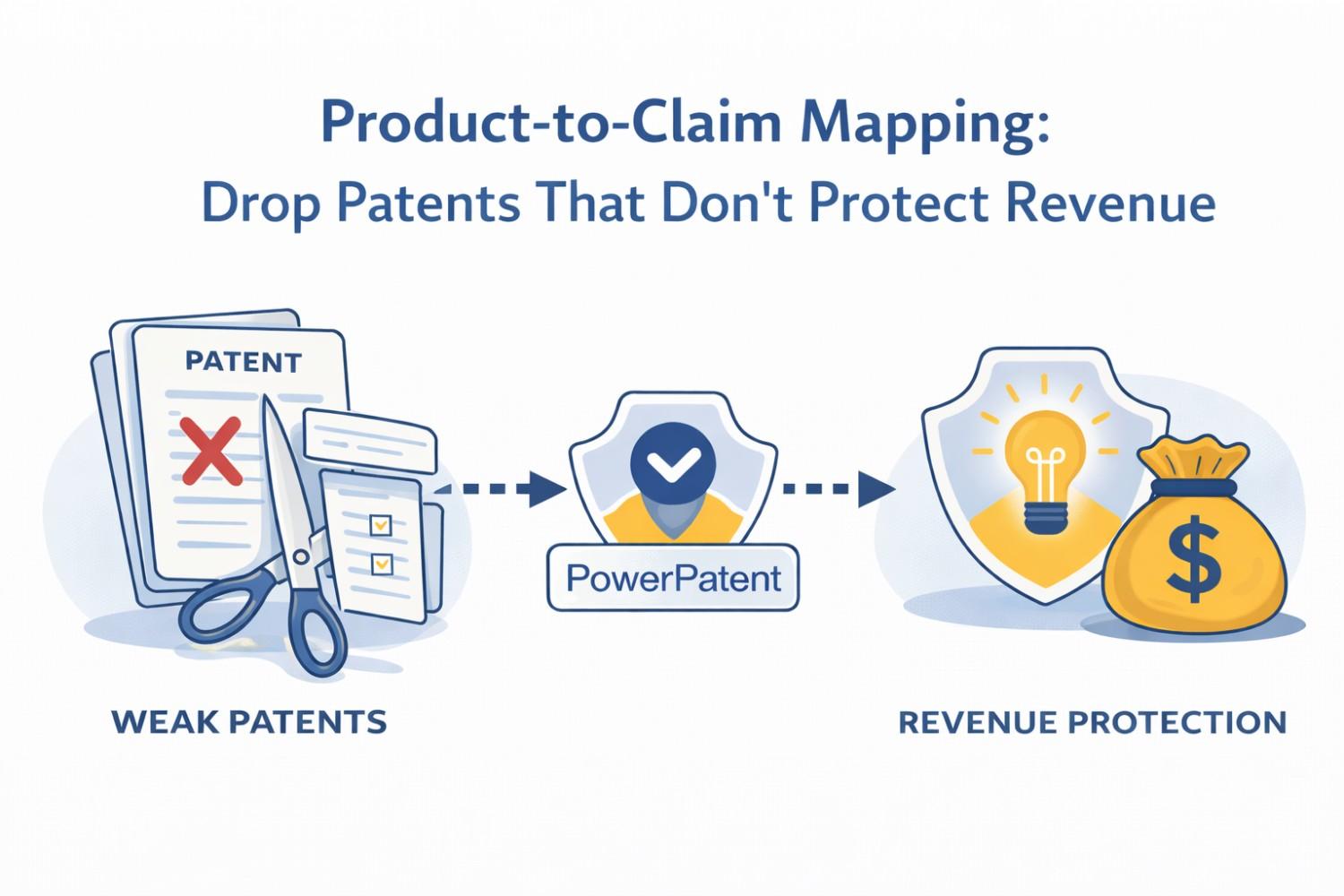
You don’t need more patents. You need the right ones. If a patent does not protect how you make money, it is just paper. Product-to-claim mapping is how you make sure every patent claim lines up with real features in your product that drive revenue. If it does not protect revenue, you cut it. If it does, you double down. This is how smart founders build strong IP without wasting time or cash. If you want to see how to do this the right way from day one, take a look at how it works at PowerPatent → https://powerpatent.com/how-it-works
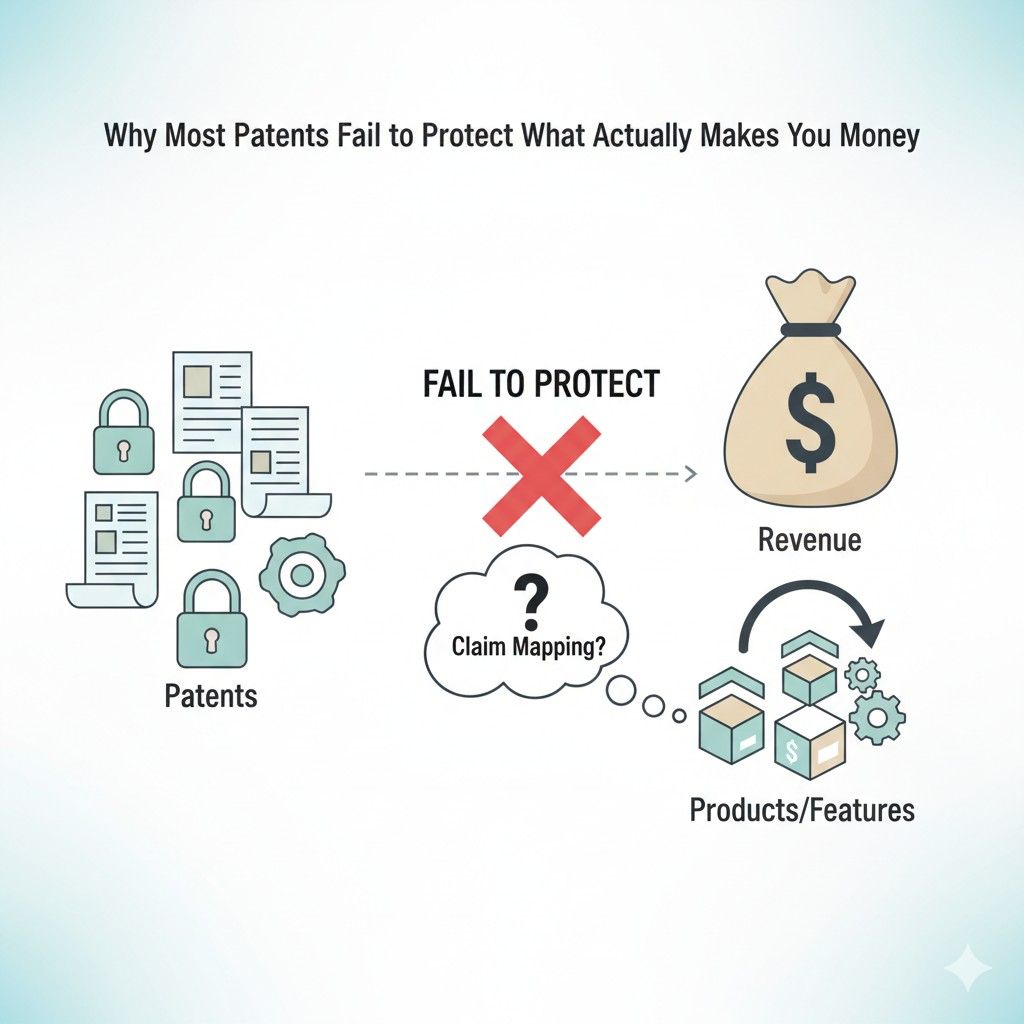
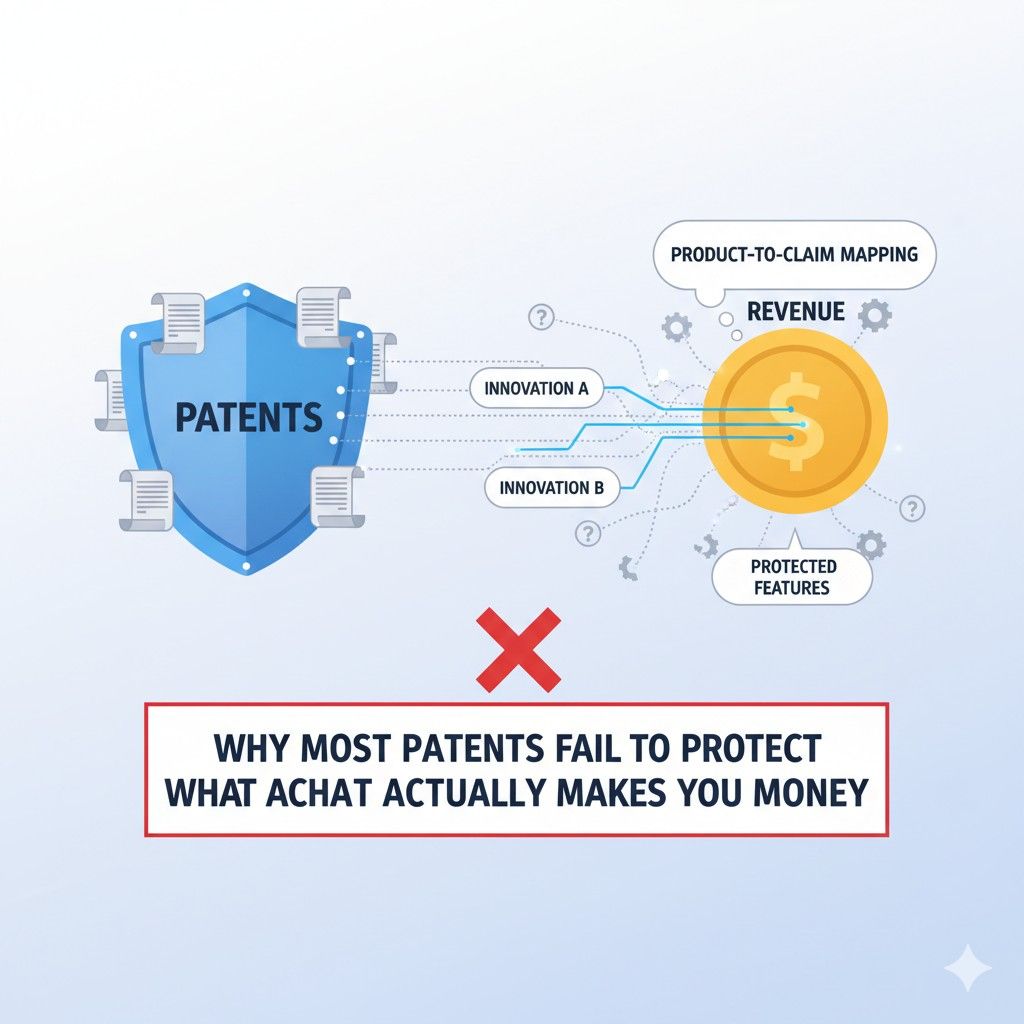
Why Most Patents Fail to Protect What Actually Makes You Money
Most founders believe that once they file a patent, their product is safe. It feels like a shield. But in reality, many patents protect the wrong thing.
They protect ideas that sound smart but do not connect to how the company earns revenue. When that happens, the patent becomes decoration instead of defense.
This section explains why that gap happens and how to avoid it. If you are building real technology and planning to scale, this is the part you cannot ignore.
And if you want support from real attorneys and smart software that keeps your patents aligned with your product, you can see how PowerPatent does it here → https://powerpatent.com/how-it-works
Patents Written Around Ideas, Not Around Products
Many patents are drafted around concepts instead of shipped features. The focus is on what sounds innovative, not on what customers actually pay for. That difference matters more than most founders realize.
When a patent centers on a high-level idea, it often misses the technical pieces that make the product hard to copy. Investors may nod. Teams may celebrate.
But competitors can still rebuild the core system in a slightly different way and avoid the claims.
To prevent this, you need to start every patent discussion with one simple question: what exact part of our product creates revenue? Not what sounds cool.
Not what looks good in a pitch deck. What do customers rely on so much that they would switch vendors if they lost it?
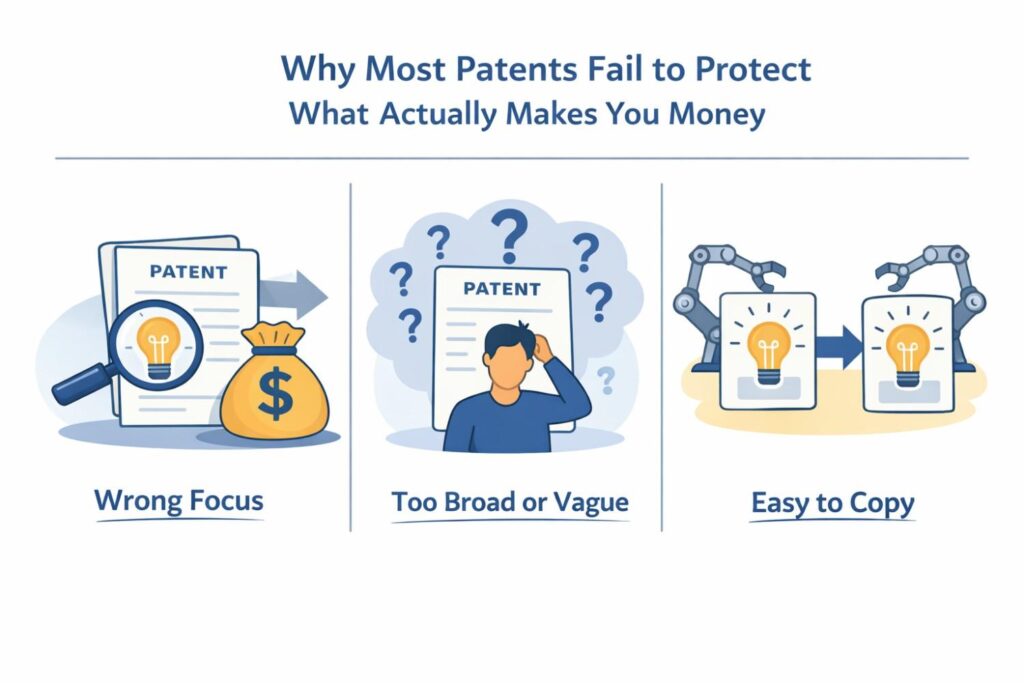
Sit down with your product team and map out the top revenue drivers. Identify the technical mechanism behind each one. Then ask whether your patent claims cover that mechanism in detail. If they do not, you have a gap.
Filing Too Early Without Real Product Insight
Speed is important in startups. But filing too early can lock you into weak protection. When patents are drafted before the product is fully understood, they often describe what you think you are building, not what you actually ship.
The result is claims that miss key features. Over time, your product evolves. Your code changes. Your architecture improves. But your patent stays frozen in an early version of your thinking.
A smart approach is to treat your patent strategy like product development. Before filing, review real usage data.
Look at what customers use most. Study what makes onboarding smooth. Identify what reduces churn. Those insights show you where revenue truly lives.
When you align claims with proven product value instead of early assumptions, your patent becomes a business tool instead of a guess.
Protecting What Is Easy Instead of What Is Critical
Another common mistake is choosing to patent the simplest part of the system. It feels safe. It feels clear. But often, that part is not where the value sits.
For example, a team might patent a user interface flow because it is easy to describe. Meanwhile, the complex backend process that delivers unique results is left exposed.
A competitor can replicate the backend logic in a different interface and avoid infringement.
You must resist the urge to protect what is easiest to explain. Instead, dig into what is hardest to replicate. That is usually where the real moat is.
Have your engineering lead walk through the system and explain which components would take the longest for a new team to rebuild. Which parts rely on deep know-how?
Which parts would break the experience if removed? Those are the parts that deserve claim coverage.
Confusing Feature Count With Real Protection
Some founders feel proud when they have multiple patents. It looks strong on paper. But quantity does not equal protection. Ten weak patents that miss revenue drivers are less valuable than one strong patent that covers your core engine.
A common pattern is filing separate patents for small features. Over time, you build a stack of documents that each protect narrow details. But none of them capture the core flow that makes customers pay.
Instead of asking how many patents you have, ask what percent of your revenue-generating features are protected. That number tells the real story.
You can perform a simple internal audit. Take your top three revenue features. For each one, review your issued or pending claims.
Highlight the exact language that covers that feature. If you cannot clearly match claim language to feature behavior, that patent may not be doing its job.
Writing Claims That Are Too Abstract
Abstract claims are risky. They sound broad. They seem powerful. But in practice, they can be hard to enforce.
If a claim describes an outcome without anchoring it to a specific technical method, competitors may design around it with small changes.
Revenue protection requires precision. You need claims that describe how your system achieves results, not just what results it achieves.
For example, instead of claiming “a system that improves data accuracy,” strong protection would describe the actual process that improves accuracy. The data structures used. The sequence of steps. The technical interactions between components.
The more grounded your claims are in real technical implementation, the harder it becomes for someone to copy your system without stepping into your claim language.
Ignoring the Business Model
Many patents focus only on technology and ignore how the company makes money. But your business model shapes what needs protection.
If you charge per transaction, then the transaction flow is critical. If you rely on subscription retention, the long-term performance and system reliability may be the true revenue driver.
If you monetize through API access, the integration layer becomes key.
Before filing or maintaining a patent, step back and look at your pricing structure. Identify what triggers payment. Then analyze whether your claims protect that trigger mechanism.
If your revenue comes from automated decision outputs, do your claims protect the way decisions are generated? If your value lies in real-time processing, do your claims capture that timing structure?
When patents ignore business mechanics, they drift away from revenue.
Patents That Do Not Match Current Code
Over time, startups refactor code. They optimize systems. They remove parts that no longer serve customers. But rarely do they revisit patent claims to check alignment.
This creates a silent problem. Your patent may protect a version of your system that no longer exists. Meanwhile, your current architecture might sit outside the scope of your own claims.
To avoid this, build a habit of reviewing patent claims during major product updates. When you release a new version, ask your legal team whether the changes still fall under your protected structure.
If not, consider filing additional claims that reflect the new system.
This is where combining software tools with real attorney oversight becomes powerful. With the right platform, you can track changes and align them with claim language before gaps form.
If you want to see how that works in practice, explore the process at https://powerpatent.com/how-it-works
Defensive Filings Without Strategic Focus
Sometimes companies file patents mainly to say they have them. It feels like a defensive move. But without strategy, defensive filings often protect peripheral elements instead of central value.
A better mindset is to treat each filing as a business decision. Ask whether this claim would matter in a dispute. Would blocking this feature slow a competitor’s revenue? If the answer is no, rethink the filing.
Strong patent strategy focuses on choke points. These are areas competitors must pass through to compete in your space. If your claims control those choke points, your patents hold real power.
To identify choke points, study how competitors operate. Map their likely technical paths. Then analyze whether your claims would intersect with those paths. If not, refine your approach.
Relying Fully on Outside Counsel Without Product Input
Traditional patent drafting often happens far from the engineering team. Attorneys may write based on limited input. Without deep product understanding, claims can drift into generic territory.
Founders and engineers must stay involved. You do not need to write the claims yourself, but you must guide what matters.
Explain the hard problems you solved. Show where competitors struggle. Share real-world constraints your system overcomes.
The more context your drafting team has, the stronger the alignment between claims and revenue.
When software tools help organize product details and attorneys refine them into clear claims, the result is both speed and strength. That blend reduces the risk of filing something that looks official but fails under pressure.
Failing to Think About Enforcement
A patent only protects revenue if it can be enforced. Many filings do not consider how infringement would be proven.
Imagine you need to show that a competitor uses your patented method. If your claim depends on hidden internal data that cannot be observed, enforcement becomes harder.
When drafting claims, think about evidence. Can you detect the behavior from public outputs? Can you infer steps from observable results? Designing claims with enforcement in mind increases real-world value.
Before finalizing a patent, ask how you would prove infringement. Walk through a hypothetical competitor scenario. If proof would be nearly impossible, adjust the claim structure.
Overlooking Global Revenue Strategy
If you plan to sell internationally, your patents should reflect that path. Some companies focus on one jurisdiction while expanding revenue abroad. Without proper coverage, competitors in other markets may operate freely.
Strategic founders align patent filings with expansion plans. If a market represents future revenue growth, consider protection there early.
Review your five-year roadmap. Identify where major customer segments will be located. Then align your patent geography with revenue forecasts, not just current operations.
Treating Patents as Static Documents
Perhaps the biggest reason patents fail to protect revenue is the belief that they are one-time events. In reality, patent strategy should evolve with your business.
As your product shifts from early feature validation to scale optimization, the technical core may change. New value drivers appear. Old ones fade.
Revenue-focused patent management requires regular review. It requires mapping new features to existing claims and identifying gaps before competitors do.
Schedule annual reviews where product, engineering, and legal sit together. Revisit revenue metrics. Revisit claim language. Update where needed. This keeps your IP aligned with growth instead of stuck in the past.
When patents move in sync with your roadmap, they become assets that strengthen valuation, deter competitors, and protect cash flow.
And if you want a structured way to manage that alignment without slowing down your build cycle, see how PowerPatent blends smart software with real attorneys to keep your patents tied to revenue from day one → https://powerpatent.com/how-it-works
We have now covered the core reasons most patents fail to protect what actually makes you money and how to avoid those traps.
What Product-to-Claim Mapping Really Means (And Why It Changes Everything)
Most founders hear the word “claims” and mentally check out. It sounds legal. It sounds slow. It feels far away from code, users, and revenue.
But claims are the only part of a patent that truly matters.
The claims define what you actually own. Not the title. Not the summary. Not the diagrams. The claims are the fence around your property. If the fence is in the wrong place, you do not protect what makes you money.
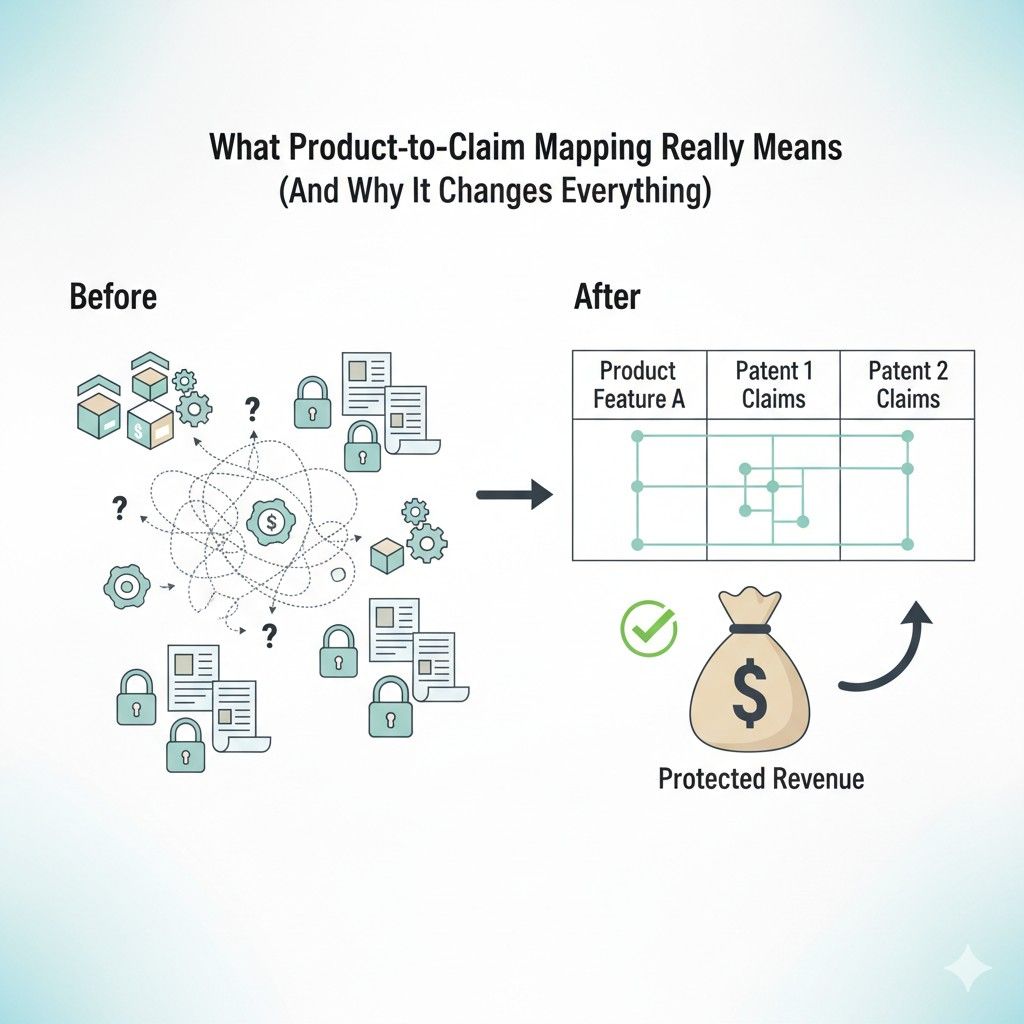
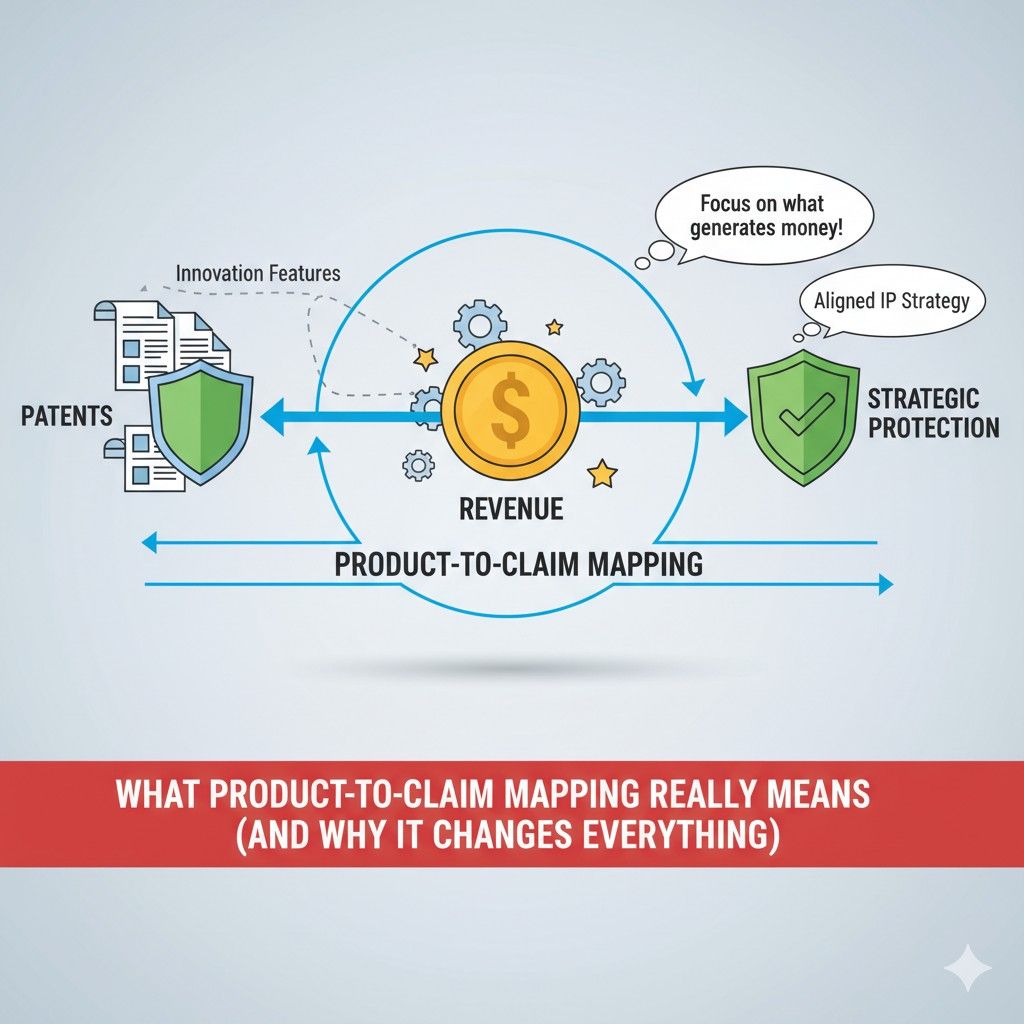
Product-to-claim mapping is the discipline of drawing a straight line between your real product and those fences. It forces you to answer a hard question: does this claim protect the thing customers pay for?
When done right, it changes how you think about patents. They stop being paperwork. They become revenue armor.
And if you want a faster way to align claims with real product features from the start, see how PowerPatent structures that process here → https://powerpatent.com/how-it-works
The Simple Definition Most People Miss
Product-to-claim mapping means taking each key feature in your live product and matching it directly to specific language in your patent claims.
Not loosely. Not conceptually. Directly.
If your product has a real-time ranking engine that drives user engagement, you should be able to point to claim language that covers how that ranking engine works. If you cannot, you have exposure.
The mapping process removes guesswork. It forces clarity.
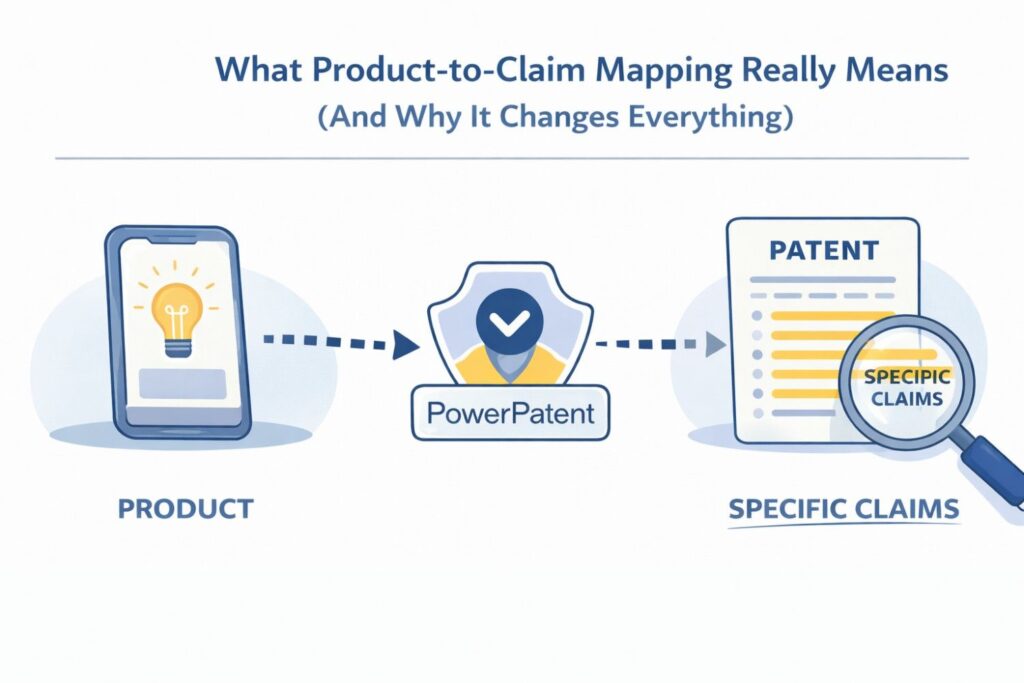
Instead of asking, “Do we have patents?” you start asking, “Do our patents cover this exact revenue feature?”
That shift alone changes the value of your IP.
Claims Are Not Marketing Copy
A common mistake is assuming the patent description protects you. It does not. Only the claims define your legal rights.
You may have twenty pages describing your AI system. But if the claims do not include the core technical flow that drives revenue, competitors can copy that flow and avoid infringement.
Product-to-claim mapping makes you live inside the claims. You read them like code. You test them against real system behavior.
If your product performs step A, B, and C, your claim should reflect that sequence or its equivalent structure. If it skips a step that your system relies on, that gap matters.
This is where founders often feel uncomfortable. But that discomfort is good. It reveals risk early, before a competitor does.
Revenue Is the Anchor, Not the Invention Story
Many patents are written around the story of the invention. How the idea came about. What problem it solves. Why it is new.
That is fine for background. But revenue rarely depends on the story. It depends on specific functionality.
Product-to-claim mapping shifts focus from origin story to revenue engine.
You start by identifying what customers pay for. Then you break down the technical pieces that enable that value. Then you confirm whether your claims capture those pieces.
If your main selling point is automated fraud detection, but your claims mostly focus on data storage structure, there is a disconnect.
The mapping process highlights that disconnect clearly.
Mapping Forces You to Face Hard Truths
When you actually line up product features with claim language, uncomfortable patterns appear.
You may discover that your strongest revenue driver sits outside any issued claim. You may see that older patents cover features you no longer use. You may realize you spent money protecting something that no longer exists in your codebase.
This is not failure. It is insight.
Most companies never do this exercise. They assume protection exists because a patent number does.
Founders who map product to claims operate differently. They manage IP like they manage product metrics. They measure alignment. They correct drift.
That discipline builds real defensive strength.
How Mapping Changes Strategic Decisions
Once you understand which features are truly protected, your roadmap decisions become sharper.
If a new feature extends a protected claim area, you are building inside a strong moat. That is powerful.
If a major new revenue stream falls completely outside existing claims, you know early that you may need new filings.
Mapping also influences partnership talks. When negotiating with enterprise customers or strategic partners, you can confidently explain what parts of your system are protected.
It changes investor conversations too. Instead of vague statements about “strong IP,” you can demonstrate claim alignment with top revenue drivers.
That level of clarity signals maturity.
It Reduces Waste Immediately
Product-to-claim mapping often reveals patents that no longer support the business.
Maybe you pivoted. Maybe you sunset a feature. Maybe your market changed.
If a patent does not protect current or planned revenue streams, you should question whether to keep investing in it.
Maintenance fees, international filings, and ongoing prosecution cost real money. Mapping helps you cut what does not serve revenue and redirect resources toward stronger protection.
This is not about having fewer patents. It is about having sharper ones.
It Strengthens Enforcement Position
When your claims clearly align with live product features, enforcement becomes more realistic.
You can compare your mapped features to competitor behavior. You can assess overlap quickly. You can explain infringement theories in plain terms.
Without mapping, enforcement analysis becomes abstract. With mapping, it becomes concrete.
You know exactly which claim elements correspond to which system behaviors. That clarity reduces ambiguity during disputes.
Even if you never litigate, the ability to demonstrate strong alignment can deter competitors from copying you in the first place.
Mapping Should Be Ongoing, Not One-Time
Your product evolves. Your claims do not automatically evolve with it.
Mapping should happen during major releases, pricing changes, and technical upgrades.
Every time revenue shifts, you revisit the map.
If a new feature suddenly drives a large share of revenue, that feature must be reviewed against existing claims. If coverage is thin, you act early.
Waiting until a competitor launches a similar product is too late.
Companies that integrate mapping into their operating rhythm stay ahead.
Why Traditional Processes Make Mapping Hard
In many companies, patents are handled separately from product teams. Legal works in isolation. Engineering ships features independently.
This separation makes mapping rare.
Claims get drafted based on early disclosures. Years later, no one checks whether those claims still match the product.
Modern startups move fast. Without a structured way to connect product updates to claim language, drift is inevitable.
This is where smarter systems matter. When software tools organize technical details and attorneys refine them into strong claims, mapping becomes part of the workflow instead of an afterthought.
If you want to see how that kind of system works in practice, you can explore it here → https://powerpatent.com/how-it-works
Mapping Turns Patents Into Business Assets
At its core, product-to-claim mapping transforms patents from static documents into living business tools.
It forces discipline. It aligns legal protection with revenue streams. It exposes gaps early. It sharpens resource allocation.
Most importantly, it ensures that when someone asks what your patents protect, the answer is clear: they protect how we make money.
That clarity builds confidence. It strengthens valuation. It supports long-term growth.
And it starts with one simple habit: never assume protection. Always verify alignment.
We have now explored what product-to-claim mapping truly means and why it changes everything about how you manage IP.
How to Map Your Product Features to Patent Claims Step by Step
Most founders think product-to-claim mapping is complex. It is not. It is focused work. It requires honesty and attention to detail. That is all.
You are not trying to impress anyone. You are trying to answer one question clearly: does this claim protect this revenue feature?
This section walks through how to actually do it inside your company without slowing down product velocity. When done correctly, this process becomes part of how you operate, not a separate legal task.
If you want to build this into your workflow with real attorney guidance and smart tools, you can see how PowerPatent supports that process here → https://powerpatent.com/how-it-works
Start With Revenue, Not With the Patent
Before you open any patent document, open your revenue dashboard.
Look at what drives money today. Look at what will likely drive money in the next twelve to eighteen months. Focus on real numbers, not internal excitement.
If eighty percent of your revenue depends on one core engine, that engine deserves deep claim alignment. If a new module is expected to unlock enterprise contracts, that module should be reviewed early.
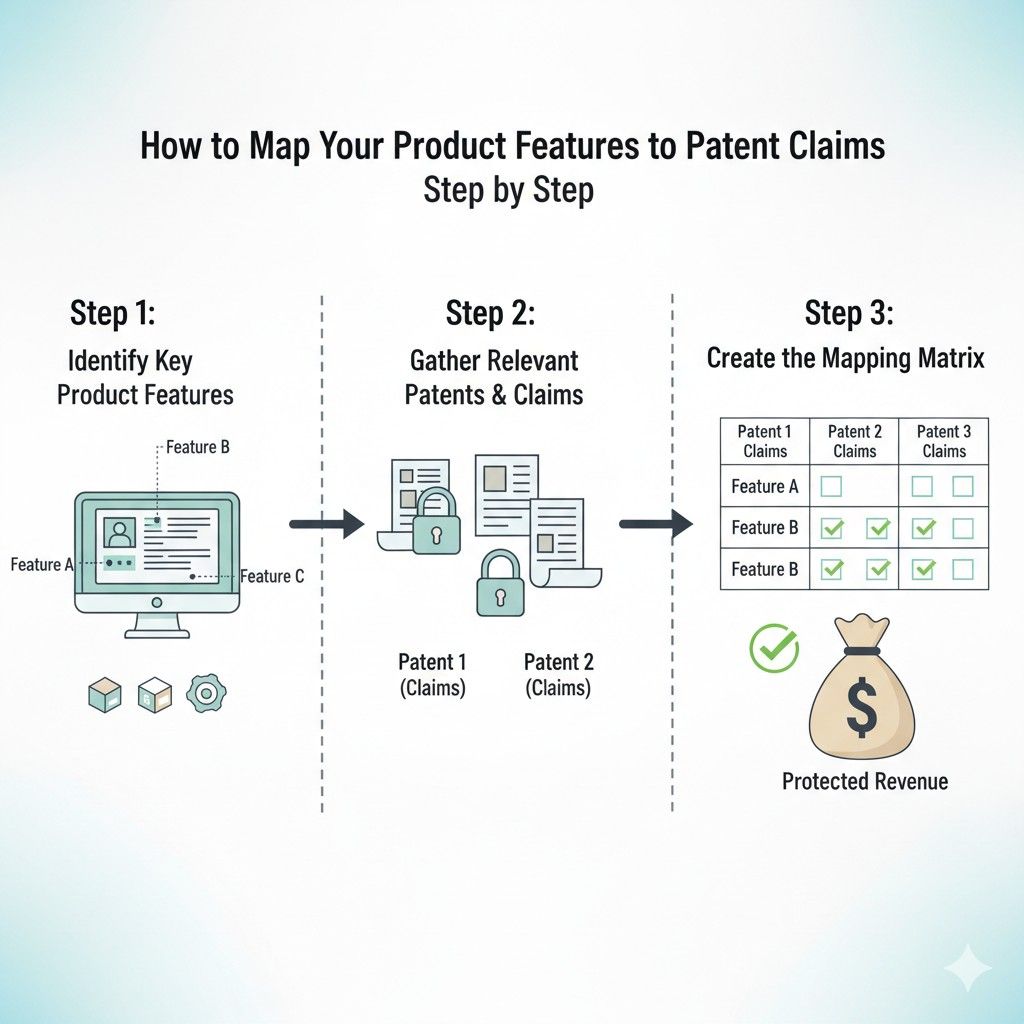
Too many companies start mapping by reading patents first. That is backward. Revenue defines priority. Claims respond to it.
When revenue anchors the process, you avoid wasting time on features that do not matter.
Break Down the Feature Into Technical Pieces
Once you identify a revenue-driving feature, break it down technically.
Do not describe it as a marketing benefit. Describe it as system behavior.
If your feature delivers automated recommendations, what actually happens under the hood? What data is collected? How is it processed? What logic is applied? What output is generated?
Write this in plain language. Engineers should lead this part. The goal is clarity, not polish.
This breakdown becomes your reference map. You will use it to compare against claim language.
Read the Claims Slowly, Line by Line
Now open your patent and focus only on the claims.
Ignore the long description for now. The claims are what matter.
Read each claim line by line. Identify the required elements. Look at how the steps are structured. Notice what is mandatory and what is optional.
This part takes patience. Claims are written in dense language. But if you slow down, they become understandable.
Ask yourself: does each key technical piece from the feature breakdown appear in this claim? If yes, how directly? If no, is there another claim that captures it?
You are not looking for general similarity. You are looking for structural alignment.
Create a Clear One-to-One Match
For each major product feature, you should be able to point to specific claim elements that cover it.
If your product performs three core technical actions, your claim should reflect those actions in some form.
If a claim requires steps that your product does not perform, that claim may not protect the feature you care about.
Write down the match explicitly. For example, if your system uses a specific data transformation before output, note the claim language that covers that transformation.
If you cannot find language that matches a key technical action, highlight that gap clearly.
This is where real insight happens.
Identify Weak Alignment Early
Sometimes you will find partial overlap. The claim may describe a general process, but not the exact technical structure you now use.
This is common, especially if your product evolved after filing.
Partial alignment is not enough. If a competitor can change one small element and avoid your claim, your protection is thin.
When you spot weak alignment, flag it. That may signal the need for a continuation filing or new claims that better capture your current architecture.
The earlier you catch this, the cheaper and easier it is to fix.
Review From a Competitor’s Perspective
Once you map feature to claim, flip the viewpoint.
Imagine you are a competitor trying to copy your revenue feature. Read your own claims and ask: how would I design around this?
If your claim requires a very specific step that is not essential to the value, a competitor might remove or alter that step and avoid infringement.
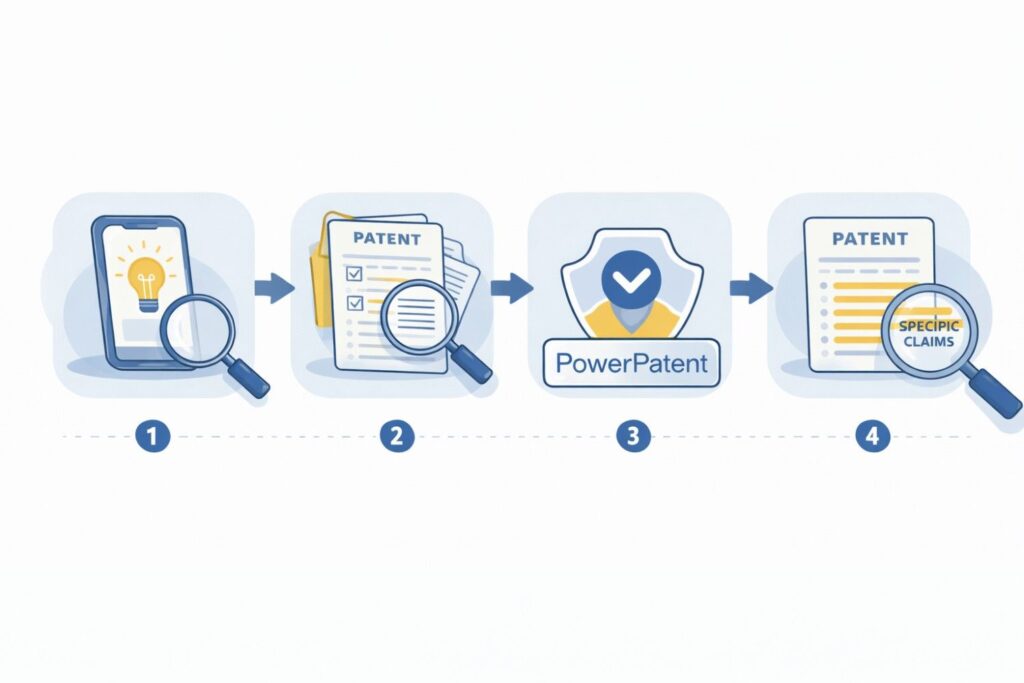
If your claim focuses on one implementation path while your feature can be implemented in multiple ways, your coverage may be narrow.
This mental exercise strengthens your mapping process. It forces you to test durability, not just alignment.
Connect Mapping to Product Updates
Mapping should not live in a forgotten document.
Tie it directly to product release cycles. When a major update ships, revisit the map.
Ask whether new technical elements have been introduced. Ask whether core logic changed. Ask whether any protected steps were removed or replaced.
Even small changes can affect claim coverage.
By making mapping part of release review, you prevent long-term drift between your patents and your live system.
This habit protects you as you scale.
Involve Engineering and Legal Together
Mapping fails when done in isolation.
Engineers understand the real system behavior. Attorneys understand how claims function legally. Both views are necessary.
When mapping sessions include both perspectives, you catch more gaps and reduce misinterpretation.
Engineers can explain what truly drives value. Attorneys can adjust claim language to reflect that value in enforceable terms.
Modern tools make this collaboration smoother. Instead of back-and-forth email chains, structured platforms allow product details and claim drafts to live in the same workflow.
If you want to see how that kind of system operates, explore the approach here → https://powerpatent.com/how-it-works
Prioritize Gaps Based on Revenue Impact
Not every gap requires urgent action.
If a feature generates minimal revenue and has weak claim coverage, it may not justify immediate cost.
But if a core revenue engine lacks strong claim alignment, that is a priority.
Rank gaps based on revenue contribution and future strategic importance. Focus resources where financial risk is highest.
This ensures you invest in IP where it matters most.
Turn the Map Into a Living Asset
Once you complete mapping for your major features, document it clearly.
Create a simple internal reference that shows each revenue feature and the claims that protect it.
This document becomes valuable during fundraising, partnerships, and board discussions.
It shows that your IP strategy is not random. It is aligned with business outcomes.
More importantly, it keeps your team accountable. Every time revenue shifts, the map must be revisited.
That discipline builds long-term strength.
Avoid Overcomplicating the Process
Mapping does not require complex software models or legal jargon.
It requires clarity about three things: how you make money, how your system works, and what your claims say.
If you stay grounded in those three pillars, the process becomes manageable.
The goal is not perfection. The goal is visibility. You want to know where you are protected and where you are exposed.
Once you have that visibility, you can act strategically.
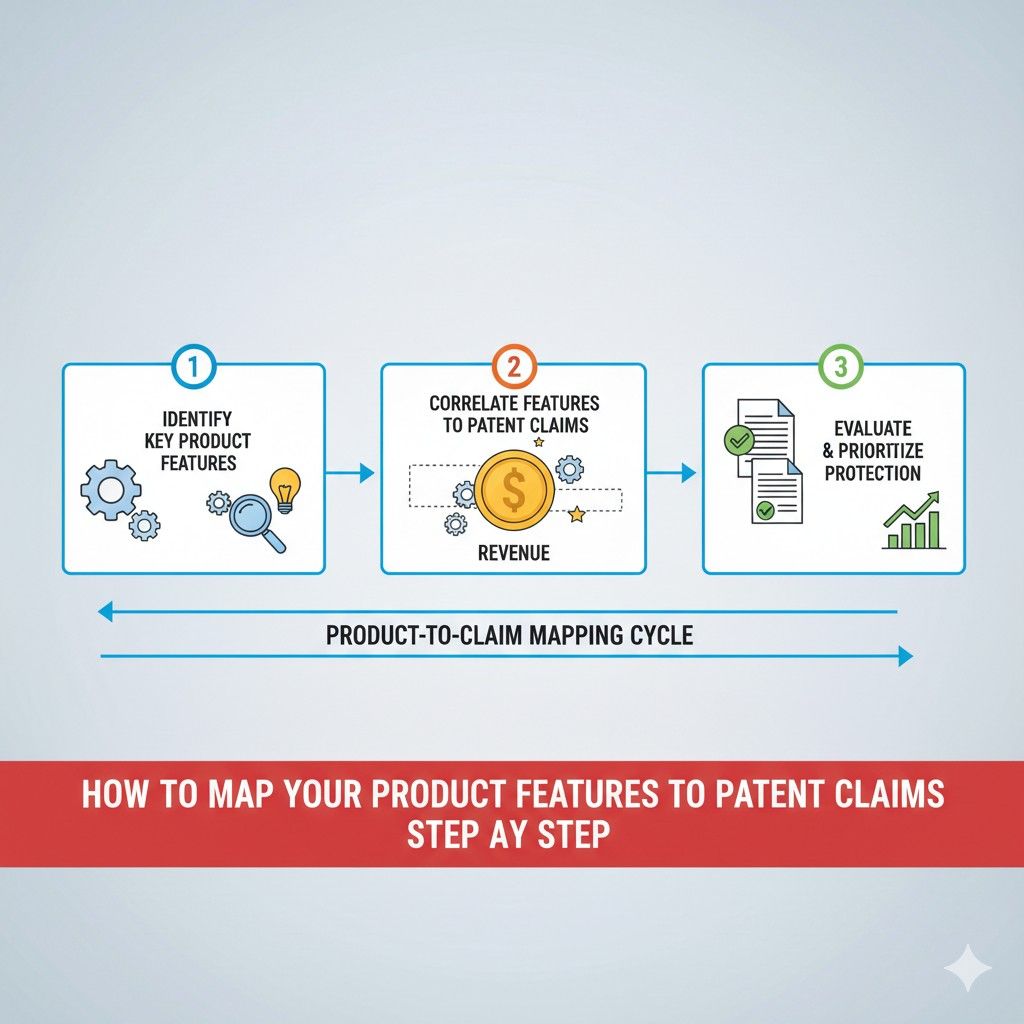
And when you combine structured software tools with real attorney oversight, the process becomes faster and more reliable. That combination helps you avoid costly mistakes while keeping momentum high. You can learn more about that model here → https://powerpatent.com/how-it-works
You now have a clear framework for mapping product features to patent claims in a way that protects revenue instead of just creating paperwork.
How to Cut Weak Patents and Focus Only on Revenue Protection
Once you complete product-to-claim mapping, you will see something clearly.
Some patents help protect revenue.
Some patents do not.
This is where most companies hesitate. They feel attached to filings because time and money were spent. But patents are business tools, not trophies. If a patent does not protect how you make money now or in the future, it should not quietly drain resources.
Strong founders do not measure IP strength by count. They measure it by coverage of revenue.
This section explains how to evaluate, cut, and refocus your patent portfolio with discipline and confidence.
If you want a smarter way to manage this process with real attorney oversight and structured tools, explore how PowerPatent approaches portfolio strategy here → https://powerpatent.com/how-it-works
Accept That Sunk Cost Does Not Equal Future Value
One of the biggest mental traps in patent strategy is sunk cost thinking.
You filed it. You paid for it. You defended it during examination. It feels wrong to let it go.
But none of that matters if the patent does not protect revenue.
The only question that matters is forward-looking: does this patent reduce competitive risk tied to how we earn money?
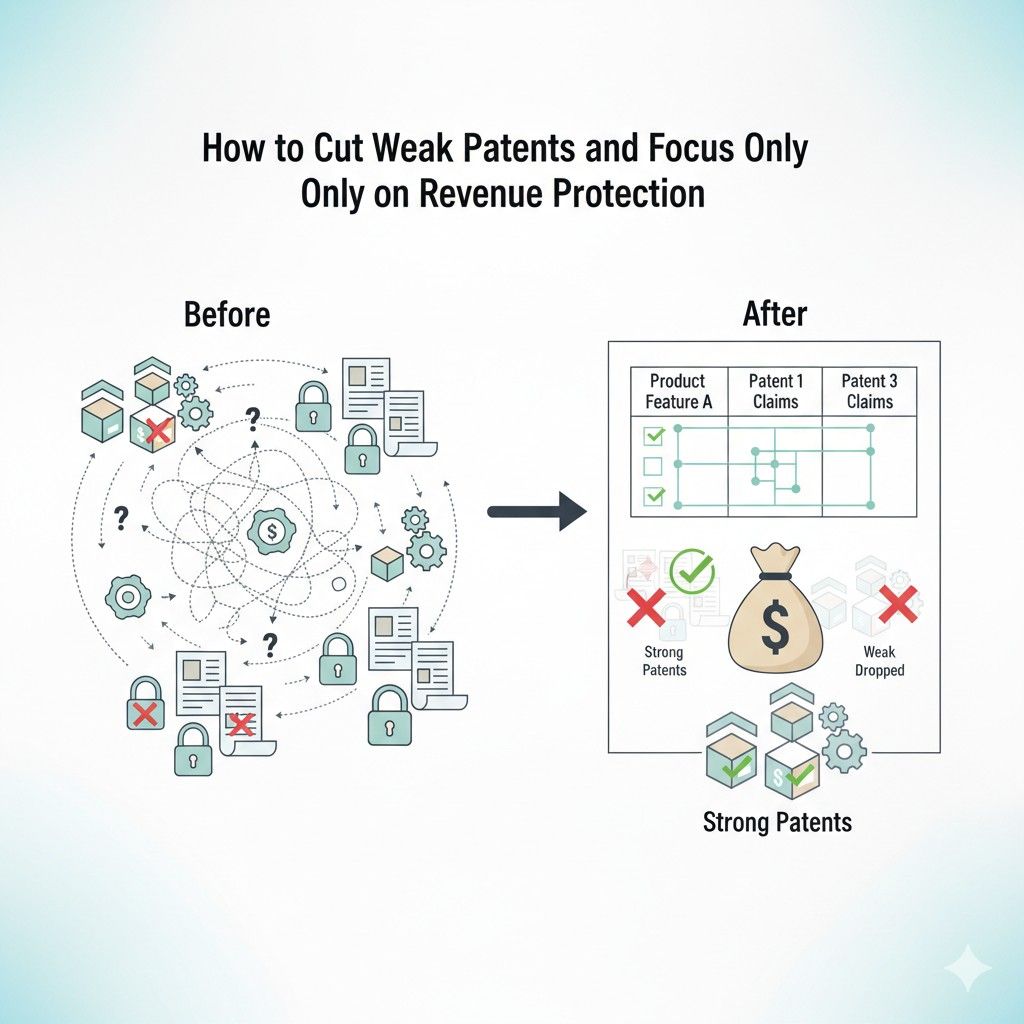
If the answer is no, continuing to pay maintenance fees or international costs may not be rational.
Letting go of weak patents is not failure. It is focus.
Re-Evaluate Every Patent Against Current Revenue Streams
Your company today is not the company you were two years ago.
Revenue drivers shift. Markets change. Features get replaced. New technical layers are added.
Every issued patent and pending application should be reviewed against current and projected revenue streams.
If a patent covers a feature that has been sunset, ask whether that feature will realistically return. If not, its strategic value likely declined.
If a patent protects a product line that no longer drives meaningful revenue, you must question ongoing investment.
This review should be honest and unemotional.
Distinguish Between Strategic and Emotional Attachment
Founders often feel proud of early inventions. Those ideas represent long nights and breakthrough moments.
But pride is not strategy.
Ask whether the invention still connects to your core product. Ask whether competitors could generate revenue without touching that patent.
If competitors can ignore the patent entirely and still compete effectively, its defensive value is weak.
IP strategy must be grounded in market reality, not history.
Look at Enforcement Practicality
Some patents technically align with old features but would be extremely hard to enforce.
Maybe proving infringement requires access to internal data that competitors will never disclose. Maybe the claim language is narrow and easy to design around.
If enforcement would be unrealistic or excessively costly relative to the revenue at stake, the patent may not justify long-term maintenance.
Strong patents are not only aligned with revenue. They are enforceable in practical terms.
During review, simulate a competitor scenario. If someone launched a similar feature tomorrow, would this patent give you real leverage? If not, its strategic weight drops.
Redirect Budget Toward High-Impact Areas
Every dollar spent maintaining weak patents is a dollar not spent strengthening critical coverage.
Once you identify patents that do not protect revenue, redirect resources.
Invest in continuation filings that deepen protection around your core engine. Expand claims in jurisdictions tied to growth markets. Strengthen new filings around upcoming revenue streams.
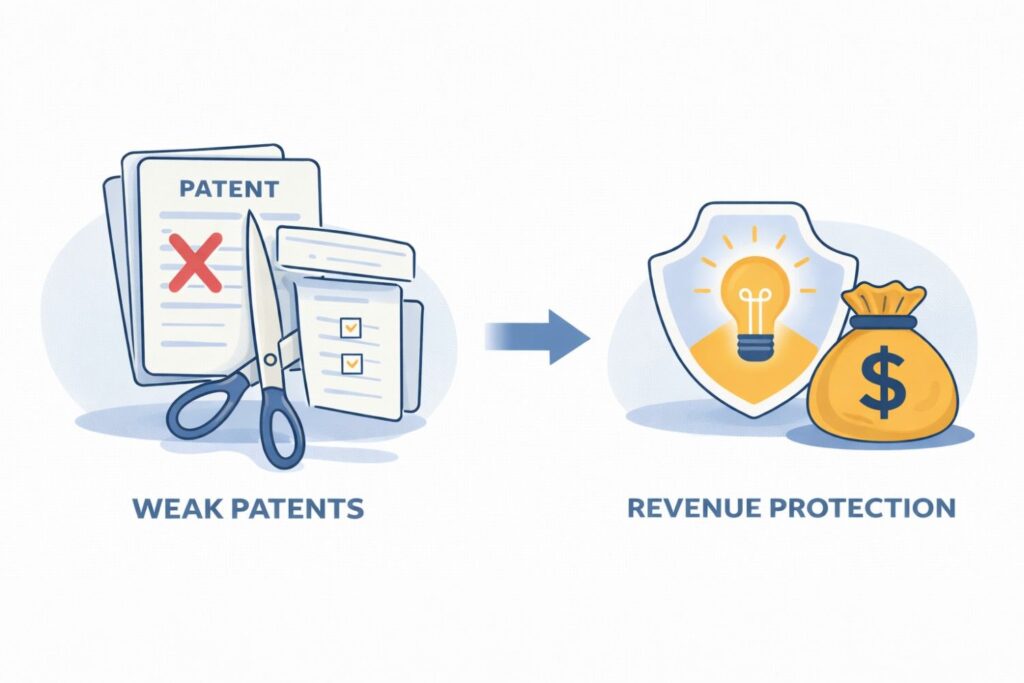
This reallocation improves portfolio density around what truly matters.
Instead of thin protection across many disconnected ideas, you build layered defense around revenue centers.
That density increases valuation and deterrence.
Align Patent Geography With Revenue Geography
Many companies file broadly early on without knowing where revenue will actually scale.
Over time, patterns become clear. Certain regions generate strong adoption. Others do not.
If you are paying to maintain patents in markets that no longer align with growth plans, reconsider that strategy.
Patent coverage should reflect expansion plans and customer concentration.
If your strongest enterprise traction is in specific regions, concentrate protection there.
Global filings should follow revenue strategy, not generic ambition.
Consolidate Around Core Technical Moats
As your mapping work becomes clearer, patterns will emerge.
You may see that multiple patents touch the same technical core. Some may be stronger. Some may be redundant.
Rather than maintaining fragmented coverage, consider focusing on a few well-structured patent families that deeply protect the core moat.
This layered approach is more intimidating to competitors than scattered filings.
It also simplifies management and messaging to investors.
When you can say, “Our core revenue engine is protected by a focused family of patents that cover implementation from multiple angles,” that carries weight.
Tie Portfolio Decisions to Product Roadmap
Cutting weak patents is not just about cleaning up the past. It is about supporting the future.
Look at your roadmap. Identify features expected to drive significant revenue over the next three to five years.
Ensure your strongest patent resources support those features.
If your roadmap includes new architecture, new AI layers, or new monetization structures, allocate budget toward protecting those areas early.
Forward alignment matters more than backward coverage.
Build a Repeatable Annual Review Process
Portfolio trimming should not be random. It should be systematic.
Set a yearly review where product, engineering, leadership, and legal meet to evaluate the portfolio.
Review revenue metrics. Review feature usage. Review geographic growth. Then assess each patent against those realities.
Document decisions clearly. Decide which patents to maintain aggressively, which to expand, and which to allow to lapse.
When this process becomes routine, IP management stops being reactive.
It becomes strategic.
Use Data, Not Guesswork
Modern startups track everything. User behavior. Conversion rates. Churn. Lifetime value.
Patent strategy should be just as data-driven.
If a feature drives high lifetime value, its protection priority increases.
If a product line sees declining adoption, its patent weight may decrease.
When IP decisions follow business data, they become rational and defensible.
This approach also strengthens investor trust. It shows that your portfolio is not vanity-driven but revenue-focused.
Replace “More Patents” With “Better Coverage”
The goal is not a large portfolio. The goal is strong coverage of what makes money.
When you cut weak patents, your total count may decrease. But your strategic strength increases.
You concentrate power where it counts.
Competitors face higher risk if they attempt to replicate your core value.
Investors see clarity instead of clutter.
Internal teams understand why certain technical areas are prioritized.
Focus always beats volume.
Make Revenue Protection the Default Standard
Going forward, every new patent idea should pass a simple filter.
Does this directly protect a current or clearly planned revenue stream?
If the answer is unclear, pause.
You may still choose to file for strategic reasons, but the decision should be deliberate, not automatic.
When revenue protection becomes the default lens, your portfolio evolves with discipline.
And when that process is supported by structured tools and real attorney insight, you avoid both over-filing and under-protecting.
If you want to build that kind of disciplined, revenue-first patent strategy without slowing down product development, see how PowerPatent combines smart software and real legal oversight to keep patents aligned with growth → https://powerpatent.com/how-it-works
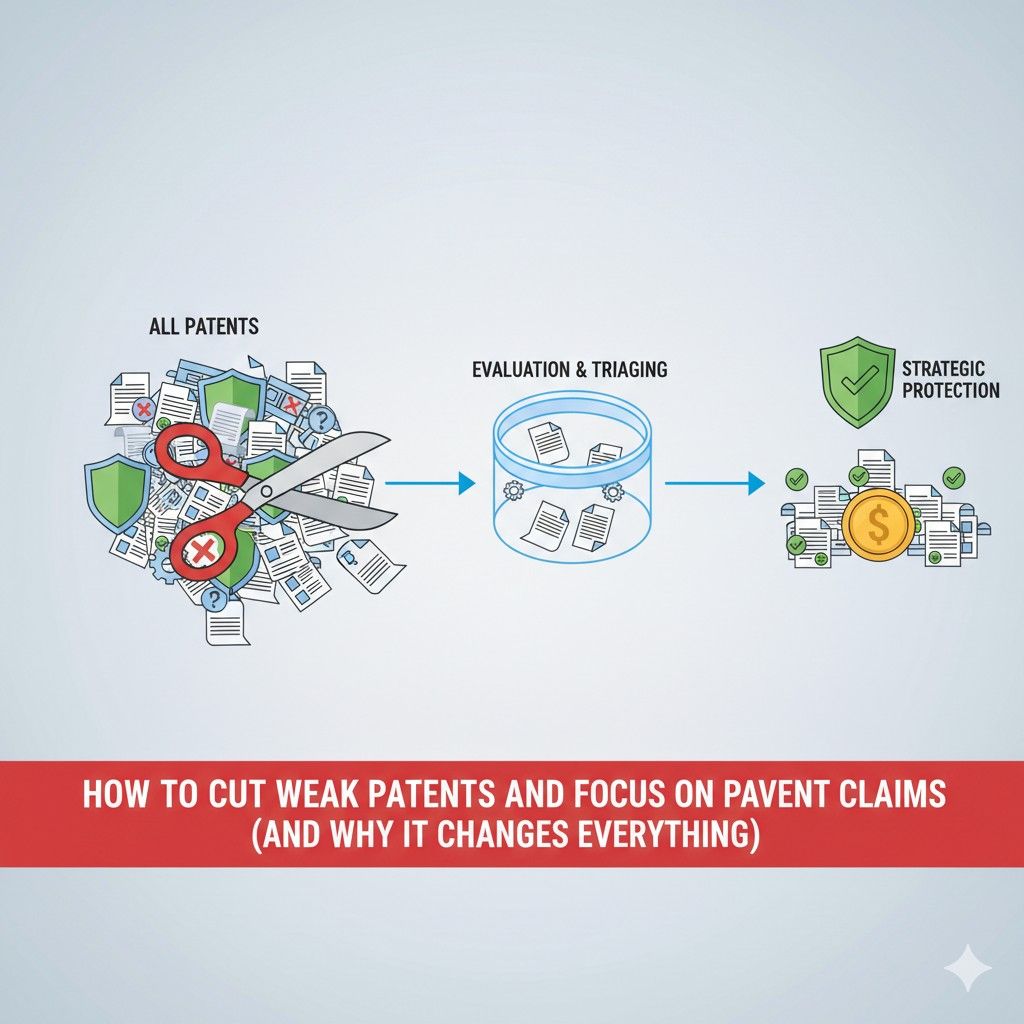
You now have the full framework: understand why most patents fail to protect revenue, map product features to claims with precision, and cut anything that does not support your financial engine.
This is how patents stop being paperwork and start being strategic assets.
Wrapping It Up
Patents should not exist for decoration. They should not exist for ego. They should not exist just to say you have them. They should exist to protect revenue. Product-to-claim mapping forces clarity. It forces discipline. It forces you to stop assuming and start verifying. When you connect real product behavior to real claim language, you finally see whether your IP is strong or just expensive. Most companies never look this closely. They file. They move on. They hope it is enough. But hope is not strategy.