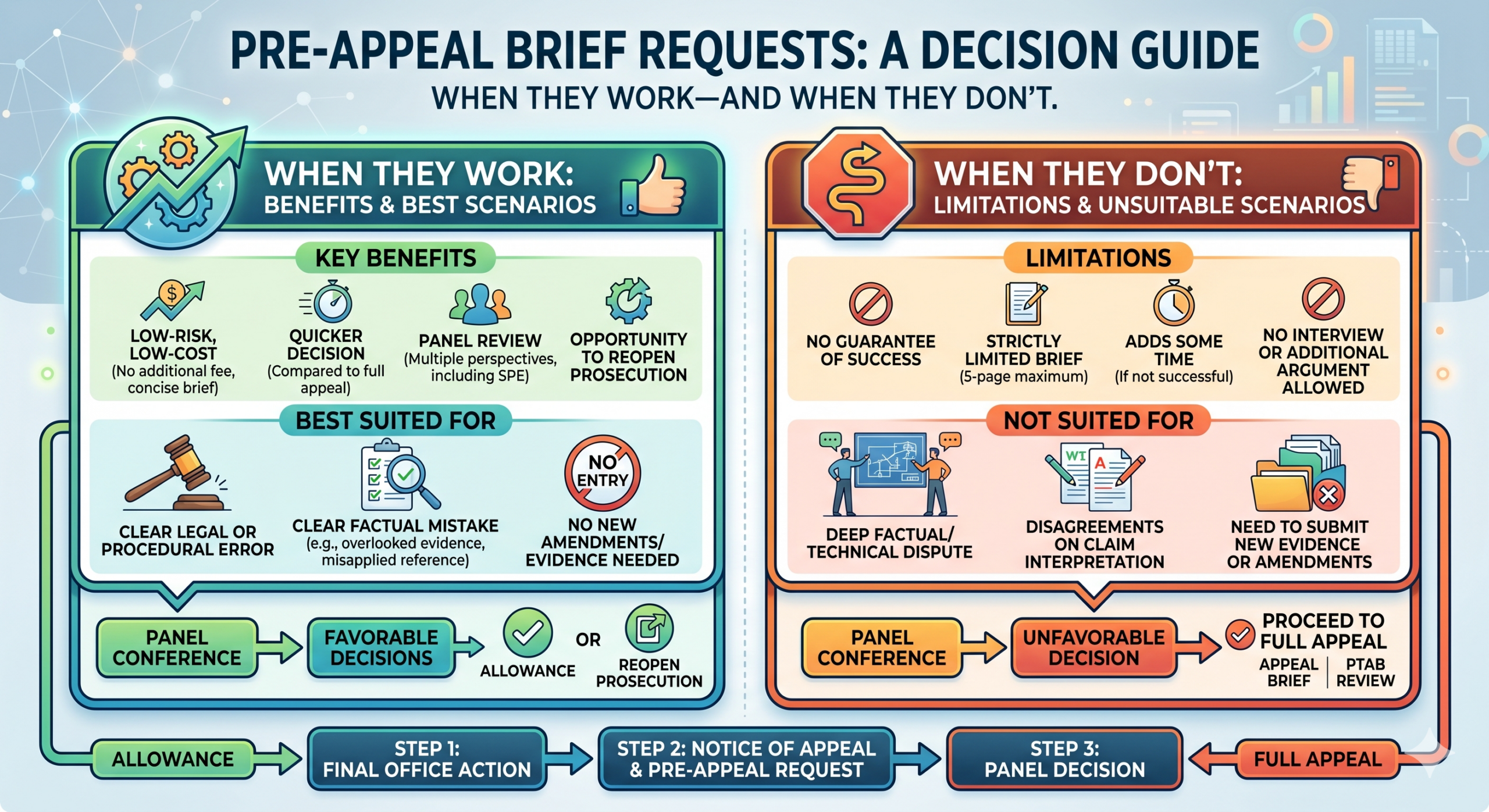
A pre-appeal brief request sounds like a small step. In the right case, it can be a smart move. It can stop a weak rejection before you spend time and money on a full appeal brief. It can also give your patent application a fresh look before things get more formal.
A pre-appeal brief request is not a full appeal, and that is the point.
A pre-appeal brief request is a short request that asks the Patent Office to take another look at a final rejection before you write a full appeal brief. It is not a long fight. It is not a new round of changes.
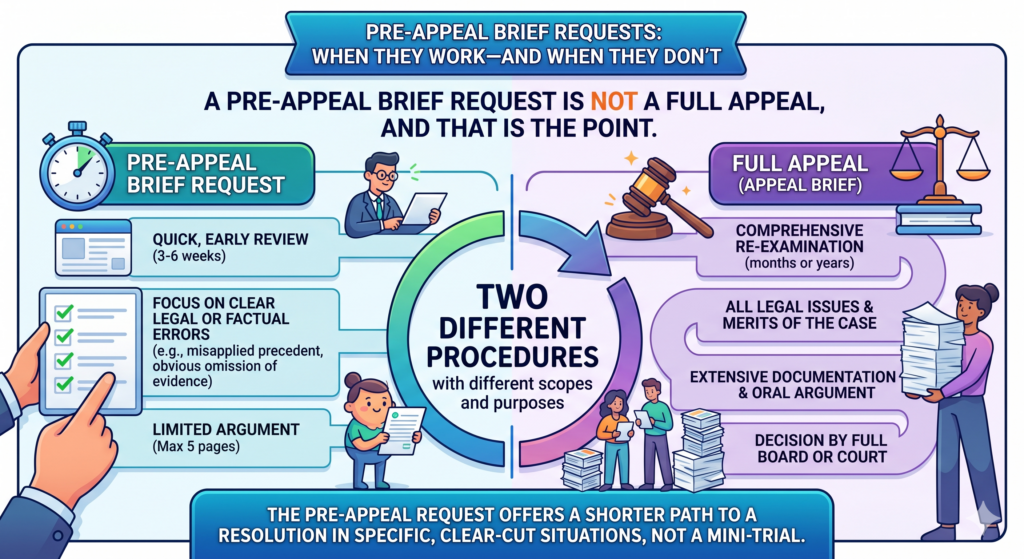
It is not a place to tell the full story of your startup, your product, or your market. It is a focused move used when you believe the rejection has a clear problem that should be fixed before the case goes deeper into appeal.
For founders, this matters because a full appeal can take real time and money. A pre-appeal request can sometimes cut through that.
The goal is simple: show that the rejection has a clear mistake, so a small review panel can decide whether the case should move forward, be reopened, or be allowed.
The request has to be filed at the right moment.
Timing is not flexible here. The request must be filed with the notice of appeal and before the appeal brief. The USPTO also says the request itself, not counting the form, may not be more than five pages.
It must stay short, focused, and based on issues that can be reviewed on appeal.
An amendment cannot be filed with the request. That means you do not use this tool to rewrite the claims while also asking for review. You use it to point to a problem already in the record.
This is where many teams get it wrong. They think the pre-appeal request is a softer way to keep talking with the examiner. It is not.
It is closer to saying, “The record already shows the rejection is not right, and here is the clean reason why.” That is why the best requests read like a clear map, not a debate.
The best pre-appeal request is narrow enough to make the mistake easy to see.
A strong request does not try to win every point. It picks the point that can change the outcome. If the examiner used a reference that does not teach the key feature, say that clearly.
If the examiner combined two references but never explained why a skilled person would do that, say that clearly. If the rejection skips a claim element, do not bury that issue under five other complaints.
This is where PowerPatent’s approach can help founders move faster. When your invention is mapped clearly from the start, it becomes easier to see which parts of the rejection are weak and which parts need more work.
PowerPatent combines smart software with real attorney oversight so teams can make sharper calls instead of guessing. You can see how that process works here: https://powerpatent.com/how-it-works
A pre-appeal brief request works when the error is clear from the written record.
The best cases for a pre-appeal request are the cases where the problem is already visible. You should not need new facts.
You should not need new test data. You should not need a long backstory. The request works best when the examiner’s own rejection, the cited patent papers, and your current claims show the issue.
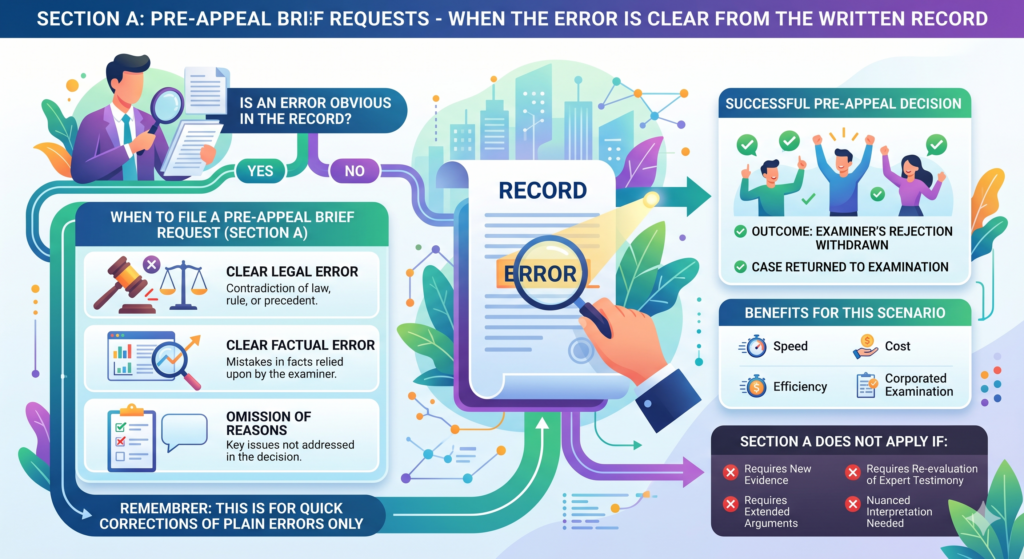
Think of it like asking a second set of eyes to check a math problem. If the examiner says two plus two equals five, the panel can see the problem fast.
But if the issue depends on a long business story, a new product demo, or a deep technical teaching that was never put into the record, a pre-appeal request is usually the wrong tool.
The cleanest wins often come from missing claim parts.
A very common strong case is when the examiner points to a prior patent or publication but that reference does not show every part of the claim.
In simple terms, the rejection says, “This old thing already has your invention,” but the old thing is missing a key piece.
That key piece must matter. It should not be a tiny wording issue. It should be a real part of how the invention works.
For example, if your claim requires a model to adjust based on live sensor feedback, and the cited reference only shows a fixed model trained once, that gap may be important. The request should make that gap easy to see.
The request should compare the claim to the cited reference without turning into a lecture.
Do not write like you are trying to impress someone. Write like you are trying to help a busy panel spot the problem fast.
State what the claim requires. State what the examiner cited. Then explain why the cited part does not match the claim. Keep the language direct.
For technical founders, this can feel strange. Engineers are trained to explain everything. But in this setting, too much detail can weaken the point.
You are not trying to teach the whole invention. You are trying to show that the rejection does not line up with the claim.
A good test is this: could someone understand the problem in three minutes? If yes, the pre-appeal request may be a strong fit.
If the answer is no, the case may need a full appeal brief, an interview, an amendment, or a different plan.
A pre-appeal brief request can work when the examiner’s logic has a simple break.
Not every rejection says one old reference has the whole invention. Many rejections are built by combining two or more references.
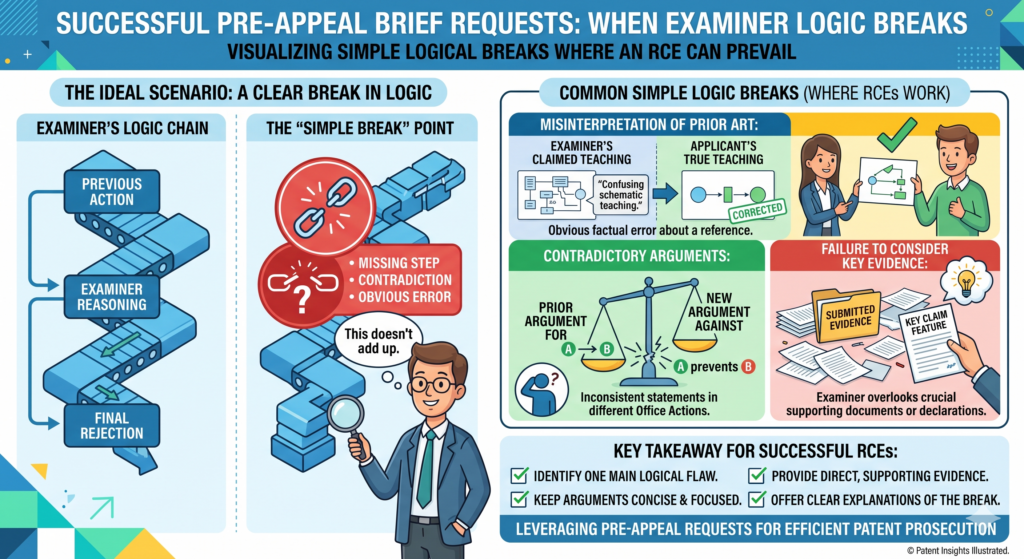
The examiner may say one reference teaches part of the claim, another reference teaches another part, and it would have been obvious to put them together.
That type of rejection can be valid in some cases. But it still needs a reason that makes sense. The examiner cannot just say, “These pieces exist, so they could be combined.”
There should be a clear reason why a person in that field would have made that combination in the way the claim requires.
The strongest attack is not that the invention is clever.
Founders often want to say, “No one had this idea before because it is hard.” That may be true, but it is often not enough.
The better argument is more exact. You want to show that the examiner’s stated reason for combining the references does not work.
For example, one reference may solve a speed problem, while another reference solves a privacy problem. If the examiner combines them in a way that hurts the purpose of one reference, that may be a clean issue.
Or one reference may require centralized control, while your claim requires local control at the edge. If the second reference does not fix that gap, the rejection may have a simple break.
The request should show the break in the chain, not retell the whole invention story.
A pre-appeal panel is not looking for a product pitch. It is looking at whether the rejection should stand. That means your request should stay close to the examiner’s words.
If the examiner gave three reasons, focus on the reason that fails. If the rejection depends on a feature being “similar,” explain why the actual claim needs something different.
This is where a startup can lose time by being too broad. The team may want to protect the big idea, so the argument becomes big too.
But patent work often turns on small, clear details. The sharper the detail, the better the chance the request gets taken seriously.
Before spending time on a full appeal brief, it can be useful to have your invention and claim chart reviewed in a structured way.
PowerPatent helps teams organize the invention, the claim language, and the examiner’s position so the next move is based on the real record, not hope. You can explore that workflow here: https://powerpatent.com/how-it-works
A pre-appeal brief request does not work well when the case needs new claim changes.
A pre-appeal request is not the place to fix the claim by changing it. That point is easy to miss, but it is very important.
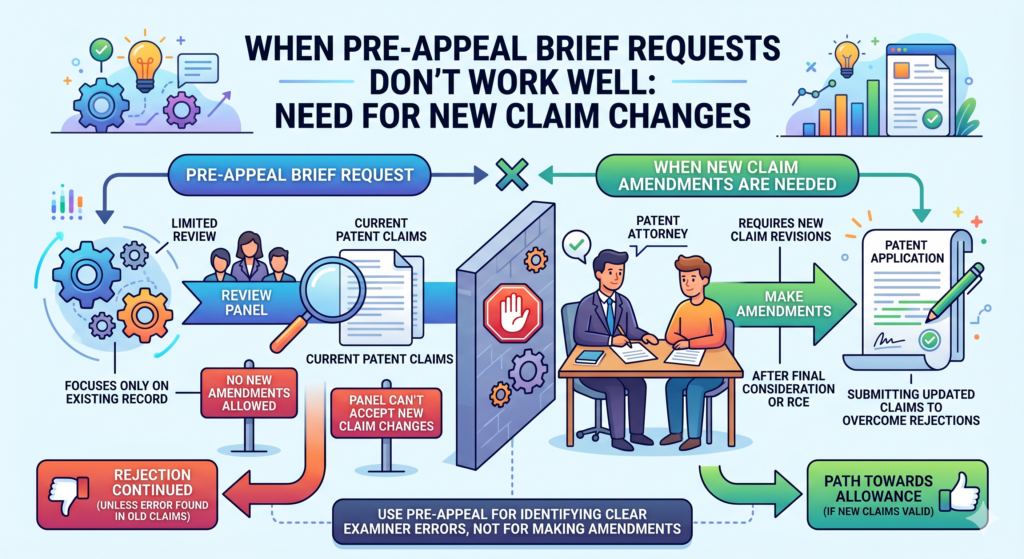
The USPTO’s rules for this program say an after-final amendment may not accompany the request. The official form also says no amendments are being filed with the request.
So if the real problem is that the claim is too broad, unclear, or missing a key limit, a pre-appeal request may not help.
The panel will review the rejection against the claims as they stand. If those claims still read too broadly, the panel may let the appeal continue. That can waste time.
A weak claim cannot be saved by a strong tone.
Some teams want to use a pre-appeal request because they are tired of the back-and-forth. That feeling is fair.
Patent work can feel slow, and founders do not want to spend months on wording while the product is changing. But frustration is not a strategy.
If the claims need work, the better move may be to file a request for continued examination, conduct a focused interview, or make a clean amendment.
The right move depends on the case. What matters is being honest about the problem. If the rejection is weak, push back. If the claim is weak, fix the claim.
The hard call is knowing whether to fight or adjust.
This is one of the most valuable decisions in patent work. A founder does not need a long legal speech. They need to know whether the current claim is worth defending.
That means looking at what the invention really is, what the prior art shows, and what claim scope still supports the business.
If the narrow version of the claim still protects the product and blocks likely copycats, an amendment may be smarter than appeal.
If the examiner is wrong and the claim already captures the invention well, appeal may be the right pressure point. If the issue is clear and short, a pre-appeal request may be the best first move.
This is why PowerPatent is built for modern technical teams. The goal is not to create more paperwork.
The goal is to help founders protect what matters with speed, control, and real attorney review. You can see how PowerPatent helps turn inventions into stronger patent filings here: https://powerpatent.com/how-it-works
A pre-appeal brief request works best when the panel can see the problem without guessing.
A good pre-appeal request does not ask the panel to imagine what your invention could become. It asks the panel to look at the claims, look at the rejection, look at the cited reference, and see a clear mismatch.
That is the heart of this tool. It is built for cases where the issue is already clean enough to review before a full appeal brief is filed.
The request is not meant to be a long story. The USPTO’s own form says the request is filed with a notice of appeal, says no amendments are being filed with it, and notes that the attached argument may be no more than five pages.
That tells you how focused this step is supposed to be. It is a short, record-based review, not a new round of claim drafting.
The best cases are often the ones where the examiner skipped something important.
When a claim has five required parts, the rejection must deal with those parts. If one part is missing from the reference, or if the examiner points to text that does not actually teach that part, the request may have real strength.
This comes up often in software, artificial intelligence, robotics, sensors, chips, clean tech, and other deep tech fields. The examiner may cite a broad system and say it teaches your claim.
But your claim may require a very specific step, timing rule, training method, control loop, device link, or data path. If that piece is missing, the gap should be made plain.
The winning move is to make the missing piece feel obvious.
Do not make the panel hunt. Show the claim language. Then show the examiner’s citation.
Then explain the gap in short, calm words. The point is not to sound angry. The point is to make the error easy to agree with.
A weak request says, “The examiner failed to understand the invention.” A stronger request says, “Claim 1 requires live sensor feedback to change the model during operation.
The cited paragraph describes training before operation and does not describe live sensor feedback changing the model during operation.” That second version gives the panel something solid to work with.
This is why founders should care about clear claim drafting from day one. When the claim is clean, the argument can be clean.
When the claim is messy, even a good invention can be hard to defend.
A pre-appeal brief request does not work well when the argument needs a long technical lesson.
Some inventions are hard to explain. That does not make them weak. In fact, many strong inventions are hard to explain because they solve deep problems in a new way.
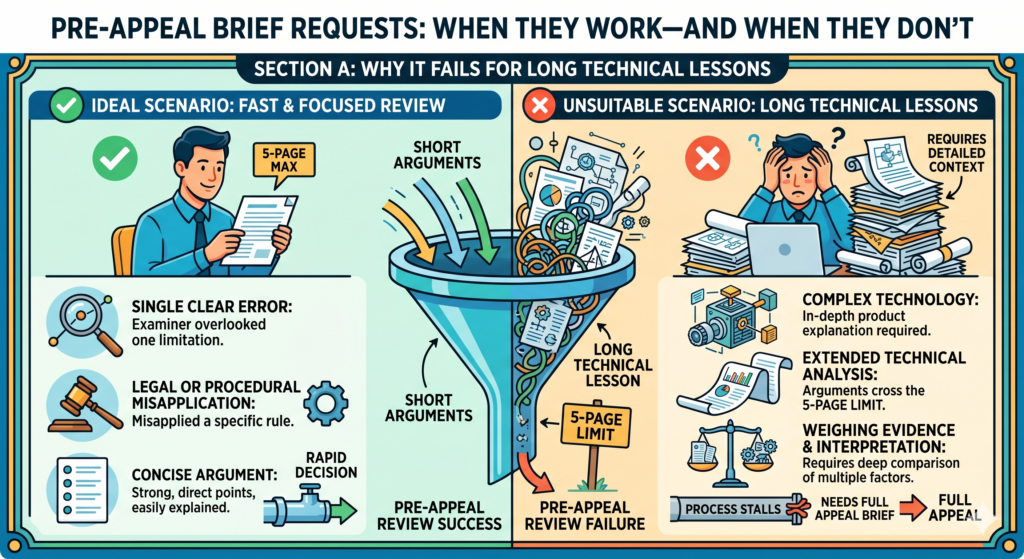
But a pre-appeal request may not be the best place to teach the full technical background.
This is where founders need to be honest about the job at hand. If the panel must understand ten pages of system design before it can see why the rejection is wrong, the request may be too small for the fight.
A full appeal brief gives more room to build the argument. A focused amendment may be even better if the claim can be sharpened without giving up too much value.
Long arguments can make a strong case look weaker than it is.
There is a real risk in squeezing a large argument into a small box. When too much is packed into a pre-appeal request, the key point can get buried.
The panel may see a dense debate and decide the case should continue to full appeal instead of being fixed right away.
That does not mean the request failed because the invention is bad. It may only mean the issue was not the kind of issue the pre-appeal process handles well. This is a tactical call, not a judgment on the value of the patent.
The better question is whether the mistake can be shown in one clean path.
Before filing, ask this simple question: can the core error be explained without teaching the entire invention? If yes, the request may be worth serious thought. If no, it may be better to use another path.
For example, if your claim turns on how a model updates based on user behavior over time, and the cited art only shows a static rule engine, that may be easy to explain.
But if your argument depends on a deep difference between two types of neural network training methods, and the claim language does not make that difference clear, you may need more than a pre-appeal request.
This is where PowerPatent can help technical teams avoid wasted moves. The platform helps organize the invention, the claims, and the rejection so a real attorney can see whether the next step should be pushback, claim changes, or a stronger appeal path. You can see how it works here: https://powerpatent.com/how-it-works
A pre-appeal brief request can be powerful when the examiner used the wrong reference in the wrong way.
Sometimes the issue is not just that a reference is missing one part. Sometimes the reference is being used for something it does not support. This can happen when a reference is close in topic but different in function.
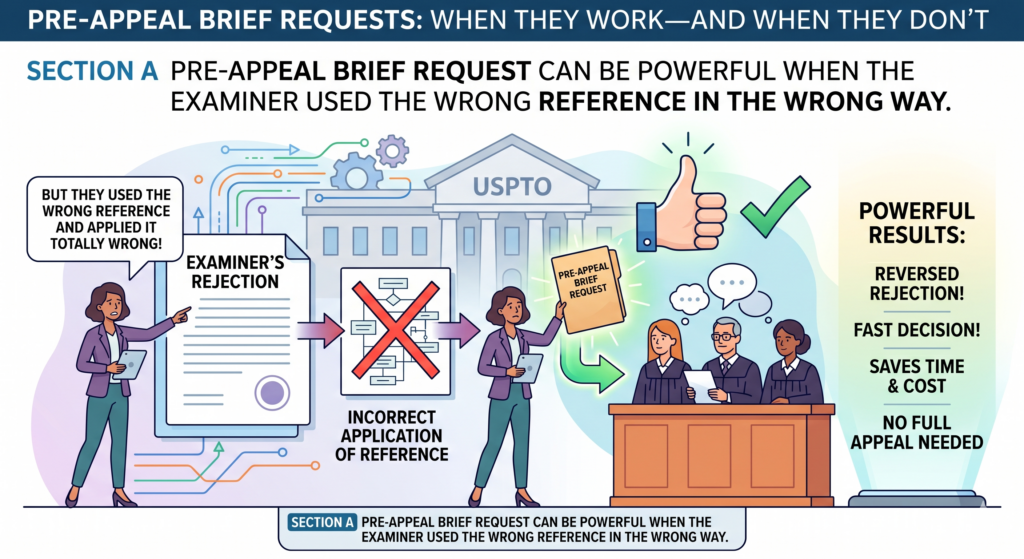
It may talk about the same industry, the same device type, or the same kind of data, but it may not teach the thing the examiner says it teaches.
That difference matters. Patent examination is not about whether an old paper sounds similar at a high level. It is about what the old paper actually shows and what the claim actually requires.
A broad match is not the same as a real match.
This problem is common in fast-moving fields. A prior reference may mention “machine learning,” “automation,” “cloud processing,” “image data,” or “optimization.”
But broad words do not always match a specific claim. A claim may require a special way of using data, a certain order of steps, a live update, a hardware link, or a safety check.
A strong pre-appeal request can point out that the examiner treated a broad word as if it covered the claimed feature. The tone should stay respectful. The writing should stay simple.
The panel should be able to see that the cited reference does not carry the weight the rejection places on it.
The strongest wording ties the error to the actual claim language.
Do not argue in loose terms. Do not say only that the reference is “different.” Say what the claim requires and why the cited part does not meet it.
For example, a claim may require that an edge device selects a model based on local power limits before sending results to a cloud system.
A cited reference may show a cloud system selecting a model after receiving data. Those systems may sound related, but they are not the same. The request should show the difference with care.
This is also why claim words matter so much. Small words like “before,” “after,” “based on,” “in response to,” and “at the device” can change the whole case. In deep tech patents, those words are not filler. They often define the real edge.
A pre-appeal brief request is weaker when the main problem is claim scope.
Claim scope means how much ground the claim covers. A broad claim can be valuable because it may cover more copycats.
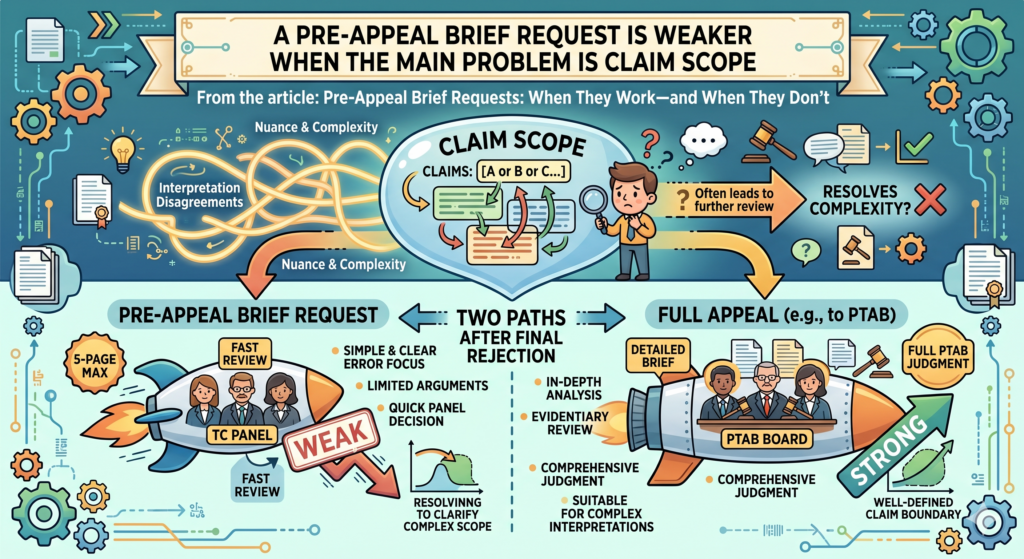
But a claim that is too broad can also be easier to reject. If the claim reaches far beyond the real invention, the examiner may find older references that fit the broad words.
This is one of the hardest parts of patent work for startups. Founders want strong protection, and they should.
But strong does not always mean broad in every direction. Strong means the claim covers what matters in a way that can survive review.
The wrong kind of broad claim can turn a good invention into a hard appeal.
A pre-appeal request is not a repair shop for overbroad claims. Since the request is filed without amendments, the panel reviews the claims as they stand. If the current claim language is broad enough to cover the prior art, the panel may not have a clean reason to help.
The MPEP section on appeals also explains that a notice of appeal is tied to the rejected claims, and appeal practice works from the record already made.
That means you should not use the request just because you dislike the rejection. You should use it when the rejection is clearly wrong under the current claim language.
If the claim itself is the reason the rejection is hard to beat, then changing the claim may be the smarter path.
A narrower claim can still be a very strong business asset.
This is where founders often pause. They worry that narrowing the claim means losing value.
Sometimes that is true. But often, a well-chosen narrow claim is far better than a broad claim that never gets allowed.
The right question is not, “Can we keep every word as broad as possible?” The better question is, “What claim would protect the product, block the most likely copycats, and still have a real chance of being allowed?”
That is a business question as much as a patent question.
For example, a startup building a novel AI pipeline may not need to claim every possible AI workflow.
It may need strong protection around its training loop, data filter, model update step, deployment method, or hardware-software link.
If those pieces are what make the product hard to copy, the claim should protect those pieces clearly.
PowerPatent is built around this kind of practical decision. It helps founders move from raw technical detail to stronger patent work with smart software and real attorney oversight, so the team is not left guessing which path protects the business best. Learn more here: https://powerpatent.com/how-it-works
A pre-appeal brief request can end in a few different ways, and each one changes your next move.
A founder should never file a pre-appeal brief request just to “see what happens.” That is too loose. Before you file, you should know what each possible result means for the business.
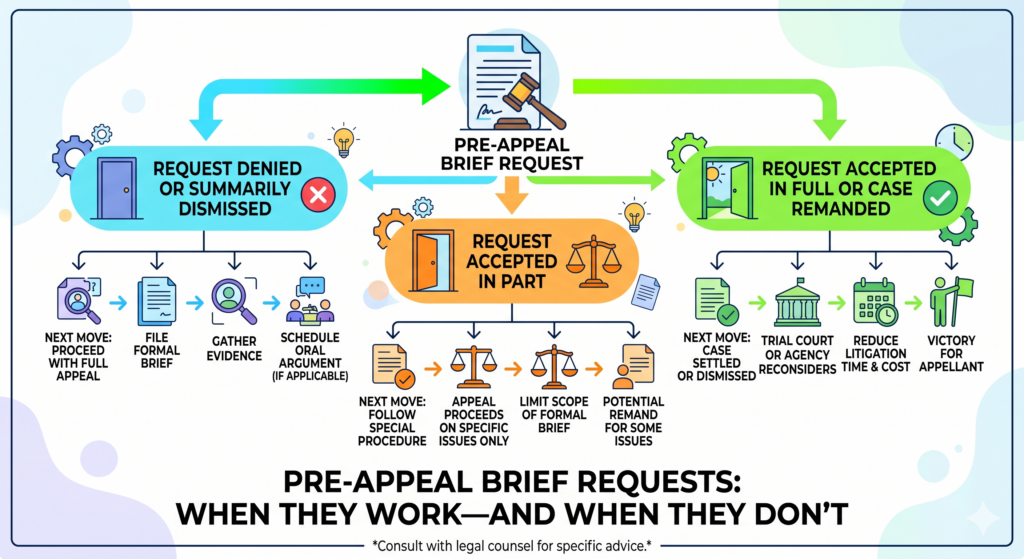
The result may help you move faster, but it may also tell you that the case needs a deeper strategy.
The USPTO form for this request makes the setup clear. The request is filed with a notice of appeal, no amendments are filed with it, and the written argument is limited to five pages.
That means you are asking for a focused review of the final rejection as it stands, not opening a wide new round of changes.
The best result is allowance, but that is not the only useful result.
The dream result is simple. The panel agrees that the rejection should not stand, and the application moves toward allowance.
That can happen, but founders should not plan as if it is the only good outcome.
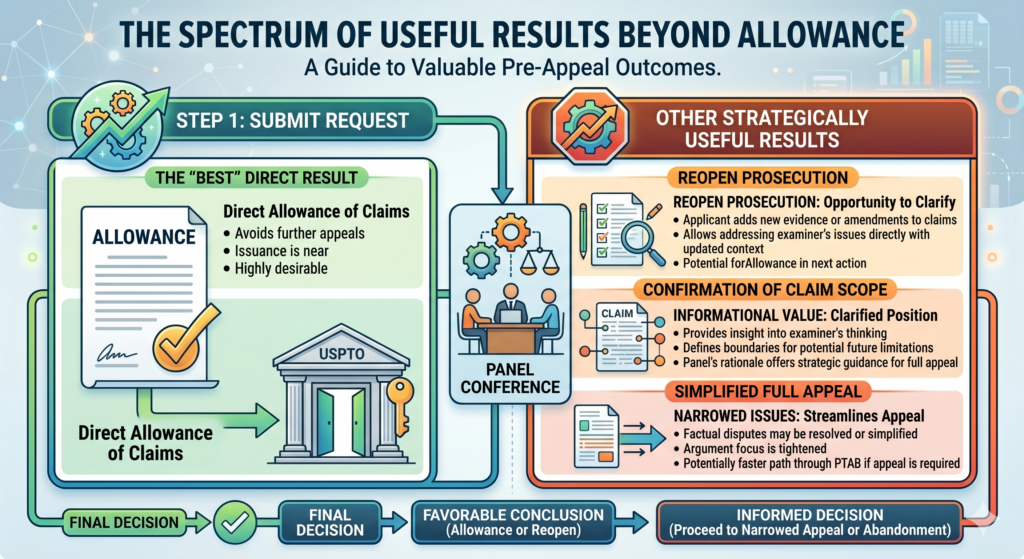
Another useful outcome is that prosecution is reopened. In plain words, the case goes back to the examiner instead of moving straight into a full appeal.
That may sound like a delay, but it can be a win when the rejection was weak or unclear.
Reopening can give your team a chance to respond to a new office action, make a cleaner record, or move the case closer to allowance without the cost and effort of a full appeal brief.
The “appeal must continue” result is not always a loss.
Sometimes the panel decides there is still an issue for appeal. That means your team must decide whether to file the appeal brief, file an RCE, adjust the claims, or take another path.
This can feel frustrating, but it gives you useful information. It tells you that the short-form argument did not end the dispute.
That is the moment to step back. Do not let sunk cost drive the next move. A founder may think, “We already filed the request, so now we should keep appealing.”
Maybe. But maybe the better move is to revise the claims and protect the product in a sharper way.
A good patent process is not about proving a point. It is about getting strong protection that supports the company.
PowerPatent helps founders make these calls with smart software and real attorney oversight, so the team can move with more confidence instead of reacting to each office action as a surprise. You can explore the process here: PowerPatent’s how-it-works page.
A pre-appeal brief request should not be used when you still need an examiner interview.
An interview can be very useful before appeal. It lets your attorney speak with the examiner, test possible claim changes, and find out what is really blocking allowance.
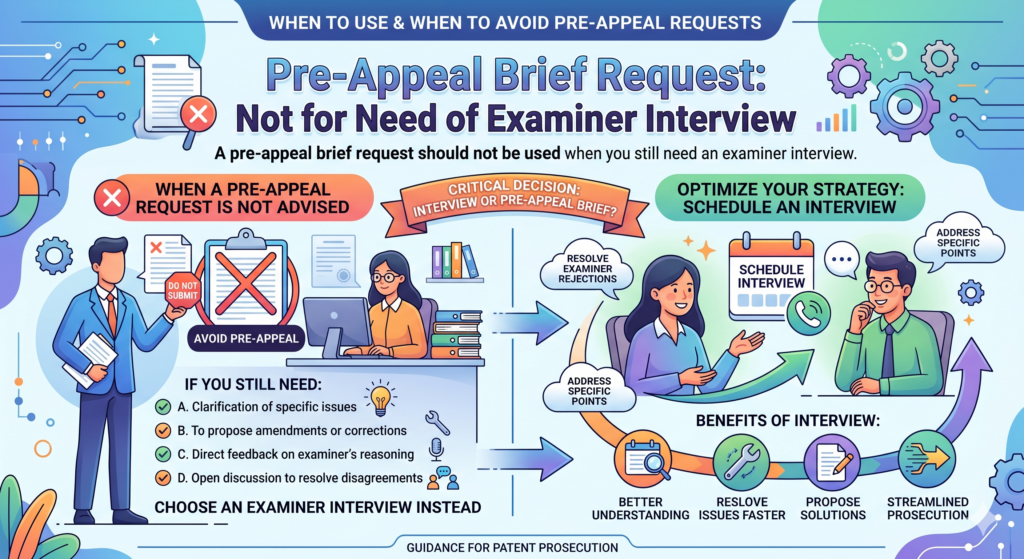
But once a pre-appeal request is filed, the timing changes. The MPEP says that no interviews will be granted from the filing of the pre-appeal request until a decision is issued on that request.
That rule matters because some cases need a live discussion before a written appeal step. A rejection may be confusing.
The examiner may be open to a narrow change. The claims may have several paths forward, and the best one may not be clear from the written record alone.
A good interview can save a bad appeal plan.
Before filing a pre-appeal request, ask whether a short talk with the examiner could change the path. Sometimes the examiner will point to the exact wording that would place the case in better shape.
Sometimes the examiner will explain that one claim is close, while another claim is still too broad. Sometimes the interview shows that the examiner’s position is firm and appeal pressure makes sense.
That information can be valuable. Filing a pre-appeal request too soon may cut off that chance for a while. That does not make the request bad. It only means timing matters.
The best sequence depends on how much you already know.
If the record is clean and the examiner’s error is clear, a pre-appeal request may be a strong next step.
If the record is muddy, an interview may come first. If the claims are not yet in the right shape, an amendment path may be better.
For a startup, this is not just legal housekeeping. It is product strategy. Your patent claims should line up with the parts of the product that matter most.
If the team still does not know which claim version protects the moat, a pre-appeal request may come too soon.
This is where founders can lose months. They keep pushing the same broad claim because it sounds stronger, while a more precise claim could protect the real product and move faster.
A clean attorney review, supported by well-organized technical detail, can help avoid that trap.
A strong pre-appeal brief request reads like a clear correction, not a complaint.
The tone of the request matters. The panel is not looking for anger. It is looking for a reason to change course.
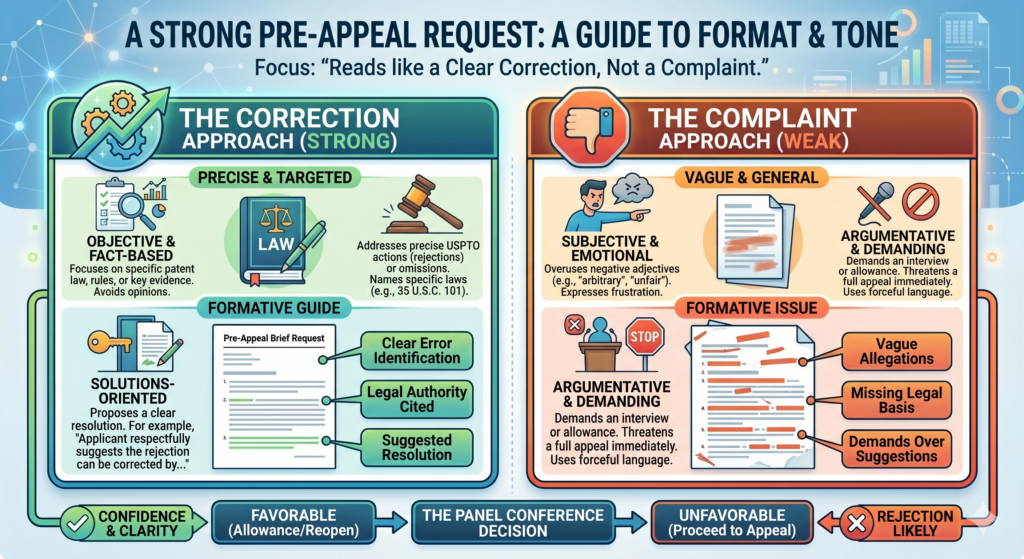
That means the writing should be calm, tight, and tied to the record. A good request does not say the examiner was careless. It shows why the rejection does not match the claim.
This is a small writing task with high stakes. The request has limited space, so every sentence needs to work.
There is no room for long background, soft claims, or broad statements about how new the product is.
The first job is to frame the exact error.
A strong request starts by naming the issue in simple terms. The examiner relied on a reference that does not teach a required claim element. The examiner combined references without a sound reason.
The examiner treated two different steps as the same step. The examiner used a broad label in the reference as if it matched a specific technical feature in the claim.
That kind of framing gives the panel a handle. It makes the dispute easier to review. The less work the panel must do to understand the problem, the better.
The best sentence is often the simplest sentence.
Here is the style that works best: the claim requires one thing, the cited reference shows another thing, and the rejection does not explain the gap. That is not fancy, but it is strong.
For example, do not write, “The cited art fails to appreciate the inventive nature of the applicant’s novel distributed intelligence architecture.” That sounds big, but it does not help much.
A stronger version is, “Claim 1 requires the edge device to select the model before sending data to the server. The cited paragraph describes the server selecting the model after receiving the data.”
That kind of sentence is hard to ignore because it is concrete. It lets the panel check the claim and the cited text right away. The best pre-appeal requests are built from sentences like that.
Founders often think patent writing needs to sound complex. It does not. Clear is stronger than complex. Clear writing makes the invention easier to protect, easier to review, and easier to enforce later.
That is one reason PowerPatent focuses on turning technical input into organized patent work with real attorney oversight. The goal is not more words. The goal is better protection with less friction.
A pre-appeal brief request works best when it protects business speed, not just legal pride.
A patent application is not an academic paper. It is part of a company’s plan.
For a startup, the right patent move should support fundraising, product growth, partner talks, and long-term defense. That means the pre-appeal decision should not be made in isolation.
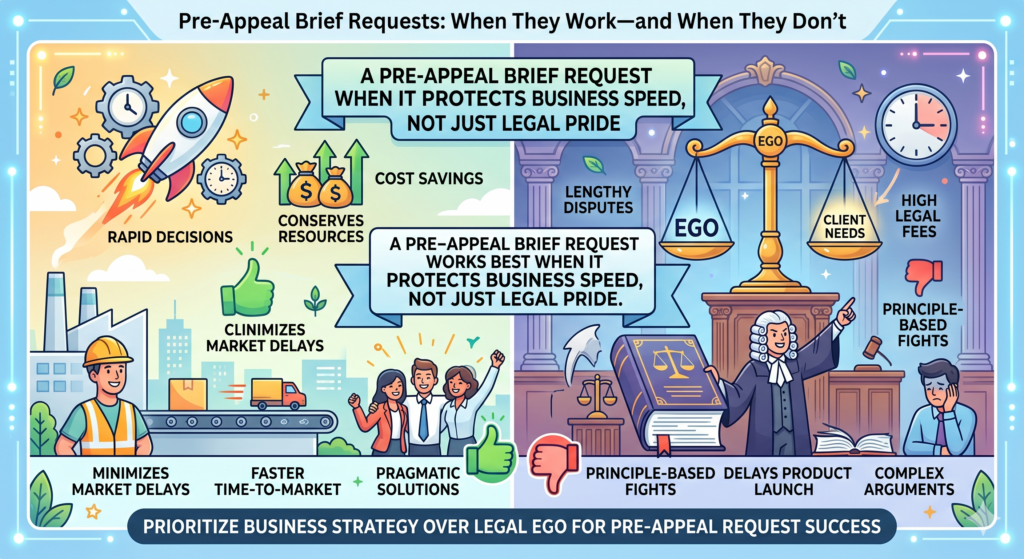
Sometimes fighting the rejection is the right call. Sometimes changing the claim is smarter.
Sometimes filing a continuation is the better way to keep broader protection alive while moving one version of the case toward allowance. The best path depends on what the company needs the patent to do.
The right question is what outcome helps the company now.
A founder may care about speed because investors want to see progress. A founder may care about scope because a competitor is circling the same space.
A founder may care about cost because the company is still small and every dollar matters. These are real concerns, and they should shape the patent strategy.
A pre-appeal request can be useful when it gives the case a chance to move forward without the weight of a full appeal.
It can also be useful when it puts pressure on a weak rejection and forces a better review. But it is not always the lowest-cost path if the claims need changes anyway.
The strongest strategy connects the patent move to the product moat.
Before filing, ask what the company must protect. Is it the way the model is trained? Is it the device that collects the data? Is it the control loop?
Is it the user workflow? Is it the data filter, the chip layout, the battery method, the robotic motion path, or the safety rule?
Once that answer is clear, the appeal decision becomes sharper. If the rejected claim protects that core moat and the rejection is clearly wrong, a pre-appeal request may be worth it.
If the claim misses the moat or covers it in a weak way, the better move may be to rebuild the claim strategy.
This is why founders should not treat patents as paperwork pushed to the side.
A strong patent can help protect the thing that makes the company hard to copy. A weak patent path can drain time and still leave the real edge exposed.
PowerPatent gives founders a better way to move from invention to filing to prosecution strategy, with software that helps organize the work and real attorneys who help guide the hard calls. See how it works here: PowerPatent’s how-it-works page.
A pre-appeal brief request is strongest when the case is already clean.
A clean case does not mean the invention is simple. It means the record is easy to read. The claims say what matters.
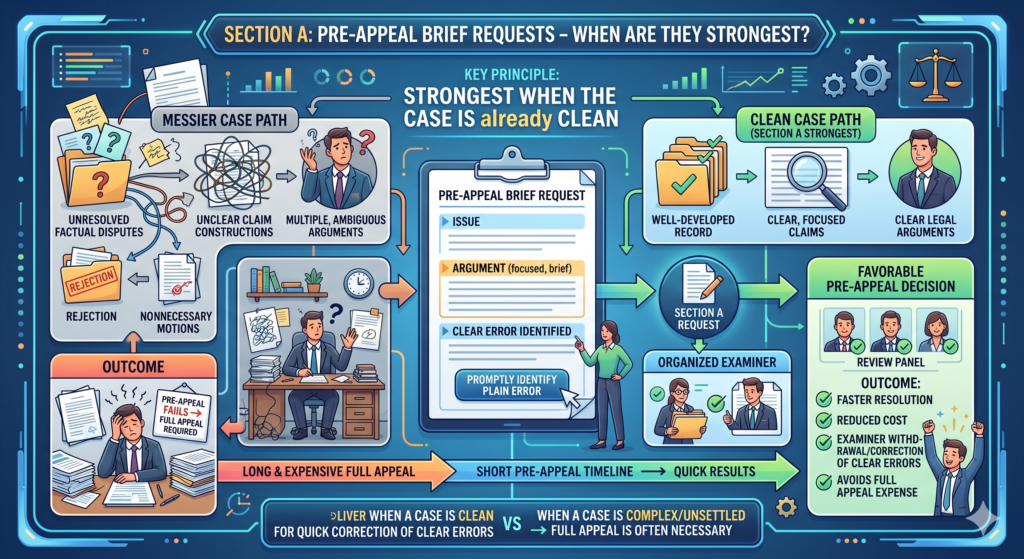
The examiner’s rejection is clear. The cited reference is easy to compare against the claim. When those pieces line up, a pre-appeal request can do its job well.
This matters because the request is short by design.
The USPTO’s current request form says the request is filed with the notice of appeal, no amendments are filed with it, and the attached argument may be no more than five pages.
That setup favors focused issues, not long repair work.
A messy record makes a short request harder to win.
A messy record can have many causes. Maybe the claims changed several times. Maybe the examiner relied on different parts of different references.
Maybe the last response argued too many points at once. Maybe the invention was not explained in a way that tied back to the claim language.
When that happens, a pre-appeal request can become risky. The panel may not see one clear error.
Instead, it may see a complex dispute that belongs in a full appeal brief. That does not mean the case is bad. It means the short path may not be strong enough.
A founder should ask whether the record tells one clear story.
Before filing, read the final rejection like a stranger. Then read the claims. Then ask whether the error jumps out.
If the answer is yes, the request may be useful. If the answer is no, the team may need to clean up the record first.
This is where founders should avoid ego. The goal is not to prove the examiner wrong at any cost. The goal is to get useful patent protection with the least wasted motion.
Sometimes that means a pre-appeal request. Sometimes that means an interview, an RCE, a continuation, or a better claim set.
PowerPatent helps teams make this decision with more structure. The software helps organize the invention and the patent record, while real attorneys help guide the strategy.
That gives founders a clearer path than guessing from office action to office action. Learn how it works here: https://powerpatent.com/how-it-works
A pre-appeal brief request should not be used to introduce a new story.
A pre-appeal request is not the right place to bring in a brand-new theory. It is also not the right place to explain a new product angle that was never tied to the claims.
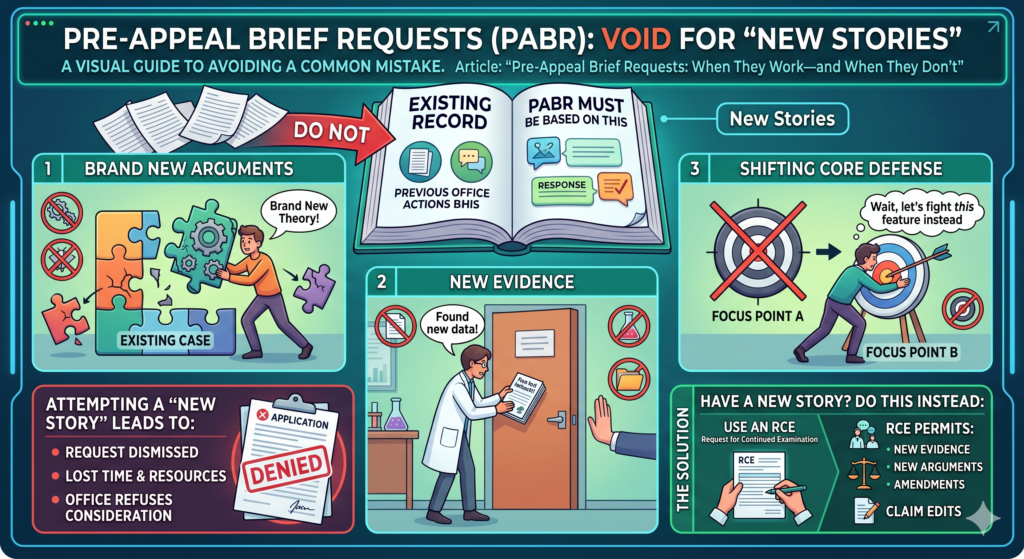
The panel is reviewing the rejection based on the record. If your best point was not already built into the claims or earlier responses, the request may not have enough to work with.
This is a common startup problem. The product moves fast. The patent application may describe one version.
The team may now see the invention in a sharper way. That is normal. But a pre-appeal request is usually not the best place to rebuild the story from scratch.
New insight is useful, but it must be used in the right tool.
A founder may realize late in prosecution that the true value is not the broad platform, but one key step inside the platform. Maybe it is a special way to rank data.
Maybe it is a timing rule. Maybe it is a safety check. Maybe it is a control method that makes the system cheaper, faster, or more reliable.
That insight can be very valuable. But if the current claims do not clearly cover that feature, the right move may be new claim drafting, not pre-appeal.
The request reviews what is already there. It does not let you rewrite the case while asking for review.
The best patent strategy leaves room for product learning.
Startups learn as they build. That is why patent strategy should not be frozen on day one.
A strong first filing should capture the invention well, but later prosecution should also account for what the team learns from users, tests, partners, and market pressure.
This is where continuation planning can matter. One application may be pushed toward allowance with focused claims, while another may keep room for broader or later-evolving claim sets.
That way, the company does not have to place every bet on one appeal path.
The key is to avoid using the wrong tool for the right problem. If the issue is a clear examiner error, a pre-appeal request can be sharp.
If the issue is that the patent story has changed, the better move may be to reshape the claim plan.
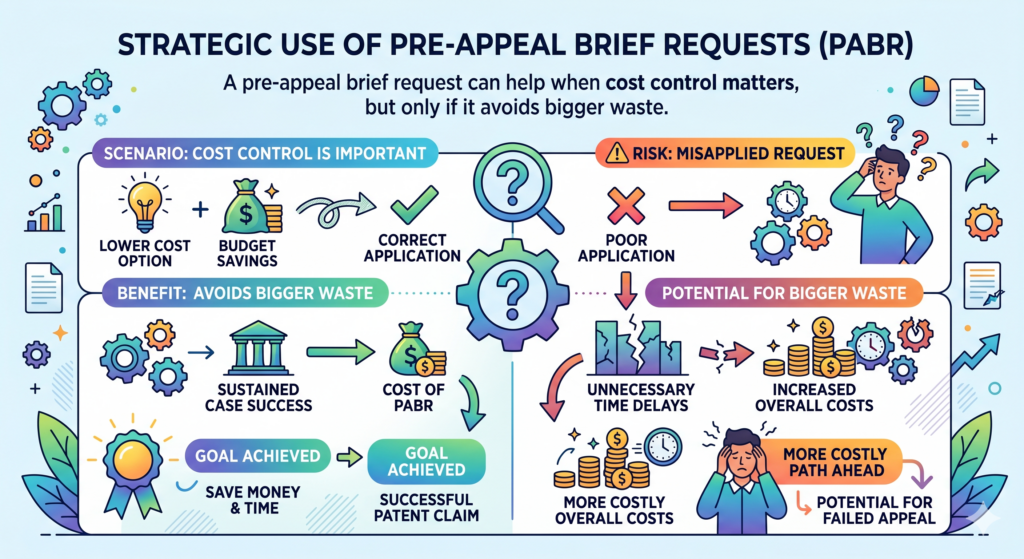
A pre-appeal brief request can help when cost control matters, but only if it avoids bigger waste.
Startups care about cost because they have to. Every dollar used on patent work is a dollar not used on hiring, product, sales, or runway.
That does not mean patents should be cheap at all costs. It means each patent move should earn its place.
A pre-appeal request can be attractive because it may avoid the work of a full appeal brief.
But the savings are real only if the request has a fair chance of changing the path. A low-quality request can add cost without moving the case forward.
The cheapest move is not always the lowest-risk move.
Founders sometimes choose a pre-appeal request because it feels smaller than a full appeal. That may be true. But smaller is not always smarter.
If the case needs claim changes, a request may delay the real fix. If the record is unclear, the request may fail and leave the team in the same place.
If the invention needs a broader strategy, the short request may only treat a symptom.
The smarter cost question is this: what move gives the company the best chance of stronger protection with the least waste? That question is more useful than asking which filing is cheaper today.
A strong request should reduce uncertainty, not create more of it.
A good pre-appeal request should make the next step clearer. If it leads to allowance, that is clear.
If it reopens prosecution, that can also be useful. If it confirms that appeal must continue, the team at least knows the short argument did not end the dispute.
But a weak request can create fog. The team spends money, loses time, and still does not know whether the claim is worth defending.
That is why the request should be filed only after a serious read of the claim, the rejection, and the business goal.
PowerPatent is built to help founders make those calls earlier. Instead of waiting until prosecution becomes painful, teams can organize their invention, see what matters, and work with real patent attorneys through a faster, more modern process. See the process here: https://powerpatent.com/how-it-works
A pre-appeal brief request should be written for a busy panel, not for your future press release.
The people reviewing the request are not judging your startup’s vision. They are not deciding whether your market is exciting.
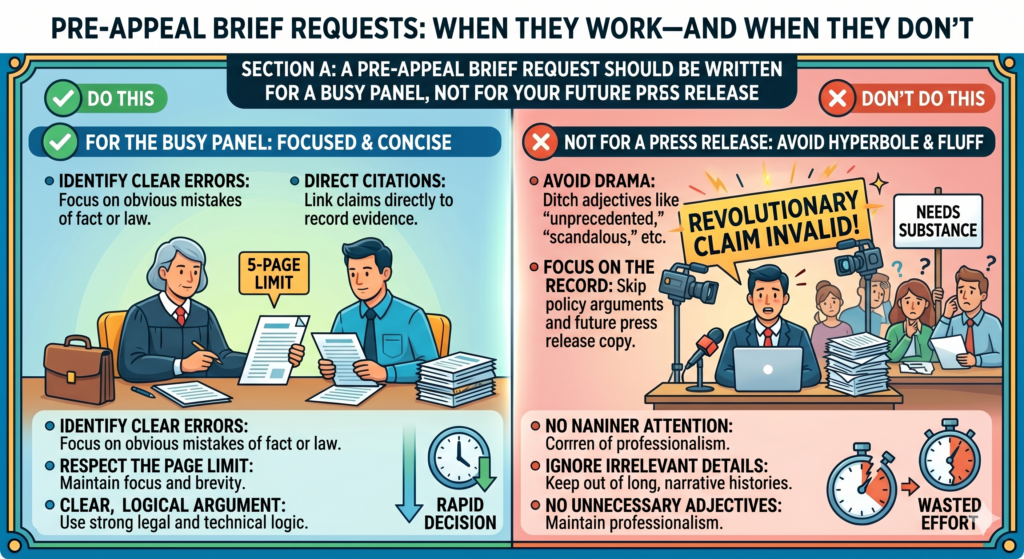
They are not reading your deck. They are checking whether the final rejection has a clear problem that should be corrected before a full appeal brief.
That means the writing must be plain. It should not sound like a product launch. It should not sound like a research paper.
It should sound like a careful correction written by someone who respects the process and knows the record.
The best request removes every sentence that does not help the decision.
Space is limited, so every line must matter. A sentence that explains the claim can help. A sentence that compares the claim to the cited reference can help.
A sentence that shows why the examiner’s reasoning breaks can help. But long background about the industry usually does not help.
This is hard for technical founders because the invention may have taken years to build.
The team wants the reviewer to understand the full journey. But the request is not about the journey. It is about the rejection.
A simple structure makes the argument easier to accept.
The cleanest request often follows a natural flow. It starts with the exact claim feature at issue. It states how the examiner treated that feature.
It then shows why the cited reference or reasoning does not support the rejection. The argument stays close to the record and avoids emotional language.
For example, the request should not say, “The examiner ignored the unique architecture of the applicant’s platform.” That sounds broad and hard to verify.
It is better to say, “Claim 1 requires the device to perform the selection before sending the data. The cited passage describes selection after the server receives the data.”
That kind of writing works because it is easy to check. It does not ask the panel to trust your view of the invention. It points to the claim and the citation, then lets the mismatch speak.
This is also how strong patent work should feel from the start. Clear input. Clear claim strategy. Clear attorney review. Clear next steps.
PowerPatent helps founders move that way, so patents feel less like a slow maze and more like a useful part of building the company.
A pre-appeal brief request can help when the examiner’s position keeps moving.
One of the most frustrating parts of patent prosecution is when the reason for rejection seems to shift. The first office action may say one thing. The final rejection may lean on a different paragraph.
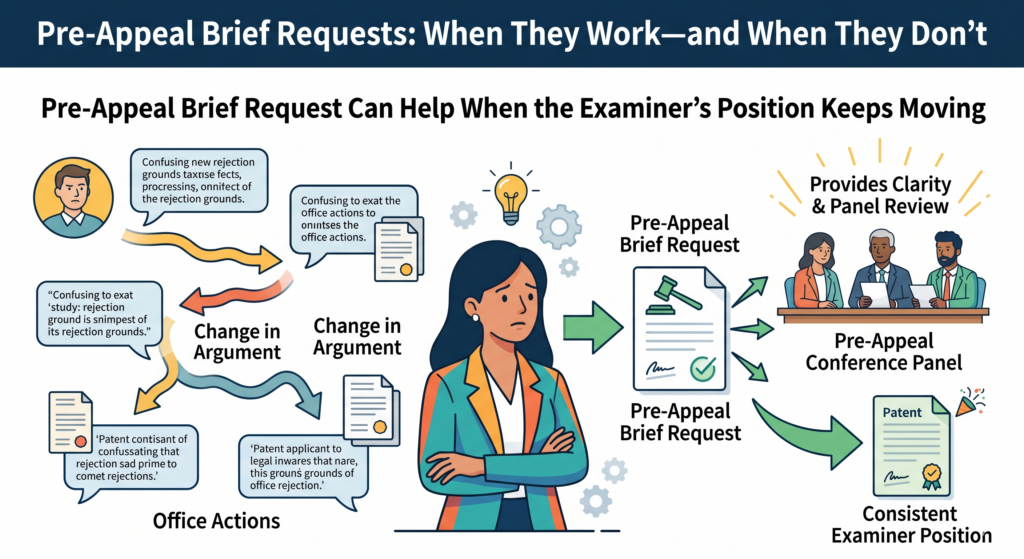
The examiner’s answer, if the case reaches that stage, may sharpen the point again. For a founder, this can feel like trying to hit a moving target.
A pre-appeal brief request can sometimes help when the final rejection rests on a position that is not well supported.
It gives a small review panel a chance to look at whether the rejection is ready for appeal or whether the case should be reopened.
The USPTO’s MPEP explains that, while the program remains in effect, filing a pre-appeal review request may extend the time to file the appeal brief until a decision is made or the request is dismissed.
A moving rejection is different from a hard rejection.
A hard rejection may still be clear. The examiner may be wrong, but at least the issue is stable. A moving rejection is harder because it can hide the real disagreement.
One day the issue is one claim feature. The next day it is another. That makes it difficult for the applicant to know whether to amend, argue, appeal, or file a continuation.
This is where the pre-appeal request can be useful. It can force the review to focus on the final rejection as written.
If that rejection does not clearly support the examiner’s position, the request can point that out in a calm and direct way.
The request should not accuse the examiner of changing the rules.
The better move is to show the mismatch. Say what the final rejection relies on. Then say why that relied-on part does not support the claim rejection.
Do not turn the request into a history of every disagreement in the case unless that history is needed to show the problem.
For example, a weak request might say, “The examiner has repeatedly failed to understand the applicant’s technology.” That feels personal and vague.
A stronger request says, “The final rejection now relies on paragraph 42 for the claimed local ranking step, but paragraph 42 describes ranking at the server after upload and does not describe local ranking before upload.”
That is the kind of point a panel can check. It is respectful. It is short. It is grounded in the record. Most of all, it gives the reviewer a clean reason to act.
A pre-appeal brief request is a poor fit when the main issue is enablement or written support.
Some rejections are about whether the claimed invention is new or obvious over older work. Other rejections are about whether the patent application itself supports the claim well enough.
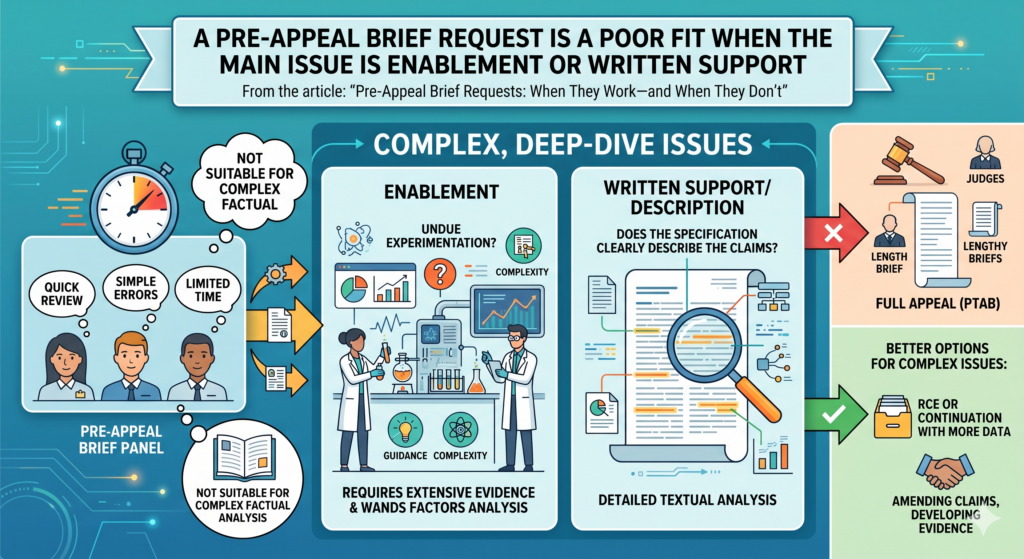
Those support issues can be harder to handle in a pre-appeal request, especially if the answer depends on a deep reading of the full specification.
This does not mean a pre-appeal request can never be used for those issues. It means the request is usually strongest when the support point is simple.
If the examiner says the application does not describe a feature, and the application clearly describes that exact feature in a cited passage, a short request may work.
But if the dispute turns on what a skilled person would understand from several pages of technical detail, a full appeal brief may be better.
Support issues often need more room than five pages.
The official pre-appeal request form states that the argument attached to the request may not be more than five pages and that no amendments are filed with the request.
That page limit tells you what kind of tool this is. It is built for focused errors, not for long technical showings or new claim repairs.
When the issue is written support, the best argument may require walking through the application, the drawings, the examples, and the claim terms.
That can take space. Trying to compress it too much may weaken the point.
A support rejection should make the team recheck the original filing.
For founders, this is a bigger lesson. Many patent problems start much earlier than the final rejection. If the first filing did not capture enough technical detail, later claim work becomes harder.
You may have built a great product, but the patent office reviews what the application says, not what the team later remembers.
That is why a strong first filing matters so much. It should explain the invention clearly, include practical examples, and leave room for future claim paths.
This is especially important for AI, robotics, chips, medical devices, energy systems, and other fields where the details change fast.
PowerPatent helps founders capture the invention in a structured way before key details get lost.
The platform combines smart software with real attorney oversight, so the first filing is not just fast, but also built with future prosecution in mind. You can see how that works here: https://powerpatent.com/how-it-works
A pre-appeal brief request can work when the examiner treats two different things as the same thing.
This is one of the most common and most useful pre-appeal arguments. The examiner may say a reference teaches the claim because the reference uses a similar word.
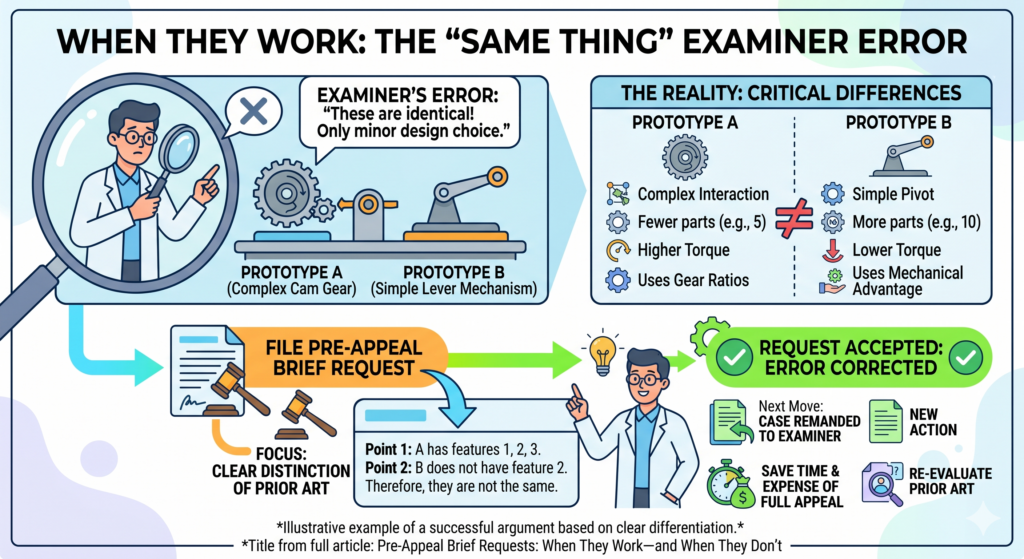
But similar words are not always the same thing. In technology, the difference between two steps can be the whole invention.
A claim may require training a model, while the reference only uses a trained model. A claim may require filtering data before encryption, while the reference filters after storage.
A claim may require the device to make a decision, while the reference has a remote server make that decision. These differences may sound small to a non-technical reader, but they can define the core invention.
The strongest request explains the difference in everyday words.
Do not assume the panel will see the difference just because the words are different. Explain why the difference matters to the claim.
Keep it simple. Do not turn it into a lecture. The goal is to make the technical gap feel clear.
For example, instead of saying, “The cited system is architecturally distinct from the claimed distributed inferencing arrangement,” write something clearer.
Say, “The claim requires the edge device to choose the model. The cited system has the server choose the model. Those are different decision points.”
That kind of writing is not less smart. It is more useful. Clear words help the reviewer see the error without working hard.
The key is to tie the difference to a claim requirement.
A technical difference only matters if the claim requires it. This is where many startup teams get off track. They argue that their product is different from the reference.
But the panel is not comparing the product to the reference. It is comparing the claim to the rejection.
That means the request should not drift into product details that are not in the claim.
If the product has a smart feature but the claim does not include it, that feature may not help the pre-appeal request. The fix may be claim strategy, not argument.
This is also why founders should not wait until a rejection arrives to think about claim language. The words in the claim decide what can be defended.
A strong invention with weak claim wording is harder to protect. A strong invention with clear claim wording gives your attorney better tools at every stage.
A pre-appeal brief request should be part of a larger patent plan, not a one-off reaction.
The worst way to handle patent prosecution is to react to each office action in isolation. That creates a stop-start process.
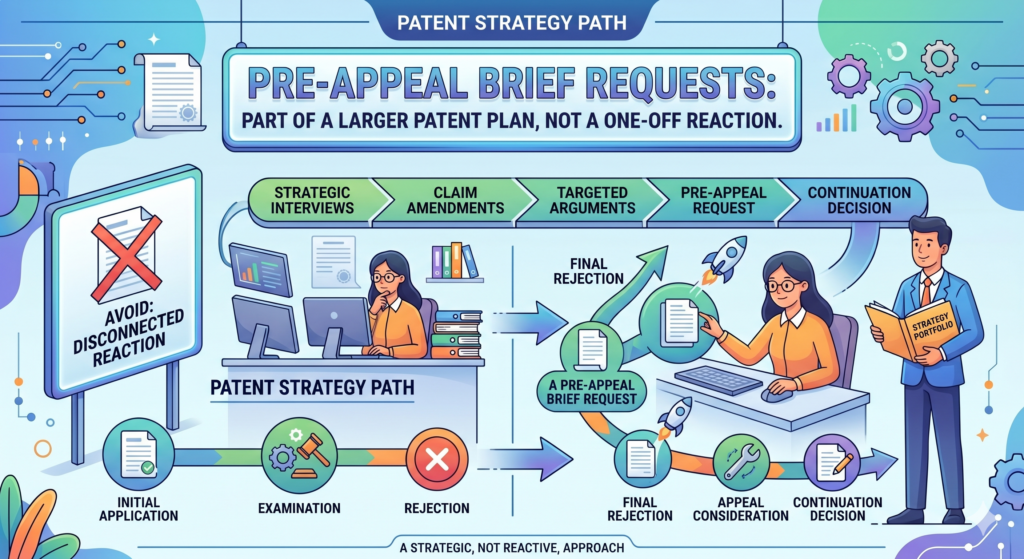
The team argues a little, amends a little, waits, reacts again, and slowly loses track of the business goal. A pre-appeal request should not be another random move in that cycle.
It should fit into a bigger plan. That plan should answer a few plain questions. What does the company need to protect? Which claim covers that value?
Is the rejection truly wrong? Would a narrower claim still protect the business? Is there a continuation path that keeps broader options alive?
A smart appeal choice protects time, money, and leverage.
For a startup, leverage matters. A pending patent application can support investor talks. An allowed claim can give more confidence.
A continuation can preserve room to pursue future claims as the product grows. But a slow, unfocused appeal can drain energy and delay useful outcomes.
A pre-appeal request can be a strong tool when it speeds up a good case. It can be a weak tool when it delays a needed claim change.
That is why the decision should not be based only on whether the team feels the examiner is wrong. It should be based on whether this exact request can move this exact case closer to a useful patent.
The best teams decide the path before emotions take over.
Final rejections can feel personal. They are not. They are part of the process. The founder’s job is not to win an argument for the sake of pride. The job is to protect the company’s edge.
That means slowing down just enough to make the right move. If the rejection has a clear error, a pre-appeal request may be the fastest pressure point.
If the claim is too broad, an amendment may be better. If the invention has grown, a continuation may be important. If the examiner’s position is unclear, an interview may come first.
PowerPatent helps founders make these choices with less stress. You get smart software that helps organize the invention and patent record, plus real attorney oversight to guide the strategy.
That means your team can move faster without treating patents like a guessing game. See how PowerPatent works here: https://powerpatent.com/how-it-works
Conclusion
A pre-appeal brief request can be a smart move when the examiner’s error is easy to show from the record.
It works best when the claims are clean, the rejection is weak, and the issue can be explained in a few plain pages.
It does not work well when the claims need changes, the facts are messy, or the argument needs a long technical lesson.