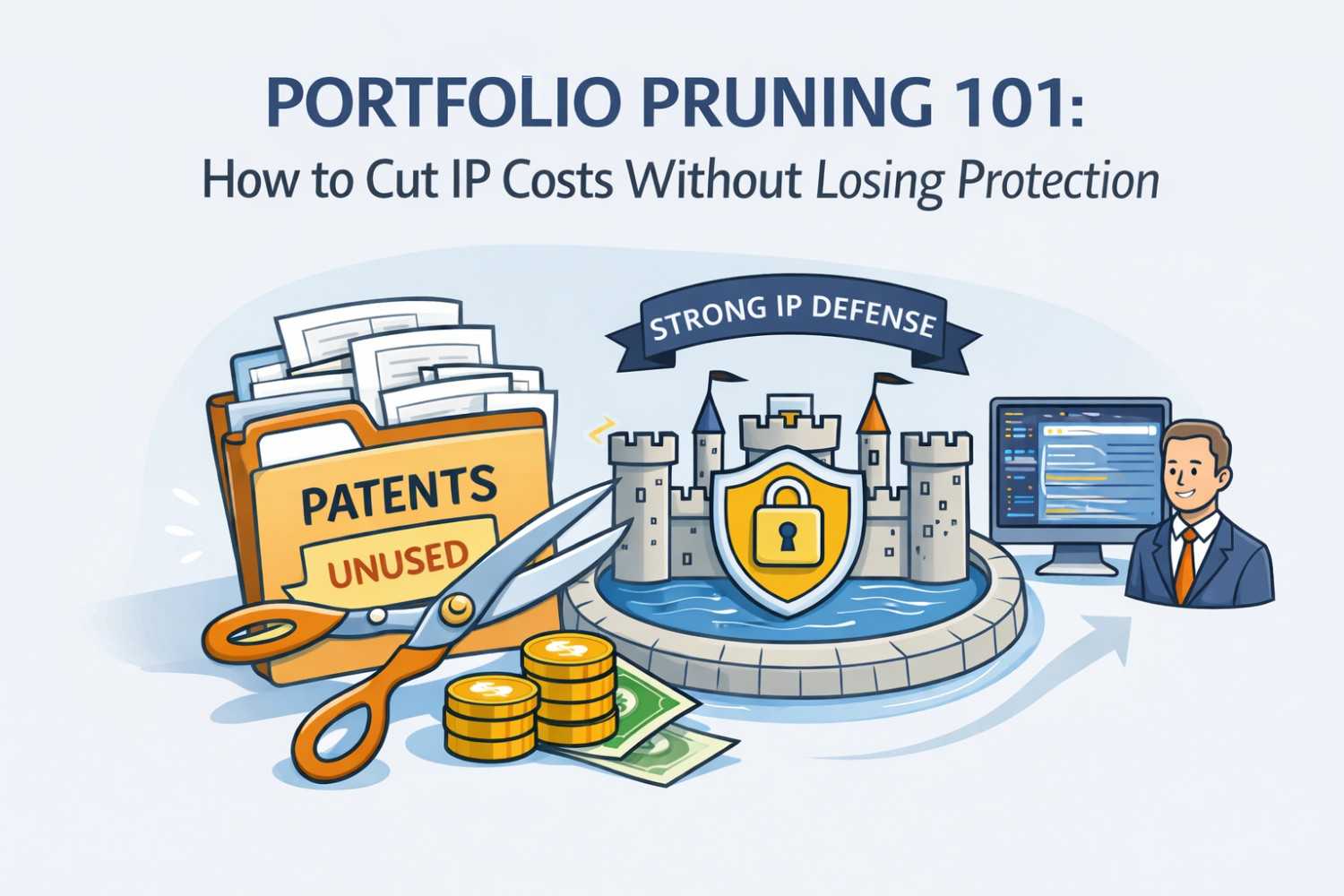
Patents cost money. Sometimes a lot of it. Filing fees, lawyer time, office actions, renewals, foreign filings—it adds up fast. If you are building a startup, every dollar matters. But cutting patents the wrong way can hurt you later when investors ask hard questions or a big company copies your work. That is where portfolio pruning comes in. Portfolio pruning means you keep the patents that truly protect your edge and cut the ones that do not move the needle. Done right, you lower costs without lowering your guard. In this guide, we will walk through exactly how to do that in a smart, calm, and strategic way—so you stay protected and stay lean.
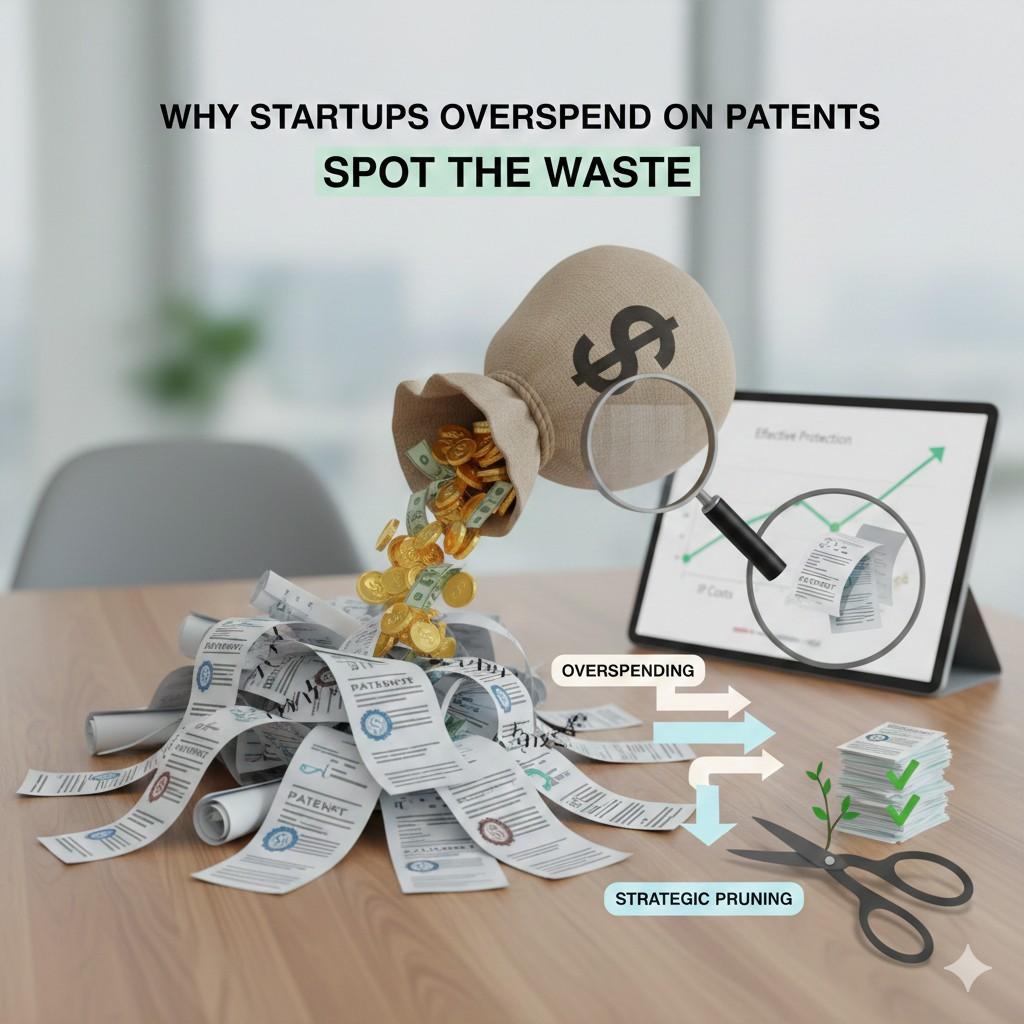
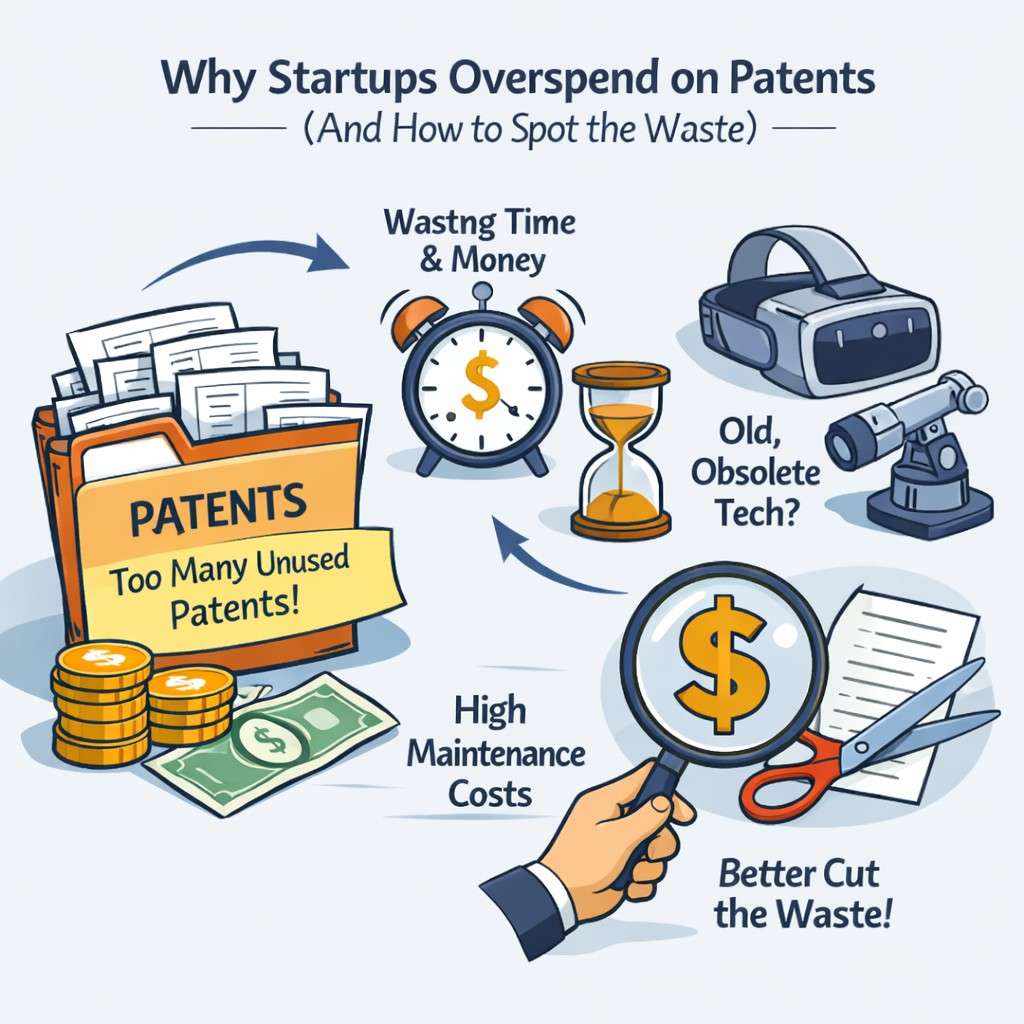
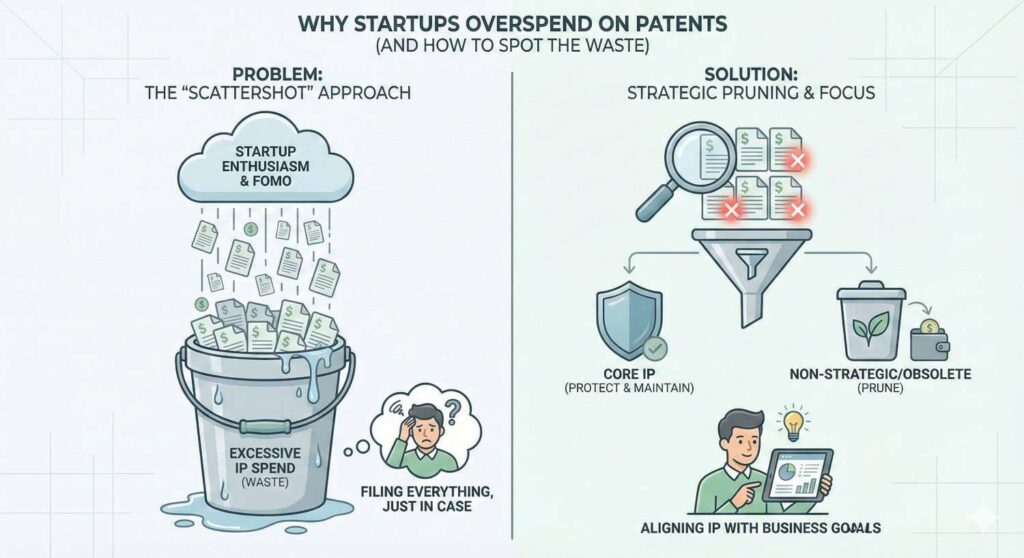
Why Startups Overspend on Patents (And How to Spot the Waste)
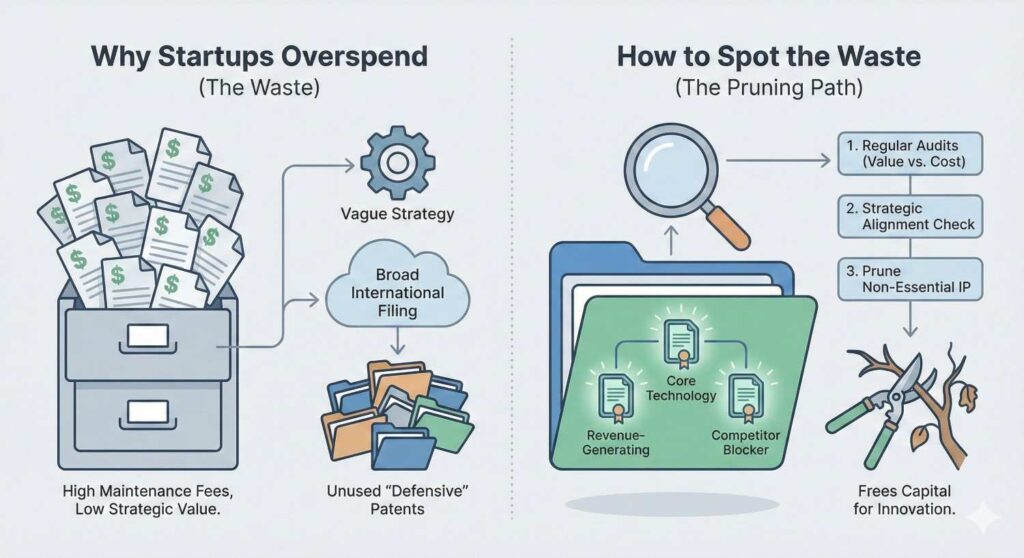
Most startups do not plan to overspend on patents. It just happens. A founder files one application to feel safe. Then an investor suggests filing more. Then a lawyer recommends foreign coverage.
Then renewal fees start rolling in. Before long, the patent budget feels heavy and hard to control.
The problem is not that patents are bad. The problem is that many teams never stop to ask a simple question: does this patent still protect what we are building today?
If you want to cut IP costs without losing protection, you first need to understand where the waste hides.
Waste is not always obvious. It hides in old strategies, in fear-based decisions, and in habits picked up from bigger companies that play a very different game than startups do.
Filing Out of Fear Instead of Strategy
Fear is expensive. Many early-stage founders file patents because they are afraid someone will copy them. That fear is valid. But fear alone should never guide your filing strategy.
When filings are driven by panic, startups end up protecting half-built ideas, features that never ship, or small tweaks that do not truly matter.
Over time, this creates a pile of patents that look impressive on paper but do not protect the core engine of the business.
A better approach is to step back and ask: if a competitor copied this exact patent, would it hurt us? If the answer is no, that filing may not be worth the long-term cost.
Strategic founders protect the parts of their technology that create leverage. That is what investors care about. That is what acquirers value.
Before filing anything new, pause and connect it to revenue, product direction, or long-term platform advantage. If you cannot draw a straight line between the patent and future value, it may be a fear-based filing.
Chasing Quantity Over Quality
Some startups believe that more patents equal more value. They see large corporations with hundreds of filings and assume that is the goal. But those companies have different budgets and different risk profiles.
Early-stage startups do not win by volume. They win by precision.
When quantity becomes the goal, costs rise fast. Each application brings filing fees, attorney time, and long-term maintenance payments. Multiply that by ten or twenty filings, and the numbers become serious.
Instead of counting patents, count strategic coverage. Ask whether your core system is covered from multiple angles.
One well-drafted patent that blocks competitors from copying your main workflow is more powerful than five weak patents around minor features.
This is where many teams overspend. They spread protection thin instead of building strong walls around what truly matters.
If you are unsure whether your current patents are strong or scattered, this is a good moment to step back and review your portfolio with fresh eyes.
Tools that combine smart software with real patent attorney oversight, like what we built at PowerPatent, can help founders see the bigger picture without drowning in legal noise. You can explore how that works here: https://powerpatent.com/how-it-works
Filing Internationally Too Early
Global protection sounds smart. It feels ambitious. But filing in multiple countries too early is one of the biggest cost traps for startups.
Each country means translation costs, local attorney fees, and ongoing maintenance payments. Those bills do not care whether your product has market traction yet.
Many founders file abroad before they know where their customers will actually be. They protect markets they may never enter.
A smarter move is to align foreign filings with real expansion plans. If you are not actively selling or planning to sell in a region within the next few years, it may not deserve immediate protection.
Before entering national phases or filing direct foreign applications, ask: do we have revenue, partners, or clear plans in this region? If not, delay may be the better move.
Strategic timing alone can save hundreds of thousands of dollars over the life of a portfolio.
Letting Old Patents Run on Autopilot
Another hidden cost comes from doing nothing.
Once a patent is filed and granted, it enters maintenance mode. Fees are due at set intervals. If no one reviews them, payments continue automatically.
The issue is that startups change fast. Your roadmap today may look nothing like your roadmap two years ago. Yet your patent portfolio may still reflect your original idea.
This mismatch creates silent waste. You may be paying to maintain patents that no longer align with your product or market.
At least once a year, review your granted patents and pending applications. Compare them to your current product stack. Are they still core? Or are they relics from an earlier pivot?
If a patent no longer supports your strategy, letting it expire can be a smart business move. Protection is valuable, but only when it protects something that still matters.
Overpaying for Traditional Law Firm Processes
Many startups assume that high patent costs are just the price of doing business. But a large part of the expense often comes from process, not substance.
Traditional firms bill by the hour. Every call, every revision, every small change adds cost. Drafting from scratch each time increases fees even further.
Modern startups build with software. They use tools that speed up design, testing, and deployment. Yet when it comes to patents, many fall back into slow, manual systems.
This gap leads to overspending.
There is a better way. Smart platforms that combine automation with real attorney review can reduce drafting time while keeping quality high. That means fewer billable hours and faster filings.
PowerPatent was built for this exact reason. Founders can turn technical work into strong patent applications quickly, while still having experienced patent attorneys review and back the filings.
That mix of speed and oversight helps cut waste without cutting protection. You can see the full process here: https://powerpatent.com/how-it-works
Filing Before the Product Is Clear
Another common pattern is filing too early, before the invention is fully shaped.
Early filings often lack depth because the system is still evolving. Later, as the product matures, teams realize the original patent does not fully cover the final design.
That leads to follow-up filings, continuation applications, or entirely new patents.
The result is stacking costs on top of earlier costs.
While it is important not to wait too long, it is also wise to file when the core system is stable enough to describe clearly and broadly.
Ask yourself whether your current version represents the architecture you plan to scale. If major pieces are still shifting, consider refining the design before locking it into a patent application.
Strong, well-timed filings reduce the need for constant patchwork later.
Ignoring Competitive Landscape Signals
Some startups file without studying the existing patent landscape. They protect features that competitors are not even focused on.
When you understand where competitors are placing their bets, you can protect smarter. If everyone else is solving problem A, and you are uniquely solving problem B, your filings should lean heavily into that difference.
Without this awareness, startups may spend money protecting ground that is already crowded or less important.
Even a light landscape review can shift strategy. You do not need a full legal report to gain insight. What you need is clarity about where your edge sits.
A targeted approach lowers the number of filings while increasing their impact.
Treating Patents as a One-Time Task
Patents are not a checkbox. They are part of company strategy.
When treated as a one-time task, portfolios grow without direction. When treated as an ongoing strategy, they stay aligned with business goals.
Founders who revisit their patent plans during major milestones—new funding rounds, pivots, product launches—spend more wisely. They adjust coverage to reflect new realities.
This mindset shift alone can cut significant long-term costs.
Instead of asking, “Do we have patents?” ask, “Are our patents aligned with where we are going next?”
That question keeps protection sharp and budgets under control.
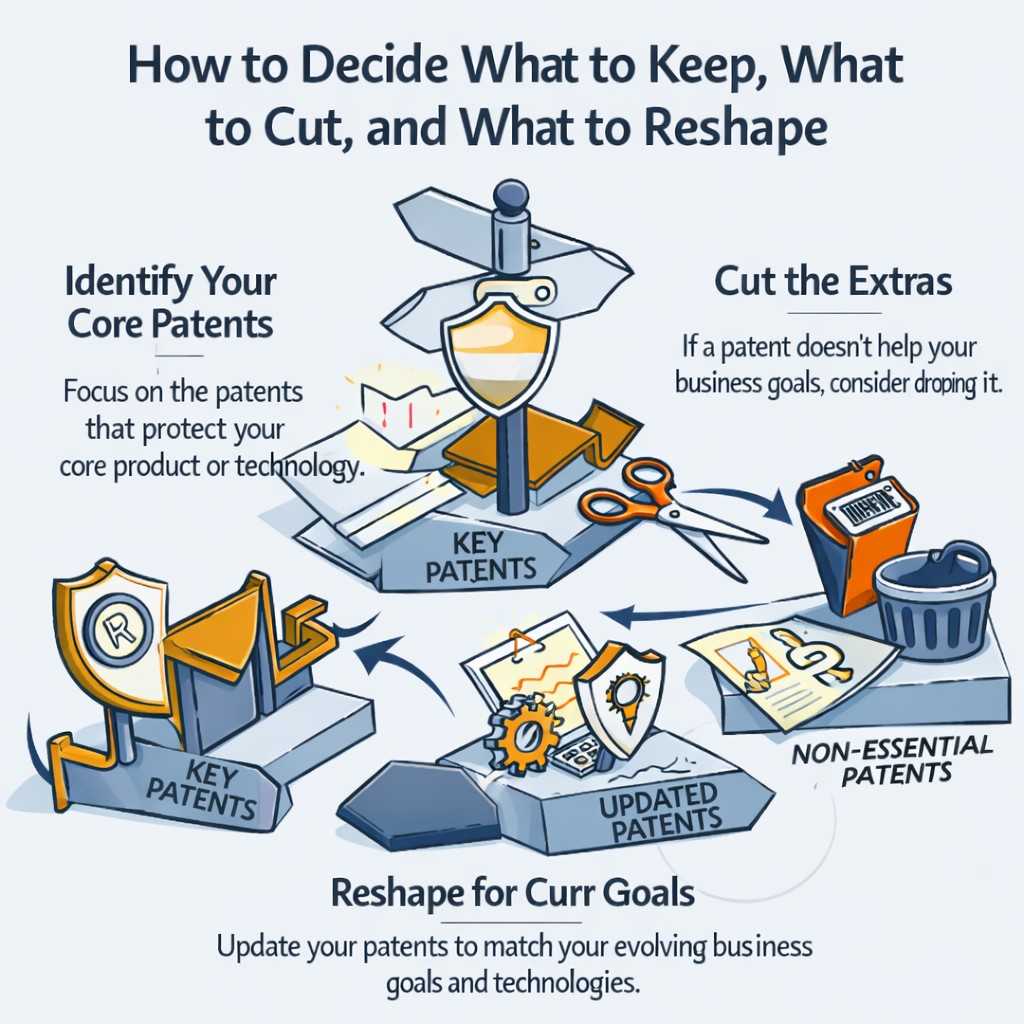
How to Decide What to Keep, What to Cut, and What to Reshape
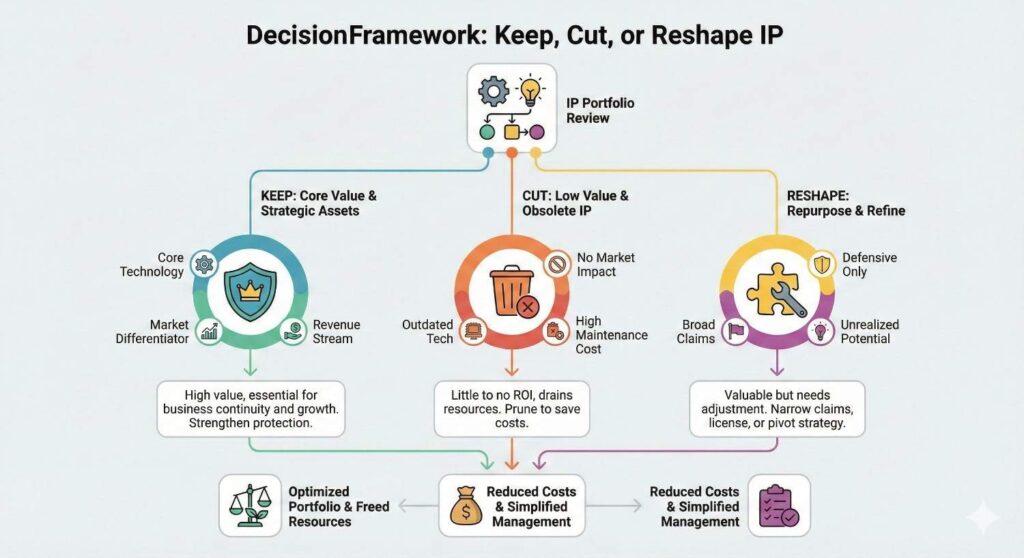
Cutting patent costs is not about randomly dropping filings. It is about making calm, smart choices. Every patent in your portfolio should earn its place. Some will clearly protect your core engine.
Some will clearly not. Others will sit in the middle and need reshaping instead of removal.
This section is about building a simple but powerful filter. A way to look at your portfolio like a product roadmap, not a legal archive. When you do this right, you lower cost and raise strength at the same time.
Start With Your Current Product, Not Your Old Roadmap
Before reviewing any patent, open your current product dashboard. Look at what customers are using right now. Look at what drives revenue. Look at what investors get excited about.
Your patent portfolio should reflect that reality.
Many startups review patents in isolation. They read claim language and legal descriptions without grounding them in the live product. That creates confusion. Instead, start from the product outward.
Ask a simple question: if a competitor copied this exact feature tomorrow, would it hurt our growth?
If the answer is yes, that feature likely deserves strong patent coverage. If the answer is no, that patent may not be critical anymore.
This approach instantly creates clarity. It shifts the review from theory to business impact.
Tie Every Patent to a Revenue Path
Not every patent must generate revenue directly. But every strong patent should protect something that connects to revenue.
When reviewing your portfolio, write down how each patent supports one of three things: current sales, future expansion, or strategic leverage.
If you cannot link a patent to one of these paths, it may be dead weight.
Strategic leverage means the patent blocks competitors from copying a system that gives you speed, lower cost, better accuracy, or better user experience. Even if that feature is behind the scenes, it still supports growth.
If a patent protects a side experiment that never made it into production, that is a candidate for pruning.
This exercise alone often reveals that twenty to thirty percent of a portfolio no longer aligns with revenue direction.
Separate Core Architecture From Edge Features
Your core architecture is the engine. It is the system that makes your company hard to copy. Edge features are helpful, but they are not the heart.
During pruning, draw a clear line between the two.
Core architecture patents are usually worth keeping and even strengthening. Edge feature patents need deeper scrutiny.
For example, if your company builds an AI-driven workflow engine, patents around your model training system, data pipeline, and inference logic likely matter deeply. But patents around minor user interface tweaks may not justify long-term maintenance.

That does not mean interface patents are always weak. It means they must pass a higher bar. They must protect something competitors would truly want to copy.
If they do not, reshaping your focus toward the core can save large amounts over time.
Look at Claim Breadth, Not Just Patent Count
Some patents look impressive because they are granted. But the real power lies in claim breadth.
A narrow patent that covers only one specific version of your system may offer limited protection. A broader patent that captures the underlying method provides more value.
When reviewing what to keep, study how flexible your claims are. Do they cover variations? Do they protect the concept behind the implementation?
If you find a narrow patent that protects a key system but in a limited way, it may not be a candidate for cutting. It may be a candidate for reshaping.
Reshaping can mean filing a continuation to broaden coverage or refining claims to better reflect how the product evolved.
This is where strategy matters. Cutting too aggressively can weaken future leverage. Reshaping allows you to refine protection instead of discarding it.
Working with a system that allows technical founders to clearly map product updates into patent strategy makes this easier.
PowerPatent helps translate live technical work into updated patent language, while real patent attorneys guide claim strategy.
That combination makes reshaping practical instead of overwhelming. You can see how it works here: https://powerpatent.com/how-it-works
Review Market Direction Before Cutting International Filings
Foreign patents are expensive. But cutting them blindly can create regret later.
Before deciding to drop international coverage, revisit your market plan. Are you entering Europe? Expanding into Asia? Partnering with global players?
If your expansion plan has shifted away from certain regions, those filings may not deserve continued funding.
But if you see strong signals of growth in a region, maintaining protection there could become more valuable over time.
Use real data. Look at user growth by geography. Look at inbound enterprise interest. Look at regulatory trends.
Your global patent footprint should match your real market footprint, not your old pitch deck.
Evaluate Enforcement Potential
A patent has value when it can be enforced or used as leverage.
During pruning, ask whether you could realistically enforce each patent if needed. Does it cover observable behavior? Would you be able to detect infringement?
If a patent protects an internal process that competitors cannot see and you cannot detect externally, enforcement may be difficult.
This does not automatically make it useless, but it lowers practical value.
Patents that cover visible system behavior, public APIs, hardware components, or measurable outputs are often easier to enforce.
When deciding what to keep, favor patents that you could confidently assert if necessary.
Align With Fundraising and Exit Strategy
Your patent strategy should match your long-term goals.
If you plan to raise institutional capital, investors will review your IP. They will want to see coverage around your differentiation.
If you plan for acquisition, buyers will assess whether your patents strengthen their position or block competitors.
During pruning, think ahead. Which patents would a buyer care about? Which ones would an investor ask about in diligence?
Patents that clearly protect scalable systems and competitive advantage are strong candidates to keep. Patents that feel disconnected from growth narrative may be better trimmed.
A clean, aligned portfolio tells a strong story. A bloated one raises questions.
Decide When to Reshape Instead of Remove
Not every weak patent should be dropped. Some need adjustment.
If a patent protects a valuable concept but is too narrow or outdated, consider reshaping through continuations or claim amendments.
Reshaping allows you to refine protection as your product evolves. It keeps the filing alive while improving alignment.
The key is to act before deadlines pass. Once maintenance windows close or continuation periods expire, options shrink.
This is why regular review cycles matter. Twice a year is a good rhythm for most startups.
Use those reviews to ask three simple questions about each patent. Does it protect something critical today? Does it align with where we are going? Can it be improved?
The answers will guide whether to keep, cut, or reshape.
Build a Simple Scoring Framework
Even without complex spreadsheets, you can build a simple internal scoring method.
Score each patent on product alignment, revenue connection, competitive leverage, and enforcement visibility.
You do not need perfect numbers. You need relative clarity.
When a patent scores low across multiple dimensions, it becomes an obvious pruning candidate. When it scores high, you double down. When it sits in the middle, you reshape or monitor.
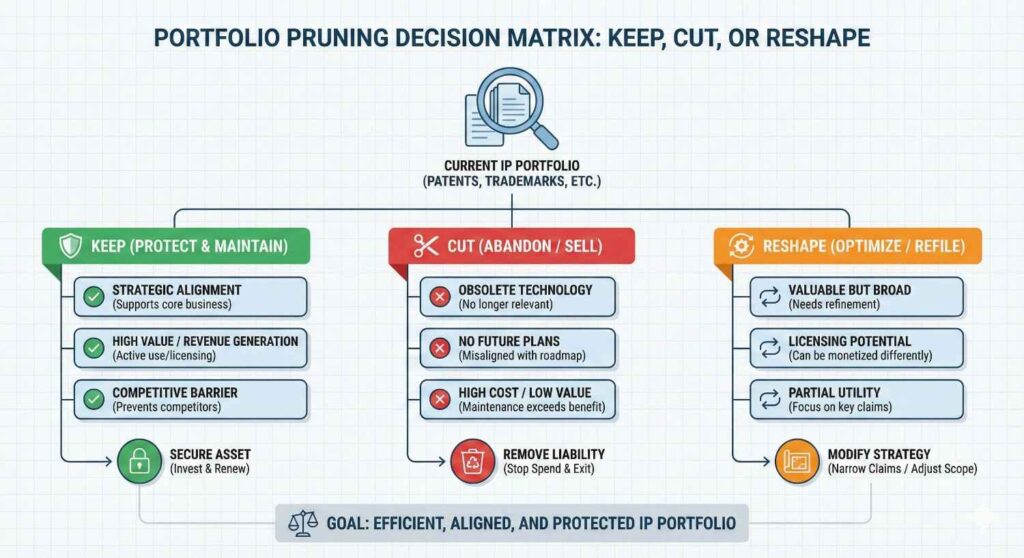
This structured thinking removes emotion from the decision.
Portfolio pruning is not about shrinking. It is about sharpening.
When you keep only what strengthens your moat, your budget stretches further and your protection grows stronger at the same time.
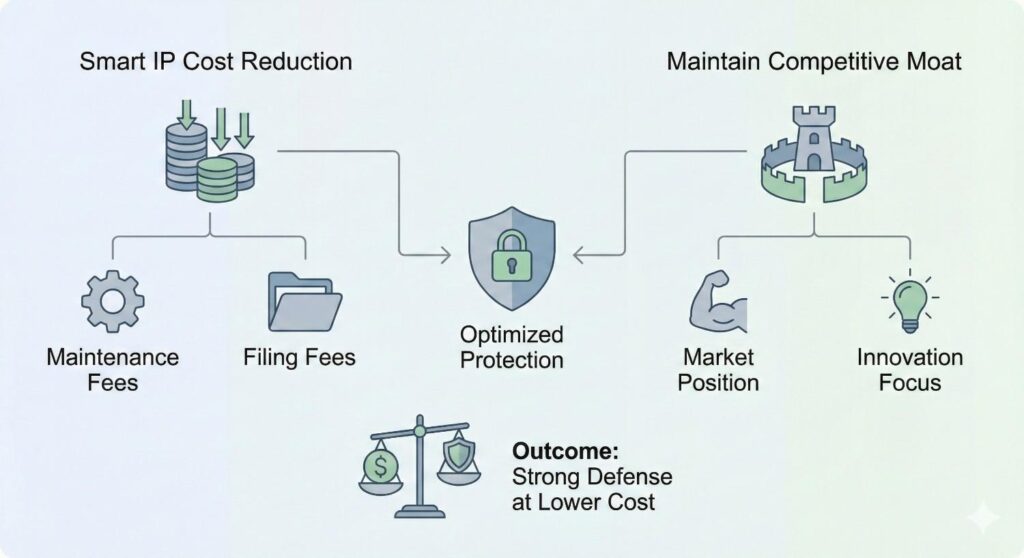
How to Reduce IP Costs Without Weakening Your Competitive Moat
Cutting cost is easy. You can stop filing. You can drop patents. You can delay payments. But that kind of cutting is short term. It weakens your shield.
The real goal is different. You want to spend less while protecting more of what truly matters. You want your patent portfolio to feel tight, focused, and strong. Not bloated. Not fragile.
Reducing IP costs without weakening your moat requires intention. It requires systems. And it requires seeing patents as part of product strategy, not as random legal tasks.
Let’s walk through how to do this the right way.
Protect the Engine, Not the Paint
Your moat lives in your engine. It lives in the system that makes your company hard to copy.
That engine might be your model training process. It might be your hardware design. It might be your data pipeline. It might be your novel workflow logic.
It is rarely your button color. It is rarely your layout. It is rarely small cosmetic pieces.
When cost pressure rises, focus on strengthening protection around the engine. If you must cut, cut around the edges first.
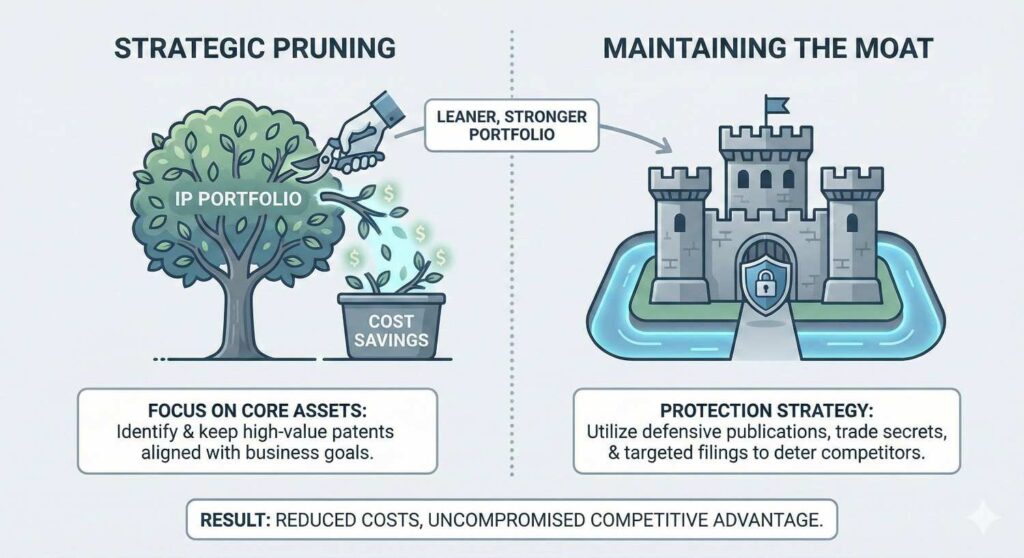
One powerful move is to consolidate filings around your core architecture. Instead of scattering patents across minor features, concentrate them around the systems that power everything else.
This builds density around what matters most.
When investors or acquirers review your portfolio, they will see depth where it counts. That depth is what creates leverage.
Draft Broader, Smarter Claims From the Start
One of the best ways to reduce long-term cost is to draft strong applications at the beginning.
Weak drafting creates future expense. It leads to multiple office actions. It leads to narrow claims. It leads to follow-up filings that patch earlier gaps.
Smart drafting reduces that cycle.
Broad does not mean careless. It means capturing the concept behind your system, not just one version of it.
For example, if your invention relates to a specific machine learning architecture, the claims should protect the method of solving the problem, not just one model type.
When your claims cover the idea at a deeper level, you reduce the need for multiple similar filings later.
This is where combining software-driven drafting with real attorney oversight becomes powerful. Software helps you move fast and structure technical details clearly. Experienced patent attorneys shape the claims so they are strong and defensible.
PowerPatent was built exactly for this balance. It helps founders turn real technical work into structured applications, then real attorneys review and guide the claim strategy. That reduces waste at the root. You can explore how the system works here: https://powerpatent.com/how-it-works
Use Continuations Strategically Instead of Filing From Scratch
Many startups file entirely new patents when their product evolves. That can be expensive.
In many cases, a continuation application can extend and adjust existing protection without starting over.
A continuation lets you pursue new claim angles based on the same original disclosure. This can be far more cost-effective than drafting a brand-new application.
When used correctly, continuations allow you to adapt protection as your product matures. You reshape your moat without rebuilding it.
The key is timing. Continuations must be filed while the parent application is still alive. That means planning ahead.
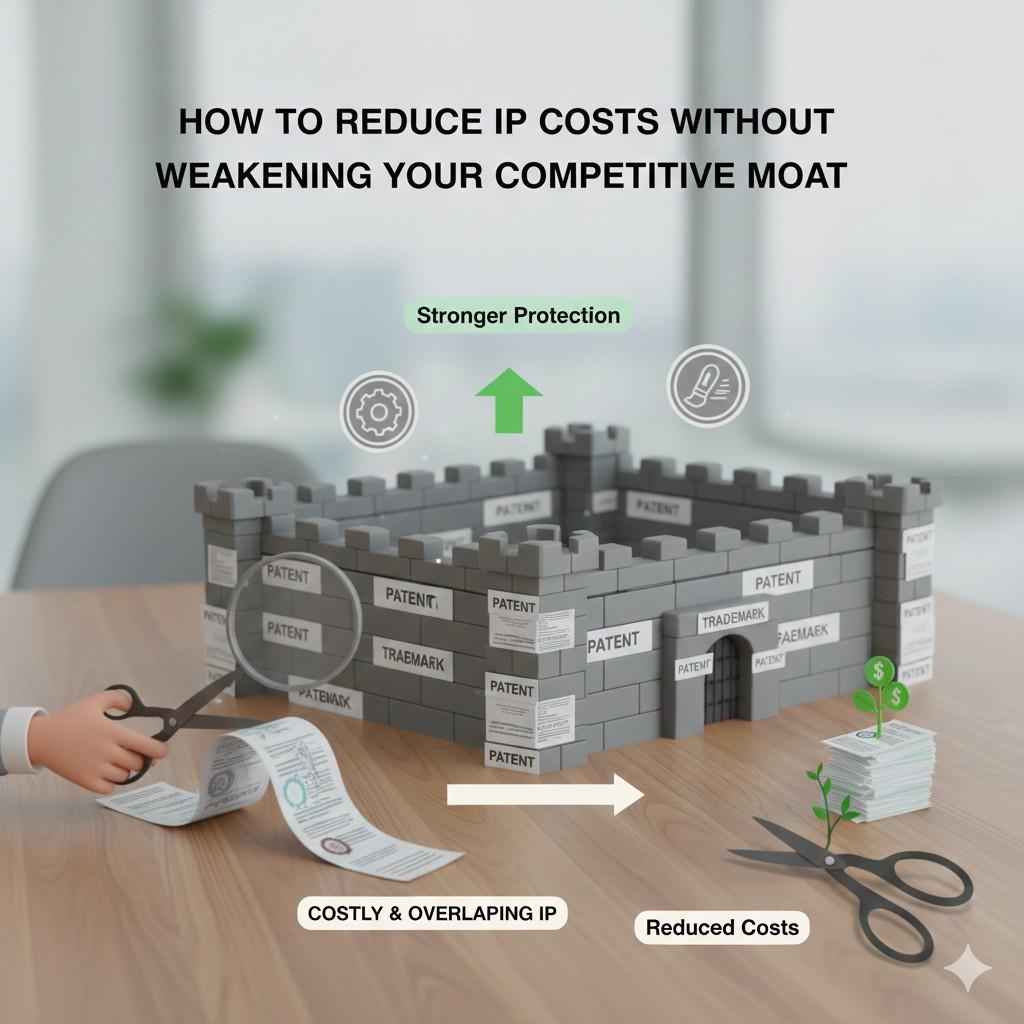
During regular portfolio reviews, identify strong foundational patents that can support future continuations. Keep those alive strategically. Let weaker ones expire.
This approach creates flexibility while controlling budget.
Align Filing Cadence With Product Milestones
Another way to reduce waste is to match patent activity to real product milestones.
Avoid filing every time a minor improvement is made. Instead, group related innovations into cohesive applications when possible.
When your team releases a major version upgrade or introduces a new platform layer, that is often the right time to evaluate new filings.
This rhythm keeps your portfolio organized. It avoids fragmented filings that overlap or duplicate each other.
It also reduces attorney time spent on constant small updates.
Strong coordination between engineering and IP planning is essential here. When engineers understand how patents fit into growth strategy, they can document innovations in a structured way.
That structure lowers drafting time and cost.
Reduce International Spend With Phased Expansion
International filings are powerful but expensive.
A smart way to reduce cost without weakening your moat is to phase global protection according to traction.
Start with core markets where you already have users or revenue signals. Expand to new regions only when real opportunity appears.
You do not need global coverage on day one.
You need coverage where competitive risk and revenue potential overlap.
This targeted approach keeps your global footprint aligned with business reality.
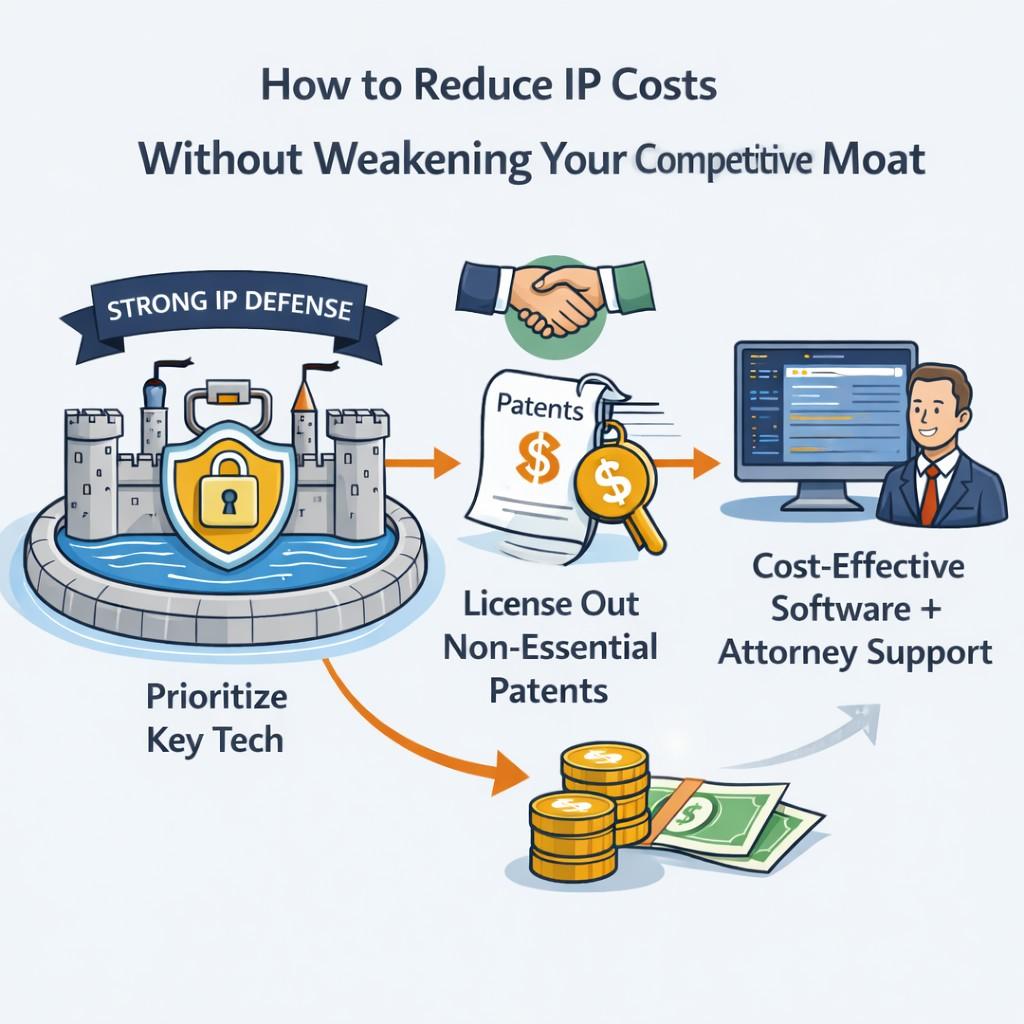
Over time, as your company grows, your international portfolio can grow with it. But it grows based on data, not guesswork.
Prune Maintenance Fees With Discipline
Maintenance fees often become automatic. That is risky.
Each maintenance decision should feel fresh. Just because you paid for a patent five years ago does not mean it deserves payment today.
Before each fee deadline, review the patent’s alignment with current product and market direction.
If it no longer protects a meaningful part of your moat, let it expire with confidence.
Strong portfolios are not measured by age. They are measured by relevance.
Cutting outdated patents reduces cost and clarifies your story.
Integrate IP Review Into Executive Planning
IP should not live in a separate legal corner. It should sit at the executive table.
When leadership reviews product roadmap, fundraising plans, and expansion strategy, patent alignment should be part of the same discussion.
This integration reduces random filings. It prevents drift.
When patents reflect executive priorities, spending becomes intentional.
A quarterly strategy review that includes both technical and IP perspectives can prevent costly misalignment.
With modern tools, this integration becomes easier. PowerPatent allows founders and engineers to stay close to the drafting process instead of handing it off blindly.
That visibility keeps patents tied directly to product evolution, reducing unnecessary expense. You can see how founders stay in control here: https://powerpatent.com/how-it-works
Focus on Defensive Leverage, Not Litigation Fantasy
Some founders imagine patents as weapons for massive lawsuits. In reality, early-stage startups rarely engage in large-scale litigation.
Your patents should serve as leverage. They should deter competitors. They should strengthen negotiation power. They should increase valuation.
When reviewing cost, ask whether each patent contributes to that leverage.
If a patent would not meaningfully influence a negotiation or deter a competitor, its strategic value may be limited.
This mindset shift keeps your portfolio practical.
You are not building a museum of filings. You are building a shield around your advantage.
Build a Lean, Living Portfolio
The healthiest portfolios are living systems. They evolve as the company evolves.
They are reviewed regularly. They are pruned carefully. They are expanded thoughtfully.
A lean portfolio is not weak. It is sharp.
When every patent has purpose, your budget stretches further. Investors see focus. Acquirers see clarity. Competitors see real barriers.
Reducing IP costs without weakening your moat is not about spending less at all costs. It is about spending with precision.
When you combine structured review, smart drafting, phased expansion, and real attorney guidance supported by modern software, you can protect what matters most without draining your runway.
PowerPatent was designed to help founders do exactly that. It brings together intelligent tools and experienced patent attorneys so you can move fast, stay in control, and avoid costly mistakes.
If you are ready to build a focused, defensible portfolio without the old-school overhead, you can learn more here: https://powerpatent.com/how-it-works
Wrapping It Up
Portfolio pruning is not about shrinking your ambition. It is about sharpening it. Every dollar you spend on patents should protect something that truly drives your company forward. When you remove what no longer serves you, you create room to double down on what does. That is how you cut cost without cutting strength. Most startups overspend not because they are careless, but because they never stop to realign. They file during early excitement. They expand during fundraising. They maintain out of habit. Over time, the portfolio grows faster than the strategy behind it.