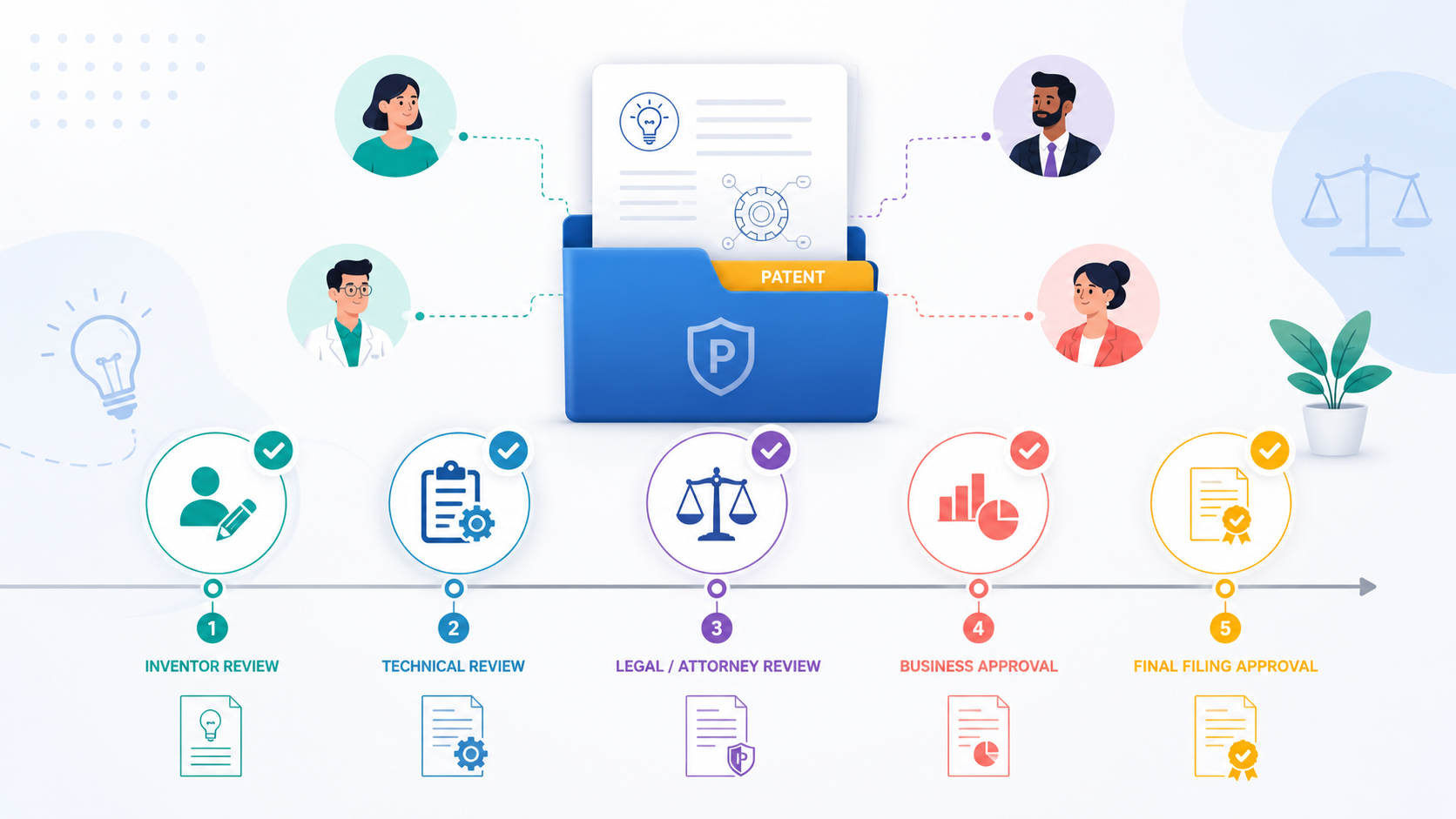
A patent filing can move fast, but it should never move blindly. PowerPatent helps teams do this with smart software and real attorney oversight, so founders can move faster with more confidence. You can see how that works here: https://powerpatent.com/how-it-works
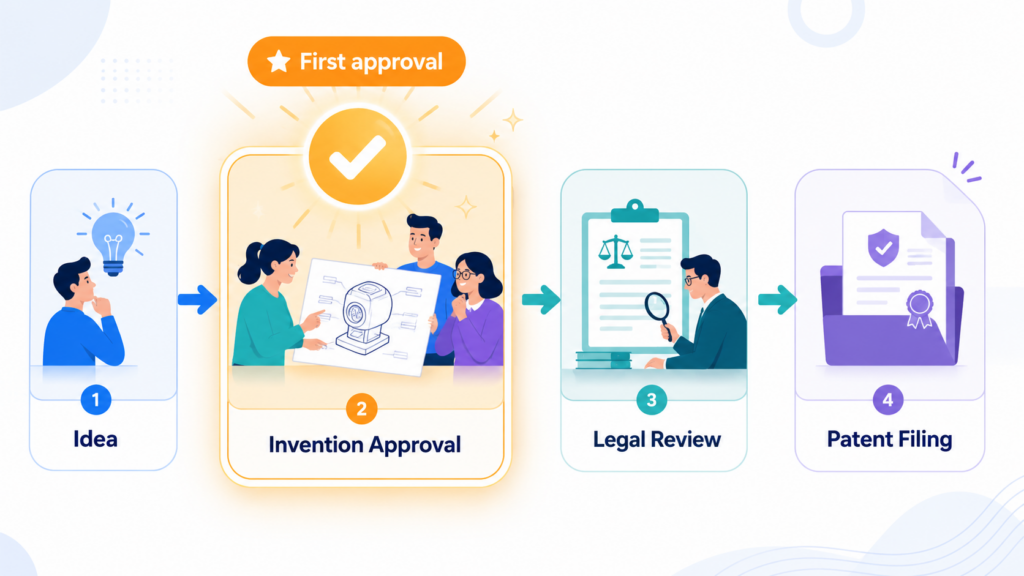
The First Approval Is Not Legal Approval. It Is Invention Approval.
The first review should not start with forms, filing dates, or claim language. It should start with a plain question: what is the actual invention?
This sounds simple, but it is where many patent filings go wrong. A founder may think the invention is the whole product. An engineer may think it is one model, one system step, one data flow, or one clever fix inside the product.
A business leader may think the value is in the customer outcome. The patent attorney needs to know what is new, how it works, and why it matters.
Before anyone approves a patent filing, the team must agree on the core invention. This is the first gate. If this gate is weak, every later review becomes harder. The draft may describe too much, claim too little, or focus on the wrong part of the system.
A strong patent review starts with the people closest to the build. That usually means the inventor, the lead engineer, the product owner, and the founder or executive who owns the company’s IP plan.
The goal is not to make the patent perfect at this stage. The goal is to make sure the filing is aimed at the right target.
For a startup, this matters a lot. You may only have time and budget to file on the most important parts of your work. So the first approval should answer this: are we protecting the thing that gives us an edge?
PowerPatent is built for this exact early step. It helps teams turn technical notes, code, product ideas, and inventor input into a cleaner patent workflow, while real patent attorneys review the work before filing. You can see how it works here: https://powerpatent.com/how-it-works
The inventor must confirm what is truly new before the draft gets too far.
The inventor’s review is the most important early review because the inventor knows the real build story.
They know what failed, what changed, what was hard, and what finally worked. That detail is often where the patent value lives.
Many weak patent filings sound polished but miss the real invention. They describe the product at a high level and skip the hard technical choice that made it work.
For example, a filing may say the system “uses AI to rank results.” That is not enough. The stronger question is how the ranking works, what signals it uses, how the model is trained, how bad outputs are handled, and what makes this better than normal ranking.
The inventor should review the invention summary before a full draft is prepared. This review should happen while the idea is still flexible.
At this point, the inventor should correct wrong terms, add missing steps, explain edge cases, and point out what competitors would likely copy.
This review should be direct and practical. The inventor does not need to write legal text. They need to say, in simple words, “This is the part we invented,” “This is the part that was already known,” and “This is the part that makes our version better.”
The inventor should approve the technical truth, not the legal style.
An inventor approval should never mean, “I read every legal sentence and it sounds fine.” That is not the best use of the inventor’s time. The inventor should approve whether the filing describes the invention correctly.
This means the inventor should look for wrong steps, missing parts, false limits, and loose language that may hurt the patent later.
If the patent says the system always uses one type of model, but the product can work with several model types, that should be fixed. If the patent says the user must click a button, but the system can also run in the background, that should be fixed too.
These small details can shape the future value of the patent. A patent application is not just a record of what exists today.
It should also leave room for smart future versions, as long as those versions are supported by the invention. The inventor is often the best person to see those future paths.
This is why the first approval should happen before the full draft is locked. Once a draft becomes long and formal, people tend to skim it.
They assume someone else checked the hard parts. That is dangerous. The best patent teams keep the early invention review simple, focused, and fast.
The founder must confirm why this filing matters to the business.
The founder does not need to review the patent like an engineer. The founder should review it like a builder of company value.
A patent filing should map to a real business reason. It may protect a key product feature. It may support fundraising. It may help keep larger competitors from copying the technical core.
It may protect a new platform layer before launch. It may create a stronger story for partners, acquirers, or investors.
The founder’s approval should answer a different question than the inventor’s approval. The inventor asks, “Is this technically right?” The founder asks, “Is this worth protecting now?”
That timing matters. The USPTO explains that a provisional patent application can be filed without formal patent claims, an oath or declaration, or an information disclosure statement, which can make it useful when a team wants to secure an early filing position while the product is still moving.
But a provisional still needs a clear and complete description if it is going to be useful later.
This is why founder approval should happen early, before the team spends too much time drafting around the wrong asset.
A patent filing that does not support the company’s plan may still be technically interesting, but it may not be the best use of attention.
The founder should approve the filing goal before the filing format.
The founder should not begin by asking, “Should this be provisional or non-provisional?” That question matters, but it comes after the business goal is clear.
A better first question is: what do we need this filing to do?
If the company is about to pitch investors, the goal may be to show that the core technology is being protected. If the company is preparing for launch, the goal may be to file before public disclosure.
If the company is building a deep tech moat, the goal may be to build a family of filings around a platform, not just one feature.
Once the goal is clear, the legal team can guide the right filing path. A provisional application may be useful for speed and early positioning. A non-provisional application starts the formal examination path.
The USPTO’s own guidance notes that a non-provisional application generally includes a specification, claims, drawings when needed, required fees, and an inventor oath or declaration.
The founder does not need to manage every rule. But the founder must make sure the patent plan matches the company plan.
The product lead must confirm the filing protects the product’s real user value.
The product lead sees the invention from the customer side. That view matters because patents can become too narrow when they only describe internal engineering details.
A strong filing should connect the technical invention to the useful result it creates.
For example, the engineering team may focus on a new data pipeline. The product lead may explain that the real customer value is faster setup, better output quality, fewer manual steps, or safer automation.
That does not replace the technical detail, but it helps frame why the invention matters.
The product lead should review the invention summary after the inventor has confirmed the core mechanics.
At this point, the product lead can check whether the filing covers the right workflows, user paths, and practical use cases.
This is not a branding review. It is not a marketing review. It is a value review.
The product lead should catch missing use cases before claims are drafted.
Claims are the part of a patent application that define the legal scope of the invention. Because claims can shape what the patent may later cover, missing use cases can become a real problem.
The USPTO’s basic patent guidance explains that claims define the scope of protection and are central to how infringement questions are judged.
That means the product lead should speak up before the claims become too fixed. If the draft only covers one workflow, but customers use the system in three different ways, that matters.
If the draft assumes one kind of user, but the product is used by admins, developers, and end users, that may matter too.
The point is not to stuff the filing with every possible feature. The point is to avoid filing a patent that protects a narrow demo while the real product grows somewhere else.
This is one reason PowerPatent’s workflow is useful for startup teams. It helps bring inventor input, product context, and attorney review into one cleaner path, instead of letting the patent live in a slow email chain. Start here: https://powerpatent.com/how-it-works
The engineering lead must confirm the patent does not expose more than needed.
A patent filing must explain the invention well enough to support the protection being sought. But that does not mean every private detail belongs in the filing. Engineering review helps strike that balance.
The engineering lead should check whether the draft includes trade secrets, security details, private infrastructure choices, customer-specific details, or internal shortcuts that do not need to be disclosed.
This is a careful review. The team should not remove details that are needed to support the invention. But it should avoid spilling extra information that does not help the patent.
This review should happen after the invention is clear but before final approval. It works best when the attorney and engineering lead talk through what is needed and what is not.
The engineering lead should separate patent support from private know-how.
Some details help the patent. Some details only teach competitors too much.
For example, a filing may need to explain the logic of a new model training process. But it may not need to include private customer data structures, secret performance thresholds, internal vendor choices, or exact deployment settings. The line depends on the invention, which is why attorney oversight is important.
This is also where teams should review known prior work. People involved in a patent application have a duty to disclose known information that is material to patentability to the USPTO.
The point is simple: if the team knows about close prior work, the attorney should know too.
A clean review process makes this easier. Engineers should not hide close references because they are worried it will hurt the filing. The better move is to surface them early so the claims can be written with eyes open.
The Second Approval Should Check Timing Before the Team Shares Too Much.
Once the team agrees on the invention, the next approval is about timing.
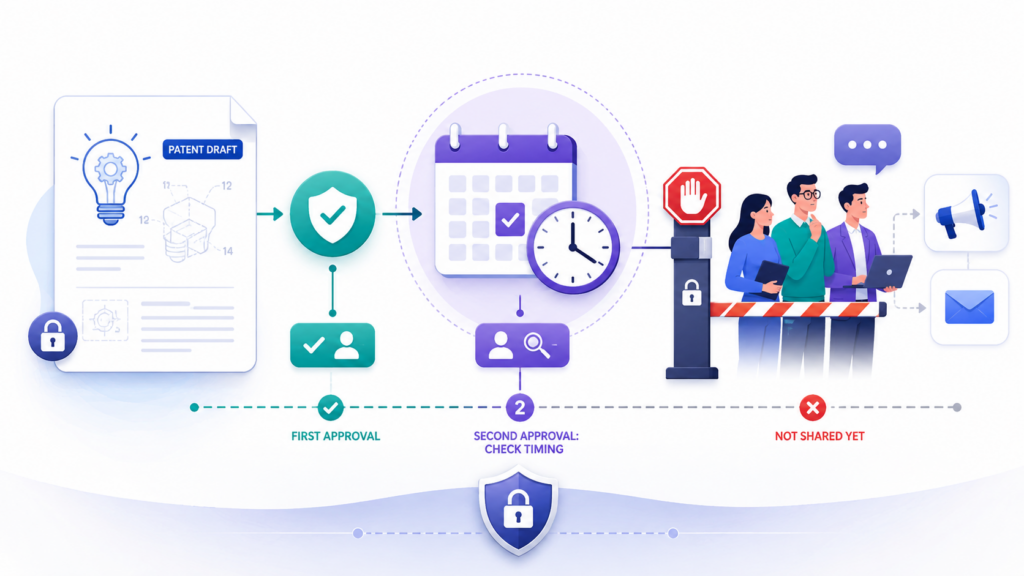
This is where many startups get into trouble because the product team wants to demo, the sales team wants to pitch, the founder wants to raise, and the engineering team wants to publish a post or ship a feature.
All of that can be smart business. But if the team has not yet filed, those public moves can create risk.
Patent filing approval is not only about saying, “This draft looks good.” It is also about saying, “We are safe to move forward with this public step.”
That means the timing review should happen before launch, before a public demo, before a conference talk, before a customer pilot that is not under a clear private agreement, and before any blog post that explains how the invention works.
A strong approval process treats timing like a real company control. It does not leave timing to chance. It does not assume the legal team will hear about a launch by magic.
It builds a simple habit: before the invention is shown outside the company, someone confirms whether a filing should happen first.
This does not mean every idea needs a patent filing before anyone talks. That would slow the company down. The better rule is more practical.
If the thing being shown includes the technical edge you may want to protect, then the team should pause long enough to review filing timing.
PowerPatent helps founders move through this faster because the process can start from the real invention materials the team already has, like product notes, code details, system flows, and inventor input.
With smart software and real attorney oversight, the filing path becomes less of a drag on launch speed. You can see the workflow here: https://powerpatent.com/how-it-works
The founder should approve whether the filing must happen before a public move.
The founder is usually the right person to own this timing choice because the founder sees the full business plan. The engineer may know what is new. The attorney may know what needs to be filed.
But the founder knows whether the company is about to raise money, announce a partnership, publish a launch post, or open access to the product.
That timing call matters because a patent filing is often strongest when it happens before public disclosure.
The rules can vary by country, and even in the United States there are time limits and risks that should not be handled casually. A founder does not need to master every rule. The founder needs to make sure the team asks the question early enough.
The best time to ask is not the night before launch. It is when the launch plan is being built. If the product roadmap says a major technical feature is going live in four weeks, the patent review should start then.
If a fundraising deck includes a deep tech slide, the review should start before that deck is widely shared. If the company is preparing a technical white paper, the review should happen before the paper is posted.
This review is not meant to slow the company. It is meant to stop a painful mistake that could have been avoided with one clear check.
The timing approval should be tied to real company events, not vague legal dates.
A weak approval process says, “We should file soon.” A strong process says, “We need to decide before the demo on March 12,” or, “We need attorney review before the launch post is approved.” The more real the event, the easier it is for the team to act.
This is why every startup should connect patent review to normal company motion. Product launch, public beta, investor pitch, customer rollout, press briefing, open-source release, research post, app store submission, and conference talk are all moments that can trigger a filing review.
The decision may be to file a provisional application, file a non-provisional application, keep the matter as a trade secret, or take no action. But the team should not drift into the answer. It should make the choice with eyes open.
A provisional application can be useful when the team wants to secure an early filing date while the invention is still moving.
The USPTO explains that a provisional application can be filed without a formal patent claim, oath or declaration, or information disclosure statement, though it still needs a proper description to be useful later.
The product lead should approve what can be shown and what should stay private.
The product lead plays a key role in timing because product teams often control demos, screenshots, workflows, help docs, release notes, and user-facing messages. Those materials can reveal more than people expect.
A release note may explain a feature in broad terms. That may be fine. But a technical blog post may explain the inner steps.
A demo video may show hidden flows. A help article may reveal how the system handles edge cases. A sales deck may show the architecture in enough detail for a sharp competitor to learn the core idea.
This is why the product lead should review outside-facing materials with the patent goal in mind. The question is not, “Is this good marketing?” The question is, “Does this disclose the thing we may still want to protect?”
That review should happen before the material is final. If the patent filing is already done, the product team may have more freedom.
If the filing is not done, the product team may need to keep the message higher level until the filing is in place.
The product lead should create a clean bridge between launch language and patent language.
Patent language and product language do not need to sound the same, but they should not fight each other.
If the product page says the system works one way and the patent draft says it works another way, the team should slow down and fix the mismatch.
This does not mean marketing copy must reveal the invention. In fact, it often should not. But internally, the product story and the patent story should point to the same truth.
The product lead can help make sure the patent captures the customer value while the public message stays simple and safe.
This is a very practical approval step. Before launch, the product lead should compare the public materials against the invention summary.
If the public material reveals the key technical method, the team should ask whether filing should come first. If the public material stays at the outcome level, the risk may be lower, but attorney review is still smart when the invention is important.
PowerPatent makes this easier because the same invention record can guide both the patent filing process and the internal review conversation.
Instead of hunting through scattered notes, the team can work from a clearer view of what is being protected. Learn more here: https://powerpatent.com/how-it-works
The Third Approval Should Confirm Inventorship Before Names Become a Problem.
After the invention and timing are clear, the team should confirm who actually invented the subject matter being filed. This is not a credit exercise.
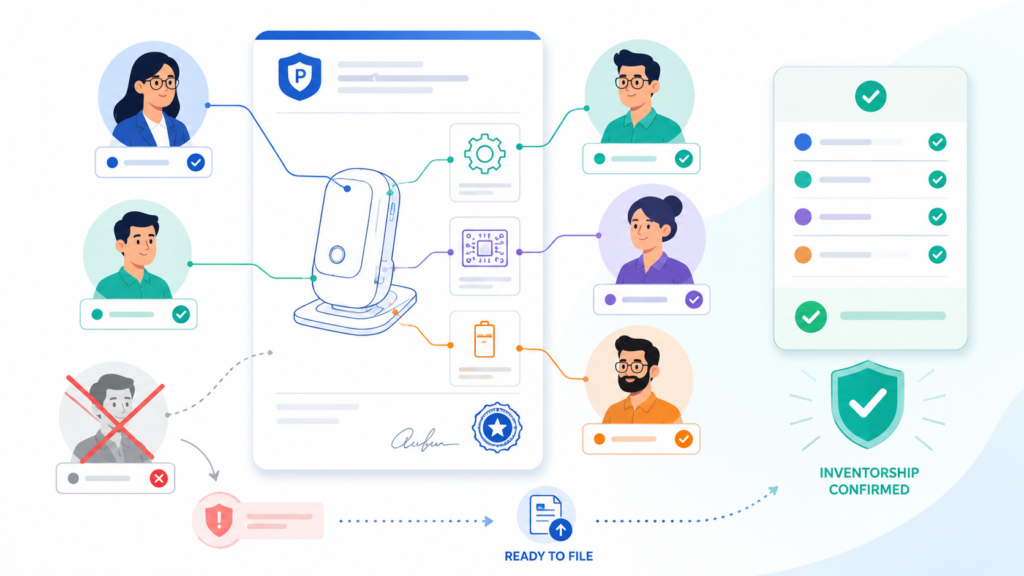
It is not about who worked the hardest, who managed the team, who funded the project, or who had the highest title. It is about who contributed to the actual invention described in the patent application.
This step can feel sensitive inside a startup because people care about recognition. But it is much better to handle it early and calmly than to fix it later under pressure.
Wrong inventorship can create delay, confusion, and hard feelings. It can also cause legal issues that are avoidable when the team asks the right questions at the right time.
The inventorship review should happen after the invention scope is clear, because you cannot name inventors well if you do not know what the filing is actually about.
If the patent covers the model training method, the inventors may be different from the people who built the user interface. If the filing covers a new data routing system, the inventors may be the people who designed that system, not everyone who worked on the product.
A clean inventorship review is simple in spirit. It asks each possible inventor what they contributed to the claimed invention.
It checks whether that contribution is part of what the patent application is trying to protect. It does not turn into a popularity contest.
The technical lead should help map people to the actual invention.
The technical lead often has the best view of who contributed what. They know who proposed the key method, who solved the hard block, who changed the system design, and who simply implemented normal parts after the inventive concept was already set.
This matters because patent inventorship is tied to contribution to the invention, not general work on the product. A person can be a major engineer on the product and still not be an inventor on a specific filing.
Another person may have made one key design contribution and properly belong on the filing.
The technical lead should review the invention summary and then walk through the real build history. Who first proposed the approach? Who changed it in a meaningful way? Who solved the issue that made it work? Who added a technical feature that is now part of the filing? Who only followed instructions after the core idea was set?
This review should be done with care. The point is not to shrink the inventor list. The point is to make it accurate.
The inventorship review should be based on contribution, not job title.
Founders often assume they should be named because they started the company. Managers may assume they should be named because they led the work.
Engineers may assume the whole team should be named because everyone helped ship the feature. Those assumptions can be wrong.
The better approach is to ask a simple question: did this person help create the invention that the patent application is trying to protect?
If the answer is yes, they should be considered. If the answer is no, they should not be added just to be nice. Adding someone who did not invent can be as risky as leaving out someone who did.
The USPTO’s application materials make clear that a non-provisional utility application includes an oath or declaration, and the rules around naming inventors are part of the formal filing process.
That is why inventorship should not be guessed at the end. It should be checked before final filing approval.
The attorney should make the final inventorship call after hearing the facts.
The team can gather facts, but the patent attorney should guide the final inventorship decision. This is because inventorship depends on the legal scope of the invention and the claims being filed.
The same project may support different patent applications with different inventor lists.
For example, one application may cover a backend method. Another may cover a user workflow. A third may cover model monitoring.
Each may have different contributors. If the team names the same people on every filing without checking the actual invention, mistakes can creep in.
This is also why inventorship review should not be finished too early. If the claims change a lot, the inventor list may need to be checked again.
A person who contributed to an idea that was removed may no longer belong. A person who contributed to a feature that became central may need to be added.
The attorney should ask targeted questions, not broad ones. “Who worked on this product?” is too wide. “Who contributed to the adaptive routing step described here?” is better. “Who created the rule for model fallback under these conditions?” is even better.
The final inventorship approval should happen after claim strategy is stable.
Inventorship is tied to what the application claims and describes. So the best final review happens when the claims are stable enough for filing.
That does not mean the application will never change. Patent applications often change during examination. But before filing, the team should know what it is trying to protect.
This is where PowerPatent’s attorney-backed workflow helps. It gives technical teams a smoother way to capture who did what, while still keeping attorney review in the loop.
That is much better than asking busy engineers to remember six months of invention history at the last minute. See how PowerPatent supports a cleaner process here: https://powerpatent.com/how-it-works
The founder should make sure ownership is handled, not assumed.
Inventorship and ownership are not the same thing. The inventor is the person who made the inventive contribution. The owner is the person or company that holds rights in the patent application.
In a startup, the company usually wants to own the patent rights, but that should be handled with proper agreements and records.
This is a major approval point. Before filing or soon after, the company should confirm that inventor assignment obligations are in place.
If an inventor is an employee, contractor, advisor, university researcher, agency developer, or former team member, the ownership path may not be as simple as the founder assumes.
The USPTO notes that patents and patent applications can be assigned by a written instrument, and that the Office maintains a register for recording interests in patents and applications.
The practical lesson for founders is clear: do not treat ownership as a handshake memory.
Ownership review should happen before fundraising, diligence, or acquisition talks.
Investors and buyers care about whether the company owns what it says it owns. A patent application can look impressive in a pitch deck, but if assignments are missing, the story gets weaker fast.
The founder or operations lead should confirm that every inventor has signed the right company documents.
This may include invention assignment agreements, employment agreements, contractor agreements, advisor agreements, or later patent assignment documents. The exact documents depend on the company and should be handled with counsel.
This review should not wait until due diligence. By then, a former contractor may be hard to reach. A former employee may be annoyed.
A university or prior employer issue may take time to untangle. The clean move is to handle ownership while the team is still close to the filing.
The Fourth Approval Should Review the Draft for Technical Strength, Not Just Typos.
Once the patent draft exists, the review should become more exact. At this point, many teams make a poor choice.
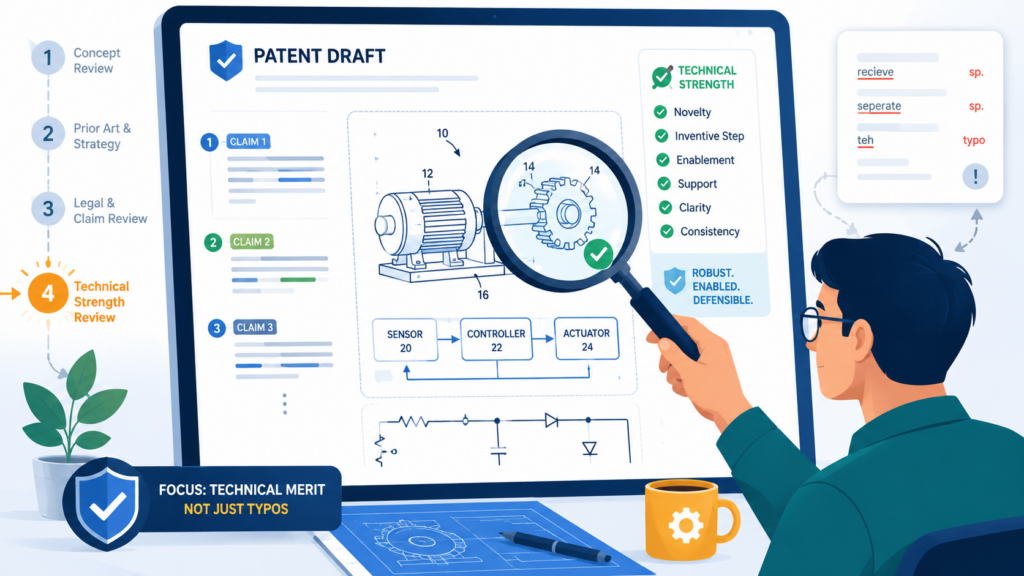
They send the draft around and ask, “Any comments?” That sounds efficient, but it creates weak review. People skim. They fix wording. They ignore claim scope. They assume someone else checked the important parts.
A better review assigns each person a clear role. The inventor checks technical truth. The engineering lead checks depth and accuracy.
The product lead checks use cases. The founder checks business fit. The attorney checks legal strength and filing readiness.
The draft review should not become a giant group edit. Too many voices can blur the filing. The goal is not to make every sentence sound like the company website. The goal is to make sure the patent application supports strong protection for the invention.
This is where a startup needs discipline. The team may be busy. The product may have changed since the first invention notes were captured. New versions may exist.
Competitor products may have appeared. The draft review is the moment to catch those changes before the filing goes in.
The inventor should read the detailed description like a system test.
The inventor’s draft review should be slow enough to catch mistakes but focused enough to avoid wasting time.
The inventor should not try to rewrite the application in legal language. Instead, the inventor should test the draft against the real system.
Does the draft describe the required steps correctly? Does it include optional versions? Does it avoid saying “always” when the system only does that in one version? Does it explain the part that was hard to build?
Does it include enough detail for the invention to make sense? Does it leave out a key fallback, training step, signal, rule, data change, or control flow?
These questions matter because the detailed description supports the patent claims. If the description is thin, the claims may have less room to stand.
If the description is too narrow, the patent may not cover future versions. If the description is wrong, the team may have to live with those words later.
The inventor should look for hidden limits that could shrink the patent.
Hidden limits are small words that can cause big trouble. Words like “must,” “only,” “always,” “required,” and “single” can narrow the invention if they are not true. Sometimes those words are needed. Often they are not.
For example, a draft might say the system “always trains the model using user feedback.” But maybe the system can also train using synthetic data, expert labels, event logs, or third-party signals. If the draft says “always,” it may make the invention sound smaller than it is.
A draft might say the method runs on a mobile device. But maybe it can run on a server, edge device, browser, private cloud, or embedded system.
If the platform is not the invention, the draft should avoid locking the idea to one platform.
This is why inventor review should happen before final attorney review. The inventor catches technical limits. The attorney then decides how to shape the wording in a way that supports the filing.
The engineering lead should test whether the draft covers likely design-arounds.
A design-around is a way a competitor may try to copy the value while changing the details.
The engineering lead is often very good at seeing those paths. They know which parts are required and which parts can be swapped.
This review is strategic. The engineering lead should ask, “If I wanted to build the same result without copying this exact version, what would I change?”
Then the team should check whether the draft supports broader language around those changes.
For example, if the invention uses one type of neural network, could another model type do the same job? If it uses a certain database, could another storage layer work? If it uses a threshold, could a scoring function replace it? If it uses a user action, could the same result be triggered automatically?
The patent application should not claim things the team did not invent. But it should avoid being trapped in one narrow build when the real invention is broader.
The best engineering review protects the principle, not just the prototype.
A prototype is one version of the idea. A patent application should often protect the deeper method or system behind that version. That requires the engineering lead to explain what can change while the invention still works.
This does not mean the application should be vague. Vague patents are not strong. The filing should give enough real detail to support the invention.
But it should also include meaningful variations when those variations are part of the team’s real insight.
The USPTO filing guide states that a non-provisional utility application must include a specification with a description and claim or claims, drawings when needed, an oath or declaration, and required fees.
For founders, the practical point is that the words and drawings are not side items. They are the foundation of the application.
This is where PowerPatent can help a technical team move faster without losing detail.
The platform helps turn real invention inputs into a more organized filing process, while patent attorneys oversee the result. See how this works here: https://powerpatent.com/how-it-works
The product lead should check that the draft includes the right user and business contexts.
Some patents fail to capture value because they only describe internal machinery. The product lead can help connect the invention to the real-world setting where it matters.
This does not mean adding marketing claims. It means making sure the application describes useful operating environments, user actions, system outcomes, and deployment paths.
For example, an invention may help reduce false alerts in a security platform. The technical method matters, but the filing may also need to describe how alerts are reviewed, ranked, suppressed, grouped, or sent to different users.
An invention may improve data sync across tools. The filing may need to show how that sync helps admins, developers, or automated systems.
The product lead should not try to turn the patent into a product brochure. The product lead should check whether the draft reflects how the invention creates value in actual use.
Product review should make the filing harder to outgrow.
Startups change fast. A product may begin as a dashboard, become an API, and later become an automation layer. If the patent only describes the first dashboard version, it may age badly.
The product lead can help by pointing out near-term roadmap paths. If the team already knows the invention may support enterprise workflows, developer tools, agent systems, mobile flows, or marketplace integrations, those contexts may be worth discussing with the attorney.
This is not about stuffing the draft with guesses. It is about capturing real planned versions while the filing is still being prepared.
A patent application cannot be fixed later by adding brand-new matter after filing, so the team should take the draft review seriously before submission.
The Fifth Approval Should Focus on Claims Because Claims Decide the Real Fence.
The claims are the heart of the patent application. The rest of the application explains the invention, but the claims define the fence the team is trying to build.
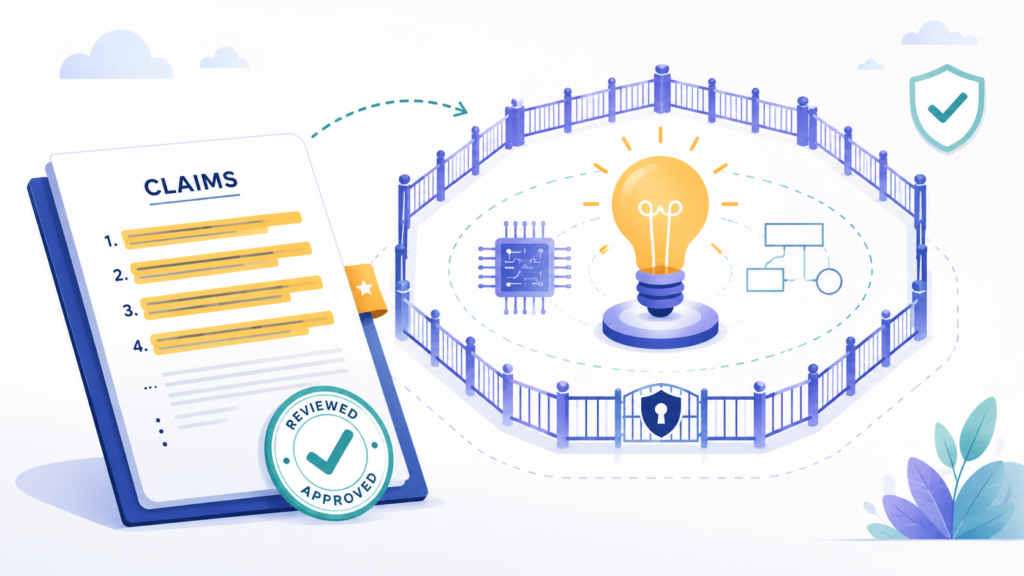
For founders, this is the part that deserves special attention even if the language feels strange.
Claims can be hard to read because they use a formal style. That does not mean the team should ignore them.
It means the attorney should explain them in plain words, and the team should review them against the business goal and technical truth.
A smart patent approval process includes a claim review before filing. This does not mean every founder needs to become a patent lawyer. It means the founder, inventor, and attorney should align on what the claims are trying to cover.
The worst claim review is a silent one. The attorney sends claims. The team sees dense language. Nobody wants to look foolish.
Everyone says yes. Then months later, the founder learns the claims were aimed at the wrong feature or too narrow to matter.
The better way is to translate each key claim into plain English. What does this claim cover? What does it leave out? What would a competitor need to do to avoid it? Does it match the product, the roadmap, and the business moat?
The attorney should explain the claim strategy in simple business terms.
The attorney should not only send claim text. They should explain the strategy. This is especially important for startup founders who need to make fast choices with limited resources.
A claim strategy may focus on the core method, the system, the computer-readable medium, the workflow, the data structure, the model operation, the training process, the control logic, or another technical layer. The right focus depends on the invention and the business goal.
For example, if the company’s edge is a backend decision engine, the claims should not focus only on the user interface.
If the edge is a new model monitoring method, the claims should not only describe a broad AI platform. If the value is in how data is cleaned and routed before prediction, the claims should not stop at the final output.
The attorney should tell the team where the strongest protection likely sits and why.
The claim review should ask what a competitor would copy first.
This is one of the most useful claim review questions. If a competitor wanted the benefit of your invention, what would they copy first? The answer often reveals whether the claims are aimed at the right target.
If the claims focus on a nice-to-have feature while the competitor would copy the core engine, the claims need work.
If the claims are limited to a workflow that is not the main value, the team should say so. If the claims miss a key technical step that makes the invention work, the inventor should flag it.
The claims do not need to cover every possible thing. But they should be centered on the value that matters most.
The USPTO explains that a non-provisional utility application includes claim or claims as part of the required specification package.
That sounds basic, but the business lesson is large. Claims are not a formality. They are the part of the filing that most directly shapes what protection the company is seeking.
The founder should approve the claim target, not every legal phrase.
A founder does not need to edit claim grammar. That is the attorney’s job. The founder’s job is to approve the claim target.
The founder should ask whether the claims protect the company’s most valuable layer.
That layer may be the algorithm, the data flow, the automation method, the model control system, the hardware-software interaction, the training loop, or the way the product solves a hard customer problem.
The founder should also ask whether the claims support the company’s future story. If the startup is building a platform, claims that only cover one small feature may not be enough.
If the startup is trying to protect a narrow breakthrough, very broad platform claims may miss the point or face issues later.
This is why claim approval should not be rushed. It should be direct, plain, and tied to the business plan.
The founder should ask for a plain-English claim map before final approval.
A plain-English claim map is a simple explanation of what each main claim is trying to cover. It does not need to be long. It needs to be clear.
The attorney might explain that one claim covers the main method, another covers a system that performs the method, and another covers stored instructions that cause a computer to perform the method.
The attorney might explain which claim is broad, which is narrower, and which features are being used as fallback positions.
This helps the founder make a real approval decision. Without that explanation, the founder may approve claims they do not understand.
With it, the founder can say, “Yes, this protects the core engine,” or, “No, we are missing the part investors care about.”
PowerPatent’s model is built around this need for clarity. Founders should not feel lost in legal text.
They should understand what is being protected and why, with real attorney oversight guiding the filing. Start here: https://powerpatent.com/how-it-works
The inventor should confirm that the claims are broad but still true.
Claims should be broad enough to matter, but they must still be supported by the invention. The inventor helps keep that balance honest.
If a claim is so broad that it no longer reflects what the team invented, the inventor should say so. If a claim is so narrow that it only covers one demo version, the inventor should say that too. The attorney can then adjust the claim set.
This is a healthy tension. The attorney may push for useful breadth. The inventor may push for technical accuracy. The founder may push for business value. The best claim set comes from aligning all three.
Claims should not be approved until the team understands the tradeoff.
Broad claims may face more pushback. Narrow claims may be easier to explain but less valuable.
Claims with many details may be safer in some ways but easier to design around. Claims with fewer details may be stronger if supported, but they need careful drafting.
The team does not need to solve all of this alone. But it should understand the tradeoff before filing. A patent application is a strategic asset, not just a document upload.
The Sixth Approval Should Make Sure the Filing Package Is Complete and Clean.
The final pre-filing approval is about filing readiness. At this point, the team should not be debating the whole invention from scratch.
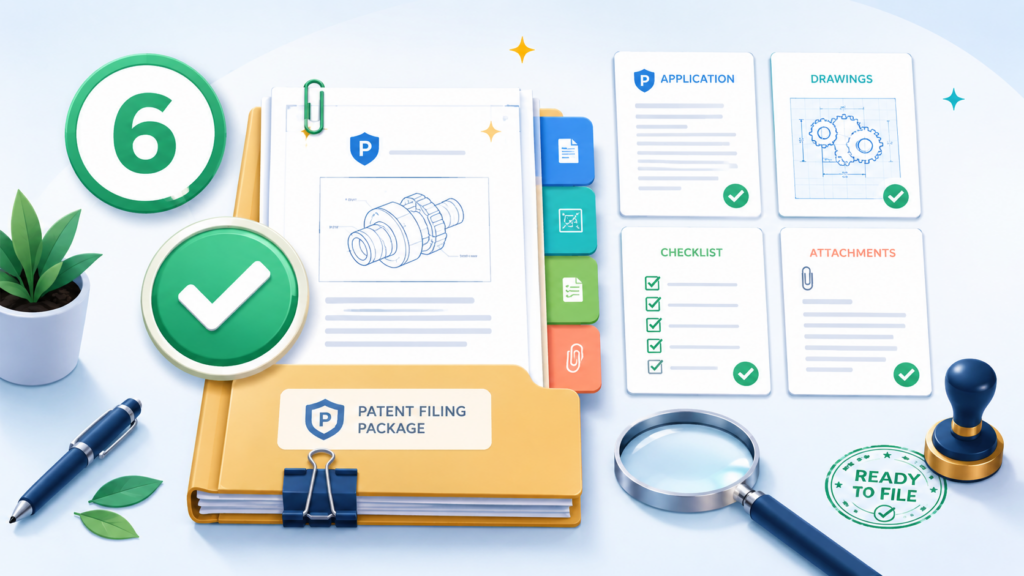
The major choices should already be made. The final check should confirm that the application is complete, accurate, internally consistent, and ready to submit.
This is where details matter. Names must be correct. Entity information must be right. Drawings should match the description. The title should fit the invention.
The priority claim, if any, should be checked. The filing type should be clear. The right people should know what is being filed. The attorney should confirm that the package matches the strategy.
For a startup, this final step can feel boring compared to the invention work. But boring details can create real pain when they are wrong.
A misspelled inventor name, wrong company name, missing drawing, inconsistent term, or outdated draft can cause delay and confusion.
The final approval should be owned by the attorney or patent operations lead, with quick signoff from the founder and inventors only on the areas that need their review. This keeps the process fast without making it careless.
The attorney should own final filing readiness.
The attorney should be the final gatekeeper for the filing package. That means checking that the application is ready for the chosen filing path and that the required pieces are present.
For a non-provisional utility application, the USPTO states that the application must include a specification with a description and claim or claims, drawings when necessary, an oath or declaration, and the required filing, search, and examination fees.
For a provisional application, the USPTO explains that the filing can be made without formal patent claims, an oath or declaration, or an information disclosure statement, but the disclosure still needs to support the invention.
The founder does not need to check every rule. The attorney should. But the founder should understand the filing path well enough to know what is being submitted and why.
Final filing approval should not reopen strategy unless something is wrong.
At the final stage, the team should avoid a full reset. If someone suddenly asks, “Are we sure this is the right invention?” that means the earlier process failed or new facts appeared. Sometimes a reset is needed. But it should not be normal.
A clean process lets final approval stay focused. The inventor confirms the final draft still describes the invention correctly.
The founder confirms the filing still matches the business goal. The attorney confirms the package is ready. The operations lead confirms signatures, assignments, and company records are moving.
This final approval should be calm. If it feels chaotic, that is a sign the review process started too late.
The operations lead should check signatures, company names, and ownership records.
Many startups do not have a patent operations person. That is fine. The work may be handled by a founder, chief of staff, legal ops person, outside counsel, or platform workflow. What matters is that someone owns the records.
This person should check the company name, inventor names, addresses when needed, assignment status, engagement records, and internal approval trail.
They should know where the final filed copy will live. They should know who needs notice after filing. They should know whether the filing ties to a product launch, funding round, or board update.
This is not just admin work. It protects the company’s future story.
If an investor later asks what was filed and who owns it, the company should not scramble through inboxes.
If a buyer later asks for the patent chain of title, the company should not depend on memory. If a founder later needs to file related applications, the earlier records should be easy to find.
The best filing record tells the story six months later.
A good filing record should answer simple questions. What was filed? When was it filed? Who were the inventors? What product or invention did it cover? Which public launch or business event did it support? Where are the final documents? Are assignments handled? Who approved the filing?
These answers should not live only in one attorney’s inbox or one founder’s memory. Startups move too fast for that.
People change roles. Engineers leave. Products shift. Funding rounds happen. The patent record should be clean enough that the company can understand it later without detective work.
PowerPatent helps make this less painful by giving teams a more organized path from invention intake to attorney-backed filing.
That can save founders from scattered files, unclear comments, and last-minute confusion. See how it works here: https://powerpatent.com/how-it-works
The founder should approve the final business go-ahead.
The founder’s final approval is not a line edit. It is a business go-ahead. The founder should confirm that this filing still makes sense for the company right now.
That means checking whether the filing supports the product plan, fundraising story, competitive moat, launch schedule, or long-term patent strategy.
It also means confirming that the cost and timing are acceptable. A filing may be valuable, but the founder still needs to make a business decision.
This final approval should be short because the deeper review already happened. The founder should not be learning the invention for the first time at the final stage. They should be confirming the choice.
The final go-ahead should create confidence, not confusion.
A good patent filing process should end with the team feeling clear. The inventor knows the technology was captured correctly.
The founder knows the filing supports the business. The attorney knows the package is ready. The operations lead knows the records are in order.
That is the whole point of approvals. They are not meant to create delay. They are meant to create trust.
When patent approvals are clear, founders can keep building without wondering whether they missed something important.
Engineers can give useful input without drowning in legal text. Attorneys can draft with better facts. The company can move faster because the path is clean.
PowerPatent was built for this kind of modern patent work: smart software, real attorney oversight, and a process that helps startups protect what they are building without losing momentum.
Learn how to make patent filing easier here: https://powerpatent.com/how-it-works
The Seventh Approval Should Decide What Must Stay Secret After Filing.
Filing a patent application does not mean the team can now share everything. This is one of the most common mistakes startups make after filing.
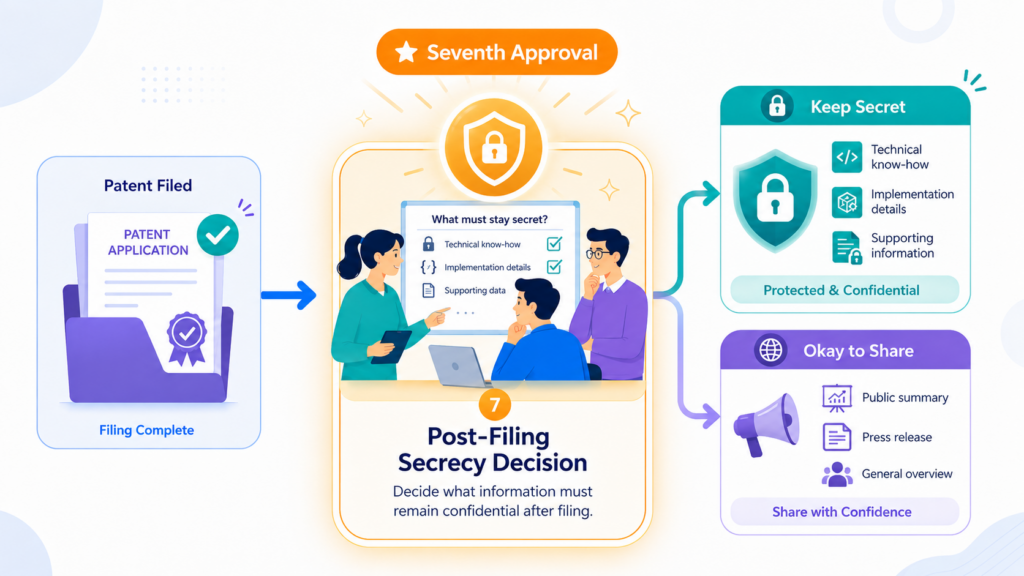
They think the filing is done, so the whole invention is safe to talk about in public. That is not always true.
A patent filing protects what is actually described and claimed or later claimable from that description.
It does not protect every future feature, every private method, every secret model setting, every customer data process, or every new version the team builds after the filing date. If the team keeps improving the product, there may be fresh ideas that are not yet covered.
That is why the post-filing approval step matters. The team should decide what is now safe to share, what should stay private, and what needs a new review before it goes outside the company.
This approval should happen right after filing, not months later. The founder, product lead, engineering lead, and attorney should align on the boundary. The question is simple: what did we file, and what did we not file?
This is especially important for AI, software, robotics, biotech tools, semiconductor tools, cloud systems, data platforms, medical devices, and other technical products where improvements happen fast.
A filing may cover the first major invention, but the team may already be building the next layer.
PowerPatent helps teams keep this cleaner by making the invention record easier to organize and review with real patent attorney oversight.
When the team knows what was filed, it can make smarter choices about what to share next. See how PowerPatent works here: https://powerpatent.com/how-it-works
The attorney should explain the filing boundary in plain words.
After filing, the attorney should give the team a simple summary of what the application covers. This does not need to be long or full of legal terms.
It should tell the team what the filing is mainly about, what examples it includes, what technical areas it supports, and what may need more review before public sharing.
This summary is useful because most founders and engineers will not remember every detail of the final filing.
They may remember the broad idea, but they may not remember which versions were included, which diagrams were filed, or which fallback options were described.
A plain summary helps the company avoid false confidence. It can stop a product manager from publishing a deep post about a feature that was not covered.
It can stop an engineer from open-sourcing code that includes a new method. It can stop a founder from showing an unreleased architecture slide in a pitch deck before the next filing is ready.
The attorney’s job here is not to scare the team. It is to give them a usable map.
The post-filing summary should separate covered ideas from new ideas.
A useful post-filing summary should make the line clear between the invention that was filed and the improvements that came later or were left out.
This line can be simple. It may say that the filing covers the core scoring workflow, but not the new multi-agent routing layer.
It may say that the filing covers the training loop, but not the new deployment monitor. It may say that the filing covers the sensor calibration method, but not the hardware enclosure design.
That kind of plain explanation gives the team real power. They can move faster because they know where the risks are.
Without this step, teams often go back to guesswork. Someone says, “I think the patent covers this.” Someone else says, “I am pretty sure we filed on that.” Then the company shares more than it should.
Patent strategy should not depend on memory. It should depend on clear records and clean approvals.
The product lead should review public materials after the filing, not just before it.
Many teams do a careful review before filing and then stop. That is not enough. The product may launch after the filing. The website may change. Sales decks may be updated.
The help center may add technical pages. The founder may give a conference talk. Engineers may write a build post.
Each of those public materials can reveal fresh details. Even if the first filing is done, the team should still review whether the new material matches what was filed.
This does not mean every tweet, post, or product page needs attorney review. That would be too slow. But public materials that explain how the core technology works should get a second look.
The product lead is the best owner for this because they are close to launch assets. They know what customers will see. They know which pages explain outcomes and which pages explain mechanics. They know whether a demo shows the surface of the product or exposes the deeper system.
The public message should sell the benefit without exposing every method.
Strong product copy does not need to reveal the secret sauce. In fact, the best public messaging often focuses on the pain, the result, and the trust story. It does not need to explain every technical step.
For example, a company can say that its tool helps teams review complex code faster without explaining the full model orchestration system behind the review.
A medical device startup can explain that its system helps improve signal clarity without publishing every calibration rule.
A data startup can say that it reduces duplicate records without showing every matching method.
This is where product and patent strategy work together. The patent filing protects the invention. The public message creates demand. Those two goals should support each other, not collide.
PowerPatent is helpful here because it gives startups a clearer path for turning inventions into filings while keeping speed in the business.
When the team understands what has been protected, it can speak with more confidence. Learn more here: https://powerpatent.com/how-it-works
The engineering lead should create a review trigger for new technical improvements.
After filing, engineers keep building. That is the job. But the company needs a simple way to notice when a new invention appears.
This should not be a heavy process. It should be a light trigger built into the team’s normal rhythm.
When a new system design solves a hard problem, when a model change creates a major performance jump, when a data method opens a new market, when a device works in a new way, or when a customer workflow becomes much more automated, the team should flag it for patent review.
The engineering lead can help by watching for these moments during sprint planning, architecture reviews, product reviews, and release planning.
The question does not need to be formal. It can be as simple as, “Did we just create something worth protecting?”
That question can save a company a lot of trouble.
The best review trigger is tied to technical change, not legal fear.
Engineers do not want to stop every time they write code. They do not want patent review to feel like a blocker. So the trigger should be tied to meaningful technical change, not fear.
A good trigger happens when the team solves a problem in a way that was not obvious, when the solution may be hard for competitors to copy without doing the same thing, when the feature becomes central to the product, or when the company plans to share the idea outside the company.
That makes the process practical. Engineers can keep building, while the company still catches important inventions early enough to protect them.
The goal is not to patent everything. The goal is to notice the things that matter before they become public or forgotten.
The Eighth Approval Should Decide Whether to File More Than One Application.
Many teams try to squeeze too much into one patent application. They have one big product, so they want one big filing. That can work in some cases, but it is often not the best strategy.
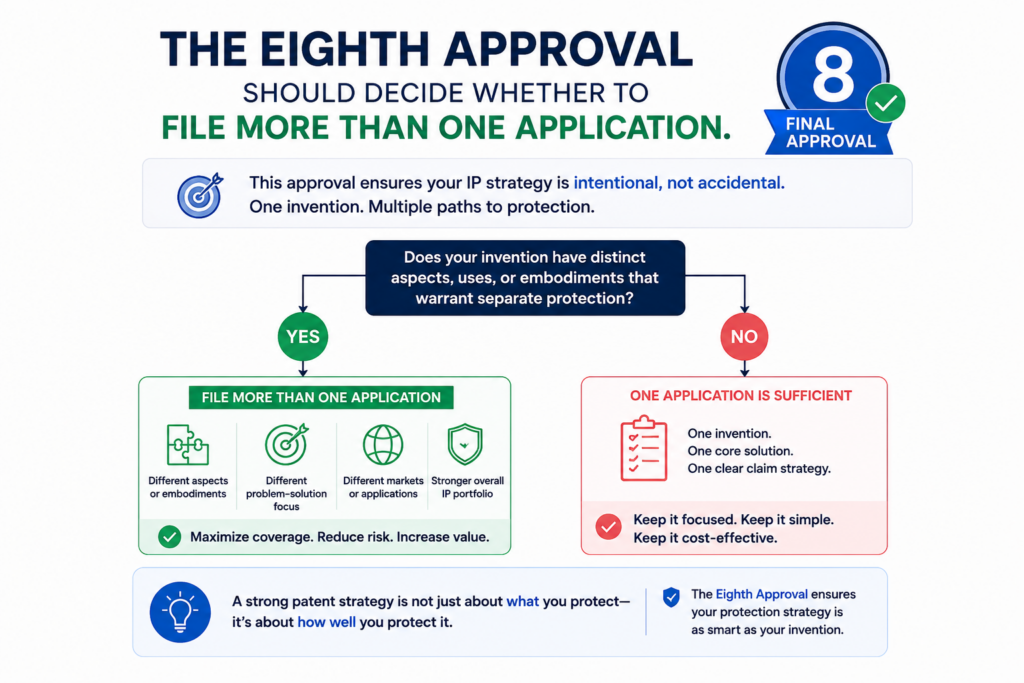
A product may contain several inventions. One may sit in the backend system. One may sit in the model training process. One may sit in the user workflow. One may sit in the data pipeline.
One may sit in the hardware layout. One may sit in the control logic. If all of those are forced into one filing without care, the application may become unfocused.
The eighth approval should ask whether the company needs one filing or a group of filings. This is a strategic decision. It should involve the founder, attorney, technical lead, and sometimes the product lead.
The answer depends on the business goal, the invention scope, the budget, the timing, and the competitive risk. A startup does not always need many filings. But it should understand when one filing is doing too much work.
This matters most for deep tech companies, AI startups, robotics teams, advanced manufacturing companies, chip startups, climate tech teams, and software platforms where one product may include many patentable layers.
The founder should decide whether the filing strategy matches the company’s moat.
A moat is the thing that makes the company hard to copy. For some companies, the moat is one breakthrough. For others, it is a stack of small technical advantages that work together. The filing strategy should match that reality.
If the company’s moat is a core model training method, one strong filing may be the right first move. If the moat is a full platform with several technical layers, one filing may not be enough.
If the company is entering a crowded market, it may need filings around the parts competitors are most likely to copy.
The founder should not approve a filing strategy just because it is cheaper or faster. Cost matters, of course. But a cheap filing that misses the company’s real edge may not help much later.
A better question is: what protection would make the company stronger in fundraising, partnerships, hiring, sales, and future exits?
That question keeps the patent plan tied to company value.
A single filing should not be used to hide a weak strategy.
Sometimes teams say, “Let’s put everything in one provisional and figure it out later.” That can be a useful emergency move when launch is near and time is short. But it should not become the full strategy by default.
A broad provisional may help secure an early date for what it properly describes. But the company still needs to decide how to turn that early filing into a stronger plan.
Before the one-year provisional window ends, the team may need to file a non-provisional application, split inventions, add new filings for improvements, or make other choices with counsel.
The danger is thinking the first filing solved every future problem. It did not. It created a starting point. The team still needs a plan.
This is where PowerPatent can support founders with a cleaner workflow and real attorney oversight, so the team can move from raw invention material to a smarter filing path. See how PowerPatent helps here: https://powerpatent.com/how-it-works
The attorney should identify whether the application contains several invention groups.
The patent attorney should review whether the draft contains one main invention or multiple invention groups. This matters because patent offices may require the applicant to focus on one invention in one application if the filing contains distinct inventions.
Even before that happens, the team should know whether the filing is trying to cover several different ideas.
For example, a filing may describe a new data cleaning method, a new model selection method, and a new user permission system.
These may all be part of one product, but they may not be one invention. The attorney can help decide whether they belong together or should become separate filings.
This review is not only about rules. It is about strategy. Separate filings may allow sharper claims, clearer examination, and better alignment with business goals. But they also cost more and require more management. The answer should be practical, not automatic.
The attorney should explain the tradeoff between focus and coverage.
A focused filing can be easier to understand and may support stronger claim strategy around one invention.
A broader filing may capture more material early, which can be useful when the product is moving quickly. Both paths can make sense.
The attorney should explain what the team gains and loses with each option. If the company files one application, what might be too thin? If it files several, what will each one protect? If budget only allows one now, what should be saved for the next filing?
This conversation should happen before final filing approval, not after. Once the application is filed, the team may still have options, but some choices become more limited or more costly.
The product lead should connect filing groups to product lines and roadmap layers.
The product lead can help decide whether separate filings match how the company actually sells and builds the product. A single technical platform may power several product lines.
A single customer workflow may rely on several backend inventions. A future enterprise version may use a different technical path than the first self-serve version.
This product view can make the filing strategy sharper. Instead of filing around random technical pieces, the company can file around the layers that map to product value.
For example, one filing may protect the core engine. Another may protect the enterprise workflow.
Another may protect the developer integration layer. Another may protect the safety or compliance system. This kind of structure can help the company tell a clearer IP story later.
The roadmap can reveal which inventions need protection first.
Not every invention has the same urgency. If a feature will launch next month, it may need review now. If a deeper platform improvement will stay private for six months, it may have more time.
If a feature is central to a fundraising story, it may need faster action. If a feature is experimental and may be dropped, it may not deserve filing yet.
The product lead helps rank these choices. That is important because startups cannot protect everything at once. They need to protect the right things in the right order.
A good patent approval process does not ask, “Can we file?” It asks, “What should we file first, and why?”
The Ninth Approval Should Review Prior Work Without Letting It Kill Momentum.
Prior work review is one of the most misunderstood parts of patent filing. Founders often fear it because they think any similar product means they cannot file.
Engineers may avoid it because they do not want to spend days searching papers and patents. Attorneys need it because close prior work helps shape better claims.
The goal is not to prove that nobody has ever done anything similar. That is usually impossible. The goal is to understand the closest known work well enough to draft with care.
This approval should happen before claim strategy is final. It should involve the inventors, technical lead, and attorney.
The team should share known papers, products, patents, open-source tools, competitor systems, customer comments, standards, and internal references that may be close to the invention.
This is not a reason to stop. It is a reason to get sharper.
When prior work is handled well, it can make the patent stronger because the team can focus on the real difference. When it is ignored, the filing may claim too broadly, miss the true inventive step, or run into avoidable problems later.
The inventor should share known close work early and openly.
Inventors often know the closest work better than anyone. They know what papers they read, what tools they tested, what systems failed, what competitor products inspired concern, and what older methods the team improved.
That knowledge should be shared early. The inventor should not hold back because they worry it will ruin the patent. A good attorney needs those facts to write better claims.
If the invention is truly valuable, the difference often sits in the details. Maybe the prior tool used static rules, but your system adapts based on live signals.
Maybe the prior model worked only after manual labeling, but yours creates training data in a new way. Maybe the prior device needed factory calibration, but yours self-calibrates in the field.
Those differences are the story. The team cannot tell that story well if it hides the closest references.
Prior work should be used to sharpen the invention story.
A strong patent filing does not pretend the world was blank before the company arrived. It explains the invention in view of what came before.
That does not mean the application must include a long history lesson. It means the drafting should focus on the technical improvement that matters.
For example, instead of saying, “We invented automated review,” the team may say, “We invented a way to route review tasks based on confidence, risk, and changing model behavior.”
Instead of saying, “We invented a sensor system,” the team may say, “We invented a calibration method that adjusts based on field drift without requiring manual reset.”
That kind of focus makes the filing more useful. It also helps founders explain the invention to investors, partners, and future hires.
PowerPatent helps teams capture these details in a more structured way, so important invention facts do not get lost in scattered notes.
With attorney oversight, those facts can become a stronger filing. Start here: https://powerpatent.com/how-it-works
The attorney should decide how deep the search needs to be.
Not every filing needs the same level of search before filing. Some teams need a fast provisional before launch. Some need a deeper patentability review before spending more money.
Some need a freedom-to-operate review, which is different from a patentability search and should be handled separately. Some need a landscape view to understand a crowded market.
The attorney should help the founder decide how much review is enough for the current goal. The answer depends on timing, budget, risk, and the importance of the invention.
A fast startup filing may begin with inventor-known prior work and a focused attorney review. A major platform filing may deserve a deeper search. A company entering a heavily patented field may need more care.
The key is to make a conscious decision. Do not skip prior work review by accident. Do not overdo it so much that you miss a filing window.
Prior work review should not become an endless research project.
There is always one more paper, one more patent, one more competitor, and one more search term. At some point, the team needs to make a decision and file.
This is where founders need balance. The review should be serious enough to improve the filing, but not so open-ended that the company loses momentum. Patent strategy must serve the business, not freeze it.
The attorney can set a practical scope. For example, the team may review known references, run targeted searches around the core technical difference, and then draft claims that account for what was found.
That may be enough for an early filing. Later, the team can do deeper work if the asset becomes more important.
The founder should approve the risk level, not pretend risk is zero.
No patent filing comes with perfect certainty. Prior work may exist that the team has not seen. Patent examiners may find references later. Claims may need to change. Some ideas may be harder to protect than expected.
The founder’s job is not to demand certainty. The founder’s job is to approve a smart risk level.
If the invention is central to the company, it may be worth a deeper review. If the filing is defensive and tied to a fast launch, a lighter review may make sense.
If the company is about to raise money on the strength of the technology, the founder may want more confidence before making strong public statements.
This is a business decision, guided by legal advice.
The best approval says what the team knows and what it does not know.
A mature approval process is honest. It records what prior work was reviewed, what close references were found, what the team believes is different, and what questions remain.
That does not need to be a long document. It just needs to be clear enough that the team can understand the decision later.
This is very useful when the company revisits the filing during prosecution, fundraising, diligence, or related applications.
A clean risk record also helps avoid emotional decisions. The team is not saying, “This is definitely patentable forever.” It is saying, “Based on what we know now, this filing is worth moving forward.”
That is how strong startups make patent choices.
The Tenth Approval Should Align Patent Filing With Fundraising and Board Strategy.
Patent filings often matter far beyond the legal file. They can shape how investors see the company. They can support board discussions.
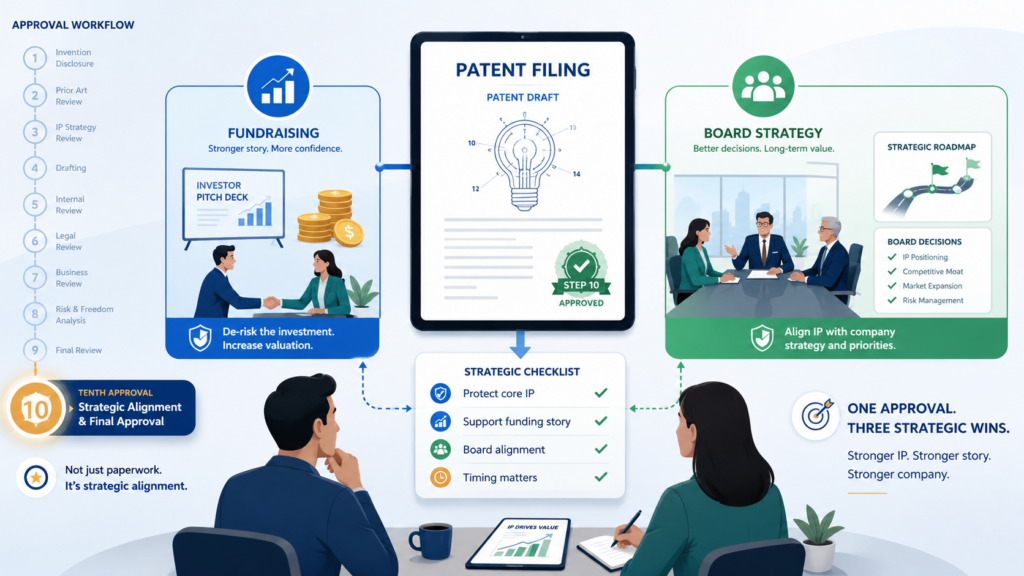
They can help explain why the startup has a real technical edge. They can give the team more confidence when talking to partners, buyers, or strategic investors.
This does not mean a patent application magically makes a company valuable. It does not. The product, team, market, traction, and execution still matter.
But a clear patent strategy can help show that the company is protecting the parts of the business that are hard to build and hard to copy.
That is why fundraising and board review should be part of the approval process for important filings. The founder should not treat patents as paperwork that sits outside the company story. The filing should connect to the bigger plan.
This approval should happen before major investor conversations when the invention is central to the pitch. It should also happen before board updates if the filing represents a major technical milestone.
The founder should decide how the filing supports the investor story.
Investors do not want to hear vague claims like, “We have IP.” They want to understand what the company has built that others cannot easily copy.
A patent filing can support that story when it is tied to a clear technical edge.
The founder should be able to explain the filing in simple words. What problem does it solve? Why was it hard? Why does it matter to customers? Why would a competitor care? How does it fit the product roadmap? What else might the company file later?
That explanation should not reveal private details that should stay confidential. It should give enough clarity to show that the company is thinking strategically.
PowerPatent can help founders get to that clearer story by combining smart invention capture with attorney-backed patent filing.
When the process is clear, the founder can speak about protection with more control and less guesswork. Learn how it works here: https://powerpatent.com/how-it-works
The patent story should be simple enough for a non-lawyer to repeat.
A strong investor-facing patent story is not full of legal terms. It is plain. It may sound like this: “We filed to protect the way our system learns from real-time failure signals and changes the workflow before errors reach the user.”
Or this: “We filed around the control method that lets our device adjust in the field without manual tuning.” Or this: “We filed on the routing layer that lets our AI system pick the right model based on risk, cost, and confidence.”
That kind of story is useful because people can remember it. They can repeat it inside their firm. They can connect it to the company’s edge.
A weak story says, “We filed a provisional.” That tells investors almost nothing. The filing type matters, but the protected advantage matters more.
The board or executive team should approve filings that affect budget and strategy.
Not every patent filing needs a board discussion. Early startups should not turn every invention decision into a formal meeting.
But filings that affect budget, timing, public launch, major partnerships, or long-term moat strategy should be visible to the right leaders.
The board or executive team may need to understand why the company is filing, what it is protecting, what it may cost over time, and how it fits the broader IP plan. Patent costs do not end at filing.
There may be later non-provisional filings, foreign filing decisions, office action responses, continuations, maintenance fees, and portfolio management choices.
The founder should not surprise the board with these costs later. A simple explanation early can build trust.
Strategic patent approvals should include the next decision point.
A filing is not the end of the road. It creates future choices. If the company files a provisional application, it will need to decide what to do before the one-year deadline.
If the company files a non-provisional application, it may later face examination steps. If the company wants protection outside the United States, it may need to make foreign filing decisions on a schedule.
The approval should name the next decision point so it does not sneak up on the team.
This is where many startups lose value. They file something, celebrate, and forget about it.
Then a deadline arrives, the product has changed, the team is busy, and nobody is ready. A strong approval process keeps the next step visible.
The attorney should prepare a founder-ready filing summary.
After an important filing, the attorney should prepare a short summary the founder can use for internal updates and investor discussions.
This should not be a confidential deep-dive that reveals every claim. It should be a clear, safe description of the protected area and why it matters.
The summary should be reviewed carefully so it does not overstate what has been granted. A filed application is not the same as an issued patent. The founder should be accurate.
Saying “patent pending” may be appropriate after filing, but saying “patented” before a patent issues can be misleading.
This distinction matters because trust matters. Investors, partners, and customers can tell when a founder is sloppy with claims. Clear language makes the company look more mature.
The filing summary should help the company sound confident without overselling.
Good patent communication is calm. It does not need hype. It does not need big legal words. It should say what the company filed around, why it matters, and how it fits the product.
For example, “We have filed a patent application covering our adaptive routing system for selecting and checking AI outputs in high-risk workflows” is stronger than “We own the IP for AI automation.” The first statement is clearer and more credible. The second sounds inflated.
PowerPatent helps teams build this kind of confidence because the process is designed for modern founders who want speed, clarity, and real attorney oversight without the old slow back-and-forth.
See the process here: https://powerpatent.com/how-it-works
The Eleventh Approval Should Decide International Filing Plans Early.
International patent filing can be easy to ignore at first because the startup is focused on building, selling, and raising money.
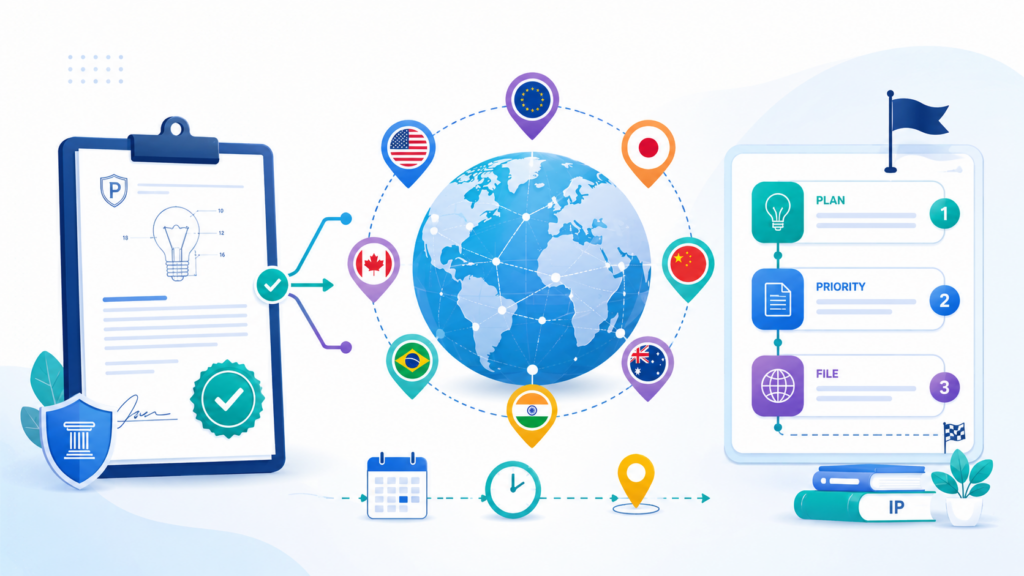
But waiting too long can remove choices. If the company may need protection outside the United States, the international plan should be discussed early.
This does not mean every startup should file around the world. Most should not. International filing can be expensive and complex.
But the team should make a deliberate decision based on market, manufacturing, competitors, investors, and future value.
The eleventh approval should happen before key deadlines and preferably before the first filing if international rights may matter. The founder, attorney, and business lead should decide which countries or regions may matter and why.
For some companies, the United States may be the main market. For others, Europe, China, Japan, Korea, India, Canada, Australia, or other markets may matter.
For hardware companies, manufacturing locations may matter. For software companies, customer markets and competitor locations may matter. For biotech or medical device companies, regulatory and commercial markets may matter.
The point is not to file everywhere. The point is to keep valuable options open when they matter.
The founder should approve the international business logic.
International filing should not be driven by fear. It should be driven by business logic.
The founder should ask where the company will sell, where competitors are based, where manufacturing may happen, where investors expect protection, and where future buyers may care about patents.
If the answer is unclear, the team may need a staged approach. For example, an early filing may preserve a priority date, and later the company may decide whether to enter more countries. The exact path should be guided by counsel.
The founder should also understand that international protection can become costly. Filing in many countries may not make sense for a seed-stage startup unless the invention is central and the market supports it.
A smart international plan is focused. It protects what matters where it matters.
Filing outside the home market should match revenue, risk, and future value.
A company should not file in a country just because it sounds important. It should file because there is a reason. Maybe that country is a key market. Maybe a main competitor operates there.
Maybe manufacturing will happen there. Maybe a future acquirer will care. Maybe the invention is so central that broader protection is worth the cost.
This review should include the business team, not only legal. The attorney can explain rules and deadlines. The founder must decide whether the cost fits the company plan.
PowerPatent helps startups approach these choices with more order by getting the invention and filing record organized early.
That makes later decisions easier because the team is not starting from chaos. Learn more here: https://powerpatent.com/how-it-works
The attorney should explain the deadline path in simple terms.
International filing has deadline rules, and missing them can be costly. The attorney should explain the path in plain language, with clear dates and next steps. The founder should not have to guess.
The explanation should cover what was filed first, what priority date the company is relying on, when the next international decisions are due, and what choices the company will need to make. It should also explain the cost range at a high level so the founder can plan.
This should happen early because budgets and board discussions may need time. A founder should not learn about a major foreign filing cost one week before the decision is due.
Calendar control is part of patent approval.
Approving a patent filing should create a calendar record. The company should track the one-year date from a provisional filing, foreign filing decision dates, response deadlines, and any internal review dates. These should not live only with outside counsel.
The founder or operations lead should have visibility. This does not mean they manage legal rules alone. It means the company has enough control to avoid surprises.
Good patent operations are not fancy. They are calm, clear, and reliable.
The product and sales teams should share where customers and competitors are moving.
The international filing plan should not be made in a vacuum. Product and sales teams often know where demand is growing, where enterprise buyers are asking hard questions, where competitors are appearing, and where partners may open doors.
That information should feed into the filing decision. If the company is suddenly getting strong interest from European enterprise customers, that may matter.
If manufacturing is shifting to a certain region, that may matter. If a competitor in a specific country is copying features fast, that may matter.
This does not mean legal strategy follows every sales lead. It means the business facts should be part of the approval.
Market signals can change the filing plan before deadlines arrive.
A startup’s market can change quickly. At the time of first filing, the team may think one country matters most. Six months later, a new partnership or customer pipeline may change that view.
That is why international filing approval should not be a single conversation on filing day.
The team should revisit the plan before major deadlines. This gives the founder time to weigh cost against opportunity.
A strong patent process gives the company options. It does not force rushed choices at the last minute.
The Twelfth Approval Should Decide Who Can Say “Patent Pending” and Where.
Once a patent application is filed, the company may want to use “patent pending” in product pages, pitch decks, packaging, sales materials, investor updates, or press materials.
That can be useful. It can signal that the company is protecting its technology. It can also create trust when used carefully.
But “patent pending” should not be used loosely. The team should approve where it appears, what it refers to, and how it is worded.
This is especially true if the company has many products but only one filing, or if the filing covers one feature but marketing wants to apply the phrase to the whole platform.
The twelfth approval should involve the founder, attorney, marketing or product lead, and sales lead. The goal is to make sure the company gets the value of the filing without overstating it.
A clear patent pending message can help. A sloppy one can hurt credibility.
The attorney should confirm when the company can use patent pending language.
The attorney should confirm that the application has actually been filed before the company uses patent pending language. The team should not use it because a draft exists, because an idea was approved, or because the company plans to file soon.
This sounds obvious, but in fast startups, marketing pages and pitch decks can move ahead of legal events.
A founder may tell the team, “The patent is basically done,” and someone may update the website too early. That should not happen.
The better process is simple. Once the application is filed, the attorney or filing owner gives the company a clear notice. Then approved patent pending language can be used.
Patent pending should point to the protected technology, not everything the company does.
If the filing covers one feature, the company should be careful about making the whole product sound patent pending in a way that misleads people. The wording should match the filing.
For example, it may be better to say, “Patent-pending technology for adaptive model routing,” rather than placing “patent pending” across every page of a large platform if the filing only covers that routing layer.
The exact wording should be reviewed by counsel. The larger point is that accuracy builds trust.
PowerPatent helps founders get to a cleaner patent pending moment because the workflow is built to move from invention capture to attorney-backed filing with less confusion.
When the filing is done, the team knows what it can say with more confidence. See how it works here: https://powerpatent.com/how-it-works
The marketing lead should use patent pending as proof, not as the whole story.
Patent pending is not a sales pitch by itself. Customers care about the problem you solve. Investors care about the edge you are building.
Partners care about trust, speed, and results. Patent pending language should support that story, not replace it.
A strong message might explain the customer benefit first, then mention that the underlying technology is patent pending. That makes the phrase feel earned. It does not sound like empty bragging.
For example, the copy might say that the product helps teams detect costly errors before they reach production, powered by patent-pending review technology. That is much better than leading with a vague IP claim.
Patent pending should give the reader more confidence, not make them ask, “What does that even mean?”
The best patent pending copy is clear, narrow, and tied to value.
Good copy says what the protected technology helps do. It does not speak in fog. It does not overclaim. It does not bury the reader in patent words.
For a startup, this matters because every message is part of trust-building. A careful patent pending statement can make the company look serious. A broad or confusing statement can make the company look careless.
The marketing lead should work with the attorney to create approved language that can be reused in sales decks, the website, pitch materials, and launch notes. This saves time and avoids random wording across teams.
The sales team should know how to talk about patent pending without making risky promises.
Sales teams often face hard questions from customers. A buyer may ask, “Is this patented?” or “Can your competitors copy this?” or “What does patent pending mean?” The sales team needs a simple approved answer.
That answer should be honest. Patent pending means a patent application has been filed. It does not mean a patent has been granted.
It does not mean competitors can never build something similar. It does not mean the company owns every idea in the space.
The sales answer should keep the focus on customer value. It can say that the company has filed patent applications around key technology and is investing in protecting its work, while the product’s real value is the result it gives the customer.
Sales approval should include a plain answer for common buyer questions.
The sales lead should work with the founder and attorney to create a simple response that reps can use. This prevents overpromising and keeps the message consistent.
The response should be short, true, and useful. It should help the buyer feel confidence without turning the sales call into a legal debate.
This is a small approval step, but it can prevent big communication mistakes. It also helps the whole company sound more mature.
When a patent filing is reviewed well, the company does not just file better. It speaks better. It sells better. It raises better. It moves with more confidence.
PowerPatent gives startups a faster, clearer way to reach that point, with smart software and real attorney oversight built for modern technical teams. Start here: https://powerpatent.com/how-it-works
Conclusion
Patent filing approvals are not about slowing the team down. They are about making sure the right people check the right things at the right time, so the company files with confidence instead of guesswork. The inventor protects the truth. The founder protects the business goal. The product lead protects the user value. The engineering lead protects the technical depth.
The attorney protects the filing strength. When these reviews happen in the right order, patents become less stressful and far more useful. PowerPatent helps startups make this process faster, clearer, and attorney-backed from start to finish: https://powerpatent.com/how-it-works