Software and AI inventions move fast. Your model changes. Your code improves. Your product shifts. But once a patent draft is filed, weak wording can follow you for years. That is why a patent draft review matters so much.
A patent draft review should begin with the real product, not the patent form
A patent draft review for software and AI inventions should not begin with legal words. It should begin with the product.
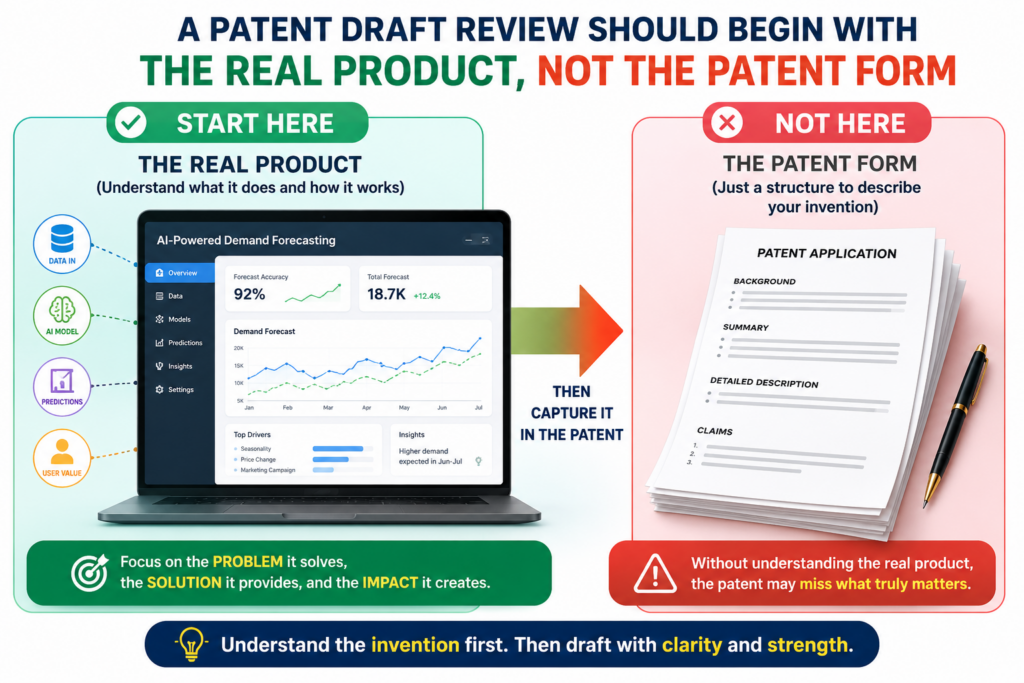
Before anyone worries about claim style, figure numbers, or formal wording, the first question should be simple: what did the team actually build that is new, useful, and hard for others to copy?
This matters because many weak software patent drafts fail at the same early point. They describe the invention too loosely.
They talk about “using AI,” “processing data,” “training a model,” or “improving results,” but they do not explain the exact thing that makes the system different.
For a founder, that can feel fine at first because the draft may sound broad. But broad words without clear support can become fragile. A strong draft should explain the invention in plain, direct detail so the protection has something solid to stand on.
When reviewing a patent draft, start by reading it like a product person, not a patent person. Ask whether the draft matches the actual flow of the software.
Ask whether the main problem is clear. Ask whether the steps make sense in the same order the product uses them.
Ask whether the draft explains why the system works better than old ways. If the draft feels like it could describe almost any app, model, or cloud tool, it needs more work.
The draft must show the real technical improvement behind the invention
For software and AI, the core value is often hidden inside the workflow. It may be a smarter way to clean data, route requests, rank outputs, update a model, reduce delay, lower compute use, detect errors, or adapt to user behavior.
These details can look small inside the product, but they may be the heart of the invention.
A good review should pull those details forward. The draft should not only say the system gets better results. It should explain how it gets those results.
For example, if the invention improves model accuracy, the draft should explain what changes before, during, or after model use.
If it reduces cloud cost, the draft should explain what work is skipped, delayed, batched, cached, compressed, or moved.
If it improves safety, the draft should show how the system spots risky input, filters output, checks context, or stops a bad action before it reaches the user.
This is where many founders need help. They know the product deeply, but they may not know which details belong in the patent draft.
PowerPatent helps by giving teams a more guided way to capture the invention, then pairing that with real attorney oversight so the draft is not just filled out, but actually reviewed with the invention in mind.
You can see how that process works here: https://powerpatent.com/how-it-works
The best review question is what would a competitor copy first
A patent draft should be reviewed through the eyes of a smart competitor. Imagine another team sees your product, understands the market, and wants to build around you.
What would they copy? Would they copy your data flow? Your model update method? Your ranking logic? Your way of joining signals? Your guardrail system? Your user feedback loop? Your deployment method?
That question makes the review sharper. It moves the draft away from surface features and toward the real engine of the invention. It also helps avoid a common mistake: describing only the user-facing screen.
For many software and AI products, the screen is not the invention. The invention is the system behind the screen. It is the hidden path from input to result.
During review, the draft should be checked for that hidden path. The patent should explain the inputs, the key steps, the outputs, and the reason the result is better.
It should also include enough different examples so the invention is not trapped inside one product version.
Your first launch may use one model, one cloud setup, or one type of data. Your company may later change all of that.
A careful draft review looks for language that protects the idea as it grows, without losing the clear detail needed to support it.
This is why patent draft review is not a last-minute cleanup task. It is a business step. It helps your team make sure the thing being filed is the thing worth protecting.
The claims should protect the invention without boxing the company in
The claims are the most important part of a patent draft because they define what the patent is trying to protect.
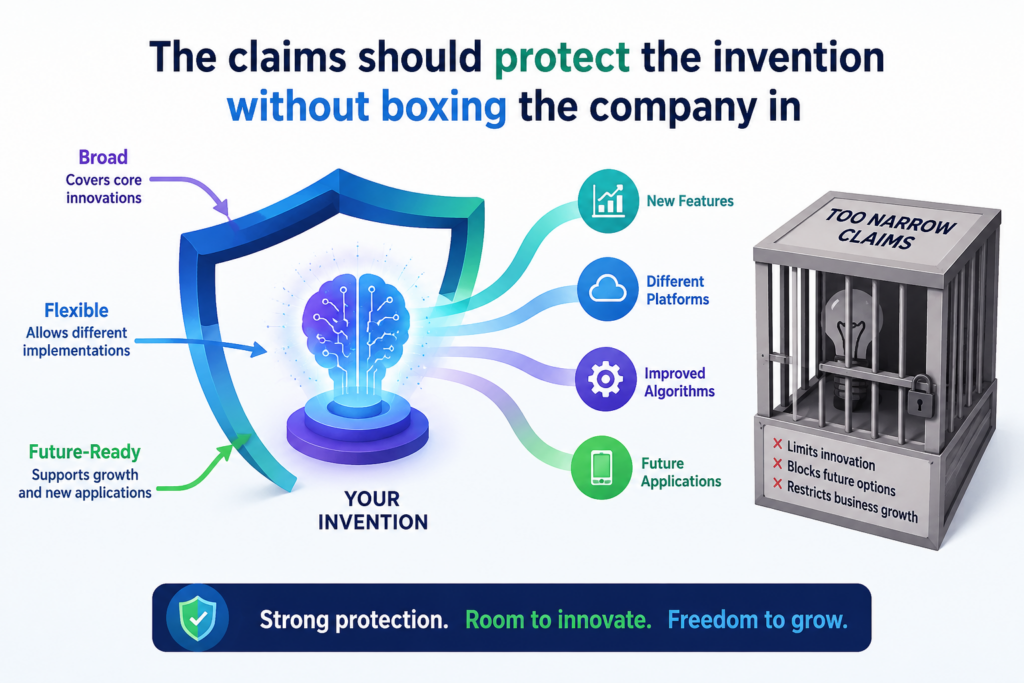
For software and AI inventions, claim review should be careful, practical, and tied to the way the business may grow.
A claim that is too narrow can leave room for others to copy the main idea with small changes. A claim that is too vague can be easier to challenge. The goal is to find the useful middle: clear enough to be strong, but broad enough to matter.
When reviewing claims, a founder should not try to become a patent lawyer. But the founder should still understand the basic business question behind the claims. Do these words cover the valuable part of what we built? That question is simple, but powerful.
If the claims only cover one small feature, one exact model type, one narrow data format, or one screen flow, the patent may not match the company’s real edge.
Software and AI products change fast. A startup may begin with one model and later use another. It may start with a rule-based layer and later replace it with a trained system.
It may launch for one industry and then move into another. The claims should be reviewed with that future in mind. The draft should not be so tied to today’s version that tomorrow’s product falls outside of it.
The claim language should avoid needless limits that weaken protection
A common issue in patent drafts is needless detail in the claims. Detail is useful in the full description, but too much detail in the wrong claim can shrink protection.
For example, a claim may say the system uses a specific type of database, a specific model name, a specific number of steps, or a specific user device when those details are not central to the invention.
If those limits are not needed, they may give competitors an easy path around the patent.
A smart review looks for those narrow words. It asks whether each detail is truly part of the invention or just part of the current product build.
This is especially important for AI inventions because tools, model types, and deployment choices change often. A draft that depends too much on one current tool may feel outdated faster than the company expects.
The review should also check whether the claims cover different ways the invention could be used. In software, the same idea may run on a server, a local device, an edge device, or across several systems.
In AI, the same method may work with text, images, audio, code, sensor data, or mixed data. The draft does not need to claim everything in the world, but it should not ignore clear versions that the team may use later.
This is where PowerPatent can help founders stay in control without getting buried in patent mechanics.
The platform helps capture the technical story, while attorney review helps shape that story into a draft that is more likely to support real protection.
Founders can move faster, but still have trained eyes checking the words before filing. Learn more here: https://powerpatent.com/how-it-works
A strong claim set should include the core method and the system around it
For software and AI inventions, the review should look at whether the claim set protects both the method and the system.
The method is what the invention does step by step. The system is the set of parts that carries out those steps. In many cases, both matter because a competitor may copy the process, the architecture, or both.
A good draft may describe how data is received, how it is changed, how a model or logic layer uses it, how a result is created, and how that result changes what happens next.
That flow should feel connected. It should not read like a random pile of tech words. Each step should lead to the next step in a way that makes the invention easy to understand.
Reviewers should also check whether the claims include the feedback loop when the feedback loop is part of the value.
Many AI systems improve because they learn from user actions, human review, model scores, test results, or real-world outcomes.
If that loop is important, the draft should not hide it. It should show how feedback is collected, how it is used, and how it changes later results.
The same is true for safety and control features. If the invention has a way to block bad outputs, reduce false results, protect private data, or explain why a result was chosen, those details may be important.
They may also be key reasons why customers trust the product. During review, those features should be checked carefully because they can often support a stronger and more useful patent story.
The point is not to stuff the claims with every feature. The point is to make sure the claims protect the right invention.
A strong review keeps asking whether the patent draft matches the business value, the technical edge, and the way the product may grow.
The description should give enough detail to support the full invention
The description is where the patent draft teaches the invention. It should explain the problem, the system, the steps, the options, and the examples in enough detail that the invention feels real.
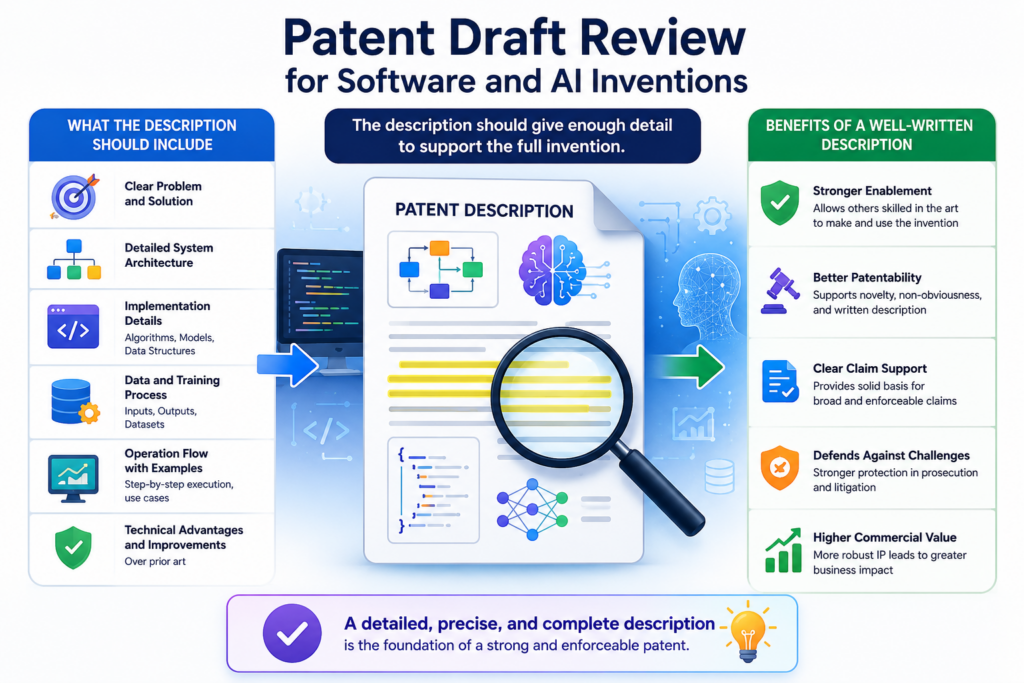
For software and AI drafts, this part is often where strength is won or lost.
A thin description can hurt even if the claims sound good. Claims need support. If the claims talk about a broad idea, but the description only gives one shallow example, the draft may have a weak base.
A strong review should check whether the description gives enough depth for the claims the company wants.
This does not mean the draft should be packed with filler. It means the draft should clearly explain the useful ways the invention can work.
For AI inventions, the description should often cover the data path. What data comes in? How is it prepared? What signals matter? What happens before the model is used? What happens after the model gives an output?
How does the system decide whether the output is good enough? What happens when the output is low quality, unsafe, late, costly, or unclear?
For software inventions, the description should often cover the control flow. What starts the process? What decisions does the system make? What rules, scores, models, or checks guide the path?
What changes in the user experience or backend process because of the invention? What is faster, safer, cheaper, more accurate, or easier than before?
The draft should explain more than one way to build the invention
One of the most useful parts of a patent draft review is checking for alternate versions. Startups often file around the first working version of the product. That is natural, but it can be risky.
The first version is rarely the final version. If the patent draft only describes the first version, it may not protect the better version that comes later.
A strong description should include practical variations.
It may describe different model types, different data sources, different user devices, different cloud setups, different scoring methods, different thresholds, different ways to store data, and different ways to trigger the process.
These variations should not be random. They should be tied to real ways the product could work.
This makes the patent draft more useful because it gives room for growth. It can also make the draft more helpful for attorney review because the attorney can see what parts are fixed and what parts are flexible.
That is a big deal for founders. You do not want a patent that protects only the version you built during one sprint. You want a patent that protects the deeper idea your company is building around.
PowerPatent is built for this kind of founder-led detail capture. It helps teams turn technical input into a stronger invention record, then brings in real patent attorney review so the filing is not left to software alone.
That mix helps startups move quickly while still taking the draft seriously. You can explore the process here: https://powerpatent.com/how-it-works
Good examples make the patent easier to understand and harder to dismiss
Examples are not filler. In software and AI patent drafts, examples can make the invention come alive. They show how the system works in real settings.
They help explain why the invention matters. They can also support broader claim language by showing that the idea is not limited to one tiny use case.
During review, the examples should be checked for clarity and range.
If the invention can apply to finance, healthcare, robotics, developer tools, security, logistics, or customer support, the draft may need examples that show different settings.
The examples should be concrete enough to be useful, but not so narrow that they trap the invention in one market.
A good example may show a user sending a request, the system breaking the request into parts, the model ranking possible outputs, a safety layer checking the answer, and the system sending a final result with a reason code.
Another example may show the same invention used with sensor data, where the system spots a pattern, compares it with past events, and triggers a control action.
These examples help readers understand that the invention is not just an idea in the air. It is a working system with real steps.
The review should also check whether the description explains failure handling. Many strong software inventions are not only about what happens when everything works.
They are about what happens when something goes wrong. The system may detect missing data, reject low-confidence output, ask for human review, fall back to another model, or delay an action until more data arrives.
These details can be very important because they often show the practical skill behind the invention.
A strong patent draft does not need to be confusing to be powerful. It needs to be clear, complete, and tied to the real invention. That is the heart of a good review.
A software patent draft should show the exact problem the invention solves in the system
A strong software patent draft review should make one thing clear right away: the invention is not just “software that does something.” It is a real technical answer to a real technical problem.
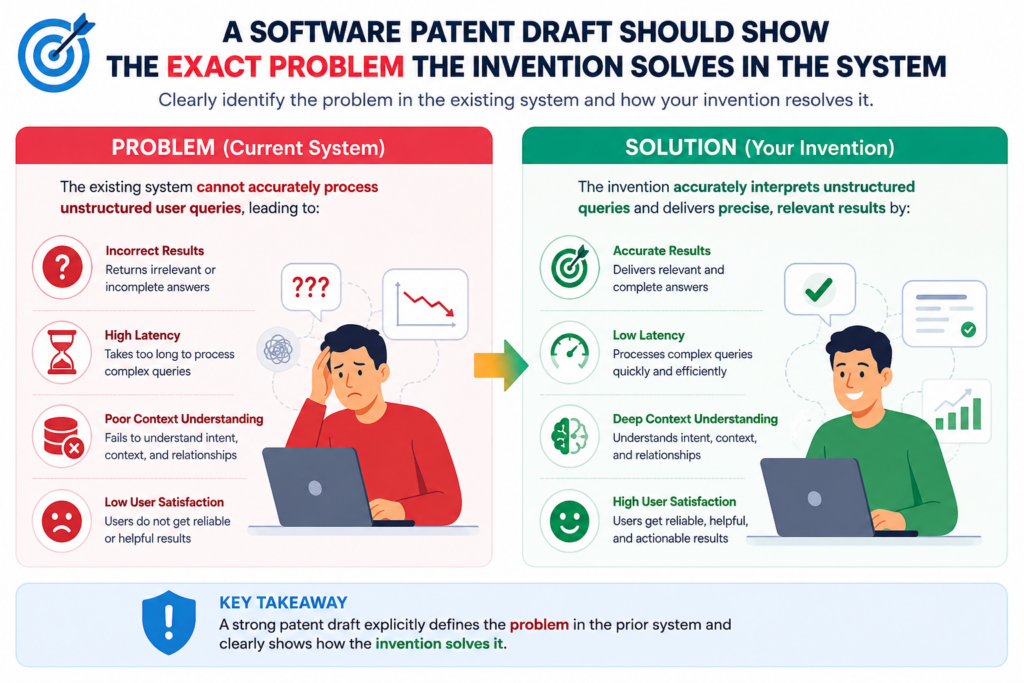
That problem may live in speed, scale, accuracy, memory use, model control, data quality, user flow, security, or system trust. The draft must bring that problem into focus before it tries to claim the solution.
This is important because software products often look simple from the outside. A user clicks a button, uploads a file, types a prompt, or sees a result. But behind that simple action, the system may be doing hard work.
It may split a task into smaller jobs, route data through several checks, choose one model over another, remove bad input, rank results, track user intent, or create a new output in a more stable way.
A good patent draft review should ask whether the draft explains that hidden work. If the draft only talks about the final result, it may miss the true invention.
For example, saying that a system “generates a better answer” is not enough. The draft should explain what happens before the answer is made, how the system judges quality, and why the final answer is better than what old systems could do.
The problem statement should be sharp enough that the solution feels needed
The problem section of the draft should not feel like a broad complaint. It should not only say that existing tools are slow, costly, or hard to use. Many tools are slow, costly, or hard to use.
The draft should explain the specific pain that the invention fixes. In software and AI, that pain often comes from a narrow point in the workflow.
For example, maybe old systems treat every request the same way, which wastes compute. Maybe they use a single model for every task, even when a smaller model would work.
Maybe they fail when data is missing. Maybe they cannot explain why one output was chosen over another. Maybe they do not update fast enough after user feedback. Maybe they expose private data while moving it between services.
When reviewing the draft, look for that level of detail. The problem should make the reader think, “Yes, this is a real issue in a real system.” Once the problem is clear, the invention becomes easier to understand.
The draft becomes more than a technical write-up. It becomes a story of cause and effect. There was a hard issue. The team found a better way. The system now works in a way that old systems did not.
This is where PowerPatent can be useful for busy founders. Instead of forcing your team to turn raw technical notes into patent language alone, PowerPatent helps you capture the real problem and the real solution in a guided way, with attorney oversight added before filing. You can see how founders use it here: https://powerpatent.com/how-it-works
The review should remove vague words that hide the real invention
Many weak drafts use words that sound smart but do not say much. Words like “optimized,” “intelligent,” “dynamic,” “automated,” and “AI-powered” can be useful in normal marketing, but they do not do enough by themselves in a patent draft.
During review, those words should be checked carefully. If the draft says the system is optimized, it should explain what is optimized and how.
If it says the system is intelligent, it should show what decision is being made and what data supports that decision.
This does not mean the draft must be hard to read. In fact, the best drafts are often easier to read because they replace vague words with clear steps.
A sentence that says “the system intelligently improves routing” may sound polished, but a sentence that says “the system selects a processing path based on task size, confidence score, and expected compute cost” is much more useful. It tells the reader what is happening.
A good review should also compare the draft to the product roadmap. If the draft explains the current problem too narrowly, it may not cover the next version of the product.
If it explains the problem too broadly, it may feel generic. The sweet spot is a clear problem that connects to the team’s real technical edge and can still support future versions.
Software and AI patents should not be written as if they are trying to impress someone. They should be written to protect the work. That starts with a problem statement that is real, specific, and tied to the invention.
An AI patent draft should explain the model, the data, and the control layer without overclaiming
AI inventions need a careful patent draft review because the word “AI” can hide too much. A strong draft should not act like the invention begins and ends with using a model. Many companies use models.
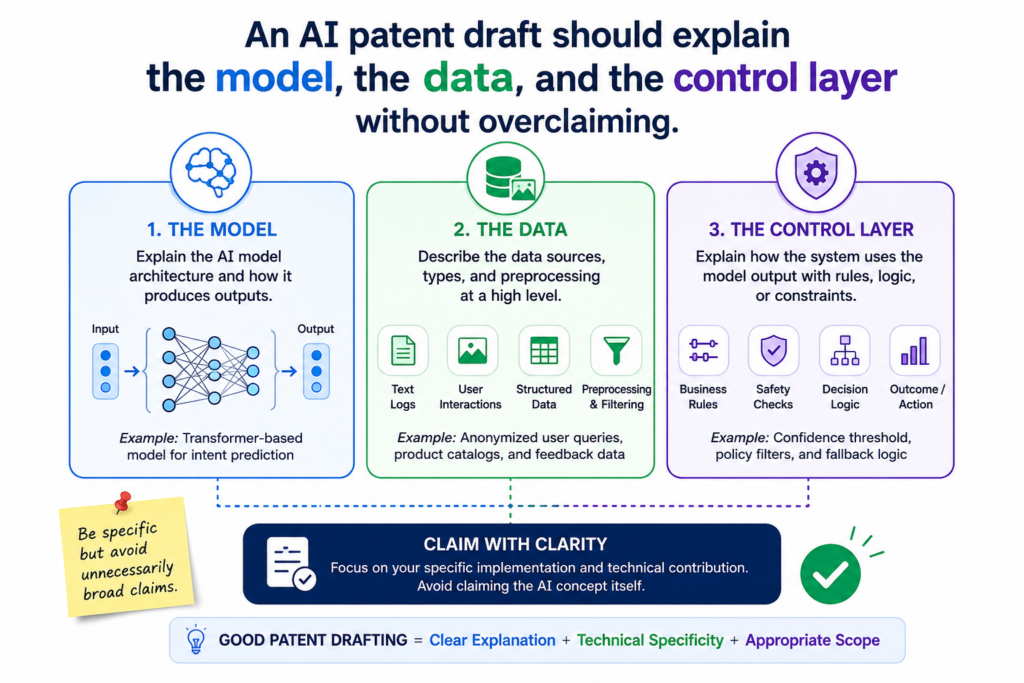
Many companies train models. Many companies send data into a model and get an output back. The patent draft should show what your system does differently around the model, with the model, or after the model gives a result.
This is where founders should slow down during review. The draft should explain the AI system as a full working flow.
It should show what data goes in, how the data is prepared, what the model or model group does, how the output is checked, how the result is used, and how the system changes over time.
If the draft skips these parts, it may sound broad, but it may not give enough support for strong protection.
The point is not to reveal secret business details that do not belong in the filing. The point is to describe the invention well enough that the patent draft stands on real technical ground.
A patent does not protect a dream. It protects an invention that is explained.
The draft should show where the AI work actually adds value
When reviewing an AI patent draft, ask where the value is created. Sometimes the value is in training. Sometimes it is in data selection.
Sometimes it is in prompt control, model routing, output scoring, human review, error handling, privacy protection, or feedback loops.
Sometimes the model is not the main invention at all. The main invention may be the way the system uses model output to control another system.
For example, an AI product for code review may not be new just because it reads code and gives comments.
The stronger invention may be how it maps code changes to risk areas, chooses review depth based on deployment history, and sends high-risk changes to a different check path.
An AI product for medical intake may not be new just because it summarizes patient text. The stronger invention may be how it detects missing answers, asks follow-up questions, and flags low-confidence summaries before a clinician sees them.
The review should make sure the patent draft captures that kind of value. A draft that only says “a machine learning model analyzes data” is too thin for most serious software companies.
The draft should explain the surrounding system that makes the model useful, safe, fast, or reliable.
PowerPatent helps founders and engineers organize these details without turning the process into a long legal maze. The platform helps teams explain the invention in a structured way, while real patent attorneys review the work before it moves forward.
That mix is especially helpful for AI teams that are shipping fast and changing often. You can explore the process here: https://powerpatent.com/how-it-works
The review should separate what is core from what is only one example
A big risk in AI patent drafts is mixing up the invention with one current model choice. A team may use a certain model type today because it is easy to access, works well, or fits the budget.
But the company may switch later. If the patent draft is too tied to that one model type, it can age badly.
During review, ask whether the model details in the draft are core or optional. If the invention truly depends on a certain model architecture, then the draft should explain why.
But if the invention could work with many model types, the draft should say so. It may explain one version in detail, then describe other possible versions. This gives the draft more room to match the product as it grows.
The same rule applies to data. If the invention works with text today but could later work with audio, images, code, sensor data, or mixed data, the review should check whether the draft supports those versions.
If the invention depends on a special data structure, that structure should be explained. If the invention depends on a way of cleaning, labeling, scoring, or joining data, that detail may deserve more attention than the model name itself.
AI patent drafts also need care around claims of results. It is usually not enough to say that the invention is more accurate or more efficient. The draft should explain what makes it so.
It may point to reduced steps, better ranking, improved confidence checks, smarter routing, safer output control, or faster updates from feedback. The review should make sure the result is tied to the technical method, not just stated as a wish.
A strong AI patent draft does not treat AI as magic. It treats AI as part of a system. That is what makes the invention easier to understand and stronger to protect.
The review should check whether the draft protects future product versions, not only the first release
A startup’s first product version is rarely the full invention. It is the first proof that the idea works. The team may ship quickly, learn from users, change the workflow, add new models, move to new markets, and rebuild parts of the backend.
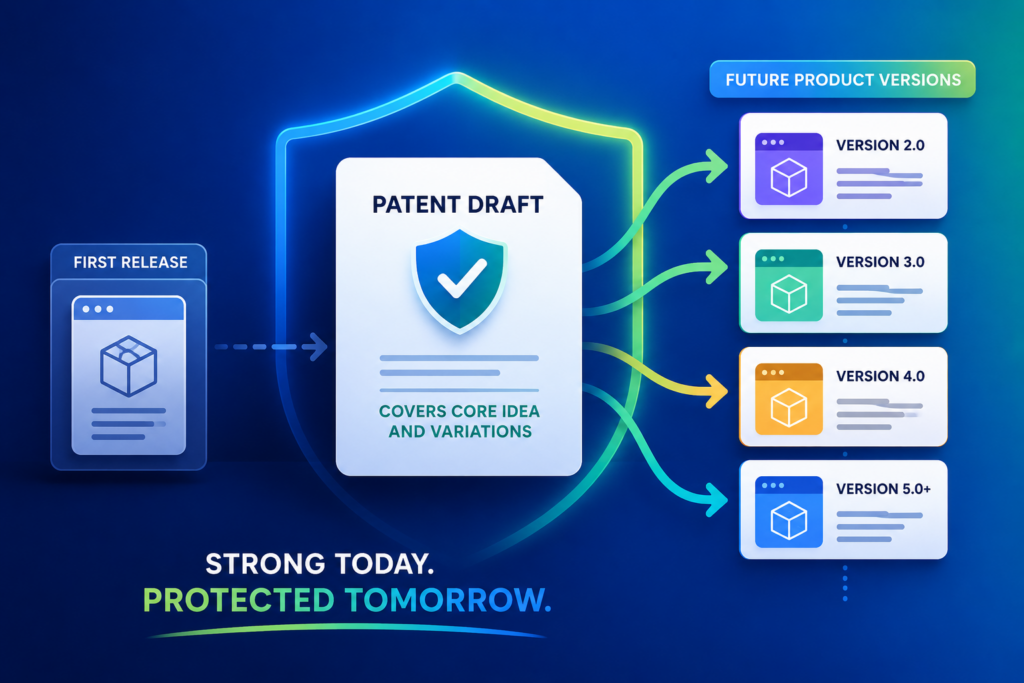
A patent draft review must respect that reality. The draft should protect the invention in a way that still makes sense after the product evolves.
This matters a lot for software and AI companies because the product can change faster than the patent process. What you file today may still matter years from now.
If the draft is locked to the first version, it may miss the best version of the business. That is why review should always include a future-fit check.
A future-fit check asks whether the patent draft covers the main idea across different ways of building it. It does not mean the draft should become vague.
It means the draft should explain the invention with enough detail and enough range. The goal is to protect the technical heart, not just one screen, one tool, one dataset, or one release.
The draft should include practical variations that match the company roadmap
During review, founders should compare the patent draft to the roadmap. This does not require a perfect five-year plan. It only requires honest thinking about where the product may go.
Will the system handle more data types? Will it move from one market to another? Will it support enterprise customers? Will it run on edge devices? Will it add human review? Will it use more than one model? Will it connect to outside systems?
If the answer is yes, the draft should be checked for support. For example, a patent draft for an AI support tool may start with customer service chat. But the same system may later help sales teams, success teams, or internal ops teams.
If the core invention is a way to route tasks, score answers, and learn from user corrections, the draft should not be trapped inside customer support unless that market is truly the invention.
This is also important for platform companies. A platform may begin with one feature, but the real edge may be the way the platform handles workflows across many apps. If the patent draft only describes the first feature, it may understate the invention.
The review should ask whether the draft explains the platform layer, the control logic, the data flow, and the way the system can support many use cases.
PowerPatent is designed for founders who need this kind of speed and clarity. It helps you capture invention details while they are fresh, then adds attorney review so your filing can reflect both the current product and the bigger technical direction. You can see how it works here: https://powerpatent.com/how-it-works
The review should avoid words that freeze the invention in place
Some words can quietly narrow a patent draft. They may seem harmless, but they can make the invention look smaller than it is.
For example, the draft may say the system always uses one type of user input, always runs on a remote server, always performs steps in a fixed order, or always uses a specific model. If those things are not required, the review should flag them.
A better draft often uses clear but flexible language. It may describe one version as an example, then explain that other versions can use other data types, other storage methods, other devices, or other orderings of steps when the invention allows it.
This does not make the draft loose. It makes the draft more accurate because software can often be built in several ways.
Review should also look for missing product paths. Many drafts describe the happy path, where the user enters clean data, the system works perfectly, and the output is accepted.
Real products are not that neat. Users give messy input. Models make uncertain guesses. APIs fail. Data arrives late.
Systems need fallback paths. These paths may be important to the invention. They may also be the reason the product works better than older tools.
Future protection is not about guessing every possible change. It is about not filing a draft that blocks your own growth. The patent draft should feel like it was written for the company you are building, not only the demo you have today.
A strong review gives founders that confidence. It helps the team file with a wider view, without losing the concrete detail that makes the patent draft useful.
The review should make the patent draft easy for engineers and attorneys to trust
A patent draft for a software or AI invention has more than one reader. It may be read by founders, engineers, investors, patent attorneys, patent examiners, future partners, future buyers, and sometimes competitors.
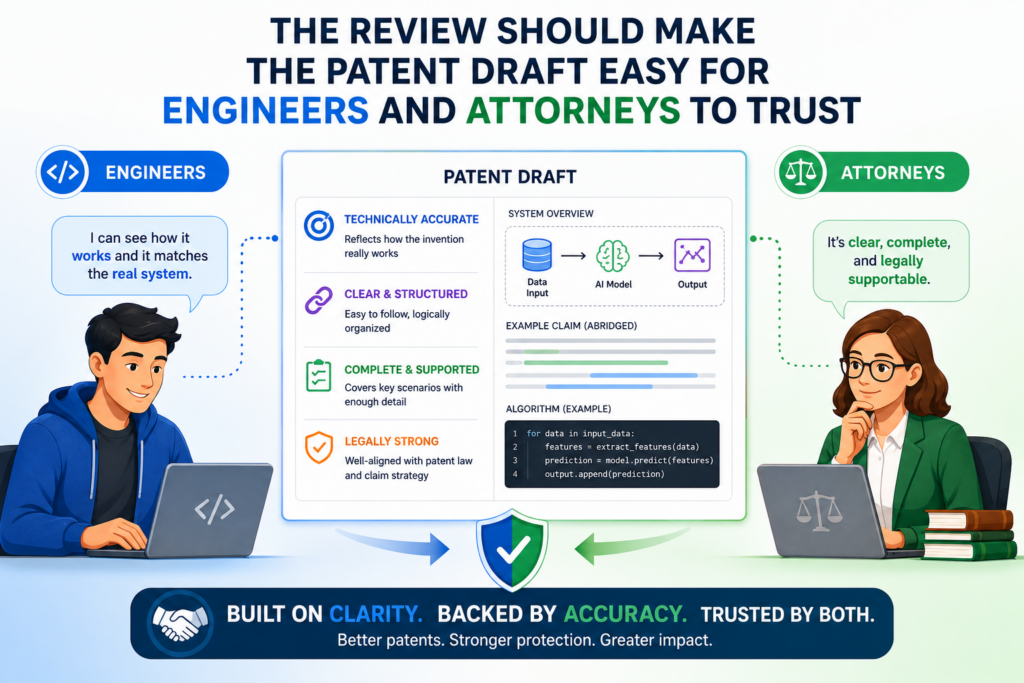
The draft should be clear enough that technical people can recognize the invention and formal enough that the legal process can use it.
This is a hard balance. Some drafts sound too legal and lose the product. Other drafts sound too casual and miss the structure needed for a filing.
A strong review should bring these two sides together. It should keep the invention understandable while making sure the draft has the depth and support needed for serious review.
For founders, this is not just a writing issue. It is a control issue. When the draft is unclear, the founder loses control.
The attorney may have to guess. The engineer may not recognize the system. The final filing may protect the wrong thing. A clear draft helps everyone work from the same map.
The draft should use plain words without losing technical meaning
Plain language is not weak language. In patent drafting, plain language can be powerful because it makes the invention easier to follow.
The review should check whether the draft explains each key part in simple, steady terms. If the invention uses an input processor, ranking engine, model selector, feedback store, or output filter, the draft should explain what that part does in the system.
The goal is not to dumb the invention down. The goal is to remove fog. A sentence should not need to sound complex to be useful.
For example, a draft can say that the system receives user data, removes private fields, creates a task score, selects one of several models based on that score, checks the model output, and stores user feedback for later updates. That is simple, but it still explains a real technical flow.
A good review also checks for terms that change meaning. If the draft uses the word “score,” it should be clear what the score means. Is it a confidence score, risk score, relevance score, quality score, cost score, or priority score?
If the draft uses the word “profile,” it should explain whether that means a user profile, device profile, model profile, task profile, or data profile. Clear terms reduce confusion.
This is one reason PowerPatent can be helpful for technical teams. It gives founders a more guided way to explain the invention in normal language, while attorney oversight helps turn that into a draft that fits the patent process.
You keep more control over the technical story without having to manage every drafting detail alone. See how it works here: https://powerpatent.com/how-it-works
The review should confirm that the engineers recognize the invention
Before filing, the draft should be read by someone close to the build. That may be a founder, lead engineer, AI lead, product head, or technical advisor.
The question is simple: does this draft describe what we actually built and what we care about protecting?
This step can catch major issues. Sometimes a draft uses terms that do not match the product. Sometimes it skips the most important part of the architecture.
Sometimes it describes a feature that was removed. Sometimes it uses an example that no longer fits the roadmap. These issues are easier to fix before filing than after filing.
The engineer review should not become a debate over every sentence. It should focus on the heart of the invention.
The reviewer should check the main flow, the important components, the data path, the model path, the feedback path, and the examples. If something feels wrong, it should be raised clearly.
The attorney review then brings a different lens. The attorney looks at claim scope, support, clarity, filing rules, and risk.
The best drafts come from both sides working well together. The founder and engineer know the invention. The attorney knows how to shape it for the patent process.
A strong patent draft review does not hide the draft from the people who built the product. It invites them in at the right moment. That is how the team avoids filing something that sounds official but misses the real invention.
The review should test the draft against copycat behavior before filing
A useful patent draft should not only describe what your company built. It should also make life harder for a copycat. That does not mean the draft should be aggressive or messy.
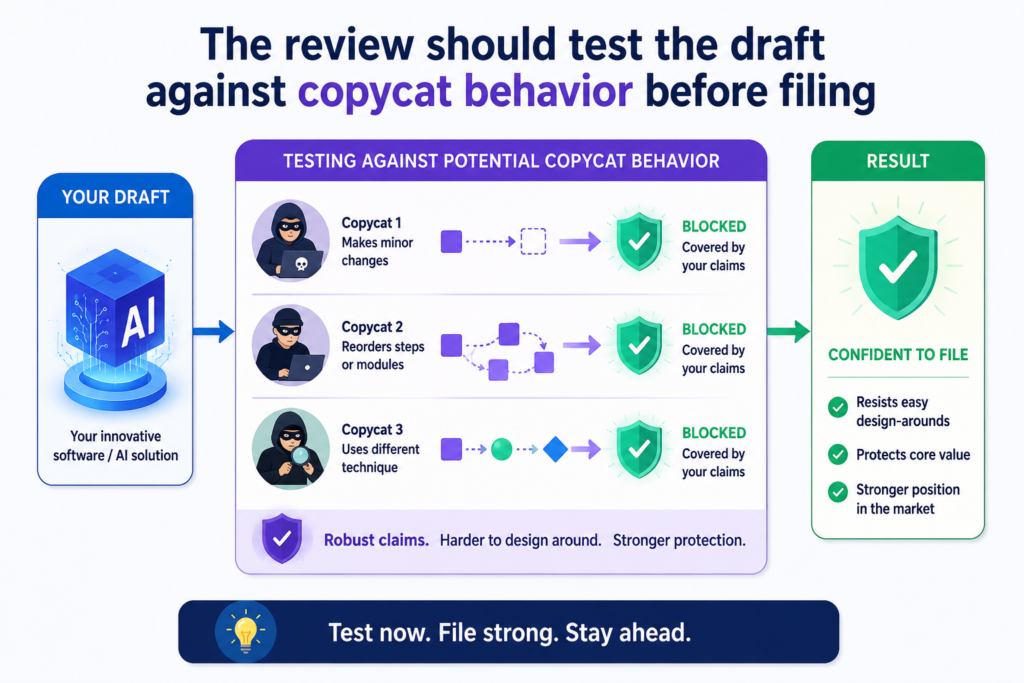
It means the draft should be reviewed with a clear business question in mind: how would another team try to copy this invention while changing just enough to avoid the patent?
This is one of the most practical ways to review software and AI patent drafts. It forces the team to think beyond the current product. It also reveals weak spots in the claims and description.
If a competitor could avoid the draft by changing one small setting, using a different model, moving a step to another server, or changing the order of operations, the draft may need stronger support or better claim structure.
Founders often find this step useful because it connects the patent back to the market. A patent is not just a document. It is part of the company’s defense.
It can help protect the work, support investor trust, and create a stronger position when others enter the space. But it only helps if the draft is built around the real edge.
The copycat test should focus on the most valuable part of the system
The review should start by naming the part of the system that a competitor would want most. In an AI product, it may be the model routing method, feedback loop, safety check, data labeling method, or output scoring process.
In a software platform, it may be the workflow engine, integration layer, task automation path, or control logic. In a developer tool, it may be the way the system reads code, maps risk, suggests changes, or learns from accepted fixes.
Once that valuable part is clear, the draft should be checked against likely workarounds. Could someone use a different database and still copy the invention?
Could they run the steps in a different order? Could they replace one model with a set of models? Could they move part of the system to the user device? Could they use manual review for one step and still get the same value?
These questions do not mean the patent must cover every workaround. But they help the team see whether the current draft is too easy to avoid.
They also help decide what examples and variations should be added to the description.
PowerPatent helps founders think through these issues in a more structured way. The platform helps gather invention details and supports attorney review, so the patent draft can be checked before filing rather than rushed out with blind spots. You can learn more here: https://powerpatent.com/how-it-works
The review should make sure the draft covers the business moat, not only the feature
A feature is what users see. A moat is what makes the feature hard to copy well. Patent draft review should focus on the moat. This is especially true for software and AI products because many surface features can look similar.
Two products may both offer automated summaries, smart search, document review, code suggestions, or workflow automation. The difference is often in how the system gets the result.
If your system is faster because it uses a task score to choose a lighter model, that routing logic may be part of the moat. If your system is safer because it checks outputs against user rules and past approvals, that control layer may be part of the moat.
If your system is more accurate because it updates a private context store from user behavior, that feedback path may be part of the moat.
The review should check whether those moat details appear in the draft. If they only live in the founders’ heads or engineering notes, the patent draft may miss them.
This is why early invention capture matters. Once a product is moving fast, details can get lost across Slack threads, sprint tickets, demos, and code changes.
A good draft does not need to disclose every business secret. But it should explain the protected invention well enough to matter.
It should show the system, the flow, the choices, the checks, and the technical reason the product works better.
The copycat test gives the review sharper eyes. It turns the patent draft from a passive document into a practical tool. That is the kind of draft a startup should want before filing.
The review should catch filing mistakes that can cost time, money, and leverage
A patent draft review is not only about making the draft stronger. It is also about avoiding mistakes that can hurt the company later. For software and AI startups, those mistakes often happen because the team is moving fast.
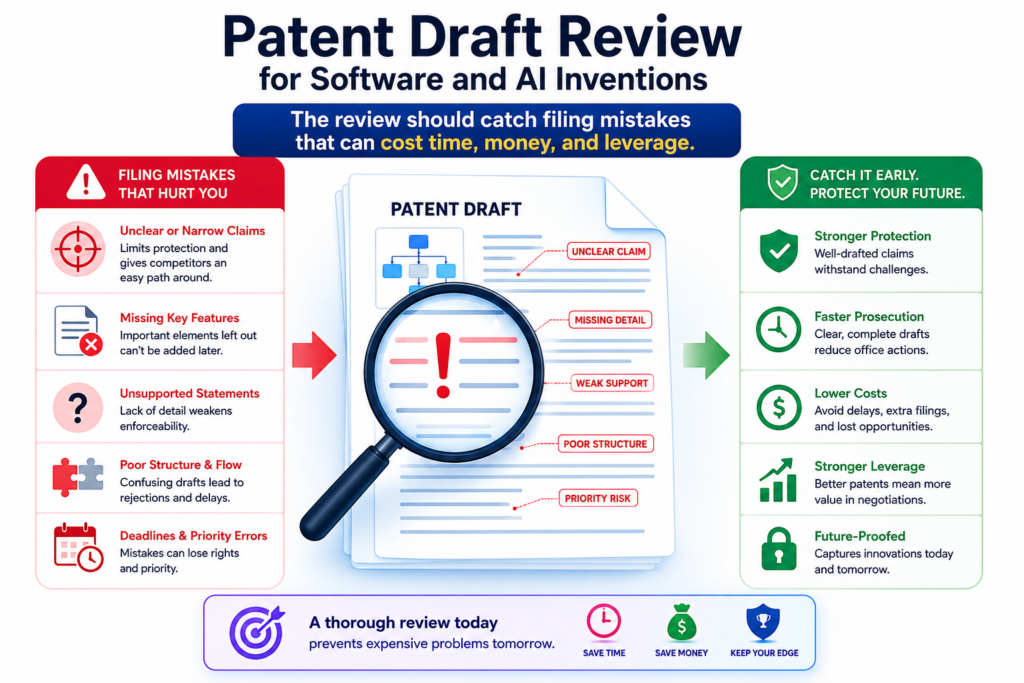
The invention is changing, investor calls are happening, customers are testing the product, and the team wants to file quickly. Speed matters, but rushed filing can create problems.
A weak draft can cost more later because it may need extra rounds of correction, extra attorney time, or follow-up filings. It can also create a false sense of safety.
The company may think it has protected the invention, but the filed draft may not cover the product in a useful way. That can be painful when a competitor appears, a partner asks hard questions, or an investor reviews the IP.
This is why review should happen before filing, not after. Once the draft is filed, the team may have less room to add new matter to that filing. The better move is to catch gaps while the draft can still be improved.
The review should check for missing inventors, missing versions, and public disclosure risk
One practical part of patent draft review is making sure the filing facts are clean. The draft should match the people who contributed to the invention. It should reflect the versions that matter.
It should also be checked against anything the company has already shared in public, with customers, in pitch decks, in papers, in demos, in app stores, in open-source code, or on the company website.
Founders sometimes treat these issues as admin tasks, but they can matter a lot. If the draft leaves out an important version of the invention, the company may need a new filing later.
If the team has already shown the invention publicly, timing may become important. If the wrong people are listed or the invention record is messy, the company may face clean-up work at the worst possible time.
The review should also check whether the draft matches the company’s ownership picture. In startups, invention work may involve founders, employees, contractors, advisors, or research partners.
Before filing, the team should make sure the right agreements and assignment steps are being handled. This is not about slowing the company down. It is about avoiding loose ends that can create stress later.
PowerPatent helps founders avoid many of these painful gaps by giving them a guided patent workflow backed by real attorney oversight. That means the draft is not just generated and forgotten.
It can be reviewed with the kinds of practical issues that matter to startup teams. You can see how PowerPatent helps here: https://powerpatent.com/how-it-works
The review should make the filing ready for investors, partners, and future diligence
A patent draft may become part of a much bigger story. Investors may ask what the company has filed. Partners may ask how the technology is protected.
Future buyers may review the IP during diligence. In those moments, a clean patent draft matters because it shows that the company took its invention seriously.
That does not mean the patent draft has to be perfect in every possible way. No draft is perfect. But it should be thoughtful, clear, and tied to the real technical edge.
It should show that the team knew what it was protecting and why it mattered. It should not look like a generic AI filing with the company name pasted in.
A strong review should ask whether the draft would make sense to a smart outside reader.
Could an investor understand the protected area at a high level? Could a technical reviewer see the difference between this invention and ordinary software?
Could an attorney explain why the claim strategy matches the business? Could the team point to the patent draft with confidence during a fundraise or partner talk?
This is where patent work becomes more than paperwork. It becomes part of the company’s story. A strong patent draft can help show that the team is not only building fast, but also protecting what makes the product special.
For software and AI founders, the best time to improve the draft is before it is filed. That is when the team has the most control.
That is when the details are fresh. That is when the attorney can shape the filing around the real invention instead of trying to fix a thin record later.
A careful review can save time, reduce stress, and give the company a stronger base. That is exactly the kind of practical patent process PowerPatent was built to support.
A patent draft review should make sure the invention is not described like a normal business idea
Many software and AI patent drafts become weak because they describe the business result instead of the technical work. They say the system helps users save time, make better choices, find better matches, or reduce errors.
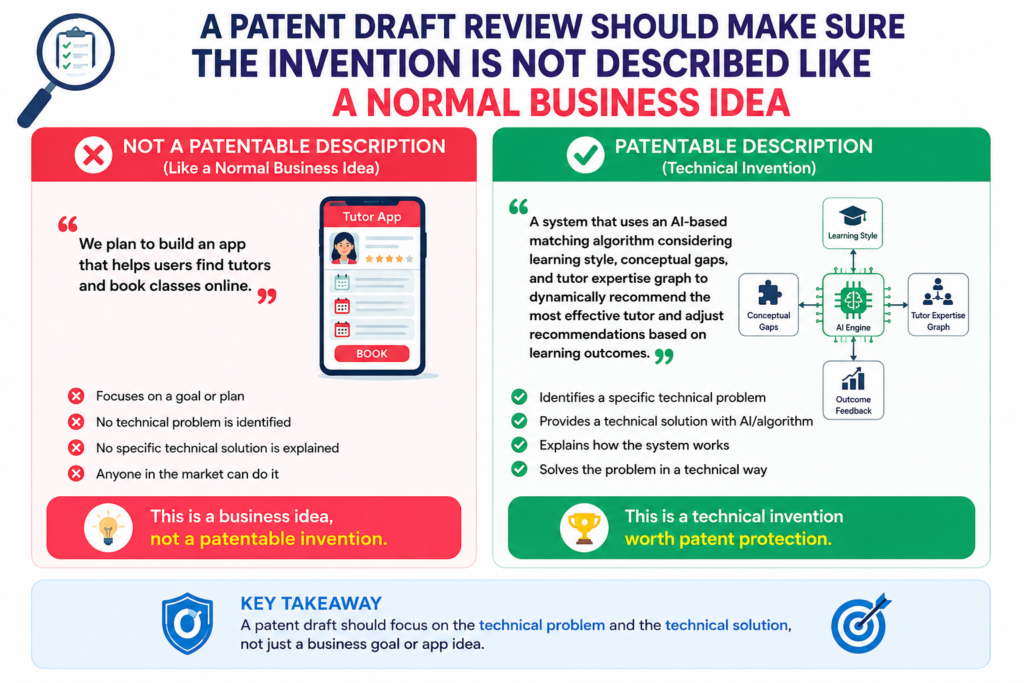
Those things may be true, but they are not enough by themselves. A patent draft should show the machine-side steps that make those results happen.
For a founder, this is a key review point. Your patent draft should not read like a pitch deck. A pitch deck sells the value. A patent draft explains the engine behind the value.
The review should look for places where the draft talks about outcomes without explaining the system steps that produce those outcomes.
If the invention helps users find better documents, the draft should explain how the system searches, ranks, filters, compares, or updates results.
If the invention helps a sales team predict a deal risk, the draft should explain what data is used, how signals are scored, how the risk level is created, and how the system changes the next action.
If the invention improves AI answers, the draft should explain how prompts, context, model choice, output checks, or feedback are handled.
The review should turn business value into clear technical action
A strong draft connects the business benefit to a technical path. It does not stop at “the system improves speed.” It explains what work is reduced, skipped, grouped, cached, routed, or done in a new order.
It does not stop at “the system improves accuracy.” It explains how the system selects better data, checks confidence, compares outputs, or updates a model or rule set.
This step is very useful because it helps founders see whether the draft protects what actually matters.
Sometimes the business value is easy to name, but the technical path is buried in code, data choices, or workflow logic. That hidden work is often where the invention lives.
PowerPatent helps founders bring that hidden work into the open without turning the process into a slow legal project.
The platform helps gather the technical story, then adds real patent attorney oversight so the draft can be shaped with more care. You can see how that works here: https://powerpatent.com/how-it-works
The draft should explain the system in a way a technical buyer could respect
A good test is to imagine a technical buyer reading the draft during diligence. Would they see a real invention, or would they see broad claims about a business goal?
Would they understand why the system is hard to copy, or would they think the draft describes a common app feature?
This does not mean the draft should expose every secret or every line of code. It means the draft should explain the important system logic clearly enough to show that the invention is real.
The review should look for missing parts in the flow. It should ask what starts the process, what data is used, what decisions are made, what output is created, and what happens after that output.
For AI inventions, this is even more important. Saying that a model is used is rarely the full invention. The draft should show the control layer around the model.
It should explain how the system chooses data, prepares context, selects a model, checks output, handles low confidence, protects privacy, or learns from later input.
When a patent draft turns a business idea into a clear technical story, it becomes much more useful.
It can support stronger review, better claims, and more confidence before filing. That is the kind of draft a software or AI startup should want.
A patent draft review should check whether the drawings support the full story
Drawings are often treated as a side task, but they can make a software or AI patent draft much easier to understand. A good drawing can show the system flow faster than a long paragraph.
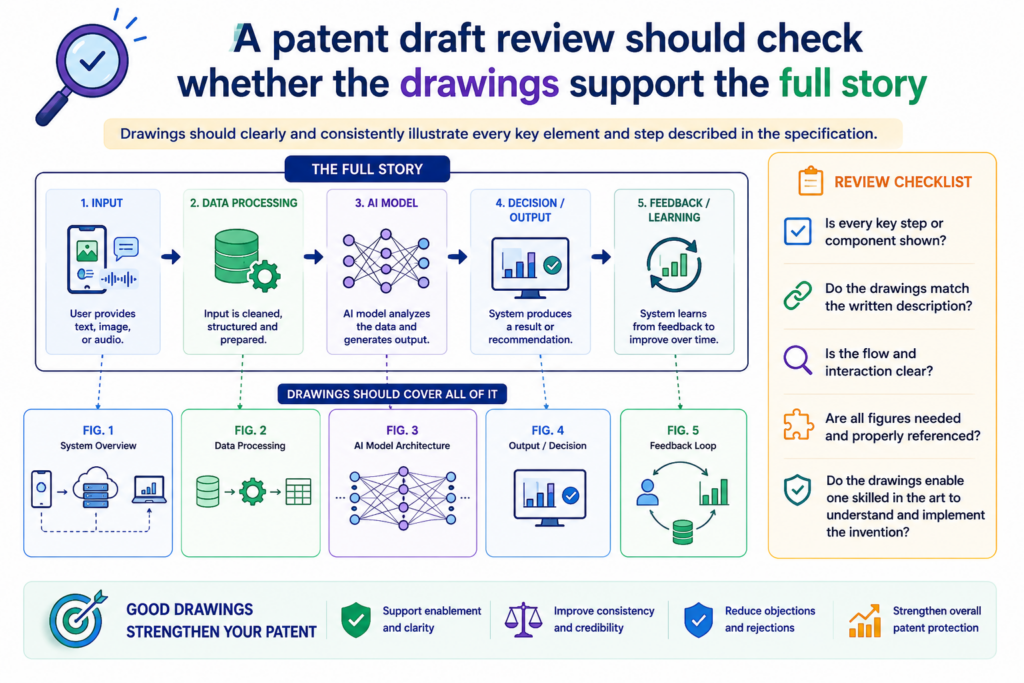
It can show how data moves, how parts connect, how decisions happen, and how outputs return to the user or another system.
For software and AI inventions, drawings do not need to look fancy. They need to be useful. A clear block diagram, flow diagram, data path, model pipeline, or decision path can help support the written description.
During review, the team should ask whether the drawings match the invention as described in the draft. If the drawings are too generic, they may not add much. If they are too narrow, they may make the invention look smaller than it is.
The draft should not include drawings that only show a phone, a server, and a database unless those parts actually explain the invention. Many software systems have those parts.
The drawings should point to what is special. They should show the model selector, ranking engine, feedback loop, privacy filter, context builder, risk scorer, task router, or other part that gives the invention its edge.
The drawings should match the claims and the written description
A strong review checks for alignment. The claims may describe certain steps. The written description may explain those steps in detail. The drawings should help the reader see those steps.
If a claim talks about receiving data, generating a score, selecting a model, checking an output, and updating a stored profile, then a drawing should show that path in a simple and clear way.
Mismatch creates confusion. If the drawings show one flow but the text describes another, the draft can feel careless. If the drawings leave out the most important part of the invention, the reader may miss the core idea.
If the drawings show only one narrow version, but the text tries to support several versions, the review should consider whether more drawings are needed.
This is one reason a guided patent process can help. PowerPatent helps founders capture the invention with more structure, while real attorney oversight helps check whether the draft pieces work together before filing.
That can save time and reduce the risk of sending out a draft that looks complete but does not fully support the invention. You can learn more here: https://powerpatent.com/how-it-works
The best drawings make the invention easier to explain in one minute
A founder should be able to look at the main drawing and explain the invention in a simple way. The explanation should not feel forced. It should flow from the drawing. Data enters the system.
The system cleans or transforms it. A score or context is created. A model or engine uses that information. An output is checked. A final action is taken. Feedback updates a later step.
That kind of drawing can be very helpful because it gives everyone the same map. The founder, engineer, attorney, investor, and examiner can all see the invention path. They may not all care about the same details, but they can follow the structure.
During review, the team should also look for missing fallback paths. If the invention handles errors, low confidence, bad input, missing data, unsafe output, or failed connections, the drawings may need to show that.
These details can be important because they often show why the system works better in real life.
A good drawing does not replace strong writing. It supports it. When the drawings, claims, and description all tell the same clear story, the patent draft becomes easier to trust.
A patent draft review should end with a founder-level filing check
Before a software or AI patent draft is filed, the founder should step back and review the draft from a business point of view. This final check is not about editing every word.
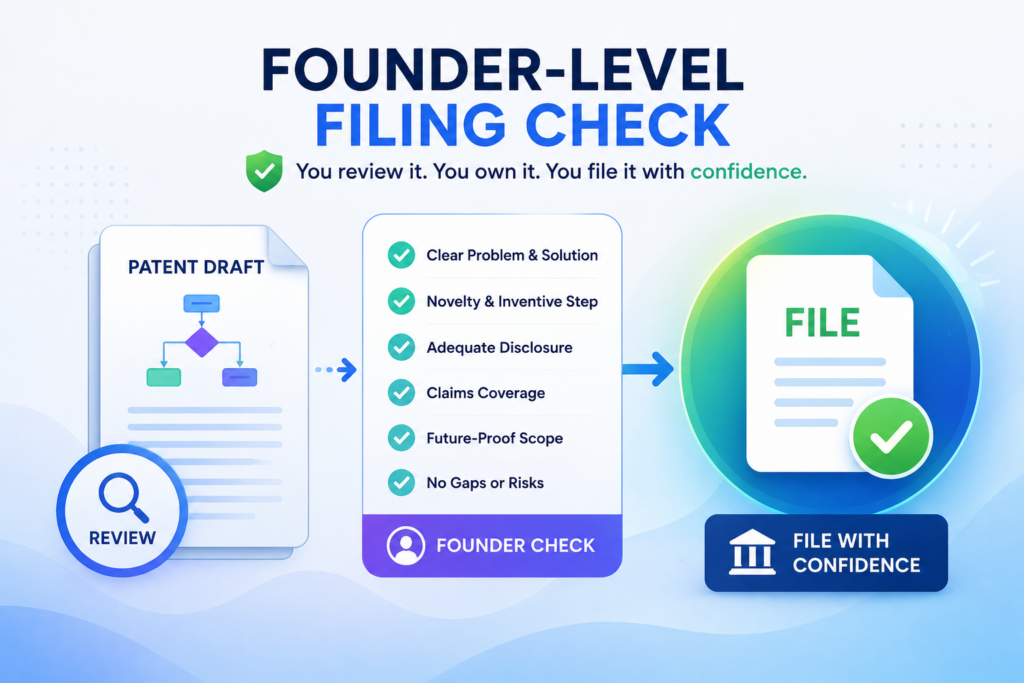
It is about asking whether the filing supports the company’s real goals. The draft should protect the technical edge, match the product direction, and give the team more confidence as it builds.
This founder-level review matters because patents are not just legal files. They are company assets. They can support fundraising, partnerships, exits, licensing talks, and long-term defense.
A rushed or unclear draft may create a weak asset. A thoughtful draft can become part of the company’s moat.
The final review should feel practical. Does the draft describe the invention the team actually cares about? Does it cover the main product path? Does it include future versions the company is likely to build?
Does it avoid needless limits? Does it explain the system clearly enough that a technical person can follow it? Does it give the attorney enough detail to build strong protection?
The final check should focus on confidence, coverage, and clarity
Confidence means the team understands what is being filed. The founder should not feel lost when reading the draft.
Even if some patent wording is formal, the core invention should be clear. If the founder cannot explain what the draft protects, that is a sign the review is not done.
Coverage means the draft is not too small for the business. A patent draft should not only protect a button, screen, or one exact release unless that is truly the invention.
It should cover the technical method, system flow, data path, model control, or workflow logic that gives the company an edge. For software and AI startups, this is where much of the real value lives.
Clarity means the draft says what it means. It should not hide behind vague words like smart, dynamic, optimized, seamless, or AI-powered.
It should explain what the system does and how the parts work together. Clear drafting makes the invention easier to review, easier to discuss, and easier to improve before filing.
PowerPatent was built for this exact kind of founder need. It gives startups a faster, clearer way to turn technical work into patent filings, with smart software and real patent attorney review working together.
That means founders do not have to choose between speed and care. You can see how the process works here: https://powerpatent.com/how-it-works
The best time to fix a patent draft is before it becomes the filed record
Once a patent draft is filed, the team may not be able to add new technical matter to that filing. That is why the final review is so important.
It is the last chance to catch missing examples, weak descriptions, narrow wording, unclear drawings, or claim gaps before the filing becomes part of the company’s IP record.
A founder should treat this step with the same care as a product launch. You would not ship an important feature without checking the flow, the edge cases, and the user impact.
A patent filing deserves the same kind of clear thinking. The draft should be checked for the main invention, the future roadmap, the copycat risk, and the technical details that make the system special.
This does not mean the process needs to be slow. It means the process needs to be focused. With the right workflow, the team can move quickly while still making smart choices.
PowerPatent helps make that possible by giving founders a modern path for patent work that fits how startups actually build.
A strong patent draft review gives the founder peace of mind. It helps the team file with more control, less guesswork, and a better chance of protecting the invention that matters.
For software and AI companies, that can make a real difference. The draft is not just paperwork. It is a way to protect the hard work behind the product.
Conclusion
A patent draft review is where a software or AI invention becomes stronger, clearer, and safer to file. It helps founders catch weak wording, missing details, narrow claims, unclear drawings, and gaps that copycats could use later. More than anything, it gives your team control before the draft becomes part of your company’s record.
For fast-moving startups, that control matters. PowerPatent helps you move quickly without treating patents like a risky guess, combining smart software with real patent attorney oversight so your invention is reviewed with care. See how it works here: https://powerpatent.com/how-it-works