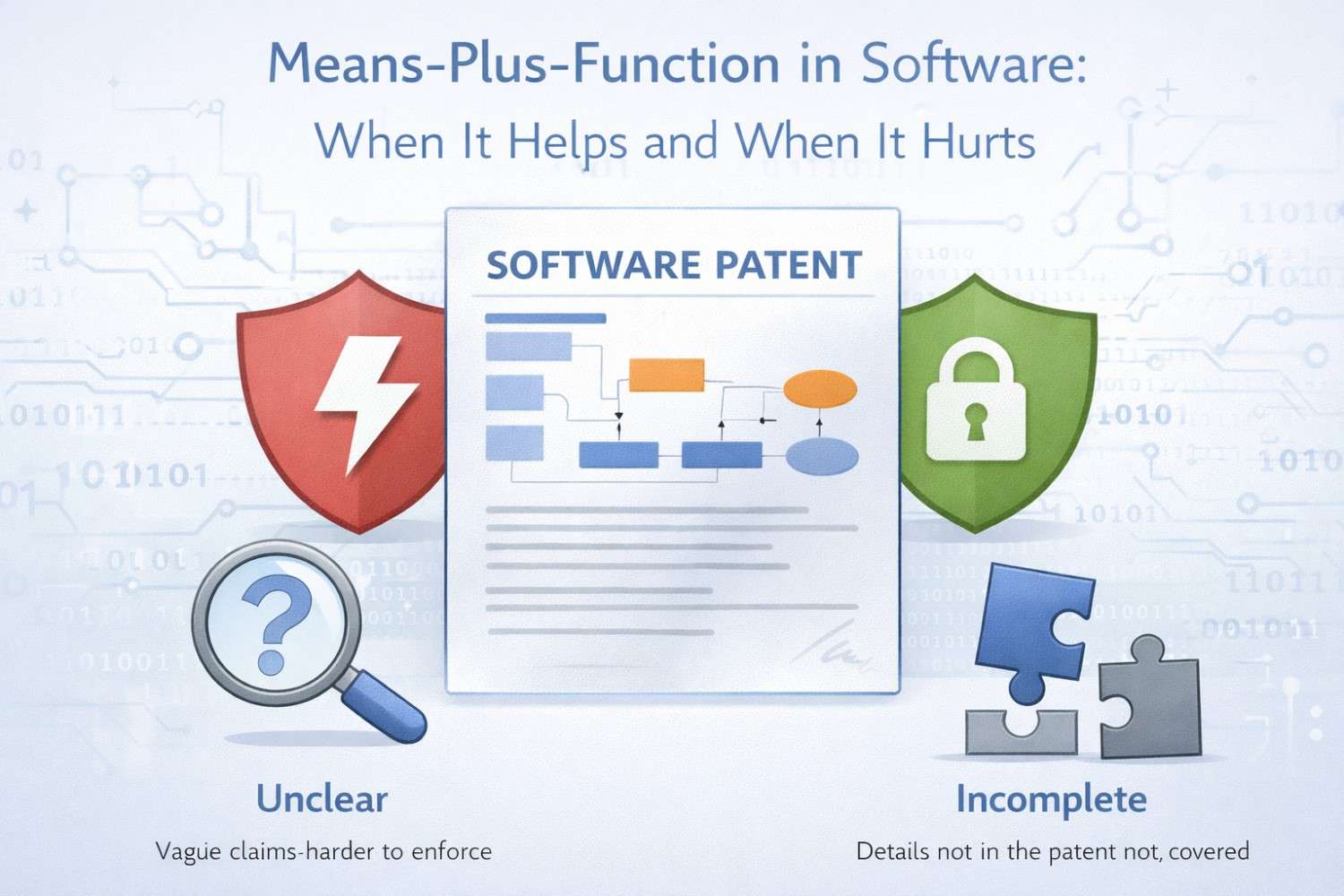
Most software founders do not lose patent protection because their idea was weak. They lose it because the patent was written in a way that sounds broad, but turns out to be thin when it matters. That is why means-plus-function language is such a big deal. It can look powerful at first glance. It can seem like a smart way to claim what your software does without locking yourself into one exact way of doing it. For busy founders, that sounds great. You want room to grow. You want strong coverage. You do not want your patent boxed into one version of your code while competitors build around it with a small change.
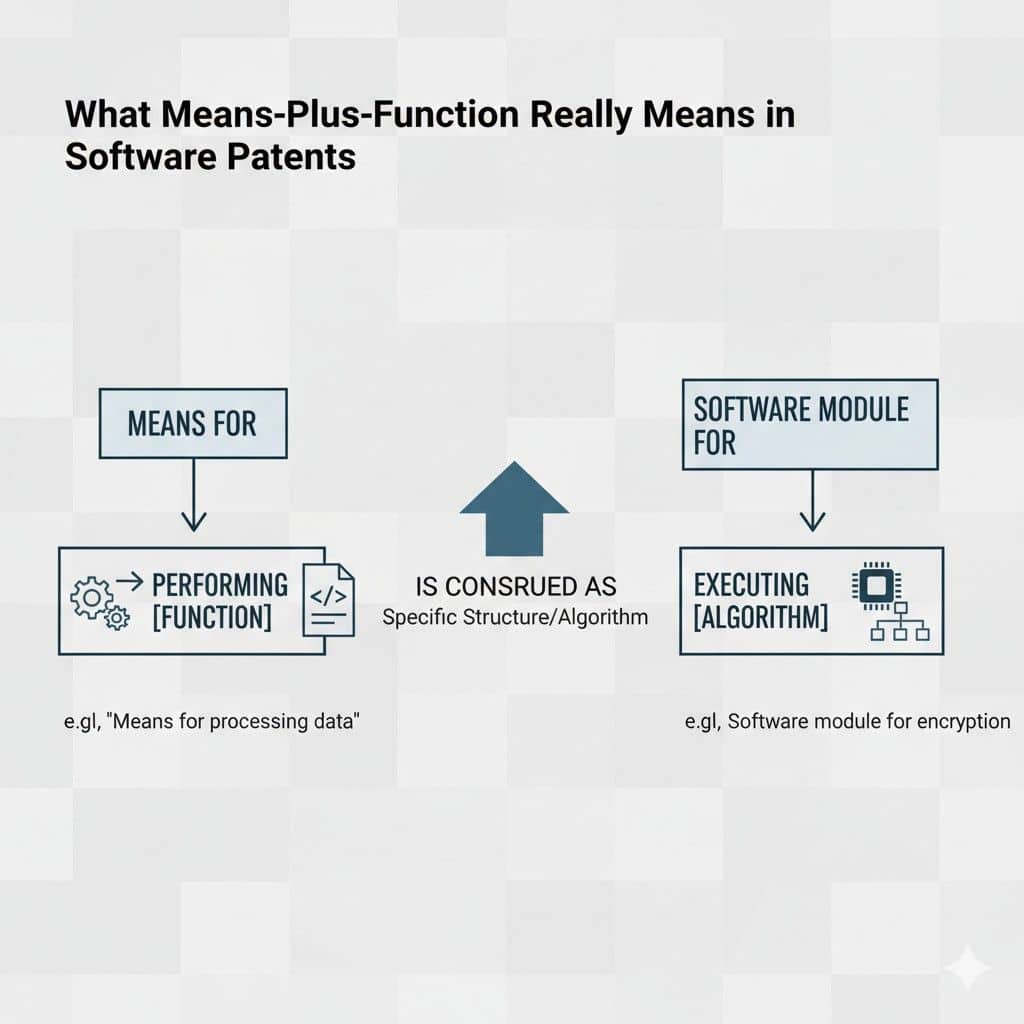
What Means-Plus-Function Really Means in Software Patents
Most founders first hear this phrase and assume it is just patent lawyer language. It is not. It affects how much protection a software patent may actually give your business when it matters most.
In simple terms, means-plus-function language is a way of claiming an invention by saying what something does instead of clearly saying what that thing is. That may sound harmless.
In fact, it can sound efficient. A company may think, “Great, we can claim the result without boxing ourselves into one exact design.” But in software, that choice can change the strength of the whole patent.
This matters for businesses because patents are not judged by how impressive they sound. They are judged by how they hold up under pressure.
If your company plans to raise money, enter a crowded market, license technology, or stop copycats, the wording of the claims matters a great deal.
Means-plus-function language can become either a useful tool or a weak point, depending on how the patent is built behind the scenes.
The Core Idea Behind Means-Plus-Function
At its core, means-plus-function language tries to describe a part of the invention by its job. Instead of naming a specific structure, the claim may point to a function.
In older hardware cases, that often looked like “means for” doing a certain task. In software, the same issue can come up even when those exact words are not used.
This is where many businesses get caught off guard. A founder may believe the claim is broad because it sounds broad.
The claim may say a system performs some useful task, such as ranking content, validating identities, matching users, or detecting anomalies.
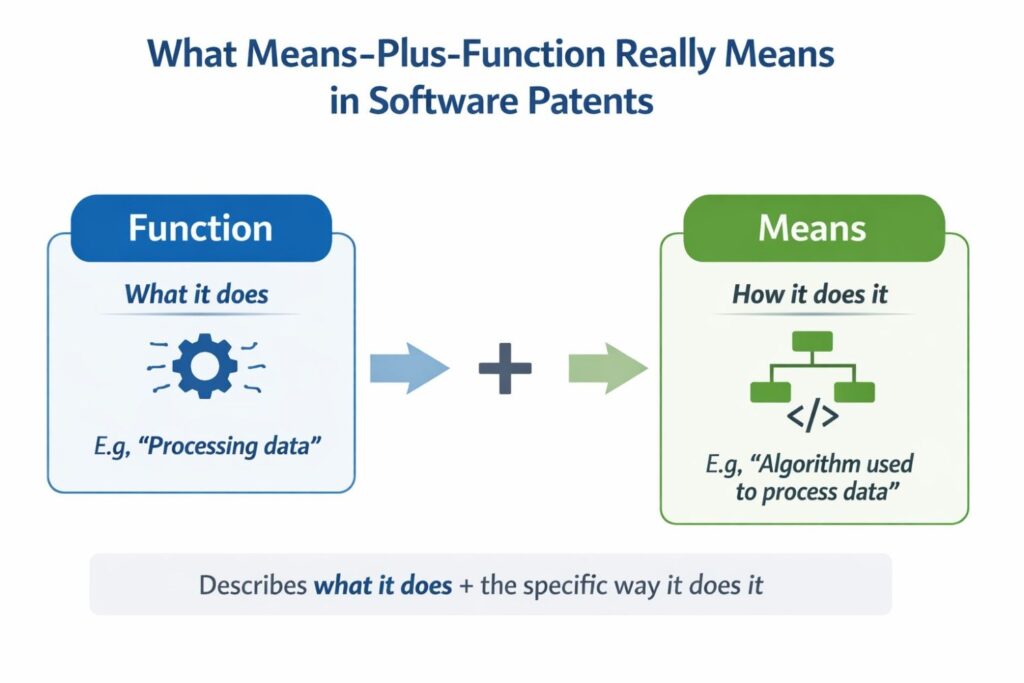
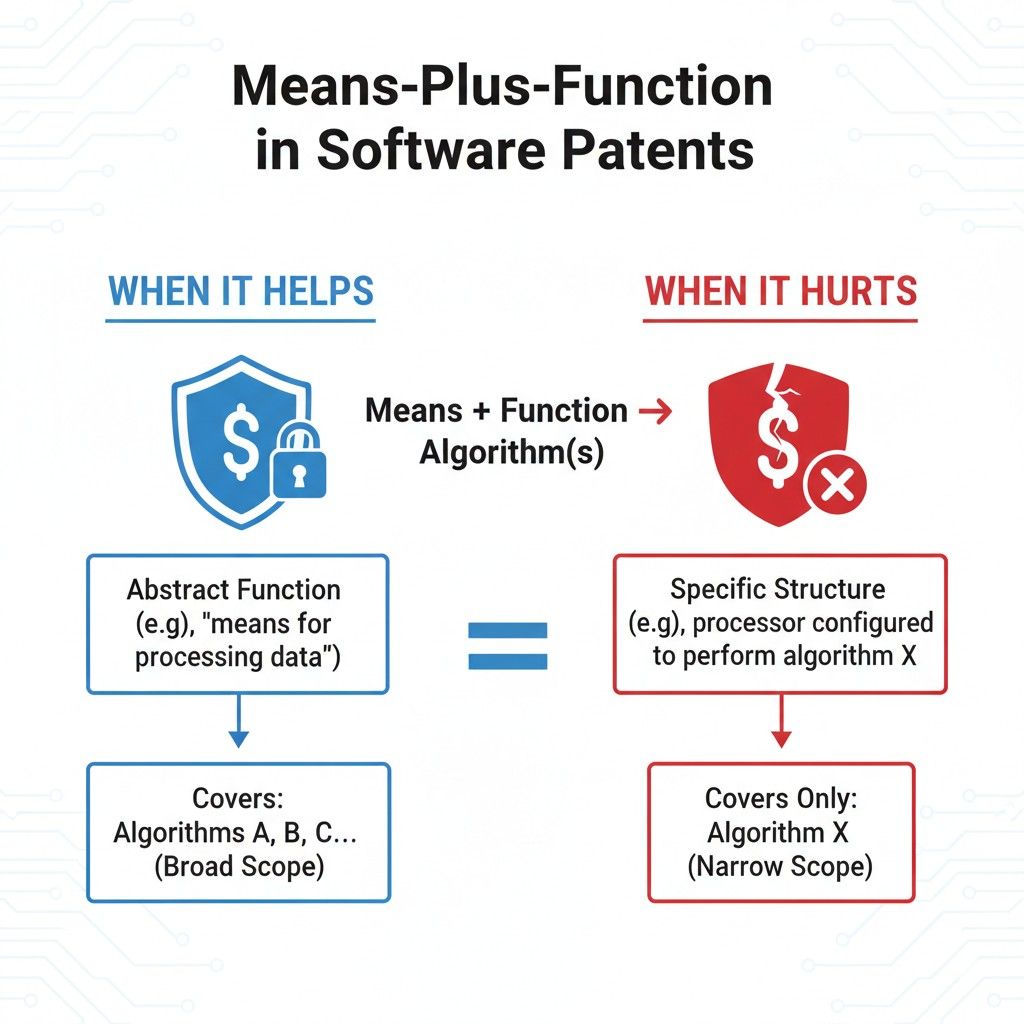
But that does not automatically mean the patent covers every way to do that task. In many cases, the law asks a deeper question: what is the actual structure in the patent that performs that function?
If the patent does not answer that clearly enough, the claim can shrink fast.
Why This Is Different From Plain Functional Claiming
A lot of software patents use functional language. That alone is not unusual. Software is often explained by what it does. The real issue is not whether function is mentioned.
The issue is whether the claim is drafted in a way that gets tied to a special rule that limits the claim to the structures described in the patent and their close equivalents.
That distinction is important for business strategy.
A company may spend real money filing a patent that looks wide enough to scare competitors, only to learn later that the claim is much narrower than expected because it is linked to a very specific disclosed approach.
That gap between appearance and reality can hurt licensing talks, enforcement efforts, and even diligence in an acquisition.
Why Software Is a High-Risk Area
Software patents face this problem more often because software can be described at a very high level if the drafting is not done carefully. It is easy to write language that says what the software achieves.
It is much harder, and much more important, to explain how the software achieves it in a real technical way.
For a business, this means one simple thing. If your patent only describes outcomes, you may not really own much beyond those words.
If it explains the actual technical path, you have a better chance of creating something durable.
What Courts and Patent Reviewers Usually Want to See
The reason means-plus-function can become dangerous is that the law usually expects a real supporting structure in the patent. In software, that often means an algorithm or a clear technical process, not just a label like “module,” “engine,” “unit,” or “component.”
That can feel surprising to companies because those words show up everywhere in product design. Teams talk like that every day.
They say recommendation engine, fraud module, scoring unit, routing component. Those labels may work fine in product meetings.
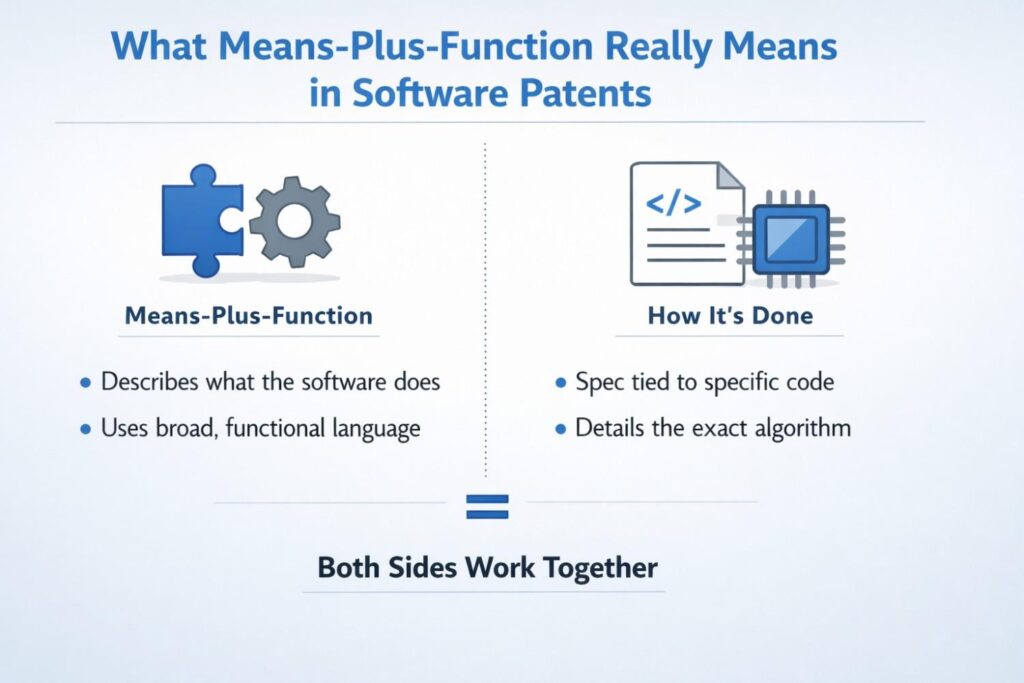
They may even be helpful in engineering docs. But inside a patent, those labels may not carry enough weight by themselves.
A Name Is Not the Same as a Structure
A common mistake is assuming that giving a software feature a polished name makes it concrete. It does not. Calling something an optimization engine does not explain what it actually does.
Calling something a trust score module does not explain how the score is created. Calling something an orchestration layer does not explain what rules, data flows, or decision steps are used.
For businesses, this creates a very practical lesson. If your patent draft uses neat labels but cannot walk through the actual process, that is a warning sign. The stronger business move is to push past labels and capture the operating logic.
The Difference Between Product Language and Patent Language
Product teams often write for speed and alignment. Patent writing has a different job. It must preserve legal protection.
That means a phrase that sounds complete in a roadmap deck may be dangerously incomplete in a patent application.
A smart company treats this as a translation problem. The business already knows what the product does. The patent needs to explain how the product works in a way that stands up later. That usually means mapping business outcomes to technical mechanisms.
If your product promise is “real-time fraud detection,” the patent should not stop there. It should explain the data inputs, the rule flow, the model steps, the threshold logic, and what happens next in the system.
That extra detail is not clutter. It is often the part that saves the claim.
Why Means-Plus-Function Can Look Attractive at First
There is a reason people keep reaching for this kind of language. It sounds flexible. It sounds broad. It sounds like a shortcut to wide protection.
For a fast-moving company, that appeal is easy to understand. Founders do not want to lock the patent to one release version of the product. They know the code will change.
They know the architecture may evolve. They want claims that can keep up with that growth.
That instinct is not wrong. The mistake is thinking that broad sounding function alone creates broad protection.
In reality, broad protection usually comes from thoughtful drafting that describes several ways the invention can be carried out, while still tying those ways to clear technical support.
The False Comfort of Broad Words
A claim that says “a module configured to classify user activity” may feel safely broad. But if the patent only teaches one vague approach, the claim may not reach nearly as far as the business hoped.
This can become a real problem when a competitor uses a different technical route to reach a similar market result.
From a business view, this is not a wording problem. It is a moat problem. If the patent cannot reach meaningful workarounds, the moat may be much smaller than the company believes.
How This Shows Up in Real Software Businesses
Means-plus-function issues are not limited to edge cases. They show up in very normal software categories.
That includes AI tools, workflow automation, fintech systems, cyber products, developer platforms, health tech software, and enterprise SaaS.
Any time a company claims a feature in result-first language, there is a risk that the patent may be tested on whether it really explains the structure behind that result.
AI and Model-Based Systems
AI companies are especially exposed here because there is a strong temptation to claim what the model accomplishes rather than how the system technically produces and uses that output.
A patent may say the system predicts churn, classifies intent, flags abuse, or generates recommendations. Those are business-useful outputs. But the patent needs more than the output story.
For an AI business, strong drafting often means capturing the input pipeline, feature treatment, model interaction, ranking or threshold logic, feedback loop, fallback behavior, and system-level use of the output.
That does not mean dumping source code into the patent. It means describing the real technical path with enough depth that the claim has support.
Why Business Teams Should Care
This is not just for patent counsel. Product leaders and technical founders should care because they know where the value actually sits.
If the advantage comes from a specific decision flow, model orchestration pattern, or system response design, that is what needs to be protected. A vague function claim may miss the very thing that makes the business hard to copy.
SaaS Platforms and Workflow Tools
In workflow software, companies often talk about automation in broad outcome terms.
The system routes tasks, scores leads, detects delays, schedules actions, or resolves tickets. Those claims may sound commercial and useful, but patents built only on those descriptions can run into trouble.
A better business move is to capture the workflow logic in detail. What triggers the action. What data is checked first. What conditions reroute the flow. What exceptions are handled.
What sequence is followed. What changes based on customer context. Those are often the details a competitor would need to copy if they wanted to match the core advantage.
That is exactly why those details belong in the patent record.
Why This Can Affect Company Value
A lot of founders think patent strength only matters if they plan to sue someone. In reality, patent quality often matters much earlier. It can affect investor trust, buyer diligence, licensing confidence, and strategic partnerships.
If your company says it has strong software patents, smart buyers and smart investors may eventually ask what those claims actually cover.
A patent that depends on shaky means-plus-function support can raise doubts. It can signal that the company paid for paperwork without building real defensibility.
Due Diligence Sees Through Surface-Level Drafting
In a deal setting, surface-level language rarely survives close review. Sophisticated parties want to know whether the claims are likely to hold up and whether they map to the company’s real technical edge.
If the patent uses function-heavy language with weak support, that may reduce how much confidence a buyer places in the portfolio.
This is why strong drafting is not just a legal asset. It is a business asset. It supports the story that your company has created something difficult to replicate and has documented it properly.
The Cost of Fixing It Later
Once a weak application is filed, your room to repair it may be limited. You usually cannot add brand-new technical detail later if it was never in the original filing.
That means the best time to avoid a means-plus-function trap is before filing, when the engineering story can still be captured fully.
For businesses, this creates a simple rule. The filing stage is not the time to be shallow. It is the time to be complete.
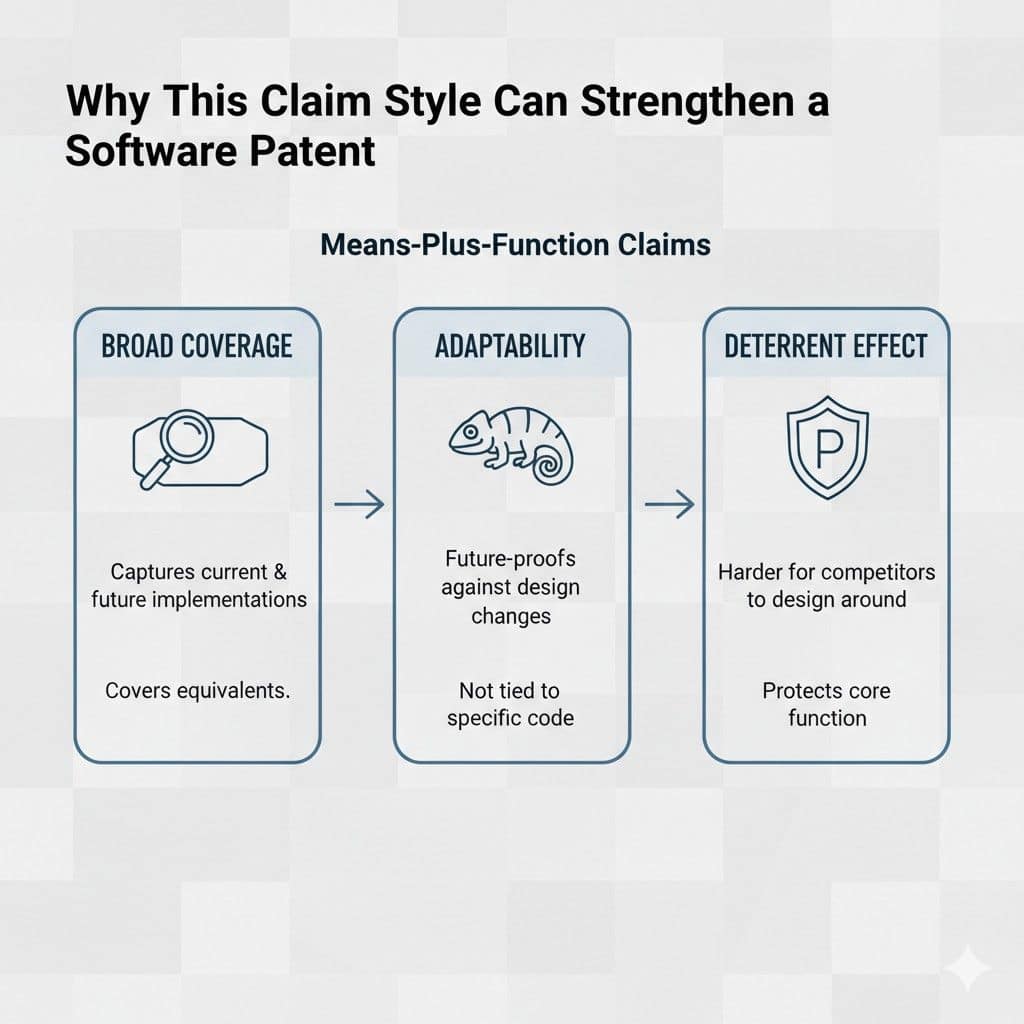
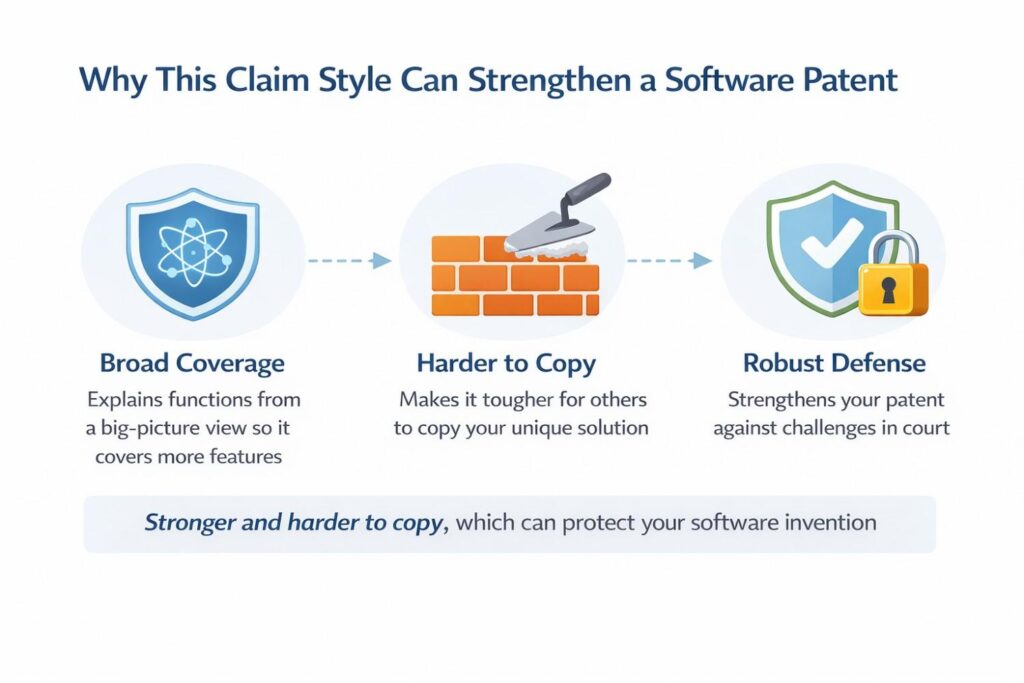
Why This Claim Style Can Strengthen a Software Patent
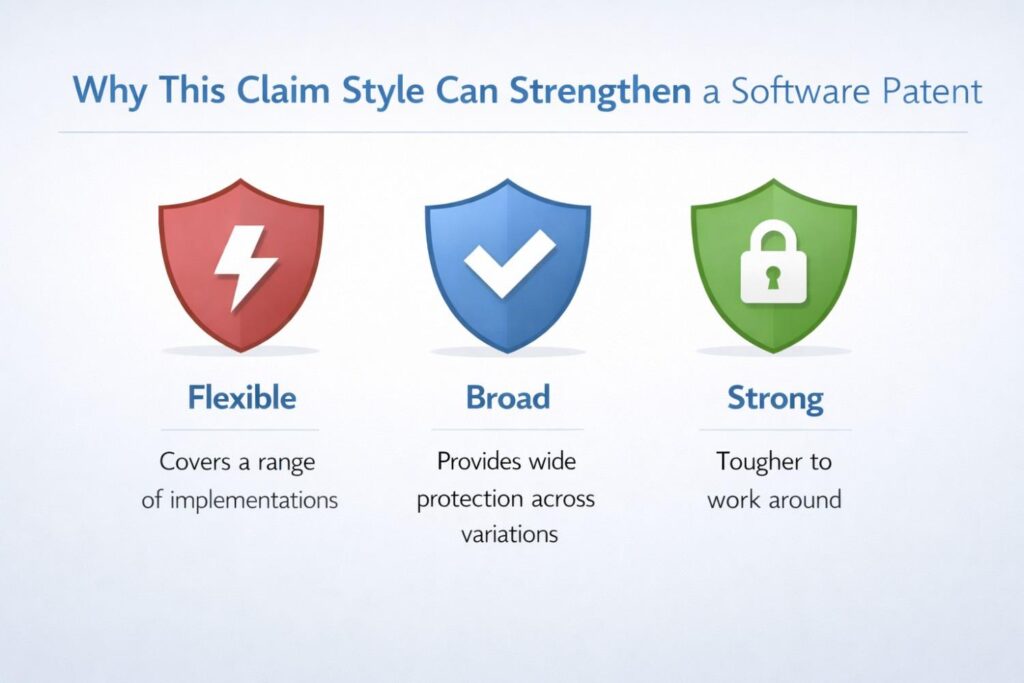
There is a reason means-plus-function language has stayed part of patent drafting for so long. Used the right way, it can help a software patent become more useful, more flexible, and more aligned with how real technology businesses grow.
The key is not the phrase itself. The key is control. When this claim style is used with strong technical support, it can help a company protect the real value of its product without locking the patent into a narrow snapshot of one code release.
For software businesses, that can matter a great deal.
Products change fast. Models improve. data flows shift. system design gets cleaner over time. If a patent is written too tightly around one exact implementation, it may miss later versions of the same invention.
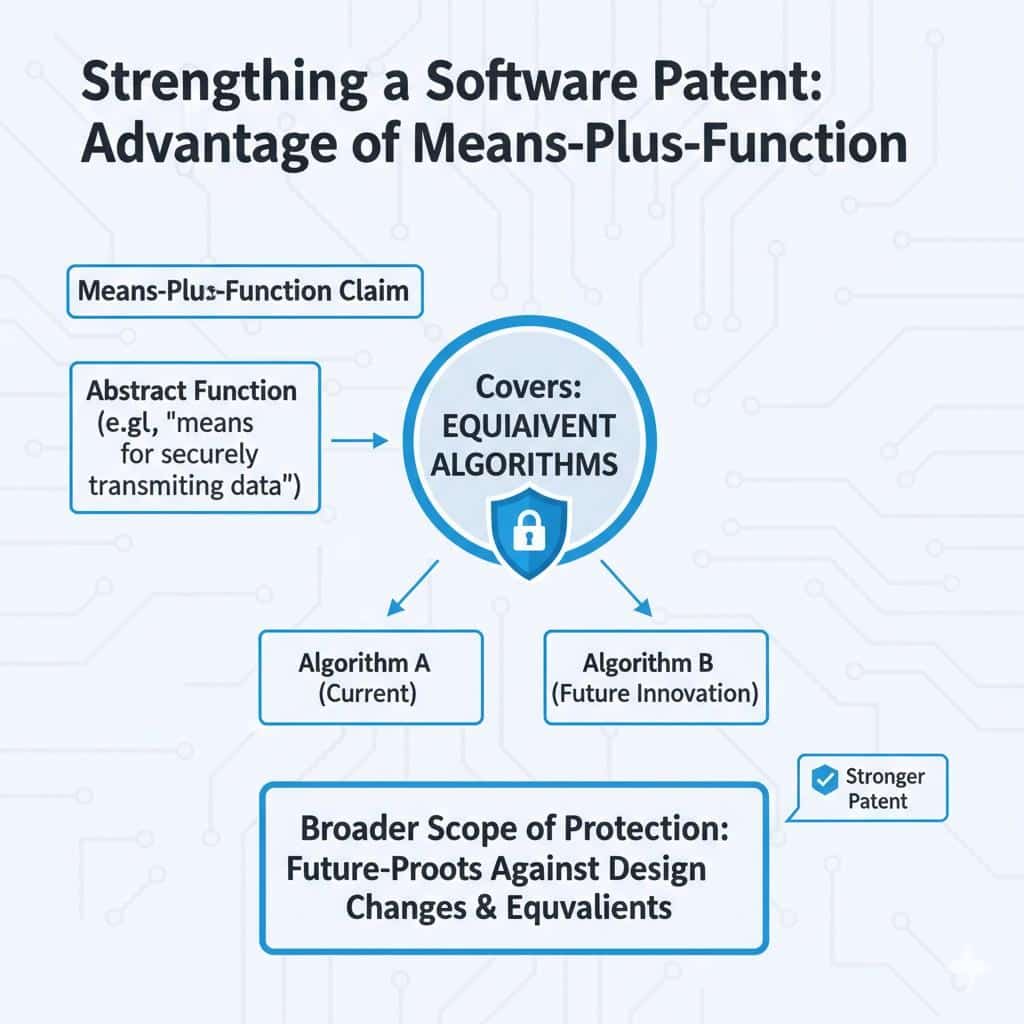
That is where this claim style can help. It can create room around the core function of the invention, as long as the patent clearly teaches the technical ways that function is carried out.
It Can Help You Claim the Real Business Advantage
Many software companies do not win because of one isolated code snippet. They win because their system performs an important job in a way that customers care about.
That job may be verifying identity faster, routing work more accurately, reducing fraud, improving matching quality, lowering cloud waste, or making model output more reliable.
A patent should try to protect that real advantage. In some cases, means-plus-function language can help a company focus the claim on the important function rather than getting trapped by one narrow naming choice.
It Helps Separate the Invention From Temporary Product Language
Startups often describe the same feature in different ways over time. A team may first call something a ranking service, then later rename it a scoring layer, then later absorb it into a decision engine.
The labels change. The value does not.
This claim style can help when the company wants protection tied to the real role played by the system, not just the wording used in one season of product development.
That can be strategically useful because competitors rarely copy your names. They copy your function. If the patent is drafted carefully, the business can align its protection with the part that matters most in the market.
It Lets the Patent Follow the Commercial Problem Being Solved
Strong software companies solve painful problems. A patent that focuses too much on a narrow structural label may miss the broader commercial reality.
A better approach is often to connect the claim to the system function that drives customer value, while also backing that claim with technical detail.
That balance can be powerful for business. It helps the patent stay close to what buyers, investors, and partners actually care about.
It also helps internal teams explain why the patented invention matters, because the patent language maps more directly to the product outcome.
It Can Create More Flexibility Across Product Versions
Software does not stand still. Founders know this better than anyone. The product a startup files on today may look very different twelve months later. New data sources get added.
models are retrained. workflows are redesigned. components are split apart or merged together. A patent that only protects one exact architecture may age badly.
This is where claim style can become a growth tool rather than just a legal tool.
It Gives Breathing Room As the Stack Evolves
When a patent is supported well, means-plus-function language can give the claim enough breathing room to stay relevant as the engineering team improves the stack.
That is valuable because early product design is often shaped by speed, not final elegance. Teams build what they need to prove the market. Later, they rebuild what matters.
A business should not have to choose between moving fast now and having useful patent coverage later.
Good drafting can help preserve both. The right patent can reflect the technical logic behind the feature while still allowing for changes in where that logic sits or how the modules are organized.
It Helps Protect the Invention Beyond Version 1
Many founders file too early with a patent story tied too tightly to version 1 of the product. The code works, the demo lands, the customer likes it, and the company rushes to capture the invention.
That instinct is often right. The risk is filing only the first visible shell of the idea.
A stronger strategy is to treat the filing as protection for the invention family, not just the first product release. Means-plus-function language can support that strategy when it is paired with multiple implementation paths in the specification.
That gives the business a better shot at covering future versions that still perform the same key function in a technically related way.
It Can Make It Harder for Competitors to Design Around You
One of the biggest business reasons to care about patents is not just to sue. It is to make copying harder. A useful patent creates friction. It raises the cost of imitation.
It forces a rival to either invent around the protected idea, license it, or accept risk.
A claim style that focuses on function can help with that goal when it is backed by strong technical disclosure.
It Forces Attention on What the Competitor Is Really Doing
A narrow claim tied to one exact component name or one rigid structure can be easy to avoid.
A competitor may make a small wording change or shift one system boundary and argue they are outside the claim. That can weaken the practical value of the patent.
By contrast, a function-focused approach can help direct the analysis toward the role the competitor’s system is performing.
That can be commercially important. In real markets, copycats often change superficial details while keeping the core operating logic close to the original. A carefully built claim style can make those shallow changes less useful as an escape path.
It Supports Better Leverage in Business Conversations
Most patents do not end in a courtroom. They show up in diligence rooms, licensing talks, partnership discussions, acquisition reviews, and strategic negotiations.
In those settings, leverage matters. A patent that appears hard to design around can shape the tone of a conversation long before formal enforcement is on the table.
That is why this style can strengthen a software patent from a business angle.
It does not just affect legal theory. It affects perceived strength. When a competitor or buyer sees that the patent protects the important function of the system with real technical backing, the asset becomes more serious.
It Can Better Match How Software Is Actually Built
Software inventions often live in flows, interactions, and logic chains rather than in a single physical object.
A founder may build value through the way inputs are handled, how conditions are evaluated, how decisions are triggered, and how outputs are used downstream.
Claim styles that acknowledge function can sometimes fit that reality better than labels that pretend software is a static machine part.
That does not mean function alone is enough. It means function can be the right lens when the invention is fundamentally about operation.
It Captures System Behavior, Not Just System Parts
This matters because many important software inventions are not about one isolated module. They are about coordinated behavior across a system.
The invention may live in how user events are classified, how model confidence is checked, how fallback paths are selected, or how state changes are propagated across services.
A patent that can express that operational role has business value. It protects what customers feel and what competitors would need to copy.
Means-plus-function language can help claim that operational role when the patent gives enough technical detail to anchor it.
It Helps When Architecture May Change but Logic Stays the Same
In modern software teams, architecture is often fluid. Companies shift from monoliths to services, from rules to models, from in-house pipelines to managed infrastructure.
But the core business logic may remain very similar. The same key function still drives differentiation.
That is why flexible claim language can be useful. It helps the patent keep sight of the logic that matters even when the packaging changes.
For a business, that is important because company value usually comes from the durable insight behind the product, not the temporary arrangement of servers or folders.
It Can Improve Portfolio Planning Across a Growing Company
A smart patent strategy is not about one filing. It is about a portfolio that supports the business over time. Different claims play different roles. Some claims should be narrow and precise.
Some should track important technical detail. Some should be positioned to cover broader commercial behavior. Means-plus-function language can play a useful role inside that larger mix.
This is where businesses can use it strategically instead of accidentally.
It Works Well as One Layer of a Broader Claim Set
A strong patent portfolio often includes different levels of claim scope. One set may focus on concrete steps and structures. Another may focus on broader system behavior.
A third may cover specific improvements or fallback mechanisms. Means-plus-function language can sometimes support that broader layer when the company wants to preserve room around the key function.
The business value here is diversification. If one claim type ends up narrower than expected, another may still carry useful weight. This layered approach can make the portfolio more resilient and more credible.
It Helps Build Patents Around Core Company Moats
Every software company should ask one basic question before filing: what is the hard part competitors will want to copy if we win? That answer is rarely “our API name” or “our screen layout.”
It is usually a deeper operating feature. It may be the matching logic, the trust scoring flow, the routing decision path, the optimization sequence, or the orchestration of model and rule outputs.
Means-plus-function language can strengthen a patent when it helps frame claims around that moat.
The company still needs to disclose the technical guts. But the focus becomes sharper. Instead of filing around surface details, the patent begins to follow the real source of advantage.
How Means-Plus-Function Can Quietly Weaken Your Protection
At first glance, means-plus-function language can feel like a shortcut to wider coverage. It can make a claim sound clean, broad, and flexible. That is exactly why it can be dangerous.
The risk is usually not obvious when the application is first drafted. The words may look strong on paper. The problem often shows up later, when the patent is examined closely, challenged, or tested against a competitor’s product.
For software companies, that delay is what makes this issue so costly. A founder may believe the company owns broad protection around a core feature, only to learn later that the claim is tied to a narrow disclosure, missing key design paths the market actually uses.
That kind of surprise can quietly reduce the value of the patent portfolio, weaken business leverage, and create false confidence at the exact moment the company needs real protection.
Broad-Looking Language Can Hide Narrow Real Coverage
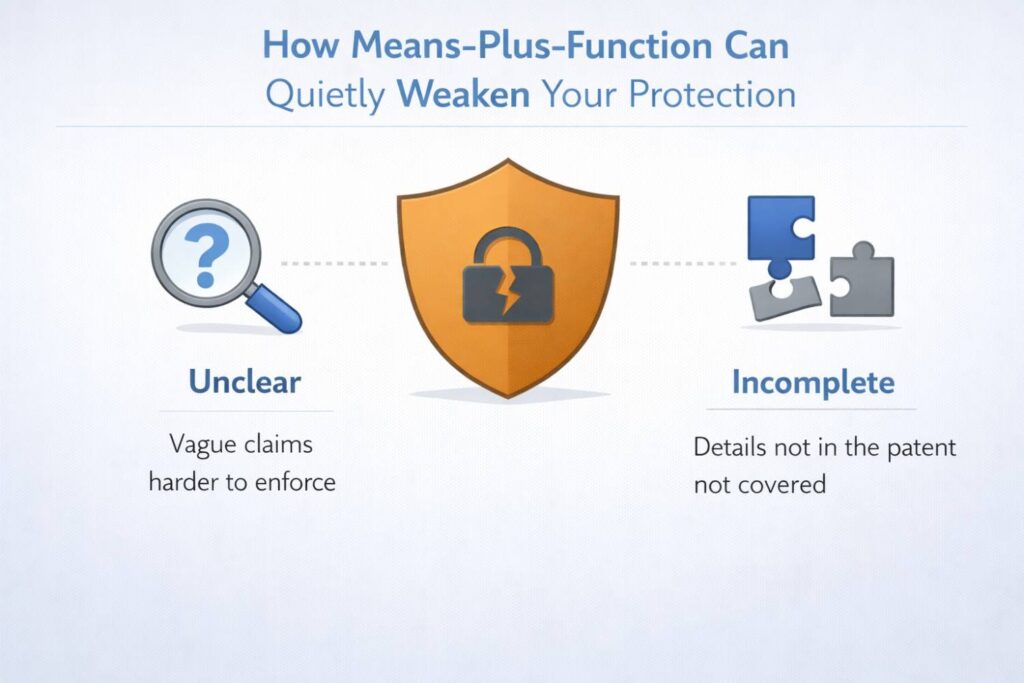
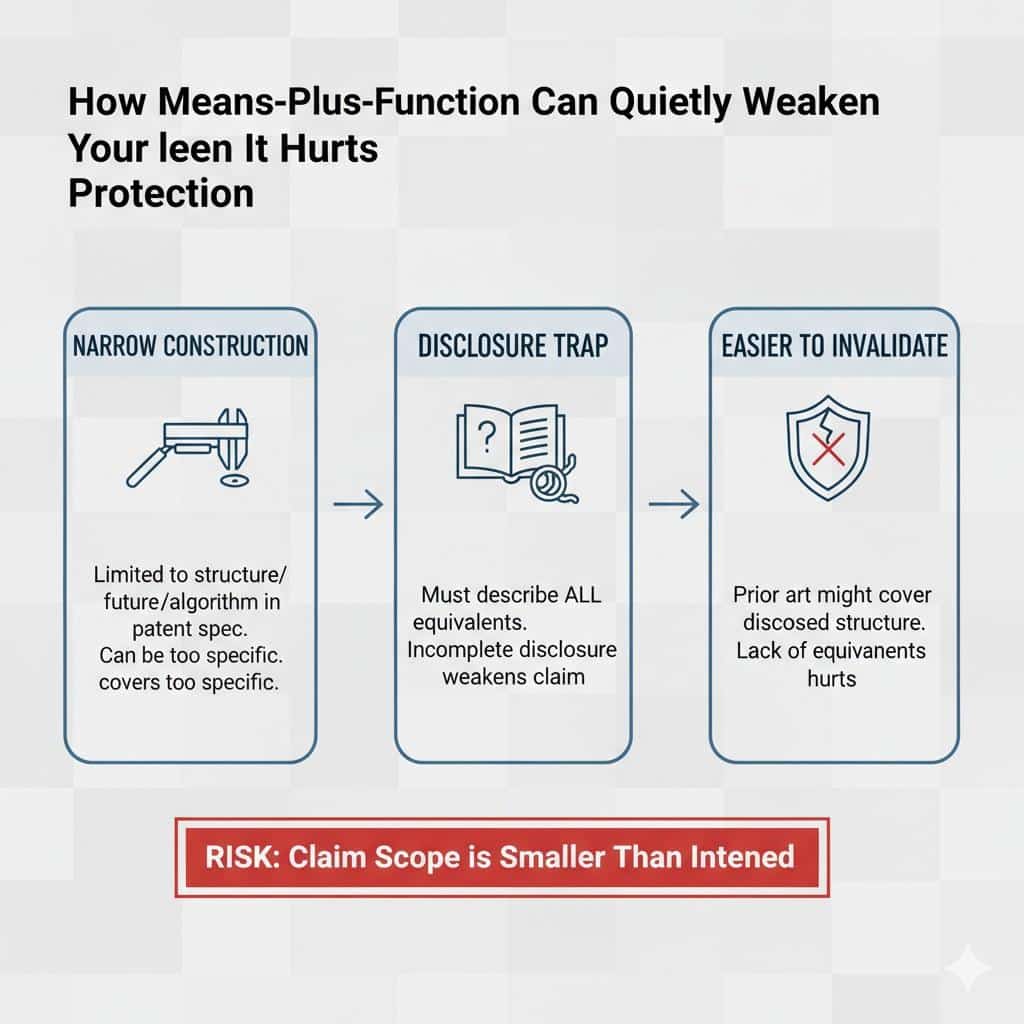
The first trap is simple. The claim sounds wider than it really is. A patent may appear to cover an important software function in general, but the law may read it much more narrowly by tying it to the specific supporting structure described in the patent.
For businesses, this gap between appearance and reality can be expensive. Internal teams may make strategic decisions based on the belief that they have strong coverage over a product advantage. Investors may hear a story about broad protection.
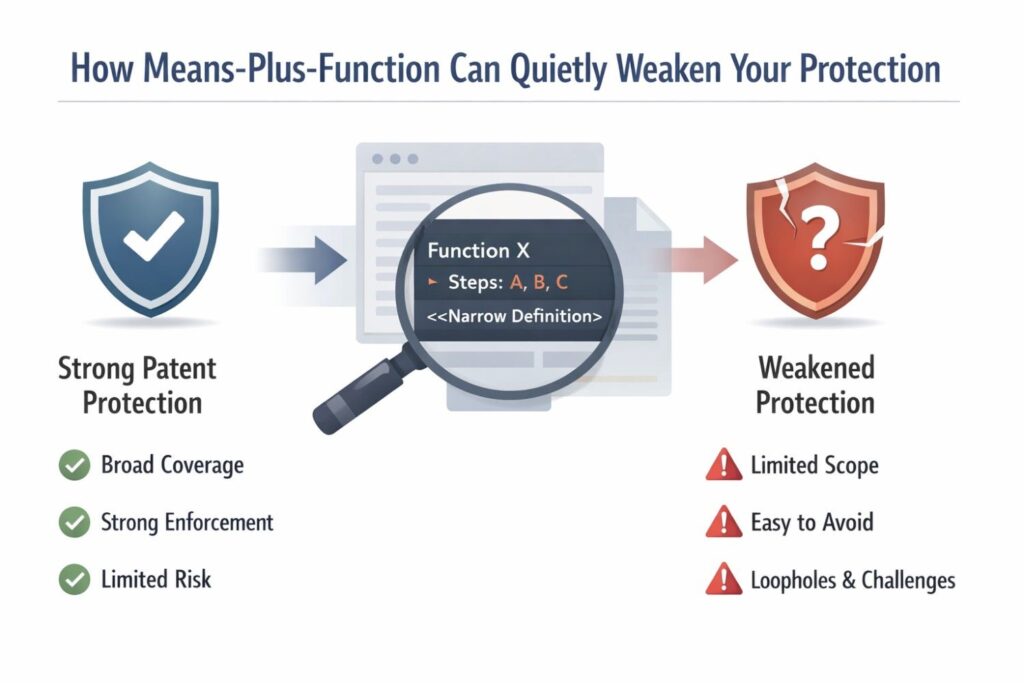
Leadership may assume competitors will have trouble working around the patent. But if the claim is later read as covering only a thin slice of the disclosed implementation, that business story can break apart quickly.
The Problem Starts With Overconfidence
The real danger is not just narrow scope. It is believing you have broader scope than you do. That can distort how a company values its patent assets and how it uses them in commercial planning.
A startup may think it has protected a recommendation system, a fraud engine, or an orchestration feature across the market, when in truth the claim only reaches the exact technical path described in the filing.
Competitors may then sidestep the patent with a small change in architecture or processing flow. The company is left with a patent that looked like a shield but acts more like a snapshot.
Actionable Advice for Founders
A useful internal test is this: if a rival changed the underlying technical path but kept the same business outcome, would your patent still matter?
If the answer is uncertain, the application may be depending too heavily on broad function words without enough flexible support.
This is the right time to review whether the patent teaches multiple technical implementations of the same core function. If it does not, the claim may be weaker than it sounds.
That is a business problem, not just a drafting problem.
Weak Support Can Collapse a Claim
Software patents often run into trouble when the application does not explain the technical mechanism clearly enough. A function is named, but the way it is carried out is left vague.
In means-plus-function situations, that weakness can be fatal.
This matters because software inventions are often easy to describe at the result level. It is much harder to explain the actual internal logic in a way that survives scrutiny.
A draft that says a system “classifies,” “optimizes,” “matches,” or “filters” may feel complete to a business team that already knows how the product works. But that same draft may look empty to a reviewer if the actual process is missing.
A Label Does Not Save a Thin Disclosure
Giving something a polished name does not create technical support. Calling a feature a resolution engine or a prediction module does not explain what it actually does.
In practice, many weak software patents rely on labels as if the label itself were a mechanism.
That approach can hurt a business badly. A patent should help the company protect its moat.
But if the filing only wraps an important function in a label without walking through the technical process, the company may not really be protecting the moat at all. It may just be describing the product in a way that sounds formal.
Why This Matters in Diligence
Sophisticated investors and acquirers often look beyond names. They want to know what is actually protected. If a key claim depends on thin support, that may reduce confidence in the portfolio and weaken the company’s IP story during diligence.
That is why founders should treat claim support as a business asset. A strong application does not just say what the feature is called. It shows how the feature works in enough detail that the claim can hold up later.
Software Changes Fast, but Thin Claims Stay Frozen
Another hidden weakness is that means-plus-function language can lock a claim to an old technical disclosure even while the product evolves. The company changes.
The market changes. The product gets better. But the patent may stay tied to a narrow earlier version of the invention.
This is especially painful for startups. Early product builds are often messy. Teams make fast choices to ship and learn. Those first versions are not always the best expression of the invention.
If the patent only supports that early design path, later improvements may sit partly outside the strongest claim coverage.
Your Best Product Version May End Up Less Protected Than the First
That is an uncomfortable outcome, but it happens. A company files based on version 1.
Over time, engineering improves performance, changes the pipeline, rewrites major components, and creates a more scalable or more accurate solution. Yet the original patent may still be anchored to the old structure.
From a business angle, this means your IP may age in the wrong direction. The better your product becomes, the less directly the original claim may map to what gives you advantage now.
Actionable Advice for Product and Engineering Leaders
Before filing, do not just document the system as it exists today. Also capture where the team expects the architecture to move in the next year.
Include likely alternate flows, variations in model use, changes in module boundaries, and fallback paths that may become important later.
This makes the patent more useful over time. It reduces the chance that your claims are quietly trapped in a product version you no longer care about.
Competitors Can Exploit Small Structural Differences
A software company often worries about direct copying, but in practice many competitors do something subtler.
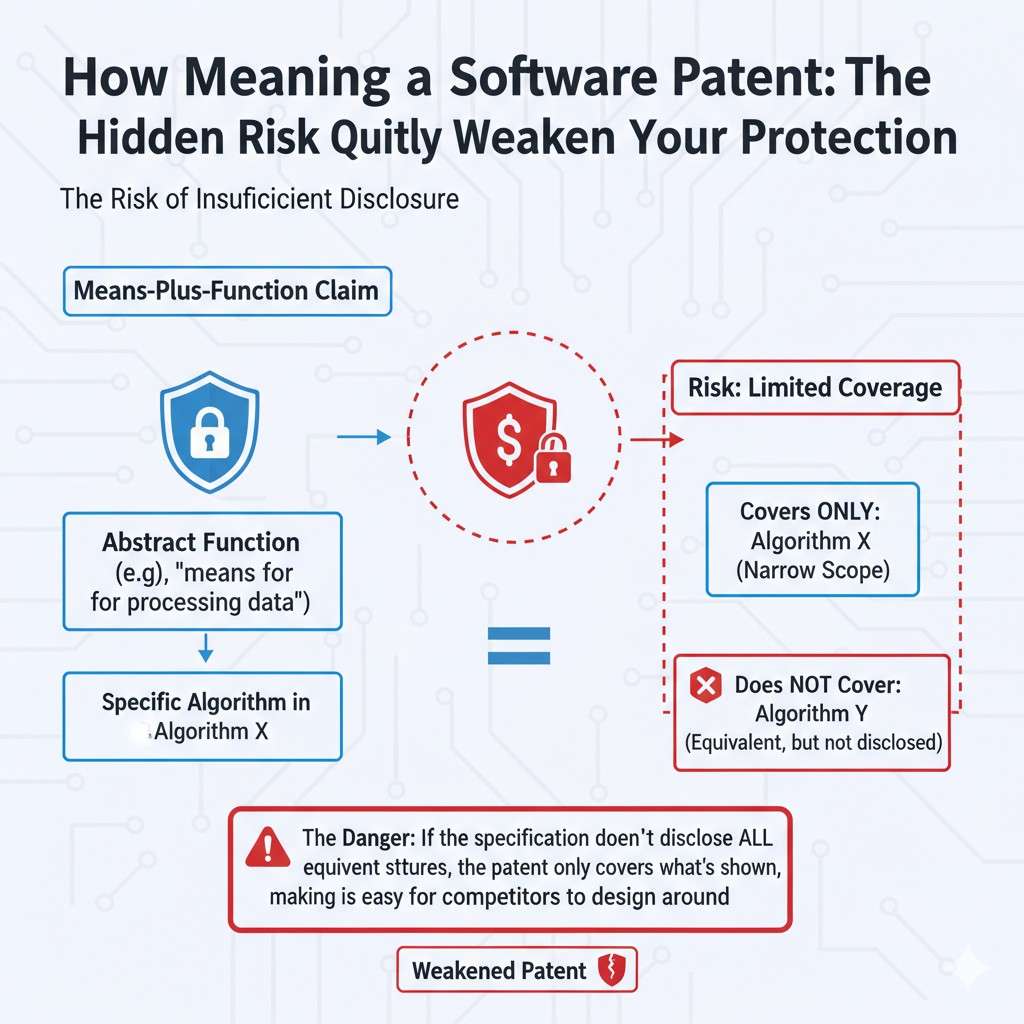
They copy the business logic while changing enough of the underlying implementation to create distance. Means-plus-function issues can make that easier if the claim is tied too tightly to specific disclosed structure.
That matters because real-world competition is rarely literal. Competitors study what works, rebuild the value in their own stack, and aim for enough difference to avoid trouble.
If your patent was drafted with thin support, they may have a clearer path than you think.
The More Abstract the Claim Sounds, the More Careful You Need to Be
Founders sometimes assume that broad wording makes it harder to design around. In software, the opposite can happen.
A claim may sound abstract and large, yet be enforceable only against systems that line up closely with the narrow structure in the patent.
This creates a strategic blind spot. The business sees broad words and feels safe. The competitor sees weak support and feels room to move.
Protecting Against Design-Arounds Starts Earlier Than Enforcement
The best time to reduce design-around risk is at filing. That is when the company can still include multiple technical pathways for the same core function.
It is also when the team can describe the invention at enough depth to make superficial variations less effective as escape routes.
If the filing is already thin, the company may have fewer options later. That is why means-plus-function risk is not just a courtroom issue. It starts as a drafting discipline issue and becomes a business leverage issue.
The Patent May Miss the True Source of Your Moat
One of the most damaging effects of weak functional drafting is that it can steer attention away from the real value in the product.
A company may believe it has patented its core advantage, when in reality it has only captured a rough description of the feature.
This often happens when teams focus on what customers see rather than what makes the system hard to replicate.
Customers may see instant approvals, better matching, faster search, or smoother workflows.
But the moat may live deeper down, in the scoring sequence, threshold logic, exception handling, feedback loops, or coordination between models and rules.
Surface-Level Claiming Creates Surface-Level Protection
A business that patents only the visible result may end up with only visible protection.
That is usually not enough. Competitors do not need to copy your interface or marketing language. They need to copy the engine behind the customer result.
If the patent fails to reach that engine, the company may own a document without owning meaningful control over the market behavior it cares about most.
A Better Question for Business Teams
When reviewing a patent draft, ask this: if a competitor wanted to copy our strongest outcome, what technical choices would they be forced to recreate? Then look at whether those choices are clearly disclosed.
That question helps uncover whether the patent protects the actual moat or just the story around it.
It Can Create Problems in Patent Examination
Means-plus-function language can also make prosecution harder if the examiner presses on support, structure, or clarity.
Even if the application ultimately survives, the process may become slower, narrower, or more expensive than expected.
That matters for startups with limited time and budget. Every round of weak drafting can create extra cost, more delay, and harder tradeoffs about what claims to pursue.
What Feels Efficient Up Front May Become Expensive Later
A loose draft may seem fast at first. It may save time in early preparation because it relies on high-level feature descriptions rather than detailed technical walkthroughs. But that early speed can lead to later friction.
A company may need to narrow claims more than planned, spend more time defending the language, or accept protection that falls below the original strategic goal. In other words, what looked efficient at filing may become inefficient over the life of the patent.
Actionable Advice on Filing Discipline
Do not reward speed alone in the patent process. Reward completeness. A faster draft is not better if it forces narrower outcomes later.
The better business move is to invest early in technical detail, especially for the functions the company believes matter most to growth or defensibility.
It Can Weaken Licensing Power
A software patent has value not only when enforced, but when discussed. In licensing talks, the other side is evaluating risk.
They want to know whether the patent likely reaches their product in a meaningful way. If the claim depends on shaky means-plus-function support, that risk may look lower to them.
This can reduce leverage in quiet but important ways. The company may still own a granted patent, but the patent may command less attention because the other side sees structural weaknesses under the surface.
Perceived Strength Shapes Negotiation Strength
In commercial settings, perception matters. A patent that appears broad but is actually vulnerable can lose force once a sophisticated counterparty studies it.
That can influence royalty expectations, settlement posture, and whether a competitor takes the company seriously at all.
For businesses, this is why patent quality should be judged by durability, not just by grant status. A granted claim that is easy to challenge or easy to read narrowly may offer far less leverage than leadership expected.
The Right Standard Is Commercial Usefulness
The real question is not whether the claim exists. The real question is whether it changes another party’s behavior. Does it raise the cost of copying, create pressure in negotiation, support a licensing program, or strengthen the company’s market story?
If the answer is weak, the claim may not be doing enough for the business, even if it looks impressive at a glance.
Wrapping It Up
Means-plus-function language is not good or bad on its own. That is the real takeaway. In software patents, it can help when it is used with care, backed by real technical detail, and tied to the part of the product that actually gives the business an edge. It can hurt when it is used as a shortcut, when the patent talks about outcomes without showing the working parts, or when broad words create a false sense of safety.