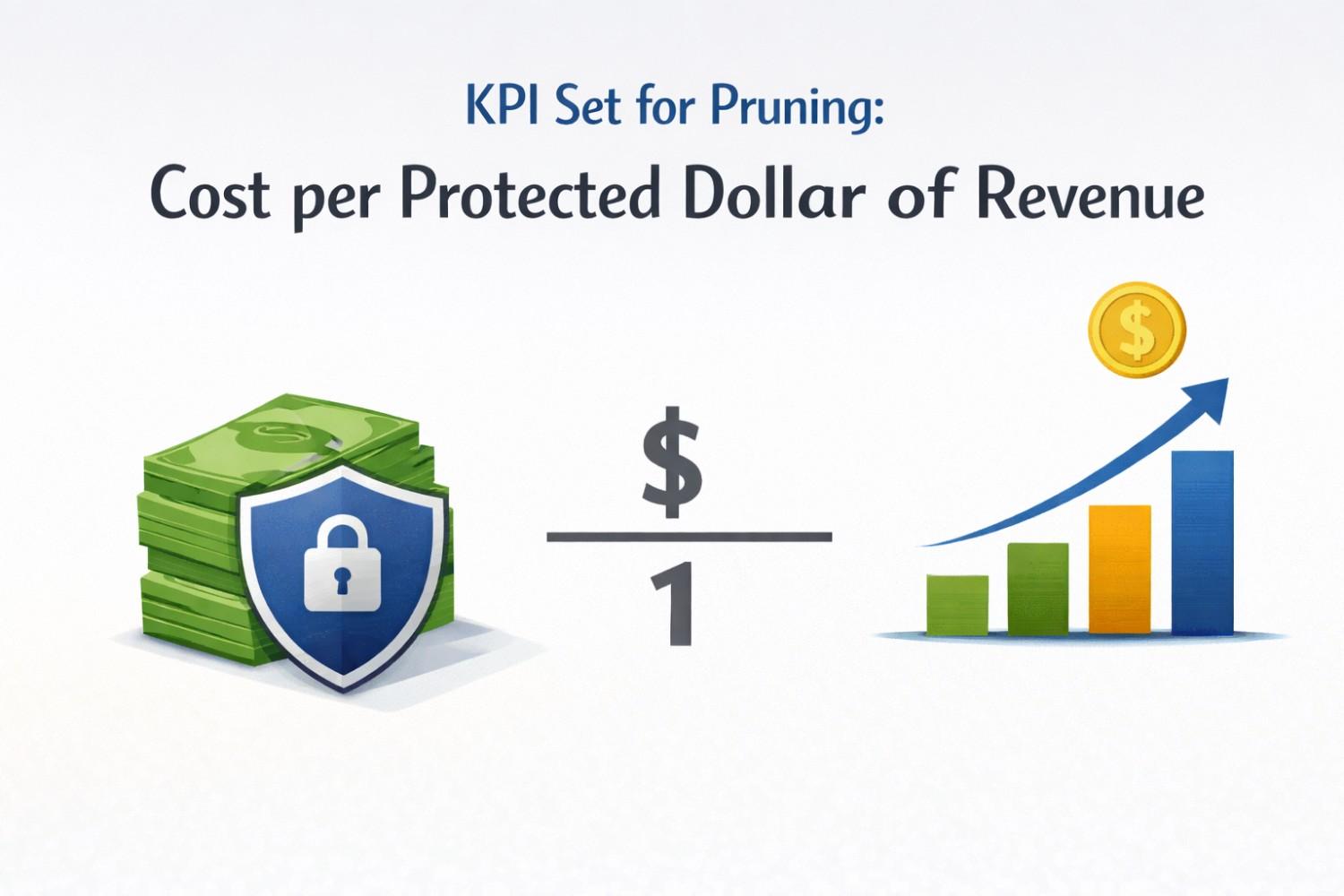
Most startups track growth, burn, and runway. Almost no one tracks how much revenue each patent dollar actually protects. That is a mistake. If you are building real tech, your code, models, and systems will one day drive serious revenue. The question is simple: how much are you spending to protect each dollar that revenue brings in? That is the KPI we call Cost per Protected Dollar of Revenue. If you understand this number, you stop filing random patents and start building a tight, powerful moat around the parts of your business that truly matter. If you do not understand it, you risk wasting money on filings that look impressive but do nothing when it counts.
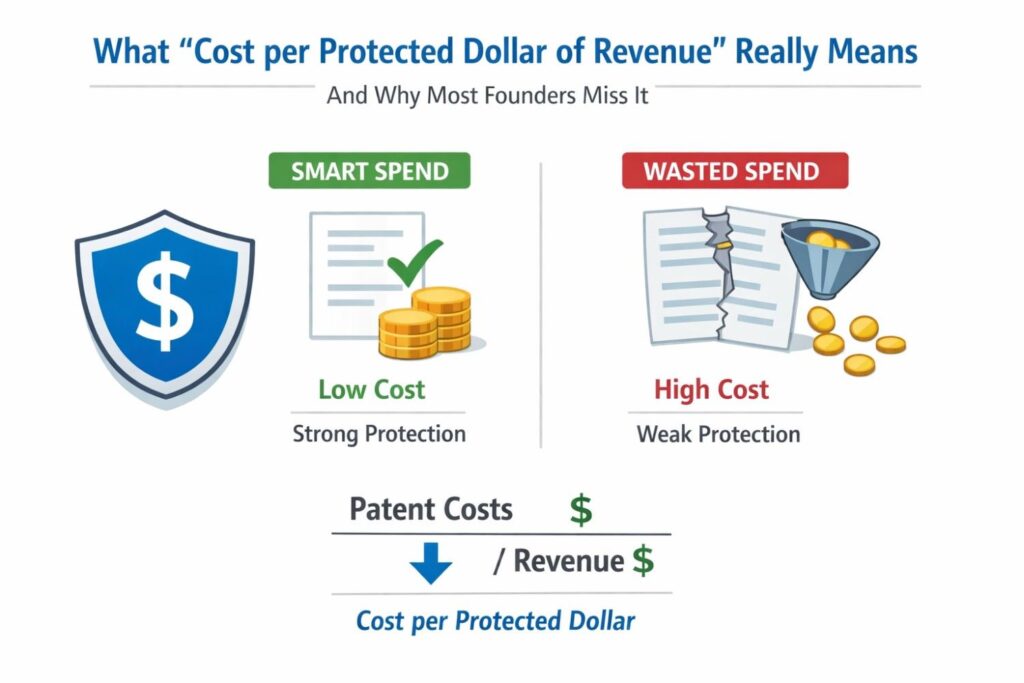
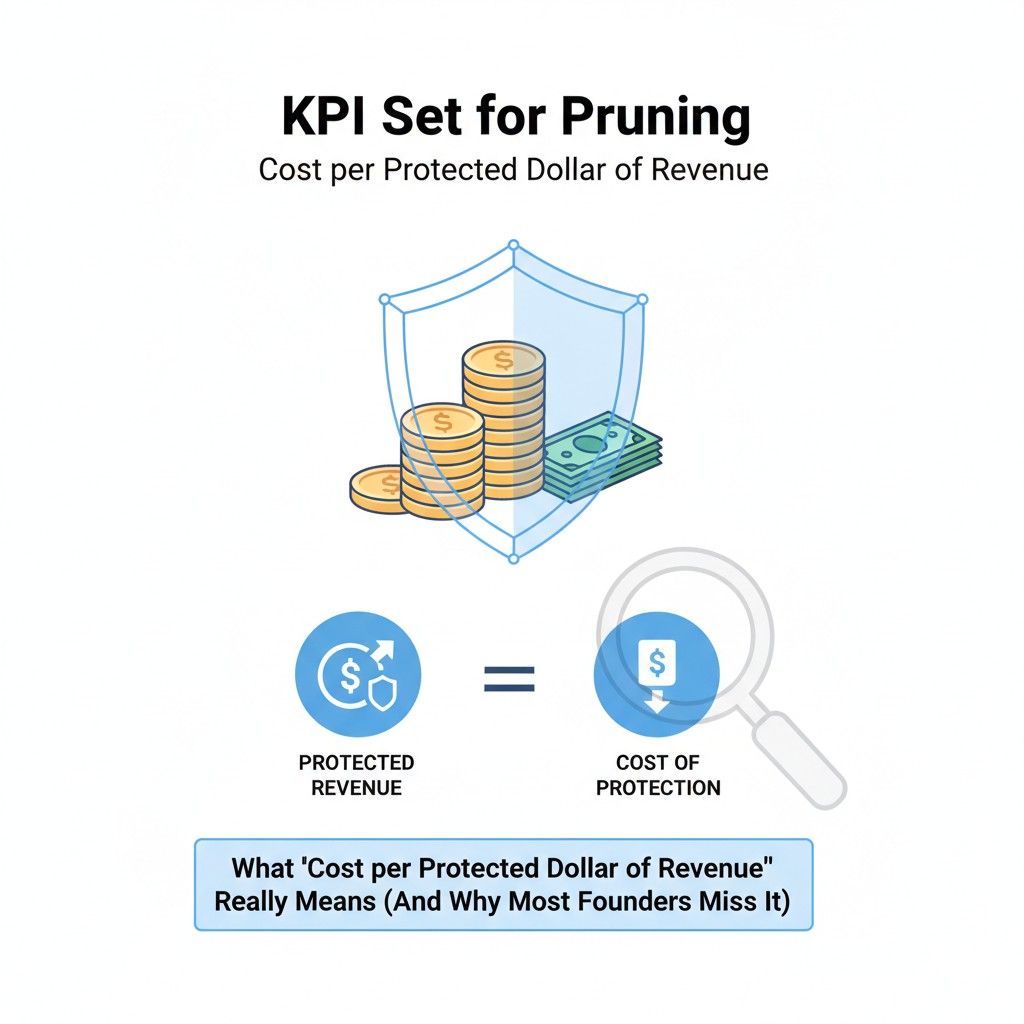
What “Cost per Protected Dollar of Revenue” Really Means (And Why Most Founders Miss It)
Most founders think patents are about defense. Or prestige. Or fundraising. Very few think about patents in terms of efficiency.
That is the gap. Cost per Protected Dollar of Revenue is not a legal idea. It is a business idea. It forces you to ask a simple question: for every dollar I spend on patents, how much real revenue am I actually protecting?
When you see patents through that lens, your strategy changes fast.
This section will go deeper into what this KPI really measures, how it reshapes decision making, and why smart companies use it to prune weak filings and double down on the inventions that truly drive revenue.
The Shift From Filing Patents to Protecting Revenue
Most teams start with a filing mindset. They ask, “What can we patent?” That question sounds smart, but it is often the wrong one. The better question is, “What part of our product drives revenue, and how do we protect that?”
When you focus on revenue first, patents stop being abstract documents and become shields around cash flow. If your AI model is the reason customers pay you, that is where your protection should go.
If your edge device optimization makes your system 10x faster and is the reason enterprises sign contracts, that is the asset that matters.
This KPI forces a shift from volume to value. Ten patents around minor features may look impressive in a pitch deck.
But if none of them protect the core engine that brings in revenue, your cost per protected dollar is high. That means you are spending money without real leverage.
If you want to apply this today, start by mapping your top three revenue drivers. Not features.
Not ideas. Revenue drivers. Then ask a direct question: if a competitor copied this exact part, would it hurt our sales? If the answer is yes, that is where patent energy should go.
If you want a faster way to think through this with real guidance, you can explore how PowerPatent helps founders focus on what truly matters at https://powerpatent.com/how-it-works.
Revenue Is Not the Same as Product
Many founders confuse product with revenue. They patent the product as a whole. But revenue rarely comes from the whole product. It comes from one sharp edge.
Sometimes it is your data pipeline that no one else can replicate. Sometimes it is a training method that reduces cost by 70 percent.
Sometimes it is a hardware layout that makes your system durable in extreme conditions. The rest may be important, but it is not what customers pay for.
Cost per Protected Dollar of Revenue pushes you to isolate that sharp edge. It forces clarity. If you cannot clearly state what technical element drives payment, that is a strategy problem, not a patent problem.
This KPI works like a mirror. It shows whether your IP strategy matches your business model. If they are disconnected, you are burning capital.
A practical step here is to sit down with your sales team. Ask them what closes deals.
Ask them what objections they hear. Ask them what customers care about most. Then compare those answers with your current patent filings. The gaps will be obvious.
When patents align with revenue drivers, your protection becomes powerful. When they do not, your filings become paperwork.
Why Most Founders Miss This KPI
Most founders are builders. They think in code, models, chips, and systems. They are proud of what they create. That pride often drives patent decisions.
There is nothing wrong with that. But pride is not a KPI.
Many startups also follow outside advice without questioning it. They are told to “build a portfolio.” So they file whenever they hit a milestone. Seed round closed? File something.
Product launch? File something. Big customer win? File something.
The problem is that no one stops to ask what that filing is actually protecting.
The truth is simple. Traditional patent firms bill by the filing. There is no built-in pressure to measure business impact.
So the metric becomes count. More filings means more activity. But more activity does not mean more protection per dollar of revenue.
Cost per Protected Dollar of Revenue introduces accountability. It asks whether each filing is tied to actual financial value. If it is not, you prune.
This is where a modern approach matters. PowerPatent combines software that helps you map your inventions clearly with real attorney oversight to make sure filings are tight and strategic.
That combination keeps the focus on business impact, not busywork. You can see how that works here: https://powerpatent.com/how-it-works.
The Hidden Cost of Filing Without Strategy
When you file without linking to revenue, the cost is not just legal fees. It is distraction. It is opportunity cost. It is false confidence.
You may believe you are protected because you have patents. But if those patents do not cover the mechanisms that generate income, they may not help when a competitor enters your market.
Worse, you may hesitate to invest further in IP because you feel you have “already done enough.” That false sense of security can slow down real protection where it matters.
A strong KPI cuts through that fog. If you calculate your cost per protected dollar and it is high, that is a signal. It does not mean patents are bad. It means your targeting is off.
A simple internal exercise can help. Estimate how much revenue depends on each core technical system. Then compare that number to what you have spent to protect it.
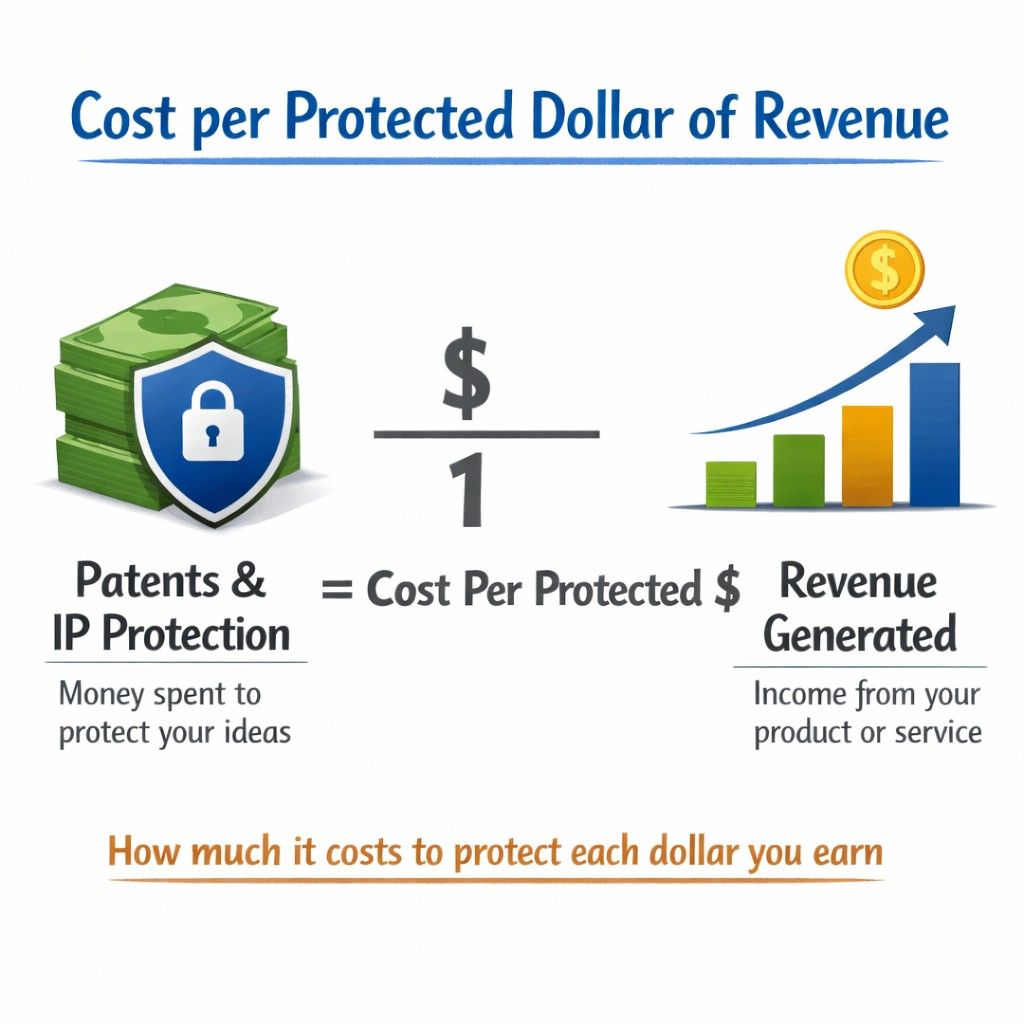
If you have spent heavily on a feature that contributes little revenue, that is a pruning candidate. If you have spent almost nothing protecting your core engine, that is a risk area.
This is not about cutting patents. It is about cutting waste.
Turning IP Into a Capital Efficiency Tool
Investors care about efficiency. They care about how much growth you get per dollar spent. Your IP strategy should follow the same rule.
Cost per Protected Dollar of Revenue reframes patents as a capital allocation decision.
If you spend fifty thousand dollars protecting a system that drives ten million dollars in annual revenue, that is efficient. If you spend the same amount protecting a side feature that brings in almost nothing, that is not.
When you track this KPI over time, you can make sharper calls. You can decide when to expand claims. You can decide when to file continuations. You can decide when to hold off.
This is pruning in action. You trim weak branches so the tree grows stronger.
The key is discipline. Each time you consider filing, ask what revenue it protects. Be honest. Do not inflate the number. Tie it to real contracts, real customer demand, or clear future pricing power.
If you are unsure how to translate your technical work into defensible claims that truly protect revenue, that is where the right tooling and attorney guidance matter.
PowerPatent was built for this exact problem. It helps founders connect code and models directly to strong patent coverage, without slowing down product work. Learn more at https://powerpatent.com/how-it-works.
Building a Culture That Thinks in Protected Revenue
A KPI only works if your team understands it. Cost per Protected Dollar of Revenue should not live only with legal or finance. It should shape product discussions.
When engineers know that their core systems may become protected revenue engines, they think differently about documentation. They capture design decisions.
They explain why something is novel. They flag breakthroughs early.
This creates a pipeline of high-impact inventions rather than random filings.
You do not need a complex process. You need a habit. During roadmap reviews, include one simple question: which upcoming features, if copied, would directly hurt our revenue? That question aligns product and IP.
Over time, your portfolio becomes lean and sharp. Each patent ties to money. Each filing has a purpose. Your cost per protected dollar goes down. Your moat grows deeper.
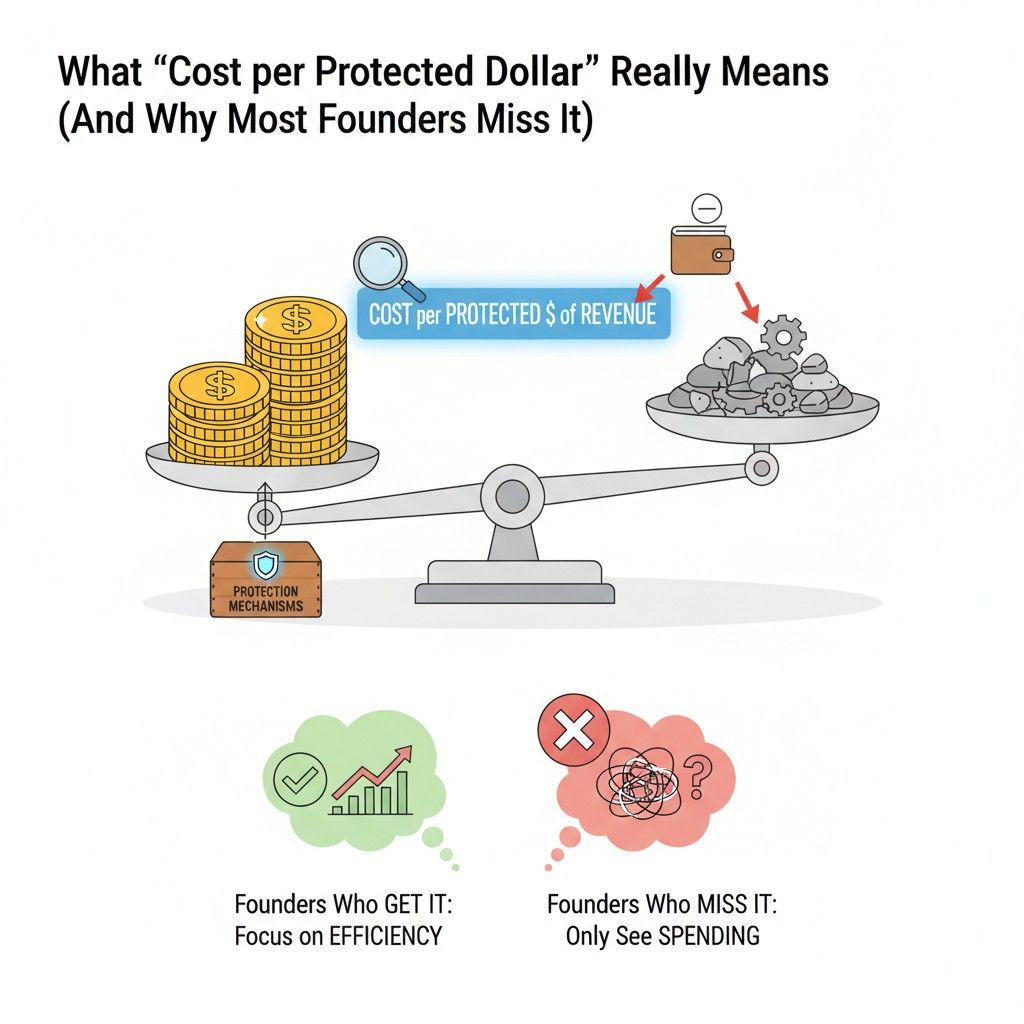
That is the real meaning of this KPI. It is not a math trick. It is a mindset shift. It forces clarity. It rewards focus. And it protects what truly pays the bills.
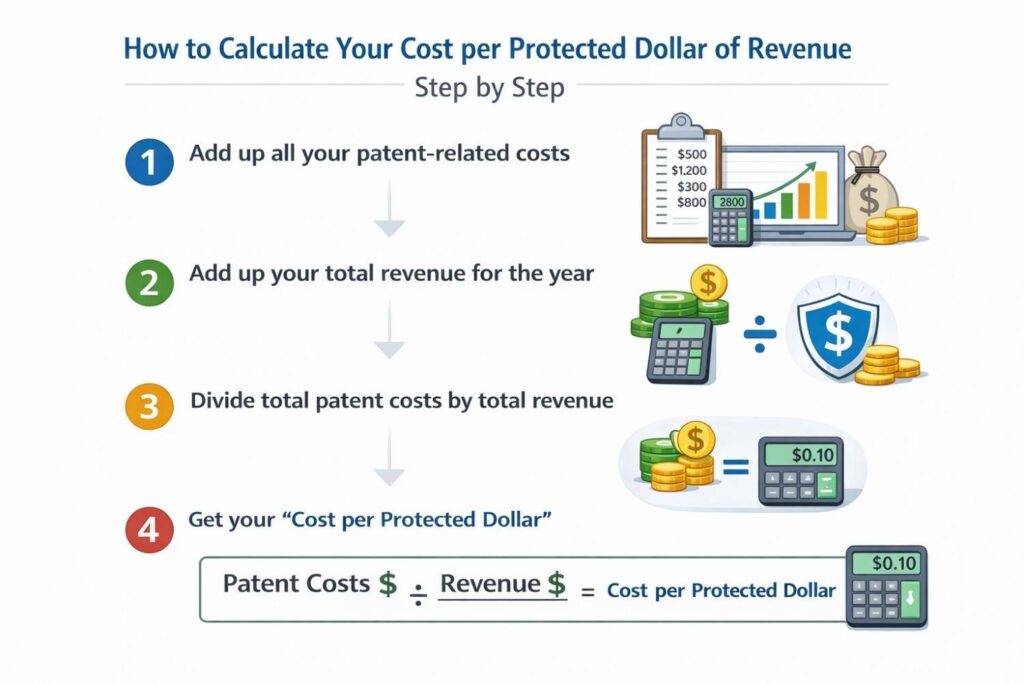
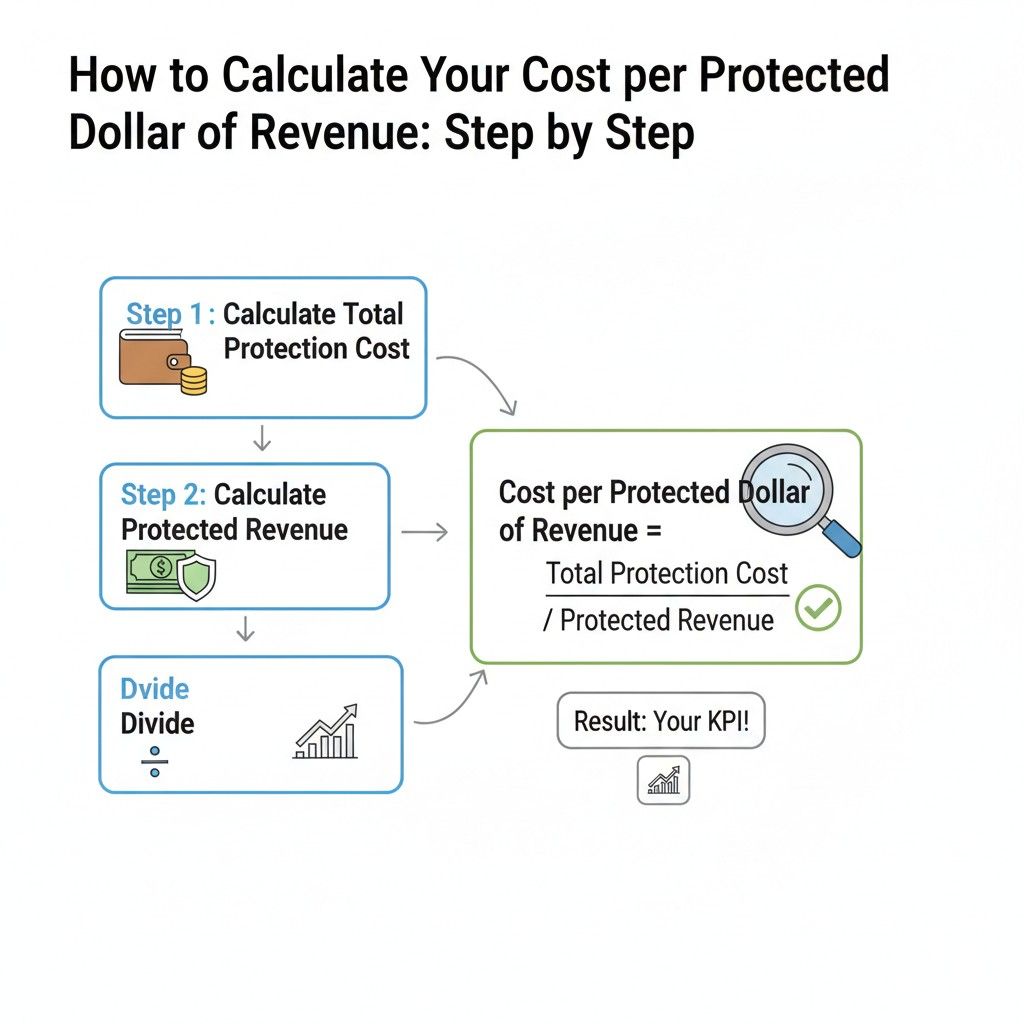
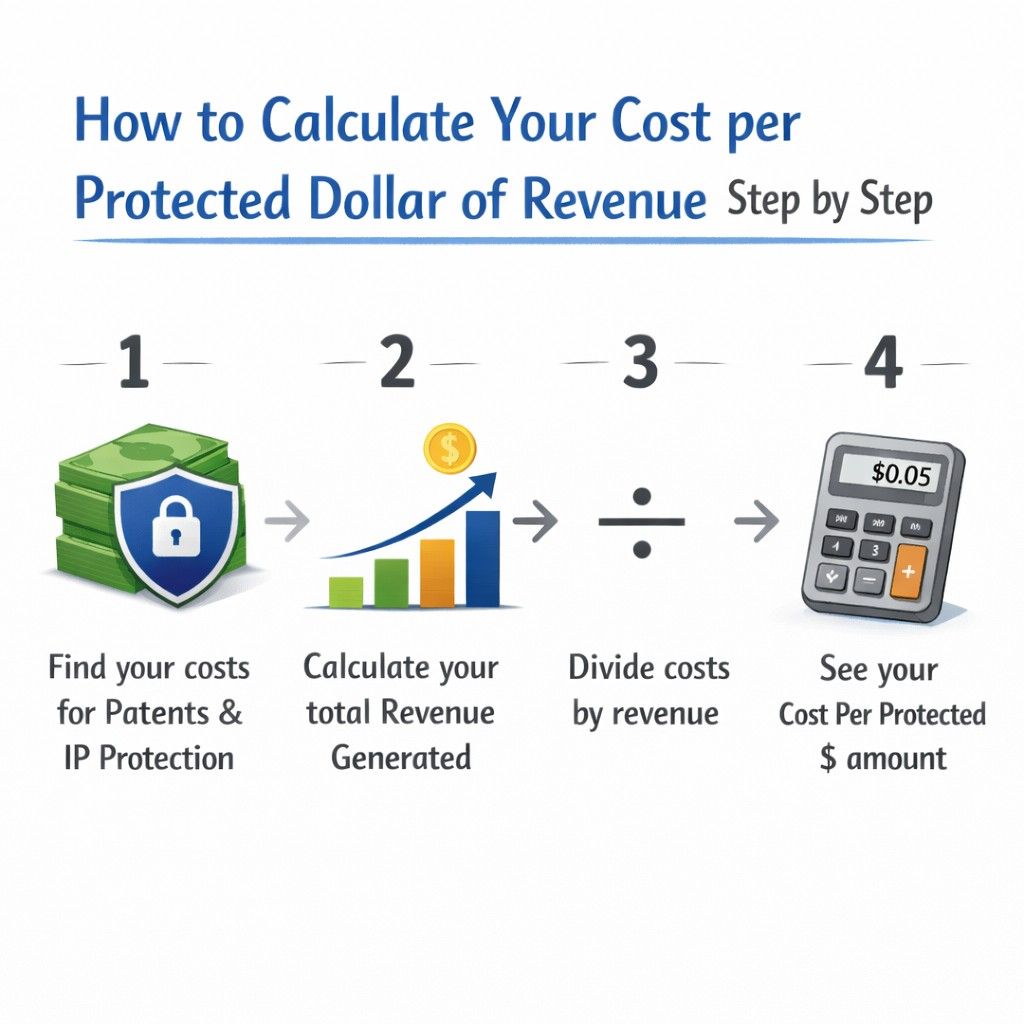
How to Calculate Your Cost per Protected Dollar of Revenue Step by Step
This is where most founders expect something complex. It is not. The math is simple. The thinking is not.
Calculating Cost per Protected Dollar of Revenue is less about formulas and more about being honest about what drives your business. If you do this right, you will see your patent strategy clearly for the first time.
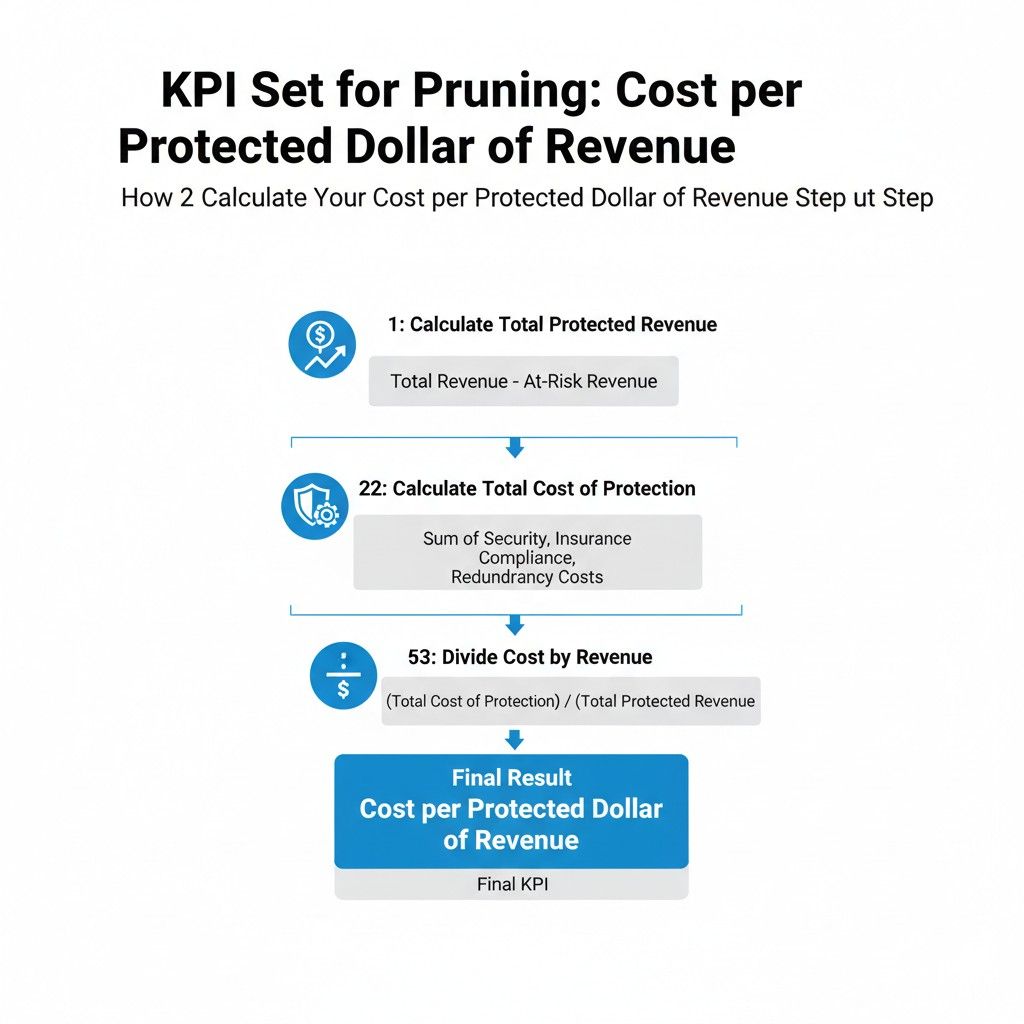
Start With Revenue That Is Actually at Risk
Before you touch cost, you must define what revenue is exposed. Not total revenue. Not projected hype revenue. Revenue that depends on specific technical advantages.
Look at your current paying customers. Why are they paying? If your core algorithm is what gives better results than competitors, that algorithm supports a slice of your revenue.
If your system runs at half the infrastructure cost, that efficiency supports another slice.
You need to isolate the portion of revenue that would be at risk if a competitor copied a specific invention.
This takes courage. It forces you to admit that some features do not drive income. That is fine. You are not judging product quality. You are measuring business impact.
A strong way to approach this is to imagine a fast-moving competitor entering your space tomorrow. If they replicated a certain technical element, would customers switch?
Would pricing drop? Would sales cycles get longer? If the answer is yes, that element supports real revenue.
Attach a revenue number to that exposure. Use current annual revenue when possible. If you are early stage, use signed contracts, strong pipeline numbers, or pricing power that is directly tied to the invention.
Be conservative. The power of this KPI comes from discipline, not exaggeration.
Define What “Protected” Really Means
Now you must ask a harder question. Is that revenue truly protected?
A patent application sitting in draft form does not count. A vague filing that barely touches your core mechanism does not count either. Protection means that your claims clearly cover the technical advantage that drives revenue.
This is where many startups overestimate their coverage. They assume that because they filed something related to their product, they are protected.
But if the claims are narrow, easy to design around, or focused on the wrong layer of the system, the protection is weak.
You should review each filing and ask whether it blocks competitors from copying the specific mechanism that supports your revenue. Not the general idea. The actual implementation that creates value.
If you are unsure, that is a sign your strategy needs tightening. This is exactly why PowerPatent blends smart software that maps your real system with real patent attorneys who ensure your claims match your business goals.
You can see how this alignment works in practice at https://powerpatent.com/how-it-works.
Protection is not about paperwork. It is about blocking revenue leakage.
Calculate Total Patent Investment for That Revenue Stream
Now you turn to cost. But again, stay focused. Do not lump everything together.
For each core revenue driver, calculate how much you have spent to protect it. Include drafting, filing fees, office action responses, and continuation work tied to that invention.
If you used outside counsel, include those invoices. If you used internal time, estimate it honestly.
You are not trying to impress anyone. You are trying to see reality.
For example, if you spent eighty thousand dollars protecting a core AI model that supports three million dollars in annual revenue, your cost per protected dollar is low. That is efficient.
If you spent the same amount protecting a feature that supports two hundred thousand dollars in revenue, your cost per protected dollar is much higher. That may signal overinvestment.
This is not about regret. It is about clarity going forward.
Divide Cost by Revenue, Then Interpret Carefully
The formula itself is simple. Total patent cost tied to a revenue-driving invention divided by the annual revenue that invention protects.
The result is your cost per protected dollar.
If you get a number like 0.02, that means you spent two cents to protect one dollar of annual revenue. That is powerful leverage.
If you get 0.40, you spent forty cents to protect one dollar of revenue. That may still be acceptable in some industries, but it demands attention.
The number alone does not judge you. It starts a conversation. It forces you to ask whether future filings should be tighter, broader, or redirected.
Over time, you should see this KPI improve. As revenue grows and your filings become more focused, the cost per protected dollar should drop.
If it does not, something is off in your strategy.
Separate Core From Edge Innovations
Not every patent needs to tie directly to current revenue. Some inventions protect future expansion. Some open licensing doors. Some block competitors in adjacent markets.
The mistake is mixing these with core revenue protection without labeling them clearly.
When you calculate this KPI, separate patents into two buckets in your mind. Core revenue protection and strategic expansion.
For core protection, the cost per protected dollar should be tight and efficient. For expansion plays, you can accept higher ratios, but you must be intentional.
This prevents emotional decisions. It replaces them with structured thinking.
A good internal habit is to tag each new filing as either revenue defense or future positioning. Then measure them differently. This alone will sharpen your portfolio.
Use the KPI to Decide What to File Next
The real value of this calculation is forward looking. Once you see your current ratio, you can decide where to invest next.
If you notice that your main revenue engine has weak or narrow coverage, that is a priority.
If your cost per protected dollar is already strong for that engine, you may shift to reinforcing adjacent layers to make it harder to design around.
If you see that you spent heavily on minor features, that is a signal to prune. Do not file continuations on weak branches. Redirect that budget toward protecting what truly pays the bills.
This is how you turn patents into a strategic weapon instead of a background expense.
If you want a structured way to evaluate new inventions before filing, PowerPatent’s workflow helps founders capture technical details directly from code and system architecture, then align them with business goals before drafting even begins.
That reduces waste and improves this KPI from day one. Learn more at https://powerpatent.com/how-it-works.
Review the KPI Every Quarter
Do not calculate this once and forget it. Revenue changes. Product focus shifts. Competitive threats evolve.
Set a quarterly review. Look at your top revenue drivers and confirm that your patent coverage still maps tightly to them. Recalculate your cost per protected dollar. Track trends.
If revenue grows faster than patent cost, your ratio improves. That is healthy. If patent cost keeps rising without clear revenue alignment, pause and reassess.
This practice builds discipline. It makes IP part of your operating rhythm, not a side project handled only during funding rounds.
Over time, this KPI becomes a pruning tool. Weak branches get cut. Strong branches get reinforced. Your portfolio becomes lean, intentional, and powerful.
And when investors ask about your moat, you will not just say you have patents. You will explain how efficiently those patents protect real dollars.
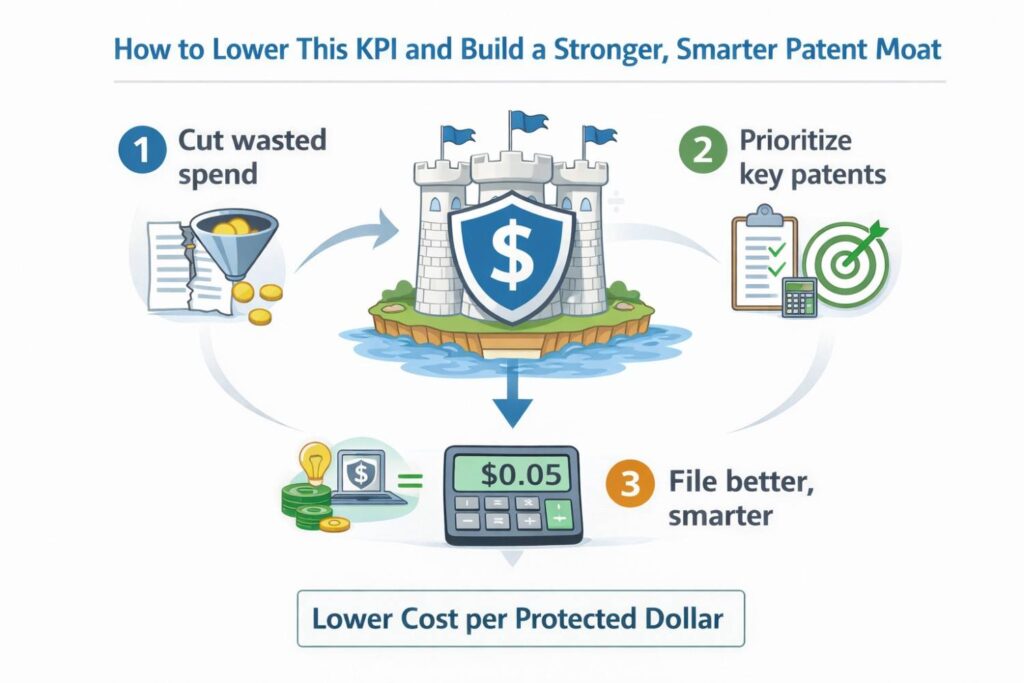
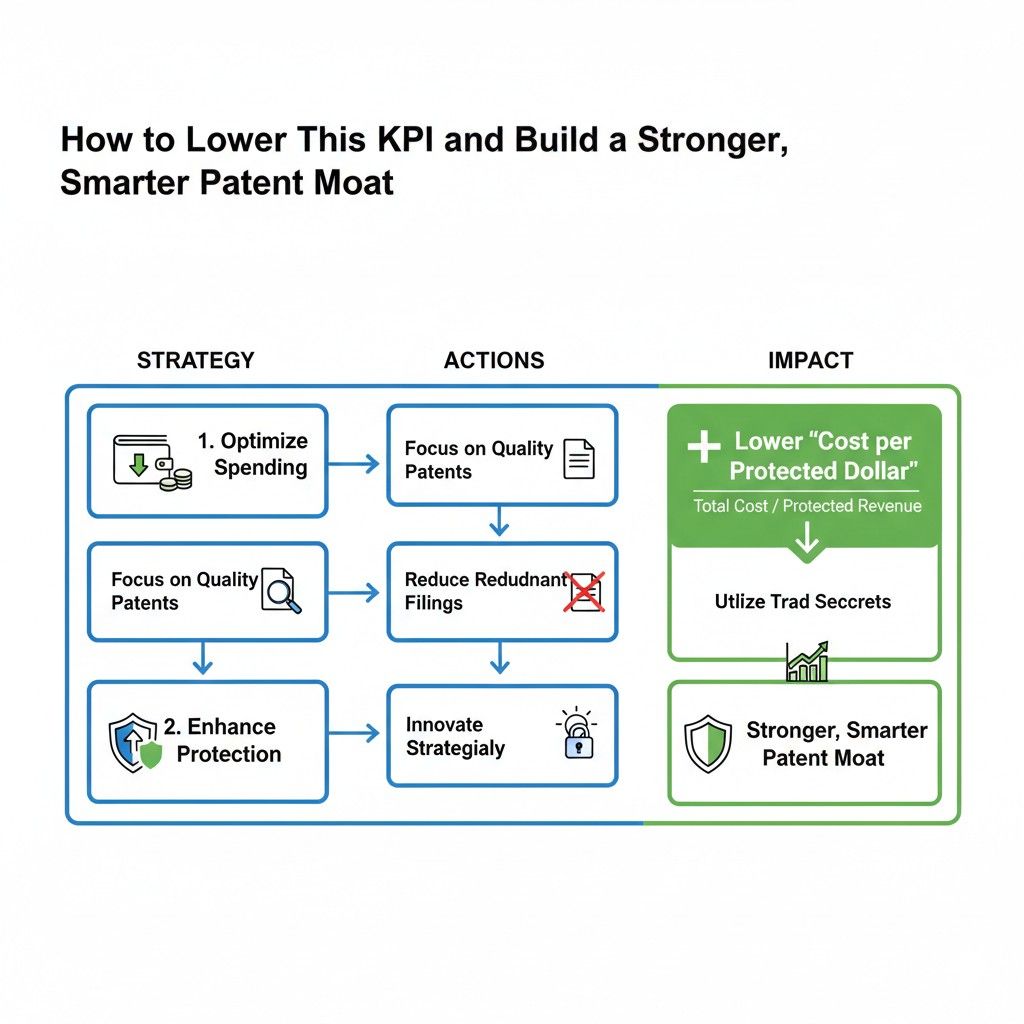
How to Lower This KPI and Build a Stronger, Smarter Patent Moat
Now we get to the part that changes behavior.
Knowing your Cost per Protected Dollar of Revenue is powerful. But lowering it is where real strategy begins. This is not about cutting patent spend blindly. It is about making every dollar of protection work harder for you.
When you lower this KPI the right way, three things happen at once. Your moat gets stronger. Your capital efficiency improves. And your confidence in your IP strategy goes up.
Let’s walk through how to do this in a way that is disciplined, practical, and built for fast-moving startups.
Focus on the Revenue Engine, Not the Noise
The fastest way to lower your cost per protected dollar is to stop protecting noise.
Every startup has noise. Small features. Minor improvements. Cosmetic upgrades. Internal tools that feel clever but do not move revenue. Filing patents around these may feel productive, but they dilute your capital.
To reduce this KPI, your patent activity must orbit around one thing: your revenue engine.
Your revenue engine is the technical system that creates pricing power, retention, or clear differentiation.
It may be your training pipeline. It may be your hardware control logic. It may be a compression method that cuts cloud cost in half.
Whatever it is, it deserves layered protection.
Layered protection means you do not just file once. You think in terms of core mechanism, variations, system-level integration, and use cases that lock competitors out.
You build coverage like a wall around the exact place money flows in.
This may sound like more filings, but it is actually more focused filings. When your protection is tight around revenue, each dollar spent protects a larger base of income.
That is how the ratio drops.
If you want a smarter way to identify and document these core mechanisms without slowing your team down, PowerPatent’s platform was built for that exact flow.
It helps founders turn real system architecture into strong filings aligned with business value. You can see how it works at https://powerpatent.com/how-it-works.
Kill Weak Continuations Early
One hidden source of high cost per protected dollar is inertia.
A patent gets filed. An office action arrives. The team keeps responding because it feels like the default move. Fees stack up. Time passes. But no one stops to ask whether the invention still ties to meaningful revenue.
Markets change. Roadmaps shift. Features get replaced. Yet the legal work continues.
Lowering your KPI requires active pruning. If a filing no longer protects something central to revenue, it is acceptable to stop investing in it. That capital can be redirected to stronger assets.
This requires discipline. It also requires visibility into how each filing connects to the business today, not when it was first drafted.
A strong quarterly review makes this easier. Ask a simple question: if this patent issued tomorrow, would it protect something we still sell or plan to scale? If the answer is weak or unclear, reconsider further spend.
This is not about being cheap. It is about being strategic.
Design Patents Around Competitive Pressure Points
Another way to lower your cost per protected dollar is to study where competitors would attack you.
Many patents are written from the inside out. They describe what the team built. A stronger approach writes from the outside in. It asks where a rival would try to copy or design around your system.
If you know which components are hardest to replicate, file there. If you know which shortcuts competitors might try, claim variations that block those paths.
When you design filings around pressure points, a single well-crafted patent can protect a wide revenue base. That increases leverage. The same legal spend shields more dollars.
This is where having real attorney oversight matters. Smart drafting is not about length. It is about precision. It is about covering the business-critical pathways, not random technical details.
PowerPatent’s model of combining software-driven clarity with experienced patent attorneys helps founders focus claims on these exact pressure zones.
That alignment is one of the most direct ways to improve this KPI over time. You can explore that approach here: https://powerpatent.com/how-it-works.
Tie Patent Roadmaps to Product Roadmaps
Your product roadmap changes every quarter. Your patent roadmap should move with it.
If you plan to expand into enterprise features that command higher pricing, protection should begin before launch. If you plan to open a new vertical where your system has unique performance, filings should align with that move.
When patents lag behind product, you end up reacting. Reaction is expensive. It leads to rushed drafting, scattered filings, and higher cost per protected dollar.
When patents move in sync with product, protection is targeted and timed. You file when the technical edge is clear and before revenue scales. That means each filing is positioned to protect future growth, not just past work.
This forward alignment lowers your ratio naturally. As revenue grows around protected systems, the denominator increases while your patent spend stays focused.
To implement this, include IP in roadmap discussions. Not as an afterthought, but as a strategy layer. When a new feature is expected to drive significant revenue, ask how it will be protected.
This habit turns patents into growth tools instead of cleanup tasks.
Use Data to Decide Where to Double Down
Lowering this KPI does not mean filing less. It means filing smarter.
When you see that a certain protected invention supports a large and growing revenue stream, that is a signal to reinforce it. You may expand claims. You may file additional applications that cover improvements or integrations.
The goal is not volume. It is dominance around revenue-heavy zones.
If one system drives fifty percent of your income, it deserves disproportionate protection. Spending more there may still lower your cost per protected dollar because the revenue base is so large.
This is pruning in action. You trim low-impact filings and feed high-impact ones.
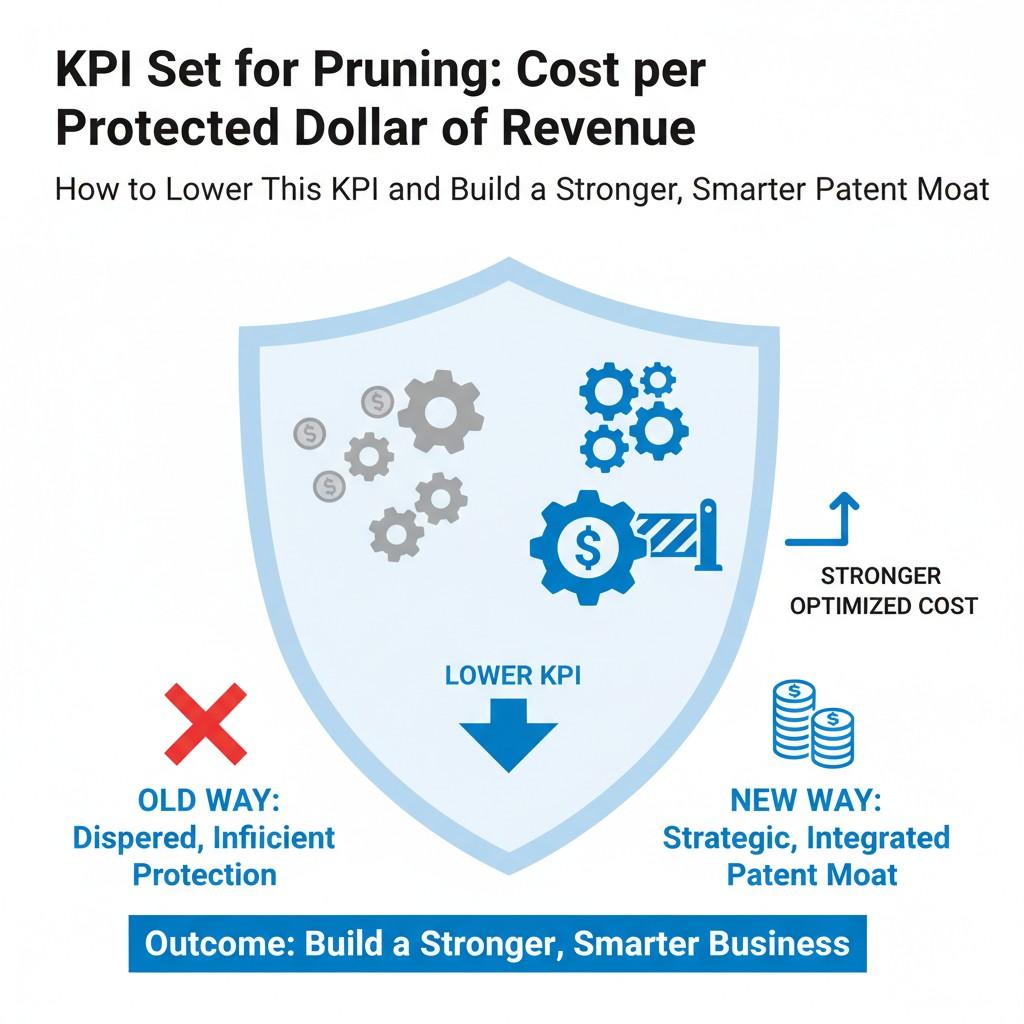
The result is a portfolio that looks smaller on paper but stronger in reality.
Build Internal Awareness of IP Leverage
Lowering this KPI also depends on culture.
If engineers do not understand which systems drive revenue, they cannot flag the right inventions early. If product leaders do not see patents as leverage, they will treat them as optional.
Share this KPI internally. Explain what it means. Show how focused protection improves capital efficiency.
When teams see the connection between their technical work and protected revenue, they become sharper about what to document and escalate.
This reduces random filings and increases high-value ones.
Over time, your patent process becomes proactive. High-impact inventions are captured quickly. Drafting becomes cleaner because documentation is better.
Attorney time is used efficiently. All of this reduces waste and improves the ratio.
Think in Terms of Revenue Shield, Not Patent Count
At the end of the day, investors, acquirers, and competitors care about one thing. Can you defend the revenue engine?
They do not count your patents. They assess whether copying you would be risky and expensive.
When you think in terms of revenue shield instead of patent count, your decisions sharpen. You stop celebrating filings for their own sake. You start measuring how much income they actually defend.
Cost per Protected Dollar of Revenue becomes your compass. If the number is dropping, your moat is strengthening efficiently. If it is rising, you adjust.
This mindset turns IP from a cost center into a capital efficiency tool.
And when you combine disciplined KPI tracking with a modern platform that helps you translate real technical systems into strong, revenue-aligned patents, the process becomes far less painful.
PowerPatent was built to give founders that speed, clarity, and attorney-backed confidence without old-school delays. If you are serious about building a smarter moat, start here: https://powerpatent.com/how-it-works.
This is how you prune. This is how you focus. And this is how you protect what truly matters.
Wrapping It Up
Most startups measure growth. Few measure protection efficiency. The ones that win long term do both. Cost per Protected Dollar of Revenue is not just another metric. It is a forcing function. It forces clarity about what truly drives your income. It forces discipline about where you spend legal dollars. And it forces alignment between product, engineering, and IP strategy. When you adopt this KPI, something shifts.