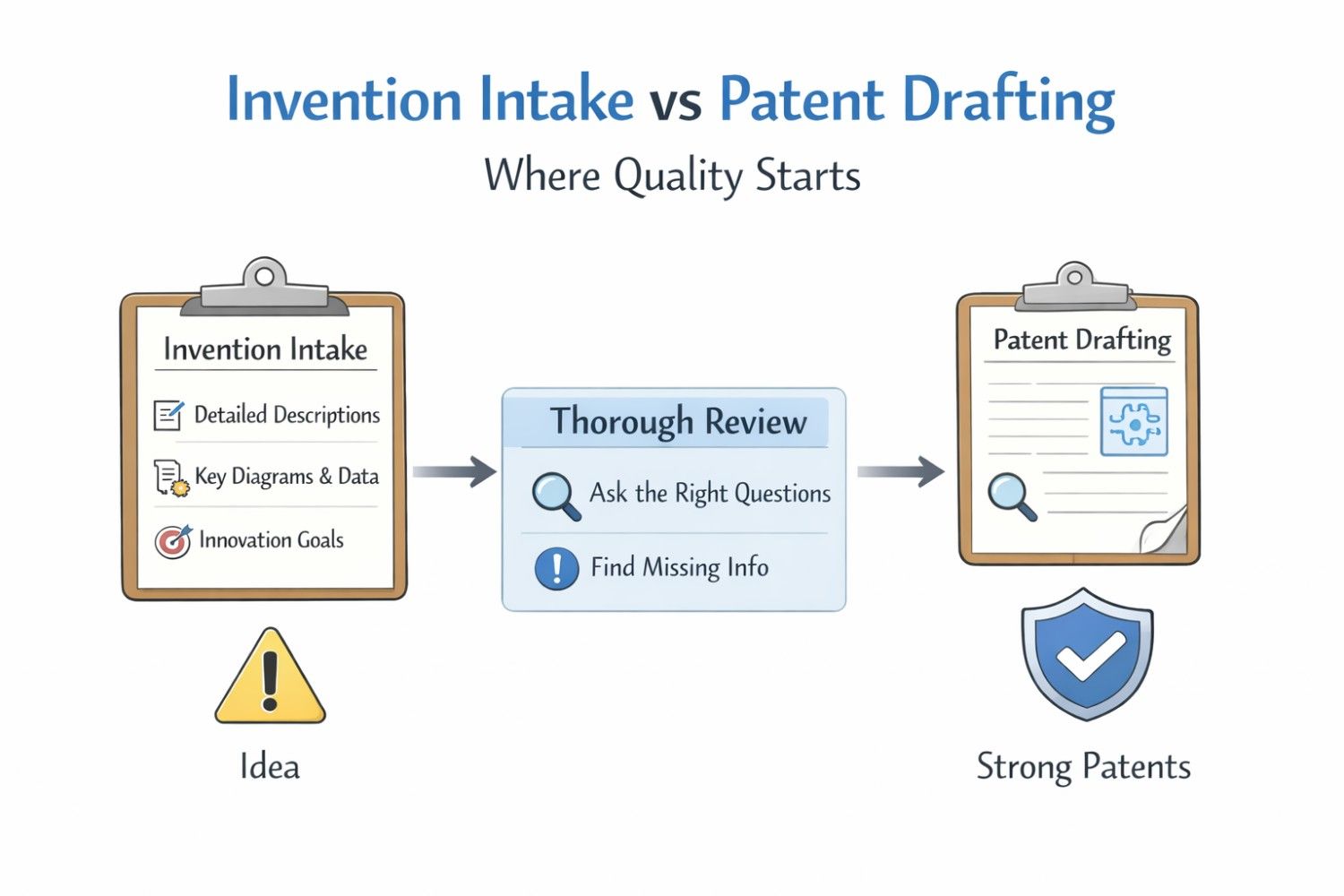
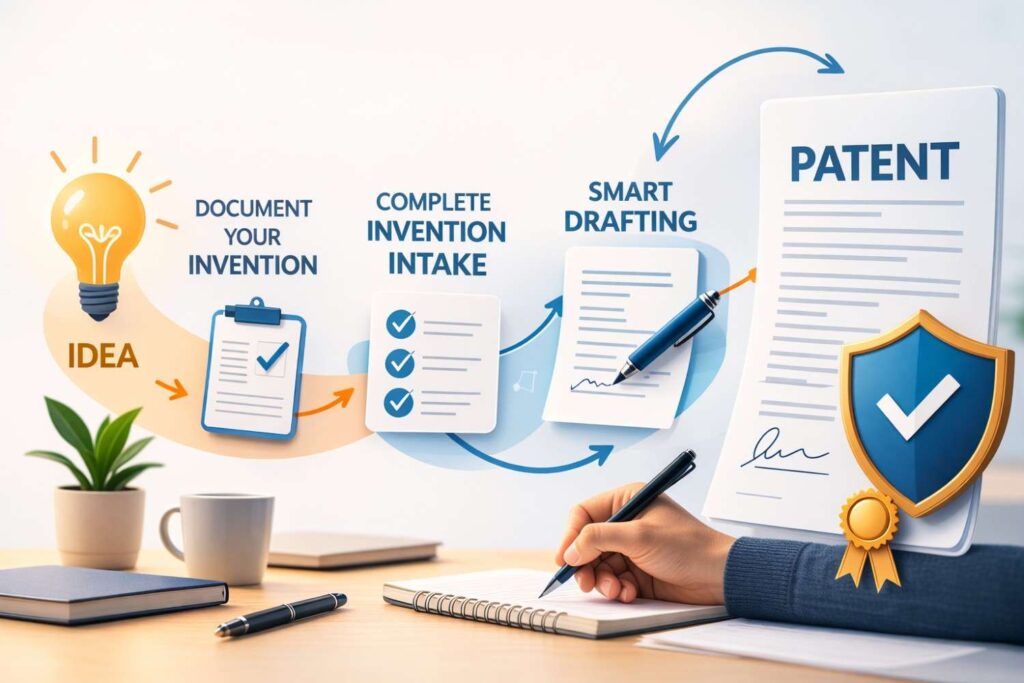
Most founders think patent quality starts when the lawyer begins writing. It does not. Quality starts much earlier—at the very first conversation about your invention. If that first step is weak, the whole patent will be weak. If that first step is sharp, clear, and complete, everything that follows becomes stronger, faster, and far more defensible. If you are building real technology and want real protection, this is the moment you need to understand.
What Invention Intake Really Is (And Why Most Teams Get It Wrong)
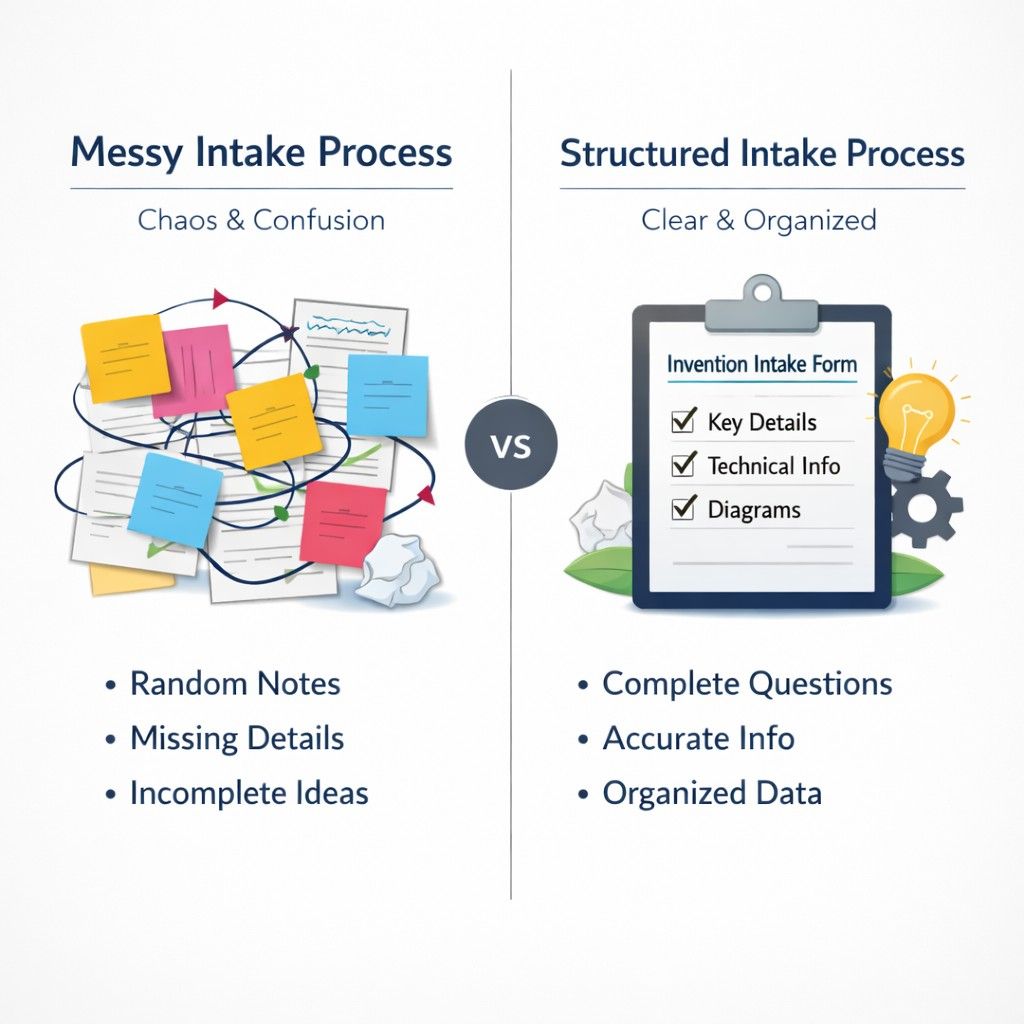
vMost founders think invention intake is just a form to fill out before the lawyer starts drafting. That belief quietly destroys patent quality. Invention intake is not paperwork.
It is not admin. It is not a box to check before “real work” begins. It is the moment where your invention either becomes clear and powerful—or blurry and fragile.
This stage decides how wide your protection can be. It decides how hard it will be for competitors to copy you. It decides whether your patent will survive real pressure later.
If you rush this part, the drafting stage becomes damage control. If you handle it with care, drafting becomes smooth, strategic, and strong.
Most teams get this wrong because they treat intake as a summary exercise. It is not a summary. It is discovery.
Intake Is Not a Summary — It Is Strategic Extraction
When teams describe their invention, they often explain what they built. That sounds right, but it is incomplete. A patent is not about what you built. It is about what makes your solution different and hard to replicate.
During intake, the goal is to extract the core idea behind the product. Not the feature list. Not the user interface. Not the brand. The real technical insight.
This requires slowing down. It requires asking questions that feel uncomfortable.
Why does this work better? What problem does it solve at a deep level? What trade-offs did you avoid? What technical constraint did you overcome?
Most companies never pause to answer those questions clearly. They assume the code speaks for itself. It does not.
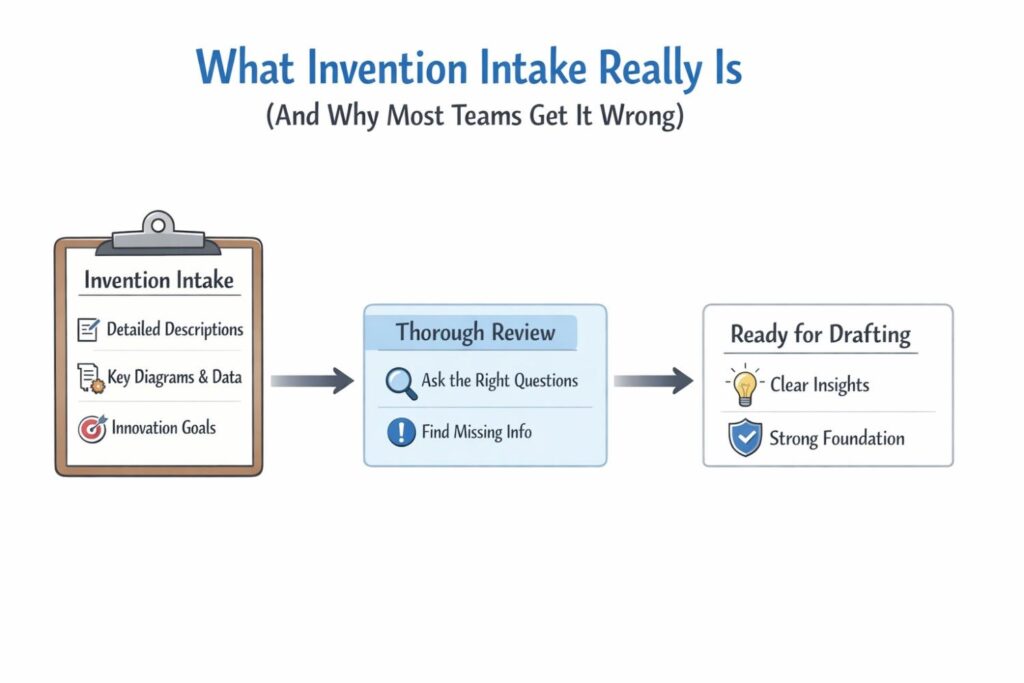
A strong intake process forces clarity. It pulls out the underlying architecture, the decision points, and the technical advantages. That clarity becomes the foundation of everything that follows.
The Real Goal of Intake: Define the Boundaries
An invention without clear boundaries is impossible to protect properly.
During intake, you are not just describing what exists today. You are defining the borders of your idea. You are deciding what belongs inside your protection and what sits outside.
If this is not done carefully, the patent ends up too narrow. It only covers one exact version of the solution. Competitors then tweak a small piece and move around you.
The smart move during intake is to think beyond the current build. Ask yourself how else this idea could be implemented. Could the same logic run on different infrastructure?
Could the same outcome be achieved using another model type? Could parts of the system be swapped while keeping the same core principle?
The stronger the intake, the more future-proof the patent.
This is where experienced guidance matters. Founders are deep in building mode. They often see what is in front of them, not what could exist next. A strong intake process helps widen the lens.
If you want to see how PowerPatent guides founders through this step with software and real attorney oversight, you can explore how it works here: https://powerpatent.com/how-it-works
Why Founders Undervalue This Stage
Many startups move fast. Speed is survival. Because of that, intake feels like a delay.
The mindset is often, “Let’s just get something filed.”
But speed without clarity creates expensive problems later. Weak claims. Multiple refilings. Gaps that investors notice. Protection that does not match the business.
The better mindset is this: intake is leverage.
Spending more time here reduces friction later. It lowers legal back-and-forth. It reduces rewriting. It strengthens claim strategy from the start.
A focused intake session can save months of correction.
Intake Is About Business Strategy, Not Just Technology
One major mistake teams make is separating patent work from business strategy.
Your patent should protect what drives your revenue. It should protect what makes you different in the market. It should protect the part of your system that competitors would most want to copy.
If intake only focuses on technical detail without business context, it misses the real opportunity.
During intake, you should connect the invention to your roadmap. What features are core to your growth? What part of the system gives you pricing power? What is the engine behind your advantage?
When those pieces are clear, the patent can be aligned with your long-term strategy.
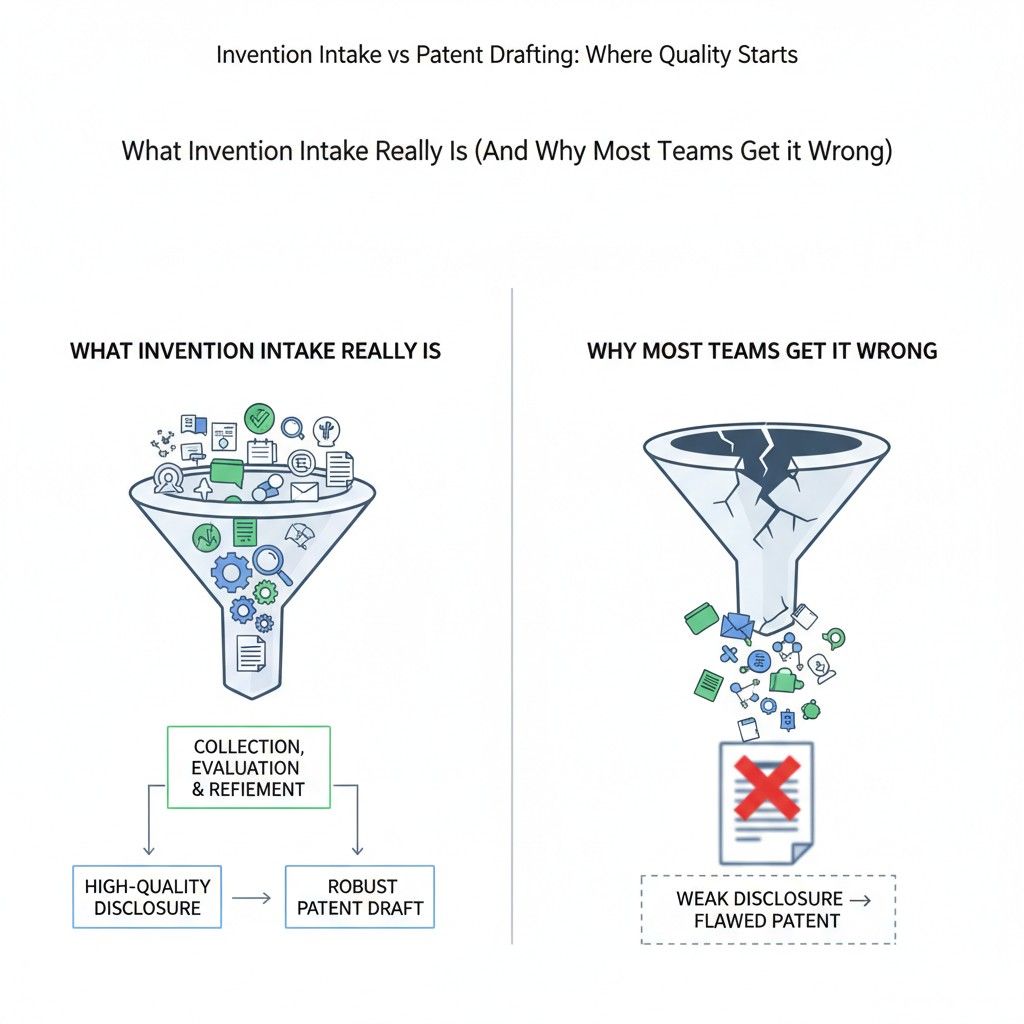
That alignment does not happen automatically. It must be built into the intake process.
The Danger of Founder Blind Spots
Founders live inside their product every day. That closeness creates blind spots.
You may think something is obvious when it is not. You may assume a design choice is standard when it is actually unique. You may overlook an improvement because it feels small.
A strong intake process surfaces these hidden edges.
One practical way to strengthen intake is to explain your system as if the listener knows nothing.
Avoid shortcuts. Walk through the flow step by step. Explain why each part exists. Describe alternatives you considered and rejected.
Often, the rejected paths reveal the inventive leap.
Another useful exercise is to imagine a competitor trying to copy you. Where would they struggle? What would they not understand at first glance? That friction often points to the protectable core.
When intake is done properly, these insights come out naturally.
Documentation Is Not Enough
Some teams believe sending a product spec or GitHub repository is enough. It is not.
Code shows implementation. It does not explain intent. It does not highlight inventive decisions. It does not describe why certain approaches were chosen over others.
Invention intake must translate technical material into structured insight.
That translation requires active collaboration. It requires back-and-forth discussion. It requires probing questions.
Software can help organize and guide this process. Attorney oversight ensures the right details are captured in the right way.
PowerPatent combines both. Founders input structured technical detail into smart software, and real patent attorneys refine and shape it. That mix reduces noise while increasing depth.
If you want to see the process step by step, visit https://powerpatent.com/how-it-works
Intake Sets the Tone for Claim Power
The strength of a patent often comes down to claims. But claim strength depends entirely on what was captured during intake.
If intake is shallow, claims must be narrow. If intake surfaces multiple embodiments and variations, claims can be broader and layered.
That layering is powerful. It creates fallback positions. It builds protection at different levels. It increases the chance of allowance without sacrificing coverage.
You cannot build layered claims from thin intake material.
That is why quality starts here.
The Cost of Getting It Wrong
Weak intake creates hidden costs.
It leads to vague descriptions that require rewriting. It leads to missed features that require new filings. It leads to confusion during examination. It leads to patents that look impressive but protect very little.
For startups, this risk is serious. Investors often review patents during diligence. Sophisticated buyers look at claim scope. If the patent does not align with the product’s core engine, questions arise.
The time to fix that is not during fundraising. It is during intake.
Building a Strong Intake Culture
Invention intake should not feel like a chore. It should feel like strategic reflection.
Schedule focused sessions. Remove distractions. Treat it as important as a product planning meeting.
Encourage technical depth. Do not oversimplify. Do not rush.
Capture diagrams. Walk through system flows. Discuss future versions.
The goal is clarity, not speed.
When intake is handled with discipline, drafting becomes execution instead of exploration. The attorney is no longer guessing. The strategy is already shaped.
And that is where real patent quality begins.
Patent Drafting: Turning Raw Ideas into Legal Protection
If invention intake is where clarity begins, patent drafting is where that clarity becomes power.
This is the stage where raw insight turns into structured protection. It is where ideas stop being internal knowledge and become enforceable rights. But drafting is not typing.
It is not copying notes into legal language. It is design work. It is strategic construction.
A strong draft does not simply describe what you built. It builds a protective wall around the true engine of your invention. When done well, it creates space for growth, room for variations, and leverage in the market.
Most patents fail here because drafting is treated like a paperwork exercise instead of a protection strategy.
Drafting Is Architecture, Not Writing
A patent document has structure for a reason. Every section works together. The summary sets direction. The detailed description builds depth. The drawings anchor understanding. The claims define the boundary.
If drafting is rushed, these parts become disconnected. The claims may not match the description. The description may not support future versions. The entire filing may look complete but lack real strength.
Drafting requires thinking in layers.
At the core is the inventive concept. Around that core sit multiple embodiments. Around those embodiments sit variations. Around those variations sit alternative implementations.
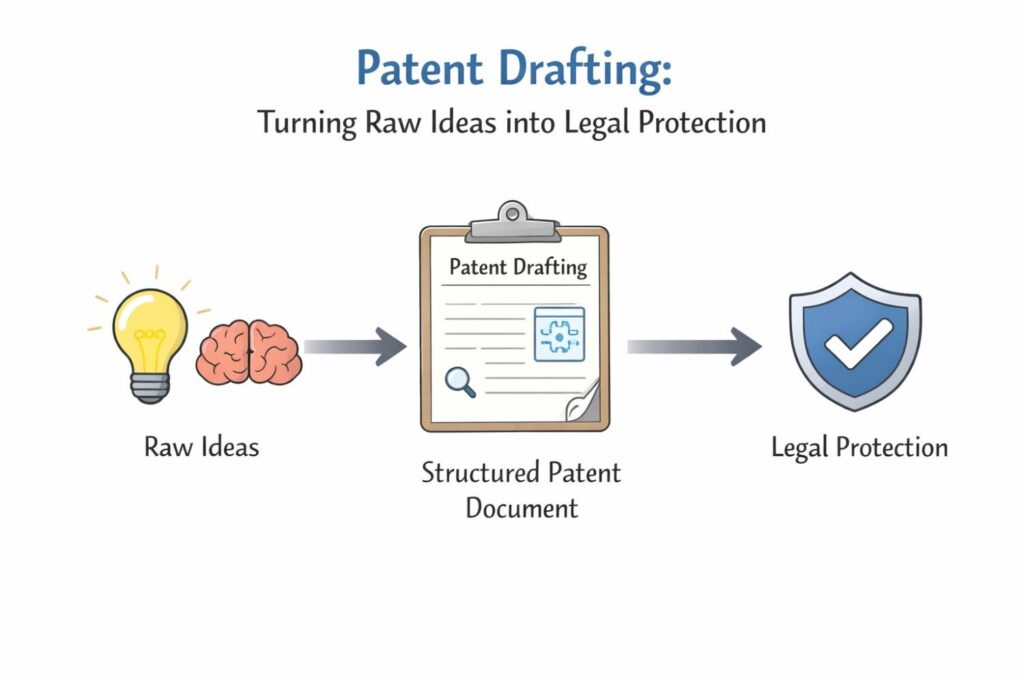
When these layers are intentionally built into the draft, the patent becomes resilient.
Without them, the patent becomes fragile.
The Claims Are the Engine
The claims are the most important part of a patent. They define what you own.
But here is the key: claims can only be as strong as the material that supports them.
If drafting simply mirrors the current product, the claims will likely be narrow. That creates risk. Competitors can design around narrow claims with small adjustments.
Strong drafting anticipates this. It frames the invention in a way that focuses on the underlying method, system, or improvement rather than surface details.
For example, instead of locking into one specific model architecture, a well-drafted patent may describe broader processing steps or structural relationships that capture multiple model types.
This does not happen by accident. It requires deliberate thinking during drafting.
It also requires technical understanding. The drafter must grasp how the system works at a deep level. Without that, the claims may sound formal but miss the real leverage point.
That is why having real attorney oversight combined with structured technical input is powerful. It keeps claims grounded in reality while maximizing coverage.
You can see how this balance works in practice here: https://powerpatent.com/how-it-works
Drafting for Today and Tomorrow
Startups evolve quickly. What you ship this year may look very different next year.
If drafting only reflects today’s version, the patent may become outdated before it is even examined.
Strong drafting thinks forward.
It considers how the core idea could scale. It describes possible expansions. It includes alternative flows and configurations that may not yet be in production.
This does not mean guessing randomly. It means identifying logical extensions of the invention.
Ask yourself during drafting: if we had twice the users, how would this change? If we migrated infrastructure, would the concept still apply? If we swapped one technical component, would the main insight remain?
By answering these questions inside the patent, you increase long-term value.
A well-drafted patent grows with your company.
Precision Without Narrowness
There is a tension in drafting. The document must be precise. But it must not be overly narrow.
If the language is vague, it risks rejection or weakness. If it is too specific, it limits coverage.
Good drafting strikes balance. It uses clear technical description while preserving flexibility.
This balance often fails when founders are not closely involved. If the drafter works in isolation, misunderstandings can creep in. Small wording choices can unintentionally limit scope.
That is why collaborative drafting is so important.
Review drafts carefully. Read them as if you are a competitor trying to escape the claims. Look for accidental constraints. Look for language that ties protection to unnecessary details.
The drafting stage should include iteration. It is normal to refine. It is healthy to challenge assumptions.
What matters is that this process is guided and structured, not chaotic.
Drawings Are Strategic Tools
Many founders treat patent drawings as simple diagrams. In reality, they are strategic.
Drawings anchor the written description. They make abstract systems concrete. They support claim language.
A strong draft uses drawings to show variations, alternative flows, and modular components.
Even in software and AI inventions, visual structure matters. System diagrams can show data flow. Flowcharts can show logic paths. Component diagrams can show flexible architecture.
The more thoughtfully these visuals are prepared, the stronger the overall draft becomes.
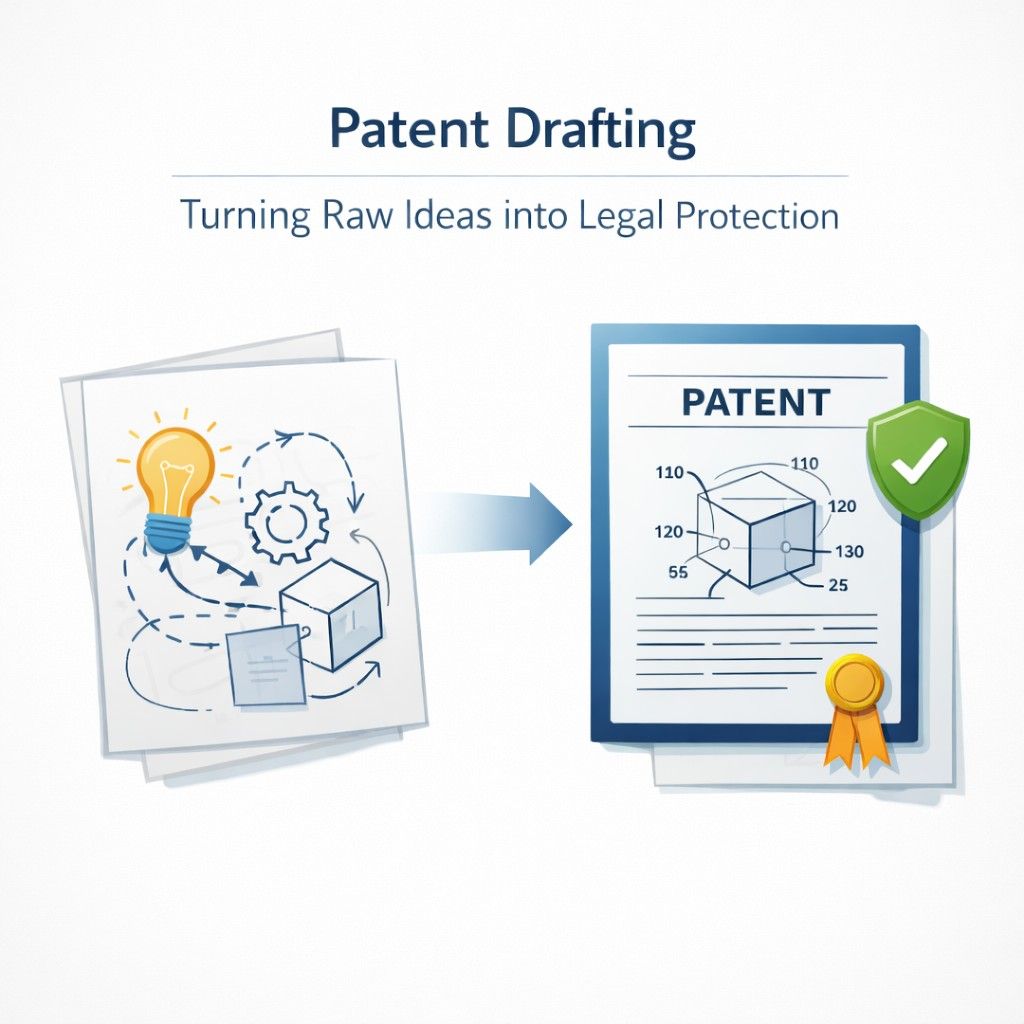
Drafting is not just text. It is integrated design.
Avoiding the “Feature Dump” Trap
A common mistake in drafting is including every feature without clear structure.
This creates noise. It hides the inventive concept inside a pile of detail.
Strong drafting organizes material around the central idea. It makes the core insight visible and supported.
This requires discipline. Not every feature needs equal attention. The draft should prioritize what makes the invention different.
If everything looks important, nothing stands out.
Clarity strengthens enforcement and improves examination outcomes.
Drafting With Examination in Mind
Patents do not get granted automatically. They are reviewed and often challenged by examiners.
A thoughtful draft anticipates objections. It frames the invention in a way that highlights technical improvement. It avoids language that sounds abstract or overly broad without support.
This does not mean weakening the claims. It means grounding them properly.
A well-drafted application makes it easier to argue for allowance later. It provides fallback positions. It includes multiple claim types if appropriate. It creates options.
This strategic foresight saves time and cost during prosecution.
Speed Without Sacrificing Quality
Startups cannot afford endless delays. But rushing drafting without structure creates more delay later.
The key is intelligent speed.
Using guided software tools to collect structured input reduces back-and-forth. Combining that with experienced attorney review ensures quality control.
This hybrid approach allows founders to move quickly while maintaining strength.
PowerPatent was built around this principle. Founders input technical detail through smart workflows. Real patent attorneys refine and finalize the draft. The result is faster turnaround without sacrificing defensibility.
If you are building something meaningful, you can see how this works here: https://powerpatent.com/how-it-works
Drafting Is Where Confidence Is Built
When you read a strong draft of your own invention, you feel it. The idea is clear. The structure makes sense. The claims reflect your real innovation.
That confidence matters.
It affects fundraising conversations. It affects partnership talks. It affects how you think about competition.
Patent drafting is not just compliance. It is positioning.
When done correctly, it transforms technical work into an asset that supports growth.
When done poorly, it creates paperwork that sits unused.
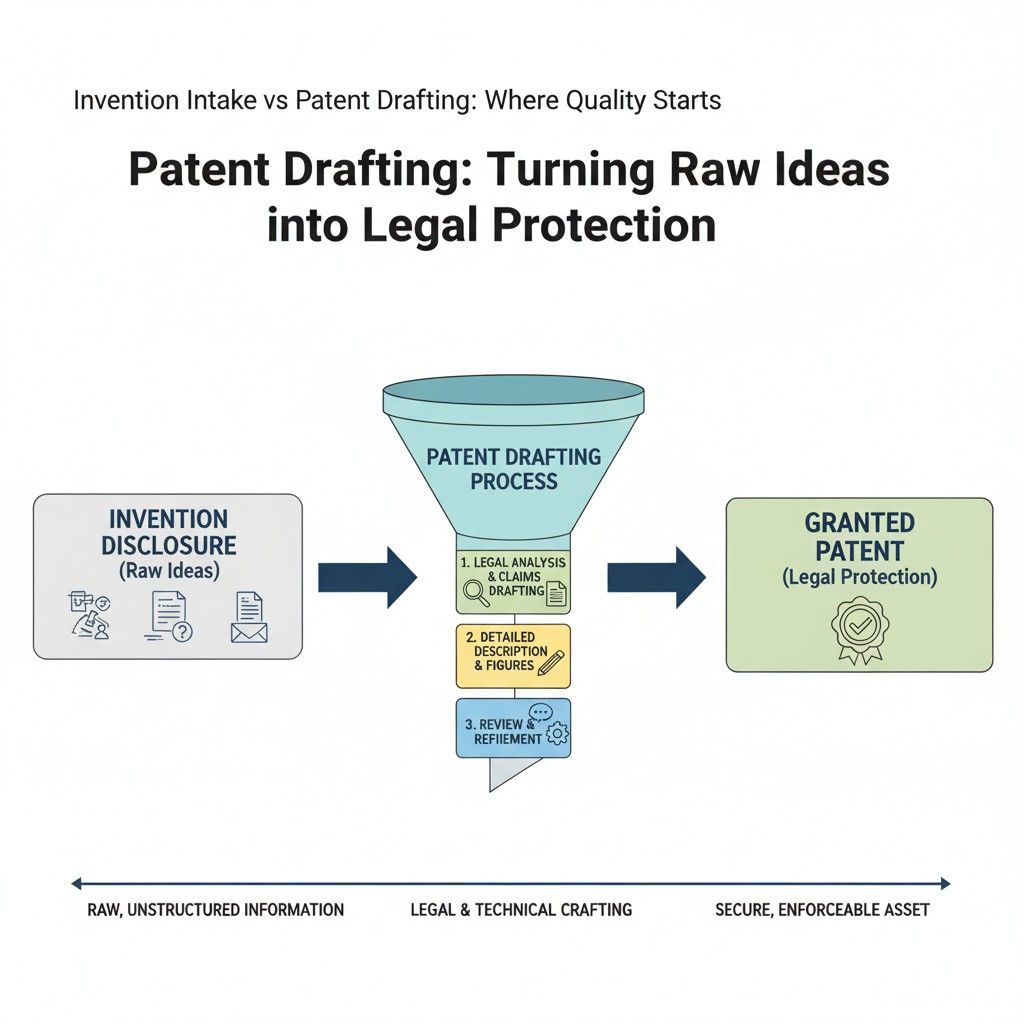
Quality does not magically appear at filing. It is built carefully during drafting, based on the clarity established in intake.
Where Most Patent Quality Breaks Down
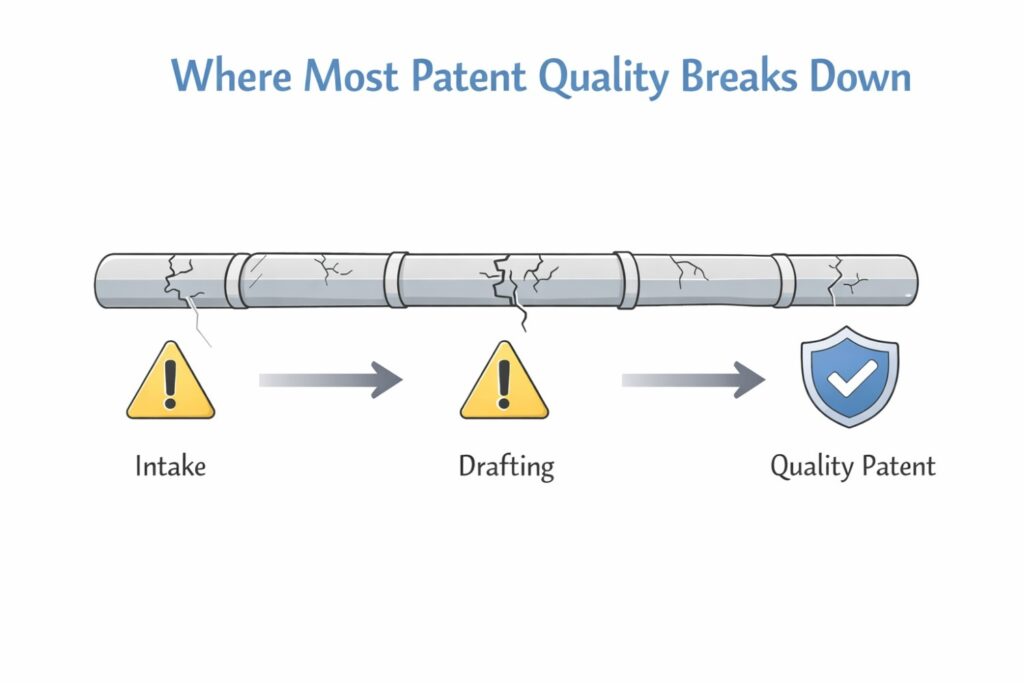
Patent quality rarely collapses in one dramatic moment. It erodes quietly. A rushed intake. A shallow draft. A missed detail. A claim that feels broad but is not. By the time the patent is filed, the weaknesses are already baked in.
Most founders do not notice the problem until much later. Sometimes it shows up during fundraising.
Sometimes during due diligence. Sometimes when a competitor launches a suspiciously similar product. And sometimes when an examiner pushes back hard and the claims start shrinking.
The hard truth is this: patent quality usually breaks down long before anyone realizes it.
The Rush to File
Speed matters in startups. Filing early can feel smart and proactive. But filing fast without clarity creates hidden damage.
When teams rush, they focus on getting something on file instead of getting the right thing on file. The difference is massive.
A weak early filing can limit what you can claim later. It can lock you into narrow descriptions. It can force you into expensive follow-up filings to correct gaps.
Quality breaks down when speed replaces strategy.
The better approach is controlled speed. Move quickly, but only after the core invention is clearly defined. Filing a strong application one month later is often far better than filing a weak one today.
If you want to understand how to move fast without cutting corners, you can see how PowerPatent structures the process here: https://powerpatent.com/how-it-works
Surface-Level Understanding of the Technology
Another common breakdown happens when the person drafting the patent does not fully understand the technology.
This is especially risky in deep tech, AI, infrastructure, biotech, and hardware systems. Small misunderstandings can lead to major claim weaknesses.
If the drafter does not grasp why your system performs better, the patent may describe what it does but fail to capture why it matters.
That gap is dangerous.
Quality requires technical depth. The drafting process must involve real back-and-forth with the inventors. Questions must go beyond “what does it do” and move into “why does this approach outperform alternatives.”
If that depth is missing, the patent becomes generic.
And generic patents are easy to design around.
Confusing Features With Invention
Startups build fast. Products evolve weekly. Features are added constantly.
During patent drafting, this can create confusion. Teams may try to protect every visible feature instead of focusing on the true inventive concept.
When this happens, the patent turns into a feature catalog. It describes buttons, screens, minor variations, and edge cases.
But features are not always inventions.
The invention is the technical leap. The architecture choice. The algorithmic insight. The system-level improvement.
When drafting loses focus on that core, the claims become cluttered and weak.
Quality breaks down when the patent does not clearly separate the engine from the accessories.
Overly Narrow Claims That Feel Broad
Some patents look impressive on paper. The language sounds formal. The document is long. The diagrams look detailed.
But when you read the claims carefully, they are narrow. They tie protection to specific hardware setups. Specific data structures. Specific sequences.
Competitors can avoid these claims with small changes.
This breakdown often happens when drafting mirrors the exact implementation instead of abstracting to the underlying principle.
It can also happen when founders do not push back during review. If something feels too specific, it probably is.
You should read your claims and ask a simple question: could someone achieve the same outcome with small tweaks and avoid this language?
If the answer is yes, quality may already be compromised.
Weak Support for Broad Protection
On the other side, some patents attempt to claim broad concepts without sufficient support in the description.
This creates a different type of weakness.
Examiners may reject the claims. Even if allowed, enforcement becomes harder because the specification does not fully explain how the invention works across its scope.
Broad claims require deep, layered support in the description. Multiple embodiments. Alternative flows. Variations.
If intake was shallow, the draft may not include these layers. That makes strong claims difficult to sustain.
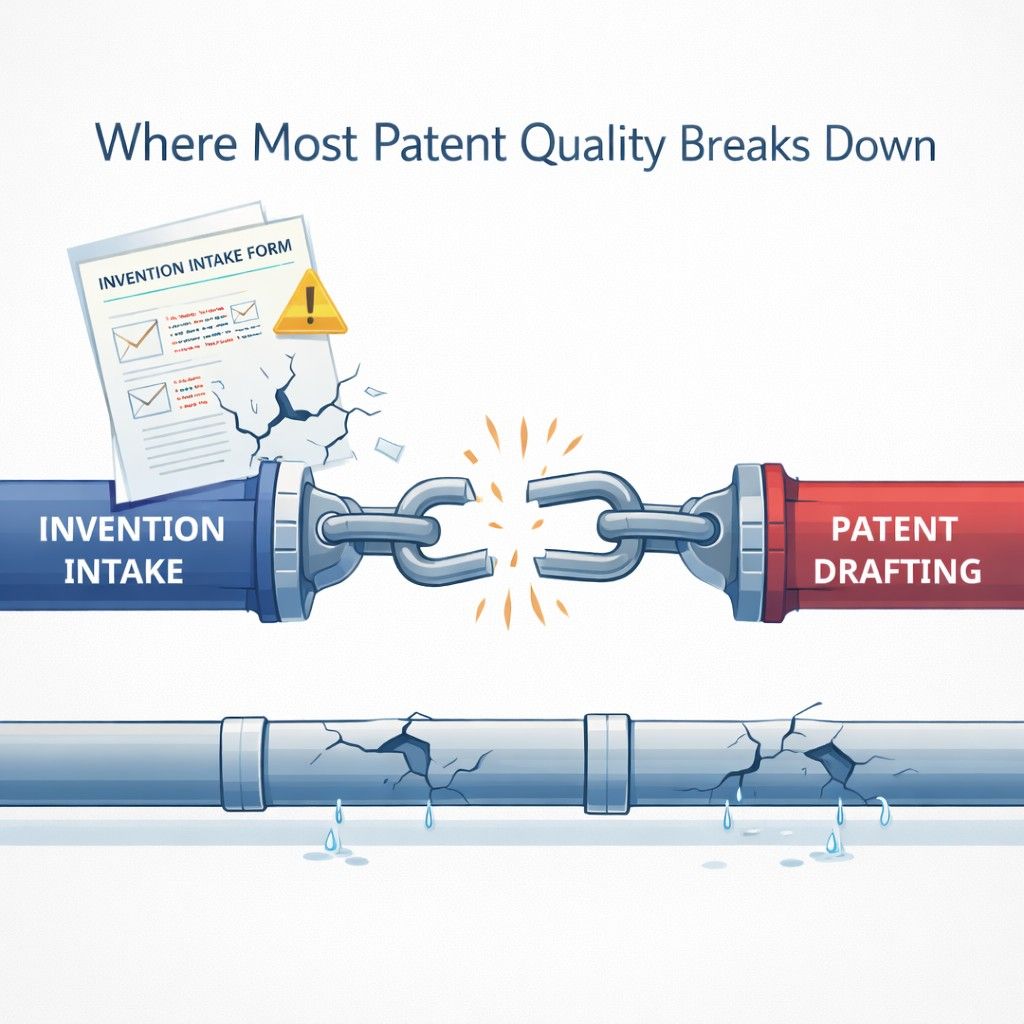
Quality breaks down when ambition exceeds foundation.
Lack of Business Alignment
Patents are business tools. Yet many filings are disconnected from the company’s real strategy.
This often happens when patent work is treated as a side task instead of a core asset.
If the patent does not protect the technology driving revenue, its value drops sharply.
For example, if your competitive edge comes from a unique data processing pipeline, but your patent focuses on a user-facing feature, you have a misalignment problem.
Quality breaks down when protection and strategy move in different directions.
A strong patent should map directly to your growth engine.
Minimal Founder Involvement
Some founders assume the patent process should be handled entirely by attorneys. They provide basic notes and step back.
This creates risk.
No one understands the invention like the builders. Without active founder involvement, subtle but critical insights may never make it into the application.
Quality breaks down when the inventors are distant from drafting.
You do not need to write the patent yourself. But you must stay engaged. Review carefully. Challenge assumptions. Clarify language.
This collaboration is not optional if you care about strength.
PowerPatent was built to keep founders deeply involved while reducing the friction that usually comes with traditional firms. Structured workflows make it easier to capture insight, and real attorneys refine the material.
The balance protects both speed and quality. You can explore that system here: https://powerpatent.com/how-it-works
Ignoring Future Evolution
Many patents freeze the invention in time.
They describe the current version and stop there. No room for scaling. No room for architectural shifts. No room for technical evolution.
But startups change fast.
If your patent does not account for logical extensions, you may need new filings sooner than expected. Worse, competitors may move into adjacent spaces that your patent does not cover.
Quality breaks down when the patent fails to think ahead.
During drafting, ask how this invention could evolve over the next three years. Build that thinking into the description.
A patent should not just protect your present. It should anticipate your direction.
Poor Review Before Filing
Sometimes the breakdown is simple: the draft was never deeply reviewed.
Founders skim it. Deadlines approach. Filing happens.
Later, small issues become big problems.
Set aside focused time to read the draft slowly. Imagine you are an examiner. Imagine you are a competitor. Imagine you are an investor.
Does the document clearly explain the technical improvement? Do the claims feel aligned with your real innovation? Is anything missing?
Quality control at this stage is far cheaper than correction later.
The Hidden Cost of Low Quality
A weak patent may still get granted. That can create false confidence.
But enforcement, licensing, and investor scrutiny reveal weaknesses quickly.
Low-quality patents waste capital. They create illusion instead of protection.
Strong patents, on the other hand, create leverage. They support valuation. They deter competitors. They strengthen negotiations.
The difference often comes down to early discipline and careful drafting.
Patent quality does not break in one place. It weakens through small compromises.
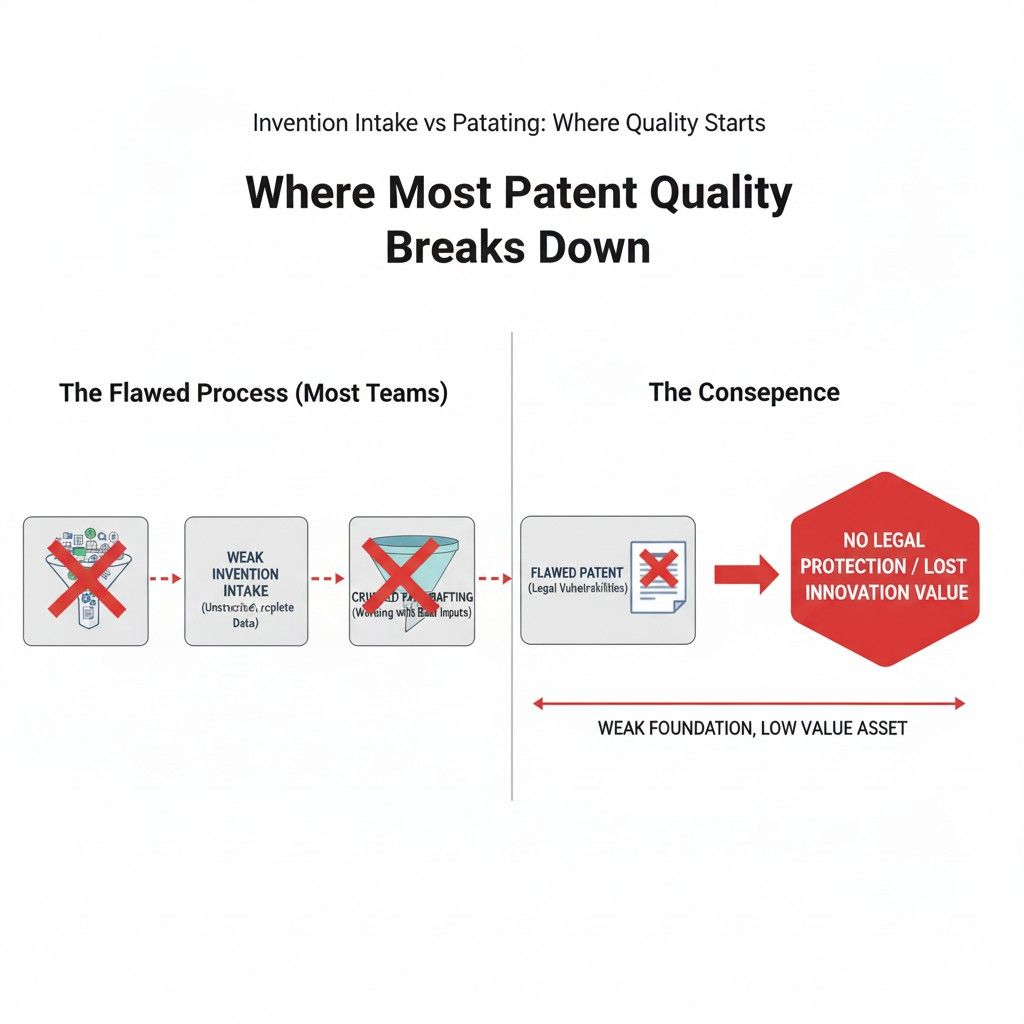
Avoiding those compromises requires structure, technical depth, business alignment, and thoughtful review.
That is where serious founders separate themselves.
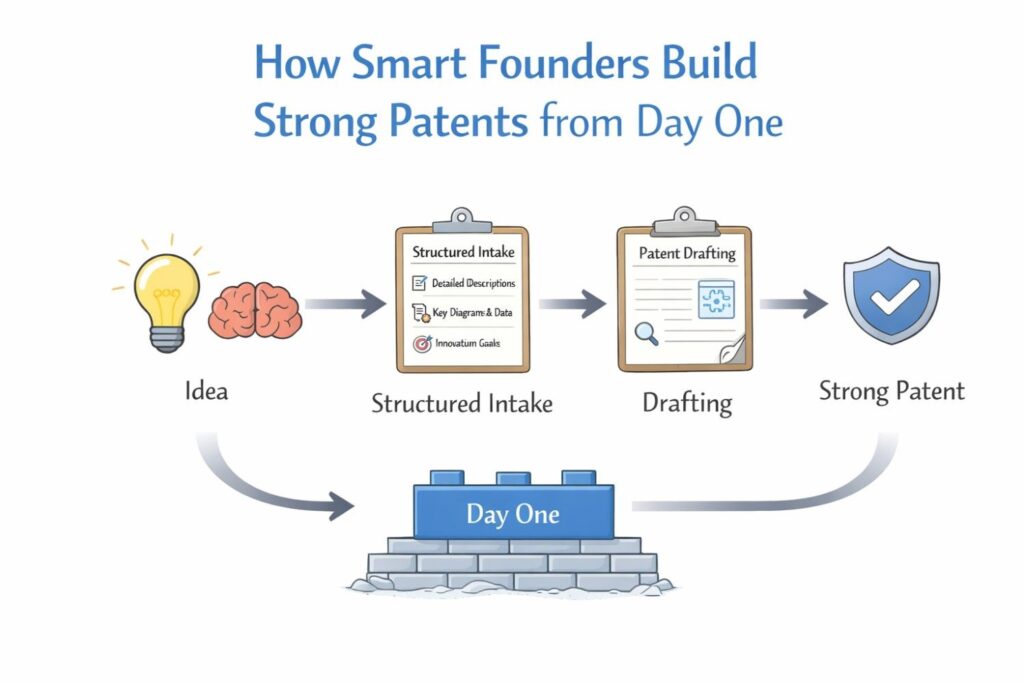
How Smart Founders Build Strong Patents from Day One
Strong patents do not happen by luck. They are not the result of filling out a form and hoping for the best.
The founders who build real protection treat patents the same way they treat product design and system architecture. They think early. They think clearly. They think long term.
From the first moment an idea takes shape, smart founders understand that what they are building is not just code or hardware. It is leverage. It is defensibility. It is future value.
The difference shows in how they approach the process from day one.
They Treat Patent Strategy as Part of Product Strategy
Founders who build strong patents do not wait until fundraising to think about intellectual property. They connect patent thinking to product thinking.
When designing a new system, they ask simple but powerful questions. What part of this solution is truly new? What decision did we make that others would not easily see? Where is the real edge?
These questions shape both the product and the patent.
This mindset changes behavior. Instead of filing random applications based on small features, they focus on protecting the technical engines that drive growth.
If your core value comes from a model training pipeline, that is where attention should go. If your strength is a unique hardware configuration that improves efficiency, that deserves focus.
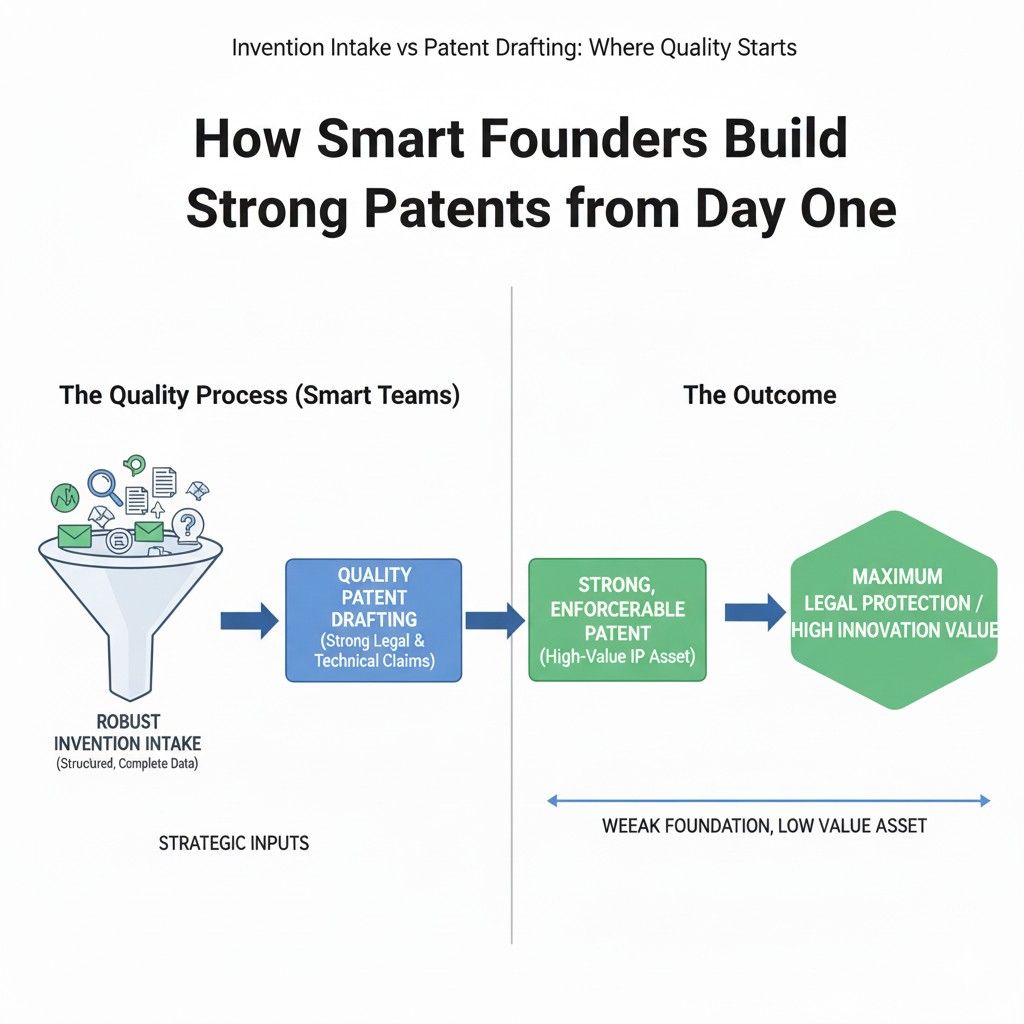
Strong founders align patent scope with revenue drivers.
They Capture Insight While Building
Most inventions lose clarity over time. Teams move fast. Decisions blur together. Early breakthroughs start to feel normal.
Smart founders document insights as they happen.
When a key architecture decision is made, they note why. When a performance improvement is achieved, they record how. When a constraint is solved in a creative way, they capture that reasoning.
This habit makes invention intake far stronger later.
You do not need complex systems to do this. Even short written notes after technical milestones can preserve critical context. The goal is not paperwork. The goal is preserving the story behind the solution.
When it is time to draft a patent, that history becomes gold.
They Invest in Clear Invention Intake
Founders who build strong patents respect the intake stage.
They do not treat it as a short call. They block real time. They prepare diagrams. They walk through flows carefully. They explain alternatives that were rejected.
They understand that this stage defines boundaries.
Instead of asking, “What did we build?” they ask, “What makes this approach fundamentally different?”
They explore variations. They think about other implementations that follow the same core logic. They consider how the invention could scale.
This discipline allows broader, stronger claims later.
If you want to see a structured way to guide this process without slowing down your company, PowerPatent blends guided software with real attorney oversight to make intake both deep and efficient. You can see how that works here: https://powerpatent.com/how-it-works
They Stay Deeply Involved in Drafting
Smart founders do not disappear after intake.
They review drafts carefully. Not casually. Carefully.
They read every section. They challenge wording that feels too narrow. They clarify technical details that may be misunderstood. They look for gaps.
They ask themselves a simple question while reviewing claims: if I were a competitor, how would I design around this?
If they see an escape path, they raise it.
This involvement does not mean rewriting legal language. It means protecting the technical truth of the invention.
The combination of founder insight and experienced attorney refinement is powerful. One without the other is weaker.
They Think in Terms of Claim Layers
Strong patents rarely rely on a single claim approach.
Smart founders understand that protection should have depth.
There may be a system-level view. A method-level view. A component-level view. Each angle captures the invention from a different direction.
This layered approach creates flexibility during examination. It also creates strength during enforcement.
To support this, founders ensure the description includes multiple embodiments and variations. They do not lock the invention into one narrow form.
The goal is not to claim everything. The goal is to claim intelligently.
They Plan for Evolution
Startups change. Architecture shifts. Infrastructure improves. Models evolve.
Founders who build strong patents think ahead.
During drafting, they ask how the invention might look two or three years from now. They include logical extensions. They describe optional configurations. They preserve room for scaling.
This foresight reduces the need for emergency filings later.
It also strengthens valuation. Investors appreciate patents that align with future roadmaps, not just past releases.
A patent should grow with your company, not lag behind it.
They Balance Speed With Depth
Smart founders understand timing. Filing too late can create risk. Filing too early with weak material can create bigger risk.
They aim for informed speed.
They move quickly once the invention is clear. They avoid unnecessary delays. But they do not sacrifice depth for the sake of hitting an arbitrary date.
This balance often requires better tools and smarter workflows.
Traditional firms can create friction through endless email chains and slow revisions. On the other hand, pure automation without attorney oversight can miss nuance.
PowerPatent was designed to solve this gap. Founders input structured technical detail into guided workflows. Real patent attorneys review, refine, and finalize.
The result is speed with substance. If you are serious about protecting what you are building, you can explore the process here: https://powerpatent.com/how-it-works
They View Patents as Leverage, Not Decoration
The strongest founders do not file patents for optics. They file them for leverage.
They understand that strong intellectual property can deter competitors from copying core systems. It can support higher valuations. It can strengthen acquisition discussions. It can create licensing opportunities.
But only if the patent is real.
A decorative patent may look good in a pitch deck. A strong patent changes behavior in the market.
The difference lies in early discipline.
They Build a Repeatable Process
Finally, smart founders do not treat patents as one-off events.
They create a repeatable internal rhythm. When major technical milestones happen, they evaluate protectability. When new architectures emerge, they assess whether the core logic is patent-worthy.
This habit prevents last-minute scrambling.
Over time, this builds a portfolio that reflects the real evolution of the company.
Each filing supports the next. Each invention builds on the previous one.
That is how defensibility compounds.
Strong patents do not start with drafting. They start with mindset.
From day one, smart founders think about clarity, boundaries, evolution, and alignment. They stay involved. They demand depth. They move with purpose.
If you are building real technology and want protection that matches your ambition, do not treat patents as an afterthought.
Build them the same way you build your product.
Carefully. Strategically. And with the right tools and guidance behind you.
Wrapping It Up
Patent quality does not begin with legal language. It begins with clarity. It begins with asking better questions. It begins the moment you decide that what you are building deserves real protection. Invention intake is where truth is uncovered. Patent drafting is where that truth is structured into enforceable rights. When either step is rushed, outsourced blindly, or treated as routine paperwork, quality breaks down. But when both are handled with care, discipline, and strategy, the result is powerful.