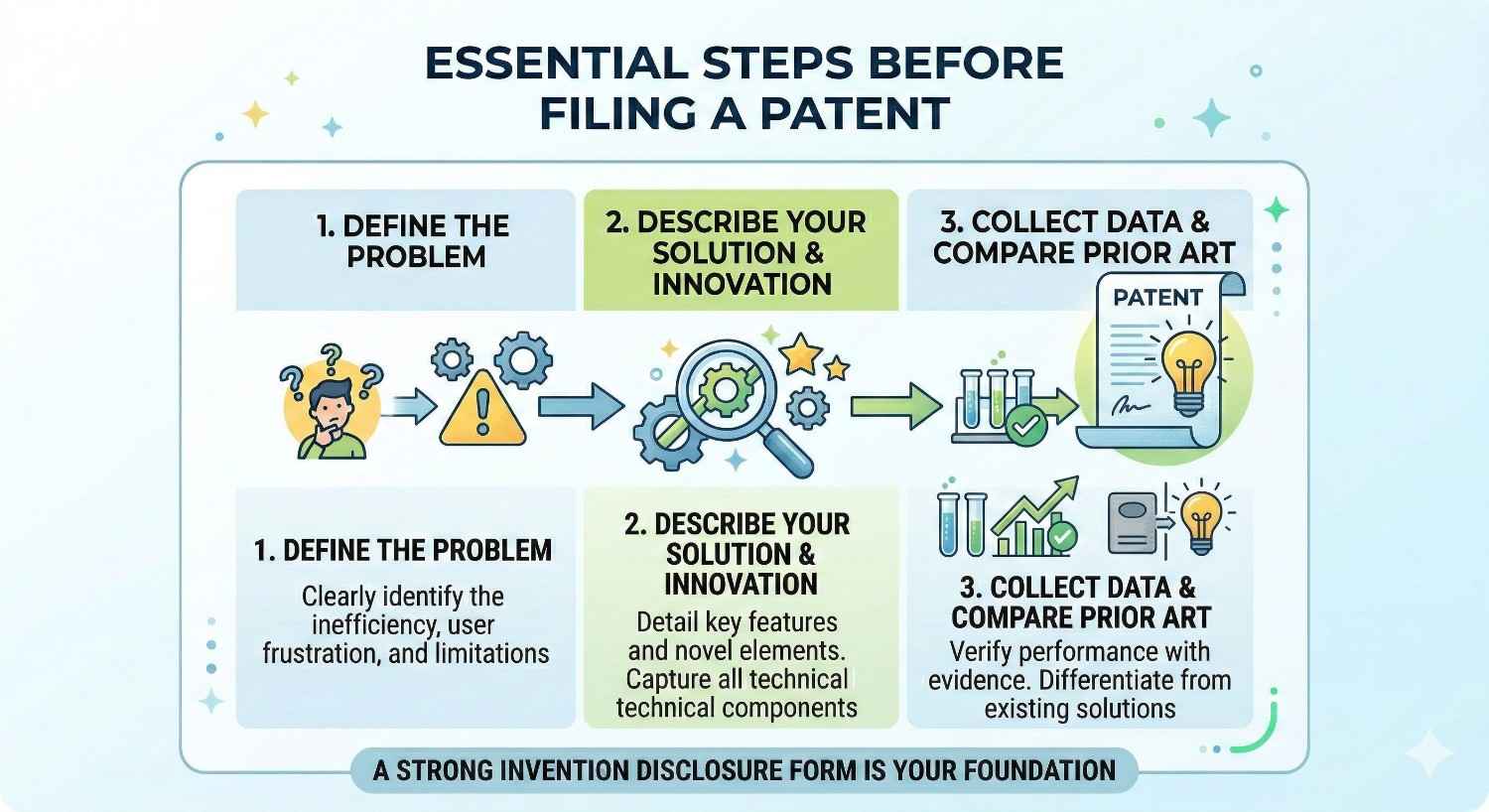
You built something real. It works. It solves a hard problem. Now you want to protect it. But before you file a patent, there is one step that can save you time, money, and stress: your invention disclosure form. This is where you slow down just enough to think clearly about what you built, how it works, and why it matters. Most founders rush this part. That is a mistake. The quality of your patent depends on the quality of what you write down at the start. In this guide, we will walk through exactly what to ask yourself before filing, so you do not miss what truly makes your invention special. If you want to see how smart software and real patent attorneys can help you turn your ideas into strong protection without slowing you down, take a look at how it works here: https://powerpatent.com/how-it-works.
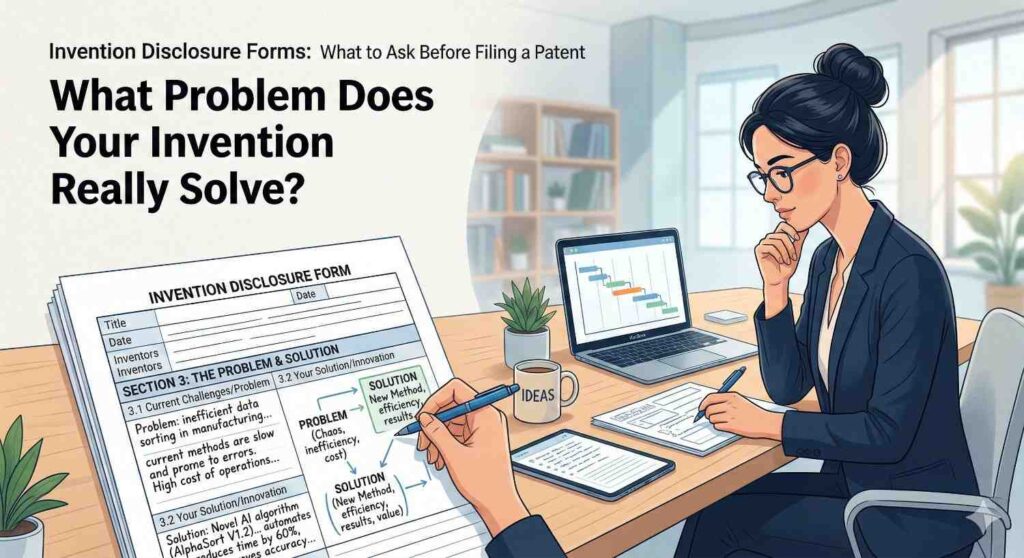
What Problem Does Your Invention Really Solve?
Before you talk about features, code, models, or system design, you must answer one simple question: what is the real problem? Not the surface problem.
Not the marketing version. The real one. The pain that made you build this in the first place.
Many founders think they know the answer. But when they sit down to fill out an invention disclosure form, their explanation is vague. They say things like “improves efficiency” or “optimizes performance.”
That is not enough. A strong patent starts with a sharp understanding of the problem.
If you skip this step, your patent may protect the wrong thing. Worse, it may protect nothing useful at all. This section is where you slow down and think deeply. The clearer you are here, the stronger your protection later.
Let’s break this down in a way that actually helps you think.
The Real-World Pain Behind the Idea
Every meaningful invention starts with friction. Something was too slow, too expensive, too risky, or too manual. Something broke. Something failed.
When you write your invention disclosure, do not describe your product yet. Describe the pain.
What was happening before your solution existed? Who was struggling? What did it cost them in time, money, or risk?
Be specific. If engineers were wasting six hours a week running tests by hand, say that. If data teams were missing edge cases that caused system crashes, write that clearly.
If fraud detection models were too slow to act in real time, explain the delay and the impact.
Patent strength grows when the problem is concrete. A detailed problem shows why your solution matters. It also helps your attorney frame your invention in a way that examiners understand.
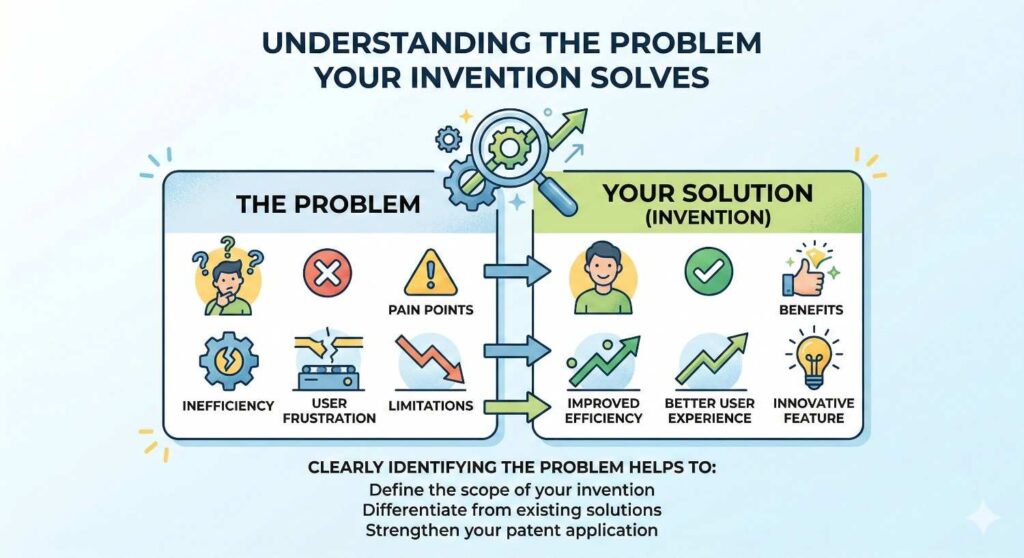
At PowerPatent, we see this all the time. Founders who clearly explain the pain behind their invention almost always end up with stronger, more focused claims.
If you want help shaping your disclosure the right way from the start, you can see how we guide founders through this step here: https://powerpatent.com/how-it-works.
The Technical Gap in Existing Systems
Now go deeper. What was technically missing?
It is not enough to say “current systems are inefficient.” Why are they inefficient? What are they doing wrong under the hood?
Maybe existing systems rely on static rules instead of adaptive logic. Maybe they process data in batches instead of streaming. Maybe they require manual labeling before training can begin. Maybe they use a hardware setup that cannot scale past a certain threshold.
Spell this out.
When you identify the technical gap, you show where innovation was needed. This is critical for your invention disclosure because patents are not about business ideas. They are about technical solutions to technical problems.
If you built a new model architecture, explain what limitation in prior models forced you to redesign it. If you changed the data pipeline, explain what bottleneck existed before.
If you built new hardware control logic, describe what failure state could not be handled by prior systems.
Do not assume your attorney knows your field as deeply as you do. And do not assume the patent office will connect the dots. Your job in the invention disclosure is to make the gap obvious.
The Cost of Doing Nothing
Here is a question most founders never write down: what happens if this problem is not solved?
Think about that for a moment.
Does a factory lose output? Does a cloud system waste compute credits? Does a hospital risk patient harm? Does a fintech platform increase fraud exposure?
Quantify it if you can. Even rough numbers help. If downtime costs $50,000 per hour, that matters. If latency above 200 milliseconds causes user drop-off, that matters.
If a manual review step requires five full-time employees, that matters.
When you include the cost of doing nothing, you are not writing marketing copy. You are strengthening the story of necessity. Patent examiners look for real-world impact.
A clearly defined consequence makes your solution feel less like an idea and more like an answer to a pressing need.
From a business standpoint, this also forces clarity inside your team. When you know the cost of the problem, you understand the value of protecting the solution.
The Moment You Knew the Old Way Was Broken
Every invention has a turning point. A moment when you realized the existing approach would not work.
Capture that moment.
Maybe you ran a test and the model failed in edge cases. Maybe you scaled users and your backend collapsed. Maybe you tried three known techniques and none achieved acceptable accuracy. Maybe regulatory limits blocked a standard approach.
Write that story in your invention disclosure. Not as drama, but as context.
This turning point often reveals the true problem. It separates your invention from common approaches. It shows that your path was not random. It was a response to a real failure.

That kind of detail helps attorneys draft claims that focus on what actually makes your system different.
The Hidden Problem Most People Miss
Sometimes the real problem is not obvious at first glance.
You may think your invention solves speed. But maybe it actually solves predictability. Or reliability. Or resource allocation. Or data integrity.
Ask yourself this: if someone copied only the visible parts of your system, what deeper issue would they still fail to solve?
This question often reveals the core of your invention.
For example, you may have built a faster database indexing method. But the deeper problem might be how to handle conflicting writes in distributed systems without locking performance.
That deeper issue is often where the patentable value lives.
Your invention disclosure form should dig into this layer. Do not stay at the surface. Look for the root.
Who Feels the Pain Most?
Another key angle: who exactly suffers from this problem?
Is it developers? Data scientists? Security teams? End users? Hardware engineers? Compliance officers?
Be precise.
If your system reduces manual feature engineering, that pain belongs to machine learning engineers. If it prevents unauthorized device access, the pain belongs to security teams and enterprise buyers.
This matters because patents often get stronger when tied to specific use cases. A broad problem may feel impressive, but a clearly defined use case gives your invention shape.
In your disclosure, describe the environment where the problem appears. Is it in high-scale cloud systems? Embedded devices? Real-time streaming platforms? Edge computing environments?
Context gives power to your claims.
What Failed Attempts Taught You
Think back to the early days. What did you try that did not work?
These failed paths are gold.
They show that your invention was not obvious. They show that known solutions were insufficient. That can be very important later.
Maybe you tried tuning hyperparameters but performance gains plateaued. Maybe you added more servers but latency remained high due to architectural limits.
Maybe you layered encryption on top of legacy systems and it created too much overhead.
Explain this in your invention disclosure.
This does two things. First, it helps your attorney understand how to position your solution. Second, it protects you from narrowing your patent too much by accident.
Many founders rush through this part. They focus only on what works now. But the road to what works is just as valuable.
The Problem in One Clear Sentence
After you explore all these layers, force yourself to write the problem in one tight sentence.
Not a paragraph. One sentence.
If you cannot do that, you are not clear yet.
A strong example might sound like this: “Existing distributed systems cannot resolve conflicting data updates in real time without sacrificing performance or consistency.”
That sentence becomes the anchor for your patent strategy.
When you work with PowerPatent, we help founders refine this exact sentence.
It becomes the backbone of the entire application. You can see how we combine smart tools with real attorney review to sharpen this clarity here: https://powerpatent.com/how-it-works.
Clarity at this stage saves months later.
Aligning the Problem With Business Strategy
Now step back and think like a founder.
Is this problem central to your company’s future? Or is it a side feature?
Your invention disclosure should focus on problems that drive your moat. Protect what makes you hard to replace. Protect what competitors would need to copy to catch up.
If the problem you describe is minor, your patent may not defend your core value. But if it sits at the heart of your system, the protection becomes powerful.
This is not just a legal exercise. It is strategic.
Ask yourself: if a competitor solved this same problem in a similar way, would that hurt us? If the answer is yes, that is a strong signal that this problem deserves serious protection.
Your invention disclosure is where strategy meets engineering. Treat it that way.
Writing the Problem So an Outsider Understands
Finally, remember this: your patent will be read by people who are smart, but not inside your startup.
If your explanation only makes sense to your internal team, it is not ready.
Rewrite your problem description until someone outside your field can grasp the core issue. You do not need to remove technical detail. But the logic must be clear.
Clear writing leads to clear patents. Clear patents lead to stronger protection.
This is why we built PowerPatent the way we did. Smart software helps you structure your thinking. Real patent attorneys review and refine it so nothing important is missed.
The goal is simple: strong patents without slowing down your build cycle.

If you want to protect what you are building the right way, start by making your problem statement sharp and real. Then let us help you turn that clarity into defensible protection. Learn more about how we work here: https://powerpatent.com/how-it-works.
What Makes Your Solution Different From Everything Else?
Once you are clear on the problem, the next step is harder. You must explain why your solution is not just another version of what already exists.
This is where many invention disclosure forms fall apart.
Founders describe what their system does. They show dashboards. They share model metrics. They explain workflows. But they do not clearly show what is new.
A patent is not a reward for building something useful. It protects what is different in how you built it.
If you cannot explain what makes your approach unique at a deep level, your protection will be weak. Worse, it may not get approved at all.
So now we go deeper.
The Core Shift in Approach
Every strong invention changes something fundamental.
It changes how data moves.
It changes how decisions are made.
It changes how hardware behaves.
It changes how components interact.
Ask yourself this: what did we do that others were not doing before?
Not what did we improve. What did we change?
Maybe others trained models offline and deployed static weights, but you built a system that updates parameters in real time during inference. That is a structural change.
Maybe others relied on centralized control, but you created distributed logic that makes local decisions at the edge. That is a shift in architecture.
Maybe others detected fraud after transactions cleared, but your system blocks suspicious activity before final authorization. That changes timing and system behavior.
Your invention disclosure must clearly describe this shift.
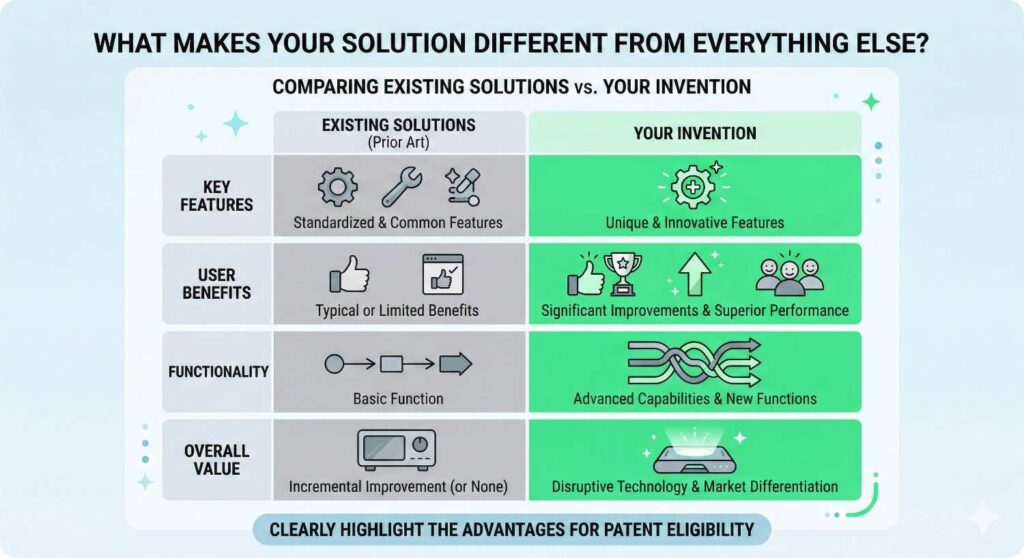
Do not hide it in technical jargon. State it directly. This is how we do it differently.
At PowerPatent, we often help founders isolate this core shift because it is easy to overlook when you are deep in the build. You can see how we guide that process here: https://powerpatent.com/how-it-works.
Where the Magic Actually Happens
Every system has layers. Interface. Logic. Storage. Processing. Communication. Control.
Where does your real innovation live?
Is it in the training method? The data preprocessing step? The orchestration logic? The hardware interaction layer? The security handshake? The caching method?
Be precise.
If your invention relies on a new way of ordering operations, describe that sequence clearly. If it depends on a new type of data structure, explain how it behaves.
If it uses a specific feedback loop that changes outputs over time, spell out how that loop works.
The goal is not to impress. The goal is to expose the engine.
Many founders focus on the output. But patents protect mechanisms.
If someone tried to copy your result without copying your mechanism, would they succeed? If not, then the mechanism is where your patent should focus.
Your invention disclosure should make that mechanism impossible to miss.
What Competitors Would Have to Reverse Engineer
Here is a powerful exercise.
Imagine a competitor trying to copy your product.
What part would be hardest for them to figure out?
Is it the data labeling process? The feature extraction method? The way your system allocates resources? The way your algorithm balances trade-offs? The control logic for hardware coordination?
That pain point for them is often your strongest patent angle.

In your invention disclosure, write as if you are explaining to your future self what must be protected to prevent easy copying.
Think in terms of barriers. What makes replication difficult?
That difficulty often signals novelty.
Improvements Are Not Enough
Many founders say, “We made it faster,” or “We improved accuracy.”
That is good. But how?
If the only difference is tuning parameters or adding more compute power, that may not be enough for strong protection.
You must show structural difference.
Did you reduce latency because you changed how tasks are scheduled? Or because you removed a synchronization step? Or because you introduced predictive preloading?
Did you improve accuracy because you built a new model structure? Or because you designed a new training signal? Or because you filtered noisy data in a new way?
The “how” matters more than the result.
Your invention disclosure must break this down clearly. Avoid vague words like optimized or enhanced. Replace them with detailed explanations of what changed inside the system.
This is not about writing a research paper. It is about explaining the machine you built.
The Small Detail That Changes Everything
Sometimes the biggest innovation is not obvious.
It may be a small rule in the logic.
A new constraint in the workflow.
A timing adjustment.
A dynamic threshold.
A conditional branch that others did not consider.
These details often feel minor when you are building. But in patent strategy, they can be huge.
Ask yourself: if we removed this one piece, would the system still solve the problem the same way?
If the answer is no, that piece may be central.
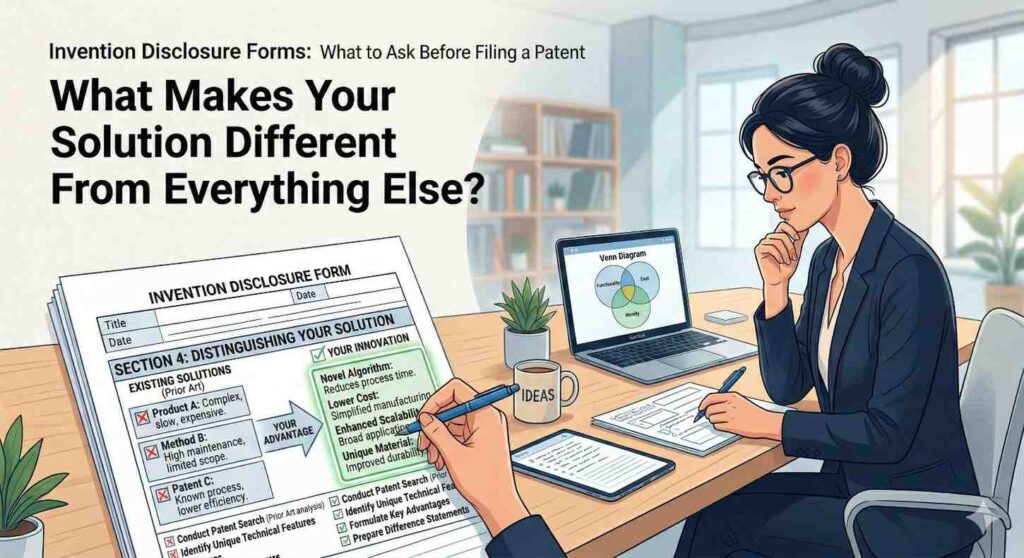
Do not assume that only big architectural changes matter. Often, the subtle difference is what makes the invention new.
Capture those subtle differences in your invention disclosure. Describe why they matter and what they change in system behavior.
Alternative Designs You Considered
A strong disclosure does not just describe one version.
It explores variations.
If your solution could be implemented in different ways, mention them. If the same logic could run on different hardware environments, describe that.
If your model structure could be swapped with another but still apply the same method, explain that too.
This expands your protection.
Think of your invention as a concept that can live in multiple forms.
When you only describe one narrow implementation, you limit your future rights. But when you describe the core idea across possible variations, you protect the idea more broadly.
This is where smart drafting matters.
At PowerPatent, our software helps you think through these variations while real patent attorneys review them to ensure they are captured correctly. That blend is what keeps founders from leaving value on the table.
You can explore how we do that here: https://powerpatent.com/how-it-works.
Why It Is Not Obvious
There is one more critical question.
Why would someone skilled in your field not naturally arrive at your solution?
This is uncomfortable. It forces you to think critically.
Was there a trade-off others assumed could not be solved?
Was there a belief that a certain method would not scale?
Was there a technical bias in the industry?
Did prior attempts fail for a reason you discovered how to overcome?
Explain that reasoning.
If your solution goes against common practice, say so. If others avoided your approach because of perceived risk or complexity, describe that context.
This helps show that your invention was not simply the next logical step. It required insight.
That insight is often what patents protect.
Aligning Uniqueness With Business Leverage
Now step back again.
Is the unique part of your solution tied to your long-term advantage?
Protecting something novel is good. Protecting something central to your competitive edge is better.
If your uniqueness lies in a small feature that can be worked around, the value may be limited. But if it sits at the heart of your product’s performance, cost structure, or reliability, the protection becomes strategic.
Your invention disclosure is not just technical documentation. It is a business defense plan.
Ask yourself: if this specific difference were protected, would it make it harder for others to compete directly?
If yes, you are on the right track.
Explaining It So a Patent Examiner Sees the Difference
Finally, remember who reads patents.
They review many applications. They see incremental changes every day.
Your job is to make your difference obvious.
Do not bury it inside dense paragraphs. Do not assume the reader will infer it. State clearly what was done before and what you do instead.
Clarity is power.
When you combine deep technical explanation with simple, direct writing, your invention stands out.
That is the goal.
Strong patents are not accidents. They begin with strong invention disclosures. And strong disclosures come from clear thinking about what truly makes your solution different.

If you want help capturing that difference without slowing your team down, PowerPatent is built exactly for that.
Smart software guides you through the right questions. Real attorneys ensure the uniqueness is framed correctly. You stay in control. You move fast. And you build real protection around what makes you special.
Take a look at how it works here: https://powerpatent.com/how-it-works.
What Details Must You Capture Before You File?
Now we get practical.
You understand the problem. You know what makes your solution different. But none of that matters if you fail to capture the right details before filing.
A patent is built on specifics. Not broad ideas. Not product promises. Not marketing slides.
Details.
This is the part where founders either build strong protection or accidentally weaken it.
The goal of your invention disclosure form is simple: capture enough depth so your invention can be rebuilt from your description. If someone skilled in your field read it, they should understand how the system works and how to implement it.
Not your entire codebase. Not trade secrets you want hidden. But the core logic and structure.
Let’s walk through what that really means.
Describe the System as If It Had to Be Rebuilt
Imagine your current product disappears tomorrow.
Servers gone. Repo deleted. Team scattered.
All you have left is your invention disclosure.
Could someone rebuild the core invention from it?
This thought experiment forces clarity.
Describe the components. Explain how they connect. Show the flow of data. Explain how inputs become outputs.
If your invention involves software, describe the major modules and their roles. If it involves hardware, explain the physical parts and how they interact. If it combines both, explain the bridge between digital logic and physical behavior.
Avoid vague phrases like “the system processes the data.” Instead, explain how it processes the data. Does it filter first? Normalize? Transform? Rank? Compare? Predict? Store? Trigger?
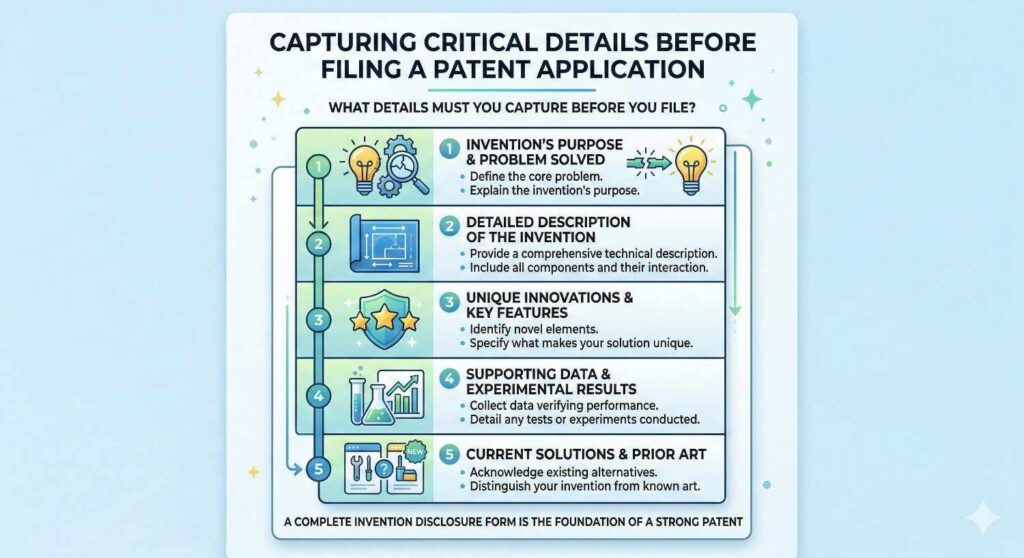
Sequence matters. Relationships matter.
The more concrete your explanation, the stronger your filing will be.
Capture the Flow, Not Just the Parts
Many founders describe components but forget the flow.
Patents care deeply about flow.
What happens first?
What decision is made next?
What condition triggers a different path?
What loops exist?
What feedback changes future behavior?
Even small timing details can matter.
For example, does your system validate inputs before or after transformation? Does it allocate resources dynamically based on predicted demand? Does it update internal state continuously or in intervals?
These are not minor implementation details. They often define what makes the invention unique.
When filling out your invention disclosure form, write through the process step by step in plain language. Imagine explaining it to a smart engineer who has never seen your code.
This exercise often reveals gaps in your own thinking. That is a good thing.
Explain the Data in Detail
If your invention touches data in any way, describe that data clearly.
What kind of data is used? Structured? Unstructured? Sensor-based? User input? Network traffic? Financial records?
How is it formatted? How is it stored? How is it cleaned?
If you generate new data as part of your process, explain what that data represents. Is it a confidence score? A ranking? A probability? A risk value? A classification?
Explain how that output is used.
Data handling is often where real novelty lives. A new way of structuring, filtering, or interpreting data can be patent-worthy.
Do not assume that because something feels routine, it lacks importance. Many breakthroughs hide in the data pipeline.
At PowerPatent, we guide founders to unpack their data flow carefully because that is where hidden value often sits. You can see how we help teams think through this in a structured way here: https://powerpatent.com/how-it-works.
Capture Edge Cases and Failure Handling
Here is something most invention disclosures ignore.
What happens when things go wrong?
How does your system handle unexpected inputs? Network failure? Corrupted data? Conflicting signals? Hardware faults?
If you designed special logic to manage these scenarios, that logic can be powerful.
For example, if your model retrains when accuracy drops below a threshold, explain that trigger clearly. If your system switches to a backup pathway when latency spikes, describe the detection and transition.
Edge case handling often shows depth of innovation.

It also shows that your invention is practical, not theoretical.
Capture those defensive layers in your disclosure.
Record Performance Benchmarks With Context
If you have performance data, include it. But do it carefully.
Do not just say “30 percent faster.”
Explain under what conditions. What environment? What baseline? What constraints?
Context matters.
If your system reduces processing time from 500 milliseconds to 50 milliseconds in high-load cloud environments with limited memory, that detail is meaningful.
If your method improves detection accuracy from 82 percent to 94 percent on noisy real-world data sets, that matters.
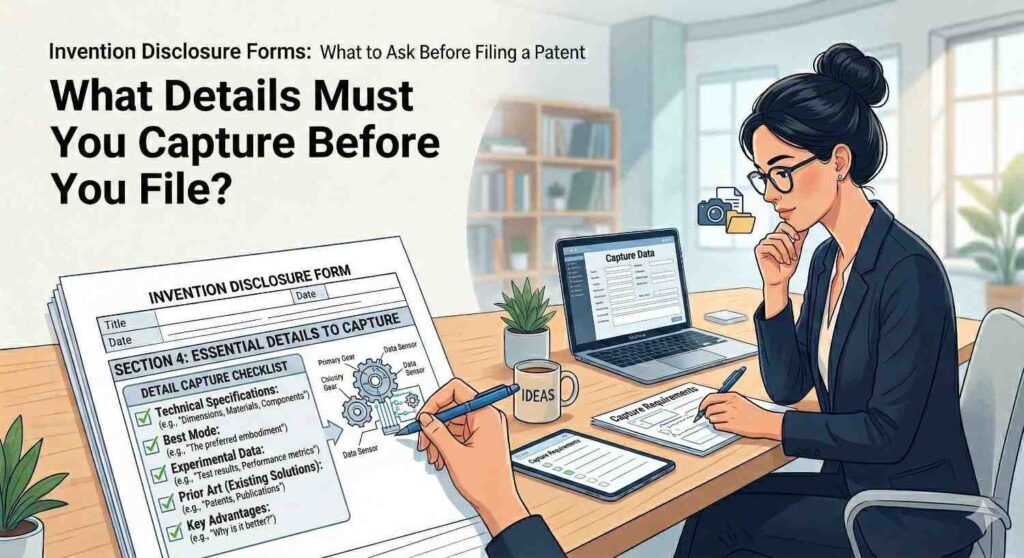
Performance improvements tied to specific methods strengthen your filing. They show that your structural changes produce measurable results.
Avoid hype. Stick to facts.
Document Variations and Extensions
Your current product version is not the limit of your invention.
Think about future versions.
Could this logic run in a different industry? On different hardware? With a different model architecture? With larger data sets? With decentralized coordination?
Capture those possibilities.
Even if you have not built them yet, if your core idea applies, write it down.
This expands your protection.
It prevents competitors from making minor tweaks and claiming they built something different.
The invention disclosure form is your chance to define the outer boundaries of your idea before filing.
Do not make it narrow by accident.
Clarify What Is Essential and What Is Optional
As you describe your system, distinguish between what is required and what is flexible.
Which components must exist for the invention to work?
Which parts could change without breaking the core idea?
This distinction helps your patent strategy later.
If you treat optional features as required, you may limit your claims. If you ignore essential elements, you weaken your position.
Think of your invention like a machine. Some gears are critical. Others are replaceable.
Mark that difference in your disclosure.
This clarity makes drafting faster and stronger.
Protecting Without Exposing Trade Secrets
Many founders worry about revealing too much.
That concern is valid.
You do not need to expose every line of code. You do not need to reveal proprietary data sets.
Focus on describing the method and structure without disclosing sensitive details that are better kept as trade secrets.
For example, you can describe how a model is trained without sharing the exact training data. You can describe a scoring method without revealing precise weight values.
A well-crafted invention disclosure strikes this balance.
This is where real attorney oversight matters. Software can guide structure, but legal review ensures you protect wisely.
PowerPatent was built around this balance. Smart tools to capture depth. Real patent attorneys to refine and protect. No unnecessary delays. No bloated law firm overhead. Just focused protection for founders who move fast.
If you want to see how we help teams capture the right details without slowing product momentum, visit https://powerpatent.com/how-it-works.
Locking In the Date
There is one final reason to capture details carefully and early.
Timing.
In many places, patent rights go to whoever files first. Not whoever invents first.
If you wait too long or document too loosely, you risk losing priority.
Your invention disclosure form is part of creating a clear record.
Write it while the system is fresh in your mind. While design decisions are clear. While you remember why certain choices were made.
Do not wait until after launch. Do not wait until after fundraising. Do not wait until a competitor appears.
Protection favors the prepared.
And preparation begins with thoughtful documentation.
Strong patents are not about legal tricks. They are about clarity. Clarity of problem. Clarity of difference. Clarity of detail.

If you capture those three layers well, filing becomes smoother. Review becomes easier. And your protection becomes meaningful.
Wrapping It Up
Filing a patent should never feel like paperwork. It is a strategic move. It is how you draw a line around what you built and say, this is ours. But that line is only as strong as the thinking behind it. An invention disclosure form is not just a form. It is a forcing function. It pushes you to slow down for a moment and look at your own system with clarity. What problem did we truly solve? What did we change at a deep level? What exactly did we build, step by step?