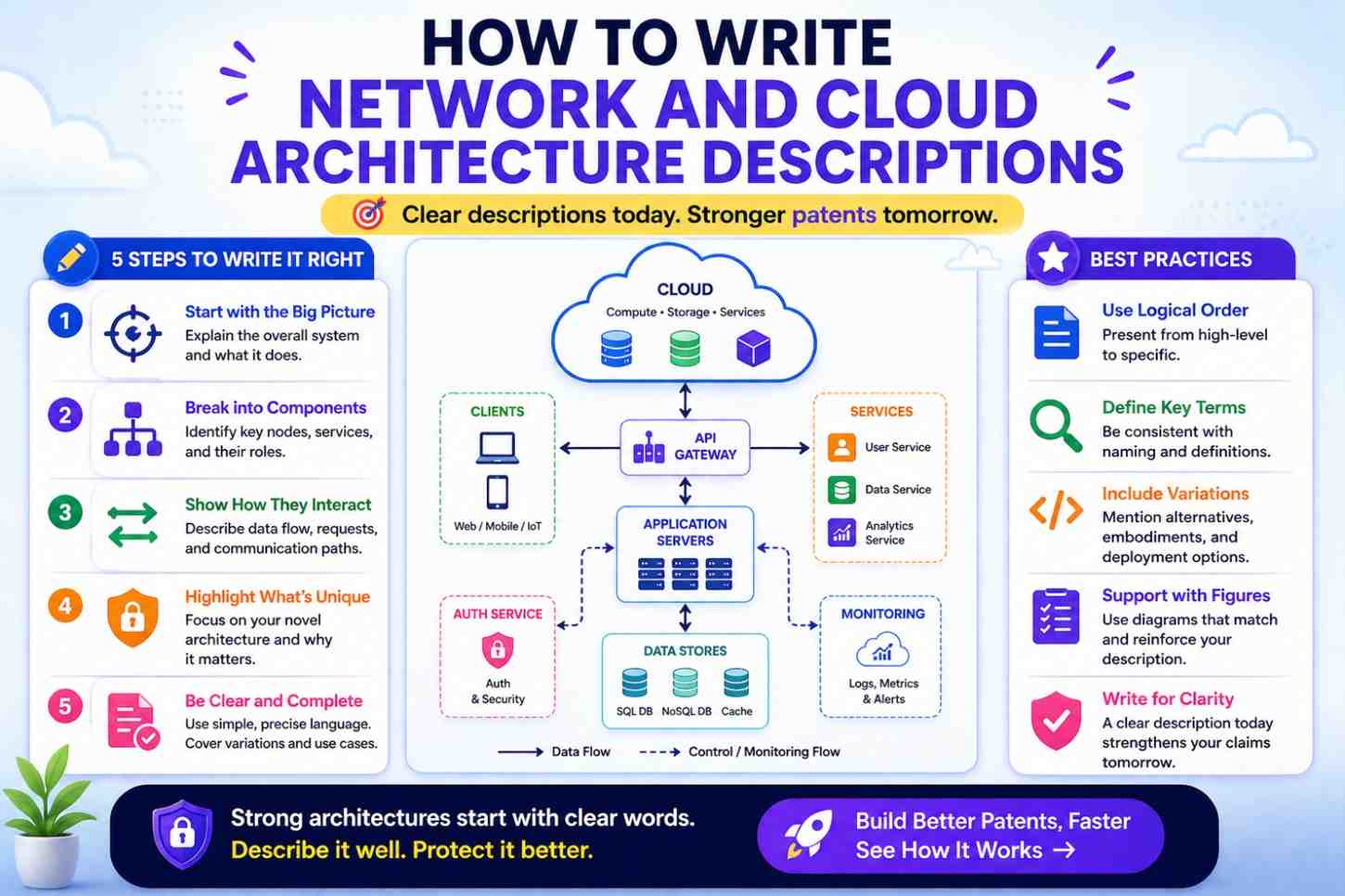
Cloud and network architecture can be the backbone of a software invention. But if you describe it too narrowly, your patent may only protect one setup.
A strong patent spec should explain how the system works today while leaving room for other deployments tomorrow. That means careful words, clear diagrams, and smart descriptions of servers, devices, networks, APIs, data flows, security, edge processing, and cloud services.
PowerPatent helps founders, engineers, and inventors turn technical systems into stronger patent filings with smart software and real patent attorney oversight. You can see how it works here: https://powerpatent.com/how-it-works
Why cloud architecture descriptions matter in patents
Many modern inventions live in the cloud.
A product may run on servers, containers, edge devices, mobile apps, APIs, queues, databases, model services, storage buckets, event streams, or third-party systems. The user may only see a clean app or dashboard, but the real invention may happen across a network.
That creates a patent drafting challenge.
You need to describe the architecture clearly enough that a reader understands how the invention works. But you also need to avoid locking the invention to one cloud provider, one server setup, one database, one API style, one deployment region, or one network path unless that detail is truly required.
Startups move fast. The architecture you use today may not be the architecture you use next year.
You may start with one cloud provider and later support others.
You may begin with a monolith and later move to services.
You may run all processing in the cloud and later move some work to the edge.
You may use one database today and a different data store later.
You may expose a dashboard first and later become API-first.
You may add customer-hosted deployments for enterprise buyers.
A patent spec should not break when your architecture grows up.
That is why cloud and network descriptions need strategy.
The goal is not to describe every server in your stack like an internal engineering doc. The goal is to explain the invention in a way that protects the technical value across reasonable deployment choices.
Start with what the system does, not where it runs
A common mistake is starting with the cloud setup.
For example:
“The invention is an AWS-based platform that uses Lambda, S3, DynamoDB, and API Gateway.”
That may describe the current build. But it may be too narrow for a patent unless those exact services are the point.
A better start is to describe the function.
For example:
“This disclosure describes systems and methods for receiving input data, processing the input data to generate an output, and providing the output to a user device or another system.”
Then you can explain deployment examples.
“In some examples, one or more operations may be performed by a cloud computing system. In other examples, one or more operations may be performed by a local device, edge device, on-premises server, mobile device, or a combination of these.”
This is much stronger.
It protects the invention’s work, not just the current hosting setup.
Cloud services are often implementation choices. The invention may be the data flow, scoring logic, model pipeline, routing method, control process, security process, or feedback loop.
Always find the core function first.
Then describe where that function can run.
PowerPatent helps teams do this by capturing the technical invention behind the architecture, not just the current stack diagram. Explore the process here: https://powerpatent.com/how-it-works
Do not confuse your cloud provider with your invention
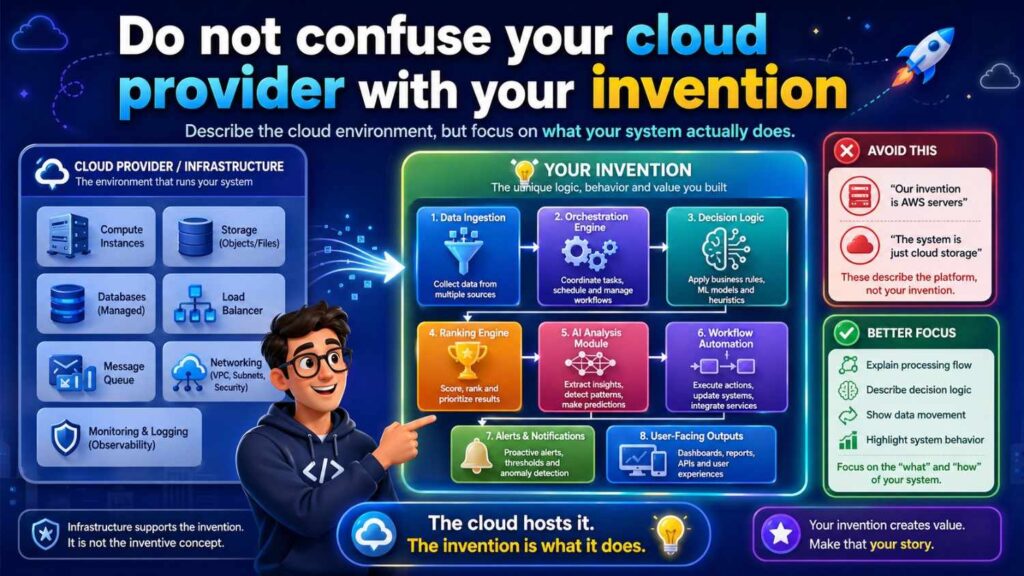
Cloud vendors are useful. They are not usually the invention.
Your system may use AWS, Azure, Google Cloud, Cloudflare, Snowflake, Databricks, Supabase, Firebase, Vercel, Netlify, or another provider. Those tools may help you build quickly, but your patent should usually describe their role in broader terms.
Instead of saying:
“The system stores files in S3.”
You might say:
“The system may store files in an object storage system.”
Then, if useful:
“In one example, the object storage system may be provided by a cloud service.”
Instead of:
“The system uses AWS Lambda to run the scoring function.”
Say:
“The system may execute a scoring function using a serverless computing service, cloud server, container, virtual machine, local processor, or other computing resource.”
Instead of:
“The system sends events through Kafka.”
Say:
“The system may send events through an event stream, message queue, publish-subscribe system, or another messaging system.”
This kind of wording protects the architecture pattern without tying the patent to a vendor.
A competitor should not be able to copy your invention and avoid the patent by changing cloud providers.
Describe components by role
Cloud systems often have many parts.
There may be a client device, API server, authentication service, processing service, model service, database, queue, cache, storage system, event bus, notification service, admin console, logging service, and third-party integration.
A patent spec should name parts based on what they do.
For example:
“client device”
“processing system”
“data store”
“model service”
“routing engine”
“output service”
“notification service”
“review system”
“feedback service”
“edge device”
“remote server”
“workflow system”
These names are broad but meaningful.
Avoid names that are too tied to internal code.
For example, an internal service named “Falcon,” “Atlas,” “Orion,” or “RiskBrain” may not help the patent unless explained. Use functional names.
Instead of:
“Falcon sends the payload to Atlas.”
Say:
“The routing service may send the input data to a processing service.”
This is clearer.
It also supports future changes. Internal names change. Functional roles last longer.
Use “one or more computing devices”
This phrase is simple and useful.
Many inventions do not care whether one server or many servers perform the work.
A patent spec can say:
“The system may be implemented by one or more computing devices.”
Then:
“The one or more computing devices may include a server, cloud computing system, local computer, mobile device, edge device, embedded device, on-premises server, virtual machine, container, or other computing device.”
This gives flexibility.
It covers many deployment forms.
It also avoids tying the invention to a single machine.
For cloud systems, this is important because modern architecture is distributed. A “server” may be a container, a serverless function, a cluster, a VM, a managed service, or a set of services.
The patent does not need to mirror every deployment detail. It needs to explain that computing devices perform the operations.
Describe local, remote, edge, and hybrid options
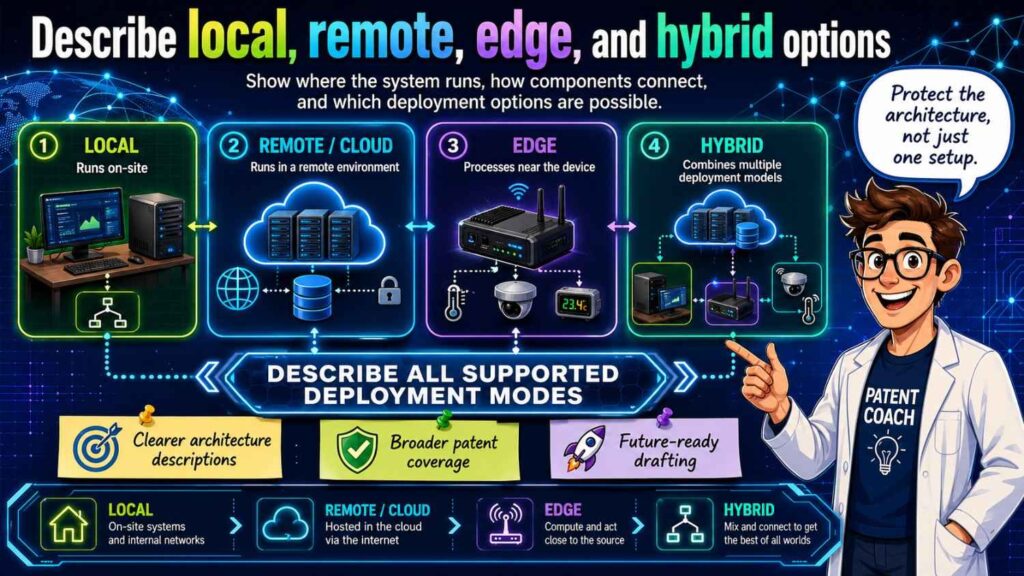
Cloud architecture is not always pure cloud.
Many products split work across devices.
A mobile app may collect data locally and send it to the cloud.
An edge device may preprocess sensor data before sending a summary.
A cloud server may train a model, while a local device runs inference.
An on-prem system may process sensitive data and send only metadata to a remote service.
A browser may perform some steps before calling an API.
A strong patent spec should describe these options when they fit the invention.
For example:
“One or more operations may be performed locally, remotely, or using a combination of local and remote processing.”
Then explain:
“In some examples, a local device may perform a first operation, and a remote server may perform a second operation.”
Then add why:
“The distribution of operations may be selected based on latency, privacy, compute cost, power use, data size, model size, network availability, or another factor.”
This is strong.
It protects cloud-only, edge-only, local-only, and hybrid versions when appropriate.
It also reflects how real products evolve.
Do not make cloud processing required unless it is required
Many patent drafts accidentally say all processing happens in the cloud.
That can be risky.
A competitor may run the same logic on an edge device or on-prem server. Your own product may also move there later.
If cloud is optional, write it that way.
Weak:
“The cloud server receives the data and generates the output.”
Better:
“In some examples, a remote server may receive the data and generate the output.”
Even better:
“The system may generate the output using one or more computing devices. In some examples, the one or more computing devices may include a remote server, cloud computing system, edge device, local device, or a combination of these.”
This keeps cloud as one example.
If the invention truly depends on cloud-scale data, distributed cloud processing, or cross-tenant learning, describe that. But do not make cloud required just because your current product uses cloud.
Describe the network broadly
A network can be many things.
It may be the internet, local area network, cellular network, Wi-Fi, Bluetooth, satellite link, wired connection, industrial network, vehicle bus, mesh network, private network, VPN, or another communication path.
If the exact network is not central, describe it broadly.
For example:
“The devices may communicate through one or more networks.”
Then:
“The one or more networks may include a wired network, wireless network, local area network, wide area network, cellular network, Wi-Fi network, Bluetooth connection, satellite link, industrial network, private network, internet-based network, or another communication network.”
This prevents the invention from being tied to one network type.
If a specific network matters, explain why.
For example, if low-power radio is important because devices run on batteries, say that. If an industrial bus matters because the system controls factory machines, say that. If a private network matters for security, explain that.
The network description should match the invention’s needs.
Describe communication without over-limiting protocols
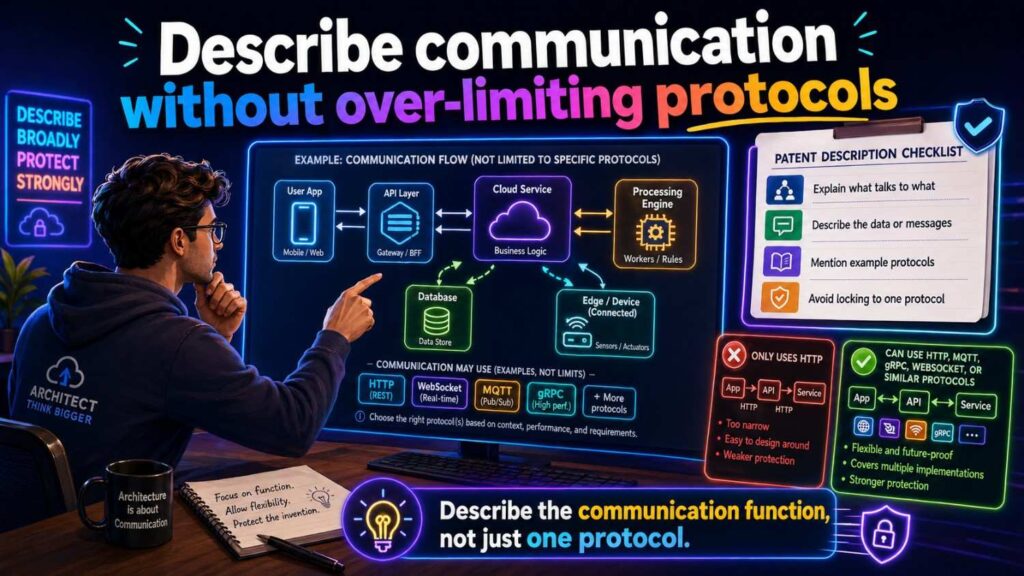
Networked systems use protocols.
HTTP, HTTPS, WebSocket, MQTT, gRPC, TCP, UDP, CAN, Modbus, OPC UA, Bluetooth, Zigbee, LoRaWAN, and many others may be relevant.
But be careful.
If your invention does not depend on a specific protocol, do not make it required.
Instead of:
“The device sends data using MQTT.”
Say:
“The device may send data using a messaging protocol.”
Then:
“In some examples, the messaging protocol may include MQTT, HTTP, WebSocket, gRPC, TCP, UDP, or another protocol.”
For industrial systems:
“The system may communicate with a machine controller using an industrial communication protocol.”
Then examples can follow.
This gives room.
A competitor should not avoid your patent by switching protocols if the protocol is not the core invention.
Describe APIs by function
APIs are common in cloud systems.
A product may receive data through an API, send outputs through an API, expose model results through an API, or call third-party APIs.
Do not just say “the system uses an API.” Explain what the API does.
For example:
“The system may receive a request through an application programming interface. The request may include input data, a user identifier, a device identifier, a query, a file, a model selection, or another request parameter.”
Then:
“The system may provide a response through the application programming interface. The response may include a score, label, prediction, recommendation, confidence value, explanation, status, task identifier, or another output.”
This is useful.
It can support future API-focused claims.
It also makes clear that the invention can work without a visual dashboard.
For many startups, this matters. The first product may have a UI, but the long-term value may be in APIs and integrations.
Describe request-response and event-driven modes
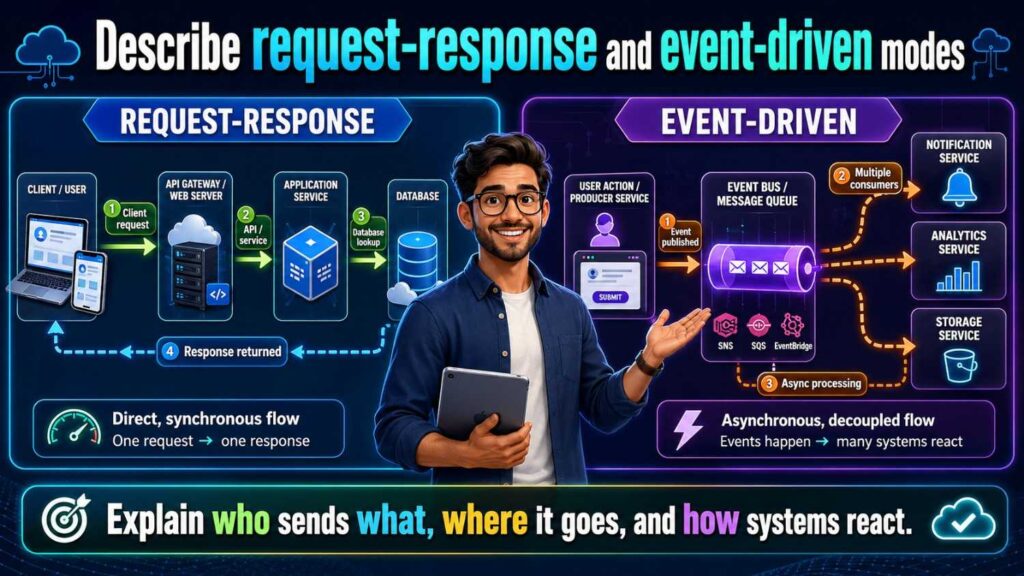
Cloud systems often work in different modes.
A client may send a request and receive a response.
Or a device may send events continuously.
Or a queue may trigger background jobs.
Or a system may process data on a schedule.
Or a webhook may notify another service.
Do not assume one mode unless it is required.
For example:
“In some examples, the system may operate in a request-response mode. In other examples, the system may operate in an event-driven mode, streaming mode, batch mode, scheduled mode, or webhook-based mode.”
Then explain how each may work.
“In request-response mode, a client device may send a request including input data, and the system may return an output in response to the request.”
“In event-driven mode, the system may receive events from one or more sources and process the events as they are received.”
“In batch mode, the system may process a group of records together.”
This gives flexibility and supports future claim paths.
It also reflects real architecture changes. Many products start as request-response systems and later add event streams or batch pipelines.
Describe data flow clearly
Network and cloud architecture descriptions should make data flow easy to follow.
Who sends data?
What data is sent?
Where does it go?
What happens to it?
What output is generated?
Where is the output sent?
What is stored?
What feedback returns?
A clear data flow might say:
“A client device may send input data to a processing system through a network. The processing system may store at least part of the input data in a data store, process the input data to generate an output, and send the output to the client device or another system.”
This is simple and strong.
Then you can add details.
“The input data may include sensor data, user data, transaction data, image data, text data, event data, device data, or other data.”
“The output may include a score, label, alert, recommendation, control signal, report, task, or other result.”
“The other system may include a workflow system, notification system, control system, database, or third-party service.”
Good data flow helps the reader understand the invention.
It also helps attorneys draft claims.
Describe data paths as examples, not rigid routes
A figure may show data moving from A to B to C.
But in real systems, data may move through other paths.
If the path can vary, say so.
For example:
“Although Figure 1 shows input data being sent from client device 102 to processing system 104 through network 106, other examples may use different data paths. For example, input data may be sent through an intermediate service, stored in a data store before processing, streamed through an event system, or processed locally before being sent to processing system 104.”
This is useful.
It prevents the figure from becoming too rigid.
A competitor should not avoid the patent by adding a queue, cache, proxy, or intermediate service if those are not central differences.
Describe intermediate services
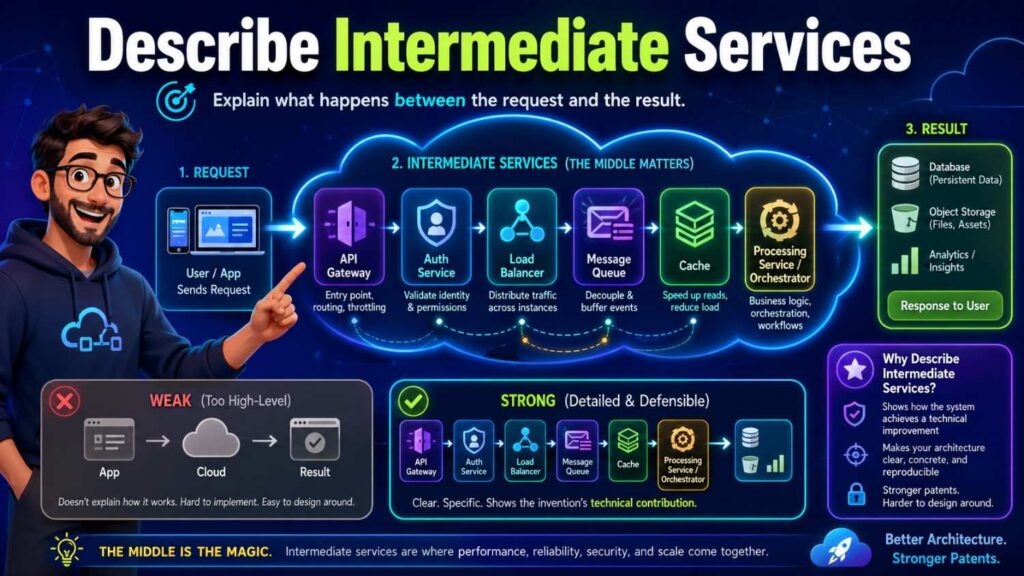
Modern cloud architecture often includes intermediate services.
These may include API gateways, load balancers, queues, caches, proxies, brokers, event streams, workers, orchestration services, service meshes, identity providers, and logging systems.
You do not need to describe every one unless relevant.
But when they matter, describe them by role.
For example:
“In some examples, an API gateway may receive requests from client devices and route the requests to one or more services.”
“In some examples, a message queue may store processing tasks before the tasks are performed by one or more worker services.”
“In some examples, a cache may store recent outputs or frequently accessed data to reduce repeated processing.”
“In some examples, a load balancer may distribute requests across multiple processing instances.”
This supports cloud architecture claims where these parts matter.
But avoid making them required unless they are.
Describe storage broadly
Cloud systems store many kinds of data.
Raw input data.
Processed data.
Outputs.
User feedback.
Audit logs.
Model versions.
Configuration settings.
Feature vectors.
Embeddings.
Training records.
Event logs.
Device states.
A strong spec should describe storage based on what is stored and why.
For example:
“The system may store input data, processed data, output data, user feedback, configuration data, model data, audit data, event data, or other data in one or more data stores.”
Then:
“The one or more data stores may include a database, object storage system, file system, key-value store, time-series database, vector database, graph database, cache, local memory, cloud storage, distributed storage, or another storage system.”
This gives broad support.
If a specific storage type matters, explain its role.
For example:
“In some examples, a vector database may store embeddings used to retrieve context data for a model input.”
That is meaningful.
Describe databases by role, not brand
Do not tie the patent to PostgreSQL, MongoDB, Redis, Snowflake, DynamoDB, BigQuery, or another tool unless needed.
Use broader terms.
A relational database can be “a relational data store.”
Redis can be “a cache” or “key-value store.”
Snowflake can be “a cloud data warehouse.”
S3 can be “object storage.”
Elasticsearch can be “a search index.”
Pinecone can be “a vector database.”
Neo4j can be “a graph database.”
This keeps the spec flexible.
You can mention examples if helpful, but the main description should be function-based.
Describe caching if it affects performance or behavior
Caching can be important in cloud architecture.
It may reduce delay, reduce compute cost, support offline use, or improve user experience.
If caching matters, describe it.
For example:
“In some examples, the system may store recent outputs in a cache. When a later request is similar to a prior request, the system may retrieve a cached output instead of performing one or more processing operations again.”
Another:
“In some examples, an edge device may store cached configuration data or cached model data to allow operation when a network connection is unavailable.”
Another:
“In some examples, a cache may store frequently requested records to reduce access to a remote data store.”
This gives the cache a technical role.
It is better than simply saying “the system includes a cache.”
Describe queues and asynchronous processing
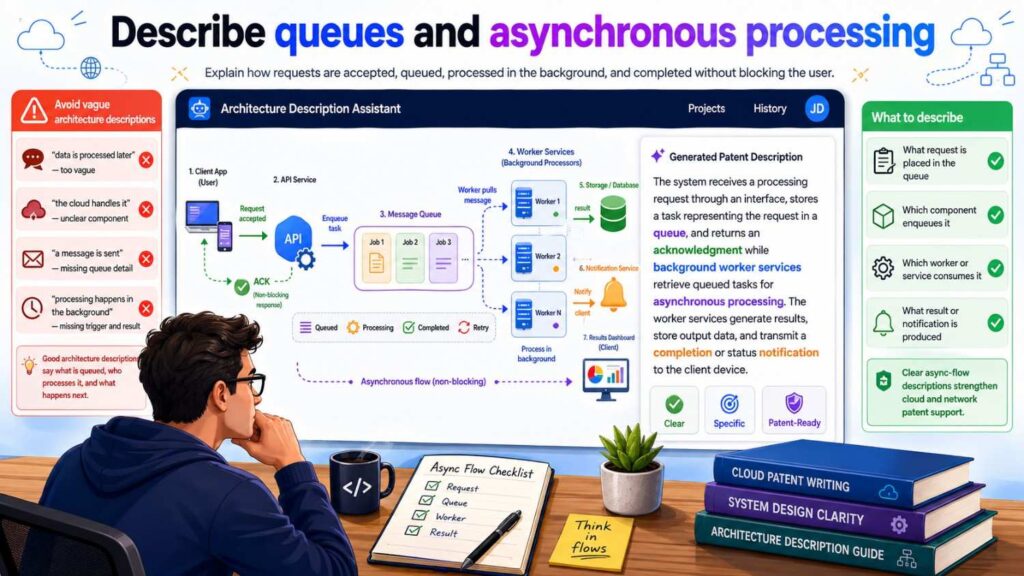
Many cloud systems use queues.
A queue may help handle spikes, retry failed tasks, process long jobs, or decouple services.
If relevant, include it.
For example:
“In some examples, the system may place a processing task in a queue. One or more worker services may retrieve the processing task from the queue and perform one or more operations associated with the task.”
Then:
“The queue may allow the system to process requests asynchronously, retry failed tasks, control processing order, or smooth changes in request volume.”
This is strong.
It supports architecture claims around scalable processing.
It also explains why the queue matters.
Describe event streams
Event streams can be important for real-time systems.
For example:
“In some examples, the system may receive a stream of events from one or more data sources. The events may include sensor readings, user actions, transaction events, device state changes, log entries, or other events.”
Then:
“The system may process the events as they are received, group related events, detect a pattern in the events, generate an output based on the pattern, or update a stored state.”
This supports claims around streaming data.
Do not call every system “real-time” if it is not. But if event streams are part of the invention, describe them clearly.
Describe batch processing
Batch processing is also common.
A system may process data every hour, daily, after a threshold number of records, or on demand.
For example:
“In some examples, the system may process a batch of records. The batch may include records collected during a time period, records associated with a user, records associated with a device, records associated with a customer, or records selected based on a processing rule.”
Then:
“The system may generate one or more outputs based on the batch.”
This supports batch-based versions.
A good spec can support real-time, near-real-time, and batch operation if the invention can work in those modes.
Describe serverless and containerized systems broadly
Modern cloud systems may use serverless functions, containers, virtual machines, or managed compute.
Avoid tying the invention to one.
For example:
“One or more operations may be performed by a serverless function, container, virtual machine, physical server, cloud service, edge process, mobile application, embedded processor, or another computing resource.”
This is broad and useful.
If serverless matters because functions are triggered by events, explain that.
“In some examples, an event may trigger execution of a serverless function that processes data associated with the event.”
If containers matter because services scale independently, explain that.
“In some examples, processing services may run in containers that may be scaled based on request volume.”
Give the feature a reason.
Describe scaling if it matters
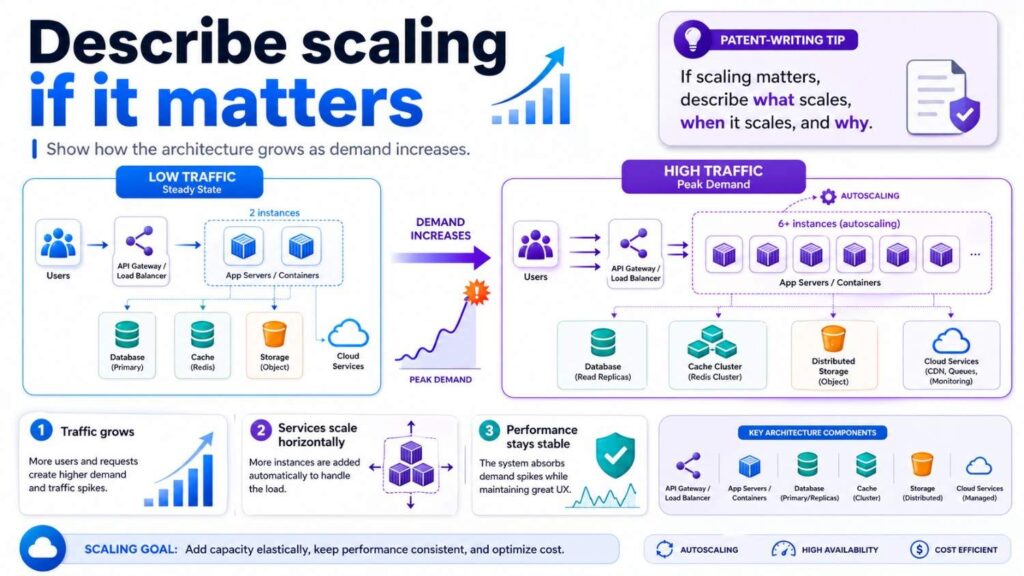
Scaling can be patent-relevant if it is tied to the invention.
A system may scale workers, allocate compute, choose cloud regions, route tasks, or switch processing modes based on load.
For example:
“In some examples, the system may increase or decrease a number of processing instances based on request volume, queue length, data size, latency, cost, or another scaling condition.”
Another:
“In some examples, the system may route a task to a processing instance based on availability, location, model version, hardware type, or expected processing time.”
This gives support for scaling features.
If scaling is just ordinary infrastructure and not part of the invention, keep it light.
Describe regions, latency, and location when relevant
Cloud systems may run in different regions or locations.
This can matter for latency, privacy, compliance, cost, or resilience.
For example:
“In some examples, the system may select a processing location based on latency, data location, user location, policy, cost, available compute, or privacy requirement.”
Another:
“In some examples, input data associated with a first region may be processed by a computing resource in the first region.”
Another:
“In some examples, the system may store data in a selected storage location based on a data residency rule.”
These details can support future claims around location-aware processing.
Do not include them if they are irrelevant, but do not omit them if they are part of your value.
Describe edge processing
Edge processing is increasingly important.
An edge device may process data near the source. This can reduce delay, reduce bandwidth, protect privacy, or allow offline operation.
A patent spec may say:
“In some examples, at least part of the processing may be performed by an edge device located near a data source.”
Then:
“The edge device may receive input data, perform preprocessing, generate an intermediate result, apply a model, store data locally, or send selected data to a remote system.”
Then explain why:
“Edge processing may reduce data transfer, reduce delay, allow operation when a network connection is unavailable, or reduce transfer of sensitive data.”
This is a strong architecture description.
If the edge device sends only summaries, say that.
“In some examples, the edge device may send a summary, feature vector, score, alert, or other processed result to the remote system instead of sending raw input data.”
That can be very useful for privacy and efficiency.
Describe cloud-edge split
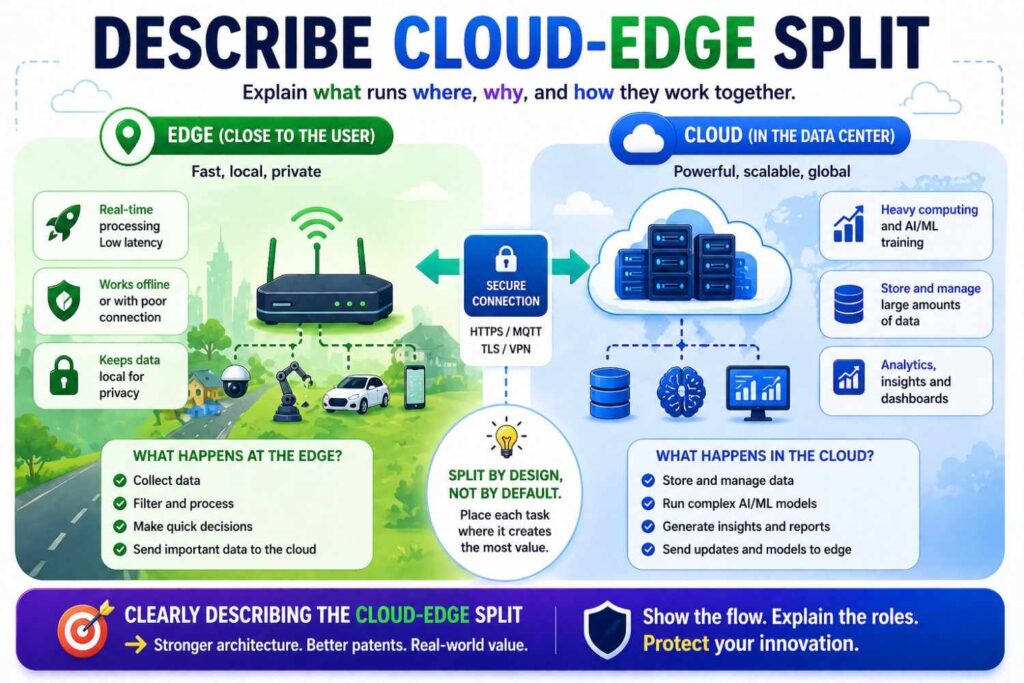
Many systems split operations between edge and cloud.
Describe the split.
For example:
“In some examples, an edge device may perform a first processing operation, and a cloud computing system may perform a second processing operation.”
Then:
“The first processing operation may include collecting data, filtering data, compressing data, extracting features, applying a local model, detecting a local condition, or generating an intermediate output.”
Then:
“The second processing operation may include aggregating data from multiple edge devices, updating a model, generating a fleet-level output, storing records, or providing a user interface.”
This is clear and powerful.
It also supports future claims around distributed processing.
Describe on-premises deployments
Enterprise customers may ask for on-prem.
If your invention can run on customer-hosted systems, include it.
For example:
“In some examples, one or more operations may be performed by an on-premises computing system controlled by a customer or organization.”
Then:
“The on-premises computing system may communicate with a remote service to receive updates, send summaries, retrieve model data, or report status.”
This supports hybrid enterprise deployments.
It also avoids tying the invention to SaaS only.
For startups selling to regulated or large enterprise customers, this can matter a lot.
Describe offline and intermittent network behavior
Many real systems cannot assume perfect connectivity.
A device may operate in a factory, vehicle, field site, hospital, warehouse, aircraft, ship, or remote location. Even web apps can face intermittent service.
If offline behavior matters, describe it.
For example:
“In some examples, a device may store input data locally when a network connection is unavailable and send the stored input data after the network connection becomes available.”
Another:
“In some examples, a device may process data locally using cached model data or cached configuration data when a remote service is unavailable.”
Another:
“In some examples, the system may queue user inputs while offline and synchronize the queued inputs with a remote system after reconnection.”
These features can support strong fallback claims.
They also show real-world readiness.
Describe synchronization
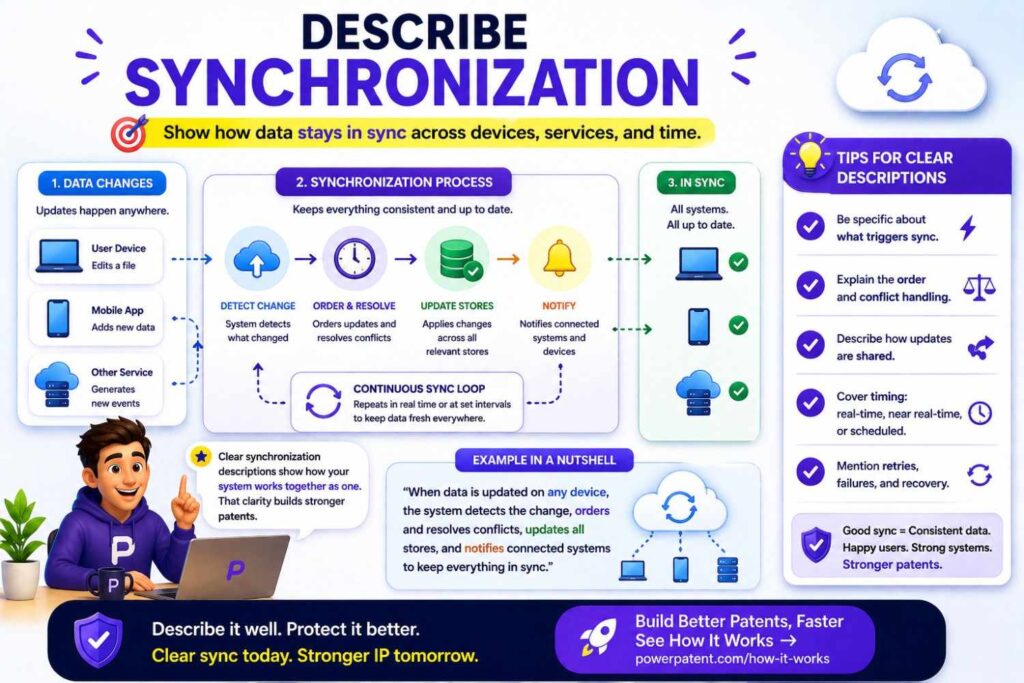
When local and remote systems both store data, synchronization may matter.
For example:
“In some examples, the system may synchronize local data with remote data. The synchronization may include sending locally stored records to a remote data store, receiving updated configuration data, resolving conflicts, or updating a local state based on remote state.”
Then:
“A conflict may be resolved based on time, user role, priority, version number, confidence value, or another rule.”
This is a useful architecture detail.
It may support claims around distributed systems and offline workflows.
Describe versioning
Cloud systems often involve versions.
Model versions.
Rule versions.
API versions.
Configuration versions.
Data schema versions.
Workflow versions.
UI versions.
If versioning matters, include it.
For example:
“In some examples, the system may store a version identifier associated with a model, rule, configuration, API, data schema, or output.”
Then:
“The version identifier may be used to select a processing operation, generate an audit record, compare outputs, roll back a change, or route data to a compatible service.”
Versioning is especially important for AI and regulated systems.
It can support auditability and safe updates.
Describe model services in cloud architecture
AI systems often use model services.
The model may run in the cloud, on edge, on a customer server, or through a third-party service.
Describe model services broadly.
For example:
“In some examples, the processing system may use one or more model services to generate an output based on input data.”
Then:
“The model service may include a locally hosted model, cloud-hosted model, third-party model service, edge model, rules-based model, or a combination of these.”
Then explain model input and output.
“The input to the model service may include input data, selected context data, user data, configuration data, or output instructions.”
“The output from the model service may include a score, label, prediction, generated content, classification, ranked list, confidence value, or other model output.”
This supports AI cloud architecture well.
Describe model routing
Some systems choose among models.
This can be valuable.
For example:
“In some examples, the system may select one or more models from a set of models based on input type, user setting, task type, confidence value, cost, latency, model availability, privacy rule, or another selection factor.”
Then:
“The selected model may be used to generate the output.”
This supports model routing claims.
It also reflects modern AI products, where teams may use different models for different tasks.
Describe retrieval and context systems
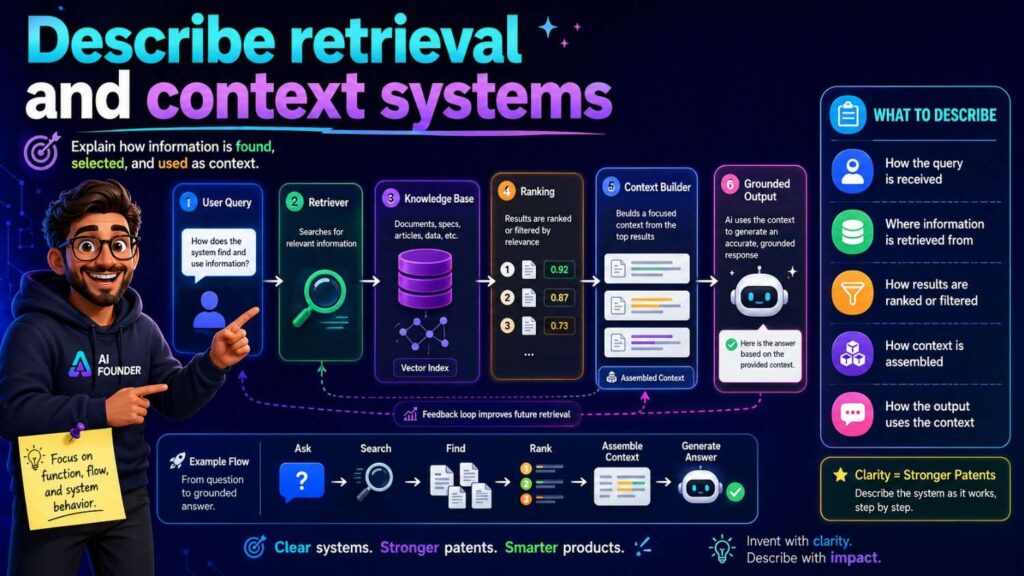
Many AI cloud systems use retrieval.
They may search documents, code, records, embeddings, knowledge bases, or databases to provide context to a model.
A strong spec may say:
“In some examples, the system may retrieve context data from one or more data sources based on a query, input data, user role, task type, similarity value, time period, or access permission.”
Then:
“The retrieved context data may be included in a model input, used to validate a model output, used to generate an explanation, or used to rank candidate outputs.”
If a vector store is used:
“In some examples, the system may generate an embedding associated with input data and use the embedding to retrieve related records from a vector data store.”
This is specific enough to support AI architecture claims.
Describe validation and guardrail services
Cloud systems may include validation services that check outputs before sending them to users or downstream systems.
This can be very important in AI.
For example:
“In some examples, a validation service may evaluate an output before the output is provided to a user or another system.”
Then:
“The validation service may compare the output to source data, apply a rule, check a confidence value, detect a conflict, verify a format, identify missing data, or determine whether review is required.”
Then:
“If the output fails validation, the system may revise the output, suppress the output, request more data, route the output for review, or generate a warning.”
This is strong.
It supports safety and reliability claims.
Describe authentication and identity
Networked systems often need authentication.
If it matters to the invention, include it.
For example:
“In some examples, the system may authenticate a user, device, service, or application before receiving input data or providing an output.”
Then:
“Authentication may be based on credentials, tokens, certificates, keys, biometric data, device identifiers, or another authentication factor.”
Then connect it:
“The system may use authentication information to select data, control access, route requests, log actions, or apply permissions.”
Do not add security details just to sound complete. But if identity affects system behavior, describe it.
Describe authorization and permissions
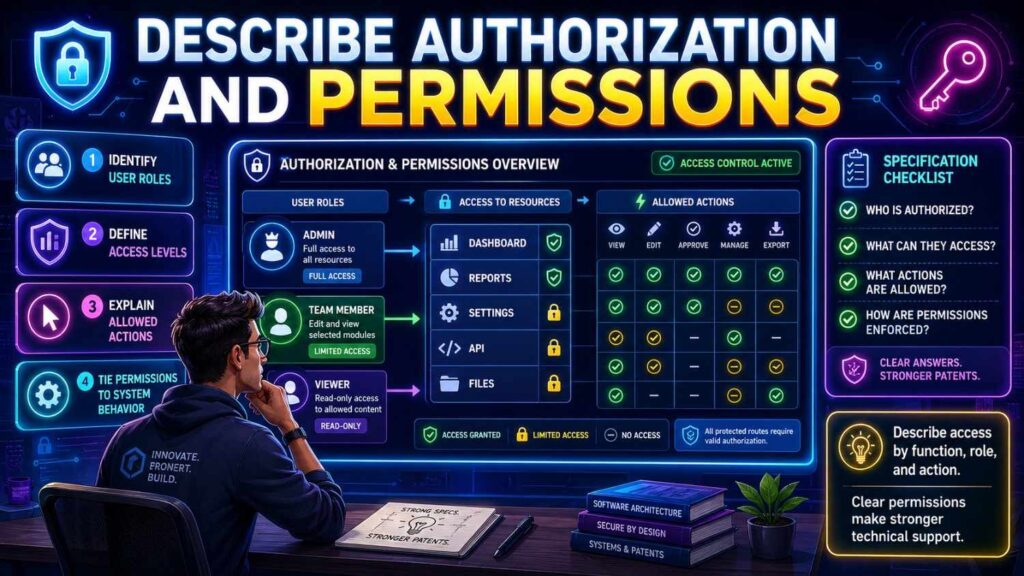
Authorization decides what a user or system can do.
For example:
“In some examples, the system may determine whether a user, device, or service is authorized to access input data, view an output, change a setting, approve an action, or send data to another system.”
Then:
“The authorization may be based on a role, permission, policy, organization, device, location, data type, or system state.”
This can support role-based cloud architecture claims.
It also matters for enterprise software.
Describe encryption and secure communication
If security is relevant, describe secure communication.
For example:
“In some examples, data sent between devices may be encrypted.”
Then:
“The system may encrypt data in transit, encrypt stored data, sign messages, verify signatures, rotate keys, or use secure communication channels.”
Tie it to function if possible.
“In some examples, the system may encrypt sensitive data before sending the sensitive data to a remote service.”
This is more meaningful than a generic security statement.
Describe privacy-preserving architecture
Privacy can be a major invention feature.
For example:
“In some examples, sensitive data may be processed locally, and a processed result may be sent to a remote system instead of the sensitive data.”
Another:
“In some examples, the system may remove, mask, tokenize, aggregate, or transform sensitive data before storing or sending the data.”
Another:
“In some examples, the system may select a processing location based on a privacy rule associated with the data.”
These details can support strong privacy-related claims.
They also matter for health, finance, enterprise AI, legal tech, education, and security tools.
Describe audit logging
Cloud systems often need audit logs.
If auditability matters, describe it.
For example:
“In some examples, the system may generate an audit record associated with a request, output, user action, model version, rule version, data source, processing location, or downstream action.”
Then:
“The audit record may be stored in a data store and used to review system behavior, explain an output, detect an error, compare model versions, or support later review.”
This is useful.
It connects architecture to trust.
Describe observability only when it matters
Logs, metrics, and traces may be part of normal cloud operations. They may not need much patent detail unless they affect the invention.
If observability is part of the inventive process, describe it.
For example:
“In some examples, the system may monitor processing latency, error rate, queue length, model performance, output confidence, or request volume. The system may adjust processing behavior based on the monitored value.”
Now observability affects behavior.
That may support claims.
If logs are only for debugging, a brief mention may be enough.
Describe failure handling and retries
Cloud systems fail.
Requests time out. Services become unavailable. Queues back up. Data stores fail. Models return errors. Networks drop.
Fallback and retry logic can matter.
For example:
“In some examples, when a request fails, the system may retry the request, place the request in a queue, route the request to another service, use a cached result, use a fallback model, generate a lower-confidence output, or notify a user.”
Another:
“In some examples, the system may select a fallback processing path when a primary processing service is unavailable.”
These details can support resilient architecture claims.
They also show the invention can work in real environments.
Describe load balancing and routing
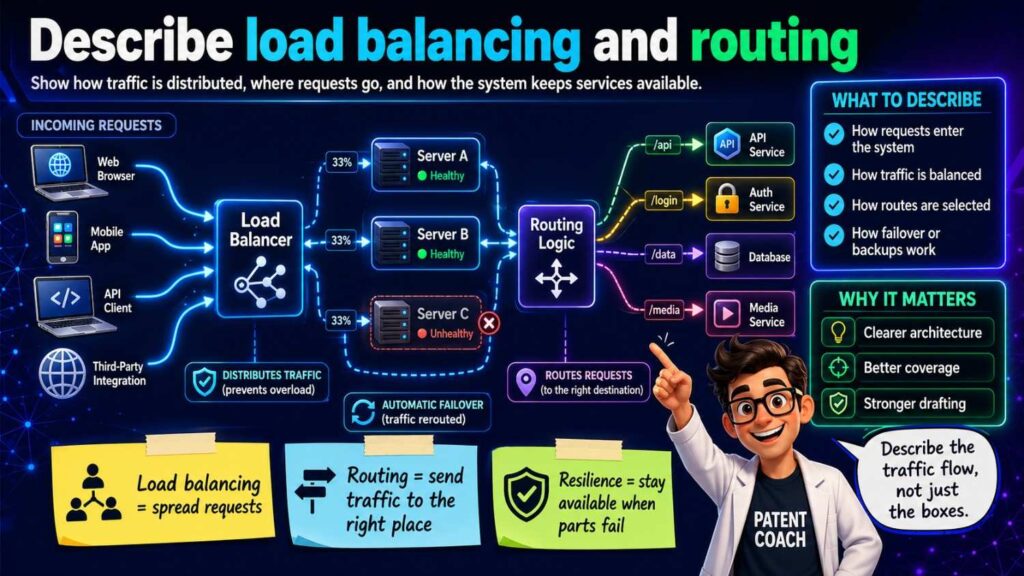
Routing can be central to some inventions.
A system may route requests based on geography, load, model type, data sensitivity, latency, cost, user tier, or service health.
For example:
“In some examples, the system may route a request to a processing service based on request type, data type, user role, location, service availability, latency, cost, privacy rule, or model version.”
This is useful.
If routing is a key invention feature, go deeper.
Explain routing conditions, routing tables, scoring, fallback, and updates.
If routing is just generic infrastructure, keep it short.
Describe multi-tenant architecture carefully
Many SaaS products are multi-tenant.
This means one system serves many customers or organizations.
If multi-tenancy matters, describe it.
For example:
“In some examples, the system may store data associated with multiple organizations. The system may associate each record with a tenant identifier and use the tenant identifier to control access, select configuration data, select a model, or route processing.”
This is strong.
It supports claims around tenant-specific processing, models, permissions, and configuration.
If each customer has different settings:
“In some examples, the system may apply tenant-specific thresholds, rules, models, output formats, or data retention settings.”
This can be valuable.
Describe single-tenant and customer-hosted options
Do not limit the invention to multi-tenant SaaS if it can also be single-tenant or customer-hosted.
For example:
“In some examples, the system may be implemented in a multi-tenant environment. In other examples, the system may be implemented in a single-tenant environment or customer-hosted environment.”
This supports enterprise deployment options.
It can matter for future sales and patent coverage.
Describe configuration management
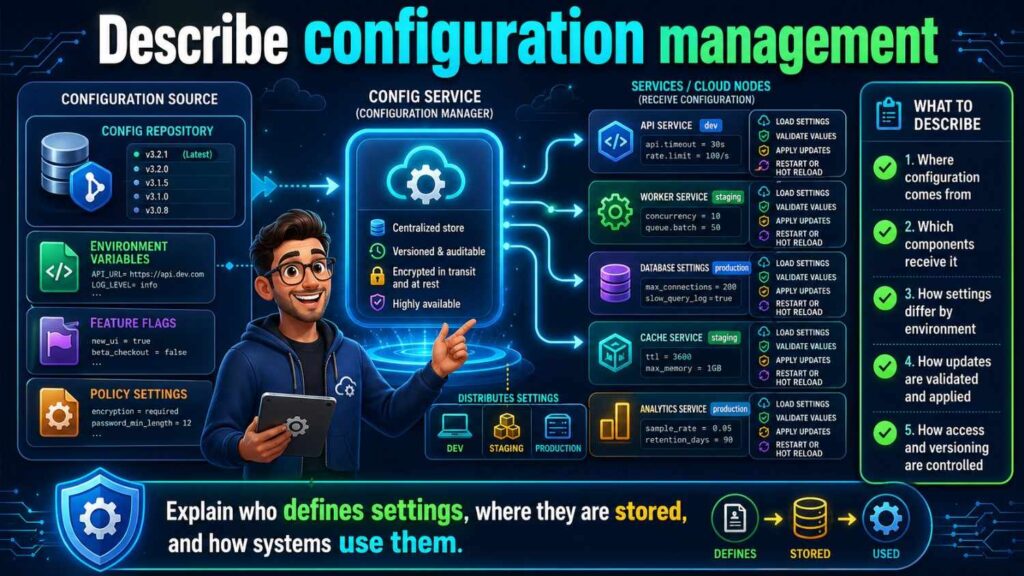
Cloud systems often rely on configuration.
Settings may control thresholds, models, data sources, permissions, routing, alert channels, or workflows.
If configuration affects the invention, describe it.
For example:
“The system may store configuration data associated with a user, device, organization, data source, model, or workflow.”
Then:
“The configuration data may specify a threshold, rule, model, output format, alert channel, processing location, permission, or other setting.”
Then:
“The system may use the configuration data to process input data or generate an output.”
This is useful for customizable systems.
Describe feature flags and rollout when relevant
Some systems roll out features, models, or rules gradually.
If that matters, describe it.
For example:
“In some examples, the system may enable or disable a processing feature based on a feature setting associated with a user, organization, device, or request.”
Another:
“In some examples, the system may apply a first model to a first group of requests and a second model to a second group of requests.”
This can support A/B testing, model rollout, and controlled deployment claims if relevant.
Describe third-party integrations by type
Cloud systems often integrate with other systems.
Do not rely only on vendor names.
For example:
“The system may receive data from an external system, such as a monitoring system, electronic record system, customer relationship system, source code repository, payment system, identity system, messaging system, storage system, or workflow system.”
Then:
“The system may send an output to an external system, such as a ticketing system, notification system, control system, reporting system, or automation system.”
This supports broad integration coverage.
If a named platform is important, it can be one example. But the broad type should usually come first.
Describe webhooks
Webhooks are common.
For example:
“In some examples, the system may send a webhook message to an external system when an output is generated, approved, rejected, updated, or otherwise changed.”
Then:
“The webhook message may include an output identifier, status, score, confidence value, suggested action, or other data.”
This supports event-based integrations.
It also helps show how your system connects to customer workflows.
Describe notifications
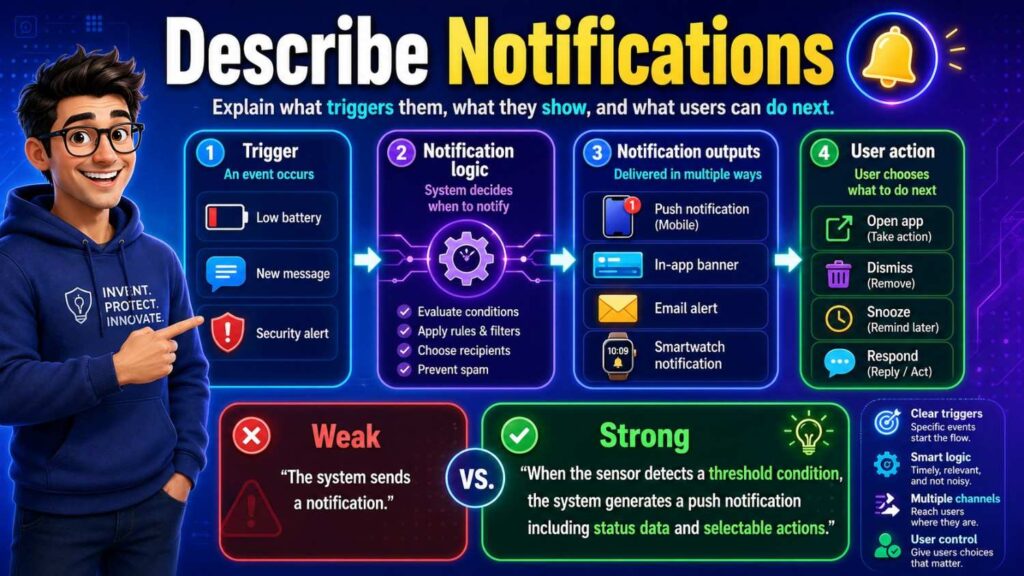
Notifications may be sent through many channels.
For example:
“The system may send a notification through a user interface, email, text message, push notification, messaging platform, webhook, API response, voice output, haptic output, or another notification channel.”
Then:
“The notification may be sent when a condition is detected, a threshold is satisfied, an output is generated, a review is required, or a workflow state changes.”
This avoids limiting the invention to one channel.
Describe control signals
Some cloud systems control devices.
A cloud or network architecture may send control signals to robots, machines, vehicles, medical devices, lab tools, IoT devices, or software systems.
If so, describe carefully.
For example:
“The system may generate a control output based on input data and send a control signal to a device based on the control output.”
Then:
“The control signal may cause the device to start, stop, change a setting, enter a safety mode, adjust a route, change power use, perform a test, or perform another operation.”
Then add safety if relevant:
“In some examples, the system may send the control signal only after a safety condition is satisfied or after user approval is received.”
This connects cloud architecture to real-world action.
Describe browser-based processing
Sometimes the browser does meaningful work.
It may preprocess data, encrypt data, render outputs, collect feedback, store local state, or call APIs.
If relevant, include it.
For example:
“In some examples, a browser-based client may perform one or more operations before sending data to a remote system.”
Then:
“The operations may include formatting data, filtering data, encrypting data, selecting a file, receiving user input, storing local state, or displaying an output.”
This supports web app architecture without tying everything to the server.
Describe mobile device processing
Mobile apps may collect sensor data, process data locally, store data offline, send data, receive outputs, and capture feedback.
For example:
“In some examples, a mobile device may collect input data using one or more sensors, process at least part of the input data locally, and send processed data or a result to a remote system.”
This is useful for mobile-heavy products.
Do not make mobile required if the invention can run elsewhere.
Describe IoT architecture
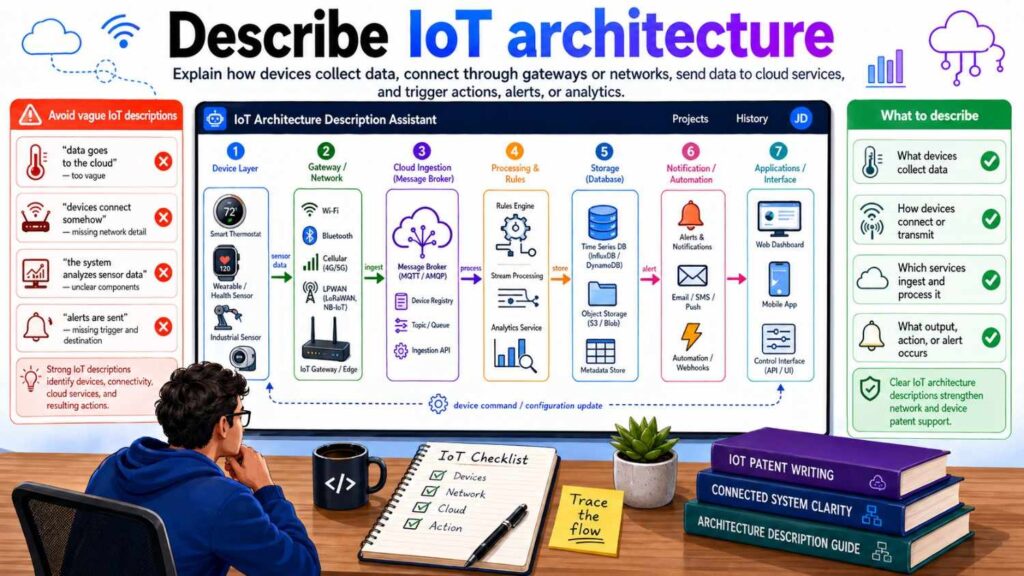
IoT systems often include devices, gateways, networks, cloud systems, dashboards, and control outputs.
A good spec may say:
“In some examples, one or more devices may collect sensor data and send the sensor data to a gateway or remote processing system.”
Then:
“The gateway may aggregate, filter, compress, encrypt, store, or route the sensor data.”
Then:
“The remote processing system may generate an output based on data from one or more devices.”
This supports device-cloud architecture.
If device commands are sent back:
“The remote processing system may send a control signal or configuration update to one or more devices based on the output.”
That completes the loop.
Describe gateways
Gateways often sit between devices and cloud systems.
If relevant:
“In some examples, a gateway device may receive data from multiple local devices and send the data or processed data to a remote system.”
Then:
“The gateway device may perform filtering, aggregation, format conversion, authentication, encryption, local storage, or local processing.”
This can support claims around edge gateways.
Describe data aggregation
Cloud systems often aggregate data across users, devices, sites, or time periods.
For example:
“In some examples, the system may aggregate data from multiple devices, users, sites, organizations, or time periods.”
Then:
“The aggregated data may be used to generate a global model, detect a trend, update a threshold, rank outputs, identify an anomaly, or generate a report.”
This can support claims around fleet learning, cross-site analytics, or aggregate risk detection.
If privacy matters, add:
“In some examples, the system may aggregate processed data or summary data instead of raw data.”
Describe multi-region or distributed systems
Some systems run across regions or distributed nodes.
If relevant:
“In some examples, the system may include multiple computing nodes located in different regions or environments.”
Then:
“The system may route requests, replicate data, synchronize state, or select a node based on latency, availability, policy, cost, or data location.”
This supports distributed architecture claims.
Again, include only if it matters.
Describe replication and backup
Replication may matter for reliability.
For example:
“In some examples, the system may replicate stored data across multiple storage locations. The replicated data may allow the system to continue operating when a storage location is unavailable.”
If backup or rollback matters:
“In some examples, the system may restore a prior version of data, configuration, model, or rule based on a stored backup or version record.”
These features can support resilience claims.
Describe data retention and deletion
Data retention can matter for privacy and enterprise products.
For example:
“In some examples, the system may store data according to a retention rule. The retention rule may specify a time period, data type, user, tenant, location, or event that controls when data is stored, deleted, anonymized, or archived.”
This supports compliance-related architecture features.
If retention is not central, keep it brief.
Describe data formats broadly
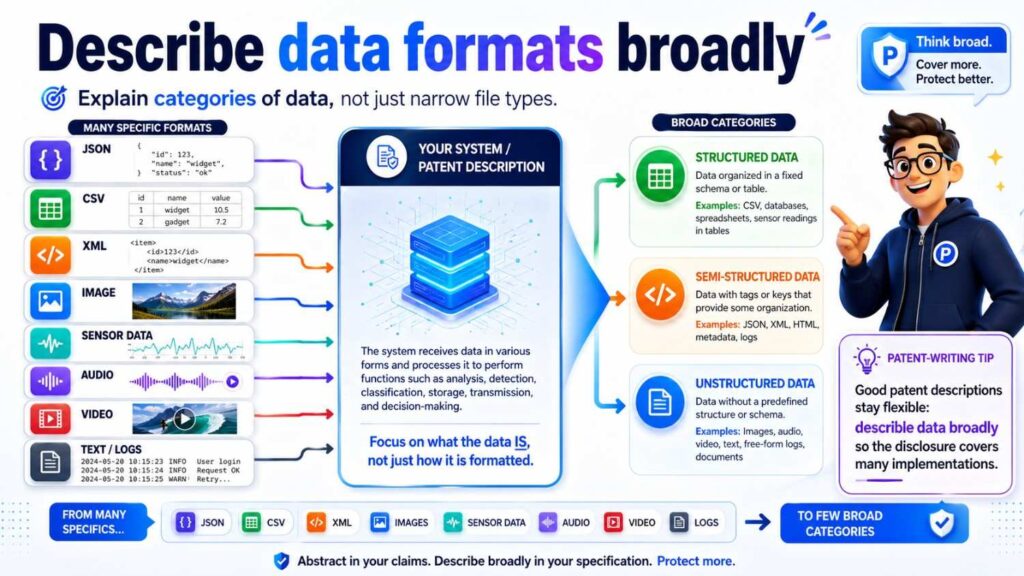
Cloud systems may exchange JSON, XML, binary data, images, audio, video, embeddings, records, events, or files.
Do not limit to one format unless needed.
For example:
“The input data may be received in one or more formats, including structured data, unstructured data, semi-structured data, file data, stream data, image data, audio data, text data, binary data, or another format.”
Then:
“The system may convert the input data from a first format to a second format before processing.”
This supports format conversion claims if relevant.
Describe schema mapping and normalization
If the system handles data from many sources, schema mapping may matter.
For example:
“In some examples, the system may map data from different source schemas to a common schema.”
Then:
“The common schema may allow the system to process data from multiple sources using a shared processing operation.”
This is useful for integration-heavy systems.
You can add:
“The mapping may be based on field names, data types, source identifiers, rules, learned mappings, or user-provided mappings.”
This adds support.
Describe data transformation
Data transformation is often central.
For example:
“The system may transform input data into processed data before generating the output.”
Then:
“The transformation may include filtering, normalizing, aggregating, compressing, encrypting, tokenizing, embedding, summarizing, extracting features, or converting a format.”
This supports many cloud pipelines.
Tie it to the invention where possible.
Describe embeddings and vector search
For AI products, embeddings may matter.
For example:
“In some examples, the system may generate an embedding from input data or context data. The embedding may represent semantic, visual, behavioral, or other information associated with the data.”
Then:
“The system may compare the embedding to stored embeddings to retrieve related records, rank results, detect similarity, or select context data.”
This is specific and useful.
If vector search is part of the architecture, describe where embeddings are stored and how they are used.
Describe training and inference separately
AI cloud systems often have training and inference paths.
Do not mix them unless they are connected.
For example:
“In some examples, a training system may train or update a model based on training data. An inference system may apply the trained model to new input data to generate an output.”
Then:
“The training system and inference system may be implemented by the same computing device, different computing devices, a cloud system, an edge device, or a combination of these.”
This gives flexibility.
If the model is only obtained and not trained by your system, say:
“The system may obtain a trained model by loading a stored model, receiving a model from another system, selecting a model from a set of models, or training the model.”
This avoids making training required.
Describe model update architecture
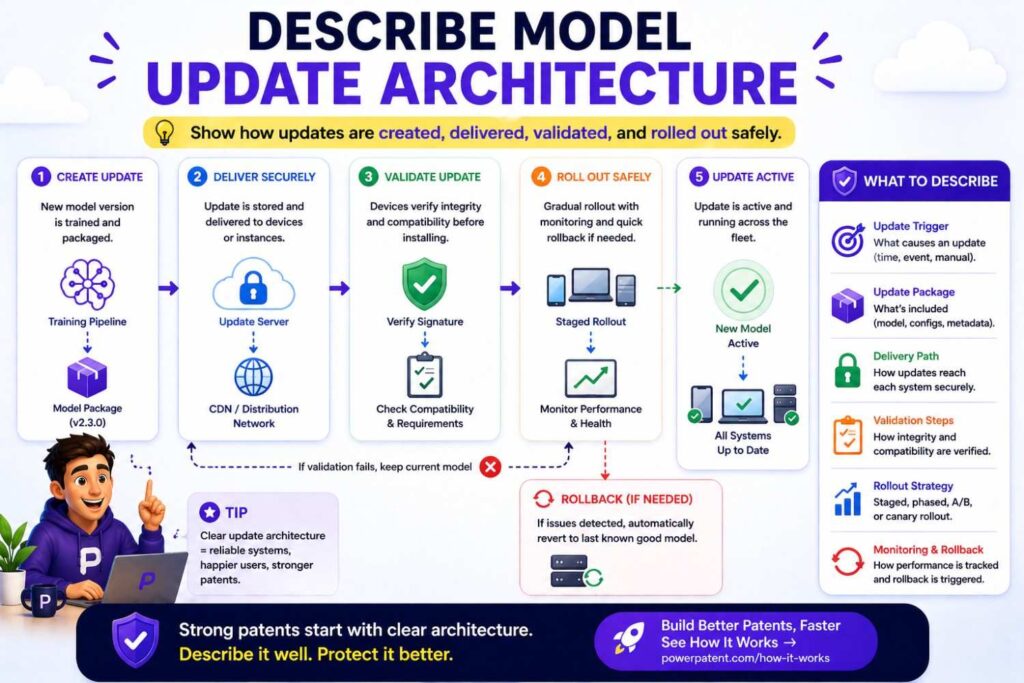
If the system updates models, describe how.
For example:
“In some examples, the system may store feedback data associated with model outputs. A model update service may use the feedback data to update a model, fine-tune a model, select a model, adjust a prompt, update a rule, or create a training record.”
Then:
“The updated model or rule may be deployed to a cloud service, edge device, local device, or customer-hosted system.”
This supports AI lifecycle claims.
It also reflects modern model operations.
Describe prompts and model inputs carefully
For generative AI products, prompt construction may be central.
A cloud architecture description may include a prompt generation service.
For example:
“In some examples, the system may generate a model input that includes a task instruction, selected context data, user input, system rule, output format instruction, or other information.”
Then:
“The model input may be provided to a model service to generate a model output.”
If prompts are stored or changed:
“In some examples, a prompt template may be selected based on task type, user role, organization setting, input data type, or model type.”
This supports prompt workflow claims.
Avoid locking the invention to one exact prompt unless the exact wording matters.
Describe output validation in cloud workflows
For AI, output validation can be vital.
For example:
“In some examples, after receiving a model output, the system may validate the model output before providing the model output to a user or downstream system.”
Then:
“The validation may include checking the output against source data, checking output format, applying a safety rule, comparing the output to a threshold, checking confidence, or routing the output for review.”
This supports safe AI architectures.
Describe human-in-the-loop architecture
A cloud system may route outputs to users for review.
For example:
“In some examples, the system may route selected outputs to a review interface.”
Then:
“An output may be selected for review based on confidence, risk, data quality, user request, review rule, random sampling, or another review condition.”
Then:
“The review result may be stored and used to update a record, model, rule, threshold, or workflow.”
This connects cloud processing, UI, and feedback.
It is a powerful pattern for patent specs.
Describe workflows and state machines
Many cloud products manage workflows.
A record may move through states like created, pending, reviewed, approved, rejected, escalated, completed, or failed.
If workflow state matters, describe it.
For example:
“The system may store a state associated with an output or task. The state may indicate whether the output is pending, reviewed, approved, rejected, escalated, completed, failed, or otherwise processed.”
Then:
“The state may be updated based on user input, system output, external system response, time, or another event.”
This supports workflow architecture claims.
Describe downstream actions
Cloud systems often trigger downstream actions.
For example:
“The system may cause a downstream action based on the output.”
Then:
“The downstream action may include sending a message, creating a task, updating a record, blocking a transaction, changing a device setting, initiating a test, routing a file, calling an API, or triggering another service.”
This is broad and useful.
It protects more than just displaying results.
For many startups, the value is the action, not just the insight.
Describe external system responses
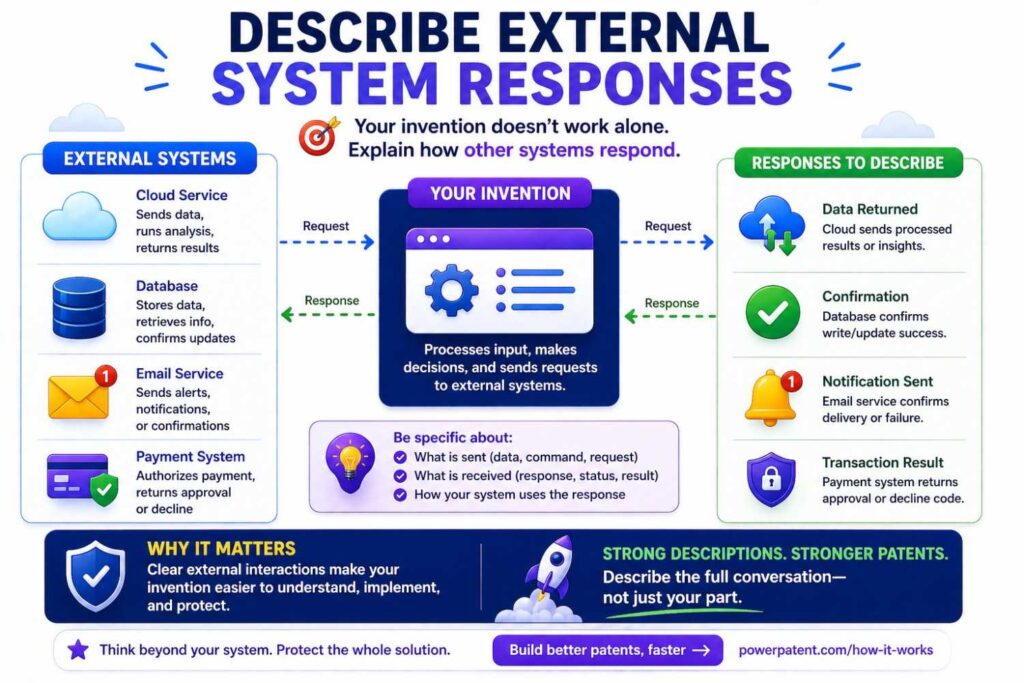
A downstream system may respond.
For example:
“In some examples, the system may receive a response from an external system after sending the output or action request. The response may indicate completion, failure, acceptance, rejection, status, or another result.”
Then:
“The system may update a record, notify a user, retry an action, or update future processing based on the response.”
This completes the architecture loop.
Describe monitoring and adaptive operation
Some cloud systems adapt based on metrics.
For example:
“The system may monitor latency, error rate, queue length, model performance, confidence values, request volume, network state, or cost.”
Then:
“The system may adjust processing behavior based on the monitored value.”
Adjustments may include routing requests, scaling services, selecting a model, changing a threshold, using a fallback service, or changing output timing.
This supports adaptive architecture.
Describe cost-aware processing
Some inventions reduce cloud cost.
If cost-aware routing or processing is part of the invention, describe it.
For example:
“In some examples, the system may select a processing operation based on an estimated compute cost.”
Then:
“The system may use a lower-cost model, cached result, batch process, edge process, or delayed process when the estimated cost satisfies a cost condition.”
This can be valuable for AI and cloud optimization inventions.
Describe latency-aware processing
If the invention improves speed, describe latency.
For example:
“In some examples, the system may select a processing path based on a latency condition.”
Then:
“The processing path may include local processing, edge processing, remote processing, cached output retrieval, model selection, or routing to a nearer processing node.”
This supports latency-focused claims.
Describe privacy-aware routing
Privacy-aware routing is important.
For example:
“In some examples, the system may select a processing path based on a privacy rule associated with input data.”
Then:
“The system may process sensitive data locally and send a processed result to a remote system.”
Or:
“The system may route data to a region or environment that satisfies a data handling rule.”
This is strong for regulated markets.
Describe hardware accelerators when relevant
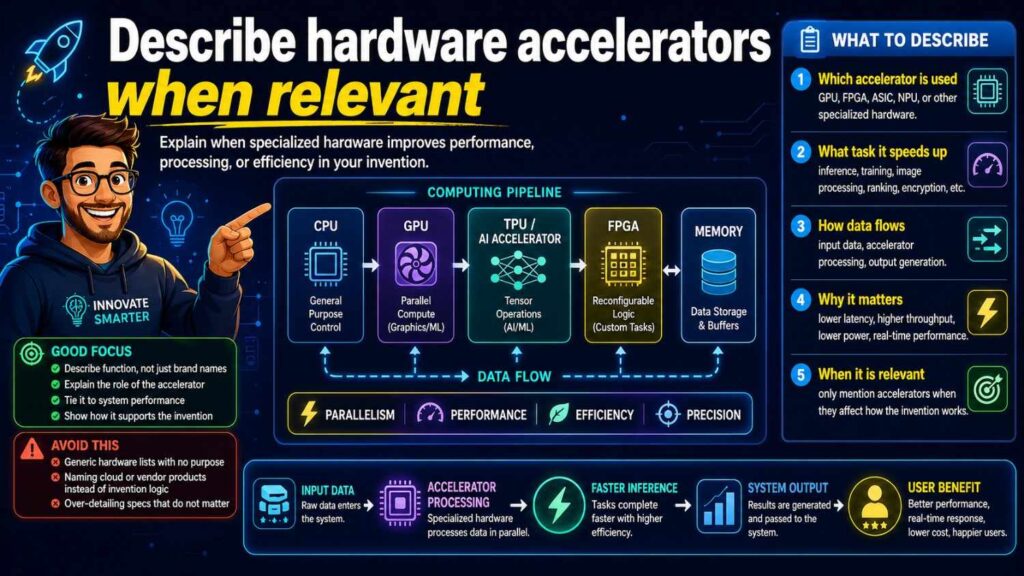
AI and cloud systems may use GPUs, TPUs, NPUs, FPGAs, or other accelerators.
If relevant:
“In some examples, one or more operations may be performed using a hardware accelerator.”
Then:
“The hardware accelerator may include a graphics processing unit, tensor processing unit, neural processing unit, field-programmable gate array, or another accelerator.”
If accelerator selection matters:
“The system may route a task to a computing resource with a selected hardware accelerator based on model type, data size, latency, cost, or availability.”
This supports compute routing claims.
Describe client-server relationships without locking roles
Sometimes a device is a client in one example and a server in another.
Use flexible language.
For example:
“Although device 102 is described as a client device in some examples, device 102 may perform one or more server-side operations in other examples.”
Or:
“A computing device may act as a client, server, peer, gateway, or combination thereof.”
This helps if architecture changes.
Describe peer-to-peer or mesh options when relevant
Not every network is client-server.
If devices communicate directly, describe it.
For example:
“In some examples, devices may communicate directly with each other through a peer-to-peer connection or mesh network.”
Then:
“The devices may share input data, processed data, configuration data, model data, or output data.”
This may matter for IoT, robotics, edge, vehicles, or distributed systems.
Describe network topology broadly
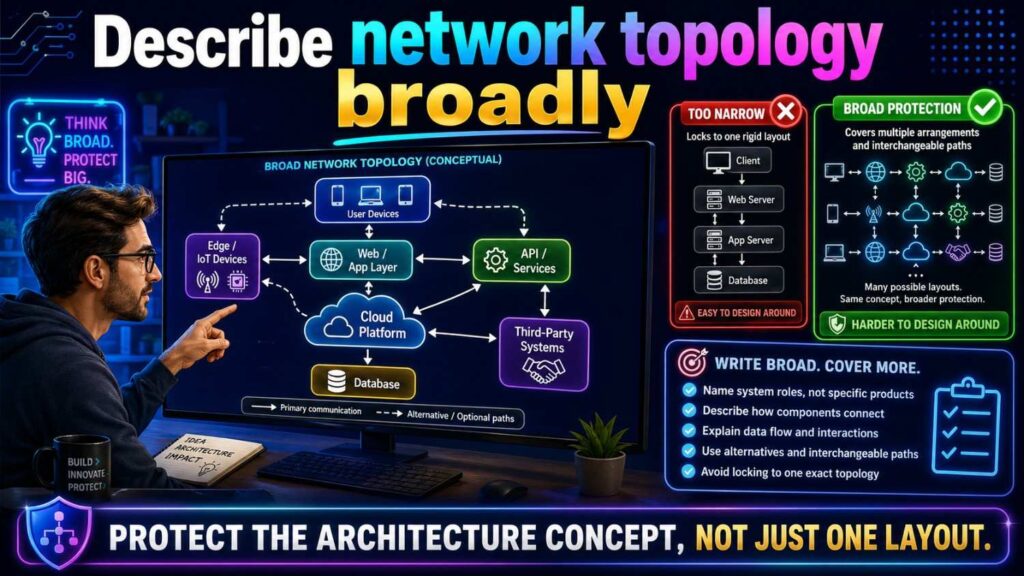
A diagram may show one topology.
But the system may support others.
For example:
“Although Figure 1 shows a client-server arrangement, other examples may use a peer-to-peer arrangement, mesh arrangement, hub-and-spoke arrangement, gateway arrangement, distributed arrangement, or hybrid arrangement.”
This keeps the architecture flexible.
Describe “cloud computing system” clearly
A cloud computing system can be abstract.
Give enough detail without narrowing.
For example:
“The cloud computing system may include one or more servers, storage systems, databases, networking resources, virtual machines, containers, serverless functions, managed services, or other computing resources.”
Then:
“The cloud computing system may perform one or more operations described herein, store data, provide an interface, train or apply a model, route requests, or communicate with external systems.”
This is broad and useful.
Describe “server” carefully
The word “server” can mean many things.
A patent spec can say:
“A server may include one or more computing devices configured to perform one or more operations.”
Then:
“A server may be implemented as a physical server, virtual server, container, serverless function, cloud service, edge server, on-premises server, or another computing resource.”
This avoids narrow physical interpretations.
Describe “service” carefully
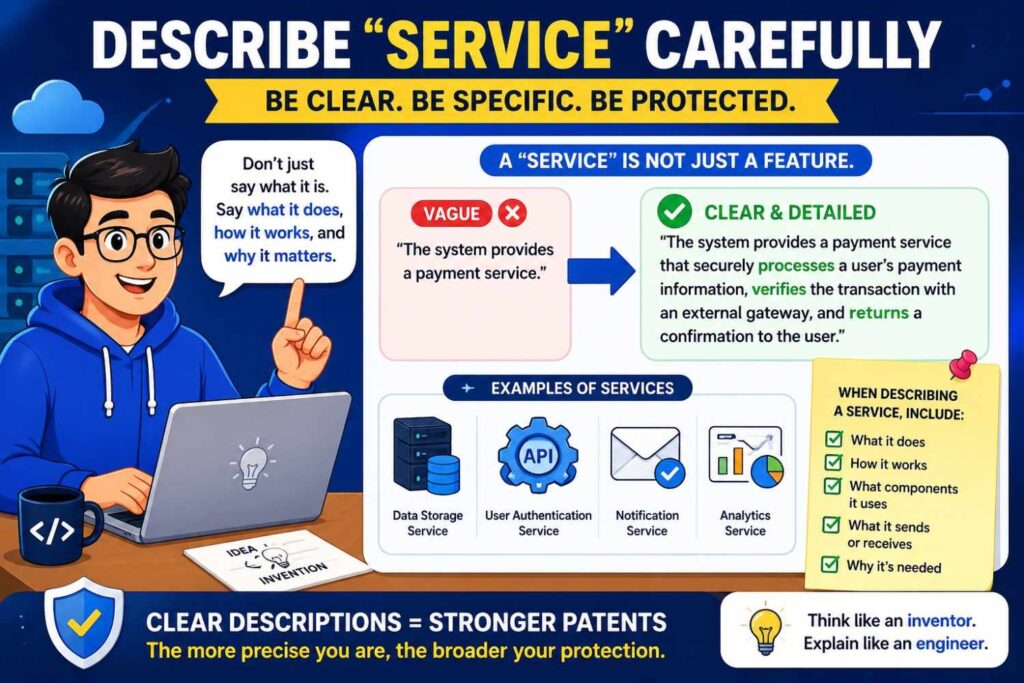
A service may be software, hardware, cloud-managed, third-party, internal, or distributed.
For example:
“A service may include software, hardware, or a combination thereof configured to perform one or more operations.”
Then:
“A service may be implemented as a standalone service, microservice, module, function, process, container, library, or part of another service.”
This gives room.
Describe modules as logical components
A patent diagram may show modules.
Make clear they are logical unless physical separation matters.
For example:
“The modules shown in Figure 1 are logical examples. In other examples, two or more modules may be combined, or a module may be divided into multiple modules.”
This prevents architecture diagrams from becoming rigid.
Describe third-party services without giving away scope
If the system uses a third-party service, decide whether it is part of the invention or just a tool.
For example, if your system sends data to a third-party payment processor, that may be an external system.
“The system may communicate with an external payment system.”
If your invention depends on how you choose between third-party model providers, describe that routing.
“The system may select a model provider based on task type, latency, cost, privacy rule, availability, or output quality.”
Do not let a third-party service become the whole invention unless that is intended.
Describe data ownership and tenant boundaries when relevant
Enterprise architecture often separates customer data.
For example:
“In some examples, the system may associate data with a tenant identifier. The tenant identifier may be used to control access, select configuration data, route processing, apply data retention rules, or store data in a tenant-specific data store.”
This is useful for SaaS patents.
It supports data isolation and tenant-specific behavior.
Describe customer configuration
Customer-specific settings can be important.
For example:
“In some examples, an organization may configure data sources, thresholds, models, workflows, alert channels, user roles, or output formats.”
Then:
“The system may apply the organization-specific configuration when processing data associated with the organization.”
This supports enterprise customization claims.
Describe deployment updates
Cloud systems evolve through updates.
If update delivery matters, describe it.
For example:
“In some examples, the system may send a software update, model update, rule update, or configuration update to a local device or edge device.”
Then:
“The local device may apply the update immediately, at a scheduled time, after user approval, or after a safety condition is satisfied.”
This can support claims around safe deployment.
Describe rollback
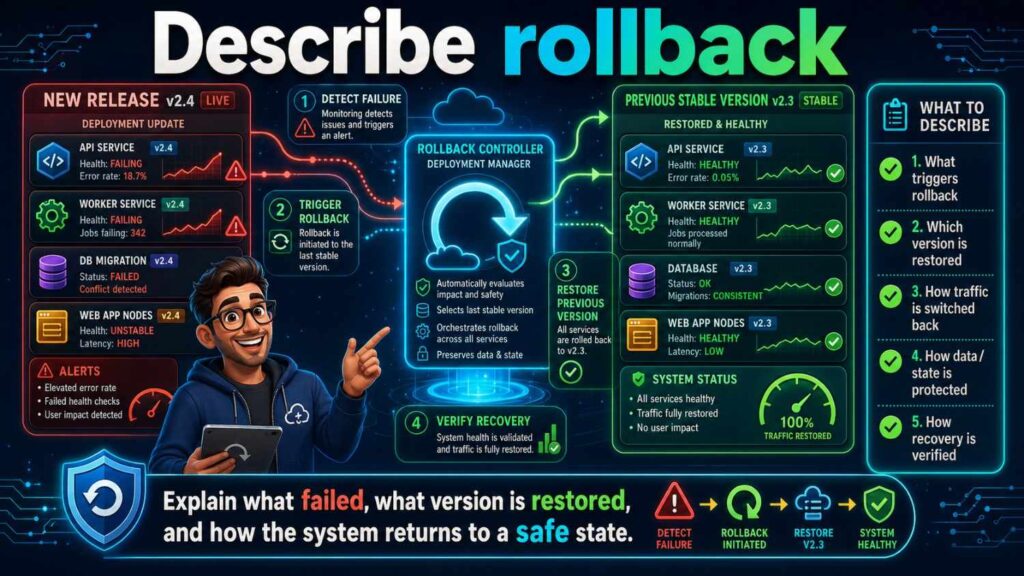
Rollback can matter for reliability.
For example:
“In some examples, the system may roll back from a first model, rule, configuration, or software version to a prior version based on an error, performance value, user input, or other rollback condition.”
This is useful for AI and cloud operations.
Describe blue-green or staged deployment only if relevant
If your invention involves staged deployment, include it.
For example:
“In some examples, the system may deploy an updated model or rule to a first group of users, devices, or requests before deploying the updated model or rule to a second group.”
Then:
“The system may compare outputs or performance values associated with the first group before broader deployment.”
This can support model rollout claims.
Describe data pipelines end to end
A cloud architecture often includes a pipeline.
For example:
“The system may receive input data, validate the input data, transform the input data, store the transformed data, process the transformed data, generate an output, store the output, and provide the output to a user or external system.”
This is a good high-level pipeline.
Then add optional variations.
“One or more of these operations may be omitted, repeated, performed in another order, or performed by different computing devices.”
This gives flexibility.
Describe validation of input data
Input validation can matter.
For example:
“In some examples, the system may validate input data before processing. Validation may include checking a format, checking required fields, checking a source, checking a signature, detecting duplicate data, checking a permission, or identifying missing data.”
Then:
“If validation fails, the system may reject the input data, request corrected data, route the input data for review, or process the input data using a fallback process.”
This is strong.
Describe output formats
Outputs may be many things.
For example:
“The output may include a score, label, classification, prediction, alert, message, report, task, ticket, recommendation, control signal, generated text, extracted value, ranked list, explanation, or other result.”
Then:
“The output may be provided in a structured format, unstructured format, file, event, API response, user interface element, message, or database record.”
This supports many product forms.
Describe time and scheduling
Cloud systems may run on time-based schedules.
For example:
“In some examples, processing may occur in response to a request, in response to an event, according to a schedule, after a time period, after a number of records, or when a condition is satisfied.”
This avoids locking timing.
Describe triggers
Triggers are central to many cloud workflows.
For example:
“A processing operation may be triggered by receipt of input data, a user request, a scheduled time, a change in stored data, an event from an external system, a threshold condition, a model output, or a review result.”
This supports event-driven architecture.
Describe “real-time” carefully
Do not say real-time if you do not mean it.
Use flexible timing language.
For example:
“The system may process input data in real time, near real time, batch mode, scheduled mode, or on request.”
If real-time matters, explain why.
“In some examples, real-time processing may allow the system to generate a control signal before a condition worsens.”
This ties timing to technical value.
Describe diagrams with flexible language
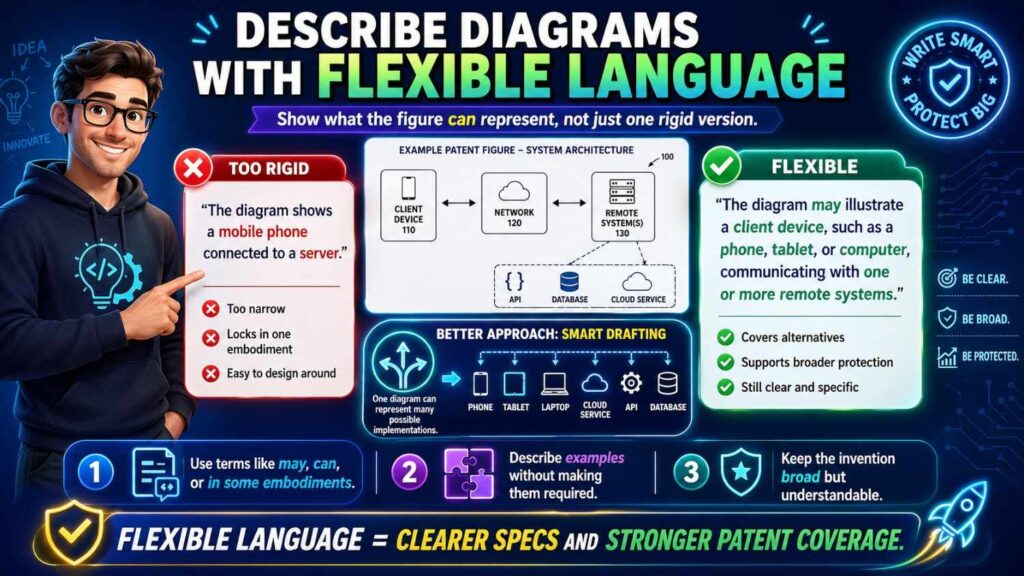
For cloud architecture figures, use captions like:
“Figure 1 illustrates an example network environment for processing input data.”
“Figure 2 illustrates an example cloud architecture for generating an output.”
“Figure 3 illustrates an example data flow between a client device, processing system, and external system.”
“Figure 4 illustrates an example edge-cloud processing arrangement.”
Then in the text:
“Other examples may include more, fewer, or different components.”
“Components may be combined or divided.”
“Operations may be performed by different components than shown.”
This keeps diagrams from becoming limits.
Do not make every box required
Architecture diagrams often show many boxes.
A patent spec should not imply that every box is required.
For example:
“Although Figure 1 shows a data store, queue, model service, user interface, and external system, one or more of these components may be omitted in some examples. Other examples may include additional or different components.”
This is useful.
If a box is optional, say so.
“In some examples, the queue may be omitted, and requests may be processed synchronously.”
“In some examples, the user interface may be omitted, and outputs may be provided through an API.”
“In some examples, the remote server may be omitted, and processing may be performed locally.”
This keeps scope flexible.
Describe “may be omitted” when useful
This phrase is valuable.
Use it when a figure shows something that is not required.
For example:
“The remote server may be omitted in examples where the local device performs the processing.”
“The user interface may be omitted in examples where the output is sent to another system.”
“The data store may be omitted in examples where outputs are not stored.”
This helps avoid accidental limits.
Describe “combined or separated” for services
Services can be split or combined.
For example:
“Although the processing service and model service are shown separately, they may be combined in some examples. In other examples, the processing service may be divided into multiple services.”
This is very useful for cloud systems.
Your architecture may change from monolith to microservices or back. The patent should allow that.
Describe “same or different devices”
This phrase is useful.
For example:
“The data collection operation, processing operation, and output operation may be performed by the same computing device or by different computing devices.”
This prevents rigid assumptions.
It supports many deployment forms.
Describe architecture without overloading the reader
Cloud specs can get too complex.
Do not dump every infrastructure detail into one paragraph.
Group related ideas.
First, describe the system overview.
Then data intake.
Then processing.
Then storage.
Then outputs.
Then optional services.
Then deployment variants.
Then security and privacy.
Then fallback behavior.
This makes the spec readable.
A patent spec can be detailed without being messy.
Use simple terms before technical terms
When possible, explain in plain words.
For example:
“The queue may store tasks until a worker is ready to process them.”
That is clear.
Then you can add technical detail:
“The queue may be implemented as a message queue, event stream, task queue, or publish-subscribe system.”
This helps both technical and non-technical readers.
Avoid internal jargon
Internal engineering terms may confuse patent readers.
If your team calls something “the brain,” “the pipe,” “the broker,” “the hub,” or “the oracle,” translate it into functional language.
“The brain” may be a processing system.
“The pipe” may be a data pipeline.
“The broker” may be a message broker.
“The hub” may be a gateway.
“The oracle” may be an external data source.
Use names that describe function.
Avoid brand-heavy architecture descriptions
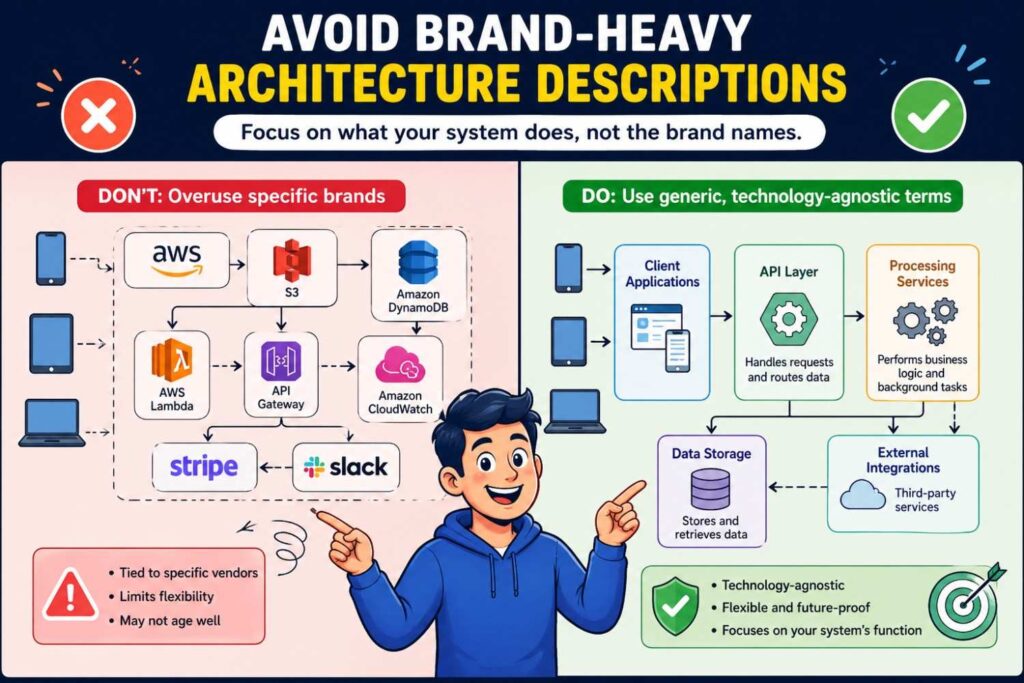
Do not write the patent like a cloud bill.
A spec full of vendor names may age badly and narrow the filing.
Instead of:
“Our system uses AWS API Gateway, Lambda, SQS, S3, DynamoDB, CloudWatch, and SageMaker.”
Write:
“In one example, the system may include an API gateway, serverless processing function, message queue, object storage system, data store, monitoring service, and model service.”
This is broader.
If a vendor service is unique to the invention, handle it carefully with attorney guidance.
Avoid making microservices required
Microservices are a common architecture style, but they may not be required.
A product may start as a monolith and later split into services, or the reverse.
Use flexible language.
For example:
“The operations may be performed by a single service or by multiple services.”
Then:
“In some examples, the multiple services may include an intake service, processing service, model service, storage service, output service, and feedback service.”
This supports both styles.
Avoid assuming the user device is passive
Some specs treat the user device only as a display.
But the user device may do more.
It may collect input, preprocess data, run a local model, store data, encrypt data, receive feedback, or control a device.
If relevant, describe it.
For example:
“The client device may collect input data, display an output, receive user input, store local data, perform local processing, or communicate with a remote system.”
This gives flexibility.
Avoid assuming the server does everything
The opposite mistake is putting every operation on the server.
If some operations can happen elsewhere, say so.
For example:
“Although certain operations are described as being performed by a server, the operations may be performed by a client device, edge device, local device, cloud system, or a combination of these.”
This is valuable.
Describe cloud architecture in relation to claims
A cloud architecture description should support the patent claims.
If the claims may cover model routing, the architecture should describe model services and selection.
If the claims may cover edge processing, the architecture should describe edge devices and cloud-edge split.
If the claims may cover feedback loops, the architecture should describe feedback flow and storage.
If the claims may cover privacy, the architecture should describe local processing, masking, and data routing.
If the claims may cover workflow automation, the architecture should describe downstream systems and actions.
Do not include architecture detail only because it sounds technical. Include detail that supports possible claim paths.
Describe future continuations
A strong first filing can support future continuation applications.
Cloud architecture descriptions can help.
For example, your first claims may focus on generating an output. Later, you may want continuation claims around edge processing, model routing, feedback updates, API workflows, privacy routing, or fallback modes.
Those later claims need support in the original spec.
So describe architecture variants early.
Not every variant needs to be claimed on day one. But important variants should be disclosed if they are part of the invention family.
PowerPatent helps founders capture those future paths before filing, so the first spec is not just a snapshot of today’s cloud stack. Learn more here: https://powerpatent.com/how-it-works
Explain why architecture choices matter
A strong spec explains why a network or cloud feature exists.
Do not just say:
“The system includes an edge device.”
Say:
“In some examples, the edge device may process data near the data source to reduce latency, reduce network use, allow offline operation, or reduce transfer of sensitive data.”
Do not just say:
“The system includes a queue.”
Say:
“In some examples, the queue may allow the system to process tasks asynchronously, retry failed tasks, or smooth changes in request volume.”
Do not just say:
“The system includes a cache.”
Say:
“In some examples, the cache may reduce repeated processing or allow access to recent outputs when a remote system is unavailable.”
The “why” helps the patent feel stronger and more grounded.
Describe examples, not limits
Use example language throughout.
“In some examples…”
“In one implementation…”
“In certain cases…”
“As one example…”
“Other examples may…”
These phrases help show that the architecture can vary.
Avoid absolute language unless required.
Do not say:
“The system always sends data to the cloud.”
Say:
“In some examples, the system may send data to a cloud computing system.”
Do not say:
“The output must be returned to the dashboard.”
Say:
“The output may be provided through a user interface, API, message, report, control signal, or other output channel.”
This matters.
Small words shape scope.
Describe networks and cloud systems in figures
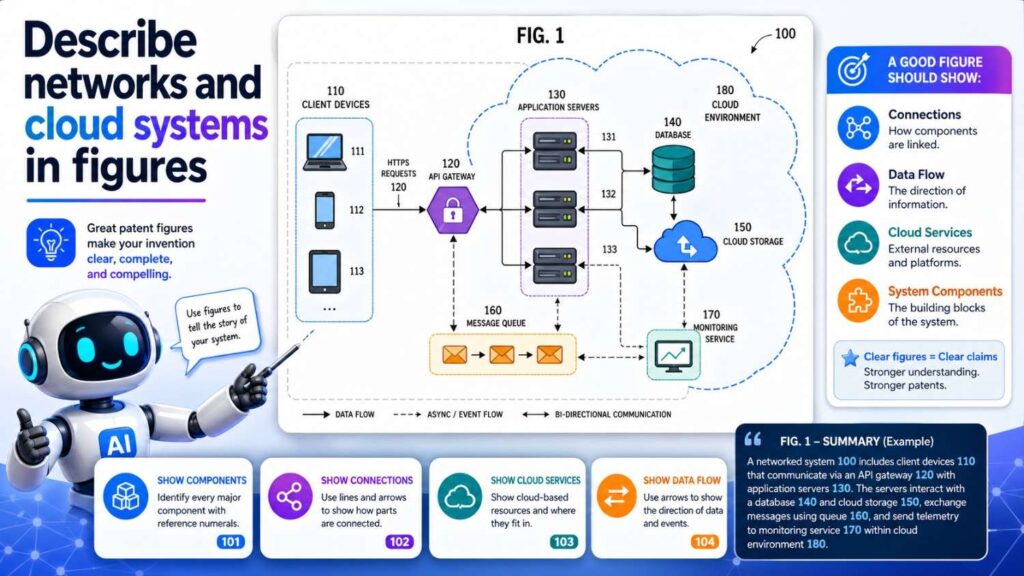
A good architecture figure may show:
client devices
network
cloud computing system
processing service
data store
model service
queue
external system
edge device
user interface
feedback path
But the text should explain that this is one example.
For example:
“Figure 1 illustrates an example network environment 100. Network environment 100 may include one or more client devices 102, one or more networks 104, and a cloud computing system 106. The cloud computing system 106 may include one or more processing services 108, data stores 110, and output services 112. Other examples may include more, fewer, or different components.”
This is clear and flexible.
Example: weak cloud architecture description
Here is a weak version:
“The invention runs on AWS. A mobile app sends JSON to API Gateway. Lambda processes the JSON, stores it in DynamoDB, calls SageMaker, saves the result to S3, and shows it on a React dashboard.”
This may be true for the current product. But it is too narrow for many patent specs.
It ties the invention to AWS, a mobile app, JSON, API Gateway, Lambda, DynamoDB, SageMaker, S3, and React.
A competitor could copy the core idea using another stack.
Your own company may also change the stack.
Example: stronger cloud architecture description
A stronger version might say:
“In some examples, a client device may send input data to a processing system through one or more networks. The processing system may include one or more cloud-based or local computing resources configured to process the input data and generate an output. The processing system may store at least part of the input data, processed data, or output data in one or more data stores. In some examples, the processing system may apply a model service to generate a score, label, prediction, recommendation, or other output. The output may be provided to the client device, a user interface, an external system, an API endpoint, a workflow system, or another destination.”
This version protects the architecture pattern.
Then you can add the current stack as one example if useful:
“In one example, the processing system may be implemented using serverless functions, managed storage services, and a cloud-hosted model service.”
Now the spec is broader and safer.
Example: describing an API-first system
A strong API description may say:
“In some examples, the system may receive an API request from an external system. The API request may include input data, an identifier, a task type, a user credential, configuration data, or another request parameter. In response to the API request, the system may process the input data and return an API response. The API response may include an output, confidence value, status, explanation, suggested action, task identifier, or other response data.”
Then add:
“In some examples, the API response may cause the external system to update a record, display a result, create a task, block an action, or perform another operation.”
This supports API-based product paths.
Example: describing edge-cloud processing
A strong edge-cloud description may say:
“In some examples, an edge device may receive sensor data from one or more sensors. The edge device may preprocess the sensor data to generate processed data. The processed data may include a summary, feature value, score, event, alert, or compressed data. The edge device may send the processed data to a cloud computing system. The cloud computing system may aggregate processed data from multiple edge devices, generate an output, update a model, or provide a user interface.”
This supports distributed architecture.
Then add:
“In some examples, the edge device may use a local model when a network connection is unavailable.”
Now you have fallback support too.
Example: describing a model routing system
A model routing architecture may say:
“In some examples, a routing service may select one or more models from a set of available models. The routing service may select the model based on input type, task type, user setting, organization setting, latency, cost, privacy rule, model availability, confidence value, or other factor. The selected model may generate a model output based on the input data. The system may validate the model output and provide a validated output to a user or external system.”
This is strong for AI startups.
It supports claims around routing, model selection, validation, and output.
Example: describing privacy-preserving cloud architecture
A privacy-focused description may say:
“In some examples, a local device may receive sensitive input data and generate processed data based on the sensitive input data. The processed data may include a summary, score, feature value, embedding, or other representation. The local device may send the processed data to a remote system without sending at least part of the sensitive input data. The remote system may generate an output based on the processed data.”
This supports privacy-preserving designs.
Then:
“In some examples, the local device may mask, tokenize, encrypt, or remove sensitive fields before sending data to the remote system.”
Now the privacy architecture is clear.
Example: describing queue-based processing
A queue-based description may say:
“In some examples, the system may receive a processing request and create a task associated with the processing request. The system may place the task in a queue. One or more worker services may retrieve the task from the queue and perform one or more processing operations. After processing, the system may store an output and send a notification that the output is available.”
This supports asynchronous processing.
Then:
“In some examples, if processing fails, the task may be retried, moved to a different queue, routed to a fallback service, or marked for review.”
That adds resilience.
Example: describing multi-tenant SaaS
A multi-tenant description may say:
“In some examples, the system may process data associated with multiple organizations. Each data record may be associated with a tenant identifier. The system may use the tenant identifier to control access to data, select organization-specific configuration data, select a model or rule, apply a data retention setting, or route processing. In some examples, data associated with different tenant identifiers may be stored in separate data stores or logically separated within a shared data store.”
This is strong for SaaS.
It supports enterprise claims and security architecture.
Example: describing downstream workflow automation
A workflow architecture may say:
“In some examples, the system may generate an output and determine a downstream action based on the output. The downstream action may include creating a task, sending a message, updating a record, calling an API, changing a device setting, blocking a transaction, or routing a file. The system may send an action request to an external workflow system and receive a response indicating a status of the downstream action.”
This protects the action path, not just the output.
For many startups, that is where value lives.
The founder’s role in cloud architecture drafting
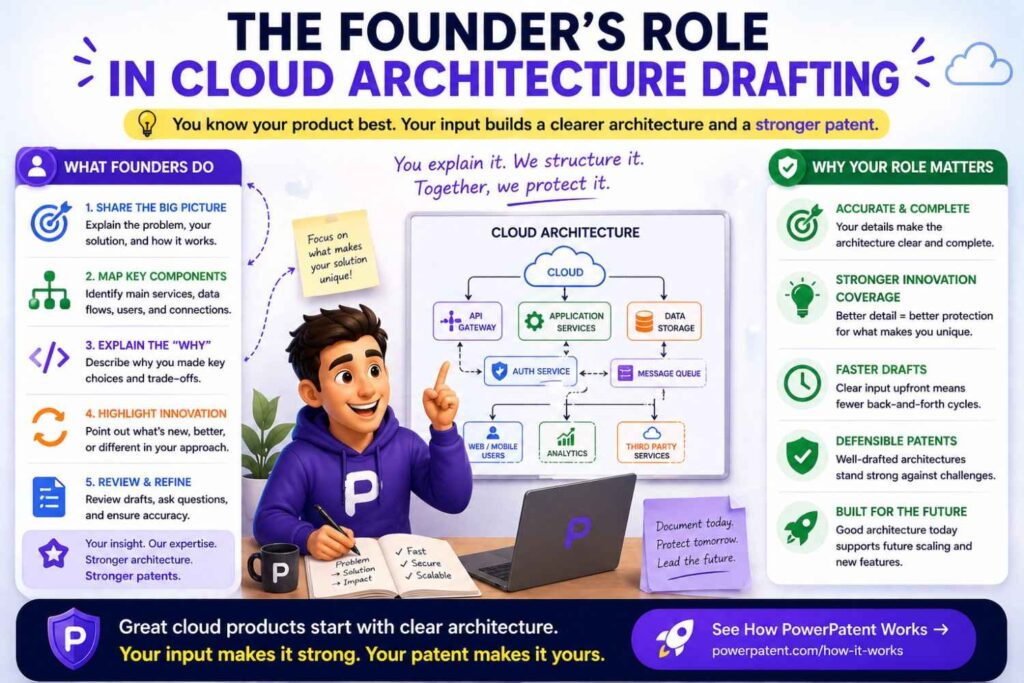
Founders do not need to write patent claims.
But founders should help explain what parts of the architecture are core and what parts are just current build choices.
Tell your patent team things like:
“We use AWS now, but the method could run on any cloud.”
“The dashboard is not required. The output can go through an API.”
“The edge device is important because we cannot send raw data to the cloud.”
“The queue is important because processing can take several minutes.”
“The model routing is the key feature.”
“The database may change. The important part is storing feedback with model version data.”
These notes help the patent team avoid narrow drafting.
The engineer’s role
Engineers know the architecture truth.
They know which parts can move.
They know which parts are required.
They know which services are replaceable.
They know what happens when systems fail.
They know whether processing can run locally.
They know whether the model is trained, fine-tuned, selected, or just called.
They know whether feedback updates the model or only creates a record.
That information is crucial.
A patent spec should not be written from a pitch deck alone. It should be grounded in real architecture knowledge.
PowerPatent helps capture that knowledge without forcing engineers into endless legal back-and-forth. See how it works here: https://powerpatent.com/how-it-works
What to give your patent team
Send more than a cloud diagram.
A diagram is useful, but it may not explain what is optional, what is core, or what may change.
Provide notes on:
What each component does.
What data flows between components.
What can run locally.
What can run in the cloud.
What can run on edge.
What data is stored.
What outputs are generated.
What external systems are involved.
What happens when a service fails.
What security or privacy rules apply.
What may change in the future.
These details help create a stronger spec.
How to describe current stack without narrowing the patent
You can include current stack details if they help.
But place them as examples.
For example:
“In one example, the processing system may be implemented using a serverless function, object storage system, managed database, and cloud-hosted model service.”
That is safer than naming exact services in the main description.
If you name a provider or product, make clear it is one example and not required.
“In one non-limiting example…”
This phrase can help, but do not rely on it alone. The whole description should be structured broadly.
The “could we move this?” test
For each architecture component, ask:
Could this move?
Could this run on a different server?
Could this run on the client?
Could this run at the edge?
Could this be handled by a third-party service?
Could this be replaced by a queue?
Could this be replaced by an API?
Could this be combined with another service?
If yes, describe that flexibility.
This helps future-proof the patent.
The “could a competitor swap this?” test
Ask how a competitor might design around the patent.
Could they use Azure instead of AWS?
Could they use PostgreSQL instead of DynamoDB?
Could they use batch instead of streaming?
Could they use edge instead of cloud?
Could they use API output instead of dashboard output?
Could they use another model provider?
Could they use a queue instead of direct calls?
If those swaps should still be covered, the spec should support them.
The “what is actually new?” test
Architecture specs can become too infrastructure-heavy.
Ask what is actually new.
Is it the way data is routed?
The way model selection happens?
The way edge and cloud split work?
The way sensitive data is handled?
The way feedback updates a model?
The way outputs trigger actions?
The way failures are handled?
The way tenant-specific settings are applied?
Focus on those parts.
Do not spend pages on generic cloud plumbing if it does not support the invention.
The “what happens if the network fails?” test
For networked systems, always ask this.
Does the device store data locally?
Does the system retry?
Does it use a fallback service?
Does it lower confidence?
Does it queue tasks?
Does it notify a user?
Does it switch to local processing?
If failure handling matters, describe it.
Fallback behavior often becomes valuable claim support.
The “future deployment” test
Ask where the product may run in the future.
Cloud only?
Customer cloud?
On-prem?
Edge?
Mobile?
Browser?
Embedded?
Hybrid?
Multi-region?
Air-gapped environment?
If future deployments are likely, include support.
Do not file a cloud-only spec if your roadmap includes on-prem or edge.
The “future continuation” test
Ask what future patent claims you may want.
API workflow claims?
Edge processing claims?
Privacy routing claims?
Model routing claims?
Queue-based processing claims?
Feedback update claims?
Tenant-specific model claims?
Fallback service claims?
If those are likely, describe them in the first spec.
A continuation can only use what the first spec supports.
Keep the patent readable
Cloud architecture can be complex.
But the spec should still be readable.
Use simple words.
Use clear component names.
Use short paragraphs.
Move from broad to detailed.
Explain why each part matters.
Avoid long chains of cloud buzzwords.
A strong patent spec should be understandable to the founder, engineer, attorney, examiner, and future investor.
Simple does not mean shallow.
Simple means clear.
How PowerPatent helps with cloud architecture patents
Cloud and network inventions can be hard to explain.
Founders have product goals.
Engineers have architecture diagrams.
Attorneys need claim support.
PowerPatent helps connect those pieces.
The platform helps capture system components, data flows, deployment options, APIs, model services, edge devices, privacy features, feedback loops, and future variants. Then real patent attorneys help turn that into a strong filing.
That means you can move fast without filing a patent that only covers today’s stack.
See how PowerPatent works here: https://powerpatent.com/how-it-works
Final thoughts
Network and cloud architecture descriptions can make or break a software patent spec.
A strong description explains how data moves, where processing happens, what components do, how outputs are generated, how systems communicate, how failures are handled, and how the architecture can vary.
It should protect the invention across cloud, local, edge, on-prem, hybrid, API-first, and future deployment forms when those forms fit the invention.
It should avoid locking the patent to one cloud vendor, one database, one protocol, one service layout, one UI, or one data path unless that detail is truly required.
The best patent specs describe architecture by function.
They explain roles, flows, triggers, outputs, storage, security, privacy, feedback, scaling, and fallback behavior.
They give examples without creating traps.
They support today’s product and tomorrow’s roadmap.
For startups, that matters. Your architecture will change. Your patent should protect the invention behind it.
If you are building a cloud platform, AI system, edge device, API product, SaaS workflow, or networked technical system, PowerPatent can help you turn your architecture into a stronger patent filing.
Learn how it works here: https://powerpatent.com/how-it-works