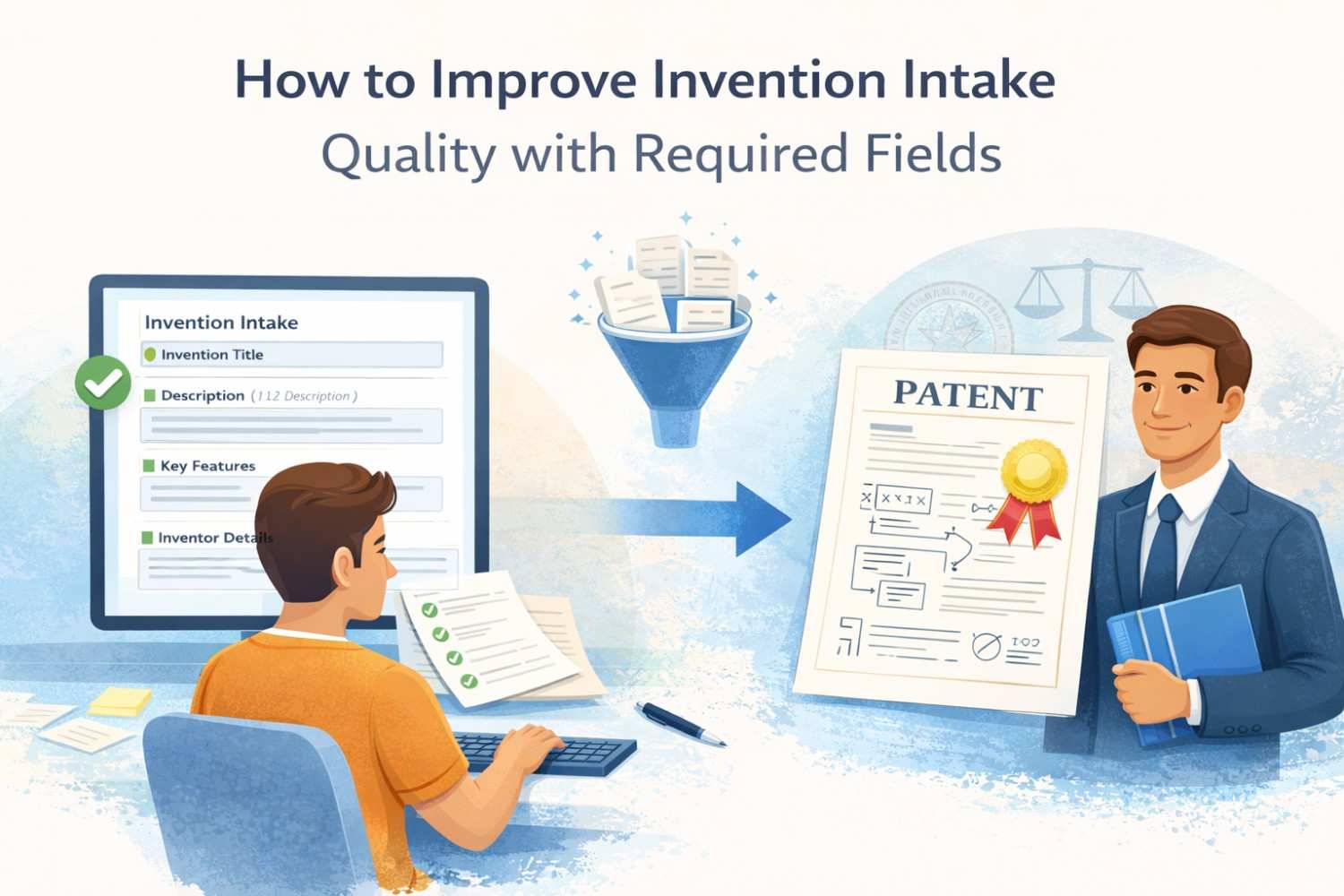
Every great patent starts with one simple thing: clean, complete invention details. If the first intake form is messy, vague, or missing key facts, everything that follows gets harder, slower, and more expensive. If the intake is strong, the patent becomes stronger. In this guide, you’ll learn exactly how to improve invention intake quality using required fields, so your team captures the right information from day one and avoids painful back-and-forth later.
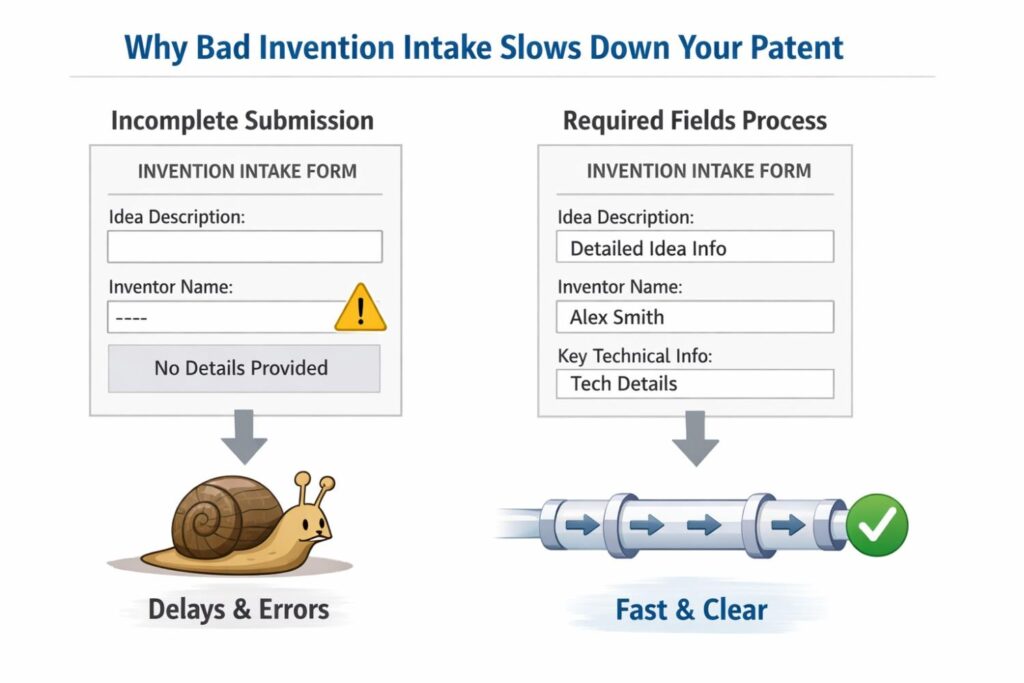
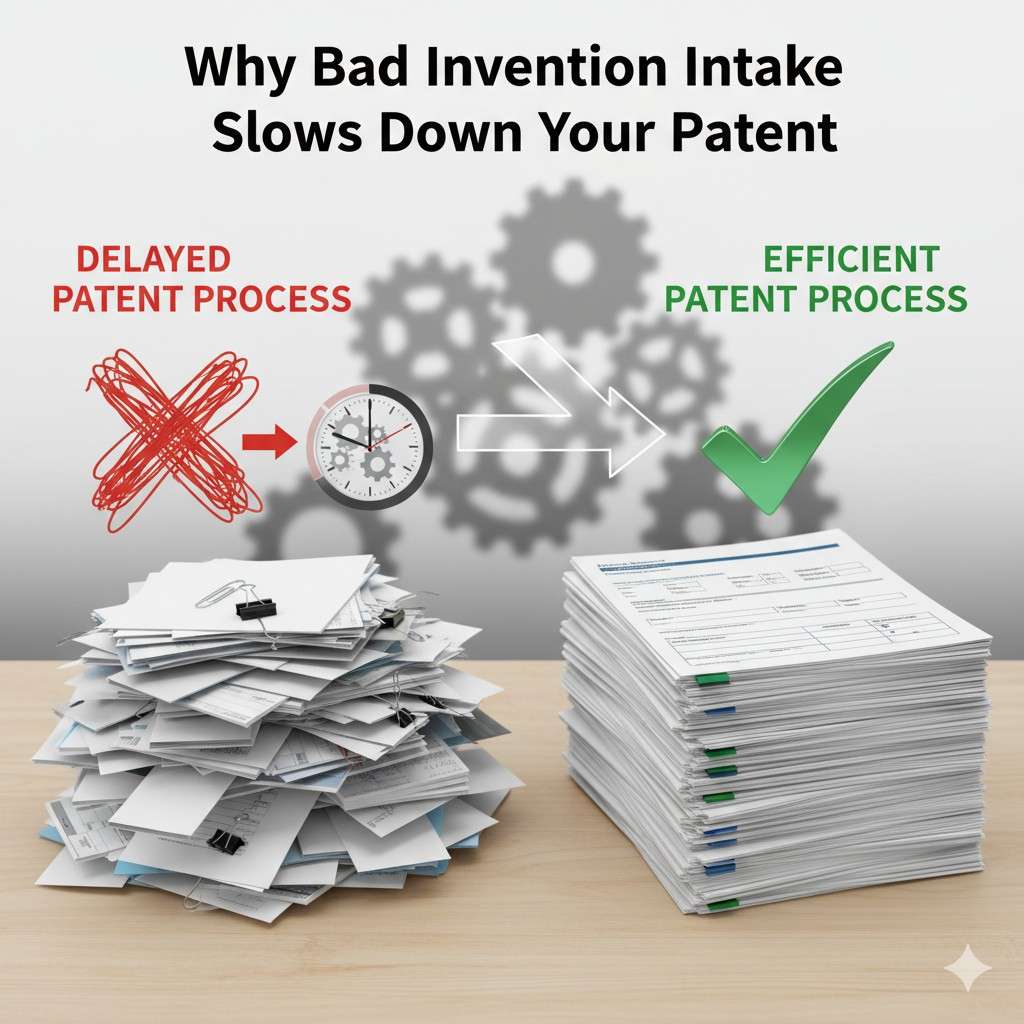
Why Bad Invention Intake Slows Down Your Patent
If the first version of your invention details is weak, the patent process slows down in ways most founders do not see at first. The delay does not always happen in one big moment.
It happens in small gaps. Missing facts. Vague answers. Half-finished thoughts. Each gap creates friction. Each vague sentence turns into an email. Each missing detail becomes a meeting.
When your intake quality is low, your patent does not fail in one dramatic way. It simply drags. And in startups, drag is dangerous.
Below is a deeper look at how bad intake creates hidden costs and how you can fix it at the source.
When Engineers Rush, Clarity Disappears
Engineers move fast. They build. They test. They ship. When they are asked to fill out an invention disclosure form, it often feels like admin work. So they rush it.
The result is surface-level answers. Short descriptions. Missing context. No explanation of why the invention matters.
The patent team then has to guess. Guessing is where problems begin.
Instead of asking “What does this feature do?” your intake form should require the engineer to explain the problem first.
A required field that says, “What problem does this solve and why is that problem hard?” forces deeper thinking. It pushes clarity.
You can also require a short comparison. Ask, “How is this different from what exists today?” This shifts the mindset from description to strategy. Now the engineer must think about competitive advantage, not just functionality.
The key action here is simple. Do not allow empty context. Make context required.
Vague Language Leads to Weak Claims
Patents live or die based on details. If the intake says, “The system improves speed,” that is useless. Improves compared to what? By how much? Under what conditions?
When your intake allows soft words, your claims become soft.
Instead of accepting broad phrases, your required fields should demand specifics.
A field that says, “Quantify the improvement. Include numbers, benchmarks, or test results if available,” changes everything. It signals that real data matters.
Even if the numbers are early or rough, they anchor the invention in something concrete. That gives your attorney stronger ground to stand on when drafting claims.
You should also require at least one real example use case. Not a theory. Not a vision. A real scenario where the invention works. This gives life to the patent. It also makes it easier to defend later.
When intake quality improves, claim strength improves. That link is direct.
Missing Technical Detail Creates Endless Back-and-Forth
One of the biggest time drains in patent work is clarification. The attorney reads the intake. Questions appear. Emails go out. Meetings get booked. Weeks pass.
All of this can be reduced if the intake form is built to surface technical depth from the start.
Instead of asking, “Describe your invention,” break it into required layers. Ask how the system works step by step. Ask what inputs it receives. Ask what outputs it produces.
Ask where the decision logic lives. Ask what happens when something fails.
Each required field should guide the engineer through their own architecture.
This does two things. It forces completeness. It also exposes gaps early. If an engineer cannot clearly explain a flow, that may signal the feature itself needs more thought.
A strong intake form is not just for patents. It improves product thinking.
Unclear Ownership Slows Legal Review
Another silent delay comes from confusion around inventorship. If the intake form does not require clear contribution details, problems show up later.
When multiple people are involved, it becomes hard to know who contributed what. That can create legal risk. It can also cause internal tension.
A required field should ask each contributor to explain their specific role in plain language. Not job title. Not department. Actual contribution.
You can also require confirmation that no outside contractor or third party contributed unless documented. This protects you from future ownership disputes.
Strong intake protects your company from messy corrections later.
Poor Intake Hides Strategic Value
Sometimes the invention is stronger than the intake shows. The engineer may not realize what is truly novel. They may focus on one small piece and ignore the broader system.
If your intake form only captures what the inventor thinks is new, you may miss bigger opportunities.
Add a required reflection field. Ask, “What part of this system would be hardest for a competitor to copy?” This question pushes strategic thinking.
Also ask, “If a competitor built something similar, what would they likely change?” That forces the inventor to consider design-arounds. This insight is powerful when drafting broader claims.
A high-quality intake does not just document. It reveals leverage.
Weak Intake Slows Internal Decisions
Not every invention should become a patent. But you cannot make a good filing decision without good information.
If your leadership team reviews thin disclosures, they cannot assess value, risk, or alignment with company goals. That leads to delays. Or worse, poor filing choices.
Your intake form should require a short explanation of business impact. Ask how this invention supports revenue, cost savings, or long-term moat.
You should also require the current product status. Is this live? In beta? Still in research?
This context allows faster decision-making. When leadership sees a complete picture, approvals move faster.
Good intake speeds not only drafting but also strategy.
Time Lost Early Multiplies Later
Many founders underestimate how small intake gaps compound over time. One missing detail today becomes three questions tomorrow. Three questions become a delayed draft.
A delayed draft pushes back filing. A late filing increases risk.
In fast markets, timing matters. If you file late, someone else may file first.
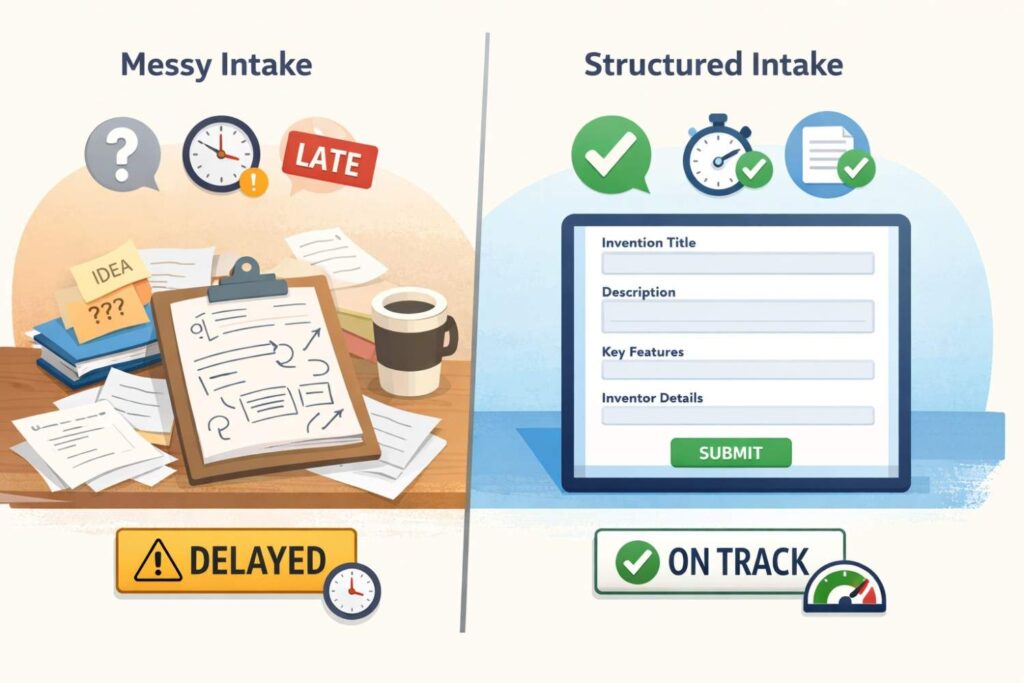
Required fields act like guardrails. They catch issues before they spread. They reduce the need for repeated clarification.
If your goal is faster patent protection, the most powerful lever is not drafting speed. It is intake quality.
How to Upgrade Your Intake Without Frustrating Engineers
You cannot just add more required fields and expect better results. If the form feels heavy or confusing, engineers will resist it.
The solution is guided simplicity.
Each required field should be clear and short. Avoid legal words. Use everyday language. Give one sentence of instruction under each question to explain what a good answer looks like.
You can also add example answers inside the form. When engineers see a strong sample, they mirror that quality.
Another tactic is to integrate intake into existing workflows. If engineers already use product docs or sprint summaries, pull from those systems instead of forcing duplicate work.
Most important, explain why the detail matters. When engineers understand that better input means stronger protection for their work, engagement improves.
Intake quality is not about control. It is about respect for the invention.
Strong Intake Builds Confidence Across the Company
When your patent drafts come back accurate, complete, and aligned with the product, trust grows. Engineers feel heard. Leadership feels secure. Legal feels supported.
All of that starts with required fields that do their job.
At PowerPatent, we see this every day. When founders use smart intake systems backed by real attorney review, the process feels smooth instead of stressful. Clean information in. Strong patent out.
If you want to see how a modern system makes invention capture simple and powerful, you can explore how it works here: https://powerpatent.com/how-it-works
Improving intake is not busy work. It is the foundation of speed, strength, and control.
What Required Fields Should Actually Capture (And Why They Matter)
If your required fields only ask for a basic summary, you are not building a patent system. You are collecting loose notes.
A strong intake form should pull out the exact pieces of information that turn raw ideas into defensible protection.
Every required field should serve one purpose. It should either strengthen claim scope, reduce legal risk, speed up drafting, or support business strategy. If a field does not do one of those things, it does not belong.
The goal is not to collect more data. The goal is to collect the right data.
Below is what your required fields must capture if you want faster filings and stronger patents.
Capture the Real Problem First
Before you describe the invention, you must define the pain.
Most engineers jump straight into how their system works. But patent strength often depends on how clearly the problem is framed. If the problem sounds small, the invention sounds small.
Your intake should require a focused explanation of the real-world problem. Not a feature description. Not a product pitch. A clear statement of what was broken or limited before this invention existed.
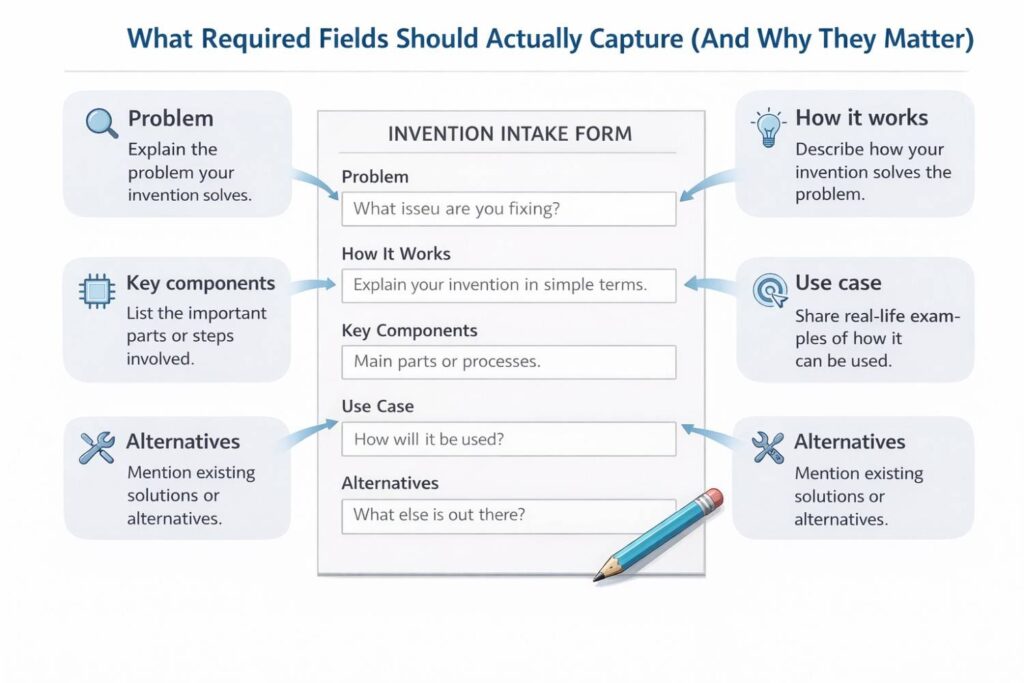
This matters because the problem sets the stage for novelty. It gives your attorney room to position the invention as a true improvement, not just another version of something common.
When the problem is sharp, the claims can be sharper.
Capture the Technical Core, Not Just the Outcome
It is easy to say, “This system improves efficiency.” That tells you nothing about how.
Your required fields must force the inventor to explain the technical engine behind the result. What logic is used? What models are involved? What hardware components interact? What sequence of steps occurs?
You want to see the moving parts.
This is important because competitors do not copy marketing language. They copy mechanisms. If your patent does not clearly describe the internal structure of the invention, it becomes easier to design around.
The intake should require a clear explanation of how the system operates from input to output. That flow becomes the backbone of your claims.
Capture Alternative Versions Early
Most inventions have more than one way to implement them. Engineers often think of variations but do not write them down.
That is a mistake.
Your required fields should ask whether the invention could be built in different ways. Could it run on different hardware? Could it use a different algorithm? Could it work in a different environment?
Capturing these alternatives early expands your patent coverage.
If you only document one version, your claims may become narrow. If you document multiple possible versions, your attorney can draft broader protection.
This single step can be the difference between a patent that blocks competitors and one that does not.
Capture What Is Truly New
Not everything in your system is new. Some parts are known. Some parts are common tools.
Your intake form should require the inventor to separate what already existed from what was invented. This forces clarity.
Ask for a plain explanation of what existed before and what changed because of this invention.
This matters because patent examiners will look for prior art. If you have already mapped out what is old versus new, your attorney can prepare better arguments and cleaner claims.
Clear boundaries lead to stronger protection.
Capture Real Use Cases
An invention without context feels abstract. Abstract ideas are harder to protect.
Your intake should require at least one concrete use case. Describe who uses it. Describe when. Describe what happens step by step in a real scenario.
This gives life to the invention. It also provides examples that can be included in the patent to support broader claims.
Real-world examples make your application stronger and easier to understand.
Capture Performance Data
Even early numbers matter.
If your invention improves speed, accuracy, storage, security, or cost, require the inventor to include any available data. Benchmarks, test results, internal experiments, even rough estimates.
This is powerful because measurable improvements support arguments for patentability. They show that the invention produces real technical results.
Without numbers, everything feels theoretical.
You do not need perfect data. But you need something real.
Capture System Architecture Clearly
Many patents fail because the architecture is not clearly described.
Your required fields should walk the inventor through the structure of the system. What components exist? How do they communicate? Where is data stored? Where does processing happen?
This should not be a drawing alone. It should be explained in words.
When architecture is clear, drafting becomes faster. The attorney does not need multiple clarification calls. They can see the system.

And when the system is clearly described, your claims can be layered to protect both high-level concepts and specific implementations.
Capture Dependencies and External Tools
If your invention relies on third-party APIs, open-source libraries, cloud services, or external data sources, this must be captured early.
Why?
Because it affects how claims are written. If a critical piece of the system is outside your control, your patent strategy may need to focus on how you use that piece, not the piece itself.
Required fields should ask whether the invention depends on any external technology and how it interacts with it.
This prevents surprises later in drafting.
Capture Inventor Contributions
Inventorship errors create legal risk. Your intake form must require each inventor to describe their specific contribution.
Not a job title. Not a department. A clear statement of what they personally added to the invention.
This protects the company. It also builds fairness and transparency internally.
Strong intake prevents messy corrections after filing.
Capture Business Impact
Patents are not academic papers. They are strategic tools.
Your intake should require a short explanation of why this invention matters to the company. Does it support a core product? Does it create a barrier to entry? Does it strengthen investor conversations?
This context helps leadership decide what to file and when.
It also helps your attorney focus on the parts of the invention that align with business goals.
A patent aligned with strategy is more valuable than a patent filed out of habit.
Capture Public Disclosure Status
Timing is critical in patent law.
Your required fields must ask whether the invention has been shared publicly. Has it been presented at a conference? Shown to customers? Published in a blog post? Included in a demo?
If so, when?
This information affects filing deadlines. Missing it can create serious risk.
By making this a required field, you reduce the chance of accidental loss of rights.
Capture Future Roadmap Possibilities
Many inventions evolve quickly. The version today may not be the version six months from now.
Your intake should ask whether improvements or expansions are planned. Even if they are not built yet.
This helps you decide whether to include forward-looking variations in the application.
Thinking ahead increases coverage.
Turning Required Fields into a Strategic Asset
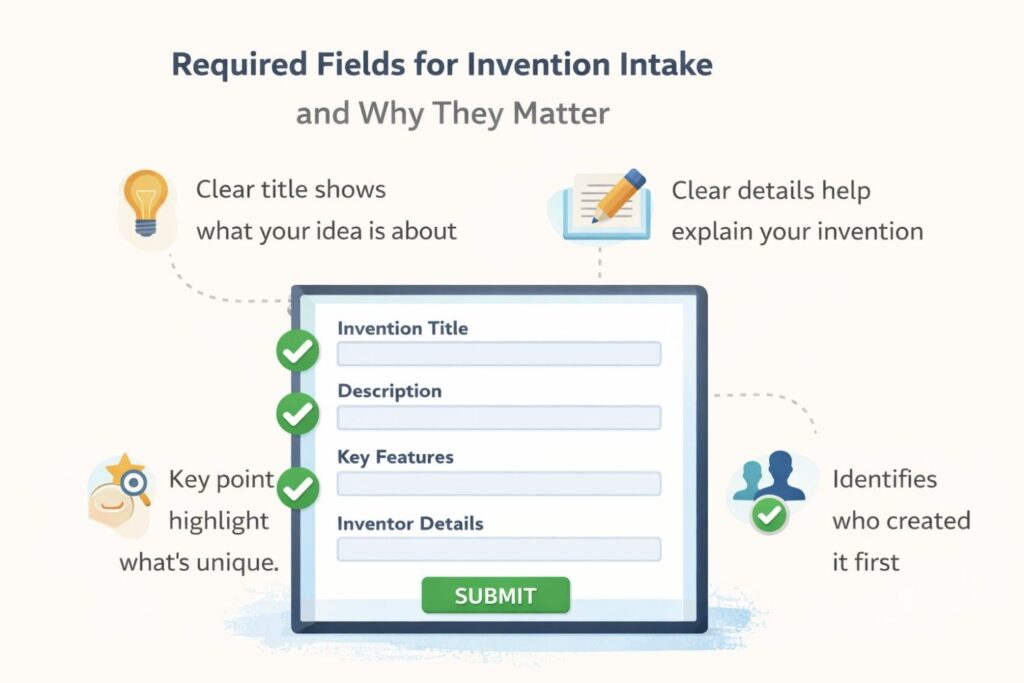
When required fields are designed with purpose, they do more than collect data. They create discipline. They guide thinking. They surface value.
At PowerPatent, we build intake systems that are structured, simple, and backed by real patent attorneys.
The software guides founders through the right questions. Attorneys review and refine the output. This combination reduces delays and avoids weak filings.
If you want to see how structured invention capture can protect your startup without slowing your team down, you can explore the full process here: https://powerpatent.com/how-it-works
Clean intake is not paperwork. It is leverage.
How to Design Required Fields That Engineers Will Actually Complete
If your intake form feels like homework, engineers will avoid it. If it feels like legal paperwork, they will rush through it. And if it feels confusing, they will give you the shortest answers possible.
The truth is simple. Required fields only improve patent quality if people take them seriously. That means the design of the form matters just as much as the content inside it.
You are not just collecting information. You are shaping behavior.
When required fields are built the right way, engineers move through them smoothly. They give better answers. They think more clearly about their own work. And your patent process speeds up instead of slowing down.
Let’s break down how to design required fields that actually work in the real world.
Start With the Engineer’s Mindset
Before you write a single question, step into the engineer’s day.
They are solving bugs. Shipping features. Reviewing pull requests. Joining standups. They are not thinking about patents.
If your form interrupts their flow without context, it becomes friction.
So the first design principle is respect for time.
Each required field must feel necessary. Not bloated. Not repetitive. Not vague.
When engineers sense that every question has a clear reason, they respond with care. When they feel like they are filling out a long legal survey, quality drops.
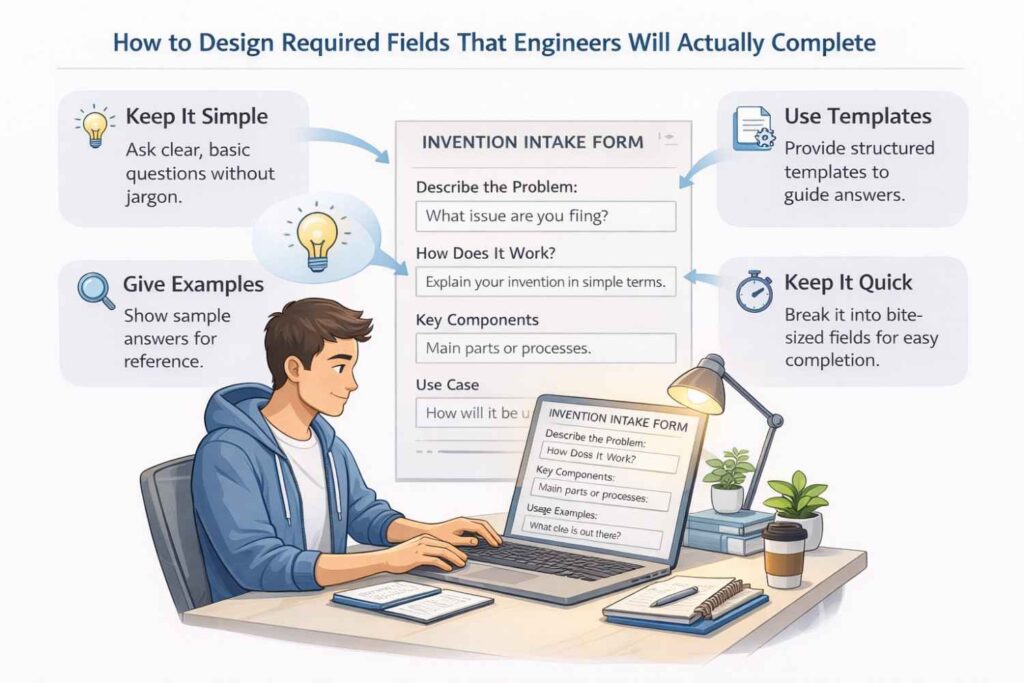
A well-designed intake feels focused and purposeful from the first screen.
Use Plain Language That Feels Natural
Legal language kills engagement.
If your required field says, “Describe the novel inventive concept and its distinguishing characteristics over prior art,” you will get weak answers. Not because the engineer lacks knowledge, but because the wording creates distance.
Instead, use simple words.
Ask, “What is new about this compared to what existed before?”
That single change makes the question human.
When fields are written in everyday language, engineers respond in everyday language. That clarity helps your attorney far more than complex phrasing ever could.
Plain language increases completion quality.
Make Each Field Solve One Clear Problem
Many intake forms fail because they try to do too much in one question.
When a required field asks for a problem statement, technical flow, business value, and performance data all at once, the answer becomes scattered.
Break it down.
One field should capture the problem. Another should capture how the system works. Another should capture measurable results.
Each field should have a single job.
This structure helps engineers think step by step. It also makes it easier for your patent team to review responses quickly.
Clarity in form design leads to clarity in invention capture.
Guide, Do Not Interrogate
There is a big difference between guiding someone and interrogating them.
If every required field feels like a demand, people will give minimal effort. If it feels like guidance, they will engage.
One way to guide is to add short helper text below each question. Not long instructions. Just one sentence explaining what a strong answer looks like.
For example, under a field asking how the system works, you might say, “Walk through the process from start to finish as if you are explaining it to another engineer.”
This small addition improves quality without adding pressure.
You are not testing them. You are helping them tell the story clearly.
Reduce Cognitive Load With Smart Sequencing
Order matters.
If the first required field asks for deep technical architecture before the problem is defined, the engineer may struggle to organize their thoughts.
Start with context. Then move to mechanics. Then move to variations. Then business impact.
This natural progression mirrors how most engineers think about their work.
When fields follow a logical flow, completion feels smoother.
You can also group related questions together so the user does not feel like they are jumping between unrelated topics.
Good sequencing reduces friction.
Use Required Fields Strategically, Not Aggressively
Making every field required can backfire.
If too many questions are mandatory, engineers may feel trapped. They may enter placeholder text just to move forward.
Instead, decide which pieces of information are truly critical for drafting a strong patent.
Problem statement should be required. Technical operation should be required. What is new should be required. Public disclosure status must be required.
Other helpful but less critical information can remain optional, especially if it may not apply to every invention.

When required fields feel reasonable, compliance improves.
Design for Real-World Detail, Not Perfection
Some engineers hesitate because they think their answers must be perfect.
Your form should signal that early-stage information is acceptable.
You can include language that says rough estimates are fine. Early test data is fine. Even partial architecture is fine.
This lowers the barrier to completion.
Waiting for perfect information delays filing. Capturing solid but evolving information keeps momentum.
Your intake system should support speed without sacrificing strength.
Build in Space for Visuals
Engineers often think in diagrams.
If your intake only allows text, you may lose clarity. Consider allowing uploads of system diagrams, flow charts, or screenshots.
Even if your patent team later rewrites everything in formal format, those visuals reduce confusion early.
A required prompt that asks, “If available, attach a diagram showing the system components and flow,” can dramatically reduce follow-up meetings.
Visual context improves drafting speed.
Create Feedback Loops
If engineers never hear what happens after they submit an invention disclosure, they disengage.
Close the loop.
When a patent draft is created, show them how their input shaped it. Highlight how their technical explanation became part of the claims. Let them see the impact of thorough answers.
Over time, this builds a culture of stronger submissions.
They begin to understand that better intake leads to better protection for their own work.
Engagement increases when people see results.
Align the Form With Product Workflows
If your intake form lives in a completely separate system from where engineers already document product features, it becomes extra work.
Whenever possible, align your required fields with existing product documentation habits.
If your team already writes design docs, mirror some of that structure. If they use internal architecture summaries, reference similar language.
This reduces duplication.
When the intake feels like an extension of existing workflow instead of a separate task, completion rates improve.
Integration reduces resistance.
Keep the Form Dynamic and Adaptive
Not every invention looks the same.
If your intake form is rigid, it may not fit hardware inventions, software systems, AI models, or hybrid solutions equally well.
Modern systems can adapt based on earlier answers. If the invention involves machine learning, additional required fields can appear asking about training data, model type, or evaluation metrics.
If it involves hardware, different prompts can guide component details.
This adaptive design makes the form feel intelligent instead of generic.
Engineers respond better when questions feel relevant to their specific work.
At PowerPatent, this is exactly how the system is built. The software adjusts based on what you are building, while real patent attorneys review the output to ensure nothing important is missed.
You get structure without rigidity. You get guidance without legal overload.
If you want to see how that works in practice, you can explore it here: https://powerpatent.com/how-it-works
Make Completion Feel Like Progress, Not Paperwork
Finally, the emotional experience matters.
If submitting an invention disclosure feels like slowing down, it will always be postponed. If it feels like locking in ownership and protecting momentum, it becomes empowering.
Position the intake process as a way to secure the value engineers are creating.
You can even show a progress indicator so users see how close they are to completion. Small design choices like this create forward motion.
When required fields are designed with empathy, clarity, and purpose, engineers complete them thoughtfully.
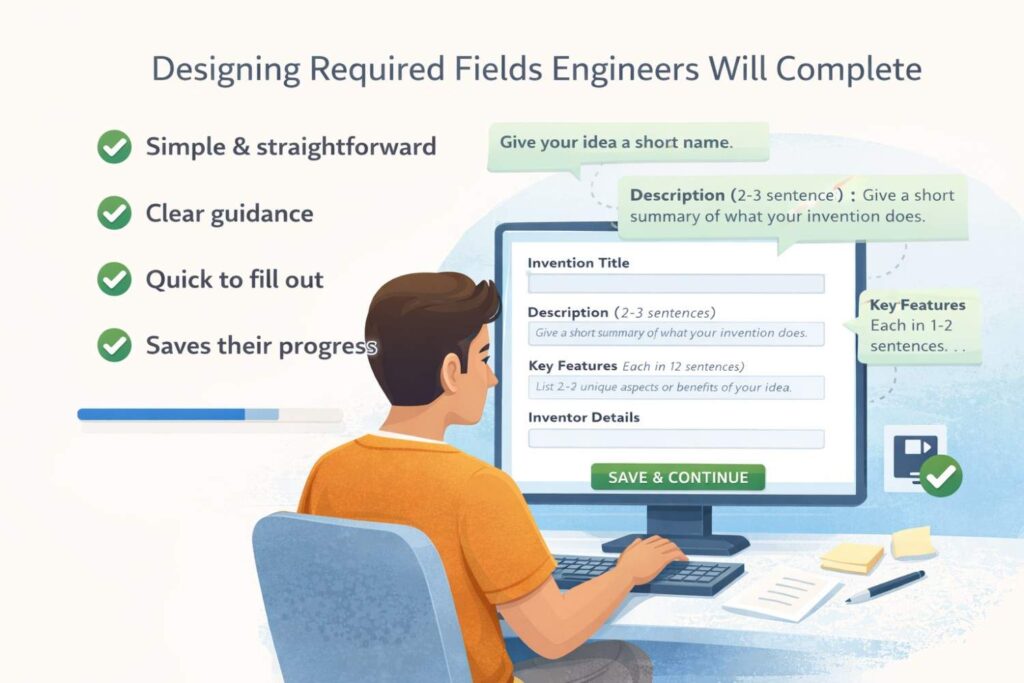
And when engineers complete them thoughtfully, your patents become stronger, faster, and more aligned with the business.
Turning Clean Intake Data into Strong, Defensible Patents
Clean intake data is not the end goal. It is the raw material. The real value shows up when that information turns into a patent that can stand up to competitors, investors, and examiners.
When your intake is structured, complete, and thoughtful, drafting becomes focused. Strategy becomes sharper. Risk drops. Speed increases.
This is where many companies either waste momentum or build real protection.
Let’s walk through how clean invention intake becomes a strong, defensible patent that actually protects your startup.
From Raw Notes to Strategic Framing
When intake data is messy, the attorney spends time decoding it. When intake data is clean, the attorney spends time strengthening it.
That difference is huge.
A strong intake already defines the problem, explains the system flow, separates what is new, and outlines possible variations. This allows the patent draft to begin with clear positioning.
Instead of trying to figure out what the invention is, the attorney can focus on how to frame it in the broadest defensible way.
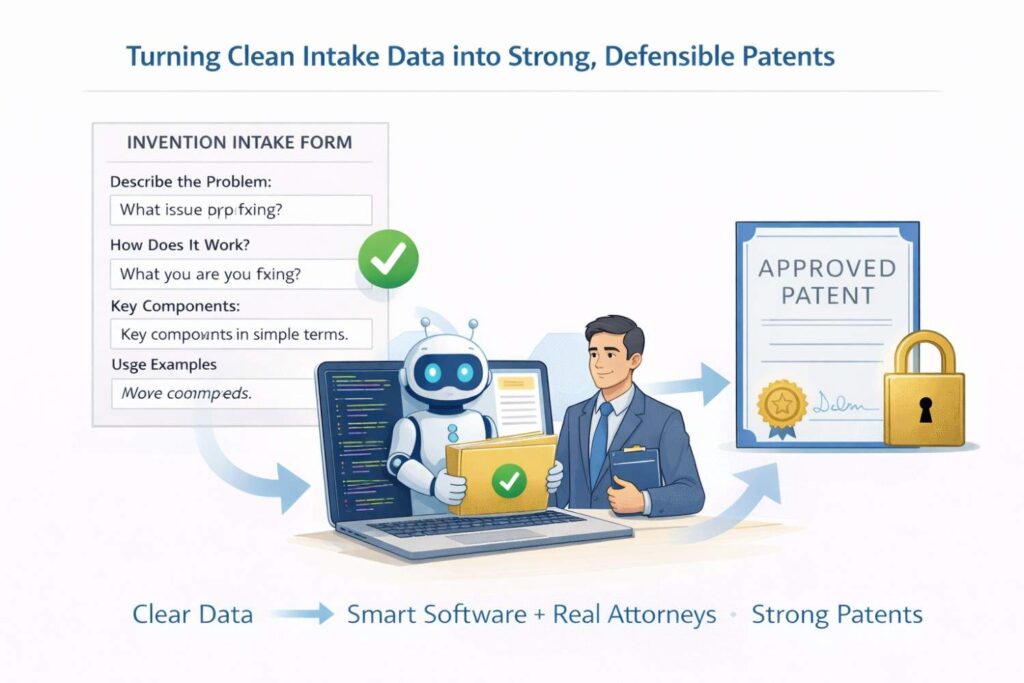
Framing matters because patent protection is not just about what you built. It is about how widely you can define the invention without overreaching.
Clean intake gives room to think strategically.
Expanding Scope Without Guessing
One of the hardest parts of patent drafting is knowing how far to stretch the claims.
If the intake only describes one narrow implementation, the resulting patent will likely be narrow. But if the intake clearly includes alternative versions, optional components, and different use cases, the attorney can build layered protection.
This means writing claims that cover both the core system and its variations.
Clean intake data removes guesswork. The attorney does not need to assume how else the invention might work. The possibilities are already documented.
That leads to broader protection without inventing details that were never discussed.
Strong patents are built on documented reality, not assumptions.
Building Claims That Match the Real Innovation
When intake quality is high, it becomes easier to pinpoint the true inventive concept.
Many founders think the novelty lies in one visible feature, when in reality the breakthrough may sit deeper in the system architecture or data handling method.
Clean intake reveals this.
Because the intake requires a breakdown of system components, technical flow, and measurable results, patterns emerge. The attorney can identify the core mechanism that drives value.
Claims can then be centered on that mechanism.
This matters because competitors rarely copy your product design exactly. They copy the engine underneath it. If your patent protects that engine, you create a real barrier.
Clean intake leads to claims that target substance, not surface features.
Reducing Office Action Risk
Patent examiners review thousands of applications. If your filing is vague or overly broad without support, you increase the chance of rejection.
When intake data includes technical detail, alternative embodiments, performance data, and real-world use cases, your application becomes more robust.
Examiners are less likely to say the invention lacks clarity or sufficient description.
Even when prior art is cited, having detailed documentation allows your attorney to respond with stronger arguments. You can point to specific mechanisms, not general statements.
Clean intake strengthens not only the initial filing but also your ability to defend it during examination.
That shortens timelines and reduces back-and-forth with the patent office.
Speeding Up Drafting Without Sacrificing Quality
Startups move fast. Filing delays create stress.
When invention disclosures are thin, drafting requires repeated clarification calls. That slows everything down.
When the intake is complete, the first draft can be produced faster because the foundation is solid.
Speed does not have to mean cutting corners. In fact, strong intake often allows both speed and depth.
At PowerPatent, this is one of the biggest advantages founders experience. The software guides inventors to provide structured, high-quality information from the start. Real patent attorneys then review and refine that data into a strong draft.

The result is faster turnaround without sacrificing strength.
If you want to see how that system works in practice, you can explore it here: https://powerpatent.com/how-it-works
Creating Layered Protection
Defensible patents are rarely built on a single claim.
They are layered.
There is a broad claim covering the core idea. Then narrower claims covering specific implementations. Then additional claims covering variations, configurations, and edge cases.
Clean intake data makes layering possible.
If alternative embodiments are captured early, the attorney can write dependent claims that protect those variations. If different environments or hardware options are documented, those can be included as well.
Layered claims make it harder for competitors to design around your patent.
Without detailed intake, layering becomes shallow.
Aligning Legal Protection With Business Strategy
Not every technical detail deserves equal weight in a patent.
Some features matter more because they drive revenue. Some matter because they are hard to replicate. Some matter because they form the core moat of the company.
When intake includes business impact context, the attorney can prioritize correctly.
Claims can be centered around the aspects of the invention that align with long-term strategy.
This prevents a common mistake where patents protect minor features while leaving the true competitive advantage exposed.
Clean intake connects legal protection to company goals.
That alignment is critical during fundraising, acquisition talks, and competitive growth.
Preventing Ownership and Inventorship Disputes
Strong patents are not just technically solid. They are legally clean.
When intake clearly documents who contributed what, inventorship is easier to determine accurately.
This reduces the risk of future disputes or correction filings.
Investors often conduct due diligence on patent ownership. Clean records create confidence.
Messy records create questions.
Clean intake protects your company not only from competitors but also from internal complications.
Supporting Continuation and Future Filings
Startups evolve. Products improve. Features expand.
When the original intake is detailed, it becomes easier to file continuation applications or additional patents later.
You already have a documented baseline of what was known at the time of the original filing. You can build on it.
This creates a strategic patent portfolio instead of isolated filings.
Each strong intake contributes to a long-term protection roadmap.
Over time, this compounds into a meaningful moat.
Turning Process Into Advantage
Many startups treat patents as a one-time event.
Smart companies treat them as a system.
When your invention intake process consistently produces clean, structured, and strategic data, patent filing becomes predictable. Faster. Stronger. Less stressful.
Engineers know what to provide. Legal knows how to use it. Leadership knows how to evaluate it.
That system becomes a competitive advantage.
Competitors who rely on rushed, incomplete disclosures often end up with weaker patents that are easier to challenge or design around.
You do not want paperwork. You want protection.
Clean intake is how you get there.
At PowerPatent, we built our platform around this exact principle. Smart software structures invention capture with required fields that actually matter.
Real patent attorneys review, guide, and strengthen every application. Founders stay in control. Engineers stay focused. Protection moves faster.

If you are serious about building defensible IP without slowing down your team, you can see how the full process works here: https://powerpatent.com/how-it-works
Clean data in. Strong patent out. That is not theory. It is process.
Wrapping It Up
Strong patents do not start with legal language. They start with clear thinking. If your invention intake is vague, rushed, or incomplete, everything that follows becomes harder. Drafting slows down. Costs rise. Protection weakens. Small gaps in the beginning turn into large risks later. But when required fields are designed with purpose, something powerful happens. Engineers explain their work clearly. Leadership makes faster filing decisions. Attorneys draft with confidence. The final patent reflects the real innovation, not a watered-down version of it.