You do not need more meetings. You need better input. If you are building real tech, your time is gold. Long patent calls that drag for hours slow you down, drain your team, and still miss key details. The good news is this: you can collect strong invention details without sitting in endless meetings. You can capture what matters, fast, clearly, and without stress. In this guide, I will show you exactly how to do that—so you protect what you are building without slowing down the build.
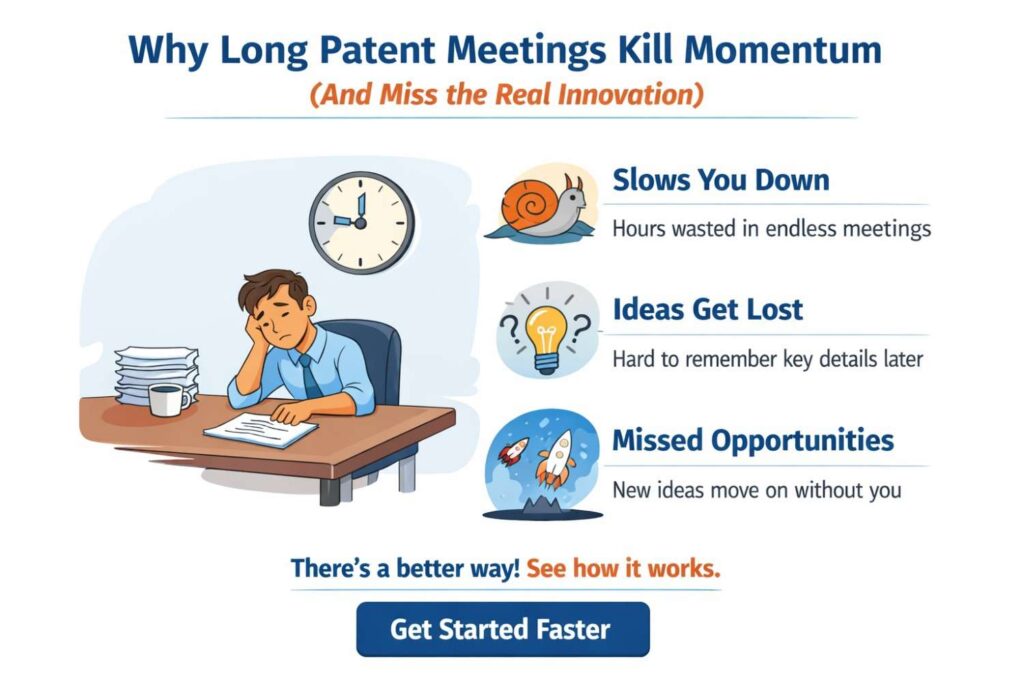
Why Long Patent Meetings Kill Momentum (And Miss the Real Innovation)
Long meetings feel productive. Calendars get filled. Notes get taken. Everyone talks. But when it comes to capturing invention details, long patent meetings often do more harm than good.
They slow your team down at the exact moment speed matters most. They pull engineers away from building.
They create pressure to “explain everything perfectly” on the spot. And in the end, they still miss the details that actually make your invention valuable.
If you are running a startup or leading a technical team, this matters more than you think. Momentum is fragile. Once broken, it is hard to rebuild. Protecting your invention should support momentum, not destroy it.
Meetings Interrupt Deep Work
Engineers do their best thinking when they are focused. Real innovation happens during deep work.
It happens when someone is solving a hard problem, testing edge cases, rewriting models, or debugging late at night. That is when insights appear.
When you schedule a long patent meeting, you pull them out of that state. The shift from deep technical work to high-level explanation is not small. It takes time to switch mental gears. After the meeting ends, it takes even more time to get back into flow.
The cost is not just the hour spent in the meeting. The cost is the lost creative energy before and after it.
If you want to collect better invention details, protect deep work first. Instead of forcing engineers to pause and explain everything live, give them a way to share details asynchronously.
Let them document thoughts when they naturally discover something new. Capture insight at the moment of creation, not days later in a conference room.
Live Conversations Reward Surface-Level Thinking
In a long meeting, people speak fast. They summarize. They simplify. They skip steps. They focus on what sounds impressive rather than what is technically unique.
But patents are not about what sounds impressive. They are about what is different under the hood.
In live calls, subtle design choices often get lost. Small architectural decisions that solve big problems may not even get mentioned. An engineer may assume something is “obvious” and leave it out.
A founder may focus on business value instead of technical mechanism. The result is a shallow description.
To fix this, shift from performance to reflection. When someone writes or records details on their own time, they think deeper. They can review code. They can check diagrams.
They can explain why they chose one method over another. This leads to stronger, more accurate capture of the real innovation.
A smart move for businesses is to build a simple habit: every time a meaningful technical change is made, the person responsible writes a short explanation of what changed and why.
Not for legal reasons. For clarity. Over time, this creates a goldmine of invention detail without any meeting at all.
Group Settings Create Silent Gaps
In long patent meetings, not everyone speaks. Junior engineers often stay quiet. Specialists may assume someone else will explain their part. Important context stays trapped in someone’s head.
This is dangerous for patent quality.
Many breakthrough details live with the person who implemented the feature, tuned the model, or handled the edge case. If that person does not feel fully comfortable speaking up in a large meeting, the invention story becomes incomplete.
You can prevent this by collecting input one-on-one or through structured written prompts. When each contributor has space to explain their part separately, you reduce social pressure.
You get richer detail. You uncover the hidden insights that often make the strongest claims later.
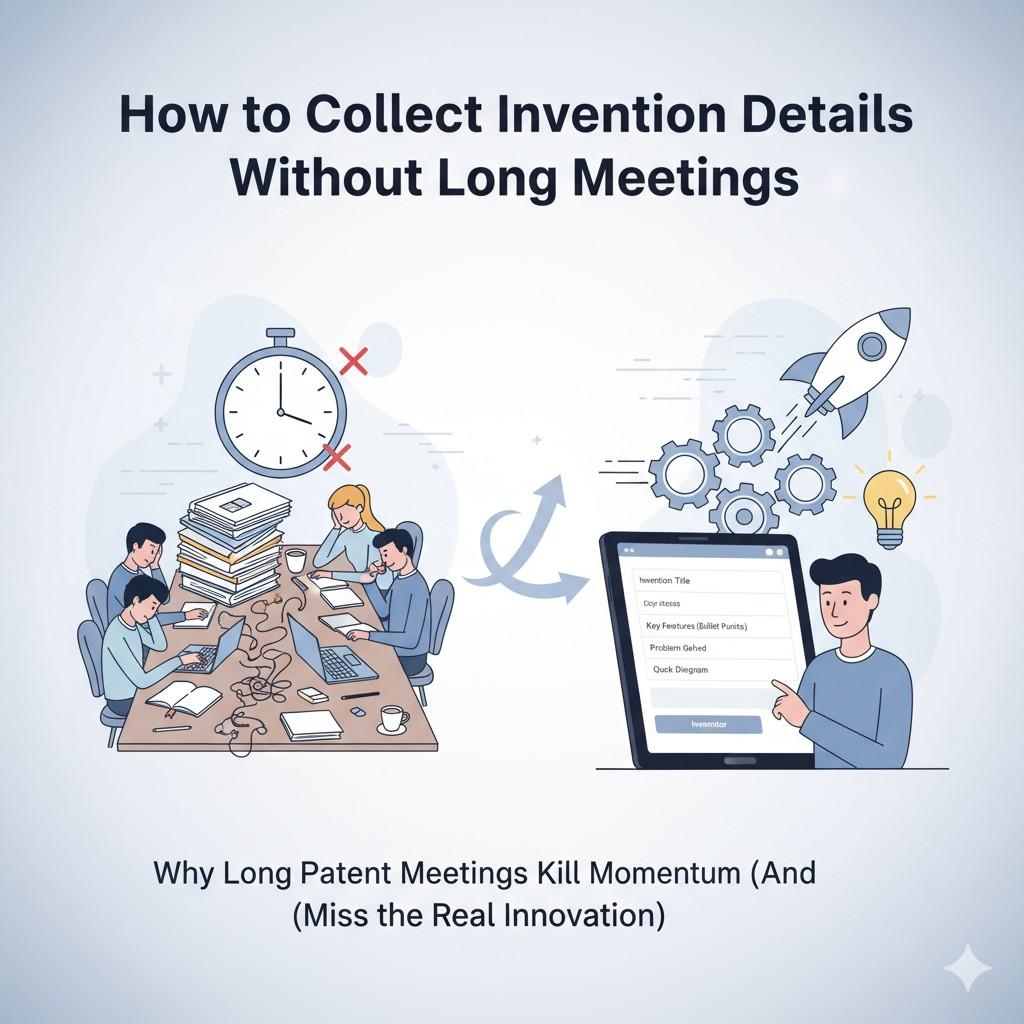
For growing companies, this is especially critical. As your team expands, relying on one big patent meeting becomes even less effective. You need a system that scales without draining everyone’s time.
Memory Is a Weak Source of Technical Detail
Most long patent meetings happen weeks or months after development began. By then, memories are blurry. Decisions that felt obvious at the time are hard to reconstruct. Key experiments may be forgotten.
When someone says, “I think we tried that approach but it did not work,” that is not enough detail for a strong patent.
Innovation is often a series of small choices. Why did you reject one architecture and choose another? Why did you change the training pipeline? Why did you modify the data structure? These details matter.
Instead of relying on memory, collect invention details in real time. Encourage your team to capture short notes during development cycles. This does not need to be formal. It can be a simple habit tied to code commits or sprint reviews.
When you later prepare a patent application, you are not starting from scratch. You are organizing what you already captured.
Businesses that adopt this approach see faster drafting and fewer follow-up questions. It saves time and reduces risk because you are not guessing about what happened months ago.
Long Meetings Create Artificial Pressure
In a traditional patent meeting, there is often a feeling that “this is the big session.” People believe they must explain everything in one go. That pressure leads to rushed thinking.
When someone feels rushed, they default to high-level summaries. They avoid exploring edge cases.
They skip over failed experiments that could reveal alternative embodiments. They focus on the main path and ignore variations.
Yet those variations often become your safety net later. They help you broaden your protection. They give your attorney room to draft stronger coverage.
To avoid this problem, break the process into smaller, lower-pressure steps. Collect core invention details first. Then gather variations separately. Then gather potential use cases.
Spread it out over short, focused interactions rather than one long call.
This reduces stress and improves quality.

If you are leading a startup, you can implement this immediately. Instead of scheduling a three-hour patent call, ask your team to submit written responses to targeted prompts over a few days.
Review them. Then hold a short follow-up call only to clarify gaps. This turns a draining meeting into a focused review.
Meetings Blur the Line Between Vision and Implementation
Founders often speak in terms of vision. Engineers speak in terms of implementation. In a long joint meeting, these perspectives mix together.
The risk is that the conversation leans too heavily toward the product vision and business story. While that story matters, patents depend on how something works, not just what it does.
If your meeting centers around customer benefits and market positioning, you may miss the technical structure that makes your solution unique.
A more strategic approach is to separate these layers when collecting invention details. First capture the technical mechanism clearly. Then connect it to business impact. Do not try to merge everything at once.
This separation leads to clearer thinking and stronger protection.
The Hidden Cost to Company Culture
Long, draining meetings send a message. They signal that protecting IP is a burden. They make patents feel like a painful requirement instead of a strategic asset.
Over time, this affects culture. Engineers may start to resist the process. Founders may delay filings because they do not want to deal with the meeting.
When you make invention capture lightweight and integrated into normal workflows, the tone shifts. Patents become a natural extension of building. They feel aligned with progress rather than opposed to it.
For businesses aiming to move fast and raise capital, this cultural shift is powerful. Investors care about defensible technology. But they also care about execution speed. A smart invention capture system supports both.
The Illusion of Efficiency
One long meeting can feel efficient. Everyone is in one place. Questions get asked. Answers are given. It feels complete.
But after the meeting, drafts go back and forth. Clarifications are needed. Details are missing. More calls get scheduled. The cycle repeats.
What looked efficient at first often becomes fragmented and slow.
A more effective system gathers detailed input upfront in structured, thoughtful ways. When the drafting phase begins, fewer questions arise. Review cycles shrink. Filing happens faster.
For businesses, this translates into real advantages. Faster filings mean earlier priority dates. Earlier priority dates mean stronger protection against competitors.
The key insight is simple: time spent capturing the right details early reduces total time spent later.

Long patent meetings promise speed but usually deliver delay.
By redesigning how you collect invention details, you protect both your innovation and your team’s momentum.
A Smarter Way to Capture Invention Details As You Build
If long meetings slow you down, the answer is not to skip patents. The answer is to change how you collect invention details.
The smartest companies do not treat patent capture as a single event. They treat it as a light, ongoing habit built into the way they already work.
When you collect details as you build, you remove pressure. You remove guesswork. And you stop scrambling at the last minute. The result is stronger protection with less stress.
Capture Innovation at the Moment It Happens
The best time to document an invention detail is right after the breakthrough occurs. Not weeks later. Not after launch. Not when you are trying to remember what you did.
When an engineer solves a hard problem, that solution is fresh. They know what alternatives they tried. They remember why one approach failed and another worked. They can clearly explain the tradeoffs.
That clarity fades fast.
A simple but powerful shift is this: tie invention capture to your development cycle.
When a meaningful technical change is pushed, when a new model architecture is finalized, or when a system improvement solves a real limitation, pause for a few minutes and capture what changed.
This does not require a formal document. It can begin as a short explanation in plain language. What was the problem? What did we try before? What did we change? Why does this work better?
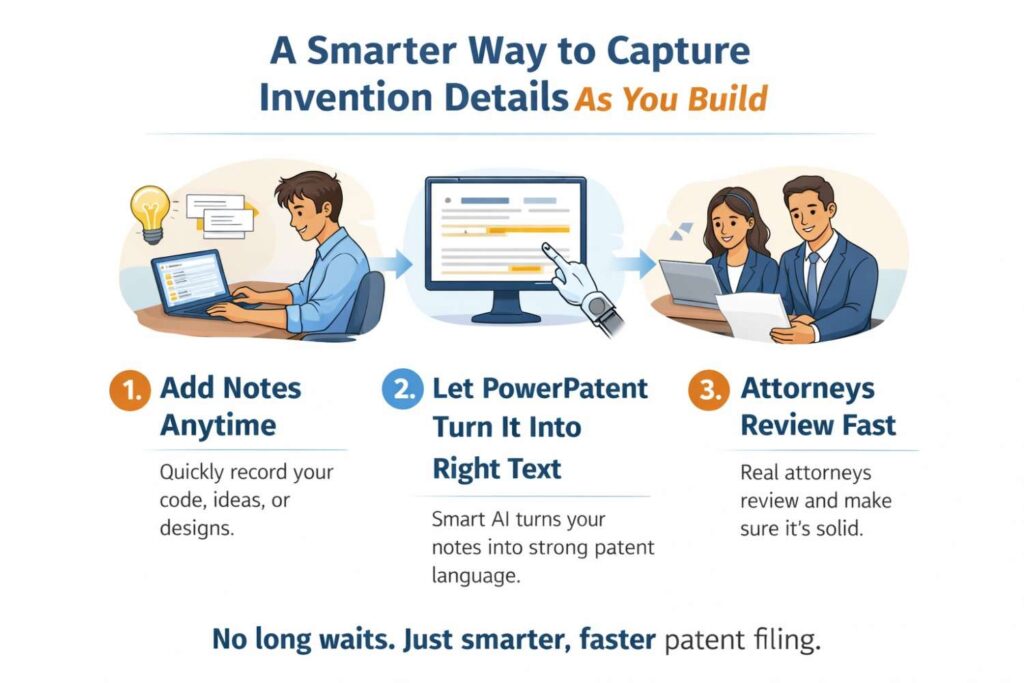
Over time, these small records form a complete invention story. When it is time to file, you are not guessing. You are organizing.
Companies that do this well rarely need long meetings because most of the thinking has already been captured.
Turn Code and Commits Into Clear Explanations
Your codebase already tells a story. Every commit reflects a decision. Every new module reflects a design choice. But code alone is not enough for a patent. You must explain the logic behind it.
Instead of scheduling a meeting to walk through the code line by line, create a lightweight system where developers add short written explanations for major technical decisions. Not comments about syntax, but reasoning.
For example, if your team changed a data processing flow to reduce latency, capture why the previous method failed and how the new structure improves performance.
If you adjusted a model to handle edge cases better, describe the insight that led to that change.
This approach has two benefits. First, it strengthens internal understanding. Second, it builds a record that can be transformed into patent-ready material later.

The key is consistency. You do not need long essays. You need clear thinking captured early.
Use Structured Prompts Instead of Open-Ended Calls
One reason long meetings fail is that the questions are too broad. “Tell me about your invention” is not a helpful prompt. It forces the inventor to summarize everything at once.
A smarter approach uses focused prompts delivered in writing. Instead of asking for a general explanation, ask specific questions that uncover depth.
What technical problem existed before this solution? What limitations did prior methods have? What specific change did you introduce? What are three variations of this approach that could also work?
When team members respond in writing, they think more carefully. They can review diagrams. They can look at test results. They are not rushed.
As a business, you can standardize this process. Create a short internal questionnaire for new features or system upgrades. Keep it simple. Keep it repeatable. Over time, this becomes part of your product culture.
This removes the need for large group meetings and replaces them with targeted input that is easier to refine.
Separate Core Innovation From Supporting Features
Not every feature deserves a patent. But in a long meeting, everything tends to blend together. The conversation jumps from core architecture to user interface details to marketing goals.
This creates confusion.
A better system separates the core technical engine from supporting features early. Ask your team to clearly identify what truly makes this solution different at a technical level. What is the engine behind the outcome?
Once that is clear, you can explore optional layers. Variations. Extensions. Alternative implementations.
By structuring your thinking this way, you avoid wasting time discussing details that do not strengthen protection. You focus attention where it matters.
For businesses, this leads to smarter filing decisions. You invest in protecting real technical leverage, not surface-level features that competitors can easily work around.
Make Documentation Feel Like Engineering, Not Legal Work
Many engineers dislike patent meetings because they feel legal and formal. The language feels foreign. The conversation feels removed from the real build.
To fix this, shift the tone completely. Treat invention capture as a technical exercise, not a legal one.
Ask engineers to explain systems the way they would explain them to another developer. Focus on structure, inputs, outputs, logic flow, and constraints. Keep the language simple.
When the process feels natural, resistance drops. The quality of detail improves. And you reduce friction across the team.
This is where smart platforms can help. When software guides engineers through structured prompts in plain language, and real patent attorneys later shape that into formal protection, you get the best of both worlds.
Clear technical input and strong legal coverage.

You avoid endless back-and-forth because the raw material is already solid.
If you want to see how this works in practice, you can explore how modern systems streamline this process without heavy meetings at https://powerpatent.com/how-it-works. The goal is simple: capture strong details without slowing down builders.
Review in Short, Focused Sessions
Even with better capture systems, some discussion is still useful. But it does not need to be long.
Instead of one massive call, schedule short review sessions focused on one topic at a time. Discuss only the core mechanism. Or only the variations. Or only the edge cases.
Short sessions force clarity. They prevent drift into unrelated topics. They respect everyone’s time.
For businesses, this improves execution speed. Your team spends less time explaining and more time building. At the same time, your patent quality improves because discussions are sharp and specific.
Build an Internal Invention Radar
The smartest companies do not wait until they “feel ready” to file a patent. They actively look for invention moments.
Create an internal signal system. When a feature significantly improves performance, reduces cost, or unlocks a new capability, flag it. When your team solves a problem competitors struggle with, flag it. When a customer says, “We have not seen this before,” flag it.
These signals trigger lightweight documentation, not a long meeting.
Over time, this builds a steady pipeline of protectable innovations. You are no longer reacting late. You are acting early.
This is especially powerful for startups preparing to raise capital. Investors want to see that you are building defensible technology, not just features. A structured invention capture process shows maturity and strategic thinking.
And when your documentation is organized and ready, filing becomes fast and smooth.
If you want a clearer view of how founders are doing this without traditional law firm delays, you can review the process here: https://powerpatent.com/how-it-works. The difference is not just speed. It is control.
Replace One Big Event With a Continuous Habit
The biggest shift is mental. Stop thinking of patent capture as a single big event. Think of it as a continuous habit.
When innovation is documented in small, steady steps, there is no panic. There is no scramble. There is no need for draining, day-long sessions.
Instead, when you decide to file, most of the work is already done. Your attorney is refining, not extracting. Your team is reviewing, not reconstructing.
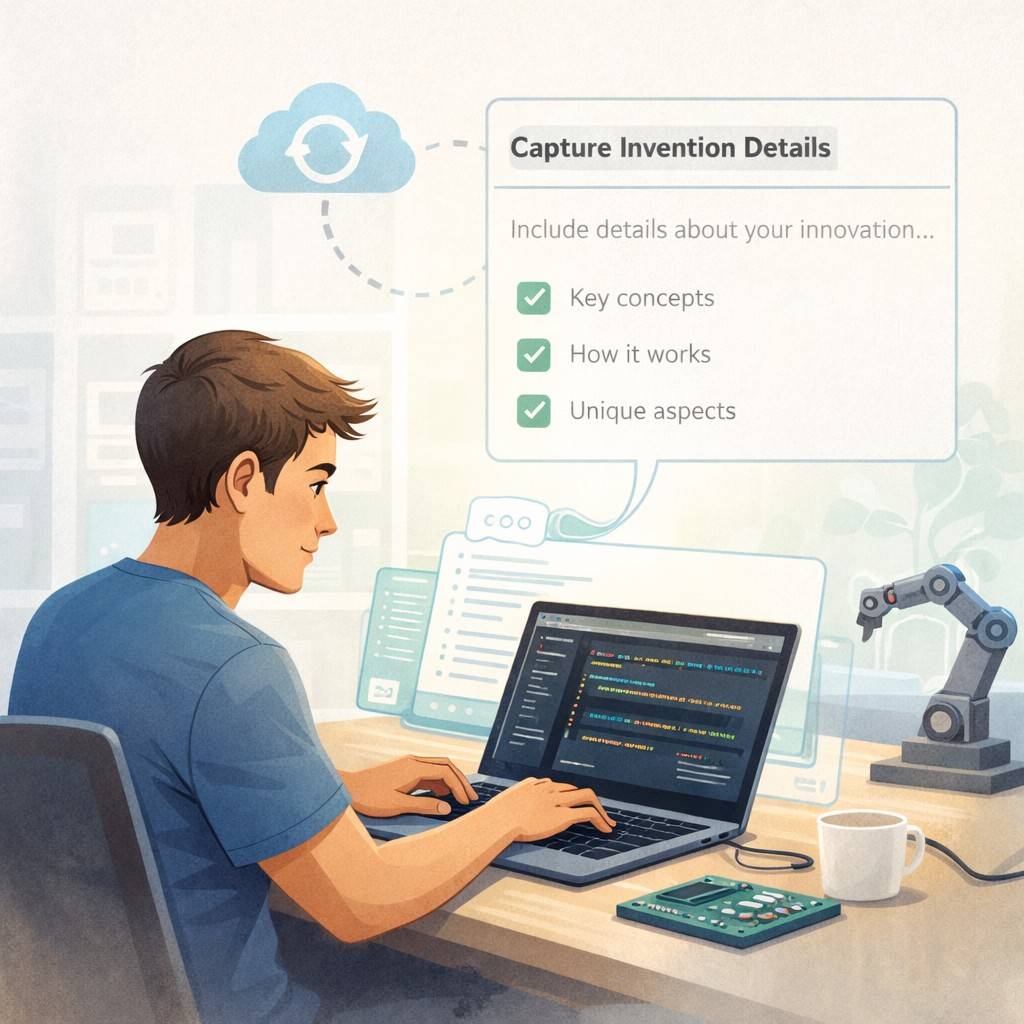
This protects momentum. It respects your engineers. It strengthens your IP.
And it keeps your startup moving forward.
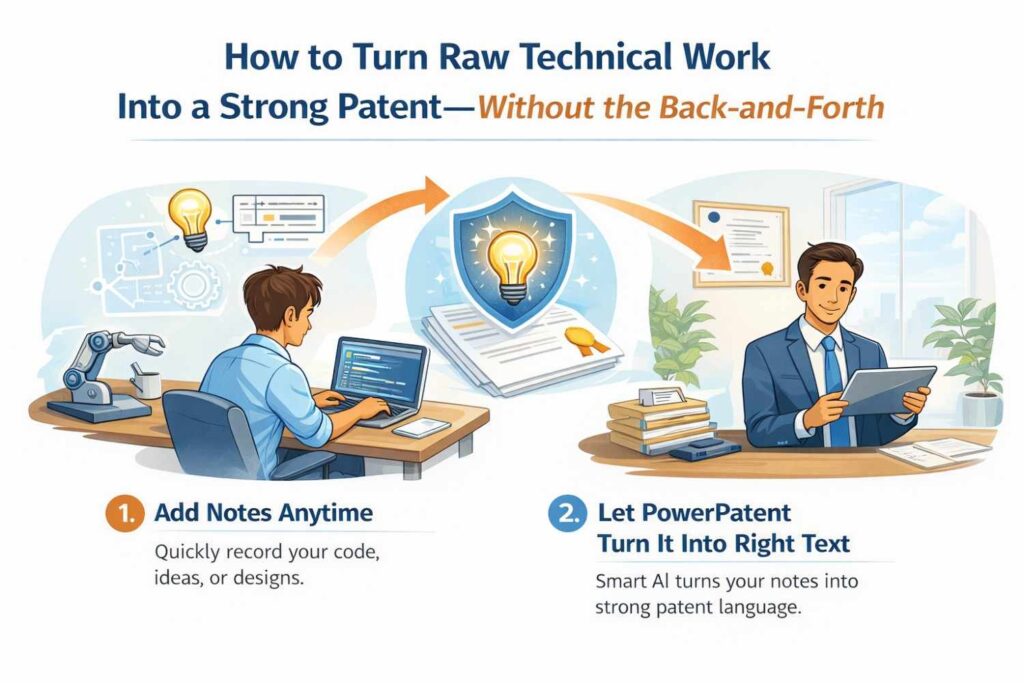
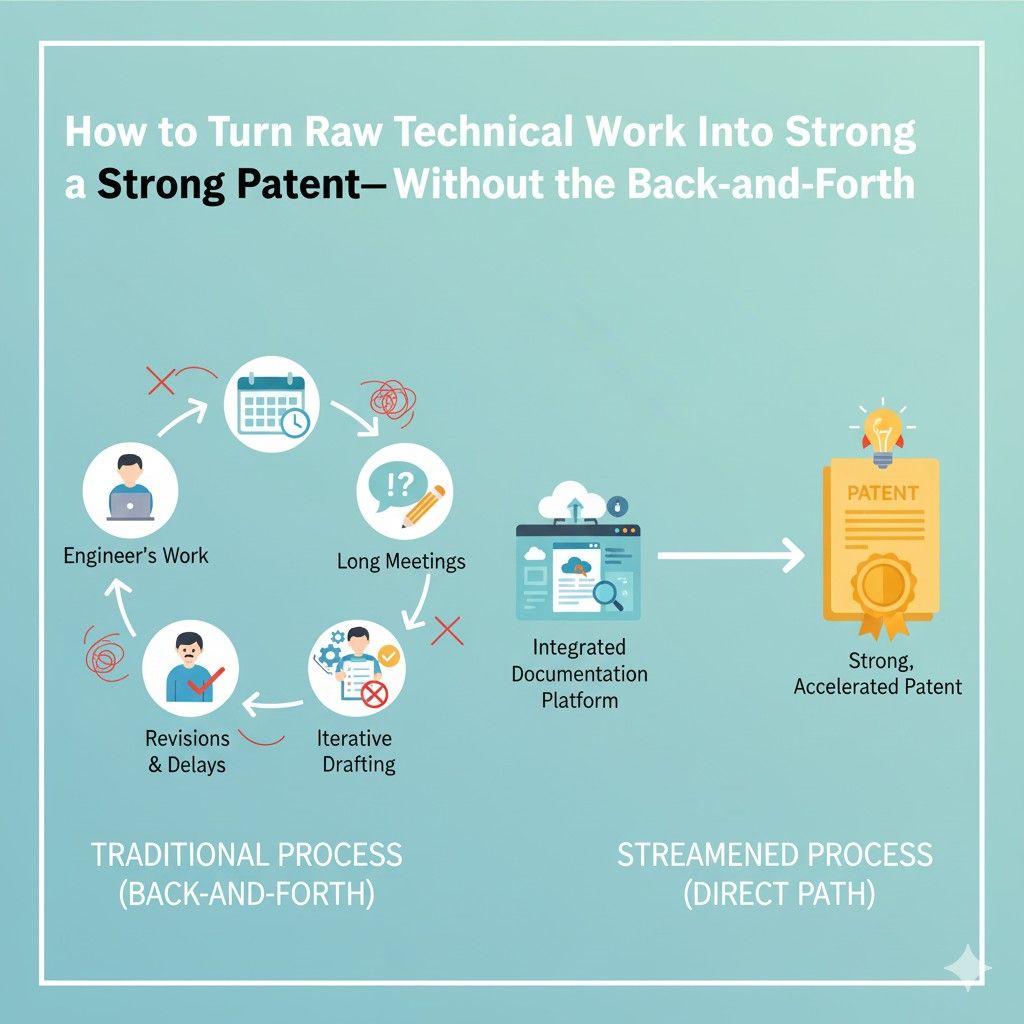
How to Turn Raw Technical Work Into a Strong Patent—Without the Back-and-Forth
Most startups do not struggle with innovation. They struggle with translation.
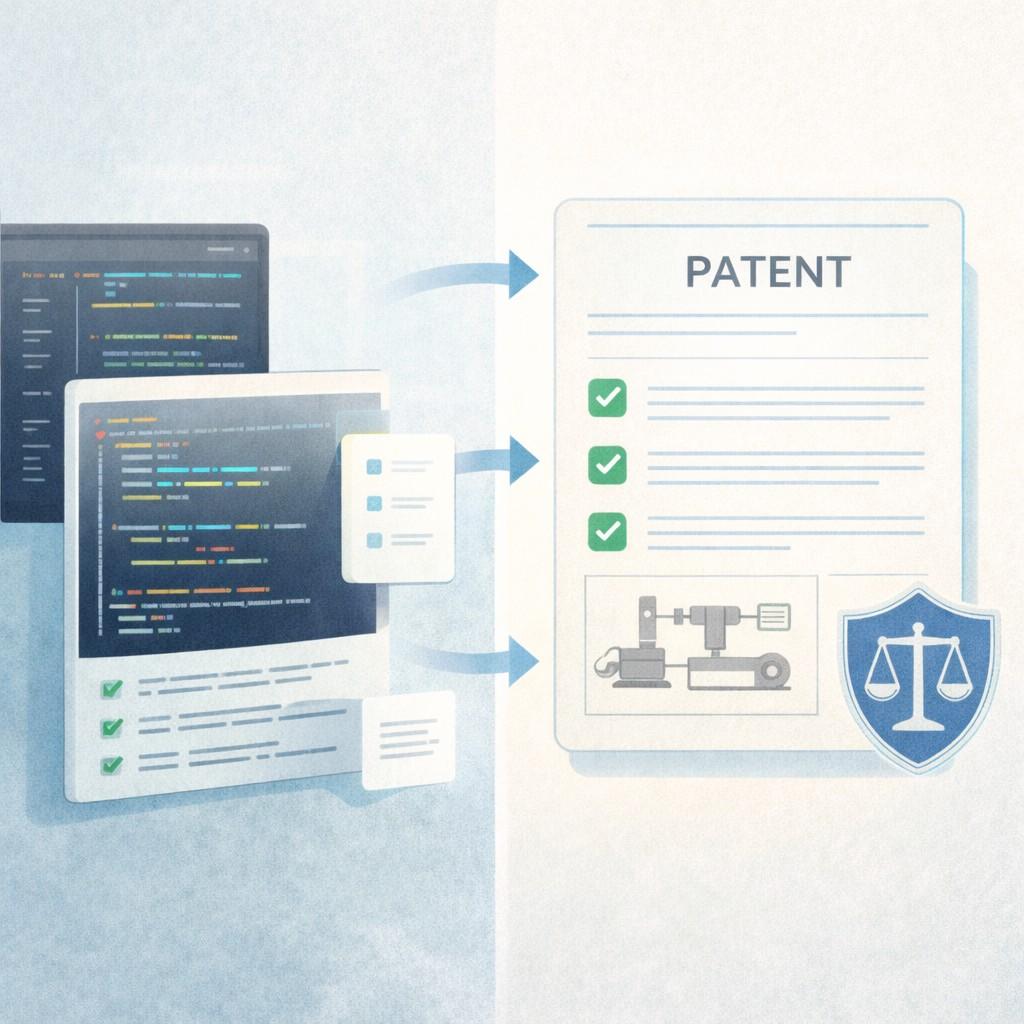
You already have the raw material. It lives in your code, your model weights, your system diagrams, your architecture decisions, your test logs.
The hard part is turning that raw technical work into a strong patent without endless email threads, repeated calls, and painful rewrites.
The back-and-forth usually happens because the first draft starts weak. The details are incomplete. The explanation is too high level. The attorney has to dig for missing pieces. That digging turns into more meetings.
You can avoid that cycle entirely if you structure your raw technical work the right way from the start.
Start With the Technical Problem, Not the Product Pitch
A strong patent does not begin with your market story. It begins with a technical problem.
Many founders open with what the product does. That is useful for customers. It is not enough for protection.
Instead, clearly describe the technical limitation that existed before your solution. Be specific. What was not working? What constraint blocked performance? What tradeoff forced compromise?
When you anchor your invention in a real technical pain point, everything else becomes clearer. The solution has context. The improvement becomes measurable.
This single shift reduces back-and-forth because it gives your attorney a solid foundation. They are not guessing why your solution matters. They see the technical gap it fills.
If your team cannot clearly describe the prior limitation, pause and dig deeper. The strongest patents often come from moments where your engineers said, “This approach keeps failing for this reason.”
Capture that frustration. It is often where the invention begins.
Explain the Mechanism Like You Are Teaching a New Engineer
Do not explain your system like you are pitching investors. Explain it like you are onboarding a new developer who must rebuild it from scratch.
Walk through the flow step by step. What comes in? What happens first? What transforms next? What decisions are made? What conditions trigger alternate paths?
When you explain the mechanism in this clear, logical way, you eliminate vague language. You force precision.
Back-and-forth usually happens when descriptions are abstract. Words like “optimized,” “intelligent,” or “advanced” sound impressive but say very little. They create questions instead of clarity.
Replace those with direct explanations. If something adapts, explain how it adapts. If something predicts, explain what inputs it uses and how outputs are generated. If something improves performance, explain what changed structurally.
This depth does not require legal skill. It requires technical honesty.
When attorneys receive detailed, structured explanations, their job becomes refinement, not investigation. That is how you avoid repeated clarification rounds.
Surface the Alternatives You Considered
One of the biggest missed opportunities in patent drafting is ignoring the paths you did not choose.
During development, your team likely tested different architectures, models, data structures, or processing methods. Many of those attempts failed or were less effective.
Those alternatives are powerful.
Why? Because they show the boundaries of your invention. They reveal design space. They often support broader protection.
If you only describe the final working version, your patent may become narrow. If you describe variations and why your chosen method is superior, you create room.
To do this without long meetings, build a habit of recording experiments briefly. When a test fails, capture why. When you reject an approach, explain the weakness.
Later, these notes help shape a stronger filing.
Instead of attorneys asking, “Could this be implemented another way?” you already have thoughtful answers. That removes friction and saves time.
Convert Architecture Diagrams Into Narrative
Most technical teams think visually. They draw system diagrams. They map data flow. They sketch components.
These visuals are extremely valuable for patents. But on their own, they are incomplete. They need explanation.
A simple and effective practice is to pair each diagram with a short written walkthrough. Describe what each block does. Describe how information moves between components.
Describe what makes this structure different from a typical system.
Do not assume the uniqueness is obvious.
This step transforms raw diagrams into usable patent content. It also reduces misinterpretation. Attorneys do not have to guess what a box means. The logic is clear.
If your team already documents architecture for internal reviews, you are halfway there. With small adjustments, those same materials can feed directly into a patent draft.
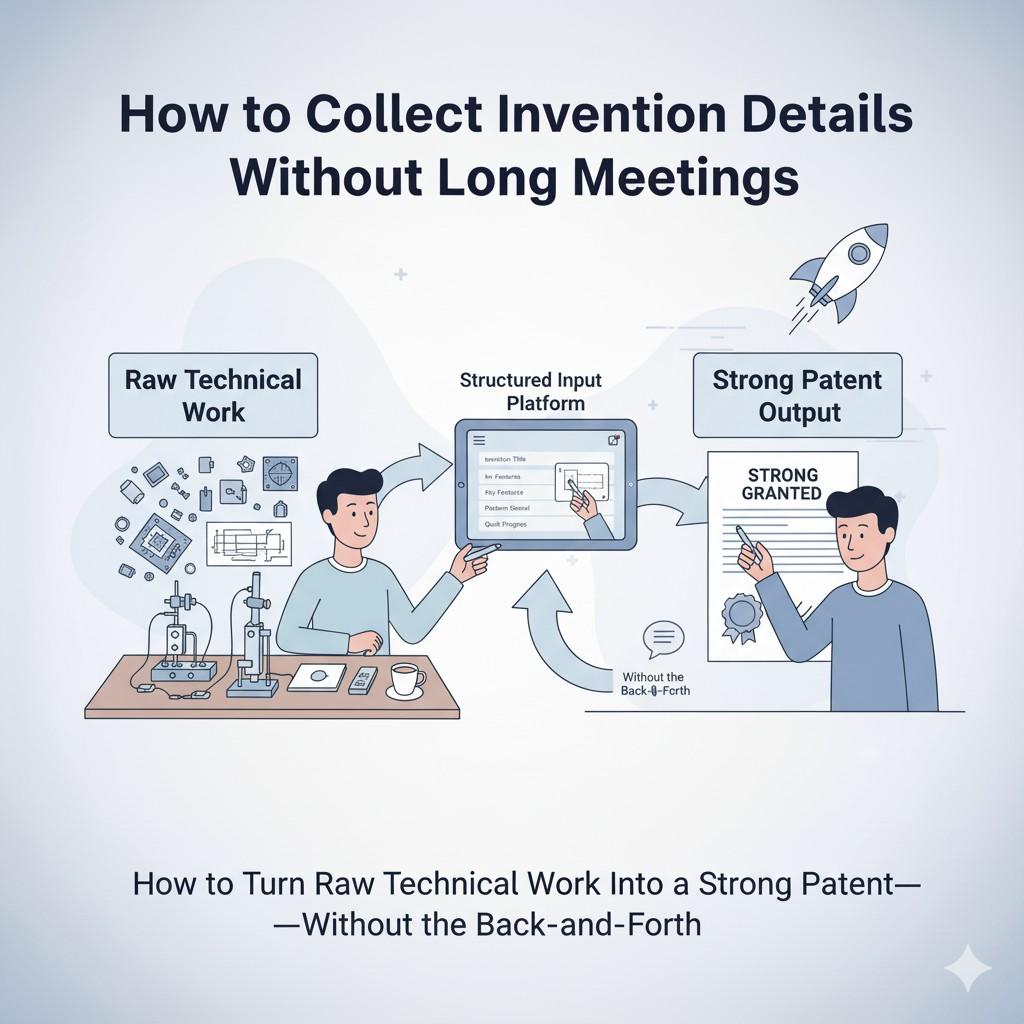
This is how you turn what you already do into defensible protection without creating extra work.
Clarify What Is Essential Versus Optional
Another cause of back-and-forth is confusion about what truly defines the invention.
Some elements are core. Remove them and the system stops working as intended. Other elements are optional enhancements.
If this distinction is not clear early, drafting becomes messy. Attorneys may overemphasize minor details or understate key mechanisms.
To prevent this, explicitly mark what is essential.
Ask yourself: if a competitor removed this feature, would they still achieve the core benefit? If yes, that feature may not define the invention. If no, it likely does.
Write this down in plain language.
This clarity allows your patent strategy to focus on the true leverage point. It also reduces revision cycles because the scope discussion becomes grounded in technical reality rather than guesswork.
Anticipate How Someone Might Work Around You
Strong patents do not just describe what you built. They anticipate how others might try to copy or modify it.
Without needing a formal strategy session, you can capture this thinking during development. When designing a system, engineers often consider simpler alternatives. They may reject them due to performance issues or limitations.
Document those thoughts.
Ask internally: if a competitor wanted similar results but used a slightly different method, what would they try? Could they swap out a component? Could they change the sequence of steps?
By writing down these possibilities early, you create material that supports broader claims later.
This reduces the need for attorneys to guess at design-arounds. You are proactively addressing them.
Use Plain Language First, Legal Language Later
Many founders believe they must sound formal when describing inventions. That instinct creates confusion.
Plain language is stronger.
Describe your system as clearly as possible without trying to sound legal. Avoid decorative phrasing. Focus on what happens and why it matters technically.
When the base description is clear, attorneys can translate it into formal structure. But if the base is vague, no amount of editing can fix it cleanly.
This is one of the reasons modern platforms that guide founders through structured, plain-language invention capture reduce so much back-and-forth. When the first input is strong, the first draft is stronger.
If you want to see how this works in practice, you can review the streamlined approach here: https://powerpatent.com/how-it-works. The system is designed to help technical teams explain clearly without getting stuck in legal complexity.
Review Drafts With Technical Eyes, Not Just Legal Eyes
When you receive a draft, do not review it like a contract. Review it like a system design document.
Ask yourself: does this truly reflect how the system works? Is anything technically inaccurate? Are key mechanisms missing? Are optional features described as mandatory?
Have the engineer who built the core system review it directly. Not just the founder. Not just leadership.
This focused technical review shortens revision cycles. Instead of multiple vague feedback rounds, you get precise corrections.
The result is a tighter, faster path to filing.
Build a Repeatable Conversion Process
The final step is turning this into a repeatable internal process.
When a significant innovation occurs, your team should know exactly what to do. Capture the technical problem. Explain the mechanism step by step. Document alternatives tested. Clarify essential elements. Attach diagrams with narrative. Flag possible design-arounds.
When this becomes routine, there is no scramble.
And when you work with a system that combines smart software guidance with real attorney oversight, the translation from raw work to filed patent becomes smooth instead of painful.
This is not about adding work. It is about redirecting effort you are already spending into structured capture that protects your advantage.
Startups that master this move faster. They file sooner. They reduce legal cost surprises. They enter investor conversations with confidence.
If you are building real technology and want protection without endless calls, explore how a modern approach works at https://powerpatent.com/how-it-works.
The goal is simple. Keep building. Capture what matters. File with confidence.
Wrapping It Up
You do not need long meetings to protect serious innovation. You need clarity. You need structure. And you need a simple system that captures what your team is already creating. Long patent meetings drain energy because they try to force everything into one moment. Real invention does not happen in one moment. It happens over weeks of testing, failing, adjusting, and refining. If you wait until the end to explain it all at once, you lose detail. You lose precision. And you lose time.