Most founders do not think about patents when they build pricing and billing logic. They think about growth. They think about churn. They think about getting users to pay without making the product feel hard to buy. That makes sense. Pricing is not just a finance job. Billing is not just back-office work. In many startups, pricing and billing logic is part of the product itself. It shapes how users enter, upgrade, expand, renew, and stay. That is exactly why it matters.
Why Pricing Logic Can Be Worth Protecting
Pricing logic often looks simple from the outside. A buyer sees a number, picks a plan, and pays. But inside a modern software company, that clean moment is powered by a deep set of rules.
Those rules decide what gets counted, when it gets counted, what changes mid-cycle, who gets charged, who gets credited, and what happens when real customer behavior does not fit a neat box.
That logic is not just admin work. In many companies, it is a core part of the product advantage.
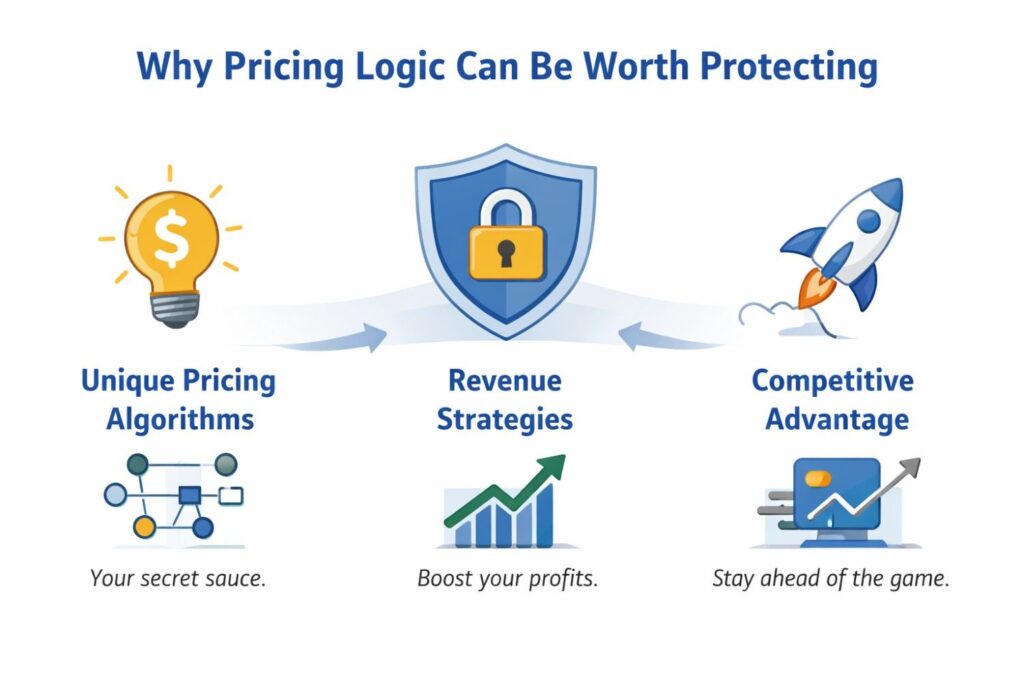
When a business creates a smarter way to handle pricing and billing, it is not only solving a money problem.
It is solving a product design problem, a growth problem, and a retention problem at the same time. That is why pricing logic can become one of the most valuable systems a company owns.
Pricing Logic Is Often Product Logic
Many teams still talk about pricing as if it lives on a pricing page and nowhere else. In reality, pricing logic reaches into onboarding, account setup, usage tracking, entitlements, renewals, upgrades, and support flows.
It decides how the product behaves once a customer starts using it. That makes it much closer to core product logic than most founders first realize.
If your software has special rules for usage thresholds, team growth, contract terms, billing triggers, or service activation, those rules shape the customer experience just as much as the interface does.
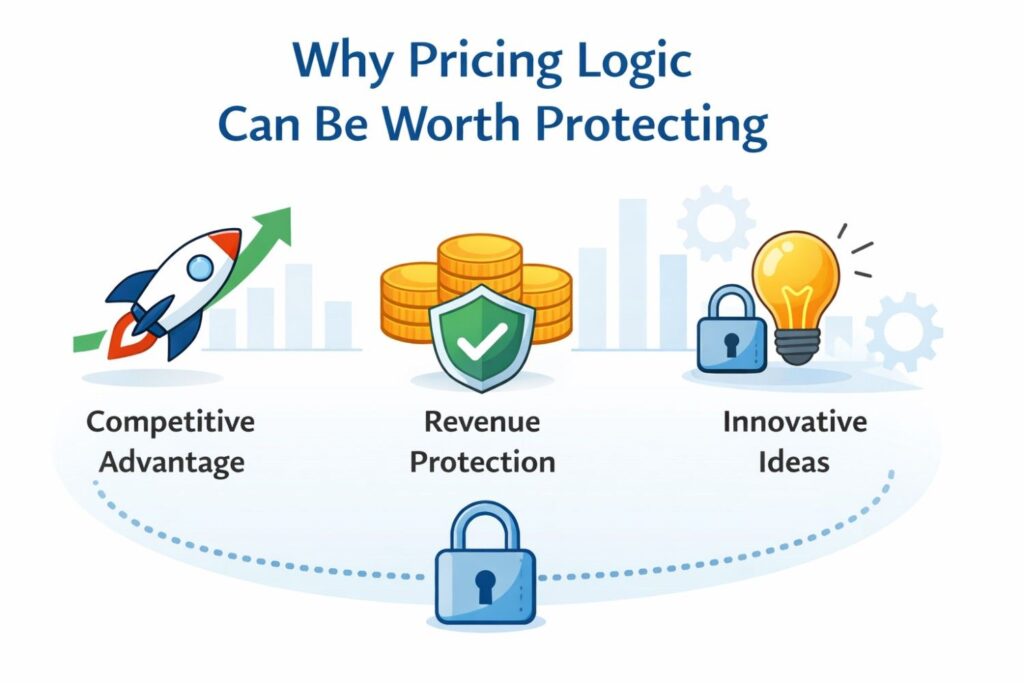
A company that treats pricing logic as part of its product stack starts making better decisions about how to protect it.
Where Product Value And Revenue Value Meet
This is where many strong inventions hide in plain sight.
A billing rule may look like a finance feature, but if that rule makes adoption easier, removes buyer friction, or supports a new go-to-market motion, it is creating value beyond the invoice. It becomes part of the engine that helps the business win.
That matters because valuable inventions are often the ones that sit at the meeting point between user benefit and business benefit.
If your billing logic helps customers buy faster while helping your company capture revenue more fairly, that is not a minor detail. That is a real system with real commercial weight.
Good Pricing Logic Can Create A Competitive Edge
Most software categories look crowded from the outside. Features overlap. Design patterns spread fast.
Marketing claims start to sound the same. But pricing and billing logic can quietly separate one company from another.
A business that charges in a way that feels fair, flexible, and easy to understand often wins trust faster than a company with a slightly bigger feature set.
That edge is easy to miss because users do not always talk about it in technical terms. They say things like, “This plan just makes sense,” or, “We were able to start small and grow without pain.”
Behind that smooth experience is usually a set of smart rules that someone designed very carefully.
The Quiet Systems Competitors Want To Copy
When a pricing structure works well, competitors notice. They may not copy your homepage first.
They may copy how you package usage, how you handle team expansion, how you treat overages, or how you convert trial behavior into paid behavior.
They study what reduces sales friction and what supports expansion revenue. Then they try to build a close version of it.
That is one reason to think about protection early. If your pricing logic helps you close deals, reduce churn, or serve more customer types with less manual work, you are not dealing with a side process.

You are dealing with something that others may want to imitate once it proves itself in the market.
The Best Billing Systems Solve Hard Real-World Problems
A lot of founders think pricing inventions have to be flashy to matter. They do not. Some of the strongest business logic comes from solving messy edge cases that everyone else hates dealing with.
That might include partial-period billing, prepaid usage credits, account merging, plan migration, custom enterprise rules, delayed usage reporting, or fair handling of shared resources across teams.
These are not abstract business ideas. These are software solutions to hard operational problems. If your team built a reliable method for handling one of these pain points at scale, there may be real patent value there.
Real Complexity Is A Sign Of Real Design Work
Teams often downplay the work because they lived through it step by step. They say they “just built a better way” to handle billing changes.
But the fact that the problem felt normal to your team does not mean the solution was obvious. In fact, the more operational pain the system removes, the more likely it reflects meaningful design choices.
One practical step for businesses is to look at the places where finance, product, and engineering had to work together for weeks or months to get a system right.
That is often where protectable logic lives. When several teams had to align on states, triggers, exceptions, and outcomes, the result may be much more than a simple pricing rule.
Protection Matters More When Revenue Depends On The Logic
Some software businesses can change pricing without touching the product much. Others cannot. In many modern companies, revenue depends directly on how system logic tracks and reacts to user behavior.
Usage-based software, hybrid plans, outcome-based pricing, enterprise provisioning, and dynamic packaging all rely on deep billing infrastructure. If that logic breaks, revenue breaks.
If that logic is copied, the company may lose one of its strongest advantages.
That is why businesses should stop thinking about patent strategy only in terms of flashy user-facing features. The systems that turn usage into revenue can matter just as much, and in some cases even more.
Revenue Architecture Deserves The Same Respect As Product Architecture
Founders usually protect what they see as “the invention.” That may be an algorithm, a device, or a platform feature. But the revenue architecture behind the product can also carry inventive value.
If your system translates messy customer activity into predictable, trusted, and scalable billing outcomes, that system deserves attention.
A useful internal exercise is to ask a simple question: if a competitor copied this logic exactly, would it hurt us? If the answer is yes, the company should take that logic seriously.
That does not prove patentability by itself, but it is a strong business signal that the system may be worth documenting and reviewing.
Pricing Logic Can Lower Friction In Ways Features Cannot
Sometimes the reason customers choose a product is not that it has more features. It is that it is easier to buy, easier to expand, and easier to justify to a finance team.
Smart pricing logic can unlock those wins. A company may design rules that let small teams start cheaply, let larger teams scale cleanly, or let buyers match cost to value without fear of surprise charges.
That kind of system can change buying behavior. It can shorten sales cycles. It can reduce approval delays. It can improve how users feel after the sale. That is strategic value, not just accounting value.
Better Billing Can Increase Trust
Trust is a major business asset. Customers stay longer when billing feels fair and easy to follow. They are more willing to expand when they believe the system will not punish them for growth.
They are more open to usage-based models when they can see how charges are tracked and controlled.
If your company built logic that creates this trust at scale, that is something worth studying closely. Businesses should not only ask whether the pricing model is novel.
They should ask whether the implementation created a better and more trusted commercial experience in a concrete way.
Strategic Protection Starts With Better Internal Language
A big reason pricing logic goes unprotected is that teams describe it too loosely. They say things like “we have flexible pricing” or “we support mixed billing.”
Those phrases may be fine for sales or marketing, but they are too vague to capture the actual invention. Strategic protection starts when the business learns to describe the mechanism, not just the outcome.
That means talking about what inputs enter the system, what events trigger decisions, what rules apply in what order, what happens when conditions change, and how outputs are produced across real billing scenarios.
The more clearly a team can explain this flow, the easier it becomes to see whether there is something distinctive worth protecting.
Move From Marketing Words To System Words
This shift is one of the most actionable things a company can do right away. When documenting pricing logic, stop with high-level labels and start naming actual states and actions.
Instead of saying “flexible upgrade support,” explain how the system detects an account change, how it recalculates entitlement access, how it handles partial-cycle value, and how it produces a billing result without manual intervention.
That level of detail does two things. First, it helps reveal the true shape of the innovation.
Second, it creates a much stronger base for a patent review. Businesses that document system behavior clearly are far more likely to spot protectable ideas before those ideas get lost in fast-moving product work.
Strong Pricing Systems Often Take Years To Refine
Another reason pricing logic deserves protection is that it rarely appears fully formed on day one. It is often shaped by real customer behavior over time.
A company launches one model, learns where confusion happens, sees where revenue leaks occur, and gradually builds smarter rules to fix those weak spots.
Years later, the final system may look clean, but it usually reflects many cycles of learning and hard-earned refinement.
That kind of refinement creates hidden value. The company is no longer relying on a generic billing setup.
It now has a custom logic layer that fits its market, product motion, and customer needs in a way that rivals may not easily reproduce.
Hard-Won Knowledge Should Not Stay Invisible
Businesses often protect breakthrough features while ignoring the systems that matured through repeated trial and correction. That is a missed chance.
Some of the most commercially useful inventions do not arrive as a single dramatic insight. They emerge as a durable system that gets better through real-world use.
One smart move is to capture why the current logic looks the way it does. What problem did the old approach fail to solve? What customer pain pushed the team to redesign the rules?
What edge case forced a new mechanism? Those facts can help show that the system was built to solve concrete technical and operational problems, not just to express a broad business idea.
Billing Logic Can Support Expansion Without Adding Headcount
For growing businesses, scalable billing is a huge asset.
A smart system can support more plans, more customer types, more contract structures, and more product combinations without requiring a matching increase in finance or support staff. That is not just efficient. It directly changes company economics.
When pricing logic reduces manual correction, invoice disputes, onboarding confusion, or custom contract chaos, it frees the company to grow faster with less operational drag.
That kind of system-level efficiency can be deeply strategic.
Scalable Logic Protects Margins
In software, growth can hide weak systems for a while. New revenue comes in, but back-office pain grows with it. Manual work piles up. Exception handling becomes normal.

Finance and support teams spend time fixing edge cases that the product should have handled automatically.
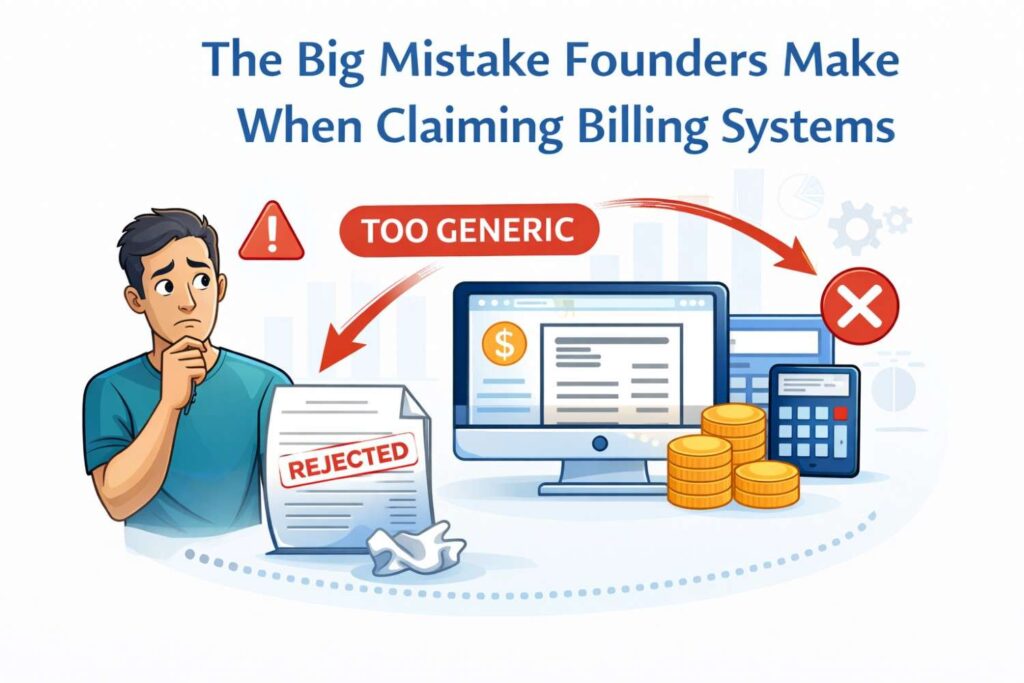
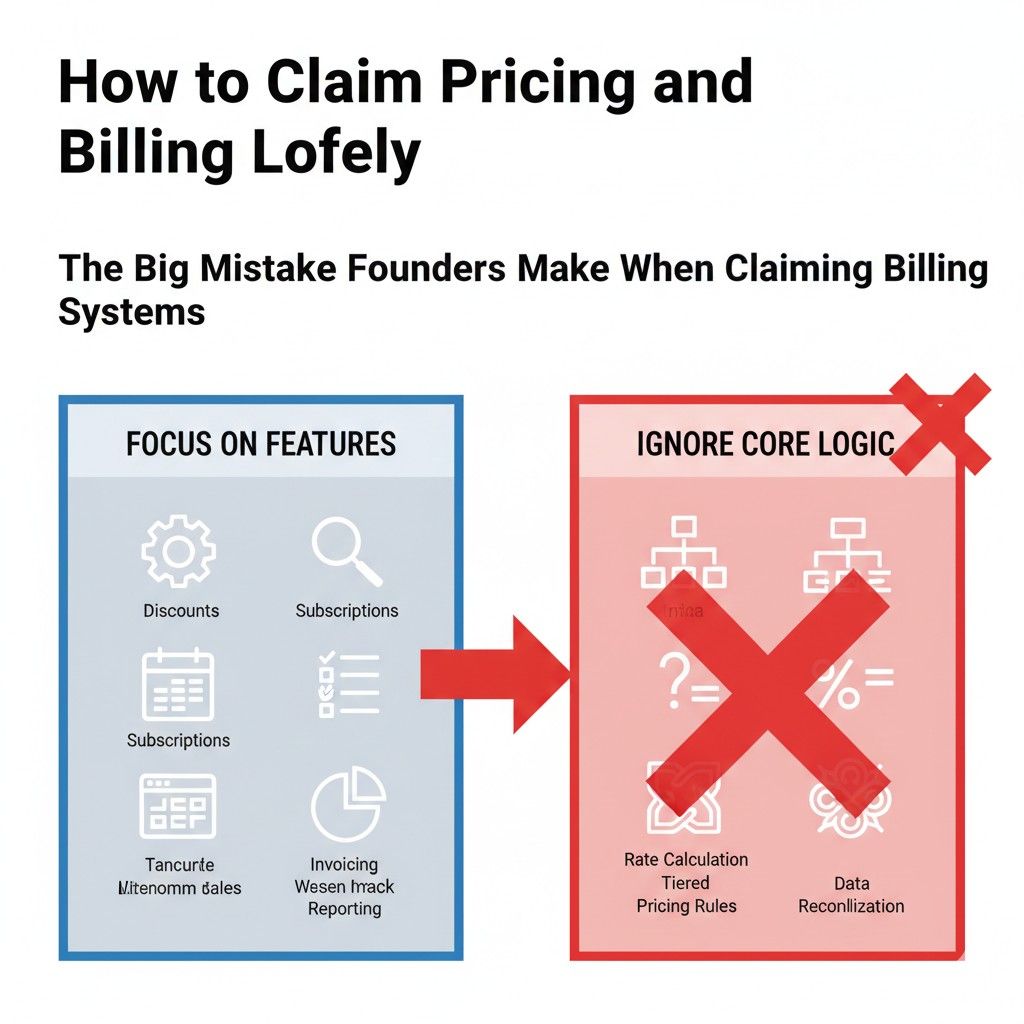
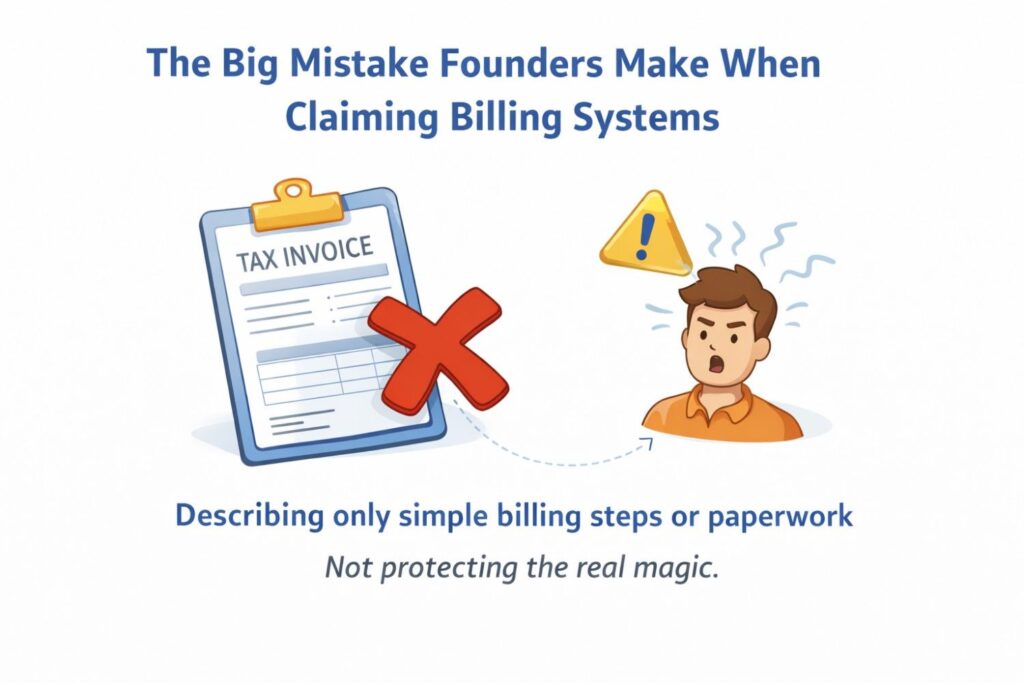
The Big Mistake Founders Make When Claiming Billing Systems
Most founders do not miss the value in their billing system because they are careless. They miss it because they are too close to the work. They know how much thought went into the logic.
They know how many edge cases had to be solved. They know how many product, finance, and engineering decisions had to line up to make the system work.
But when it is time to describe that work for patent purposes, they often shrink it into a broad business statement.
That is the big mistake.
They describe the result instead of the mechanism. They talk about flexible pricing, dynamic billing, usage-based charging, or smart invoicing.
Those phrases may sound useful in a meeting, but they are too loose to carry real weight when the goal is protection.
A billing system does not become easier to protect because it sounds modern.
It becomes easier to protect when the company can explain exactly how the system operates, what inputs it uses, what decisions it makes, and how it produces a practical outcome in a real software environment.
Founders Often Claim The Idea, Not The Actual System
This happens all the time in early-stage companies. The founder knows the business value clearly, so that is the part they lead with. They say the invention is a way to charge customers based on usage more fairly.
Or they say it is a system for flexible plan changes during a contract period. Those statements are true, but they are still only the surface.
The deeper value sits underneath. It lives in the rules engine, the event handling, the tracking flow, the timing logic, the state changes, and the reconciliation steps that make the system work in practice.
When that deeper layer is missing from the description, the claim gets weak fast.
Broad Business Language Creates Weak Protection
A billing system may be highly valuable and still be described in a way that gives almost no real protection.
That usually happens when the write-up sounds like a pitch deck instead of a product architecture discussion. The company uses polished business language, but the actual technical flow never appears.
That is dangerous because broad language can make a real invention look like nothing more than a pricing concept.
A concept is not enough. A useful patent strategy needs the company to show how the concept is carried out through concrete logic inside a working system.
A Pricing Goal Is Not The Same As A Billing Invention
There is a big difference between saying what the business wants and showing how the software makes it happen. A goal might be to reduce buyer friction.
Another goal might be to charge only when a customer reaches measurable value. Those may be smart commercial goals, but they are not yet a detailed invention.
The invention may be the way the platform measures account activity across multiple services, maps those events to billing states, delays charge creation until a threshold is met, and then adjusts future billing windows based on later account changes.
That is the part founders need to capture. The value lives in the operational structure, not just the commercial aim.
Many Teams Stop At The Pricing Model
A pricing model is important, but it is only one layer. Founders often think in terms of plan design because that is what customers see. They focus on seats, credits, tiers, bundles, add-ons, and overages.
But the patent value often sits one level lower, in the logic that connects those pricing choices to software behavior.
That lower layer is where real work happens. It is where the platform decides which account events matter, when a charge should be generated, when a credit should be applied, when a customer moves between states, and how exceptions are resolved without manual review.
That is where a company often has something original, even if the visible pricing page looks familiar on the surface.
Surface Packaging Can Hide Deep System Design
Two companies can both offer usage-based pricing and still have very different internal systems. One may rely on crude month-end calculations and heavy manual fixes.
The other may use continuous event tracking, threshold-triggered account updates, and real-time billing state management. To a customer, both may look similar at first glance. Inside the product, they are not similar at all.
This is exactly why founders should not stop at describing the packaging. The system underneath may be the more valuable invention. If that part is left out, the filing may fail to reflect what actually makes the business hard to copy.
Founders Tend To Underestimate Their Own Edge Cases
Another big mistake is assuming that edge-case handling is too minor to matter. Many teams treat exception logic like cleanup work.
They say the real invention is the main billing flow, while all the special rules around contract changes, account merges, usage corrections, delayed reporting, and partial-period transitions are just support details.
In reality, those details may be where the strongest protection lives.
Messy scenarios are often the hardest part of billing design. If your team built a reliable system for handling them at scale, that is not just operational polish. That can be a meaningful technical solution to a real business systems problem.
What Feels Ordinary Internally May Be Highly Valuable Externally
Inside the company, the team remembers the pain. They remember how broken the first version was. They remember customer complaints, finance escalations, and reporting gaps.
After months of fixing it, the final logic starts to feel normal. That is the trap. Familiarity makes the work look smaller than it is.
A smart founder steps back and asks a different question. Would another company in the same space need serious time and effort to rebuild this correctly?
If the answer is yes, then the system should not be dismissed as routine. It may reflect a real edge that deserves a stronger claim strategy.
The Wrong Description Makes Real Innovation Sound Abstract
Billing systems often sit in a risky zone. They involve money, rules, timing, and customer states. If described poorly, they can sound abstract very quickly. That is one reason founders need to be careful.
The system may be real, specific, and highly useful, but a vague explanation can make it look like a generic business method.
That does not mean billing inventions are weak by nature. It means the framing matters a lot.

A founder needs to anchor the invention in practical software operations. The more the write-up shows data flow, system actions, condition checks, and output changes, the safer the position becomes.
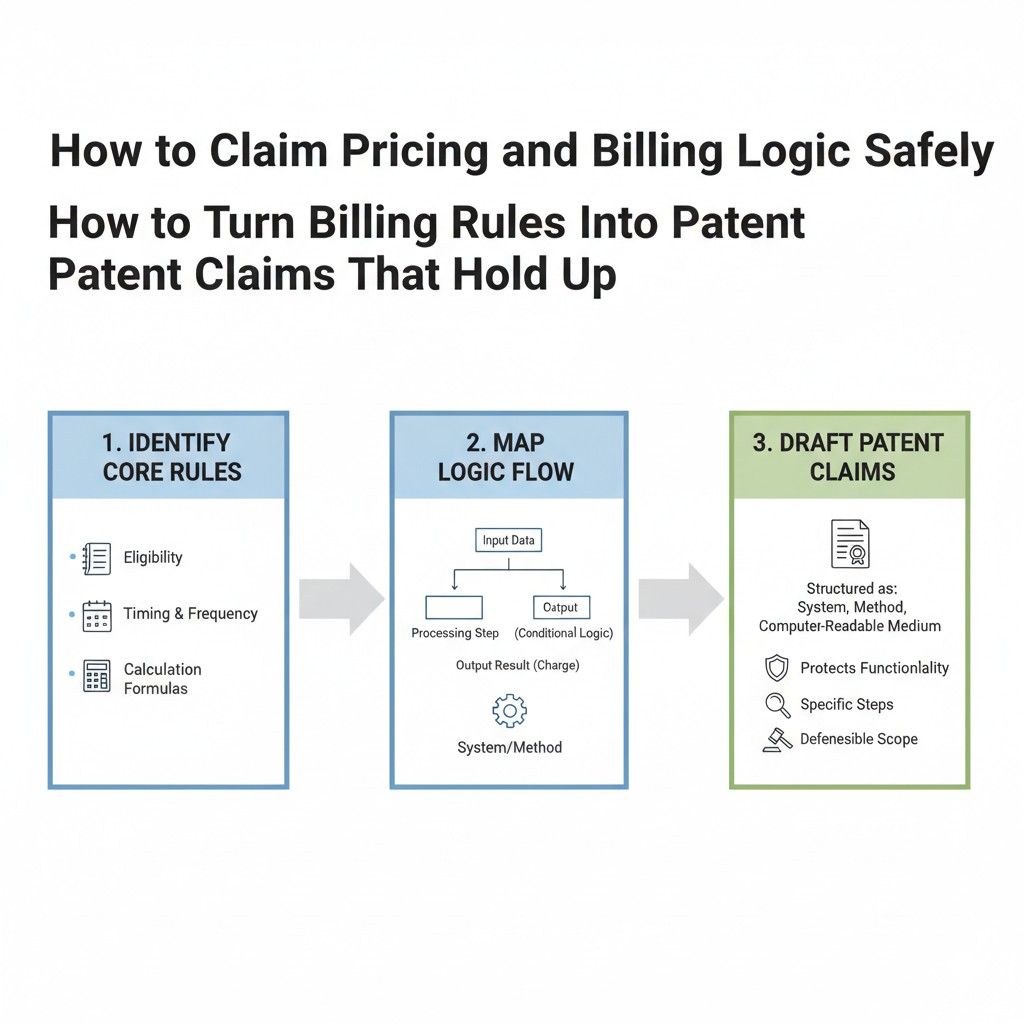
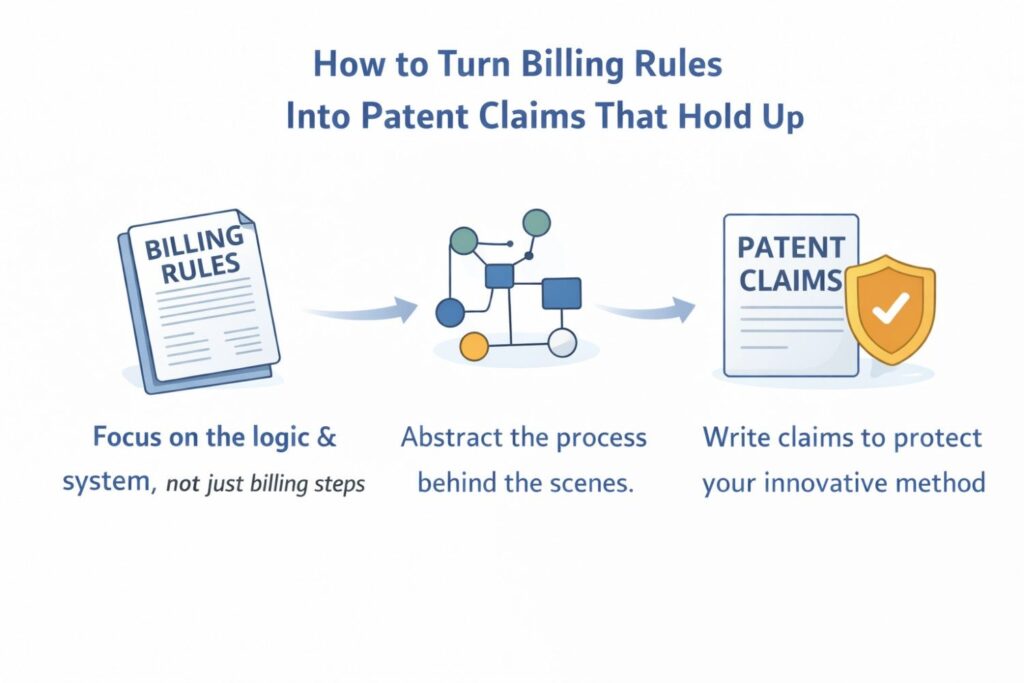
How to Turn Billing Rules Into Patent Claims That Hold Up
A lot of founders know their billing system is smart. They know it solves real problems. They know it took time to build.
But when it is time to turn that work into patent claims, the description often becomes too soft, too broad, or too business-heavy.
That is where good protection starts to fall apart. The goal is not to say your system helps companies bill better. The goal is to show exactly how your software handles real billing events through clear logic, clear steps, and clear system behavior.
Start With The Actual System, Not The Pricing Idea
Many teams begin in the wrong place. They begin with the business model. They say they invented usage-based pricing, dynamic invoicing, flexible subscriptions, or mixed contract billing.
That sounds useful, but it is not enough. A pricing concept by itself is usually too high-level. Claims hold up better when they are built around the real system that carries out the pricing logic.
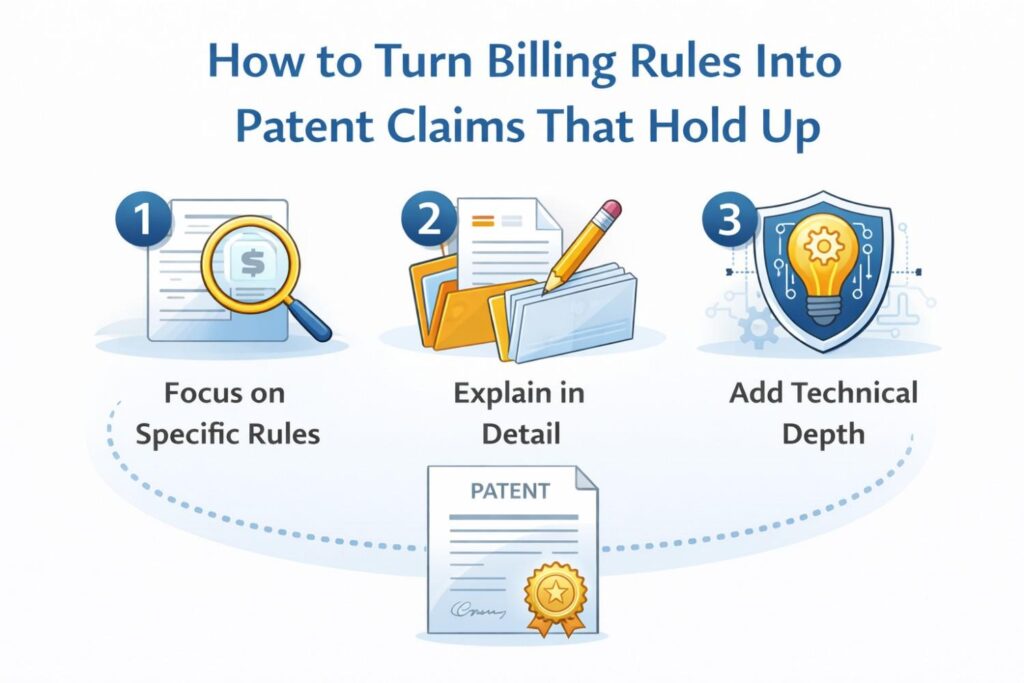
The better move is to start with what the software actually does. Look at the data it receives, the rules it checks, the timing it applies, the account state it reads, and the output it produces. That is where the real invention usually lives.
Focus On System Behavior
If your platform adjusts charges when usage crosses a threshold, the valuable part is not the idea of threshold pricing.
The valuable part may be how the platform detects that threshold, how it decides whether the change applies right away or later, how it prevents double charging, and how it updates invoice state across customer accounts.
Those details are what turn a billing idea into something more solid and defensible.
Describe Inputs With More Care
A weak patent draft often skips past the starting point. It says a system determines a charge based on usage or account activity. That leaves too much open.
A stronger draft explains what enters the system and how those inputs are defined in practice.
This matters because billing systems do not run on vague concepts.
They run on usage records, account tier settings, user count changes, feature access states, contract terms, renewal dates, credit balances, and event timestamps.
When those inputs are named clearly, the invention becomes easier to see and easier to claim.
Treat Inputs Like Technical Building Blocks
Founders should think of billing inputs the same way they think of product inputs. If an engineering team would care about where the data comes from and when it enters the logic flow, that detail probably matters here too.
You want to show that the billing result is not magic. It comes from a defined set of system conditions and measured events.
Show The Trigger, Not Just The Result
A lot of billing descriptions jump from state to outcome. They say a user upgrades and the system recalculates charges. But what causes that recalculation?
When does it happen? What exactly counts as the triggering event? Those questions matter.
Claims tend to get stronger when they explain what event starts the pricing logic.
That might be a resource crossing a threshold, a seat being added, a contract state changing, a billing period ending, a customer action being approved, or a delayed usage report arriving after a prior invoice was already formed. The more clearly the trigger is described, the more grounded the invention becomes.
Timing Is Often Part Of The Invention
In many billing systems, timing is not a side detail. It is part of the core logic. A system may apply a charge immediately in one case, defer it in another case, or split treatment across periods based on predefined rules. That timing logic can be one of the most valuable parts of the invention, especially when it solves fairness, accuracy, or scale problems that older systems handled badly.
Turn Rules Into Ordered Logic
Billing rules sound simple when spoken out loud. In practice, they often depend on sequence. One rule may apply only if another condition is true first. An exception may override a standard calculation.
A credit may be applied before or after a threshold evaluation. A usage event may count only if the account was active at a certain time.
This is why strong claims usually come from ordered logic rather than loose rule summaries. You are not just saying the system has rules. You are showing how those rules are applied in sequence to reach a reliable outcome.
Order Creates Structure
A founder may say, “Our platform supports plan changes with fair prorating.” That is a business statement.
A stronger framing is to show how the system identifies the prior service state, measures remaining entitlement value, determines a revised service state, applies adjustment logic based on timing and usage, and generates an updated billing record.
That has structure. It sounds like a system because it is one.
Include Edge Cases Early
One of the biggest missed chances in billing patents is leaving out edge cases.
Teams often think edge cases are messy details that belong in engineering notes, not in an invention story. In truth, those cases are often where the strongest value sits.
If your system handles contract overlap, delayed metering data, account mergers, seat removal during open billing periods, shared usage pools, or mixed prepaid and postpaid treatment, those scenarios may show why the system is not ordinary.
They can help prove the design solves real-world problems in a way that simple billing logic does not.
Edge Cases Show Depth
A claim set becomes more useful when the core claim captures the main mechanism and supporting claims cover the special situations that make the system practical in the real world.
This matters because a billing system that only works in clean textbook conditions is not where most startup value lives. The real value is in making the system hold together when customer behavior gets messy.
Tie The Logic To Real Software Components
Patent claims become safer when they are not floating in abstract language. They should connect to actual software behavior. That does not mean stuffing in technical jargon.
It means showing that the billing rules are carried out by defined parts of a system.
You may have a usage collector, a pricing rules engine, an account state manager, an invoice generator, an entitlement service, or a reconciliation module.
The exact names do not matter as much as the clarity. What matters is showing how parts of the system interact to perform the billing logic in a real and repeatable way.
Do Not Leave The Mechanism Invisible
A common mistake is to write as if the system simply knows what to charge. That creates a gap.
Better claim support comes from explaining how data flows between components and how one part causes another part to update records, apply rules, or generate outputs.
When the mechanism stays visible, the invention feels concrete rather than conceptual.
Write For Enforcement, Not Just Filing
A patent claim should not only sound good when filed. It should still matter when a competitor builds something close.
That means founders should think beyond broad language that feels impressive and toward language that captures what others would actually copy.
This is where strategy matters. If the real value of your system is how it handles usage spikes across multiple billing periods without manual correction, then that mechanism should not be buried deep in the draft. It should shape the claim strategy.
If a competitor could avoid your claim by changing one label while keeping your real logic, the claim may not be doing enough work.
Protect The Part That Creates Business Leverage
Good billing patents are often built around the part of the system that gives the company leverage.
That might be the automated handling of plan transitions, the fair allocation of shared usage, the reconciliation of delayed activity, or the generation of accurate charges from changing account conditions.
Founders should ask what part of the logic a competitor would most want to copy once the model proves itself. That is often where the best claim focus sits.
Keep The Language Clear Enough To Reuse Internally
One underrated advantage of a well-claimed billing invention is that the language can also sharpen internal understanding.
If the system is described clearly enough for a patent draft, it becomes easier for product, engineering, finance, and leadership to align around what actually makes the logic special.

That is useful because many teams have never written down the billing engine in one coherent form.
They have tickets, docs, pricing pages, and engineering decisions spread everywhere. Turning that into a clear invention description helps with both protection and strategy.
Wrapping It Up
Pricing and billing logic can look small when you are inside the company. It can feel like one more internal system, one more rules engine, one more thing the team had to fix so revenue runs cleanly. But that view misses what is really going on. In many startups, billing logic is not just support work. It is part of how the company wins, how it grows, and how it keeps customers.