Your invention is only as strong as the way you describe it. If you cannot clearly explain what makes it new, different, and useful, no patent attorney or examiner can protect it. An invention disclosure form is not paperwork. It is the blueprint for your protection. In this guide, you will learn exactly how to capture real novelty in your invention disclosure form so your idea stands strong, moves fast, and avoids costly mistakes.
Before we go deeper, if you want to see how PowerPatent helps founders turn raw ideas, code, and models into strong, attorney-backed patent filings without slowing down, you can explore how it works here: https://powerpatent.com/how-it-works
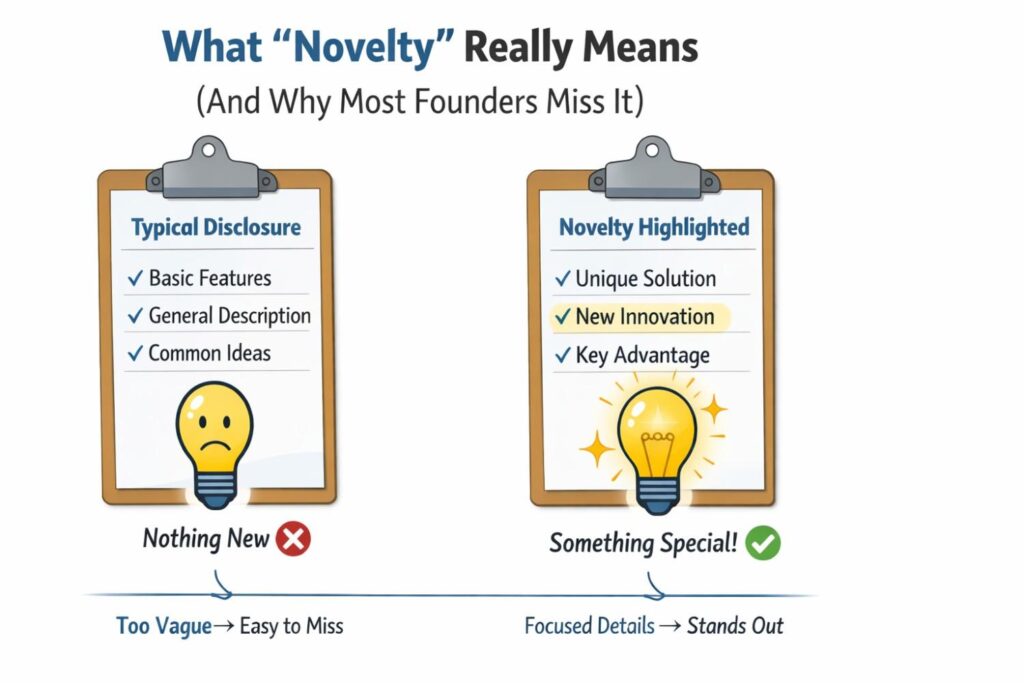
What “Novelty” Really Means (And Why Most Founders Miss It)
Most founders think novelty means “my product is cool” or “no one has built this exact thing before.” That is not enough. Novelty is about what is technically different in the way your invention works.
It is about the specific mechanics, structure, or steps that have not been publicly disclosed before. If you miss this point in your invention disclosure form, you risk building on sand.
When you fill out an invention disclosure form, you are not telling a marketing story.
You are laying down the technical truth of what makes your invention new. If you skip the details or stay too high level, you lose the very thing you are trying to protect.
Let’s go deeper.
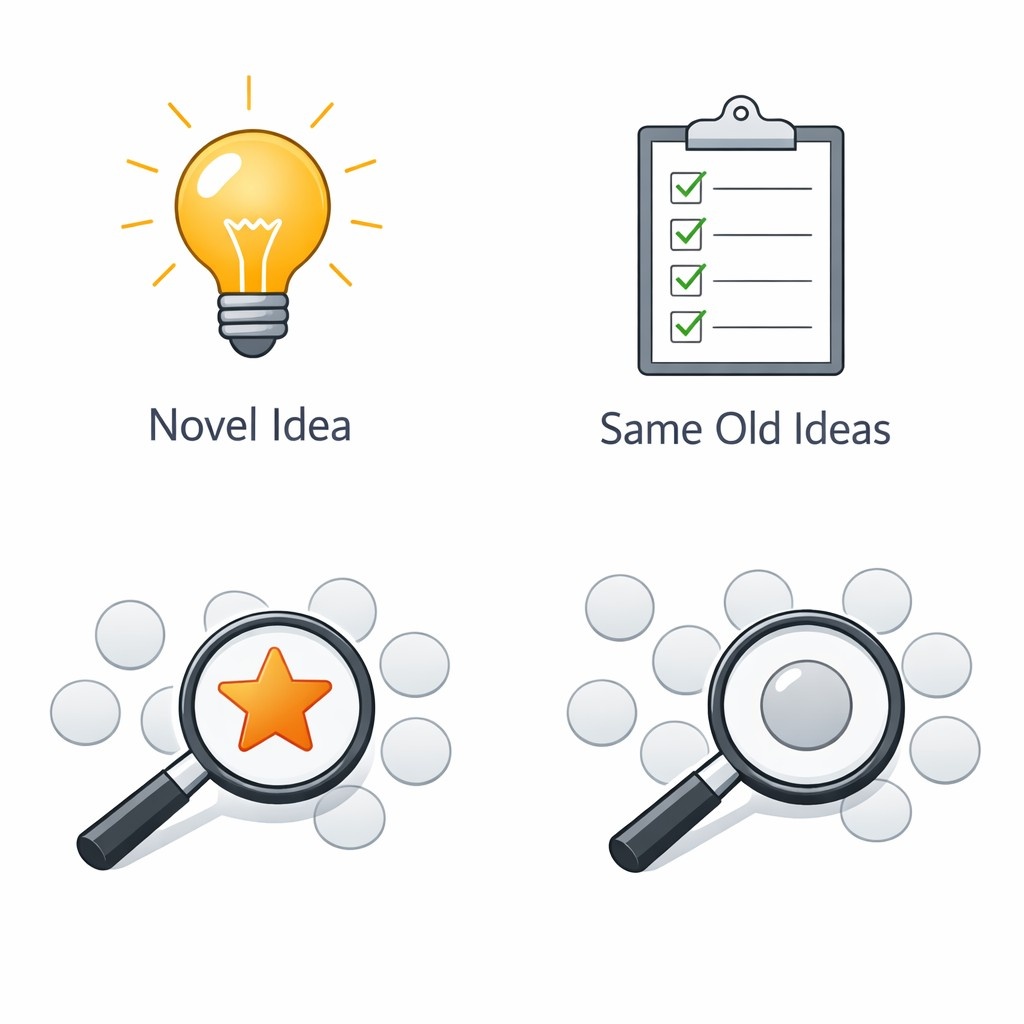
Novelty Is About Differences That Matter
Before you write a single word in your disclosure form, you need to shift your thinking. Novelty is not about surface differences. It is about meaningful technical differences.
If your software tool is “faster,” that is not novelty by itself. But if it uses a new data structure, a new training pipeline, or a new sequence of steps that no one else has described, that could be novelty.
The key question to ask yourself is simple: if someone reads my disclosure, can they clearly see what is technically different from what already exists?
In business terms, this matters because strong novelty creates leverage. It gives you defensible ground. Weak novelty gives you false confidence.
When you draft your disclosure, describe the inner engine, not the outer shell. Explain what is happening under the hood. If your system uses a specific combination of models, explain the order.
If it modifies an existing algorithm, explain how and why. The smallest change in process can create powerful protection if captured clearly.
This is where many startups go wrong. They describe outcomes. They do not describe mechanisms.
The Gap Between Idea and Implementation
Founders often think their big idea is the invention. In reality, the invention often lives in the implementation.
You may say, “We built a platform that matches buyers and sellers using AI.” That sounds impressive.
But it is not novel by itself. What may be novel is how your system ranks results, how it cleans data before training, how it balances fairness and speed, or how it reduces compute cost.
Your invention disclosure form should zoom into the technical gap between the problem and your solution. That gap is where novelty hides.
A strategic move here is to write down the problem your system solves, then write down how others typically solve it. Then describe how your method is different step by step.
This comparison thinking helps you see novelty more clearly.
For businesses, this is not just about patents. It sharpens your product story. When you know exactly how you are different at a technical level, you build stronger positioning in the market as well.
If you want help structuring this correctly so you do not miss hidden novelty in your code or models, PowerPatent guides you through this process with smart software and real attorney review. You can see how it works here: https://powerpatent.com/how-it-works
Novelty Is Not the Entire Product
Another reason founders miss novelty is because they try to protect the entire product in one sweep. That is rarely how strong patents are built.
Novelty often sits in a specific feature, workflow, architecture, or improvement. If you try to describe everything at once, you dilute the new part.
In your disclosure form, isolate the technical core. Imagine your product without the novel part. What remains? Now focus only on the piece that truly changes how the system operates.
For example, if you built a hardware device, the novelty may not be the full device. It may be a specific sensor placement, a signal processing method, or a feedback loop.
In software, it may be a new way to combine data inputs or a new sequence of validation checks.
This isolation strategy is powerful for businesses because it allows you to file focused patents that are easier to defend and harder to design around.
Public Knowledge Is the Invisible Enemy
Novelty is measured against what is already public. That includes patents, research papers, blog posts, open-source code, and even public demos.
Many founders assume that because they have not seen a direct competitor, they are safe. That assumption can be dangerous.
When drafting your disclosure, act as if an examiner will compare your invention to every public document in your field. Your job is to make the difference obvious.
A practical approach is to do a light scan of known tools or patents in your space. You do not need a full legal search at this stage. You simply need awareness.
Then, in your disclosure, clearly state how your invention operates differently.
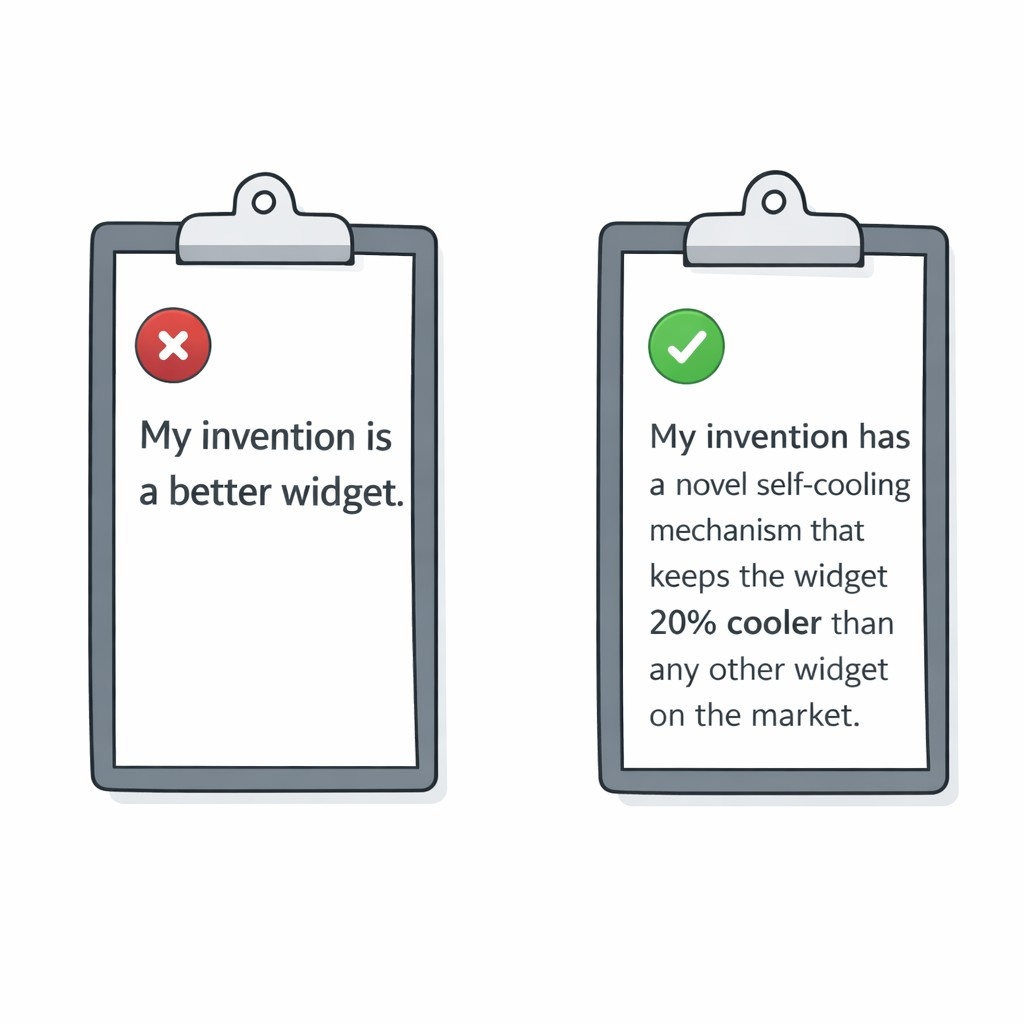
Avoid vague phrases like “improved system” or “enhanced performance.” Instead, explain the structural change. Did you remove a step? Add a new feedback loop?
Change the order of operations? Introduce a new data transformation?
The more concrete you are, the easier it is to defend your novelty later.
Why Founders Underestimate Small Technical Shifts
Many teams dismiss small changes as obvious. They think, “This is just common sense.” That mindset can cost you.
What feels obvious after you build it may not have been obvious before it existed. Many strong patents are built on simple but non-obvious technical shifts.
If your system reduces latency by changing how requests are queued, that change might look minor internally. But if no one has publicly described that exact approach, it could be powerful novelty.
In your disclosure form, do not filter out details because they seem small. Capture them. The role of the patent strategy process is to evaluate and shape those details. But they must first be documented.

This is where speed matters. The earlier you capture these insights, the less you forget. PowerPatent was built so founders can quickly document their technical edge while it is fresh, without slowing down product development.
If you want to protect your technical lead before competitors catch up, learn more here: https://powerpatent.com/how-it-works
Novelty Is a Strategic Asset, Not Just a Legal Box
Too many businesses treat novelty as a legal hurdle. In reality, it is a strategic asset.
When you clearly define what makes your invention new, you create a map of your competitive advantage. That map helps with fundraising, partnerships, and acquisitions.
Investors often ask, “What stops someone bigger from copying you?” A clear understanding of your novelty gives you a real answer.
Your invention disclosure form is the first draft of that answer.
As you write, think beyond the patent office. Think about how this technical difference supports your moat. Does it lower cost? Improve speed? Increase accuracy?
Create lock-in? The stronger the link between novelty and business value, the stronger your overall position.
Translating Technical Depth Into Clear Explanation
Engineers often know their system deeply but struggle to explain it simply. Yet clarity is critical for capturing novelty.
When filling out your disclosure form, pretend you are explaining your invention to a smart engineer in a different field. Avoid shortcuts and internal slang. Spell out what each component does and how it connects to the next.
If your invention involves machine learning, describe the data flow from input to output. If it involves hardware, describe the physical relationships between parts. If it involves a process, describe each step in sequence.
Clarity is not about being simple-minded. It is about being precise.
One powerful exercise is to draw a basic diagram of your system, even if the form does not require it. Then write your description based on that diagram. This forces you to see the moving parts and identify where novelty actually lives.
Timing Can Make or Break Novelty
There is one more hidden reason founders miss novelty. They wait too long to document it.
In fast-moving startups, features evolve quickly. If you wait until a funding round or product launch to fill out an invention disclosure form, you may forget early design decisions that were actually novel.
Capture innovation in real time. After a major technical breakthrough or architecture change, pause and document what changed and why. Even a rough draft is better than nothing.
Over time, these small records become a gold mine. They allow you to build layered protection instead of scrambling later.
If you want a system that helps you document innovation continuously, with smart prompts and real attorney oversight so you do not miss key details, explore how PowerPatent works here: https://powerpatent.com/how-it-works
How to Clearly Explain What Makes Your Invention Different
If you cannot clearly explain how your invention is different, you do not control it. And if you do not control it, you cannot protect it.
Most founders think the difference is obvious. It feels obvious because you built it. You lived inside the code. You argued about the architecture. You made trade-offs. But none of that is visible to someone outside your team.
An invention disclosure form is where you turn internal knowledge into clear, structured explanation. This is not about sounding smart. It is about making the difference impossible to ignore.
Let’s break down how to do that in a way that is strategic, practical, and built for real businesses.
Start With the Old Way Before You Explain the New Way
Before you describe your invention, describe how the problem is usually solved.
This step feels small, but it changes everything.
When you show the old way clearly, your difference becomes sharper. Without that contrast, your explanation floats in space.
Write a short explanation of how others approach the same problem. Be fair. Be factual. Do not exaggerate. Just explain the typical system, method, or structure.
Then describe the limits of that approach. Where does it slow down? Where does it waste compute? Where does it create risk? Where does it require manual work?
Now you are ready to explain your approach.
By placing your invention right next to the traditional method, you make the difference clear without trying too hard.
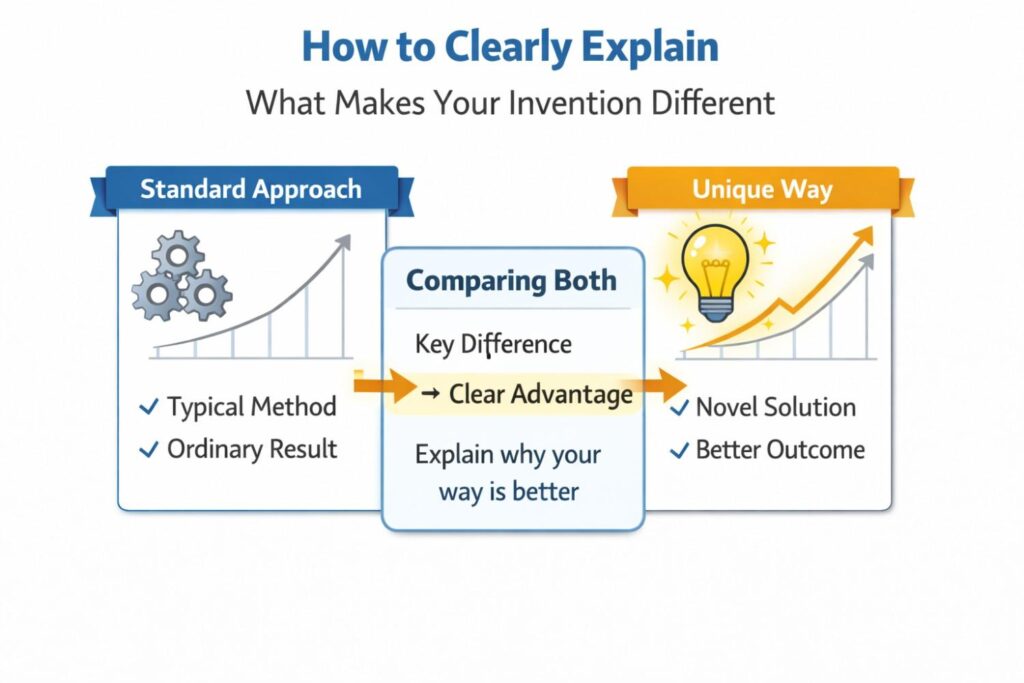
From a business view, this also helps you clarify your competitive edge. You are not just building something new. You are solving a specific weakness in the existing world.
Focus on Structure, Not Just Results
One of the biggest mistakes founders make is focusing only on results.
They write things like “Our system improves accuracy” or “Our platform reduces cost.” That is helpful for marketing, but not enough for a patent.
A patent protects structure and process. It protects how something works, not just what it achieves.
When you fill out your invention disclosure form, explain the internal structure. If your system has modules, describe how they connect. If your method has steps, describe the order and why the order matters.
If you changed how data flows through your system, explain that change clearly. If you introduced a new layer between two components, explain what it does and why it is there.
Think like an engineer reading documentation for the first time. They should be able to understand your system without guessing.
Clarity here builds strength later. It also prevents costly rewrites when working with attorneys.
At PowerPatent, founders use guided prompts to capture these structural details early, so nothing important gets lost before filing. You can see how that process works here: https://powerpatent.com/how-it-works
Break the Invention Into Moving Parts
Trying to explain your whole system in one paragraph almost always leads to confusion.
Instead, mentally break your invention into parts.
Describe each part in plain language. What does it do? What inputs does it receive? What outputs does it produce? How does it interact with other parts?
Then explain what is different about each part compared to standard systems.
For example, if you built a machine learning pipeline, do not just say “We use a custom training method.” Explain how data is collected, cleaned, labeled, transformed, and fed into the model.
If you added a feedback loop that retrains based on live user signals, explain exactly how that loop works.
Even small changes in how parts connect can be powerful differences.
From a strategic standpoint, this level of detail creates options. It allows your patent application to focus on multiple aspects of your system, not just one narrow idea. That makes it harder for competitors to design around you.
Explain Decisions, Not Just Mechanics
Many founders describe what their system does but forget to explain why it is designed that way.
The “why” often reveals novelty.
If you chose a specific data structure to reduce latency, say so. If you rearranged processing steps to reduce memory use, explain that reasoning.
If you replaced a manual review step with an automated scoring engine, describe the logic behind that shift.
When you show the reasoning behind design choices, you highlight the problem your invention solves at a deeper level.
This is important because patents often hinge on solving technical problems in new ways. The more clearly you connect your structure to the problem it solves, the stronger your position.
For businesses, this also sharpens your internal clarity. When your team understands why the system is designed the way it is, you make better product decisions going forward.
Avoid Vague Language at All Costs
Vague language weakens protection.
Words like “optimized,” “improved,” “advanced,” and “smart” do not explain anything. They sound impressive, but they hide the real mechanics.
Instead of saying “an optimized routing system,” explain how routing decisions are made. Are you using weighted scoring? Real-time data feeds? A priority queue? A new form of clustering?
The goal is to remove guesswork.
If someone could read your disclosure and still not understand how the system operates, you need to go deeper.

This does not mean writing complicated sentences. In fact, simple words are better. Short sentences are better. Clear examples are better.
Precision beats complexity every time.
Use Real Scenarios to Show the Difference
One powerful way to explain what makes your invention different is to walk through a real example.
Describe what happens when a user interacts with your system. Follow the flow step by step. Show where your system behaves differently than existing solutions.
For example, if your software processes transactions, explain what happens from the moment a transaction is received to the moment it is finalized. Point out where your new logic changes the flow.
Concrete scenarios make abstract systems easier to understand. They also help reveal hidden novelty that might not show up in a high-level explanation.
For startups moving fast, this kind of clarity prevents missed opportunities. Many founders realize during this walkthrough that they built something more unique than they first thought.
If you want a guided way to capture these technical flows without slowing down development, PowerPatent combines software prompts with real attorney review so you stay both fast and protected. Learn more here: https://powerpatent.com/how-it-works
Think Like a Competitor Trying to Copy You
A strategic way to test your explanation is to imagine a competitor reading it.
If they could easily copy your system based on what you wrote, you may not have captured the true difference.
Ask yourself: what would they need to know to replicate this? Have I clearly explained the core mechanism that gives us our edge?
This exercise forces you to identify the real technical leverage points in your invention.
It also protects your future growth. The stronger your explanation of what makes you different, the harder it becomes for others to move into your space without stepping on your rights.
Capture Variations While You Still Remember Them
As you explain what makes your invention different, also think about variations.
Are there alternate ways your system could be implemented? Could the same logic apply to a different data type? Could the same structure be used in another industry?
You do not need to write a full expansion plan. But briefly noting these variations in your disclosure can significantly expand your protection.
Founders often forget these ideas later because they are focused on shipping. By capturing them early, you create room to grow.
This is another reason speed matters. The closer your disclosure is to the moment of invention, the more complete it will be.
At PowerPatent, the goal is simple. Help founders turn technical insight into clear, structured, attorney-backed filings without the delays and confusion of traditional firms.
If you want to protect what makes your invention truly different, explore how it works here: https://powerpatent.com/how-it-works
When you clearly explain what makes your invention different, you do more than fill out a form. You define your edge. You strengthen your moat. You turn engineering effort into real business protection.
Turning Technical Details Into Strong, Defensible Patent Language
Having strong technology is not enough. If your disclosure is full of raw technical notes, scattered comments, and half-explained diagrams, it will not translate into strong protection.
The goal is simple. You must take what lives in your codebase, hardware design, or system architecture and express it in a way that is clear, broad enough to defend, but precise enough to stand up under review.
This is where many founders struggle. They either write too casually, like internal documentation, or too narrowly, locking themselves into one specific version of their product.
Strong patent language sits in the middle. It protects the core idea while leaving room to grow.
Let’s walk through how to do that the right way.
Move From Code to Concepts
Your code is not your patent. Your concept is.
Engineers often copy blocks of logic into a disclosure form or describe their invention using function names and internal labels. That creates two problems. First, it limits protection to that exact implementation. Second, it becomes hard for someone outside your team to understand.
Instead of writing “We use function processBatchV2 to handle queued requests,” describe what the function actually does. Does it group incoming data into time-based clusters?
Does it assign priority weights? Does it validate entries before forwarding them?
Strip away internal names. Focus on what the system is doing in functional terms.
This shift from code-level detail to functional description is powerful. It allows your invention to cover future versions of your system, not just the current build.
From a business point of view, this protects your roadmap. You do not want to file a patent that only covers version 1.0 when version 2.0 is already in progress.
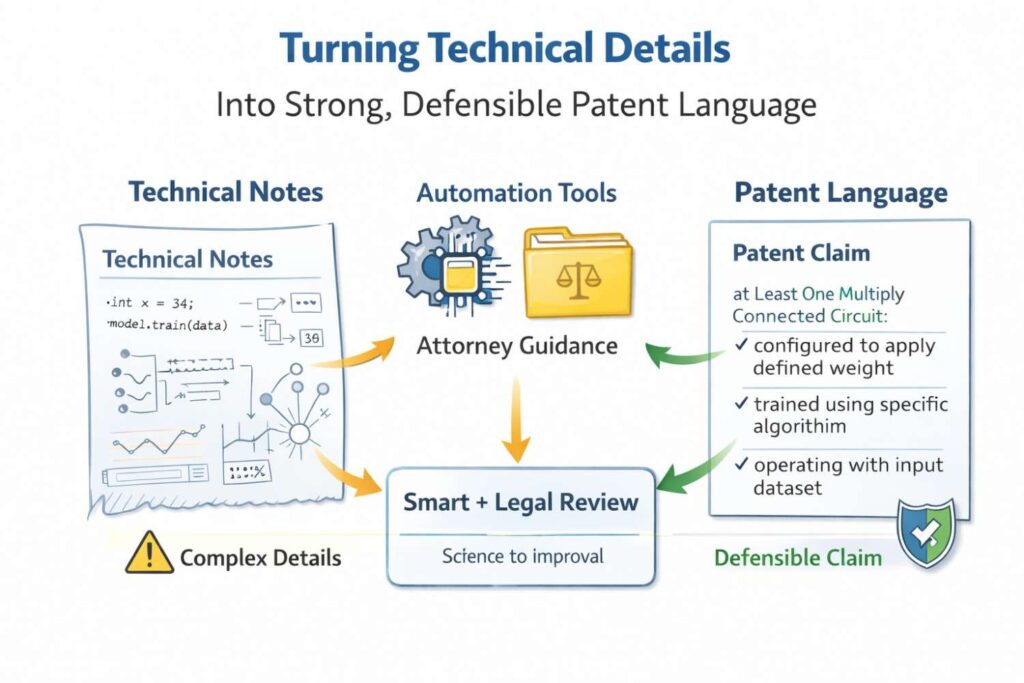
If you want guidance on translating technical builds into broader, defensible language while still being accurate, PowerPatent helps structure this process with smart prompts and real attorney oversight.
You can explore that here: https://powerpatent.com/how-it-works
Describe Systems as Capabilities, Not Just Components
Many disclosures read like inventory lists. They describe parts but not capabilities.
Strong patent language explains what each part is capable of doing within the system.
For example, instead of saying “a server connected to a database,” you might describe “a processing system configured to receive input data, analyze the data using predefined rules, and generate a structured output.”
Notice the shift. It moves from static components to active capability.
This matters because patents protect what a system is configured to do. The more clearly you define that capability, the stronger your protection becomes.
When writing your invention disclosure form, ask yourself: what is this part designed to accomplish? How does it change the state of data, signals, or physical components?
By framing your system in terms of capabilities, you widen your defensive perimeter without losing clarity.
Avoid Locking Yourself Into One Version
Founders often describe their invention in the exact form it exists today. That feels natural. It is what you built.
But if your disclosure only covers the exact architecture, hardware setup, or parameter values you currently use, you may trap yourself.
Strong patent language captures the core principle, not just the current configuration.
If your system uses three layers of processing, ask yourself whether the invention depends on exactly three layers or on the concept of layered processing.
If your algorithm uses a specific threshold value, ask whether the invention depends on that number or on adaptive thresholding more generally.
This does not mean being vague. It means identifying what truly matters.
Your disclosure should clearly explain the preferred version, but also indicate that variations can exist. That way, your patent application can be drafted in a way that protects the principle behind your solution.
This flexibility is critical for startups. Your product will evolve. Your patent protection should evolve with it.
Turn Technical Advantages Into Structured Claims
Every invention has technical advantages. Faster processing. Lower memory use. Improved accuracy. Reduced friction.
But in patent language, advantages must connect to structure.
Do not just say your system reduces latency. Explain how. Does it parallelize tasks? Does it reduce database calls? Does it preprocess data to eliminate redundant steps?
When you connect each advantage to a specific mechanism, you build the foundation for strong claims.
This is where many disclosures fall short. They describe results without anchoring them to design choices.
In your invention disclosure form, explicitly connect each benefit to the part of the system that creates it. This forces clarity and makes it easier for attorneys to draft strong, defensible claims.

For businesses, this also strengthens your story to investors. It shows that your edge is not marketing hype. It is built into the architecture.
Think in Terms of Independent and Dependent Protection
Even if you are not drafting the final patent claims yourself, you should think strategically about layers of protection.
There is usually a broad core idea and then narrower refinements.
The broad idea might be a new way to process real-time data streams. The refinements might include a specific filtering method, a feedback loop, or a unique prioritization rule.
Your disclosure should capture both.
Explain the big picture concept clearly. Then explain the detailed improvements that make your implementation powerful.
This layered thinking allows your eventual patent to include broad protection supported by detailed examples.
Without those details, broad protection may not hold. Without the broad framing, you risk protecting only a small slice of your innovation.
PowerPatent is designed to help founders capture both layers without getting buried in legal complexity.
The software guides you to document the core idea and the supporting technical depth, and real attorneys ensure it is shaped correctly before filing.
If you are building serious technology, this hybrid approach saves time and prevents costly mistakes. Learn more here: https://powerpatent.com/how-it-works
Use Clear, Neutral Language
Patent language must be clear and neutral.
Avoid exaggerated claims like “revolutionary” or “unmatched.” Those words do not strengthen protection. They weaken credibility.
Stick to factual descriptions. Explain what the system does, how it does it, and what technical effect it creates.
Short sentences help. Direct wording helps.
If you are unsure whether something is clear, imagine explaining it to an engineer who has never seen your product. Would they understand how to build a similar system based on your description?
If the answer is no, you need more detail. If the answer is yes, but only for one very specific version, you may need to generalize slightly.
Clarity with controlled breadth is the sweet spot.
Capture Edge Cases and Failure Modes
Strong patent protection does not only describe the ideal scenario. It also considers edge cases.
What happens when input data is incomplete? What happens when hardware fails? What happens when a model prediction confidence score drops below a threshold?
If your invention handles these situations in a new way, that is part of the novelty.
Document it.
These details often reveal deeper technical insight. They show that your invention is not just a concept but a working system built for real-world complexity.
For startups operating in high-stakes fields like AI, biotech, fintech, or hardware, edge-case handling can be a major differentiator. Capturing it early strengthens both your patent position and your technical narrative.
Do Not Wait Until Fundraising to Translate Your Tech
Many founders only think about patent language when investors ask about IP.
By that time, key technical insights may be forgotten or buried in old commits.
Translate your technical details into structured, defensible language while the knowledge is fresh. Do it when you finish a major architecture change. Do it when you discover a breakthrough optimization.
This habit turns patent strategy into an ongoing asset instead of a last-minute scramble.
PowerPatent was built for this exact rhythm. It allows founders to document innovation quickly, in plain language, and then have real patent attorneys refine it into strong filings.
That combination of speed and oversight is what protects serious startups from avoidable mistakes. You can see how it works here: https://powerpatent.com/how-it-works
Turning technical details into strong patent language is not about sounding legal. It is about expressing your engineering decisions in a structured, future-proof way.
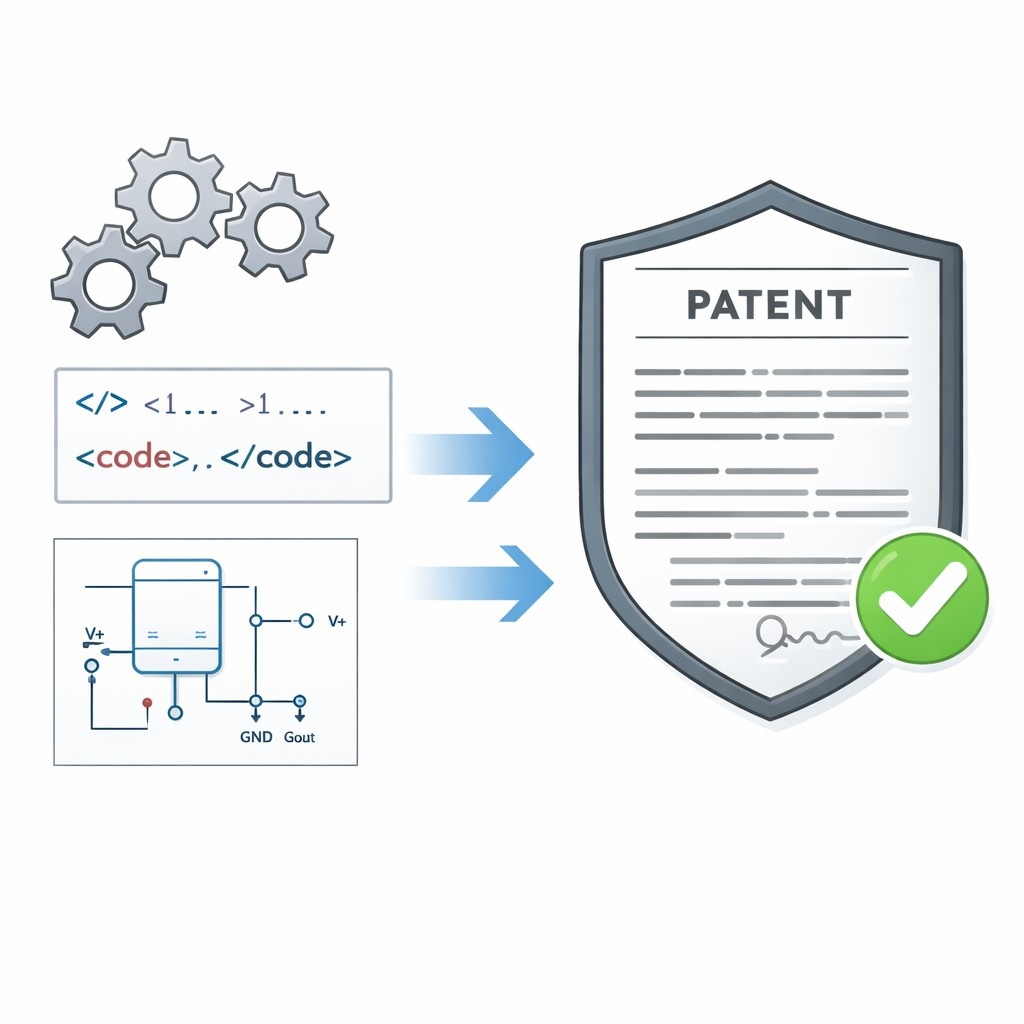
When you do this well, you are not just filing paperwork. You are building a shield around your core technology.
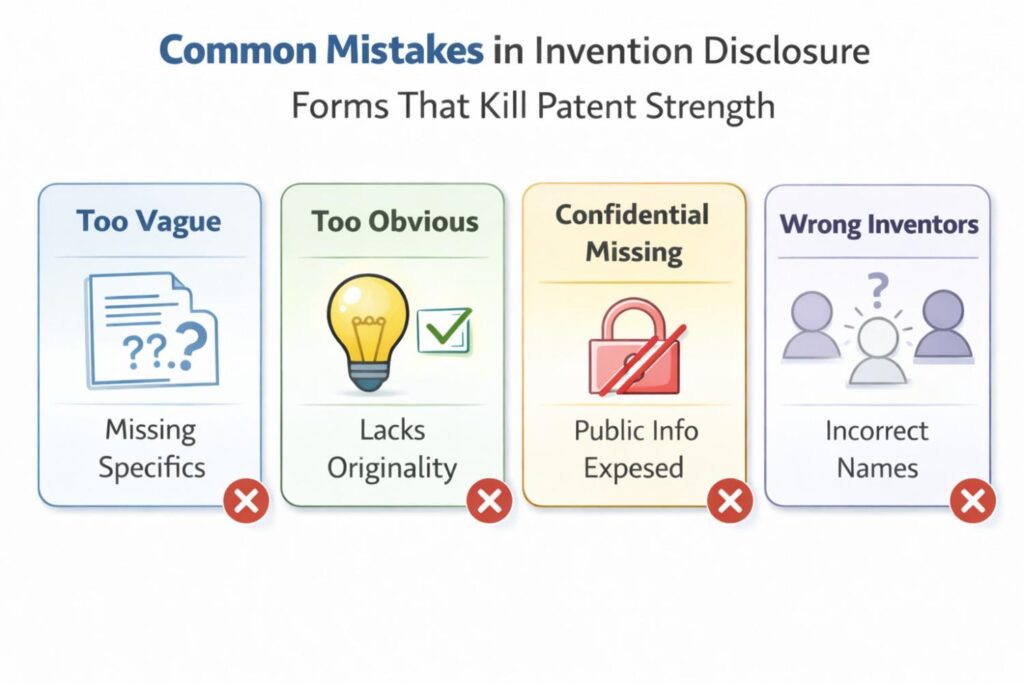
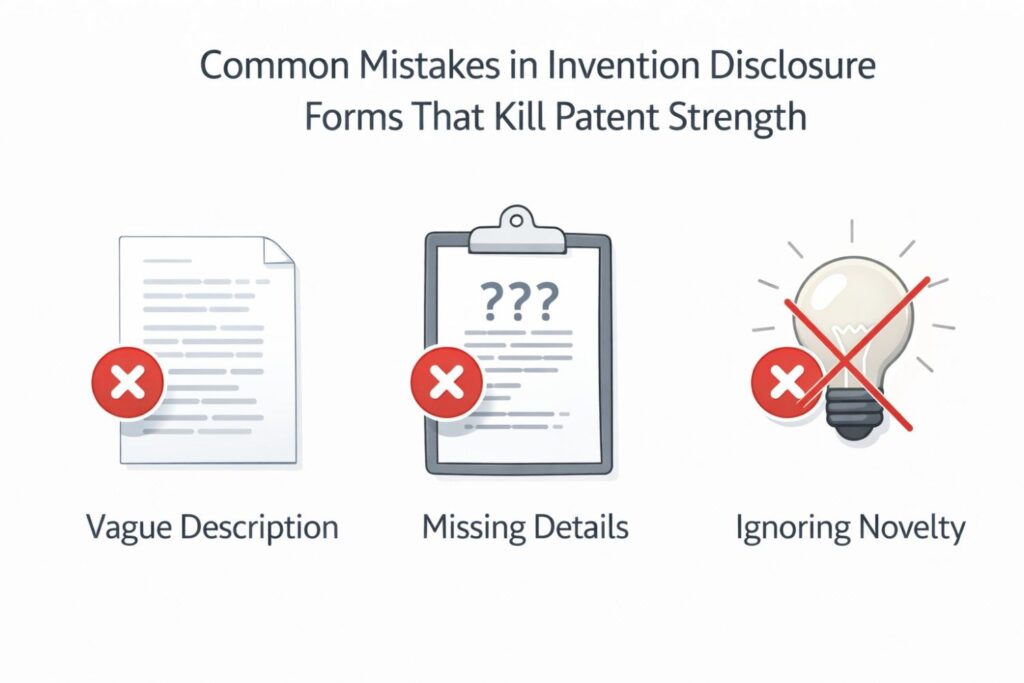
Common Mistakes in Invention Disclosure Forms That Kill Patent Strength
A weak invention disclosure does not just slow down your patent. It can quietly destroy its value.
Many founders assume that once they submit a disclosure, the hard part is done. In reality, the strength of your future patent depends heavily on what you capture at this early stage.
If key details are missing, unclear, or framed the wrong way, no attorney can magically fix it later.
This is not about paperwork. It is about protecting the core of your business.
Let’s walk through the mistakes that quietly weaken patent strength and how to avoid them.
Writing Like It’s a Pitch Deck
An invention disclosure form is not a sales document.
One of the most common mistakes founders make is writing their disclosure like they are pitching investors. They focus on market size, user growth, and high-level benefits. They talk about disruption and vision.
That language belongs in a pitch deck. It does not belong in a patent strategy document.
Patent strength comes from technical detail. It comes from explaining how the system works internally. When you focus only on outcomes, you leave your actual invention exposed.
If your disclosure reads like a product brochure, you need to rewrite it. Strip away marketing language. Replace it with clear explanations of structure, flow, logic, and mechanics.
Investors care about vision. Patent examiners care about technical difference. Your disclosure must serve the second audience first.
Staying Too High Level
Another mistake that kills patent strength is staying too abstract.
Founders often write things like “The system uses artificial intelligence to improve decision making.” That sentence sounds impressive but says almost nothing.
What kind of artificial intelligence? What inputs does it use? How is data processed? What steps are involved? What is different from existing systems?
If your description could apply to a hundred other products, it is too high level.
Strong disclosures zoom in. They explain the sequence of operations. They describe how data changes as it moves through the system. They highlight specific design decisions.
A good test is this: could a skilled engineer understand how your invention operates based on your disclosure? If not, you need more depth.
At PowerPatent, founders are guided to move beyond surface explanations and document the technical core clearly from the start. That early clarity prevents expensive rewrites later.
You can see how it works here: https://powerpatent.com/how-it-works
Only Describing the Current Version
Startups evolve quickly. What you built six months ago may look very different today.
A common mistake is describing only the exact version that exists right now. That approach can lock your protection into a narrow box.
If your invention depends on a broader principle, capture that principle. Do not limit your disclosure to one specific architecture or configuration unless that detail is truly essential.
For example, if your invention involves adaptive scoring, explain the concept of adapting based on feedback, not just the exact formula you use today. If your system can operate in cloud or on-device environments, mention both possibilities.
When you only describe the present build, you risk leaving future versions unprotected.
Your disclosure should reflect where your technology is going, not just where it stands today.
Ignoring Alternative Implementations
Many founders describe one way of implementing their invention and stop there.
But strong patent protection often depends on showing that the idea can be implemented in multiple ways.
If your system could use different data sources, mention them. If your method could be applied in different industries, capture that. If a step could be performed by hardware or software, note that flexibility.
You are not guessing. You are thinking strategically.
By documenting variations early, you give your patent application room to expand. Without those variations, competitors may design around your protection by making small changes.
Taking time to think through alternate paths strengthens your long-term position.
Forgetting to Explain the Problem Clearly
Another silent killer of patent strength is failing to explain the technical problem your invention solves.
If the problem is vague, the solution will appear obvious.
Your disclosure should clearly state the technical limitation in existing systems. Is it slow processing? High memory use? Inaccurate predictions? Manual bottlenecks? Hardware constraints?
When you define the problem precisely, your solution appears more meaningful.
This is not about exaggeration. It is about clarity.

When examiners see a clear technical problem and a structured solution, your invention is easier to defend.
From a business standpoint, this clarity also sharpens your competitive message. You understand exactly what gap you fill.
Leaving Out Edge Cases and Real-World Complexity
Many disclosures describe the happy path only.
They explain how the system works under ideal conditions but ignore what happens when things go wrong.
If your invention handles incomplete data, unexpected inputs, system failures, or security risks in a new way, that is part of your innovation.
Do not leave it out.
Edge-case handling often shows deeper technical thinking. It demonstrates that your solution is robust, not theoretical.
For deep tech startups, especially those working in AI, biotech, hardware, or fintech, real-world handling is often where true novelty lives.
Capture it while it is fresh in your mind.
Waiting Too Long to Document
Timing matters more than most founders realize.
If you wait until you are preparing for fundraising or acquisition to complete your invention disclosure, you may forget key design insights. Early technical decisions fade over time.
By the time you sit down to write everything out, you may only remember the polished version, not the breakthrough moment that made it possible.
Strong patent strategy starts early.
When you finish building a new architecture, optimizing a core process, or solving a technical bottleneck, document it right away. Even rough notes are better than silence.
PowerPatent was built for fast-moving teams who need to capture innovation without slowing down product development. The platform helps founders document technical details quickly and then refine them with real attorney review before filing.
That balance of speed and oversight prevents costly gaps. Learn more here: https://powerpatent.com/how-it-works
Assuming the Attorney Will “Figure It Out”
Some founders submit short, vague disclosures assuming the attorney will extract the brilliance from a few bullet points.
That assumption is risky.
Attorneys can only work with what you provide. If your disclosure lacks depth, they may draft a narrow application. If it lacks clarity, they may misunderstand the core innovation.
The stronger your initial explanation, the stronger the final patent.
Think of the invention disclosure form as the foundation. If the foundation is weak, the structure built on top of it cannot be strong.
By taking ownership of this early stage, you protect your own leverage.
Overlooking What Is Truly Unique
Finally, many founders underestimate their own novelty.
They assume that certain design choices are obvious because they worked on them every day. But what feels normal internally may not be common in the broader field.
Do not filter out details because they seem small. Document them. A small change in sequence, structure, or configuration can become the anchor of strong protection.
The key is disciplined clarity. Explain what you changed, why you changed it, and how it affects the system.
That is how you turn engineering effort into durable advantage.
An invention disclosure form is not just a form. It is the first step in defining your moat. Avoid these mistakes, and you dramatically increase the odds that your patent will stand strong when it matters most.
If you are serious about protecting what you are building without wasting time or making avoidable errors, see how PowerPatent combines smart software with real patent attorneys to help founders file better patents, faster: https://powerpatent.com/how-it-works
Wrapping It Up
Capturing novelty in an invention disclosure form is not about filling in blanks. It is about thinking clearly about what you built, why it matters, and how it is truly different. The strongest patents do not start in a law firm. They start inside your product. They start in the design choices you made when solving a hard technical problem. They start in the small shifts that improved speed, accuracy, efficiency, or reliability.