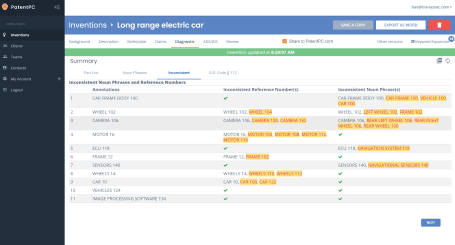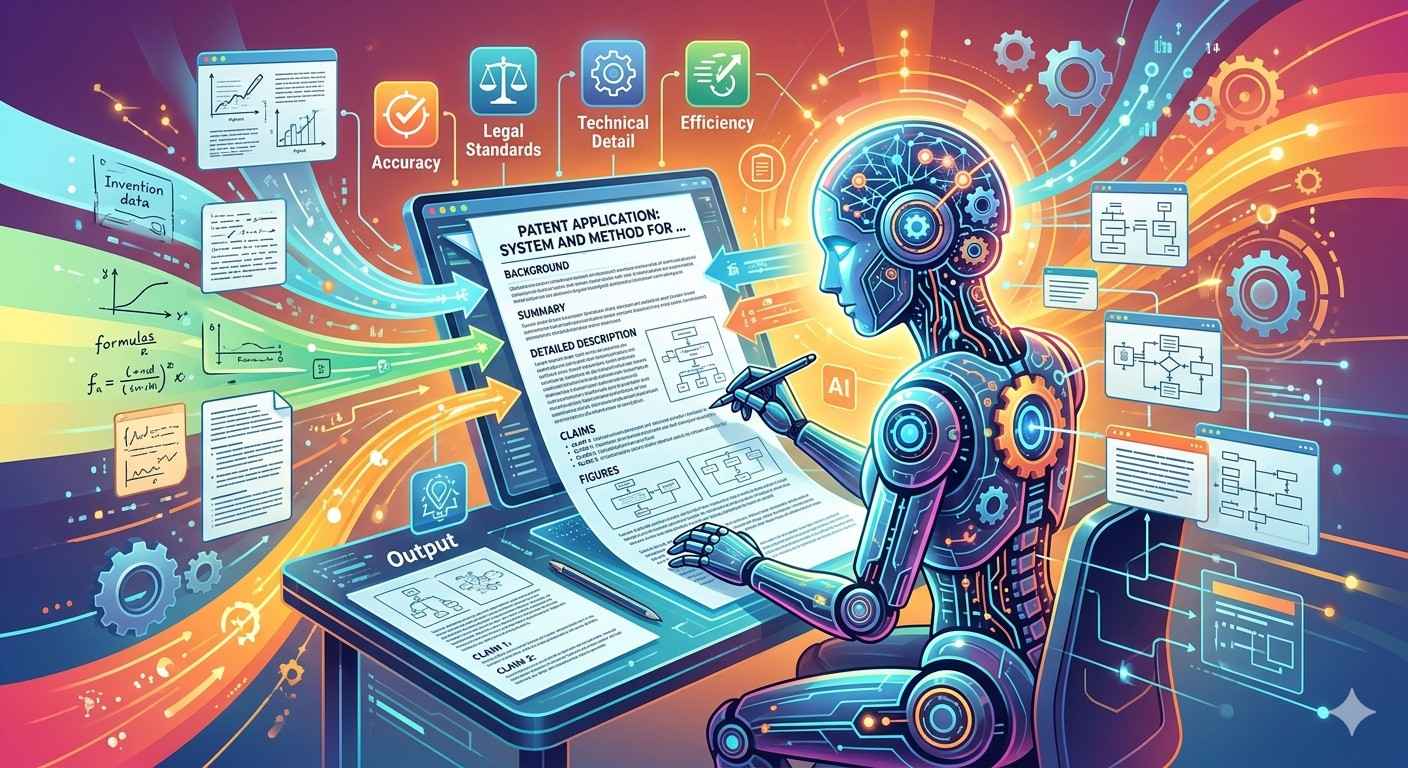
Most people hear “AI writes patent specs” and think one of two things.
Either they think, “That sounds amazing. Maybe this can save me weeks.”
Or they think, “No way. Patent writing is too important. AI will mess it up.”
Both reactions make sense.
A patent specification is not a tweet. It is not a quick outline. It is not a simple summary of what you built. It is the deep, full story of your invention.
It explains what the thing is, how it works, what problem it solves, how it can be built, and all the different ways it could be used. If that story is weak, the patent can be weak.
If the story misses key details, the protection can shrink. If the story is vague, sloppy, or narrow, competitors may find easy ways around it.
So yes, people should be careful.
But here is the part many founders miss: AI is actually very good at some of the hardest parts of patent drafting.
Not all of it. Not by itself. Not without guidance. Not without review.
But when it is used the right way, AI can do a lot of the heavy lifting in a patent specification. It can help turn scattered technical details into a clear draft. It can pull structure out of messy notes.
It can expand thin descriptions into stronger technical explanations. It can surface variations engineers often forget to include.
It can help a founder move from “we should patent this someday” to “we now have a real draft we can review.”
That matters more than ever.
Startups move fast. Teams ship code, train models, test hardware, rewrite systems, and pivot features in weeks. In that kind of speed, the old patent process often breaks.
Founders do not have time for endless back-and-forth emails. Engineers do not want to stop building to write long invention memos.
Traditional law firm workflows can drag on for weeks, sometimes months, before a first serious draft exists.
That gap is where good inventions get lost.
This is one reason many startup teams are now looking at smarter workflows that combine AI with real patent attorney oversight. They want speed, but they also want quality. They want to protect what they built without adding chaos to the roadmap. They want better patents, faster.
That is exactly why PowerPatent exists. It helps founders and technical teams turn inventions into strong patent applications using smart software and real attorney review, without the pain of the old-school process. You can see how it works here: https://powerpatent.com/how-it-works
In this article, we are going to look closely at how AI writes patent specifications, what it actually gets right, where it adds real value, and why the best results come when AI is paired with experienced legal review instead of treated like a magic button.
Because the truth is not “AI can do everything,” and it is not “AI is useless.”
The truth is much more useful than either extreme.
AI is very good at helping build the raw material of a strong patent specification.
And when that raw material is shaped the right way, it can save founders time, reduce drafting mistakes, improve coverage, and help protect the real value in what they are building.
First, what is a patent specification?
Before we talk about what AI gets right, it helps to keep one simple idea in mind.
A patent specification is the full written description of the invention.
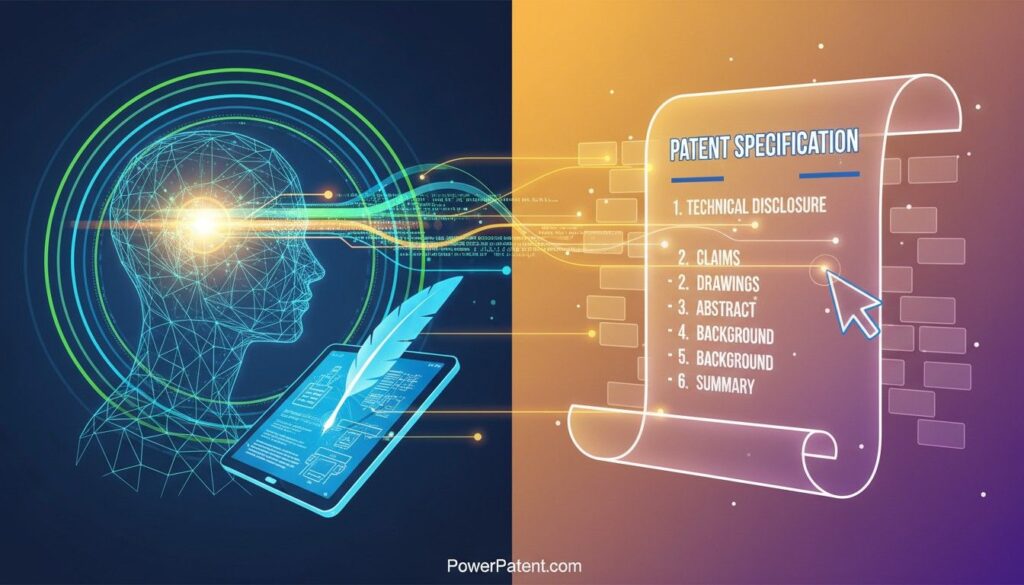
It is the long-form part of a patent application. It usually includes the field of the invention, the problem being solved, background context, a summary, figures, detailed descriptions, flowcharts, examples, system descriptions, methods, variants, optional features, and enough technical detail to show that the invention is real and can be made or used.
It is not just the claims.
A lot of founders think the claims are the whole patent. The claims are critical, of course. They define the legal boundary. But the claims do not float in space. They sit on top of the specification.
The specification is what gives them support. It is what gives them depth. It is what lets a patent attorney write broader and stronger claims because there is enough detail underneath to back them up.
Think of the claims as the fence line and the specification as the land under it.
If the land is weak, the fence line is weak too.
This is why patent specifications take real work. A good one must be clear, complete, technically sound, and broad enough to cover meaningful versions of the invention.
It must describe the invention in a way that helps now, but also leaves room for how the product may grow later.
That is hard for busy startup teams.
Most inventors do not struggle because they lack insight. They struggle because the invention lives in their heads, in code, in whiteboard sketches, in pull requests, in model runs, in test logs, in architecture docs, in Slack threads, and in half-finished notes. The knowledge is there, but it is spread out. It is not yet in patent form.
That translation step is where AI can shine.
The real job AI is doing
When people say “AI writes patent specifications,” it sounds like the machine invents legal language from thin air.
That is not the useful way to think about it.
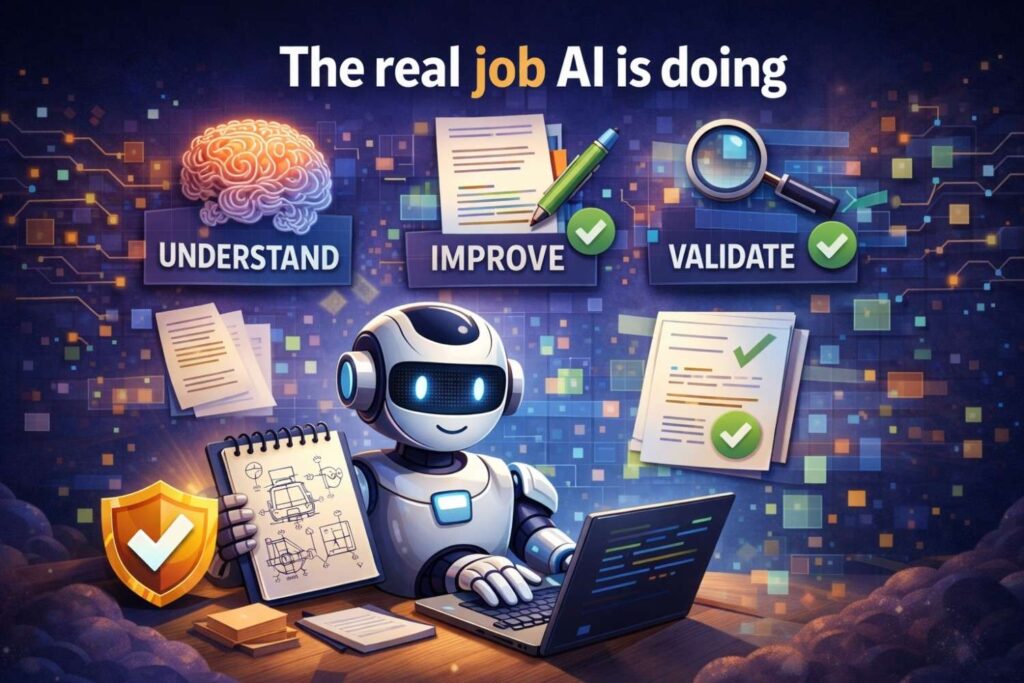
The real job AI is doing is more like this: it helps gather, organize, expand, and express technical information in a draftable form.
That is a big deal.
Patent drafting often begins with fragments. A founder says, “We built a way to reduce latency in our inference pipeline.”
An engineer says, “The key part is how we stage requests across a dynamic routing layer.” Someone else says, “The secret sauce is really the fallback logic plus the feature weighting.”
Then there are diagrams on a board, issue threads in GitHub, architecture notes in Notion, and code comments in a repo.
A human attorney still needs to exercise judgment about legal strategy, claim scope, risk, and filing choices.
But before any of that, there is a huge amount of translation work. The ideas must be turned into a coherent explanation of the invention.
AI is often very good at that translation layer.
It can take raw notes and turn them into a clean technical narrative. It can notice when one part of the system depends on another.
It can turn shorthand into full explanations. It can reframe implementation details into methods, systems, modules, data flows, model stages, or hardware blocks. It can help pull out optional variations and edge cases.
It can help a founder explain an invention more fully than they would on their own, not because the founder lacks intelligence, but because writing a patent spec is not the same thing as building a product.
This is what AI often gets right.
It helps convert invention knowledge into specification language.
That alone solves a major problem.
What founders usually get wrong when writing specs by hand
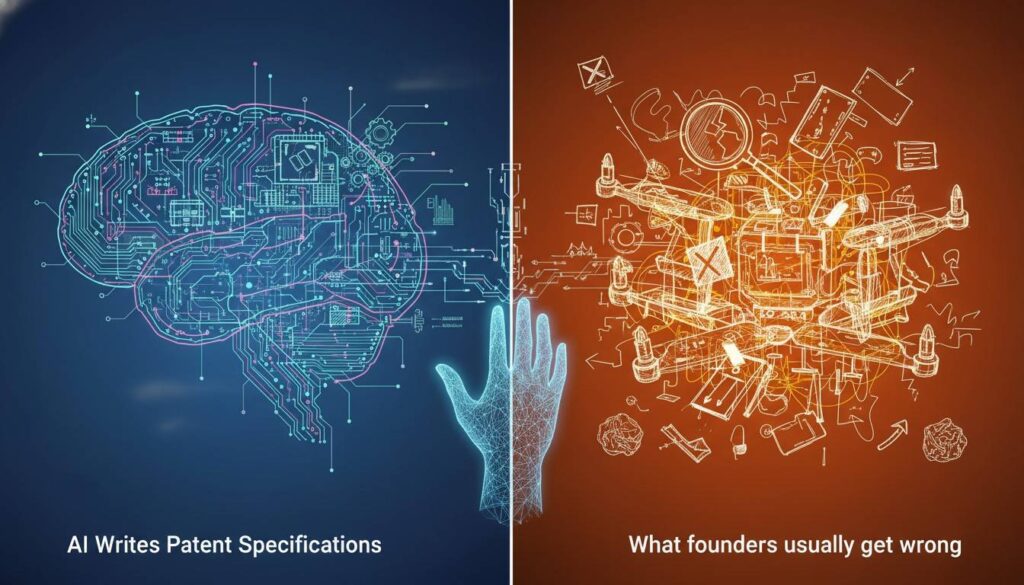
To see why AI helps, it is worth looking at what often goes wrong when startup teams try to do this alone.
Most founders start too narrow.
They describe the exact version they built last week. They explain the current architecture, the current model, the current API structure, the exact user flow, the current database layout, the exact hardware stack.
That may feel precise, but it can also create a trap. A patent based only on the current implementation may miss the larger invention.
Other founders do the opposite. They stay too high level. They say things like “a system that improves performance” or “an AI engine that optimizes workflows.”
That sounds nice, but it does not do the real job. A patent spec needs technical content. It needs detail. It needs enough substance to support meaningful claims.
Then there is another problem: many inventors forget alternatives.
They know the main path because they built it. But they do not naturally write out ten other ways the same idea could be implemented.
They do not list substitute components, optional flows, different data structures, other deployment forms, alternate input sources, other ranking methods, different communication patterns, or fallback behaviors.
And yet those alternatives can matter a lot.
Why? Because competitors rarely copy you in an obvious way. They make small changes. They rename modules. They shift steps.
They swap one model for another. They move logic from server to edge. They change order, format, or control signals.
If the specification only covers one skinny version of the invention, protection can become easy to dodge.
This is one of the most useful areas where AI can help.
AI is good at asking, in effect, “What are the other ways this could work?”
Not as a lawyer making final legal decisions, but as a drafting engine that expands possibilities around the core invention.
That expansion is often one of the biggest wins.
AI is very good at structure

A strong patent specification has shape.
It is not a random pile of facts. It moves. It starts with context, identifies a problem, introduces a solution, describes system pieces, explains flows, walks through examples, and fills in variations.
The better the structure, the easier it is for everyone involved to review and improve the draft.
This is an area where AI often performs surprisingly well.
Give AI a rough invention disclosure, some notes, a few diagrams, and a clear prompt, and it can usually produce a structured draft much faster than a human starting from a blank page. It can separate background from summary.
It can organize components into sections. It can turn process notes into step-by-step method descriptions. It can create headings that help inventors and attorneys see what is missing.
That may sound basic, but it matters.
When a draft is well structured, better thinking happens. Gaps become visible. Weak spots stand out. Missing alternatives are easier to spot. Technical reviewers are more likely to engage.
Founders can say, “This section needs to mention how batching works,” or “We forgot the on-device version,” or “The ranking logic should come before the output formatting section.”
Without structure, that kind of feedback is harder.
The blank page is a real enemy in patent work. AI helps remove it.
Instead of waiting days or weeks for someone to shape the first full draft, a team can review a concrete document early. That speeds everything up.
This is one reason PowerPatent is so useful for fast-moving startups. It helps teams get out of the blank-page stage quickly, so they can focus on improving substance instead of waiting around for a first pass.
The result is more momentum, less friction, and a much smoother path from invention to filing. You can learn more here: https://powerpatent.com/how-it-works
AI usually does a strong job expanding thin inputs
Many inventions start as a small amount of text.
A founder might say, “We built a tool that predicts machine failure from multimodal sensor streams and adjusts maintenance timing in real time.”
That may be true. But it is nowhere near enough for a patent specification.
A full draft needs to unpack what multimodal streams are involved, how the data is collected, normalized, aligned, weighted, processed, and evaluated, how predictions trigger maintenance timing, how the system responds to confidence scores, how the output is delivered, what optional modules may be used, and what variations might be included.
Human inventors often do not naturally write that way.
AI often can.
This is one of the clearest things it gets right. It takes compressed technical ideas and expands them into fuller explanations.
That does not mean every expansion is correct. It still needs review. But the drafting move itself is valuable. AI is good at asking the questions a full spec must answer, then building draft language around those answers.
For example, it may take a short note about routing requests and produce a richer section about receiving input, extracting features, identifying a target processing path, selecting one or more candidate execution environments, evaluating load or resource conditions, routing the request, monitoring results, and updating future routing behavior based on observed outcomes.
Now the team has something they can react to.
They can say yes, no, maybe, fix this, add that, remove this assumption, widen this term, add the hardware case, mention distributed state, include the model refresh loop, and so on.
That is how better patent specs are built.
Not from perfect first drafts, but from fast, meaningful iteration around a solid starting point.
AI helps create that starting point.
AI can surface variations inventors forget

This may be the most underrated strength of AI in patent drafting.
Inventors are close to what they built. Too close, sometimes.
That closeness is powerful when it comes to real technical insight. But it can also create blind spots. Inventors tend to focus on the version they know best.
They may not think to describe alternate environments, alternate control paths, alternate modules, alternate data types, alternate deployment models, alternate ordering of steps, or alternate combinations of features.
AI often helps surface those missing branches.
It may suggest that a process performed by a server could also be done by an edge device.
It may suggest that a classifier could be a rules engine, a learned model, or a hybrid scoring system. It may suggest that a user input can be explicit, inferred, or derived from context.
It may suggest that data can come from logs, sensors, external systems, stored records, or real-time streams.
It may suggest that outputs can trigger notifications, commands, re-ranking, control signals, visual overlays, or automated workflows.
This kind of expansion helps in two ways.
First, it broadens the technical description. That gives more support for broader claim drafting later.
Second, it protects against tunnel vision. It reminds the team that the invention is often bigger than the current product.
A founder may think the invention is “our dashboard that does X.”
But after a better drafting exercise, it becomes clear that the true invention is a method for transforming a type of input into a decision output using a particular architecture or sequence. That larger framing can be much more valuable.
AI is often good at helping reveal that larger framing.
AI helps turn product language into invention language
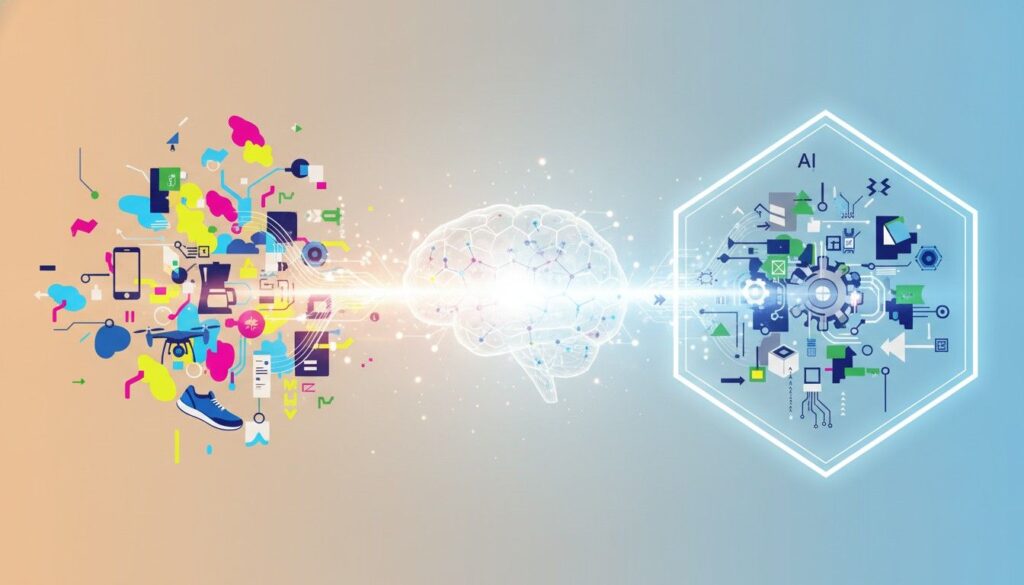
Startups usually talk in product terms.
That is normal. Teams think about features, users, pricing, adoption, retention, deployment, roadmaps, and demos. Even technical teams often describe new work in terms of what it does for the product, not in terms of how the invention should be explained in a patent document.
Patent specifications need a different kind of language.
Not fancy language. Not legal-sounding fluff. Just invention-centered language.
That means describing systems, methods, modules, components, flows, inputs, outputs, transformations, control paths, states, conditions, decision logic, and implementation options.
AI is often good at making this shift.
Give it product notes and it can recast them into a more patent-ready frame. A feature becomes a method. A service becomes a computing system. A workflow becomes a sequence of steps.
A recommendation engine becomes a ranking pipeline with one or more selection modules and one or more output formats.
A security feature becomes a device-authentication method tied to dynamic policy rules.
A robotics feature becomes a control architecture with sensor ingestion, path selection, and actuation logic.
This matters because many valuable inventions never get patented simply because nobody took the time to translate product language into invention language.
The idea existed. The code existed. The business value existed.
But the company never expressed it properly.
AI can dramatically lower the effort needed for that translation.
That does not mean every translated sentence is ready to file. It means the company can finally see what it actually has.
And once a team can see the invention clearly, protecting it becomes much easier.
AI is good at consistency across long drafts

Patent specifications are long documents. A serious draft may run dozens of pages. Some go far longer.
In long documents, consistency matters. The same module should not be called five different names unless there is a reason. The same flow should not be described in conflicting ways.
A server should not suddenly become a client halfway through unless the document explains why. A training stage should not be confused with an inference stage.
A ranking process should not look optional in one section and required in another if that difference is not intended.
Humans can miss these issues, especially when drafting under time pressure.
AI is often helpful here.
It can maintain naming patterns across a document. It can repeat core terminology cleanly. It can align section phrasing.
It can help harmonize descriptions so the specification reads like one coherent technical story rather than a patchwork of disconnected notes.
Again, this is not glamorous, but it is useful.
A cleaner, more internally consistent draft is easier for inventors to review, easier for attorneys to revise, and less likely to contain avoidable confusion.
Consistency also helps founders feel more confident in the process. They can read the draft and say, “Yes, this sounds like our system,” instead of getting stuck trying to decode a messy document that seems detached from reality.
That kind of confidence speeds review and reduces bottlenecks.
AI does not get tired of detail

This may sound small, but it is not.
Good patent specifications need detail. A lot of it.
Not because padding is helpful, but because details create support. Details show possession of the invention. Details create options. Details help map the invention in multiple ways.
Humans often get impatient with repetitive detail work. After describing one embodiment, a drafter may not feel excited to describe five more variations.
After writing out one method flow, the next three may feel like a chore. After explaining one system architecture, expanding to distributed, local, cloud, and hybrid forms may feel tedious.
AI does not mind.
It can keep going.
It can describe optional data stores, alternate communication channels, additional scoring rules, substitute models, control thresholds, fallback states, training paths, update loops, batching methods, or deployment forms without losing steam.
Used well, this can produce a much richer specification than a rushed manual process.
That richer description is not just “more words.” It creates more support for future claim choices.
It helps the invention stand on more than one narrow implementation. It gives the team more flexibility as the product evolves.
A startup rarely stays still after filing. The architecture changes. The model changes. The infrastructure changes.
The user experience changes. A specification with room to breathe is much more useful than one tied too tightly to a single product snapshot.
AI often helps create that room.
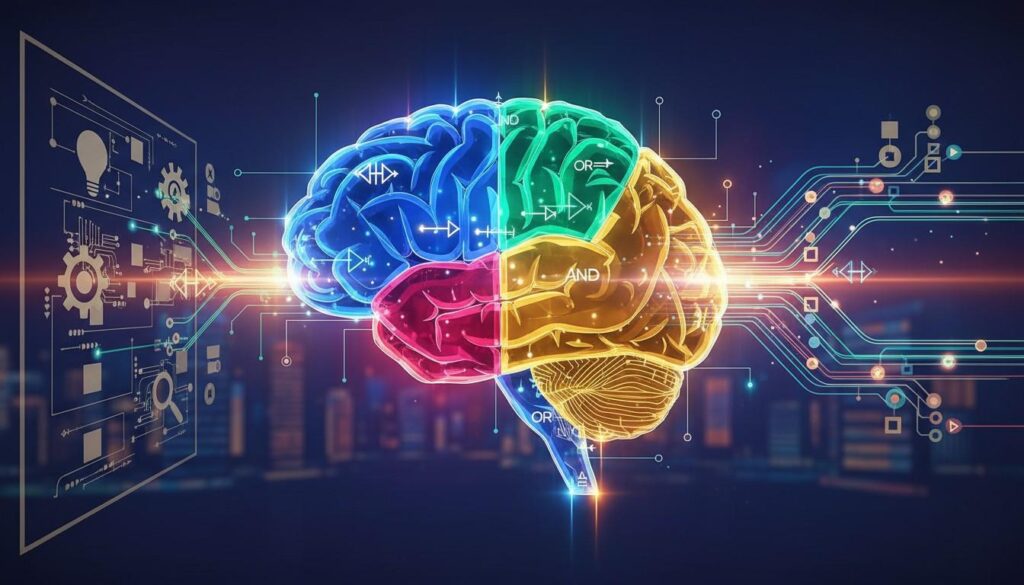
AI is often better than founders at seeing the “and/or” space
Founders tend to think in one path.
We do this, then this, then this.
Patent drafting often needs to explore the “and/or” space around that path.
Can step B happen before step A in some cases?
Can these two modules be merged?
Can the scoring logic happen locally or remotely?
Can input be direct or inferred?
Can output be visual, stored, transmitted, or used to trigger another action?
Can a component be hardware, software, firmware, or a mix?
Can the model be trained offline and updated online?
Can the data be sampled, filtered, ranked, transformed, compressed, or enriched before use?
AI is often very good at spinning out these adjacent possibilities.
Sometimes people worry this makes the spec too broad or too fluffy. That can happen if the drafting is sloppy. But when done with care, this flexibility is exactly what strengthens the document.
It helps describe the invention as a family of implementations built around a core concept, not just one frozen product build.
That is a smarter way to think about protection.
Your competitors are not going to copy your exact architecture line by line. They are going to borrow the valuable idea and adapt it. Good patent specs anticipate that.
AI often helps teams do that earlier and more fully than they would on their own.
AI can improve inventor interviews

This is a hidden benefit that more teams should appreciate.
Patent drafting usually involves inventor interviews. A lawyer, agent, or internal IP lead asks questions and tries to pull details out of the inventors.
Those conversations are useful, but they can also be slow, repetitive, and dependent on memory.
Important details may not come up in the first call. Inventors may explain the product but not the invention. The interviewer may not know which technical branch matters most until later.
AI can make these interviews much better.
When AI helps generate a pre-draft before the interview, the discussion changes. Instead of starting from zero, the team starts with substance.
The inventor can react to a draft. They can correct it, refine it, and expand it. That often leads to better discussions because concrete text triggers better memory and sharper feedback.
The inventor may say, “This part is wrong, but it points to the right issue.” Or, “You forgot the threshold adaptation logic.”
Or, “Actually, the main novelty is not the ranking stage, it is the way we generate candidate sets from mixed signals.” Or, “This should cover both model-based and rule-based selection.”
That is much more productive than a generic call where everyone tries to describe a complex system from scratch.
AI can also help by identifying questions worth asking. It may expose missing steps, weak transitions, undefined terms, unsupported claims, or optional branches that need confirmation.
In other words, AI can improve not just the writing, but the thinking around the writing.
That is a big reason why the best patent workflows today do not treat AI as a final writer. They treat it as a force multiplier for inventor input and attorney judgment.
AI is strong at handling technical source material

Many modern inventions live inside technical material that is already written, just not in patent form.
This includes code comments, architecture docs, pull request discussions, design docs, internal wikis, model cards, test notes, white papers, integration notes, data pipeline diagrams, hardware interface descriptions, and more.
AI is good at reading that kind of material and pulling out themes.
It can identify recurring components. It can see the flow of data. It can detect where decisions are made, where signals are transformed, where results are generated, and where optional branches exist.
It can take something that looks like product engineering documentation and use it to support a patent draft.
This is especially helpful for startups with lean teams.
A founder should not have to stop the company for two weeks to write a long invention memo from scratch.
A better workflow is to let the team start from what already exists, then use AI to help convert that material into a patent-ready draft that real legal professionals can refine and review.
This reduces drag on the team.
It also reduces a common problem: under-reporting the invention because nobody had time to explain it properly. When AI can work from source material the team already created during normal product development, much more of the invention makes it into the draft.
That means fewer missed details and stronger technical grounding.
PowerPatent is built for exactly this kind of modern workflow. It helps startups work from the reality of how technical teams actually build, instead of forcing them into slow, painful processes made for another era.
With the right software and real patent attorney oversight, founders can move faster without sacrificing quality. See how it works here: https://powerpatent.com/how-it-works
AI can help separate the core invention from the noise
One of the hardest parts of patent drafting is knowing what matters most.
In a real system, there may be dozens of moving parts. Not all of them are equally important. Some are routine. Some are replaceable. Some are implementation details that may not deserve center stage. Others are the real source of novelty and value.
AI can help tease this apart.
It can summarize repeated patterns in the source material. It can show where unusual logic appears. It can cluster related concepts. It can help distinguish the supporting machinery from the main inventive move.
This is not the same as making final legal judgments about patentability. That is still where human legal skill matters. But the ability to identify candidate centers of gravity in the invention is very useful.
For example, a founder may think the invention is the whole software platform. But AI-assisted drafting might reveal that the real inventive concept lies in a specific scheduling method, a dynamic model-selection process, a data normalization technique, a control loop, or an interaction between modules that creates a new result.
Once that center becomes visible, the specification can be written around it more effectively.
This is one of the most valuable outcomes of the drafting process itself. It helps the team understand what they really invented.
That understanding can shape not only the patent application, but also product strategy, fundraising language, and future filings.
AI often writes better first drafts than non-specialists
This may be obvious, but it is still worth saying.
A founder who has never written a patent specification before is usually not going to produce a strong first draft on their own. That is not a knock on the founder. Patent drafting is a specialized writing task.
It requires a certain rhythm and way of thinking that most engineers, product leads, and startup operators do not practice.
AI, when guided well, can often produce a better first draft than a non-specialist human trying to do it manually.
The structure is often better. The coverage is often broader. The terminology is often more consistent. The description is often more complete. The draft is often more usable for review.
This does not mean AI replaces expert legal drafting.
It means that, compared to the common alternative of “the founder writes a rough page and hopes for the best,” AI can be a major upgrade.
That is important because many startup patent workflows break before they even begin. The team never gets enough material together.
The draft never gets off the ground. The idea sits in a notebook until the window closes or the product becomes public.
AI reduces that failure mode.
It helps teams get to a real draft sooner.
That can be the difference between protecting an invention and missing the chance.
What AI gets right about breadth

Breadth is one of the trickiest parts of patent work.
Founders often think breadth means making everything vague. It does not.
Real breadth comes from describing the invention across enough dimensions that it is not trapped inside one thin implementation.
That usually means including multiple embodiments, alternatives, optional features, substitute components, expanded flows, and generalized descriptions that still stay anchored in technical reality.
AI is often useful here because it naturally expands.
Given a core concept, it will usually generate alternate forms around that concept. A method may become a system and a non-transitory computer-readable medium.
A process step may be described with different triggers. A module may be implemented in software, hardware, or a distributed configuration.
A classifier may use thresholds, learned weights, or rule-based logic. A communication path may be local, remote, direct, indirect, synchronous, or asynchronous.
Some of that output needs pruning. Some of it needs correction. But the instinct to explore breadth is often helpful.
A thin founder-written memo may describe one path. An AI-assisted draft may describe ten.
That broader set of descriptions gives attorneys more to work with later. It can support a smarter claim strategy. It can protect against easy design-arounds. It can make the application more resilient as the product changes over time.
This is one of the clearest cases where AI adds value before legal review even begins.
What AI gets right about speed
Speed matters in startups.
Not because fast is always good by itself, but because delay has costs.
A delayed draft means a delayed review. A delayed review may mean a delayed filing. A delayed filing can create pressure around launches, investor conversations, customer discussions, conference demos, open-source releases, hiring materials, and partnership talks.
In some cases, delay can even risk losing rights or narrowing options.
Traditional patent drafting often moves too slowly for startup reality.
AI helps here in a very practical way.
It compresses the early drafting cycle.
Instead of waiting a long time for the first full description to take shape, teams can get a strong draft much sooner. That means earlier review, earlier correction, earlier strategic input, and faster filing readiness.
This faster cycle does not just save calendar time. It improves quality too, because people remember more when the draft comes quickly. The inventors still remember why certain design choices were made.
The code is still fresh. The architecture has not changed three times before the draft arrives. The product context is still current.
Speed, in this sense, is not just convenience.
It is a quality advantage.
The faster the invention is captured after it is built, the less likely important details are to vanish.
That is one reason why AI-assisted patent workflows are becoming so attractive to startup teams. They fit the rhythm of modern product development better than slow, manual pipelines.
What AI gets right about collaboration
Patent drafting is often treated like a handoff. The inventors dump some notes. The lawyer disappears. A draft comes back later. Then everyone scrambles to react.
That is not ideal.
The best patent work is collaborative. The inventors, technical leads, and legal experts all improve the document together.
AI can support this collaboration in useful ways.
A draft can be generated early and shared quickly. Team members can comment directly on text. Engineers can correct technical descriptions without having to author the full draft themselves.
Product leaders can point out future directions worth including. Legal reviewers can focus on strategy, support, and claim alignment instead of spending all their time creating base text from scratch.
This creates a healthier process.
The inventors stay engaged because they can react to something tangible. The attorneys stay focused on high-value review and legal judgment. The company gets a stronger document without burning weeks of time in slow loops.
Good workflows matter. Better collaboration leads to better patents.
AI often makes that collaboration easier because it lowers the cost of getting a serious draft into the room.
Where people get confused
At this point, it is important to say something clearly.
Just because AI gets a lot right does not mean every AI-generated patent draft is good.
Some people hear that AI can help with specs and jump to the wrong conclusion. They think a generic chatbot can spit out a patent application that is ready to file with no review.
That is not the smart path.
A patent specification is too important to trust to blind automation.
AI can produce text that sounds polished but contains errors. It can over-assume. It can smooth over missing technical support. It can include variations that are too speculative. It can use words loosely.
It can fail to recognize legal risks. It can miss the best claim framing. It can write language that feels broad but lacks the right grounding.
This is why the real question is not “Can AI write patent specifications alone?”
The better question is “How should AI be used inside a patent workflow so it makes the draft stronger, faster, and more complete without creating risk?”
That is the question serious startup teams should ask.
And the answer is simple.
Use AI for what it is great at. Then put real patent professionals in the loop where judgment matters most.
That combination is where the value is.
The best use of AI is not replacement. It is leverage.
This idea is worth slowing down for.
AI is not best used as a substitute for legal expertise. It is best used as leverage on top of legal expertise.
Think about what drains time in traditional patent work.
Collecting invention details. Pulling signal from messy notes. Organizing the technical story. Writing long descriptive sections from rough source material.
Expanding variants. Creating initial structure. Cleaning up terminology. Generating embodiment language. Drafting method and system descriptions from the same core concept.
AI can help with all of that.
Now think about what still requires careful human judgment.
Deciding what the real inventive concept is. Assessing legal risk. Matching the disclosure to a claim strategy. Choosing what to emphasize and what to leave out. Ensuring support for desired claims. Avoiding harmful wording.
Aligning the application with business goals. Planning continuations. Thinking about enforcement value. Understanding how examiners may respond. Balancing breadth with support.
That is where experienced patent attorneys matter.
The strongest workflow is the one that lets each side do what it does best.
AI accelerates drafting and expands the raw material.
Human experts apply judgment, strategy, and review.
That combination can be far better than either one alone.
And for startups, it can be transformative.
It can mean getting strong patents without the usual delays, confusion, and drafting pain.
That is the model PowerPatent is built around: smart software plus real attorney oversight, designed for founders who need speed and quality at the same time. If that sounds like the way patenting should work, it is worth seeing the process here: https://powerpatent.com/how-it-works
What this looks like in practice
Let’s make this concrete.
Imagine a startup has built a new system for reducing hallucinations in enterprise AI workflows. The team uses retrieval, confidence scoring, policy constraints, source ranking, and adaptive response formatting.
The actual architecture is fairly complex. There are multiple modules. Some logic happens before generation, some after, and some during evaluation.
In a normal old-school process, the founder might fill out a short invention form. A patent attorney might schedule a call next week.
The team would spend time trying to explain the system verbally. Weeks later, a draft might arrive. By then, the model pipeline may already have changed.
Now imagine a better workflow.
The team shares source material: architecture notes, diagrams, product specs, a short summary from the CTO, and maybe selected technical documents. AI helps convert that material into an initial patent specification draft.
The draft includes a summary of the problem, a clear system architecture, multiple embodiments, method flows, optional policy layers, alternate confidence scoring methods, different ranking strategies, fallback mechanisms, and several implementation variations.
The inventors review it quickly because there is real text to react to. They mark corrections. They add missing details. They point out where the real novelty sits.
Then a real patent attorney reviews the draft, sharpens the framing, aligns the specification to a claim strategy, strengthens support, and ensures the application is built to protect real business value.
That is a much better process.
It is faster. It is more complete. It reduces founder burden. It still includes expert oversight. And it captures the invention while it is fresh.
This is not science fiction. This is what modern patent workflows should look like.
AI helps founders explain what they already know
Many founders feel insecure about patents because they think they need to “learn patent language” before they can start.
They do not.
They need to explain what they built.
That is different.
A good AI-assisted workflow meets founders where they are. It lets them describe the invention in plain words, technical notes, diagrams, examples, source material, and rough explanations.
Then it helps convert that into specification language that can actually be reviewed and improved.
This lowers the barrier to action.
That matters because many startups delay patent work not because they do not care, but because the process feels heavy and unfamiliar.
They think they need a perfect invention memo. They think they need to know the right legal phrases. They think they need to find time they do not have.
AI reduces that friction.
It tells founders, in effect, “Start with what you know. We can help turn it into something useful.”
That is one of the biggest things AI gets right.
It helps teams move from uncertainty to momentum.
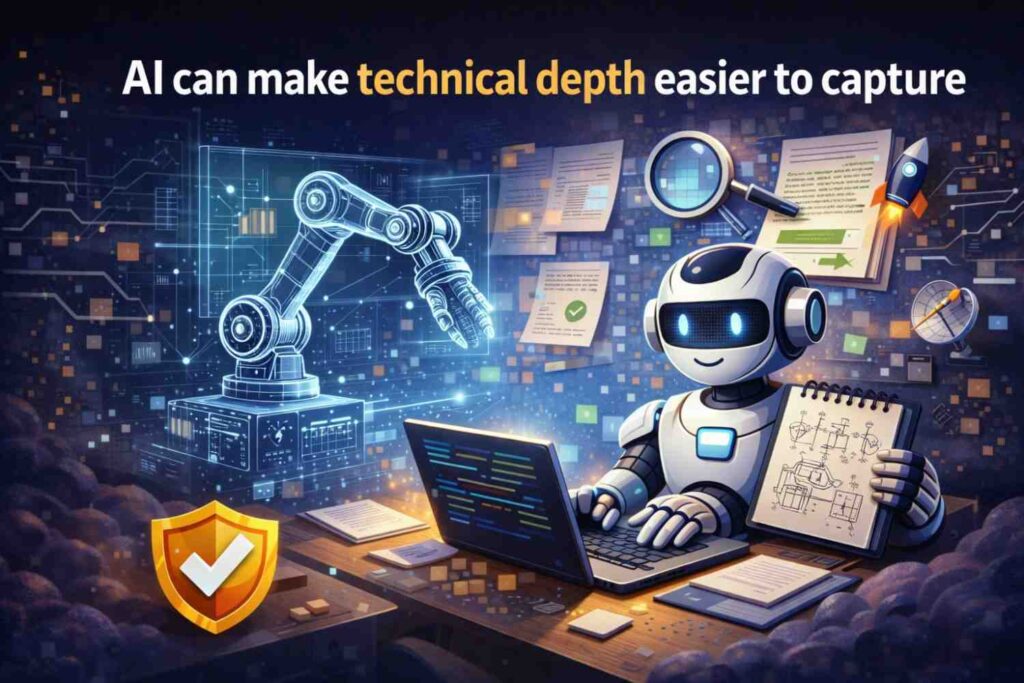
AI can make technical depth easier to capture
A lot of valuable startup inventions are not flashy on the surface.
They are buried in technical depth.
A better training pipeline. A more efficient memory layout. A smarter scheduler. A more reliable synchronization method. A new sensor fusion approach.
A more secure key exchange flow. A better way to compress, route, rank, infer, cache, align, or reconcile data.
These are exactly the kinds of inventions that can be hard to explain in a traditional manual process, especially when the inventors are busy and the novelty is subtle.
AI can help pull that technical depth into view.
It can take low-level material and express it in a fuller narrative. It can spell out the steps. It can describe why one sequence matters.
It can connect modules to outcomes. It can reveal alternative implementations. It can make hidden value visible.
This is important because subtle inventions are often highly defensible. They may not look dramatic in a demo, but they can be core to performance, cost, reliability, scale, or product differentiation.
If those inventions never get fully captured, the company loses a major opportunity.
AI helps reduce that loss.
AI can help avoid under-drafting
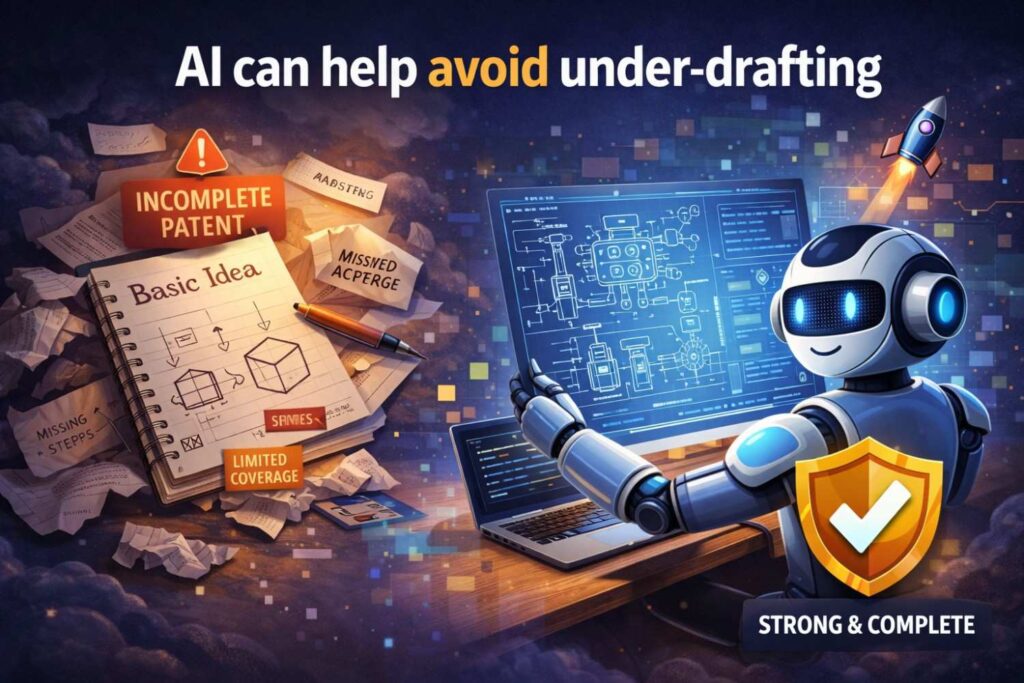
Under-drafting is one of the most common patent problems for startups.
The team files something, but it is too thin.
It covers the basic concept, but not enough of the implementation range. It mentions the main flow, but not optional branches. It names some modules, but not their variants.
It describes one environment, but not others. It misses examples. It leaves out fallback logic.
It ties terms too closely to one product version. It does not give enough support for broader future claims.
Often this happens because of time pressure. The team just wants to get the filing done.
AI can help here by making fuller drafting less expensive in terms of effort and time.
It becomes easier to add alternatives, embodiments, examples, and implementation detail when the system can draft them quickly from the core invention record.
That does not guarantee perfection. But it does reduce the odds of filing a thin, rushed document.
For startups, that can have long-term value. A stronger first filing can support later claim strategies, continuations, and follow-on applications much more effectively than a bare-bones filing.
The first draft matters. The first filing matters. AI can help both be stronger.
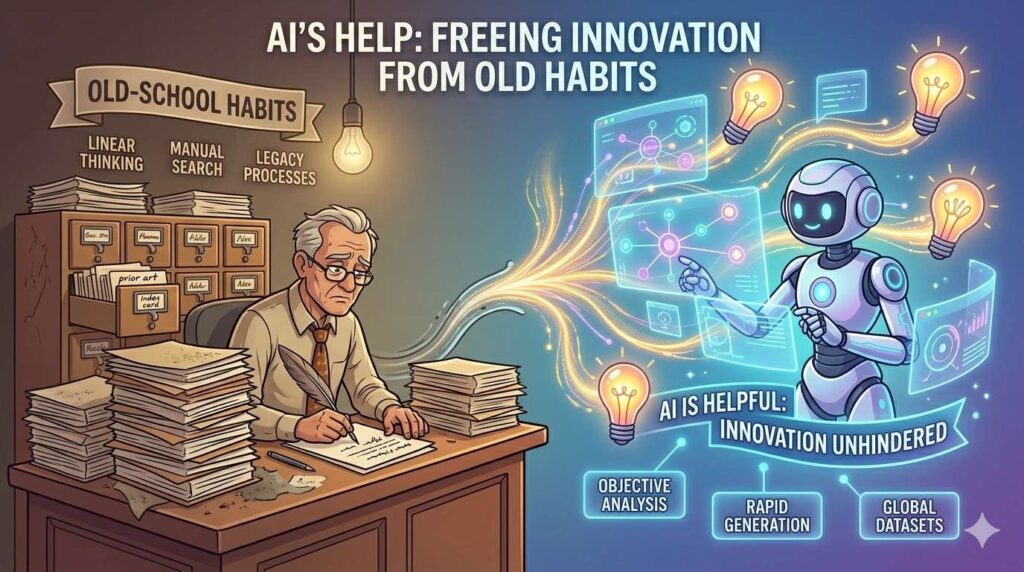
AI is helpful because it does not carry old-school habits
This is an interesting point.
Traditional patent drafting has many strengths, but it also has habits. Some are useful. Some are just old workflow patterns that survived because that is how things have always been done.
AI does not arrive with the same inertia.
It is often more flexible about pulling from modern technical materials, drafting around current system architectures, adapting to software-heavy inventions, and generating multiple framing options quickly.
It is not tied to the idea that every invention must start with the same slow interview and same thin intake form.
For startups, that flexibility matters.
Deep tech companies, AI companies, robotics teams, biotech software groups, infrastructure startups, and advanced hardware teams do not build in the same way companies did twenty years ago. Their patent workflow should reflect that.
AI can help create a drafting process that feels native to how technical teams actually work now.
That is a major advantage.
What AI still needs help with
To really understand what AI gets right, it helps to be honest about what it still needs help with.
AI needs help deciding what is legally important.
It needs help judging when language is too narrow or too unsupported.
It needs help distinguishing an interesting feature from the actual core inventive concept worth centering in claims.
It needs help avoiding harmful admissions or awkward phrasing.
It needs help matching the disclosure to a filing strategy.
It needs help understanding business context, competitor behavior, enforcement goals, and portfolio planning.
Most of all, it needs help with judgment.
That is why the best answer is not blind trust in AI. It is smart use of AI inside a workflow with real attorney oversight.
This point should actually make founders more comfortable, not less.
You do not need to choose between “slow traditional law firm” and “random machine-generated patent.”
There is a better path.
Use AI to accelerate drafting and enrich the specification.
Use real legal experts to shape, review, and protect the final result.
That is how you get both speed and confidence.
Why this matters so much for startups

Large companies can afford wasted motion. Startups cannot.
Big companies may have in-house legal teams, established invention disclosure systems, and big patent budgets.
Startups often have none of that. The founder, CTO, or lead engineer is the invention team and the operations team and half the product team too.
So when the patent process is slow, confusing, or demanding, it often just does not happen.
That is dangerous.
Startups create valuable inventions early. In some cases, their strongest IP is built before the company even reaches scale. If that work is not captured and protected, the company may lose leverage later when it matters most.
Investors care about defensibility. Acquirers care about IP posture. Competitors watch emerging categories closely. Patents are not the whole strategy, but for the right inventions they can become a serious asset.
The problem has never been that startups lack innovation.
The problem is that the patent process often does not fit startup life.
AI helps fix that.
It lowers the effort needed to start. It speeds up the path to a real draft. It helps teams express inventions they would otherwise leave buried. And when paired with expert review, it can lead to strong, defensible filings without the usual headache.
That is why so many smart founders are rethinking how patent drafting should work.
The emotional side founders rarely say out loud
There is another part of this that people do not always talk about.
Patent work can feel intimidating.
Founders worry they will say the wrong thing. They worry they will sound unsophisticated. They worry the process will eat time they do not have.
They worry they will pay for a weak result. They worry the draft will not really capture what makes their invention special.
AI can reduce some of that emotional friction.
Not because it removes the need for expertise, but because it makes the first step easier. It creates momentum.
It turns a blank page into something real. It helps founders see their invention reflected back in a more complete form. That can be energizing.
Once a founder sees a serious draft built from their own work, patenting often starts to feel possible instead of vague and painful.
That mindset shift matters.
Founders take action when a process feels clear and manageable.
This is another thing AI gets right. It can make patent drafting feel less like a mysterious legal event and more like a practical extension of product building.
That is exactly how it should feel.
AI can help preserve invention value before it slips away
In startup life, timing is brutal.
The team ships a feature. Then the roadmap moves. A quarter later, the architecture is different. People forget the original insight.
The clever workaround that solved the hard problem becomes invisible because now it is just part of the system. The engineer who built it moves to another project. The details fade.
This happens all the time.
The invention was real. The value was real. But the window to capture it starts closing the moment the team moves on.
AI can help preserve that value early.
Because it speeds drafting, the company can document and develop patent-ready descriptions while the invention is still fresh in people’s minds.
That means more detail, more accuracy, more variants, and better recall of why the system was designed the way it was.
This is one of the strongest practical reasons to use AI in patent workflows. It is not just about writing faster. It is about capturing more truth while the truth is still close at hand.
That leads to better applications.
A good patent spec should feel bigger than the current product

This is a useful test.
When you read a strong patent specification, it should clearly connect to the product, but it should also feel bigger than the current product.
It should show the invention as a concept with range.
It should reveal multiple ways the idea can live.
It should make clear that the company did not just build a feature. It developed a method, architecture, system, process, or technical approach that can appear in different forms over time.
AI often helps create this larger view.
Because it expands alternatives and variations so naturally, it tends to push the draft beyond the exact product snapshot.
That is often a good thing. It makes the team ask, “What is the core concept here?” and “How else could this be implemented?”
Those are valuable questions.
The startups that protect IP well are often the ones that learn how to answer them.
The future is not AI alone. It is AI plus expert review.

This is one of the smartest ways to tell whether a patent specification is doing its job.
A strong spec should clearly reflect the product you built, but it should not feel trapped inside the product as it exists today. It should feel larger than the current release, larger than the current interface, and larger than the exact version your team has in market right now.
That is because products change fast.
Startups update flows, rebuild systems, swap models, improve infrastructure, move features, combine modules, and enter new markets all the time.
What looks central today may become just one part of a bigger system six months from now. What starts as one feature may later become a platform capability. What begins in one industry may later work across five.
If your patent spec only describes the product exactly as it appears right now, you may end up protecting a moment instead of protecting an advantage.
That is not the goal.
The real goal is to protect the technical idea underneath the product decision.
In many cases, the current product is just the first visible form of a deeper invention. The screen, the workflow, and the customer-facing feature are often only the outer layer.
Under that layer, there may be a new data handling method, a smarter routing system, a new decision engine, a control process, a model selection framework, or a better way to transform inputs into useful outputs.
That deeper layer is often where the real long-term value sits.
Smart businesses know this. They do not just ask, “What did we ship?” They also ask, “What is the reusable technical advantage that can keep creating value as the company grows?”
That question changes how a patent gets written.
Instead of describing only one use case, the company starts identifying the broader pattern. Instead of tying the invention to one workflow, it starts showing how the same core method can work in different settings.
Instead of focusing only on how version one operates, it starts capturing how the same idea can survive product changes, expansion, and future roadmap shifts.
This is where many companies either create a strong IP asset or miss the chance.
A weak spec often follows the product too closely. It mirrors the demo. It mirrors the release notes. It mirrors the user flow.
It may be accurate, but it is narrow. That makes it easier for someone else to borrow the real idea and wrap it in a different product shape.
A stronger spec goes one level deeper.
It explains the technical engine, not just the product surface.
For example, a company may think it built a tool for sorting support tickets. But that may not be the true invention.
The deeper invention may be a system that receives incoming requests, pulls context from multiple sources, scores the requests based on likely outcome quality, assigns urgency, and routes them to a destination using adaptive decision logic.
Once you describe it that way, you can see the bigger opportunity. That same invention may apply far beyond support tickets. It may work in security, IT operations, claims review, legal intake, logistics, fraud handling, or health system triage.
That is how a patent starts to support the business, not just the current feature.
This matters because competitors rarely copy you in the most obvious way. They do not need to use your labels, your layout, or your exact implementation choices.
They only need to capture the same underlying value in a slightly different form. If your patent spec only covers the visible wrapper, it may be easier to design around. If it captures the deeper technical method, your position becomes much stronger.
That is why businesses should treat patent drafting as part of strategic planning, not just a legal task.
A useful way to think about this is to separate the invention into layers.
The first layer is the version your team built today. That includes the exact architecture, the specific flow, the current model choices, the present deployment setup, and the live product behavior.
The second layer is the technical pattern underneath it. This is where you identify what the system is actually doing at a more durable level. Maybe it is ranking, filtering, predicting, scheduling, verifying, synchronizing, compressing, adapting, or coordinating. This layer helps remove some of the noise created by product packaging.
The third layer is the future expansion layer. This is where you ask where the same technical pattern could appear next.
Could it work in another market? Could it operate with different inputs? Could it run in another environment? Could it be done through rules, models, or a mix? Could parts move from cloud to edge, from software to hardware, from user-triggered to automated?
That third layer is where a patent spec starts to feel bigger than the current product in the best possible way.
This is not about making the document vague. It is about making it durable.
A lot of teams confuse those two things. They think broad means abstract and empty. It does not. A strong spec still needs real technical detail.
It still needs actual implementation support. It still needs concrete examples. But those details should be used to show the range of the invention, not to lock the document to one narrow snapshot of the product.
That is a very important difference for businesses.
A patent should not become outdated the moment the roadmap changes.
It should still make sense after a product redesign. It should still be useful after a model upgrade.
It should still support the company if the same technical method later appears in a new market, a new platform, or a new customer segment.
This is also why the drafting process should involve more than just a description of what already shipped.
The best internal discussions include questions like these: What part of this system is likely to stay valuable even if the product evolves?
Which technical choices are core and which are just current implementation preferences?
Where else could this same method create business value?
What would a competitor copy if they wanted the same result without copying our interface?
Those questions lead to better patent strategy because they push the business to identify its real center of gravity.
That center of gravity is what deserves protection.
There is also a major portfolio benefit here. When a first filing is drafted at the right level, it can create room for future filings, continuation strategy, and later claims tied to how the market develops.
A narrow product-only filing may give you a document. A broader, well-supported filing can give you options.
For growing companies, options matter.
A good patent spec should give the business more than a record of what happened. It should give the business leverage for what comes next.
One practical way to test whether your draft is doing this well is to remove your product names, feature names, and user-facing labels from the description. Then read it again.
Does the core invention still stand on its own? Does it still describe a real technical method with value beyond one exact workflow?
Could that same description apply if the company changed interface, customer segment, or delivery model?
If the answer is yes, the spec is probably capturing something more durable.
Another useful test is even more direct. Ask whether a competitor could build the same core value with a different front end and still fall inside the heart of what your document describes. If not, the draft may still be too close to the current product shell.
Businesses that understand this early often get much more value from their patents over time.
They protect the engine, not just the dashboard.
They protect the repeatable method, not just the current release.
They protect the technical advantage that can travel with the company as it grows.
That is why a good patent spec should feel bigger than the current product.
Not because it should drift away from reality, but because it should capture the part of your invention that will still matter after the product changes, the roadmap expands, and the market gets crowded.
So, what does AI really get right?
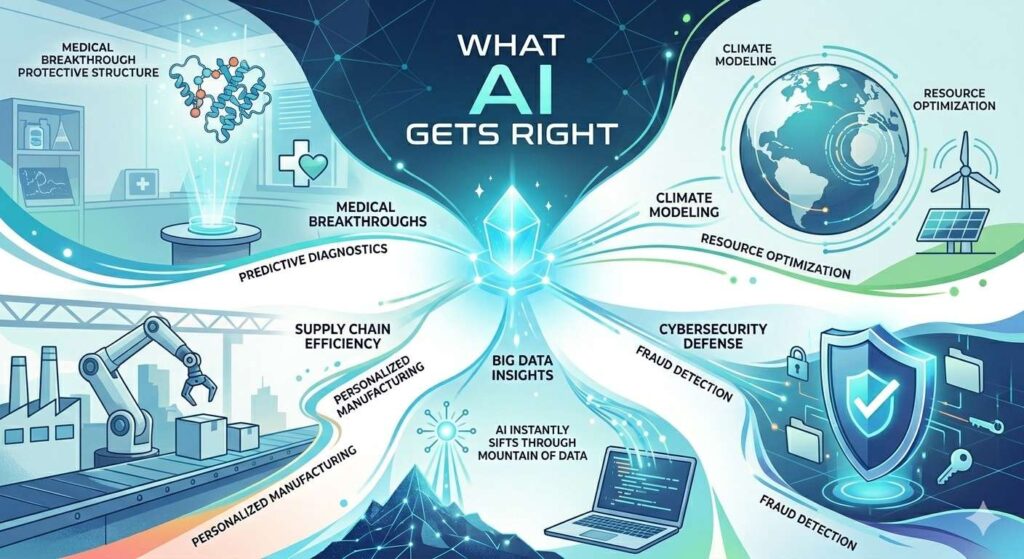
AI gets something very important right that many businesses overlook.
It helps turn patent drafting from a delayed legal event into a repeatable business process.
That shift matters more than it may seem at first.
A lot of companies still treat patent work like a special project that only happens once in a while, usually when someone finally makes time for it, or when a product launch forces the issue.
That approach creates risk. Valuable inventions pile up. Teams forget key design choices. Important technical decisions never get documented properly.
By the time someone starts drafting, the company is already two versions ahead and the original insight has gone blurry.
AI helps fix that by making invention capture much easier to operationalize.
Instead of waiting for the perfect moment, businesses can build a habit of capturing innovation in smaller, faster cycles.
When AI helps generate strong first-pass technical drafts from notes, diagrams, product docs, code context, and founder explanations, patent work becomes more practical to do on a regular basis.
That means companies are less likely to miss filing opportunities simply because the process felt too heavy.
This is one of the biggest things AI really gets right.
It reduces the gap between invention happening and invention being documented.
For a business, that is not just a writing improvement. It is a protection advantage.
The companies that win with patents are often not the ones that invent more. They are the ones that capture more of what they invent while it still matters.
AI also gets right the idea that patent drafting should start closer to the source of the work.
In many businesses, the most useful information about an invention lives with engineers, product leads, researchers, and technical founders. But those people are busy.
They are not going to stop their week to write a long, polished patent memo in legal language. That friction is one reason good inventions go unprotected.
AI lowers that barrier.
It lets businesses collect raw technical insight in a more natural way and still move toward a usable draft. That is powerful because it means the people closest to the invention can contribute more without taking on the full burden of patent writing.
The easier it is for technical teams to participate, the more complete and accurate the final patent process tends to become.
This leads to a very practical business lesson.
Do not wait for inventors to become patent writers. Build a workflow where they only need to provide technical truth, and let AI help shape that truth into draftable form.
That is a much more scalable model.
AI also gets right the fact that businesses need speed at the front end, not just polish at the end.
A lot of traditional patent processes put most of the energy into refining the final document after a slow start. AI changes that. It speeds up the early stages, which is where many businesses lose momentum.
Once a company has a real draft in hand, even an imperfect one, better decisions become easier.
Leaders can decide whether the invention is filing-worthy, whether it should be grouped with other ideas, whether there are product branches that need to be captured, and whether the business wants a narrow filing now or a broader long-term strategy.
In other words, AI does not just help write faster. It helps businesses decide faster.
That is a major strategic benefit.
A fast first draft gives a company something it can think with.
That is extremely valuable when teams are prioritizing budget, filing timing, launch timing, and IP coverage across a fast-moving roadmap.
Another thing AI gets right is pattern recognition across a company’s innovation pipeline.
This is where businesses can get much more strategic.
When AI is used across multiple invention disclosures, it can help reveal repeated themes. It may show that several product improvements all tie back to the same core system architecture.
It may reveal that a company’s real differentiator is not one feature, but a recurring technical approach showing up across products.
It may show that what looked like separate inventions are actually part of a larger platform story.
That kind of insight can shape a much smarter filing strategy.
Instead of filing isolated patent applications around random features, a business can start building a more coherent portfolio. It can identify core platform inventions, supporting implementation inventions, workflow inventions, infrastructure inventions, and future expansion areas. That creates stronger alignment between patents and business value.
This is a very actionable place for companies to improve.
If you are using AI in your patent workflow, do not use it only to draft single documents. Use it to compare inventions across time. Look for repeated technical patterns.
Look for the methods that keep showing up across products, teams, or releases. Those repeated patterns often point to the most valuable IP territory in the business.
AI also gets right the need to make patent review easier for decision-makers.
Not every patent decision is made by a patent expert. In many startups and growth-stage companies, key decisions involve founders, product leaders, CTOs, heads of research, and sometimes investors or board members.
Those people need to understand what is being protected and why it matters, but they may not want to read a dense legal-style document from top to bottom just to get the point.
AI can help produce clearer internal summaries, cleaner invention descriptions, and better framing around the business importance of the technology.
That makes it easier for leadership to prioritize filings, understand coverage gaps, and decide where to invest in protection.
That matters because patent strategy is often weak not from lack of invention, but from lack of internal visibility.
When the business cannot clearly see the IP value of what it has built, it will often underinvest or act too late.
AI helps make invention value easier to surface inside the company.
That creates better business decisions.
It also gets right the idea that good patent drafting should support planning, not just paperwork.
A lot of companies think about patents at the end of the cycle. They build first, then maybe protect later.
But one of the most useful things AI can do is help companies identify patent-worthy work earlier, while design choices are still active and future branches are still visible.
This gives businesses a chance to be more intentional.
They can ask whether a feature should be built in a way that preserves differentiation. They can ask whether a current technical path is broad enough to deserve a foundational filing.
They can ask whether a workaround developed by the engineering team is actually a core invention worth protecting before it gets buried inside the system.
That kind of early visibility is powerful.
It means patent thinking can become part of product strategy, not just a reaction after release.
For businesses, that can lead to stronger protection with less scrambling.
One highly actionable move is to create simple internal checkpoints where AI-assisted invention capture happens automatically.
For example, after major architecture changes, important performance breakthroughs, new model workflows, novel automation paths, or unusual engineering solutions, the team should capture the technical work while it is still fresh.
This does not need to be a big process. Even a short structured note, paired with source material and AI-assisted drafting, can create a strong starting point.
That one habit can dramatically improve how much protectable value a business actually preserves.
AI also gets right that not every invention starts out looking important.
This is a subtle but powerful point.
Some of the most valuable patentable work inside a business does not look dramatic when it first appears.
It may look like an infrastructure fix, an internal optimization, a routing change, a better data preparation flow, a control improvement, or a deployment adjustment.
Teams may view it as “just how we made the system work.” But those kinds of technical decisions can be exactly where real defensibility lives.
AI helps because it can pull those hidden technical moves into fuller view.
It can turn what looks like a small engineering note into a more complete explanation of the method, the system, the options, and the technical advantage.
That makes it easier for businesses to see that an internal solution may actually deserve patent attention.
This is a great reason to widen what your company treats as a possible invention source.
Do not look only at customer-facing features. Look at infrastructure choices, system reliability gains, automation logic, processing improvements, model coordination methods, and workflow controls.
AI is especially useful in these areas because it can help transform low-visibility engineering work into something leadership can evaluate strategically.
Another thing AI gets right is helping businesses standardize invention quality across teams.
In many companies, patent capture depends too much on who happens to be involved. One team documents things well. Another team does not.
One founder is good at explaining technical ideas. Another is not. One product lead flags inventions early. Another lets them pass by. This creates uneven patent coverage across the business.
AI can help level that out.
By giving every team a stronger starting point, AI makes it more likely that invention disclosures will be captured in a more complete and consistent way.
That does not remove the need for judgment, but it does reduce the randomness that often defines early-stage patent activity.
For businesses that want to build a real IP program, this is a major advantage.
You do not want your patent outcomes to depend entirely on which employee happened to be best at writing.
You want a system that helps more good ideas get captured well across the company.
This is where AI can quietly create huge value over time.
It turns invention capture from an uneven art into a more reliable operating capability.
And finally, AI really gets right that businesses need momentum.
This may be the simplest point, but it is one of the most important.
A slow patent process often dies from drag. People delay. Reviews slip. Technical details get stale. Drafts never quite start. Momentum disappears. Once that happens, even strong inventions can fall through the cracks.
AI helps create forward motion.
It gives teams something real to react to. It helps convert rough thinking into visible progress. It shortens the distance between “we should protect this” and “we have something we can review.” That movement matters because businesses act when progress feels real.
This is why the smartest way to use AI in patent work is not to ask whether it can replace every expert task.
The better question is whether it helps your business capture more important inventions, earlier, more clearly, and with less friction.
In many cases, the answer is yes.
That is what AI really gets right.
It helps businesses build a stronger bridge between innovation and protection.
It helps them spot more value in what they already created.
It helps them act before the moment passes.
And for companies trying to build durable advantage, that is not a small improvement.
That is a very meaningful one.
Final thoughts
If you are a founder, engineer, or inventor, here is the main thing to remember.
AI does not need to do everything in order to be extremely valuable in patent drafting.
It only needs to do the right things well.
And in patent specifications, it already does many of the right things well.
It helps turn messy invention knowledge into a real draft.
It helps expand narrow descriptions into fuller technical stories.
It helps uncover variations and embodiments that matter.
It helps teams move faster without losing detail.
It helps inventors stay focused on the substance of what they built instead of getting stuck trying to write a legal-style document from scratch.
That is what it gets right.
The mistake is thinking that means human expertise no longer matters.
The smarter view is the opposite.
Because AI is so good at accelerating and enriching the draft, human experts can spend more of their time where their judgment matters most. They can focus on strategy, protection, and quality. They can shape the application into something that truly supports the business.
That is the future of patent drafting.
Not a machine replacing people.
A better workflow helping smart people do better work.
For startups, that future is already here.
If you want to see how to turn your code, models, systems, or inventions into strong patent applications with smart software and real attorney oversight, take a look at PowerPatent here: https://powerpatent.com/how-it-works
If your team is building fast and you want to protect what makes your product hard to copy, this is worth exploring now, before the next release buries today’s invention under tomorrow’s roadmap: https://powerpatent.com/how-it-works
And if you are tired of the old patent process and want a simpler way to move from invention to filing with more speed, more clarity, and more confidence, start here: https://powerpatent.com/how-it-works