The detailed description is where a patent stops being a rough idea and starts becoming real.
A lot of founders think the claims are the main event. They matter a lot, of course. But the detailed description is what gives the patent its body. It is where you explain what you built, how it works, how it can be used, and how it can take different forms without losing the core idea.
When this section is strong, the whole application gets stronger.
When it is weak, the patent may look finished on the outside, but it can still have serious gaps.
That is why this part matters so much.
This article will show you how to write the detailed description in a patent specification without missing key details. We will keep it simple, practical, and useful. We will talk about what belongs in this section, what does not, how to avoid leaving holes, how to write in a way that supports broader protection, and how founders can turn messy product knowledge into a clear and complete patent draft.
If you are building something worth protecting and want a faster path to a strong filing, PowerPatent helps startups do exactly that with smart software and real attorney oversight. You can see how it works here: https://powerpatent.com/how-it-works
Why the detailed description matters more than most founders realize
The detailed description is often the longest part of the patent.
That alone tells you something.
It is not there to fill space. It is there because patents need support. The patent system does not just want a high-level promise that you built something useful. It wants a real explanation of the invention.
That means this section has real jobs to do.
It has to explain the invention clearly enough that a technically skilled reader can understand it.
It has to show that you actually had possession of the invention.
It has to support the claims you want now.
It also has to support claims you may want later, especially if the invention grows, the product changes, or the market shifts.
That is a lot of work for one section.
And that is exactly why founders cannot afford to treat it like a formality.
A weak detailed description can cause real damage. It can make the patent too narrow. It can make it harder to adapt your claim strategy later. It can leave out key versions of the invention. It can even make the whole filing feel thinner than it should.
A strong detailed description does the opposite. It gives the patent room. It gives your attorney better options. It gives your company a stronger asset.
That is why this section deserves care.
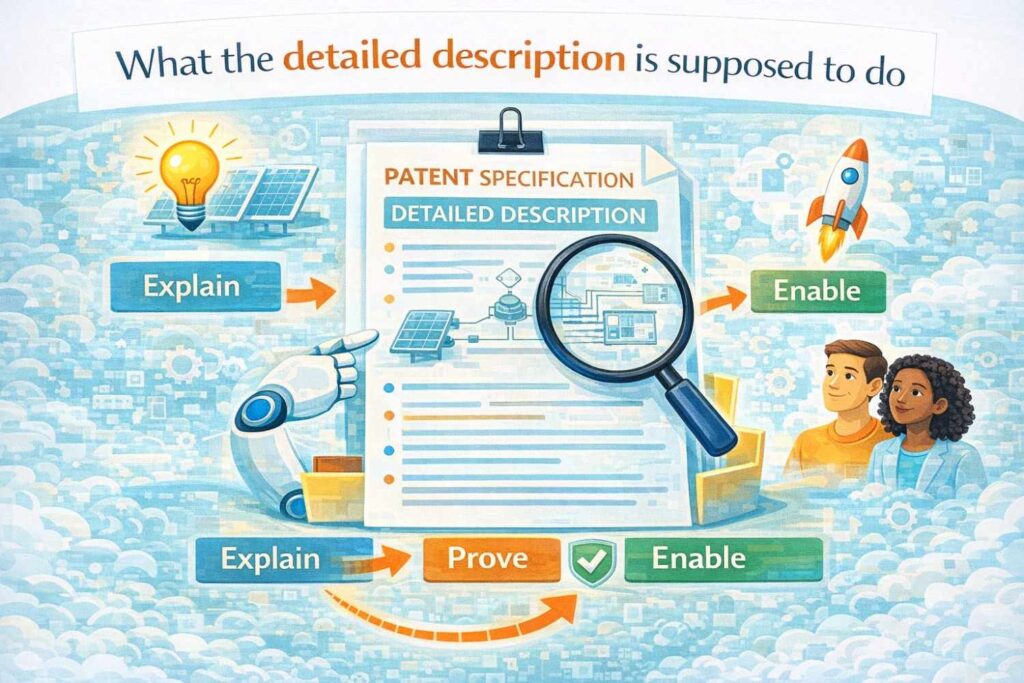
What the detailed description is supposed to do
Let us make this simple.
The detailed description is the section where you explain the invention in full.
Not with every tiny line of code.
Not with every engineering note you ever wrote.
But with enough real detail that the invention is clear, complete, and supported across meaningful versions.
This section usually answers questions like these.
What are the main parts of the invention?
How do those parts work together?
What steps happen during operation?
What inputs go in?
What outputs come out?
What decisions happen along the way?
What can vary?
What is optional?
What are the alternatives?
What examples show how it works?
That is the heart of it.
If the summary section gives the reader a map, the detailed description is the full tour.
It is where the invention becomes concrete.
Why founders often struggle with this section
Most founders are not short on knowledge.
They are short on structure.
They know their product deeply. They know the system. They know what the team built and why. But that knowledge is often spread across many places.
Some of it is in the founder’s head.
Some is in design docs.
Some is in code.
Some is in board notes.
Some is in the memory of a staff engineer who solved one hard part six months ago.
That makes the drafting process hard.
The challenge is not usually that the invention is too weak. The challenge is that the invention is not yet captured in a form that a patent specification can use.
That is why founders often either undershare or overshare.
Some give a short explanation that leaves out important detail.
Others dump huge amounts of implementation detail without structure and accidentally miss the actual inventive thread.
Neither approach works well.
A strong detailed description needs more than raw information. It needs shape.
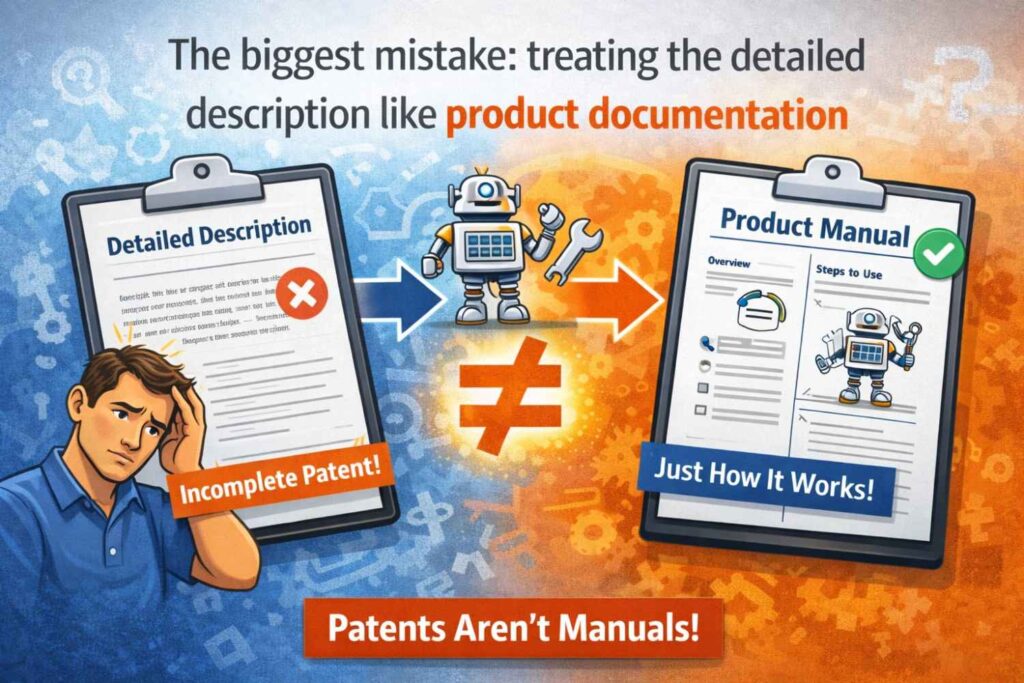
The biggest mistake: treating the detailed description like product documentation
This happens all the time.
A startup already has internal documents, so someone assumes those can just become the detailed description.
That is rarely enough on its own.
Internal product docs usually explain how the current version works right now.
A patent needs something different.
It needs to explain the invention in a way that supports protection across meaningful versions.
That means the detailed description should not just be a frozen record of today’s product release.
It should explain the broader inventive concept, the main architecture, the main flow, and the important variations that still fall within the same core idea.
Internal docs often skip those variations because the team already chose one path.
Patent drafting cannot afford to do that.
This does not mean internal docs are useless. They are often very valuable.
But they are raw material, not the finished section.
The detailed description is where missed details become expensive
If a founder misses a detail in a pitch deck, that is usually fixable.
If a founder misses a detail in a product demo, that is usually fixable too.
If a founder misses the wrong detail in a patent detailed description, the cost can be much higher.
Why?
Because the patent only protects what is supported.
If the filing leaves out an important variant, later claims may have a hard time reaching it.
If the filing explains only one narrow workflow, competitors may work around it more easily.
If the filing talks about a result but not how that result is achieved, that can create problems too.
This is why the detailed description is not a place for shortcuts.
It is where the strength of the filing gets built or lost.
What a strong detailed description feels like
A strong detailed description feels complete without feeling chaotic.
It feels technical without feeling unreadable.
It feels broad without feeling empty.
It makes the reader feel that the inventor truly understood the invention and took the time to explain it in a way that captures its real shape.
That is the standard.
You should be able to read it and say, I understand the system, I understand the workflow, I understand the different ways this can be done, and I understand what the invention really is.
That does not mean the section has to be short. It often is not.
It does mean the section has to be organized.
Start with the invention, not the patent template
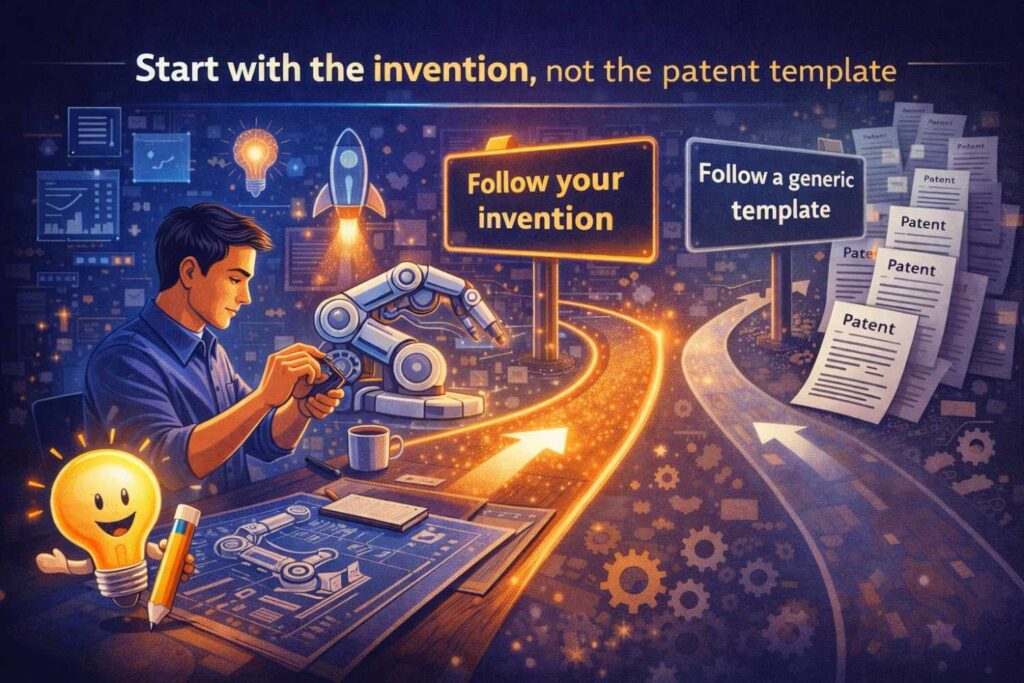
Before you write the detailed description, stop looking at the heading for a moment.
The biggest drafting gains happen before you write formal language.
They happen when you map the invention clearly.
Ask basic questions first.
What exactly did we build?
What makes it different from the obvious approach?
What are the key parts?
What is the main flow?
What inputs matter?
What outputs matter?
What changes over time?
What can vary without losing the core idea?
What would a competitor try to swap out?
These are invention questions, not formatting questions.
If you answer them well, the detailed description gets much easier.
This is one of the reasons PowerPatent works so well for fast-moving startups. It helps teams capture invention substance in a structured way before it gets flattened into vague patent language. That leads to stronger drafts and fewer missed details, especially when real attorneys help review what matters. You can see the process here: https://powerpatent.com/how-it-works
The simplest structure that works
A detailed description does not need to be mysterious.
Most strong ones follow a clear pattern.
They start with a broad system overview.
Then they explain the figures, systems, modules, or parts.
Then they walk through operation or process flow.
Then they describe meaningful variations.
Then they include examples or use cases where helpful.
Then they explain optional features, alternative embodiments, deployment options, and equivalent structures or approaches.
That basic flow works for many technologies.
Software.
AI.
Hardware.
Medical devices.
Industrial systems.
Climate tech.
Biotech.
The specifics change, but the logic stays similar.
Give the reader the map first.
Then guide them through the invention piece by piece.
Begin with a system-level overview

This is one of the best ways to open the detailed description.
Start by describing the invention as a whole.
If the invention is software, describe the main system components, data sources, models, services, processors, devices, or interfaces involved.
If it is hardware, describe the main physical components and how they interact.
If it is a method, describe the major stages.
If it is AI-based, describe the high-level pipeline.
This section should not yet drown in detail.
It should help the reader see the whole picture first.
For example, if your invention is an AI system that routes customer support tasks, the system overview might explain that the system includes an input interface for receiving support requests, a processing engine for generating request features, a classification or ranking component for determining one or more routing outputs, a resource or agent selection module, and a feedback loop for updating routing behavior over time.
That already helps a lot.
It gives the reader a frame.
Without that frame, later details feel scattered.
Then describe the major components
Once the system overview is clear, go one layer deeper.
Describe the major components one by one.
What does each part do?
What information does it receive?
What information does it produce?
How does it interact with the rest of the system?
This is where many weak drafts lose force. They name components without really explaining them.
A label is not a description.
Saying there is a scoring engine does not explain what the scoring engine actually does.
Does it apply rules?
Does it use a learned model?
Does it combine weighted inputs?
Does it rank candidates?
Does it produce a confidence value?
These details matter.
The reader should not have to guess what a component does just because it has a technical-sounding name.
The real test: can someone follow the invention without being inside your company?
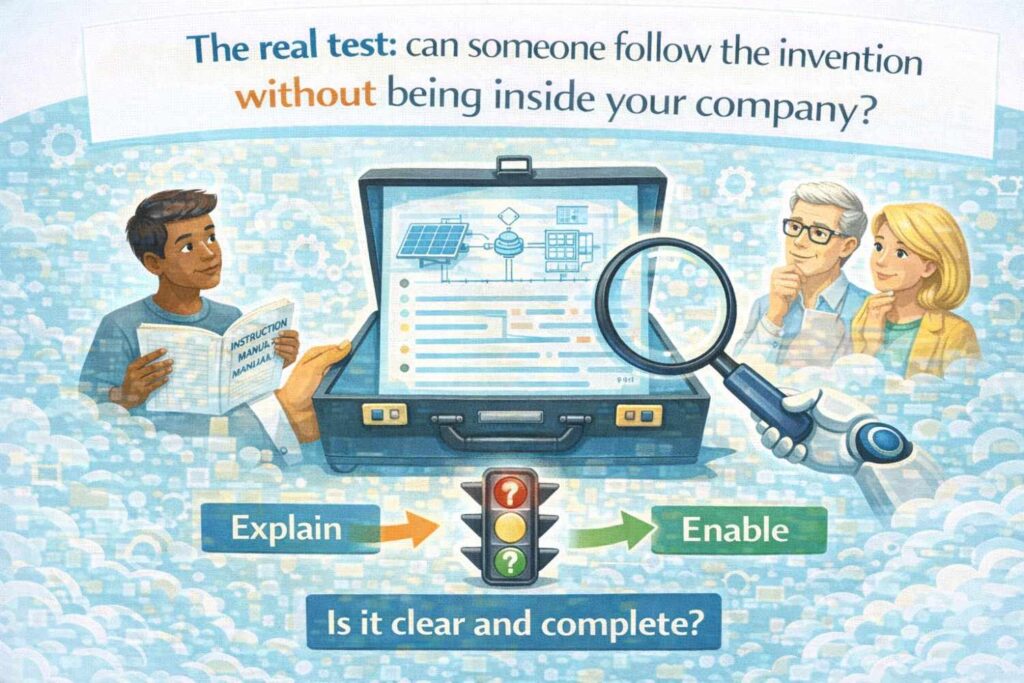
This is one of the best editing questions you can ask.
Would a technically skilled person outside your company understand how the invention works from this description?
If the answer is no, the draft probably still relies too much on insider knowledge.
This is a common founder problem. The team knows the product so well that it forgets what is not obvious to outsiders.
The detailed description has to close that gap.
That means explaining assumptions that feel obvious internally.
Where does the data come from?
What happens before the model runs?
What happens after the output is produced?
What controls the sequence?
What happens when something fails?
Those are exactly the kinds of details that insiders often skip and outsiders need.
Walk through the process step by step
After describing the main components, explain how the invention operates.
This often works best as a process flow.
What happens first?
What is received first?
How is it processed?
What decisions are made?
What action follows?
What update happens next?
What loops back?
You are not just showing pieces. You are showing motion.
That matters because a lot of invention value sits in the sequence, not just the parts.
For example, a fraud system may not be inventive because it uses a model. Many systems use models.
Its inventive value may be in the order of operations: how inputs are normalized, how session context is incorporated, how multiple signals are combined, how thresholds are adapted, and how different downstream actions are triggered.
That sequence belongs in the detailed description.
If the process flow is important, describe it clearly.
Why sequence matters more than founders think
Sometimes the invention lies in timing.
A classification may happen before storage.
A validation step may happen before a transaction is allowed.
A local screening stage may happen before cloud inference.
A fallback rule may apply only after a model confidence score falls below a threshold.
These order decisions can matter a lot.
They can be part of what makes the system better.
They can affect speed, accuracy, bandwidth, power use, safety, or reliability.
So do not just describe what the system does.
Also describe when it does it and in what relationship to other steps if that timing matters.
This is a common place where important details get lost.
Describe inputs like they are real, not abstract
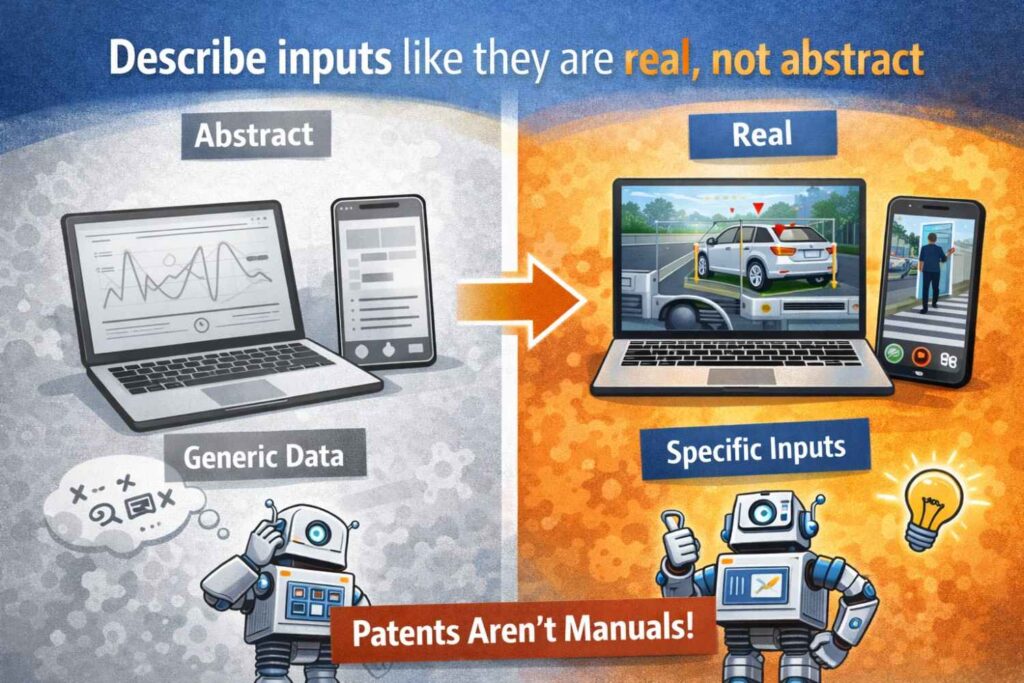
Weak patent drafting often uses vague phrases like the system receives data.
That is rarely enough.
What kind of data?
Structured fields?
Sensor streams?
Transaction records?
Images?
Audio?
User behavior logs?
Messages from another system?
Device state information?
Historical training data?
Context data from an environment?
You do not need to expose unnecessary secrets. But you do need to give the invention enough shape.
The more real the inputs sound, the more real the invention sounds.
The same goes for outputs.
What does the system generate?
A score?
A label?
A route assignment?
A control signal?
An alert?
A content item?
A prediction?
A recommendation?
A classification?
A response action?
Be specific enough to teach.
Describe transformations, not just outcomes
Many inventions live in the middle.
They are not just about what goes in or what comes out.
They are about what happens between those two points.
That middle part is often where the invention earns its value.
So explain transformations.
Is data normalized?
Grouped?
Ranked?
Compared?
Weighted?
Filtered?
Compressed?
Embedded?
Segmented?
Fused?
Tokenized?
Aligned?
Scored?
Aggregated?
The more clearly you describe the transformation steps, the stronger the detailed description becomes.
This is especially important for AI and software inventions. A generic result statement is not enough. The patent should show the pipeline, not just the promise.
Decision logic deserves its own attention

A lot of patents involve systems that make decisions.
They select one action over another.
They classify events.
They determine whether to alert, route, block, permit, recommend, or escalate.
Do not leave that logic vague.
If the decision is based on a score, say what kinds of factors feed the score.
If it is based on thresholds, explain what the thresholds may depend on.
If it is based on a model, explain what kinds of inputs the model may use and how outputs may affect downstream behavior.
If there are fallback rules, explain them.
If there is confidence-based handling, explain that.
If decisions change over time or under different conditions, describe that too.
The invention often lives in the decision layer more than founders first realize.
Use the figures as anchors
If the patent includes drawings, use them well.
The detailed description should not just mention the figures in passing. It should use them to anchor the reader.
A figure can help explain architecture.
A flow chart can help explain sequence.
A block diagram can help explain modules and data flow.
A device drawing can help explain structure.
A deployment diagram can help explain different environments.
This matters because readers often understand systems better when they can match text to a visual frame.
Figures also help founders catch missing details. When a system is drawn out, the gaps become easier to spot.
That is why figures are not just decoration. They are drafting tools.
Describe alternatives early, not as an afterthought
This is one of the most important habits in writing a strong detailed description.
Do not wait until the end to throw in a paragraph saying many other variations are possible.
That kind of catch-all language is not enough on its own.
Instead, describe alternatives where they naturally belong.
If a module can be local or remote, say that in the module description.
If a model can be rule-based, learned, or hybrid, say that where the model is discussed.
If an input can come from multiple kinds of devices, say that in the input discussion.
If a process step can occur in different order under some conditions, explain that where the step is described.
This makes the draft more honest and more useful.
It shows the invention family, not just the current product version.
The patent should protect the invention family, not just the release notes
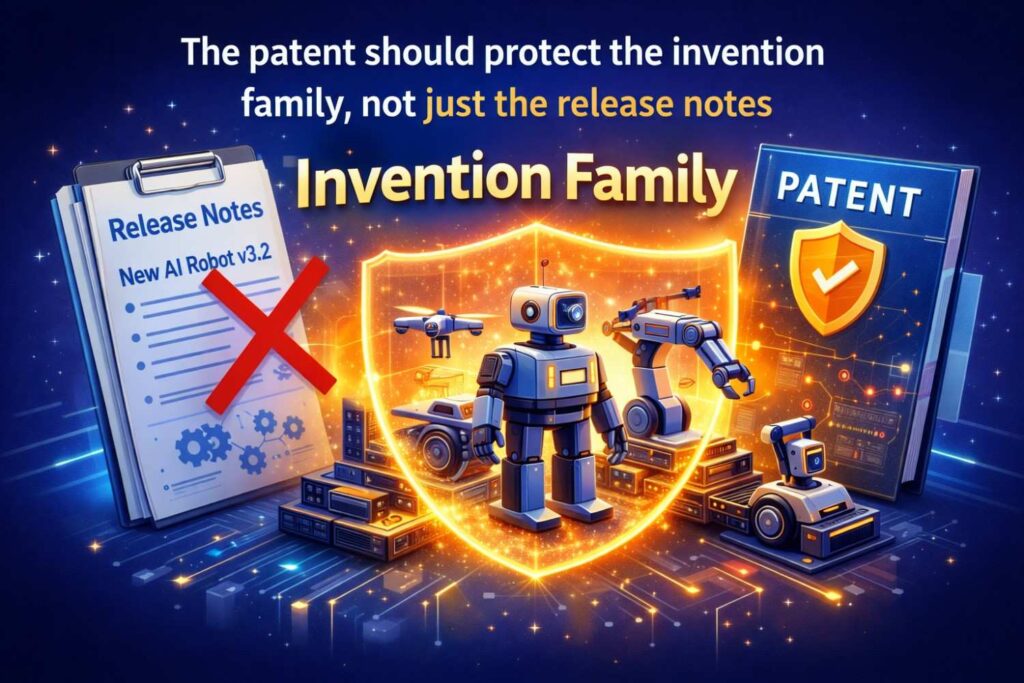
This is a mindset shift founders need.
A patent is not a record of a sprint demo.
It is a strategic asset meant to protect the inventive concept across its meaningful forms.
That means the detailed description should cover the family of the invention.
Not fantasy.
Not random add-ons.
But the real family of ways the invention can be carried out.
For example, if your current system uses a neural network but a gradient boosting model or rule-plus-model hybrid could also carry out the same key invention, describe that.
If the invention can work in mobile, cloud, or edge settings, describe that.
If it can apply to different types of resources, users, claims, transactions, or sensor data, describe that.
This is how you avoid building a patent that becomes stale too fast.
But do not confuse breadth with filler
There is a bad version of broad drafting.
It sounds like a random pile of alternatives.
The system may use any data, any model, any device, any network, any workflow, and any output in any order.
That is not good drafting.
It feels empty because it is not tied to the invention.
Strong breadth is thoughtful.
It describes meaningful variations that still belong to the same inventive idea.
So when adding alternatives, ask a simple question.
Would this variation still be recognized by a skilled person as part of the same core invention?
If yes, it likely belongs.
If not, it may just be filler.
Explain optional features clearly
A strong detailed description often includes optional features.
This matters because not every feature should sound mandatory.
Some systems may include a verification step.
Some may include user feedback loops.
Some may include adaptive thresholds.
Some may include additional data sources.
Some may include local preprocessing.
When these are optional, say so in a clear way.
Phrases like in some embodiments, in some implementations, optionally, or in certain examples help.
That said, do not make every sentence optional. The core invention should still feel solid.
The art is knowing what is central and what is flexible.
Examples are powerful when used the right way
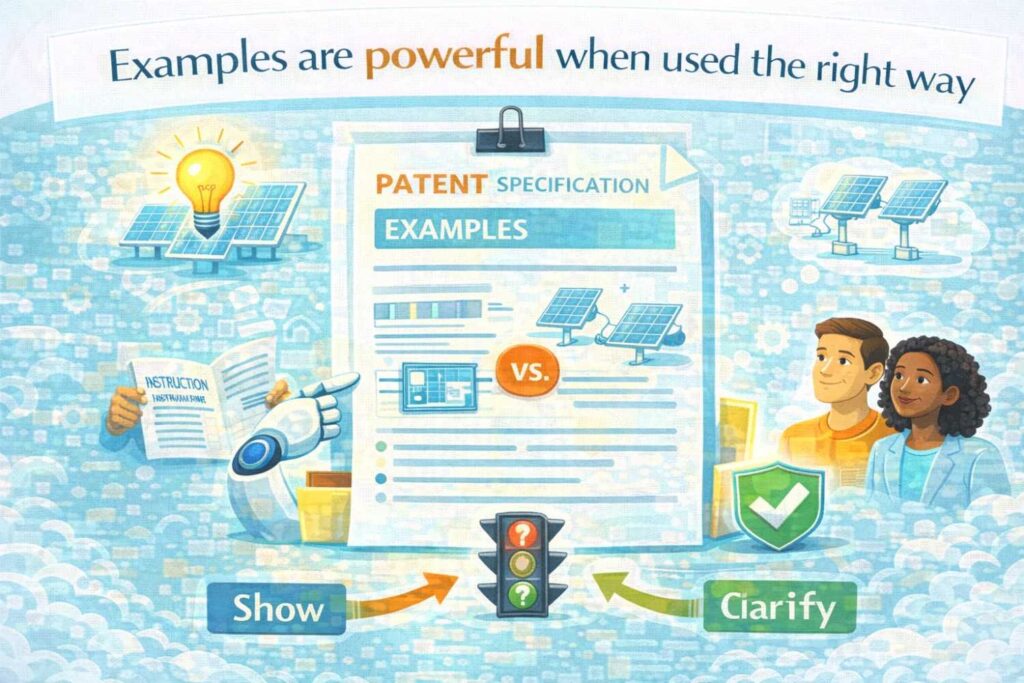
Examples help readers understand the invention in concrete terms.
They can show how the system behaves in a real scenario.
They can show how a workflow changes under certain conditions.
They can show why a technical choice matters.
That is useful.
But examples should teach, not trap.
If you describe one example too tightly and never zoom back out, the invention may start to feel limited to that exact case.
So the best practice is to use examples as illustrations, then make clear that the invention can also operate in other contexts, with other data, devices, or use cases.
For instance, if your AI system is shown through an insurance claim routing example, the description can later explain that the same techniques may be used in other task-routing environments, workflow systems, or review pipelines.
That keeps the example helpful without turning it into a cage.
Describe edge cases and failure paths where they matter
Founders often describe the happy path because that is how they want the product to look.
Patents do not always benefit from that kind of neatness.
Sometimes the strongest description includes what happens when things do not go as planned.
What happens if a data source is unavailable?
What happens if a confidence score is low?
What happens if a sensor reading conflicts with another signal?
What happens if a threshold is not met?
What happens if a remote service is unavailable?
These paths can matter a lot.
They often show real technical thought.
They also make the invention look more complete and practical.
Not every patent needs every failure mode. But where fallback behavior or exception handling is part of the real system, include it.
The invention is often bigger than the main algorithm
This is especially true in AI and software.
Founders often think the key invention is the model.
Sometimes it is.
But often the real protectable value is broader.
It may be the data flow around the model.
It may be the preprocessing layer.
It may be the way multiple models or rules interact.
It may be the trigger logic that determines when the model is used.
It may be the feedback loop that updates behavior after an event.
It may be the system architecture that makes the full solution useful in a real environment.
The detailed description should capture that full picture.
Do not shrink the invention down to only the part that sounds most advanced.
Capture the working system, not just the most impressive buzzword.
For software, describe architecture and flow together

One of the strongest ways to draft software inventions is to describe both architecture and flow.
Architecture explains what components exist.
Flow explains how they operate.
Both matter.
If you only describe architecture, the patent can feel static.
If you only describe flow, the patent can feel ungrounded.
Together, they give the invention shape.
For example, the description may explain that a system includes a client device, an application server, a scoring service, a datastore, and a notification engine. Then it may explain how a request moves through those components, how scores are generated, how results are stored, and how actions are triggered.
That is good drafting.
It teaches the system in a complete way.
For AI, describe more than “the model does it”
AI patents get weak fast when the detailed description says the model processes inputs and generates outputs, full stop.
That is not enough.
You should describe what types of inputs the model may use.
How features may be formed.
Whether training is supervised, unsupervised, reinforcement-based, or otherwise.
Whether models are updated over time.
Whether inference is local, remote, or hybrid.
Whether outputs are ranked, thresholded, filtered, calibrated, or combined with rules.
Whether human feedback or system feedback changes later behavior.
The model is part of the invention story, not the entire story.
This is especially important because AI models change quickly. A detailed description tied too closely to one exact model version can age badly. A better description supports the full technical approach.
For hardware, show relationships between parts
Hardware patents often do better at describing structure, but they can still leave key things out.
A strong hardware detailed description should not just name components. It should explain relationships.
How are parts arranged?
How do they connect?
What forces, signals, flows, or transfers happen between them?
What positions matter?
What ranges matter?
What alternatives exist?
If a thermal barrier sits between two structures, explain that.
If a coupling mechanism selectively engages under certain conditions, explain that.
If a sensor position reduces interference or improves detection, explain that too.
The relationship between parts is often the invention, not just the parts alone.
For process inventions, show the order and purpose of each stage

Process inventions benefit from clear sequencing.
Describe each stage.
Explain what happens there.
Explain why that stage exists.
Explain whether order matters.
Explain whether the process can branch, repeat, or stop based on conditions.
This is useful because process inventions often involve both action and reason.
It is not enough to say a material is heated, then cooled, then measured.
Why?
What does each stage accomplish?
Why that order?
What ranges or alternatives exist?
That is what makes the process understandable.
Do not hide behind legal-sounding language
A lot of patent drafts sound harder than they need to be.
That is not always a sign of strength.
In many cases, it is a sign that the writing is doing too much work to sound formal and not enough work to explain the invention clearly.
For businesses, that creates a real problem. A patent that sounds impressive but is hard to understand can weaken internal review, slow down decision-making, and make it easier for important gaps to go unnoticed.
Clear writing is not a style choice here.
It is a business advantage.
Clear Language Helps Businesses Catch Risk Earlier
When drafting gets too dense, founders and technical leads often stop pushing back on the document.
They assume the patent language is supposed to sound confusing, so they review it less closely. That is where weak support, missing alternatives, and narrow wording can slip through.
Clear language makes it easier for the people who actually built the invention to review the draft with confidence.
That matters because the business team often knows exactly where the invention is strong, where it may evolve, and where a competitor might try to work around it.
If they cannot follow the draft, they cannot improve it.
That is a real cost.
Dense Writing Can Hide Weak Thinking
Sometimes legal-sounding language gives the illusion that the invention has been described well when it has not.
A sentence may sound polished, but once you strip away the extra wording, it may say very little. This is dangerous for businesses because it creates false confidence. The team thinks the invention is covered, but the actual technical explanation may still be too thin.
A useful test is simple: take one paragraph and restate it in plain words. If the meaning becomes unclear or embarrassingly vague, the paragraph probably needs to be rewritten.
That test can reveal problems fast.
Simple Writing Makes Cross-Functional Review Stronger
Patent review is rarely just a legal task.
It often involves founders, engineers, product leads, and business leaders. Each person brings a different kind of insight. One person may spot a missing technical step. Another may notice that the draft is too tied to the current product version. Another may catch that the invention is being framed too narrowly for the company’s roadmap.
That kind of review only works well when the writing is understandable.
A business should want a draft that smart people across the company can react to, not one that only one outside specialist can decode.
Use Precision, Not Puff
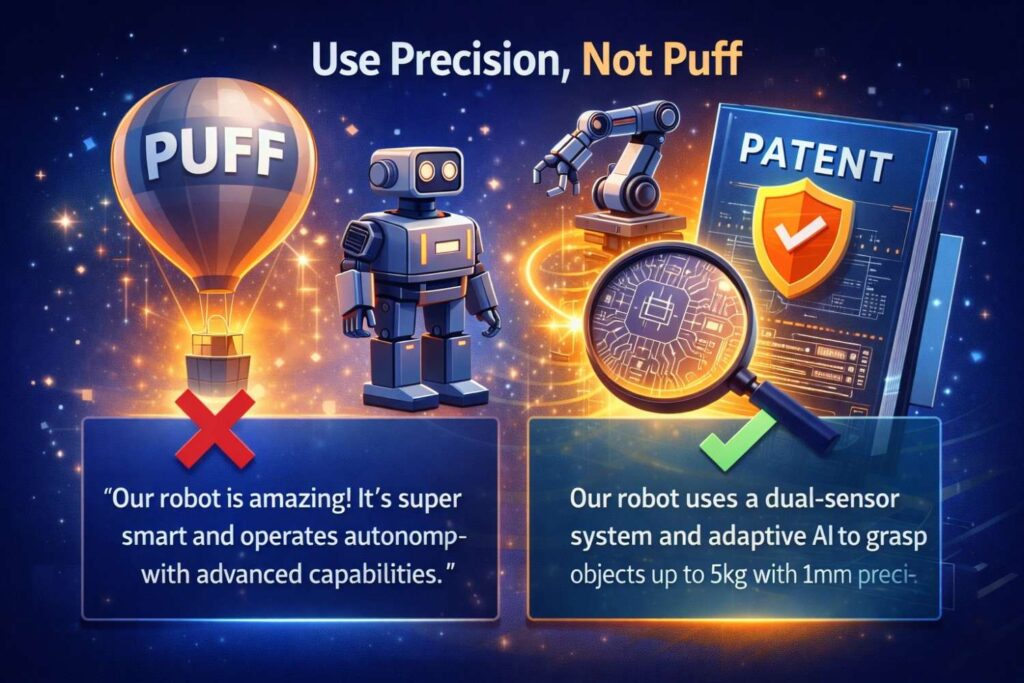
The goal is not casual writing.
The goal is precise writing.
Precision means naming the real thing clearly. Say what the system receives. Say what it determines. Say what it outputs. Say what can change. Say what is optional.
That is much stronger than dressing up weak ideas in heavy language.
For businesses, this matters because precise writing creates better long-term assets. It makes the patent easier to reuse in diligence, easier to discuss internally, and easier to connect to actual product strategy.
Translate Internal Complexity Into Plain Technical Language
Many companies build highly complex systems. That does not mean the draft has to sound tangled.
A smart way to handle this is to take each complex part of the system and ask one simple question: how would we explain this to a strong engineer joining the team next week?
That answer is often much closer to the right patent language than the bloated version that tries too hard to sound official.
This is highly actionable. During review, pick three of the most complex parts of the invention and rewrite them in clean, direct language before putting them back into formal patent structure. That usually improves clarity right away.
Make “Founder Readability” a Drafting Standard
One strong habit for businesses is to adopt a simple internal rule: if the founder or lead engineer cannot explain a section back clearly after reading it, the section is not done yet.
That does not mean every sentence should be stripped down to the point of losing legal usefulness. It means readability should be treated as a real quality standard, not a nice extra.
This helps prevent the draft from drifting into language that sounds official but does not help the business protect what actually matters.
Better Writing Leads to Better Strategy Conversations

A clear detailed description does more than help the patent.
It also improves strategic discussion inside the company. When the invention is described in direct, understandable terms, leadership can more easily talk about what is truly novel, what should be protected next, what maps to the roadmap, and where the moat really sits.
That is harder to do when the draft is buried under formal-sounding language that hides the core idea.
In that sense, clear writing is not just better communication.
It is better strategic infrastructure.
A Simple Editing Rule That Works
A practical rule for businesses is this: whenever a sentence sounds impressive, ask whether it became more accurate or just more abstract.
If it became more abstract, rewrite it.
That one habit can improve a patent draft more than many founders expect. It keeps the writing tied to the invention instead of drifting into language that feels polished but says less than it should..
The best detailed descriptions often come from guided invention capture
Most founders should not start this section from a blank page.
The best raw material usually comes from guided conversations, system walkthroughs, diagrams, and structured questions.
For example:
Walk me through the system end to end.
What happens first?
What happens next?
What are the important components?
What is different from the old way?
What alternatives could be used?
What would a competitor swap out?
What happens when a key signal is missing?
Those kinds of prompts surface the real invention details.
That is why structured invention capture matters so much.
This is also where PowerPatent helps founders move faster without losing depth. Instead of relying on slow, messy note exchanges, it helps technical teams turn what they already know into a real patent draft with stronger support and real attorney review. That combination matters a lot when writing a detailed description well. See more here: https://powerpatent.com/how-it-works
A practical way to map the section before writing it
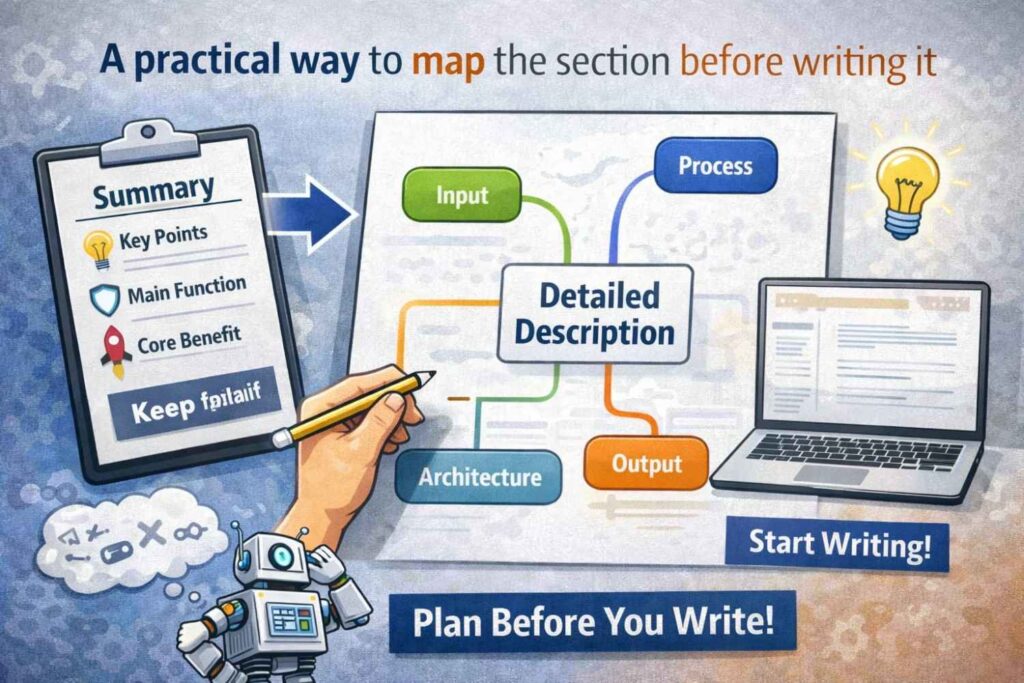
Here is a useful drafting method.
Before writing formal prose, map the section in simple blocks.
First, write a short system overview.
Then list the main components.
Then draw the main flow.
Then list inputs and outputs.
Then list key decisions.
Then list meaningful alternatives.
Then note examples or special cases.
Only after that should you write the polished section.
This simple pre-draft map can prevent a lot of missed detail.
It also helps show where the draft is too thin or too tangled before too much time is spent polishing sentences.
How to know if you are missing key details
This is the question behind the whole section.
There is no magic checklist that guarantees perfection. But there are very good signals.
You may be missing key details if the description explains the result but not the process.
You may be missing key details if it names components but not their function.
You may be missing key details if only one narrow implementation is described.
You may be missing key details if a technically skilled reader would still need to guess how the system actually works.
You may be missing key details if major product behavior is visible in the real system but absent from the draft.
You may be missing key details if important fallbacks, alternatives, or data flows are not described anywhere.
Those are all warning signs.
Check Whether the Reader Has to Fill in the Gaps
If the reader has to guess how one step leads to the next, the draft may still be too thin.
A strong description should reduce guesswork and make the invention understandable without relying on insider knowledge.
Look for Places Where the Logic Jumps Too Fast
Sometimes a draft moves from input to result so quickly that the middle disappears.
That is often a sign that an important transformation, decision point, or system interaction still needs to be explained.
Test Whether Each Important Part Has a Clear Role
If a component, step, or module is mentioned but its purpose is not fully explained, that can leave a hole in the description.
Each major part should feel necessary and understandable in context.
Compare the Draft Against How the Product Really Works
One useful check is to look at the actual system, workflow, or prototype and ask whether the draft reflects the parts that truly matter in practice.
If the real product depends on something the draft barely mentions, that is a warning sign.
See Whether Alternatives Are Missing Where They Should Exist
If the invention could clearly work in more than one meaningful way, but the draft only shows one narrow path, important supporting detail may still be absent. This is often where future flexibility gets lost.
A founder-friendly test that works
Try this test.
Give the detailed description to a technical person who understands the general field but not your exact system.
Then ask them to answer these questions in their own words.
What is the invention?
What are its main parts?
How does it work?
What different versions are possible?
If they struggle, there may still be missing details or weak structure.
This is a simple test, but it reveals a lot.
Another good test: imagine a copycat

Here is a strategic test.
Imagine a competitor reads the detailed description.
What easy workaround would they try?
Would the draft still seem to cover that variation?
If not, you may need broader support.
This test helps because it pushes you to think beyond the exact current product version.
It asks whether the description supports the invention in a way that is commercially useful, not just technically accurate.
That is important.
The difference between secrets and support
Founders sometimes worry that a strong detailed description means giving away too much.
That concern is understandable.
But there is a difference between giving away unnecessary trade secrets and providing enough support for a patent.
A patent needs a real description of the invention. It does not necessarily need every internal tuning value, every hidden weighting choice, or every line of implementation detail if those are not needed to describe the invention properly.
The key is to explain the invention enough to support protection while staying strategic about what specific low-level details truly need to be there.
That balance is one reason expert review matters.
Keep the language stable, not tied to temporary product names

A detailed description should outlast your current naming habits.
Internal feature names, temporary architecture labels, and product branding often change fast.
Patent language should be more stable.
Instead of naming a module “PulseRank” or “BoostFlow,” describe it as a ranking engine, routing module, scoring service, workflow engine, or whatever it actually is in technical terms.
That makes the patent easier to understand and more durable over time.
Use subheadings to make long descriptions readable
A long detailed description becomes much easier to handle when it is broken into useful sub-sections.
That helps founders reviewing the draft.
It helps attorneys revising it.
It helps examiners reading it later.
It helps everyone.
Subheadings like system overview, example computing environment, data ingestion flow, model generation, output handling, alternate embodiments, and example use cases can make a huge difference.
Good structure is not just cosmetic. It helps prevent missed detail because it forces the writer to cover each area clearly.
The section should grow from the core invention outward
A strong detailed description often starts with the center of the invention and then expands outward.
That means you first explain the core architecture or method.
Then you explain the major modules and steps.
Then you explain supporting features.
Then you explain alternatives.
Then you explain deployment options, examples, and extensions.
This approach keeps the writing focused.
If you start too far out with background systems, edge cases, or optional features, the main idea can get buried.
The reader should always know what the center is.
Start With the Part That Makes the Invention New
Open the section by grounding the reader in the feature, process, or system relationship that carries the real inventive weight. This keeps the draft centered on what actually matters instead of drifting into side details too early.
Add Supporting Layers in a Natural Order
After the core invention is clear, expand into the surrounding parts that help it work in practice.
This makes the description easier to follow and helps the reader understand how the broader system connects to the main idea.
Move From Essential Structure to Real-World Operation

Once the central architecture is established, the section can shift into how the invention behaves during actual use.
This creates a smoother path from static description to working implementation.
Leave Extensions and Variations for the Outer Edges
Alternative forms, optional features, and expanded use cases usually read better when they come after the main invention is already well established. This keeps the section focused while still giving the patent room to cover more.
Keep the Main Thread Visible All the Way Through
As the description expands outward, each new paragraph should still feel connected to the same central invention story. That helps prevent the section from becoming fragmented or overloaded.
Common drafting mistakes that lead to missing detail

One common mistake is assuming the reader knows what the team knows.
Another is describing only the visible feature and not the underlying technical flow.
Another is skipping alternative implementations because the team already chose one.
Another is writing from the UI backward instead of from the system logic outward.
Another is overusing labels like engine, module, platform, or subsystem without explaining what those things do.
Another is forgetting to describe what happens after the system generates an output.
Another is ignoring feedback loops.
Another is failing to describe the environment where the invention operates.
All of these lead to gaps.
The good news is that once you know what to watch for, they are fixable.
How to revise a weak detailed description
Revision matters a lot here.
A first draft is rarely perfect, especially if the invention is complex.
When revising, do not just polish words.
Look for structural gaps.
Ask whether the section explains the core system clearly.
Ask whether each major component is actually described.
Ask whether the process flow is clear.
Ask whether alternatives are included where they matter.
Ask whether examples are helping or narrowing.
Ask whether the same invention story appears throughout the section.
Ask whether the reader can follow the invention from start to finish.
This kind of revision improves more than style. It improves support.
Use product history to find missing details
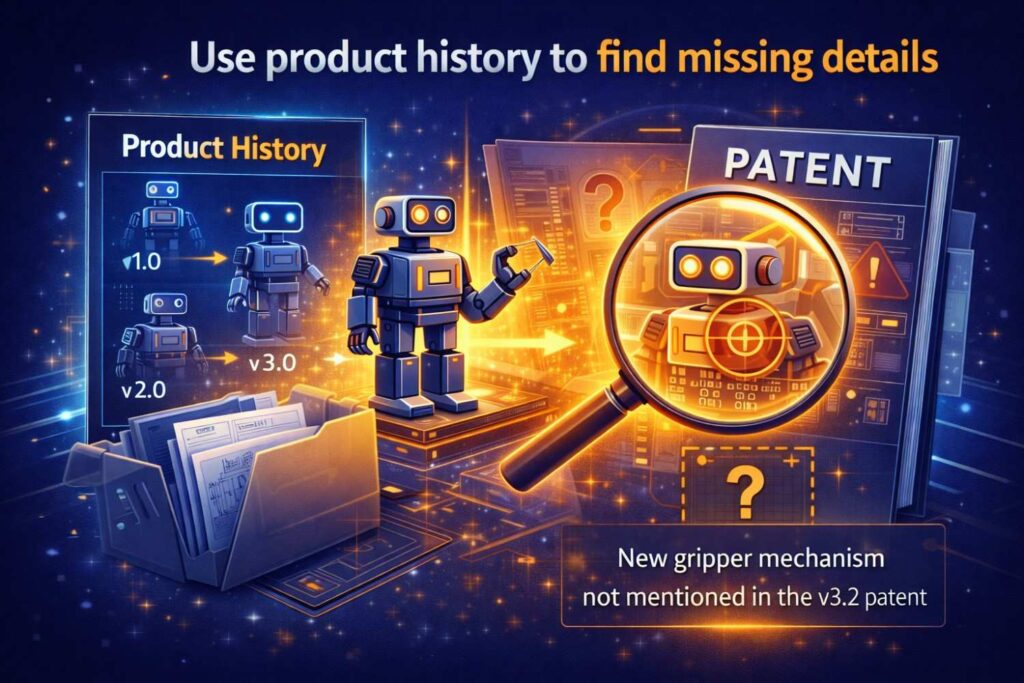
One smart revision move is to look backward.
How did the team get to the current design?
What earlier approach failed?
What had to be added later?
What hidden rule, step, or data source made the system actually work?
Those answers often expose missing detail.
The final system may look smooth now, but the history of how it got there often reveals what truly matters technically.
That history is a good source of support language.
Why the detailed description also helps business strategy
A strong detailed description does more than support a patent filing.
It can help a company think more clearly about where its real advantage lives, what parts of the product deserve the most protection, and how to explain technical depth in a way that supports bigger business goals.
That is important because many startups are not weak on innovation. They are weak on turning that innovation into a clear strategic asset.
A detailed description, when done well, helps close that gap.
It Shows Where the Real Moat Actually Sits
Many businesses think their edge is the feature customers see.
But the detailed description often reveals something deeper.
It may show that the real moat is not the dashboard, the workflow, or the visible user result. It may be the system logic underneath, the data handling layer, the control flow, the update loop, or the way several parts work together.
That matters because companies often invest too much attention in what is easiest to demo and not enough attention in what is hardest to copy.
A strong detailed description forces the team to ask a better question: what is the technical layer we would least want a competitor to replicate?
That question is strategic. It helps the business protect the right thing, not just the obvious thing.
It Helps Leadership Prioritize What to Protect First

Most startups build more invention than they file.
Time is limited. Budget is limited. Attention is limited.
So the real issue is not whether everything is interesting. The real issue is what matters most to protect first.
A strong detailed description helps with that because it shows which parts of the system carry the most leverage. Once the full invention is mapped clearly, leadership can see whether the strongest value sits in a model pipeline, a control method, a data transformation layer, a deployment approach, or a broader system design.
That makes filing strategy much smarter.
Instead of choosing what to patent based on whatever feels newest, the business can choose based on what is most central to long-term defensibility.
A simple way to use this in practice is to review the detailed description and mark three areas: what is core, what is valuable but secondary, and what is nice to have. That quick exercise often makes the next filing decision much easier.
It Improves Technical Storytelling With Investors
Investors do not always read patents in full, but they do care whether the company has real technical depth.
A strong detailed description helps founders tell that story more clearly because it forces the invention into a more disciplined form.
It helps replace vague claims like “our system is smarter” with sharper explanations of what the system actually does differently.
That is useful in fundraising.
It helps the team explain why the product is not just another feature layer on top of common tools.
It helps show that the company has built technical infrastructure that is harder to recreate than it may first appear.
A practical move here is to pull two or three plain-language moat statements from the detailed description after the draft is complete.
Not legal lines. Business-ready lines. That creates better material for fundraising conversations without turning the patent into sales copy.
It Creates Better Alignment Between Product and IP
In many companies, product planning and patent planning happen too far apart.
The product team builds. The legal team files. The connection is weak.
A strong detailed description helps fix that because it sits much closer to the actual system. It makes it easier to compare what the company is building with what the company is protecting.
This creates a useful planning habit.
When the product roadmap changes, the team can review the detailed description and ask whether the next major technical layer is already covered, partly covered, or not covered at all.
That is a much stronger way to run IP strategy than reacting late.
It Helps Spot Expandable Platform Opportunities

Sometimes the detailed description reveals that the invention is broader than the team first believed.
A workflow built for one market may also fit another. A control system built for one device type may apply to several. A data-handling method built for one internal use case may actually be the base of a larger platform.
That kind of insight is easy to miss when everyone is focused only on shipping.
The detailed description creates a fuller technical map, and that map can expose adjacent opportunities.
One actionable way to use this is to ask after the draft is done: where else could this same system architecture or method create value with only modest changes? That question can lead to stronger product expansion thinking and a smarter filing roadmap.
It Gives the Business a Better Diligence Asset
During fundraising, partnership talks, or acquisition review, companies often need to explain not just that they filed a patent, but what that filing actually covers.
A thin or poorly structured draft makes that hard.
A strong detailed description gives the business a better diligence asset because it shows a real technical record of how the invention works.
That creates more confidence. It shows the company has done more than file a title and a few broad claims. It shows the team has captured the system in a serious way.
That can matter more than founders realize, especially when outside parties are trying to judge whether the company’s technical advantage is real and durable.
A Simple Strategic Habit That Pays Off
One of the best ways to use the detailed description beyond the filing is this: after each major patent draft, hold a short internal review with leadership and ask three questions.
What part of this invention is most important to our moat?
What part is most likely to grow into a future filing family?
What part would a competitor most likely try to work around?
Those questions turn the detailed description into more than a legal document.
They turn it into a business strategy tool.
That is where the hidden value often appears.
The right level of detail is “enough to support, not enough to wander”
Founders often ask how much detail is enough.
There is no perfect page count.
But there is a useful principle.
Include enough detail to support the invention and its meaningful variations.
Do not add so much random detail that the invention gets buried or trapped in unnecessary specifics.
The art is knowing what is essential, what is helpful, what is optional, and what is noise.
That is why this section is both technical and strategic.
A plain example of building a detailed description
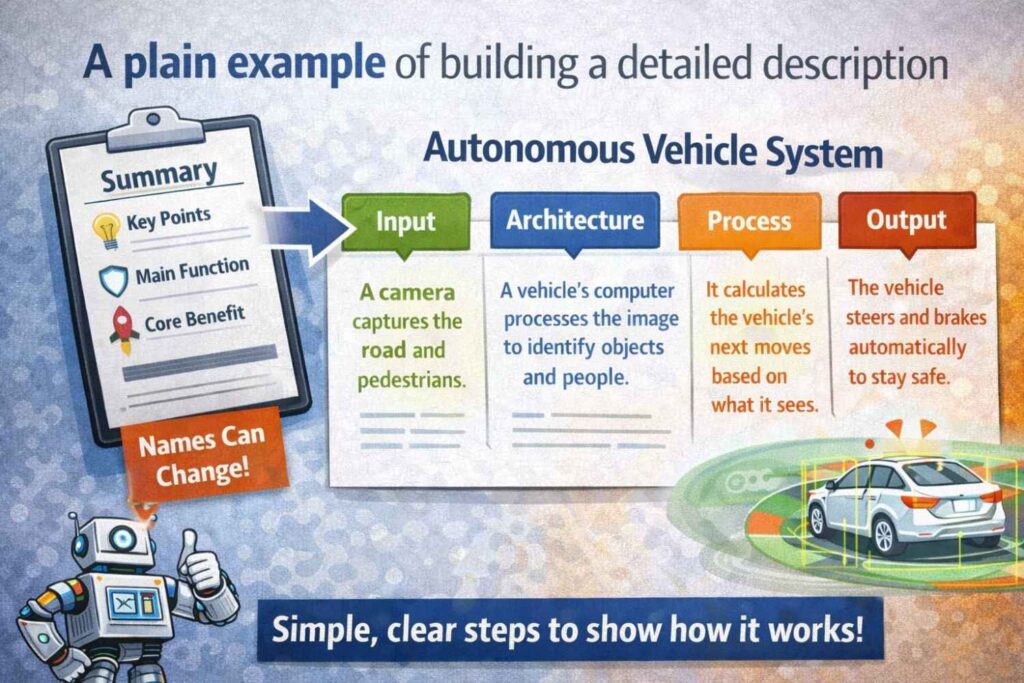
Let us make this real.
Suppose your startup built a system that reduces false fraud alerts in online payments by combining transaction context, device history, and user behavior patterns.
A strong detailed description might begin with a system overview explaining that the system includes a transaction intake interface, a context generation module, a feature processing engine, a fraud scoring component, and an action module.
Then it may describe each of those pieces.
The transaction intake interface may receive payment request data from one or more merchant or payment environments.
The context generation module may retrieve or derive context information, such as prior transaction history, device information, location-related information, account state, or session-level behavior.
The feature processing engine may normalize, combine, encode, or otherwise transform raw data into one or more features usable by a scoring component.
The fraud scoring component may apply one or more models, rule sets, or hybrid logic to determine one or more fraud-related outputs, such as a score, a classification, or a confidence value.
The action module may selectively allow the transaction, block the transaction, queue the transaction for review, or request additional verification based on the one or more fraud-related outputs.
Then the description may walk through the process.
A payment request is received.
Context is gathered or derived.
Features are created.
A score is generated.
Thresholds, rules, or confidence values are evaluated.
A downstream action is selected.
Then the description may describe alternatives.
Context may be generated locally or via remote services.
Scoring may be model-based, rules-based, or hybrid.
Outputs may vary by deployment environment, customer preference, or risk policy.
The system may update thresholds over time based on confirmed fraud outcomes or review feedback.
That is already a much stronger description than simply saying the system uses AI to reduce fraud.
How this applies to startups moving fast
Fast startups do not usually fail to protect good inventions because they lack strong ideas.
They fail because speed hides detail.
When a team is shipping quickly, fixing bugs, talking to customers, and racing toward growth, the invention often stays trapped inside Slack threads, sprint updates, whiteboard sessions, and the heads of a few key builders. By the time someone says, “we should patent this,” the team may already be two product versions ahead.
That is why startups need a different approach.
The goal is not to slow product velocity. The goal is to capture technical value before it disappears into execution.
Speed Creates Blind Spots Around What Is Actually Inventive

In a fast-moving company, the team often gets used to improvement as a normal part of work.
A model gets better. A workflow gets cleaner. A system becomes more stable. A deployment gets faster.
Because those changes happen every week, people stop noticing which ones were technically meaningful.
That is risky.
The most important invention detail is often not the headline feature. It may be the hidden system change that made the feature actually work in production.
If no one pauses to capture that shift, the company can miss its best patent material while still feeling like it is moving efficiently.
A practical fix is to ask one question after major technical wins: what changed under the hood that made this possible now when it did not work before?
That question often surfaces the real invention.
The Right Drafting Process Should Match Startup Speed
A lot of patent processes were built for slower companies.
They assume long interviews, drawn-out reviews, and lots of back and forth. That can break momentum inside a startup.
What fast companies need is a system that captures invention detail while the context is still fresh.
That means documenting the technical problem, the new approach, and the important variations close to the moment the work happens.
Not months later when memories blur and the team is deep into the next sprint.
This is why businesses should treat patent capture more like product capture. The same way you do not wait six months to write down key product decisions, you should not wait too long to record invention logic.
Build a Light Capture Habit Into the Product Cycle
The smartest move for a fast startup is not a giant legal process.
It is a small repeatable habit.
After a meaningful build, redesign, model improvement, or infrastructure breakthrough, capture a short record of what changed technically.
Keep it simple. What was not working before. What the team changed. Why the new version works better. What alternatives might also work.
That small habit can save a huge amount of time later.
It also makes the detailed description much stronger because the raw material comes from real technical memory, not from rushed reconstruction.
Tie Patent Capture to Engineering Milestones
One very useful business practice is to connect invention review to moments the company already tracks.
For example, when a feature moves from prototype to production, ask whether the technical path behind it solved a non-obvious problem.
When the company finishes a major architecture shift, ask whether that shift created a new protectable method.
When model performance improves in a way that changes product behavior, ask what technical change drove that improvement.
This works because it keeps patent thinking close to real execution.
It also helps leadership avoid random filing behavior. Instead of filing based on urgency alone, the company starts protecting the parts of the product that truly matter.
Fast Startups Need to Protect the “Why It Finally Worked” Layer
This is where many businesses miss the best material.
The invention is often not the original idea.
It is the reason the idea finally became usable at scale, under real-world conditions, or inside a working customer workflow.
That is the layer worth watching closely.
Maybe the product concept existed early, but accuracy was too low until the team changed the data handling flow.
Maybe the automation worked in testing, but not in production until a confidence gate and fallback path were added.
Maybe the system was too slow until local preprocessing changed how inference was triggered.
Those are highly valuable details.
For fast startups, the best patent strategy often comes from protecting the layer that turned a promising idea into a real product advantage.
Actionable Advice for Fast-Moving Teams

A useful internal rule is to flag any technical change that improved one of these business-critical areas: speed, accuracy, reliability, cost, scale, or automation.
If the change materially improved one of those, it is worth asking whether there is patent value behind it.
Another strong habit is to run a short monthly invention review with your founder, engineering lead, and product lead.
The goal is not to draft claims in the meeting. The goal is simply to identify what new technical work may deserve capture before it gets buried.
It also helps to keep one shared document where the team logs meaningful technical breakthroughs in plain language. Not polished. Just accurate.
That running record becomes extremely useful when it is time to draft a detailed description.
Speed Is Only an Advantage If You Retain What You Learn
Startups often talk about speed as a moat.
Sometimes it is.
But speed only becomes lasting advantage when the company keeps hold of what it discovers along the way. If every important technical insight disappears into fast execution, then speed creates output without creating durable protection.
That is why strong startups do not just move fast.
They capture fast.
And when they do, the detailed description becomes much easier to write, much more complete, and far more valuable to the business.
Why the old way feels painful
The traditional patent process often makes this section harder than it needs to be.
Founders send rough notes.
Attorneys ask dozens of follow-up questions.
The team answers in fragments.
A draft comes back in dense language.
Important details are still missing because the process never captured the system properly at the start.
That is frustrating and expensive.
A better workflow solves the problem earlier by structuring invention capture well before the final prose is locked in.
That is one reason PowerPatent has been so useful for technical founders. It helps reduce the chaos of the old process while still producing real patent work with real attorney oversight. That means stronger detailed descriptions without the same amount of drag. Learn more here: https://powerpatent.com/how-it-works
The detailed description is where serious patents are built
A serious patent is not built on a clever title or a broad claim alone.
It is built in the detailed description.
This is the section that turns a promising invention into something a business can actually use as a stronger asset. It is where the company proves it understands the invention deeply. It is where the patent starts to show whether it was drafted with long-term value in mind or just filed quickly to check a box.
That difference matters.
A thin detailed description may still produce a filing. But a strong detailed description is what gives the business real room to protect what matters as the product evolves, the market changes, and competitors start paying attention.
It Creates the Foundation for Future Leverage
Most businesses do not file patents just to admire them.
They file because they want leverage.
That leverage may matter in fundraising. It may matter in diligence. It may matter in a competitive market where similar products start appearing.
It may matter when the company expands into new product lines that still rely on the same technical core.
The detailed description is what gives that leverage substance.
If it is well built, the business has a stronger foundation for follow-on claim strategy, continuation filings, and broader protection around the same invention family. If it is weak, the company may later realize that its most valuable technical variation was never properly captured.
That is why smart businesses should treat this section like infrastructure, not paperwork.
It Protects the Part Competitors Will Actually Try to Copy
Competitors usually do not copy a startup word for word.
They copy the advantage in a slightly different form.
That is why the detailed description matters so much. It is the section where the business can describe not just the current version of the system, but the deeper operating logic behind it.
That is often the layer that matters most.
A visible product feature may be easy to imitate on the surface. But the workflow, system design, decision flow, model arrangement, data handling method, or coordination logic underneath may be much harder to recreate.
If that deeper layer is captured well in the detailed description, the patent becomes more useful in the real world.
That is a strategic drafting goal businesses should keep in mind from the start.
It Helps the Business Avoid Filing a “Snapshot Patent”
One of the most common problems in startup patent work is filing what could be called a snapshot patent.
That is a patent built too tightly around one moment in time.
It describes the current product release well enough, but it does not leave enough room for the product that exists six months later.
It protects the version the team shipped, but not the version the company is about to grow into.
A serious patent avoids that trap.
The detailed description is where the team can describe the invention in a way that captures the core technical idea across meaningful versions.
That does not mean adding random speculation. It means describing the invention at the right level so the company is not locked into one temporary configuration.
For businesses, this is one of the most practical ways to improve long-term patent value.
It Gives Leadership a Better View of the Technical Moat

A well-written detailed description is not just useful to counsel.
It can also help leadership understand what the company is really protecting.
That matters because many businesses talk about moat in broad terms, but do not always identify where the true technical defensibility sits.
The detailed description forces that issue. It makes the team define the important system parts, the real operational flow, and the technical relationships that create the edge.
That can be very useful in executive planning.
It can help leadership decide what technical layers deserve deeper investment. It can help product teams see which features are surface-level and which ones rest on more defensible infrastructure.
It can even improve how the company explains its uniqueness in investor conversations.
It Makes Follow-On Patent Strategy Smarter
A strong detailed description often has value beyond the first filing.
It can help reveal where future protection should go next.
Once the invention is fully described, the business can often see whether there are separate components, workflows, deployment models, training methods, control mechanisms, or system extensions that may deserve additional filings later.
This is one reason serious businesses think of the detailed description as a strategic map.
It does not just support one patent. It can help shape a broader portfolio if the company continues building around the same technical base.
That only happens, though, if the first detailed description is rich enough to expose those paths.
Actionable Ways Businesses Can Strengthen This Section
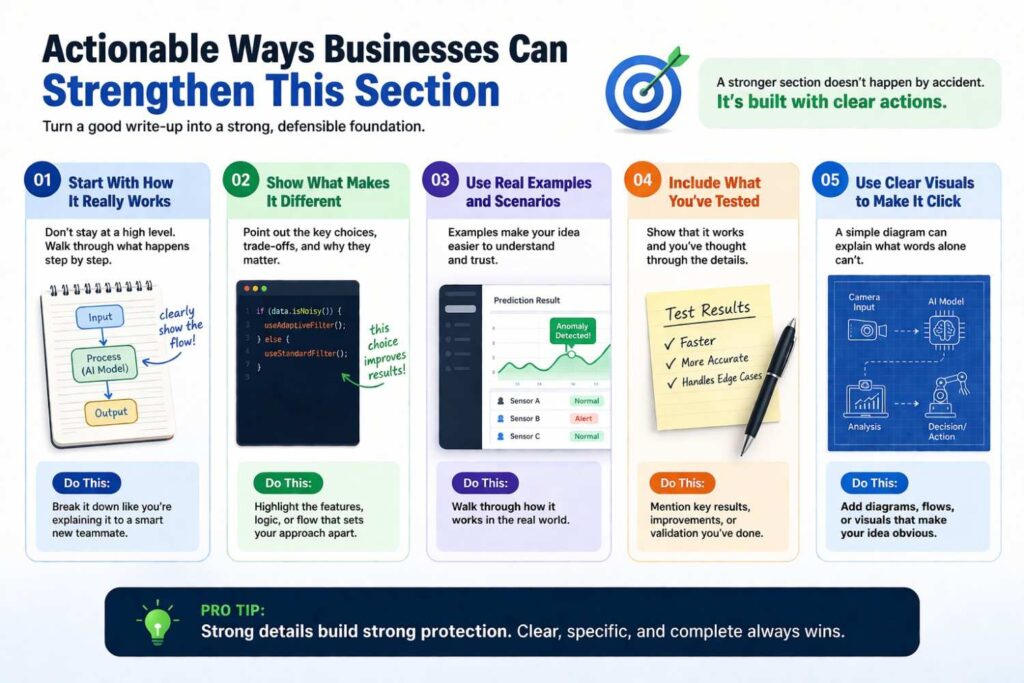
A more strategic mindset is useful, but businesses also need practical moves they can apply right away.
Review It Against the Next 12 to 24 Months, Not Just Today
One smart internal review question is this: if our product evolves in the way we expect over the next one to two years, will this detailed description still feel like it captures the core invention?
That question helps expose drafting that is too tied to the current release.
It is a simple way to push the description beyond short-term thinking without turning it into vague overreach.
Ask What a Smart Competitor Would Change First
Another highly useful exercise is to ask what a smart competitor would swap out first in order to imitate the business outcome while trying to avoid the patent.
Would they change the data source?
Would they move the processing location?
Would they replace one model type with another?
Would they alter the sequence of steps?
If those likely workarounds are not reflected anywhere in the detailed description, that is a sign the section may need more support.
Turn the Detailed Description Into an Internal Strategy Check
After a strong draft is prepared, leadership should ask one direct question: does this section describe the technical layer that actually drives our advantage?
If the answer feels weak or uncertain, that is not just a patent issue. It may be a sign that the company itself needs a clearer internal view of what really makes the product hard to copy.
That is why this section can be so valuable. It does not just support the filing. It helps test the business’s own understanding of its technical edge.
Why This Section Deserves More Business Attention
A serious patent is not built by accident.
It is built when the company takes the detailed description seriously enough to capture not only what the product does, but what makes the underlying invention durable, adaptable, and hard to work around.
That is where real patent value often begins.
And for businesses that care about defensibility, growth, and long-term strategic leverage, this section is one of the most important places to get right.
Final thoughts
Writing the detailed description without missing key details is not about making the patent longer for the sake of length.
It is about making the invention complete on paper.
A strong detailed description explains the system as a whole, explains the major parts, shows how the invention operates, captures meaningful alternatives, and gives the reader enough real technical substance to understand what was built and how it can take different forms.
That is what strong support looks like.
Start with the invention, not the form.
Map the system first.
Describe architecture and flow.
Explain inputs, outputs, transformations, and decisions.
Use figures well.
Include alternatives where they naturally belong.
Use examples wisely.
Revise for gaps, not just grammar.
And always ask whether the description reflects the invention family, not just the current release.
If you do that well, the patent becomes much more than a filing.
It becomes a stronger business asset.
And if you want a faster, founder-friendly way to turn complex technical work into a strong patent draft with real attorney oversight, PowerPatent is built for exactly that. You can see how it works here: https://powerpatent.com/how-it-works