AI can help you move faster. It can turn rough notes into clean text. It can help you explain a system, fill in gaps, and make a patent draft look more complete.
But here is the risk: a patent can look polished and still be weak.
For founders, that is the danger. The words may sound smart. The draft may be long. The sections may be neat. But if the description does not show the real invention in enough detail, the patent can run into Section 112 problems.
That can mean delay. Extra cost. Rejections. Narrow claims. Or, worse, a patent that looks useful but does not protect the thing you actually built.
This guide explains how to avoid that.
And if you want a faster way to turn real technical work into stronger patent filings, you can see how PowerPatent works here: https://powerpatent.com/how-it-works
What Section 112 really asks for
Section 112 is one of the core patent rules in the United States. It is about the quality of the patent description.
In plain words, it asks three big things.
First, the patent must show what you invented.
Second, it must teach someone skilled in the field how to make and use it.
Third, the claims must be clear enough so people can tell what is covered.
There are other details, but for AI-written descriptions, these are the big pain points.
A patent is not just a sales page. It is not just a vision memo. It is not just a high-level product pitch. It must give real technical support for the invention.
This matters even more when AI helps write the draft.
AI is good at making text sound full. It can write a smooth paragraph about almost anything. It can describe “a module,” “a system,” “a model,” “an engine,” or “a processor” in a way that sounds official. But Section 112 does not reward words that only sound complete. It looks for support.
Support means the patent tells the reader what the invention is, how it works, and how to use it without a guessing game.
That is where founders need to be careful.
A strong patent description should feel like a build guide for the core idea. It does not need to expose every trade secret. It does not need to include every line of code. But it should give enough detail to show that the inventors had the invention in hand at the time of filing.
That phrase, “had the invention in hand,” is the heart of many Section 112 problems.
AI can make it seem like the invention is in hand when it is not. It can add broad language, vague steps, and generic examples. It can make the filing look complete while hiding the fact that the most important technical choices were never explained.
That is why AI-written patent text needs review by people who understand the tech and the law.
PowerPatent is built around that idea: smart software helps founders move fast, while real patent attorneys help catch the gaps that software alone can miss. You can explore the workflow here: https://powerpatent.com/how-it-works
Why AI-written descriptions create a special risk
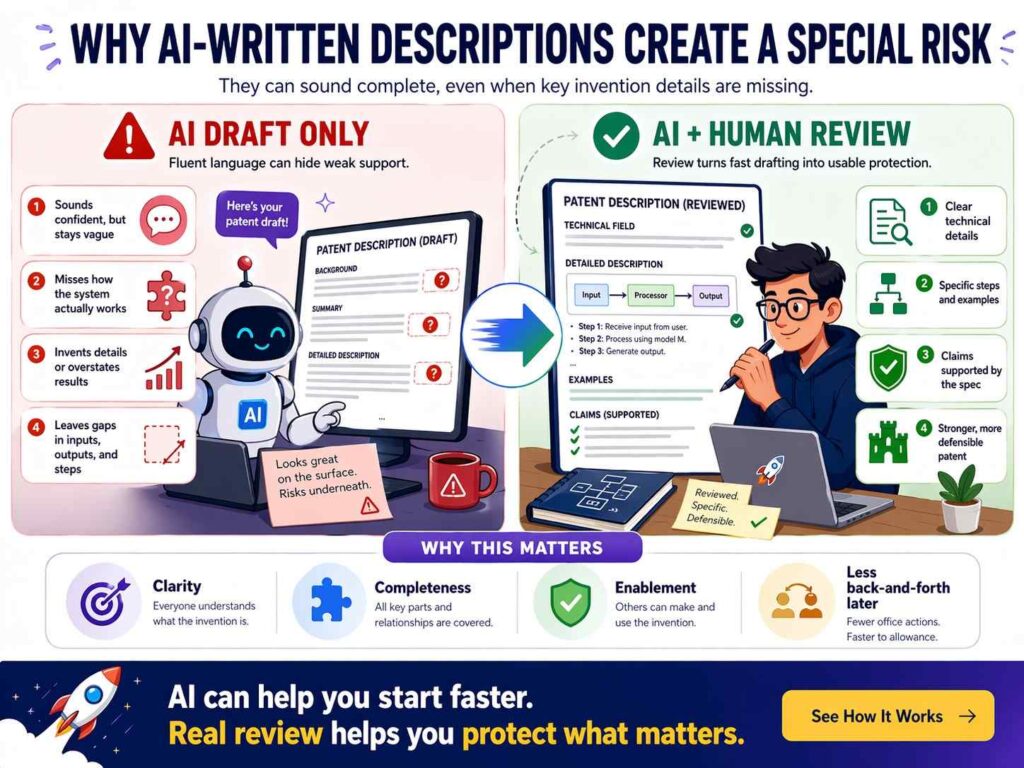
Most founders do not use AI to create a patent from nothing. They use it because they are busy.
They have notes in Notion. Diagrams in Figma. Code in GitHub. Model cards. API docs. Slack threads. Test results. Demo videos. Maybe a deck. Maybe a few tickets from the engineering team.
AI can take those pieces and turn them into a draft.
That is useful.
The problem starts when the AI fills in missing parts by guessing.
It may guess the system architecture. It may guess the data flow. It may guess the model type. It may guess the user flow. It may guess the control logic. It may guess the training method. It may guess what happens when an error occurs.
The text may still sound correct. But it may not match what you built.
In patent work, that is dangerous.
A patent description must not only be broad. It must be true and supported. If the AI writes that your system performs a step, but your system does not perform that step, you have a problem. If the AI writes that your model is trained in a certain way, but your team used a different process, you have a problem. If the AI writes a broad result without showing how the result is achieved, you may have an enablement problem.
The issue is not that AI is bad. The issue is that AI does not know your invention unless you give it the right raw material and review the output with care.
Think of AI as a fast drafting assistant, not as the inventor, not as the engineer, and not as the attorney.
The founder’s job is to bring the truth of the invention into the draft.
The attorney’s job is to make sure that truth is shaped into patent language that can hold up.
The software’s job is to make the process faster and easier.
That mix is what makes modern patent work powerful. It is also why PowerPatent combines smart AI tools with real attorney oversight. The goal is not just a faster draft. The goal is a stronger filing with fewer blind spots. You can see the process here: https://powerpatent.com/how-it-works
The polished draft trap
AI text has a strange effect on teams.
When a draft looks messy, people know it needs work. They ask questions. They mark it up. They add detail.
When a draft looks clean, people relax.
That is the trap.
AI can create a clean patent-style draft in minutes. It may include a background, summary, brief description of drawings, detailed description, examples, and claims. It may use words that sound like patent words. It may even be long.
But length is not strength.
A 40-page draft can still fail if it does not describe the right things. A long description of common parts does not fix a missing description of the new part. Ten pages about generic servers, processors, and databases do not support a claim to a new AI ranking method if the actual ranking method is never explained.
This is one of the most common mistakes in AI-assisted patent drafting.
The draft spends many words on safe, generic content and too few words on the invention.
It explains that there may be a device, a network, a memory, a processor, a data store, an interface, and a model. Fine. But what makes the invention better? What is the special flow? What is the new step? What input is transformed? What decision is made? What is stored? What is updated? What changes because of that update?
That is where the real patent value lives.
A strong description goes deep where the invention is new. It stays simple where the parts are old.
AI often does the opposite unless guided well.
It expands the generic parts because those are easy to write. It stays vague on the new parts because those require real knowledge.
When reviewing an AI-written patent description, do not ask, “Does this sound like a patent?”
Ask, “Does this explain our actual invention so clearly that a technical reader can see what we built and why it works?”
That one question will catch many Section 112 problems before they become expensive.
Written description: show that you actually had the invention
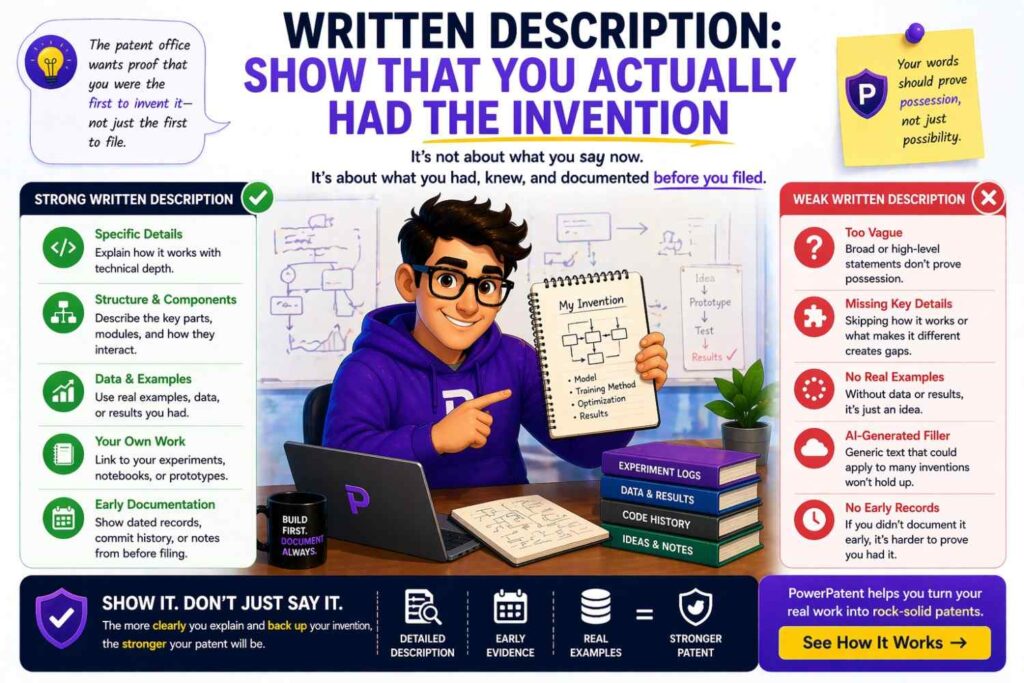
The written description part of Section 112 asks whether the patent shows that the inventors had possession of the claimed invention when they filed.
In simple words, the patent must prove that this was not just an idea, a wish, or a broad goal.
For AI-written descriptions, this is a big issue because AI loves broad goals.
It may write things like:
“The system improves model accuracy using optimized data processing.”
That sounds nice. But what does it mean?
What data? What processing? What is optimized? How is accuracy measured? What is the model doing? What is changed from prior systems? What is the key step?
A better description would explain the actual parts.
For example, it may say that the system receives noisy sensor signals, divides them into time windows, computes confidence scores for each window, removes windows that fall below a threshold, trains a model using the remaining windows, and then adjusts the threshold based on later error rates.
That is still simple. But now the reader can see a real shape.
The best patent descriptions often answer a chain of plain questions.
What comes in?
What happens to it?
What rules or model steps are used?
What comes out?
What changes after the output?
What happens when the input is messy?
What happens when the system is wrong?
What parts can vary?
What must stay the same for the invention to work?
These questions are simple, but they force the description to become real.
AI may not ask them unless your workflow makes it ask them.
That is why the input to the AI matters so much. If the AI only gets a product pitch, it will write a product-pitch patent. If it gets engineering detail, examples, tradeoffs, diagrams, logs, and real use cases, it can help produce a much better first draft.
Still, a human needs to check the result.
Written description problems often hide in the claims. A claim may say the invention covers many cases, but the description only explains one tiny case. Or the description may explain a result, but not the actual structure or steps that create the result.
This is where attorney review matters. A good attorney looks at the claims and asks, “Where is this supported in the description?” If the answer is weak, the draft needs more detail before filing.
This is also where PowerPatent helps founders avoid the old slow back-and-forth. The platform is designed to help pull technical detail from your real invention materials, then pair that with attorney review so the filing is not just fast, but better grounded. Learn more here: https://powerpatent.com/how-it-works
Enablement: teach the reader how to make and use it
Enablement is different from written description.
Written description asks, “Did you show that you had the invention?”
Enablement asks, “Did you teach enough so a skilled person can make and use it?”
This matters a lot for AI inventions.
AI systems can be hard to describe because the value may come from a mix of data, model design, training flow, user feedback, rules, and runtime decisions. If the draft only says “use machine learning to improve the result,” that is usually not enough.
A useful description should explain the key setup.
For AI and software inventions, this may include the type of data used, the form of the input, the way the data is cleaned, the model or logic used, the training or update process, the runtime steps, the output, and the way the system handles bad or unclear inputs.
You do not always need to name one exact model. In many cases, the invention may work with different models. But if the claims are broad, the description should give enough examples and guidance to support that breadth.
This is where AI-written drafts can get risky.
AI may write broad model language like “any suitable neural network, decision tree, support vector machine, or other model may be used.”
That sentence may be true in some cases. But if the invention only works because of a very specific model design, loss function, feature set, feedback loop, or constraint, then broad language alone can hurt more than it helps.
The draft should explain what matters.
Does the model need labeled data? Does it work with weak labels? Does it update after deployment? Does it use embeddings? Does it compare a new input to stored examples? Does it use a threshold? Does it change the threshold based on user behavior? Does it combine rule-based checks with model scores? Does it need a certain timing limit? Does it run on-device? Does it preserve privacy by keeping raw data local?
Each of these details can change whether the description enables the invention.
A good patent draft does not need to read like a PhD paper. It does not need to include every experiment. But it should teach the invention in a way that feels real and usable to a skilled reader.
For founders, the practical rule is simple:
Do not let the AI stop at “what the system does.” Make it explain “how the system does it.”
That “how” is where enablement lives.
Definiteness: make the claims clear
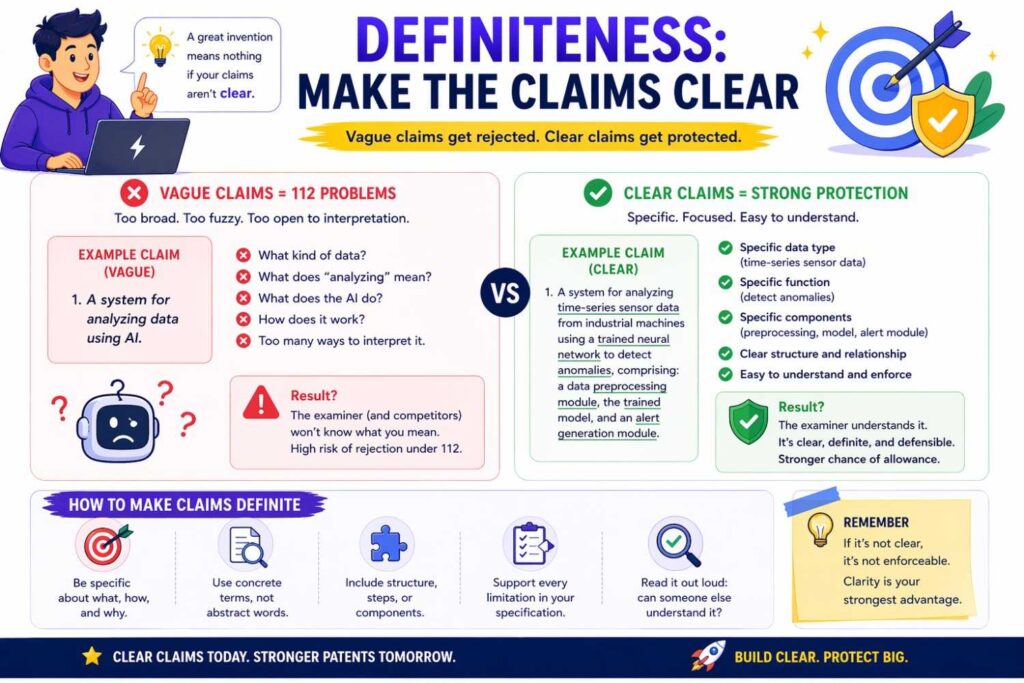
Section 112 also cares about claim clarity.
A claim tells the world what the patent covers. If the claim is too unclear, people cannot tell where the fence line is.
AI can create unclear claims because it often uses soft words without defining them.
Words like “optimized,” “intelligent,” “enhanced,” “dynamic,” “robust,” “context-aware,” “high quality,” and “real time” may be useful in a product deck. In claims, they can be risky if the patent does not explain what they mean.
This does not mean you can never use broad words. It means the description should give those words a clear anchor.
For example, instead of saying the system creates an “optimized response,” explain what is optimized. Is it latency? Accuracy? Power use? User rating? Error rate? Cost? Safety score? Memory use?
Instead of saying the model gives a “high confidence” answer, explain how confidence is measured. Is it a probability score? A margin between top results? A match score above a threshold? A vote count? A distance in embedding space?
Instead of saying the system works in “real time,” explain the timing needs. Does it respond within 100 milliseconds? Before the next video frame? During a live call? Before a robot moves to the next position?
AI often uses words that feel clear to a business reader but are fuzzy to a patent examiner.
A good review catches those words and gives them shape.
When you see a vague word in an AI-written draft, ask this:
Can we measure it?
Can we define it?
Can we give an example?
Can we replace it with a step, rule, or output?
If the answer is yes, do that before filing.
The biggest Section 112 mistake in AI-written descriptions
The biggest mistake is claiming more than the description teaches.
This happens all the time.
A founder has one working version. The AI draft turns it into a broad platform. The claims then cover every version of the idea across all devices, all data types, all models, and all use cases.
Broad protection can be good. But broad claims need broad support.
If your description only explains one narrow example, the claims may be too wide.
This does not mean you should file narrow patents. It means you should expand the description in a smart way.
You can support broader claims by adding real variations.
Show different input types. Show different model choices. Show different deployment modes. Show different user flows. Show different data sources. Show different error cases. Show different outputs. Show different ways to tune or update the system.
But do not add fake variations.
That is another AI risk.
AI can invent examples that your team never built, never tested, and never thought through. Some of those examples may be fine as possible versions if they are technically sound. Others may be nonsense. A founder may not notice because the wording sounds normal.
Before filing, every example should pass a reality check.
Could this version actually work?
Would an engineer on the team agree with it?
Does it match the invention’s core idea?
Does it create a promise we cannot support?
Does it conflict with our product, data, or architecture?
If a variation is only there because the AI made it up, be careful. It may not help. It may create confusion.
The best patent descriptions are broad on purpose. They do not become broad by accident.
Start with the invention, not the template
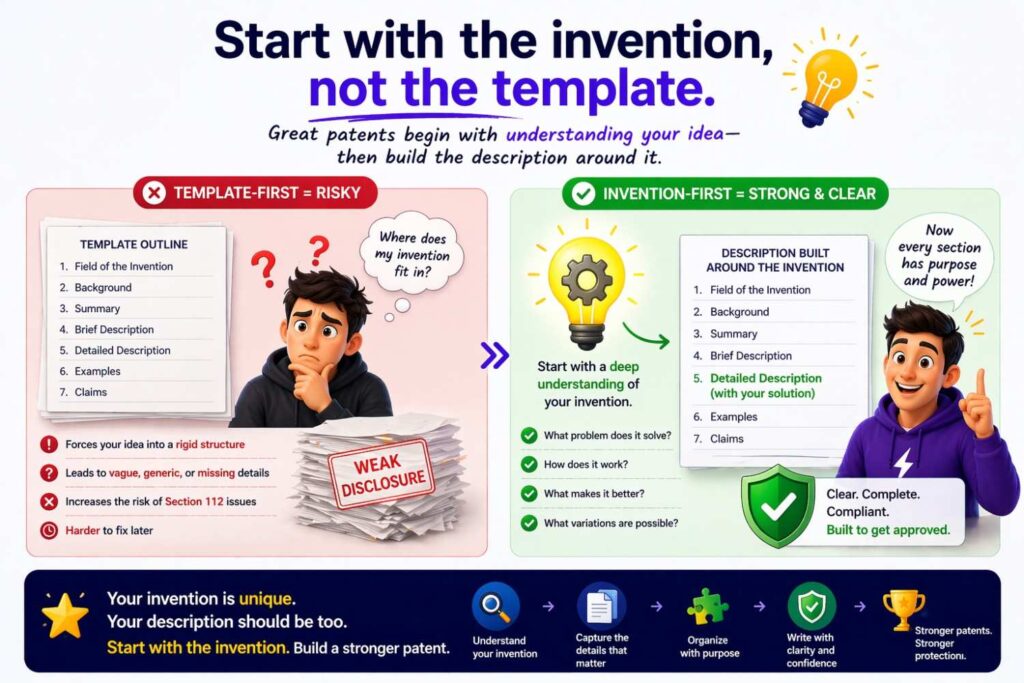
Many AI patent drafts begin with a template.
Templates are not bad. They help organize the filing. But a template should not drive the invention.
The invention should drive the template.
Before any AI draft is written, the team should be clear on the core inventive point.
That means writing one simple sentence:
“Our invention is a way to ___ by ___ so that ___.”
For example:
“Our invention is a way to detect a risky machine state by comparing live sensor patterns with stored failure patterns so that the system can slow the machine before damage occurs.”
Or:
“Our invention is a way to reduce hallucinated answers by checking model output against a private source graph before showing the answer to the user.”
Or:
“Our invention is a way to train a model with less labeled data by grouping similar events, asking for labels only on group examples, and applying those labels across the group with a confidence check.”
This simple sentence is not the full patent. But it gives the draft a spine.
Without that spine, AI will fill pages with loose language.
With that spine, the draft can explain the problem, the old way, the new way, and the key steps.
Founders should not skip this step.
It saves time. It makes the attorney review better. It helps the AI produce more useful text. It also helps prevent the final application from becoming a pile of generic patent words.
Feed the AI better raw material
AI output is only as good as the material you give it.
For a patent description, the best input is not a marketing deck. It is the real working story of the invention.
That story can come from many places.
It can come from code comments, system diagrams, API specs, model training notes, edge case notes, bug reports, test logs, architecture docs, design docs, demo scripts, customer problem notes, and founder voice memos.
The goal is not to dump everything into a tool and hope for magic.
The goal is to collect the pieces that show how the invention works.
For AI inventions, the most useful raw material often includes the data path.
Where does the data come from? What shape is it in? What cleaning happens? What features are created? What model or rule reads those features? What score or output is produced? What action follows? What feedback is stored? How does that feedback change the next run?
This flow is often the invention.
If you give the AI only the final product benefit, it will write around the invention. If you give it the flow, it can help describe the invention.
A founder can record a five-minute voice note explaining the system to a new engineer. That may be more valuable than a polished slide deck.
Say it plainly. Say what was hard. Say what broke. Say what you changed. Say what surprised you. Say why the new flow works better.
Those human details often become the strongest parts of the patent description.
PowerPatent is made for this kind of founder-friendly workflow. Instead of forcing you into old, slow legal forms, it helps turn real technical material into patent-ready work with attorney support. See how it works here: https://powerpatent.com/how-it-works
Use drawings to force clear thinking
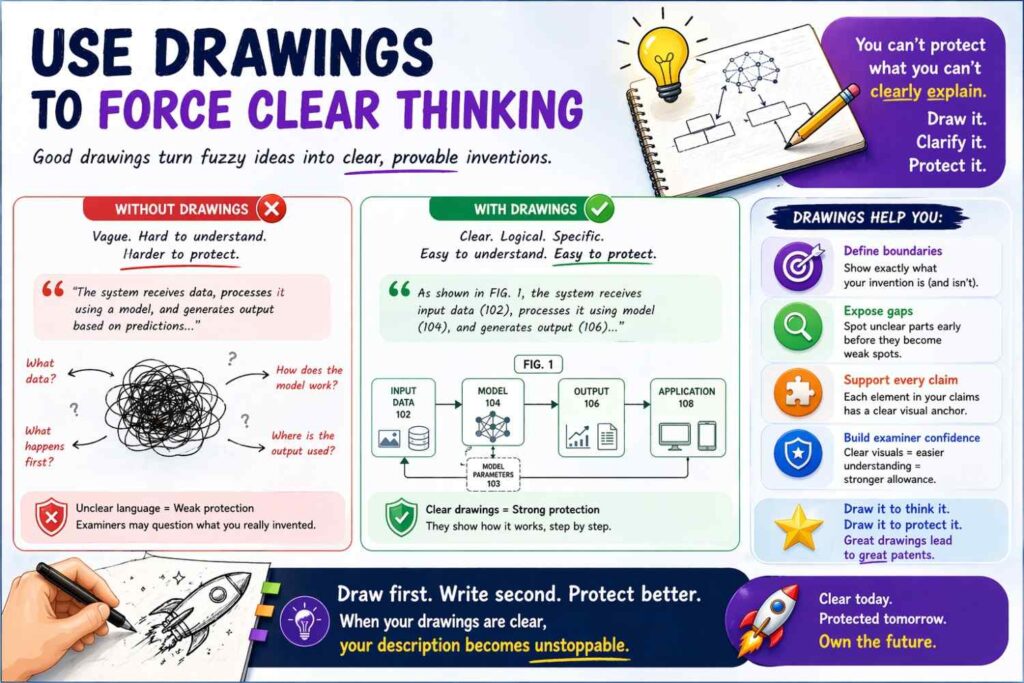
A drawing can expose a weak description fast.
If the AI-written draft says there is a “model optimization engine,” ask the team to draw it.
What connects to it? What does it receive? What does it send out? What does it store? What does it change?
If nobody can draw it, the description may be too vague.
Patent drawings do not need to be beautiful. They need to explain.
For AI and software patents, useful drawings may show the system architecture, the data flow, the training flow, the runtime flow, the feedback loop, the user interface, the device setup, or the error handling path.
A flowchart is often one of the best tools for avoiding Section 112 problems.
Each box should be a real step. Each arrow should make sense. Each input and output should be named. The text description should match the drawing.
AI sometimes creates steps that sound good but do not fit together.
A drawing catches that.
For example, the draft may say the model is trained after each user action, but the system drawing shows no stored labels or feedback. That mismatch matters.
Or the draft may say the system runs on a mobile device, but the model size and data flow only make sense on a cloud server. That mismatch matters too.
When reviewing AI-written text, use drawings as a truth test.
Can every important claim step be found in at least one drawing or described flow?
Can the parts be named the same way across the whole application?
Can an engineer follow the arrows and understand the system?
If yes, the description is likely stronger.
Name the parts with care
AI often changes names without noticing.
It may call the same thing a “confidence module,” “scoring engine,” “ranking component,” and “classification unit” in different sections.
Sometimes that is fine. Often it creates confusion.
A patent description should use names with care.
If one part has one job, give it one name and use that name the same way.
If two parts are different, make the difference clear.
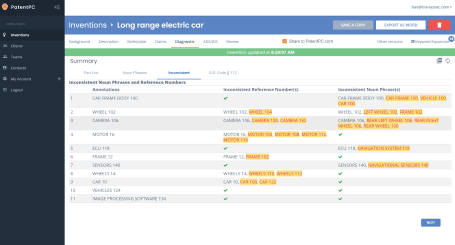
This matters for Section 112 because unclear naming can make the claims harder to understand. It can also make it harder to show support for claim terms.
Before filing, build a simple term map.
For example:
“Risk score” means the score created from live sensor data.
“Confidence score” means the score created from model agreement.
“Action threshold” means the value used to decide whether to trigger an action.
“Update threshold” means the value used to decide whether the model should be updated.
These do not need to be formal definitions in every case. But the team should know what each term means.
AI does not always protect this consistency on its own.
Human review should.
Do not hide the inventive step inside buzzwords
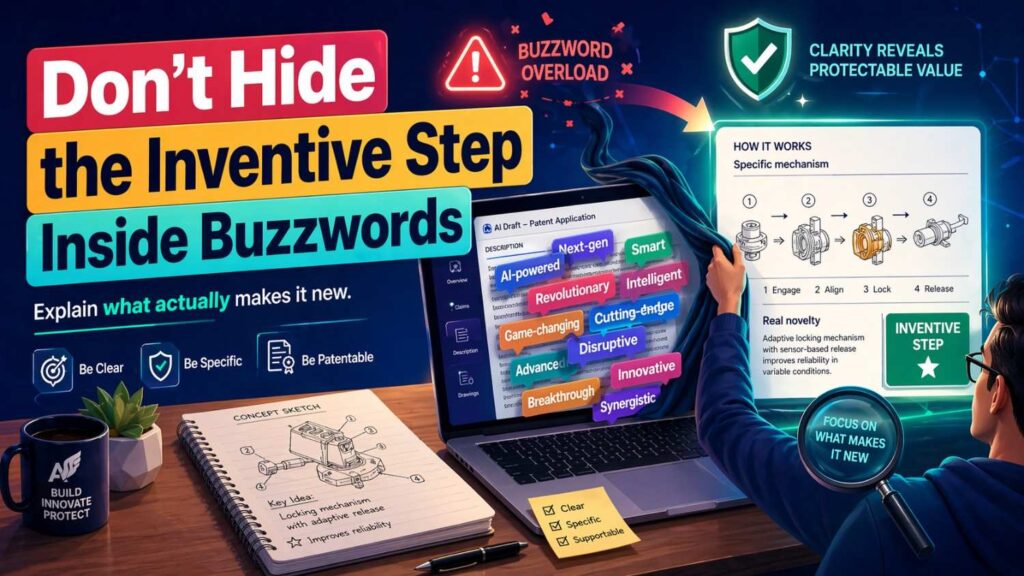
Many AI-written drafts use broad terms like “intelligent automation” or “adaptive learning.”
Those words may sound modern, but they often hide the real invention.
A patent draft should pull the invention out of the buzzword.
What makes the automation intelligent?
What adapts?
When does it adapt?
What signal causes the change?
What rule limits the change?
What improves after the change?
The more the description answers these simple questions, the stronger it becomes.
For example, “adaptive learning” is weak by itself.
A better description may say the system tracks when a user rejects a model output, stores the rejected output with the input context, compares later outputs to the stored rejected output, and lowers a confidence score when the later output is too similar to a rejected pattern.
That is still easy to understand. But now there is a real mechanism.
Mechanism beats buzzword.
In patent drafting, this is one of the most useful rules.
Do not say “smart.” Show the step that makes it smart.
Do not say “personalized.” Show what user data is used and how it changes the output.
Do not say “secure.” Show what is kept private, what is checked, what is encrypted, what is blocked, or what is stored locally.
Do not say “optimized.” Show the score, rule, or process that improves one result over another.
This is how you turn AI-written fluff into patent support.
Watch out for black-box AI descriptions
Many founders are building with AI models that are hard to explain fully.
That is normal.
But a patent description cannot simply say, “A model receives data and produces an output,” then stop.
Even if the model itself is complex, the patent can still explain the system around the model.
It can explain the input format, the preprocessing, the prompt or context construction, the retrieval step, the model call, the post-processing, the confidence check, the guardrail, the fallback action, and the feedback loop.
For many AI startups, the invention is not the base model. It is how the system uses the model.
That is good news.
You do not need to claim that you invented the whole field of AI. You can protect the smarter workflow that makes your product work.
But you need to describe that workflow.
A black-box description often creates Section 112 risk because it asks the reader to trust that some unknown AI magic happens inside.
Do not rely on magic.
Explain the chain.
For example, if your system uses a large language model to answer questions over company data, the invention may be in how the system chooses source chunks, checks answer support, blocks unsafe answers, or updates a knowledge graph.
If your system uses computer vision to inspect parts, the invention may be in the image capture timing, the defect region proposal, the threshold adjustment, or the way human review updates the model.
If your system uses AI to write code, the invention may be in the test generation loop, the dependency check, the sandbox run, or the way the system ranks fixes.
The model is part of the story. It is rarely the whole story.
A strong description shows the full system, not just the word “AI.”
Be honest about what is optional and what is required
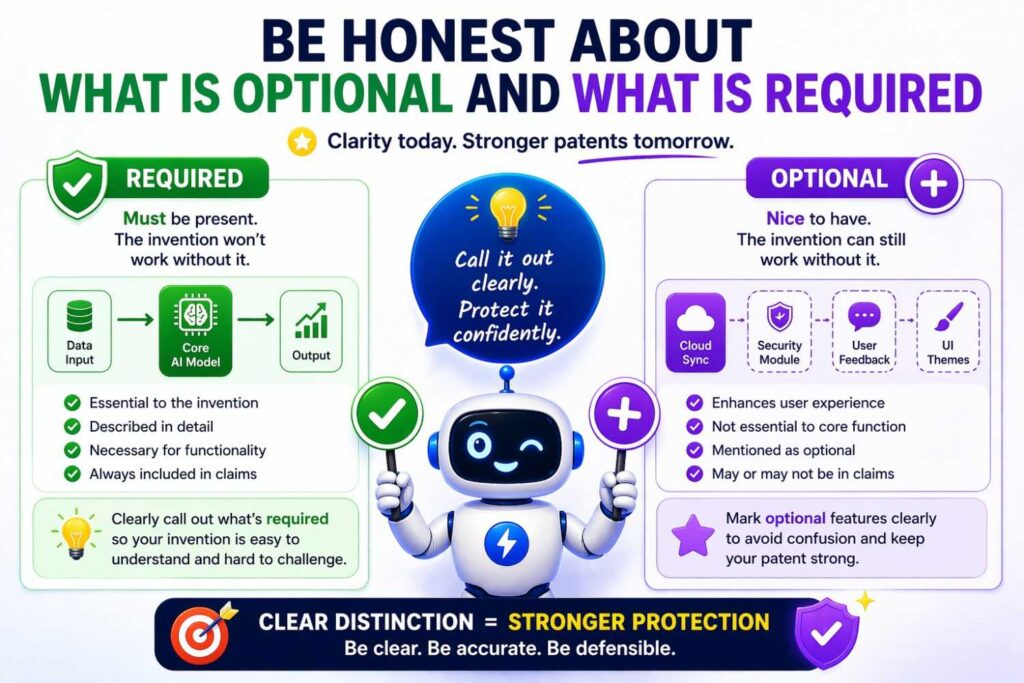
AI often uses the phrase “in some embodiments” again and again.
That phrase can be useful. It shows that the invention can have different versions.
But it can also make the draft mushy.
If everything is optional, the invention disappears.
A good patent description makes clear what is required for the core idea and what can vary.
For example, the system may require a confidence score and a threshold-based action. But the exact model used to create the score may vary.
Or the system may require local processing for privacy. But the user interface can vary.
Or the system may require a feedback loop from user corrections. But the timing of model updates can vary.
This distinction matters.
If the claims require a feature, the description should support it clearly. If the description says the feature is merely optional, that may create tension.
The AI may not know which parts are core.
The inventor does.
Before filing, mark each key feature as core, helpful, or optional.
Core means the invention does not really work without it.
Helpful means it improves the invention but is not always needed.
Optional means it is one possible version.
This simple review can clean up a draft fast.
Add real examples, not filler examples
Examples are one of the best ways to support a patent description.
But not all examples are equal.
AI can create examples that look useful but add no real support.
For example:
“In one example, the system may be used in healthcare. In another example, the system may be used in finance. In another example, the system may be used in education.”
That may be too thin.
A stronger example explains how the invention works in that setting.
For healthcare, what is the data? What is the output? What action is taken? What error is avoided?
For finance, what signal is read? What score is made? What threshold is used? What transaction is blocked or reviewed?
For education, what student action is tracked? What content is selected? What feedback updates the next lesson?
Examples should make the invention clearer.
They should not just name industries.
If the patent needs broad support, add examples that show the same inventive idea working in different settings. Each example should include enough detail to prove that the idea is not just a slogan.
This is especially useful for startups with platform technology.
Your product may begin in one market, but the core invention may apply to several. A strong patent description can show that breadth with carefully written examples.
But each example should be technically real.
That is where founder input matters.
Tie benefits to steps
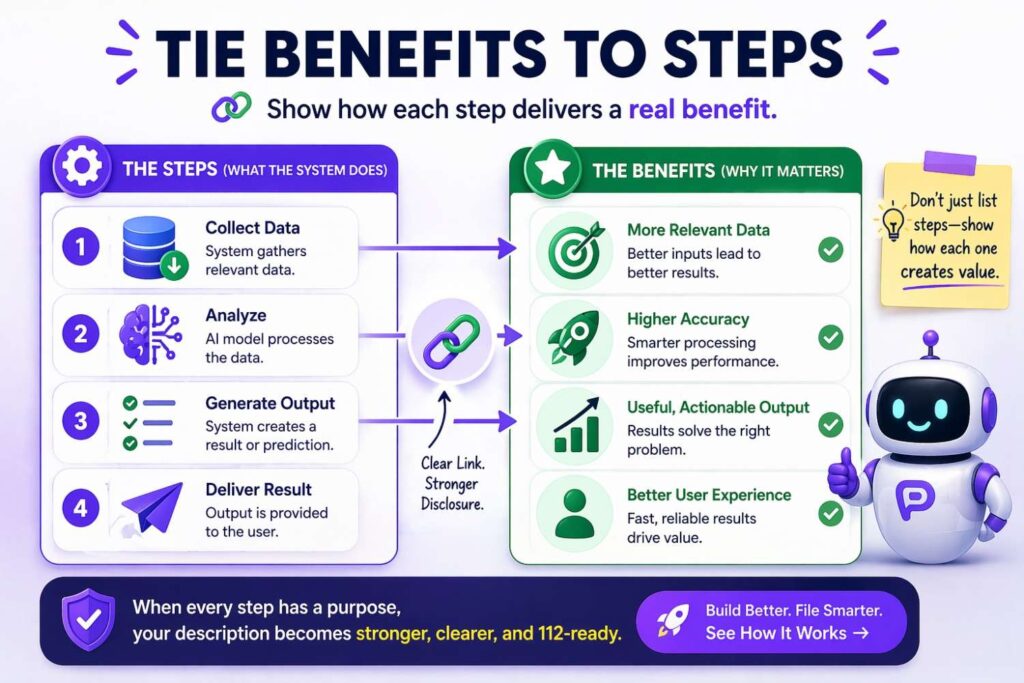
Founders love to describe benefits.
Lower cost. Better speed. Higher accuracy. Less risk. Better privacy. Fewer errors. Better user experience.
These are good. They help explain why the invention matters.
But in a patent description, benefits should be tied to technical steps.
Do not just say the system is faster.
Say what makes it faster.
Maybe it caches embeddings. Maybe it filters data before sending it to a model. Maybe it runs a small model first and only calls a large model when needed. Maybe it processes data on a device instead of a cloud server. Maybe it avoids repeated database calls by storing a state object.
Do not just say the system is more accurate.
Say what improves accuracy.
Maybe it removes low-confidence labels. Maybe it compares model outputs to source documents. Maybe it uses two different models and checks agreement. Maybe it updates a threshold after human review. Maybe it uses domain-specific constraints.
Do not just say the system is safer.
Say what safety check is performed.
Maybe it blocks output when source support is missing. Maybe it detects prompt injection. Maybe it strips sensitive data before model input. Maybe it requires a second check before an action is taken.
This matters because a benefit without a step can sound like a wish.
A benefit tied to a step can support the invention.
AI-written drafts often overstate benefits. A human review should bring each benefit back to the mechanism.
Check the claims against the description line by line
One of the simplest ways to find Section 112 problems is to map each claim element to the description.
Take the first claim. Break it into parts. For each part, ask where the description supports it.
If a claim says “generating a confidence score,” where does the description explain how that score is generated?
If a claim says “updating a model,” where does the description explain what causes the update and what changes?
If a claim says “selecting a response based on context,” where does the description explain what context means and how the response is selected?
If a claim says “training using synthetic data,” where does the description explain how the synthetic data is made or used?
This exercise is simple, but powerful.
It catches missing support before the examiner does.
It also catches cases where the AI used a term in the claims that does not appear in the description. That can happen often.
The fix may be easy. Add a paragraph. Add an example. Add a flowchart. Clarify a term. Align the names.
But the fix should happen before filing when possible.
After filing, adding new matter can be hard or impossible. That means missing detail at filing can limit what you can claim later.
This is one of the biggest reasons to invest in a good initial filing.
A cheap, thin, AI-generated draft may feel fast today. But it can cost you later when you need the patent to support a key claim.
PowerPatent helps founders avoid that tradeoff by making the process faster without removing attorney oversight. You can see the founder-friendly flow here: https://powerpatent.com/how-it-works
Do not let AI invent facts
AI can be confident and wrong.
In patent drafting, that risk shows up in small ways.
It may add a sensor that your system does not use. It may say the model was trained on a type of data you do not have. It may say the system performs encryption when it does not. It may describe an on-device process when your system is cloud-based. It may say the invention works in real time when it does not.
These errors can be easy to miss because they sound helpful.
Do not treat AI output as truth.
Treat it as a draft.
Every technical statement should be checked by someone close to the build.
This review should include engineers, product leads, and inventors. It should not be left only to a person who reads for grammar.
Ask the builders to mark anything that is wrong, too broad, too narrow, or not yet built.
Also ask them to mark what is missing.
Often, engineers catch missing details faster than attorneys because they know where the hard part was.
The attorney can then turn those details into stronger patent support.
This team loop is one of the best ways to make AI-assisted drafting safe and useful.
Keep trade secrets in mind, but do not starve the patent
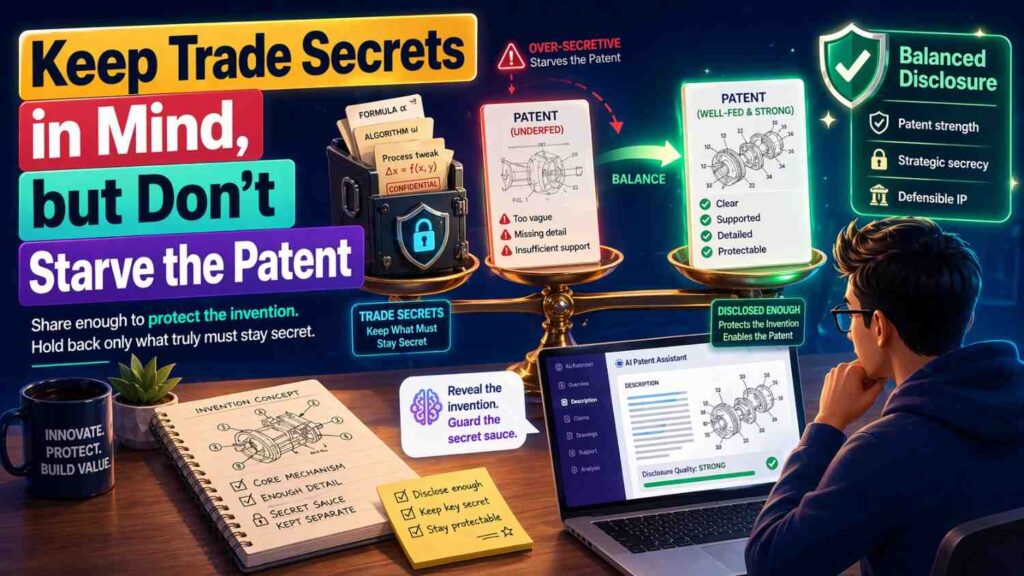
Some founders are afraid to put too much detail in a patent.
That fear makes sense. Patent applications are usually published. You do not want to give away secrets that do not need to be shared.
But if you share too little, the patent may be weak.
This is a balance.
You do not always need to disclose exact code, exact weights, exact customer data, exact prompts, exact vendor settings, or every internal trick.
But you do need to disclose enough to support the claims.
A good patent strategy decides what to patent and what to keep secret.
For example, you may patent the system flow that creates a technical advantage while keeping some model tuning details as trade secrets.
Or you may patent a privacy-preserving data path while keeping internal scoring weights private.
Or you may patent a feedback loop while keeping exact training data private.
The key is not to let fear create a hollow patent.
If the secret is the whole invention, then a patent may not be the right path for that part. But if the invention can be taught at the right level while still keeping some internal details private, a patent may give strong value.
This is a strategy call. It should not be left to AI.
PowerPatent can help founders move through this decision with software that collects the right details and attorney review that helps shape what belongs in the filing. Learn more here: https://powerpatent.com/how-it-works
Use plain language first, patent language second
Many people think patent drafts need to sound hard to read.
They do not.
A good patent can be clear.
In fact, clear technical writing often makes a stronger patent.
Before turning an invention into patent language, write it in plain language.
Explain it like this:
The problem was this.
The old way failed because of this.
Our system fixes it by doing this.
The system receives this input.
It changes the input in this way.
It uses this rule or model.
It creates this output.
It uses the output to do this action.
This works better because of this.
Once that plain story is clear, the patent draft can be built around it.
AI is often better when it starts from a plain story. Without that story, it may lean on generic patent phrases.
For founders, this is good news.
You do not need to speak like a lawyer to help create a strong patent. You need to explain the invention clearly.
The legal shaping can come after.
That is one reason PowerPatent exists: to make the patent process feel less like old legal paperwork and more like a guided path from invention to filing. See how it works here: https://powerpatent.com/how-it-works
Create a Section 112 review habit
Section 112 review should not happen only at the end.
It should happen during drafting.
When a new paragraph is added, ask whether it supports the invention or just adds noise.
When a claim is broadened, ask whether the description supports the new breadth.
When an AI-generated example is added, ask whether it is real and useful.
When a vague term appears, ask whether it needs a definition or example.
When a feature is marked optional, ask whether it is truly optional.
This habit does not slow the process as much as people think. It often makes the process faster because it catches problems early.
The worst time to discover missing support is after filing.
The second worst time is after a rejection.
The best time is during drafting, while the team can still add detail freely.
That is the mindset founders should bring to AI-assisted patent work.
Move fast, but do not file blind.
Use AI to speed up the draft. Use human review to protect the value.
What founders should collect before drafting
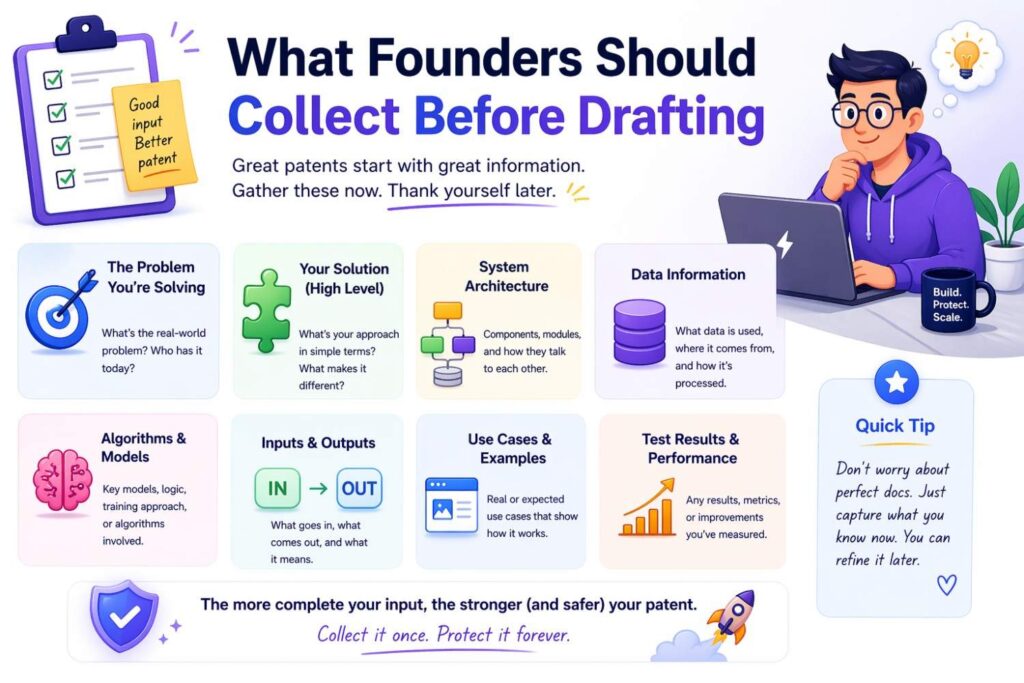
A strong AI-assisted patent draft starts before the writing begins.
Before using AI to create a patent description, collect the real invention material.
You do not need a perfect package. You need enough technical truth.
The most useful material is usually the problem, the old way, the new system flow, the architecture, the data flow, the model or logic details, the key edge cases, the test results, and the parts that may vary.
Also collect the story of why the team made these choices.
Why did you reject the obvious approach?
What failed in early tests?
What was hard to get right?
What is faster, safer, cheaper, or more accurate because of your approach?
What customer pain does it solve?
What technical limit did you work around?
These answers help the draft show invention, not just function.
They also help the attorney understand where the value is.
A good patent is not just a record of what the product does. It is a record of the technical idea that gives the product an edge.
Common weak phrases and stronger replacements
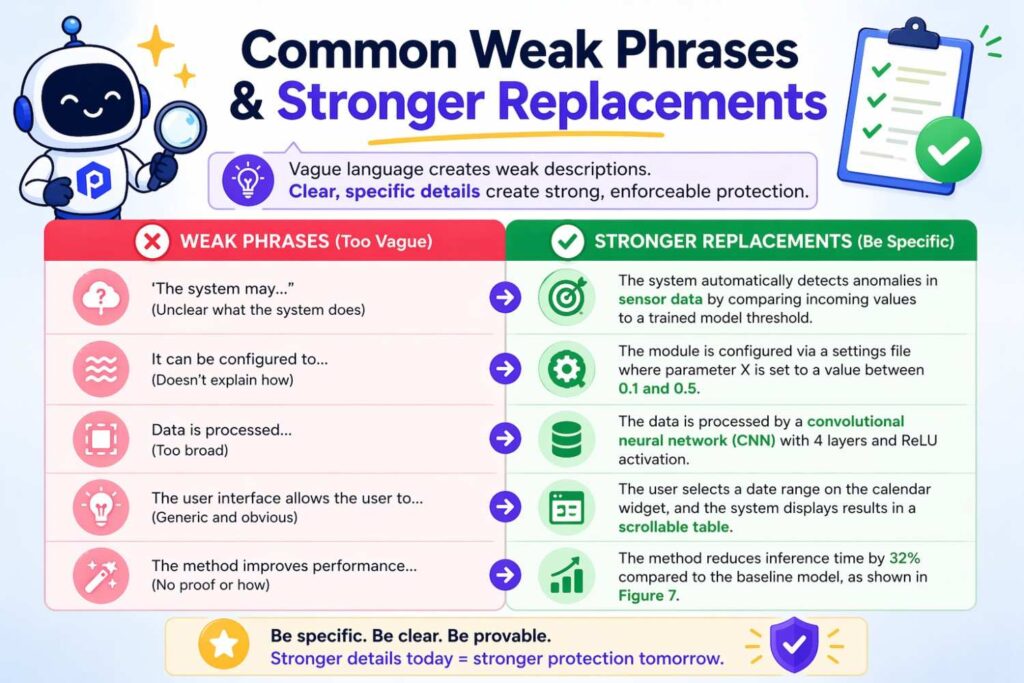
AI-written drafts often include phrases that sound good but do little work.
For example, “the system may use artificial intelligence to improve results.”
A stronger version would say what the AI receives, what it predicts, what score it produces, and how that score changes the next system action.
Another weak phrase is “the platform optimizes workflow efficiency.”
A stronger version would explain that the system removes low-priority tasks from a queue, groups tasks that share a data source, and sends the grouped tasks to one worker process to reduce repeated data loading.
Another weak phrase is “the model is trained on relevant data.”
A stronger version would explain the source of the data, the label or signal used, the feature set, the training target, and how the trained model is used at runtime.
Another weak phrase is “the system provides personalized recommendations.”
A stronger version would explain which user events are stored, how they are weighted, how the recommendation score is computed, and how recent behavior changes the ranking.
The pattern is clear.
Weak drafting names the goal.
Strong drafting explains the path.
AI is often good at naming goals. Your team must make sure the path is there.
The role of attorney oversight
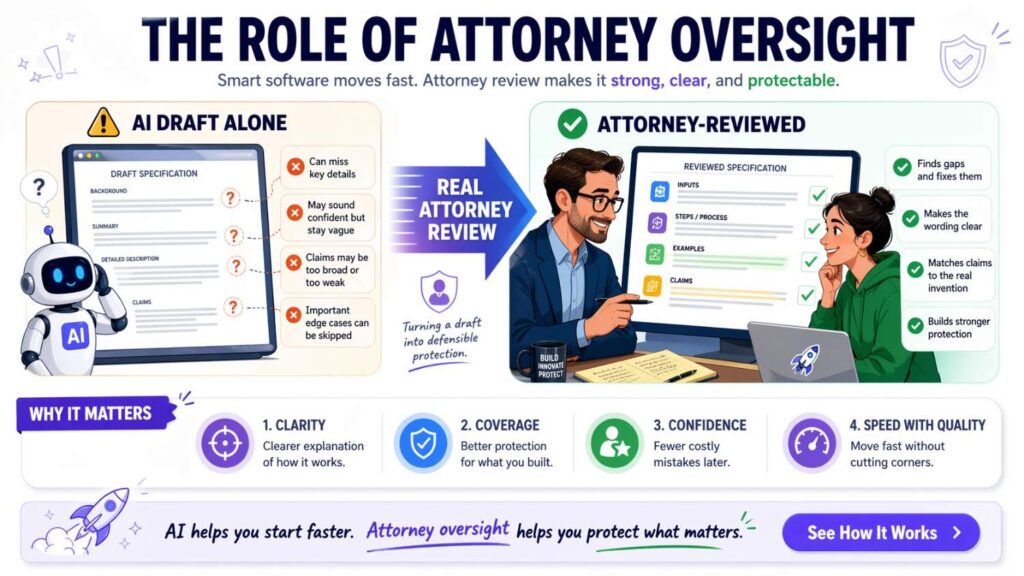
AI can help write. It can help organize. It can help find missing sections. It can help turn notes into a draft.
But AI should not be the only reviewer of an AI-written patent description.
A real patent attorney brings judgment.
They can look at the claims and see whether the description supports them. They can see when a term may be unclear. They can tell when a broad claim needs more examples. They can help decide which details should go in the patent and which may be better kept private. They can align the filing with a bigger IP plan.
That matters because patents are not just documents. They are business tools.
A patent may help with fundraising, partnerships, licensing, defense, acquisition, and market position. A weak filing can create false comfort. A strong filing can give founders more confidence.
This is why PowerPatent does not treat AI as a replacement for legal skill. The platform uses smart tools to make the work faster and easier, while real patent attorneys help guide the result. For founders, that means less friction without giving up quality.
You can see how PowerPatent combines software and attorney oversight here: https://powerpatent.com/how-it-works
A practical review method for AI-written patent descriptions
Here is a simple way to review an AI-written description before filing.
Read the claims first.
Then read the description with one question in mind: where is each claim part explained?
Do not skim. Mark the support.
If support is missing, add it.
Then read for “how” language. Every important result should have a process behind it.
If the draft says the system improves accuracy, find the steps that improve accuracy.
If the draft says the system reduces delay, find the steps that reduce delay.
If the draft says the system protects privacy, find the steps that protect privacy.
Then read for terms that feel soft.
Words like dynamic, smart, optimized, enhanced, context-aware, and real-time should be checked. Keep them only if the description gives them meaning.
Then read for consistency.
Make sure the same part is not given five names. Make sure drawings, claims, and description match. Make sure examples do not conflict with the main system.
Then ask an engineer to review the technical truth.
Finally, have a patent attorney review the legal strength.
This process is not fancy. It works because it forces the draft to prove itself.
How AI can actually make Section 112 stronger
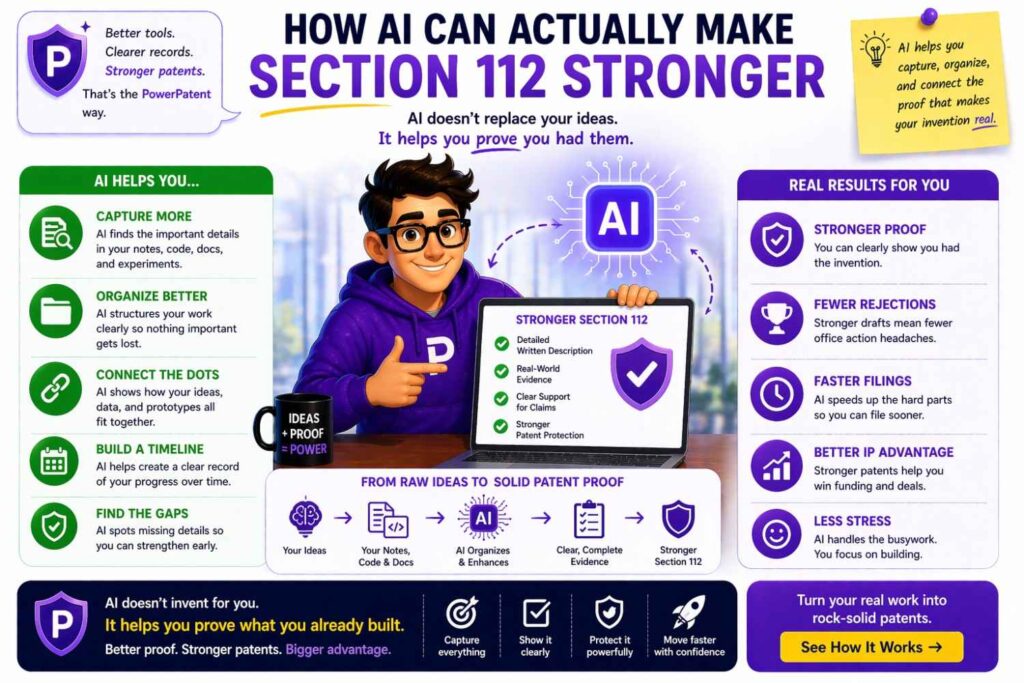
This article has warned about AI risks, but AI is not the enemy.
Used well, AI can make patent descriptions stronger.
It can help founders remember edge cases. It can turn rough engineering notes into clear steps. It can compare claim terms against the description. It can suggest places where examples are thin. It can help create first drafts of flowcharts. It can help ask better inventor questions.
The key is control.
AI should be used to surface detail, not fake detail.
It should help organize the truth, not invent the truth.
It should speed up review, not replace review.
When used this way, AI can reduce the burden on founders. It can make patent work less painful. It can help teams file sooner, while the invention is fresh and before public disclosures create problems.
That is a big win for startups.
The old patent process often felt slow, expensive, and hard to understand. AI can improve that. But only if it is paired with the right checks.
That is the PowerPatent approach: use smart software to move faster and real attorney oversight to keep the filing grounded. See how it works here: https://powerpatent.com/how-it-works
Use AI as a detail finder, not just a writer
The best use of AI in patent work is not asking it to “write a patent.”
That is too broad.
A better use is asking it to find missing detail.
For a business, this matters because missing detail can weaken the value of the patent asset. A patent is not only a filing. It can become part of a funding story, a partner deal, a license deal, or an exit. If the draft does not support the real product edge, the company may not get full value from the work it already did.
AI can help by acting like a smart question engine.
Ask it to read the invention notes and point out what is unclear. Ask it to list every place where the draft states a result without explaining the steps. Ask it to find vague words. Ask it to flag claim terms that do not appear in the detailed description. Ask it to identify where a human expert would need more information to build the system.
This turns AI from a content machine into a quality check.
That shift is important.
A draft that sounds smooth may still be weak. A draft that has been pressed with hard questions is often much stronger.
For founders, the action step is simple: before asking AI to write more, ask it to challenge what is already there.
Turn engineering work into patent support
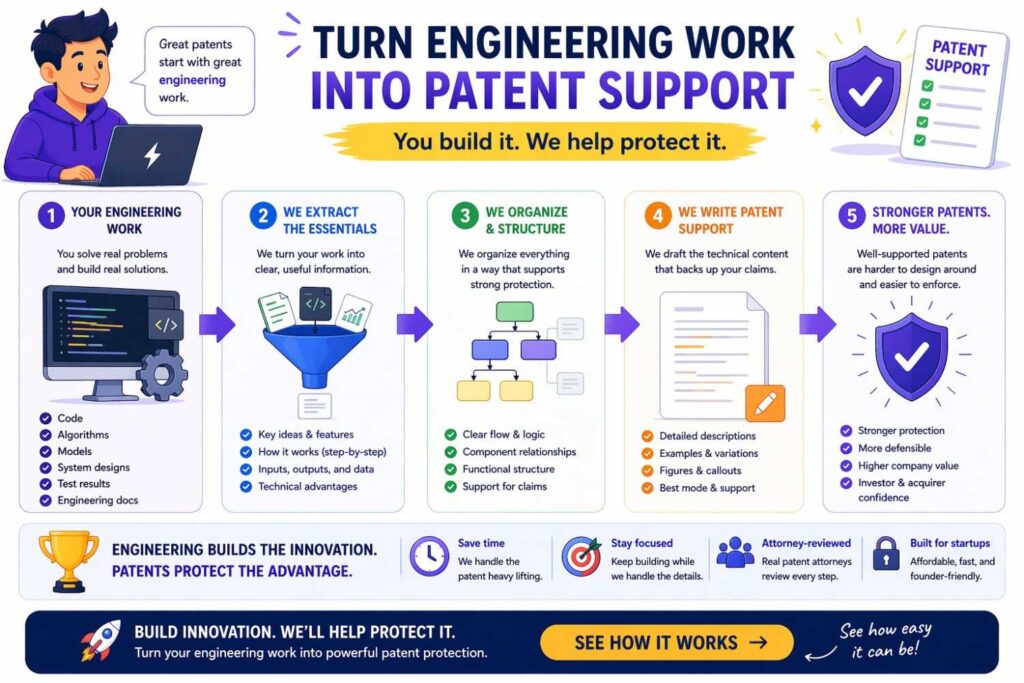
Most startups already have rich patent material inside the business.
It is just scattered.
It may live in GitHub comments, Jira tickets, model eval notes, pull request threads, design docs, customer bug reports, internal demos, or Slack messages. AI can help turn that scattered work into clear patent support.
This is powerful because it lets the company reuse work it already paid for.
The engineering team may have spent weeks solving a hard data issue, a latency issue, a model drift issue, a privacy issue, or a scaling issue. Those choices may be the exact things that make the invention worth protecting.
But if those choices do not reach the patent draft, they do not help the filing.
AI can help extract them.
A practical move is to gather a small set of source materials for each invention. Include the design doc, one or two key diagrams, a short founder note, and a few engineering comments that explain what was hard. Then use AI to create a plain-English invention brief.
That brief should answer: what was the problem, what did the old way miss, what did the team change, why did that change work, and what parts can vary?
This brief can then feed the patent draft and attorney review.
The business value is real. It reduces founder time, improves draft quality, and helps the patent reflect the actual company moat.
Build a repeatable invention capture system
One strong patent is useful.
A repeatable patent process is much more valuable.
For growing companies, AI can help create a steady invention capture system. This is a simple habit where the team records new technical wins before they are forgotten.
That matters because startup teams move fast. A key model update may feel obvious two months later. A clever data pipeline may get buried under the next sprint. A workaround that saved the product may never make it into a patent draft because nobody wrote it down.
AI can make this easier.
After each major sprint, product launch, or model release, ask the team a few short questions. What changed? What was hard? What did we try that failed? What works better now? What technical choice would be hard for a rival to copy? What did customers or tests show after the change?
The answers do not need to be formal. A short voice note or rough written note is enough.
AI can then turn those notes into invention summaries. Over time, the company builds a living record of possible patent ideas.
This helps the business in three ways.
It makes patent decisions faster. It helps leaders see which technical work may support the company’s moat. It also gives patent counsel better raw material when it is time to file.
For founders who want speed without chaos, this is one of the best uses of AI.
Use AI to test claim coverage against the roadmap
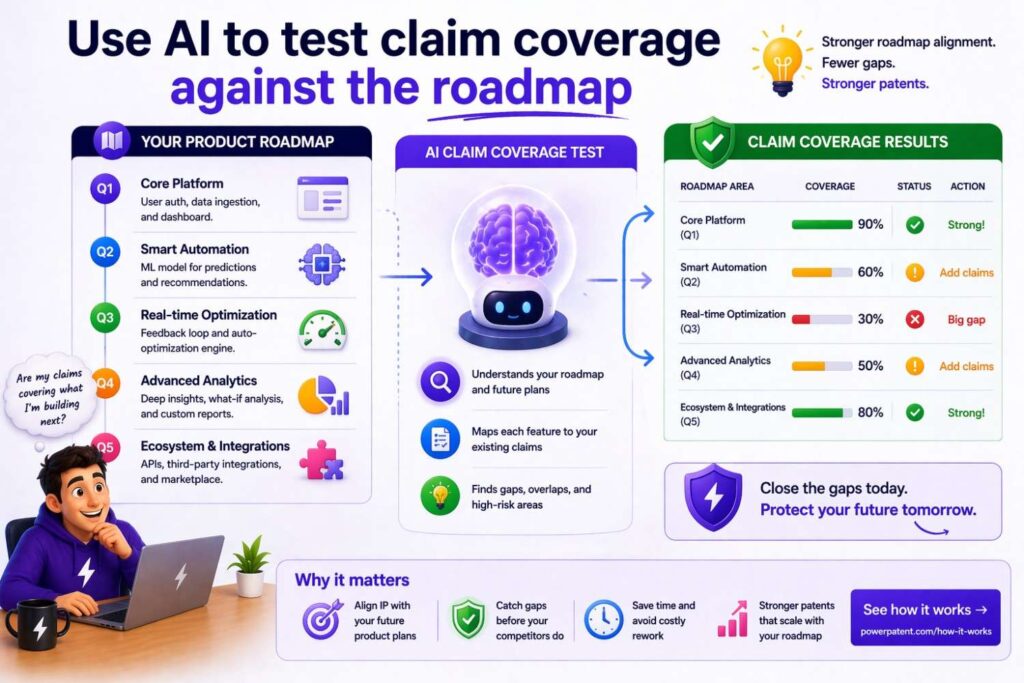
A patent should protect what the company built today.
But smart patent work also looks ahead.
Businesses should ask whether the description supports the product roadmap, not just the current demo.
AI can help compare the draft against the roadmap.
For example, say the current product uses one type of user feedback, but the roadmap includes passive feedback, team feedback, and automated feedback from test results. If those versions are real and technically planned, the description may need examples that support them.
Or say the current system runs in the cloud, but enterprise customers will need an on-premise version. The draft may need to explain how the same invention can run in that setup.
Or say the current model handles text, but the next version will handle images and audio. The patent team should decide whether those versions belong in the filing.
AI can help create a gap report.
Give it the draft and a roadmap summary. Ask it to identify product directions that are not supported in the description. Then have the founders and attorney decide what to add.
This is a strategic business move.
It helps the patent grow with the company instead of locking the company into yesterday’s version of the product.
The key is honesty. Do not add fantasy roadmap items just to sound broad. Add real, technically grounded versions that the team can support.
Use AI to create better inventor interviews
A good inventor interview can make or break a patent draft.
But many interviews are too broad. The founder explains the product. The attorney asks questions. The team talks for an hour. Important details still get missed.
AI can make these interviews sharper.
Before the interview, AI can read the invention notes and draft a focused question set. The questions should target weak spots in the description. They should ask about the data, the decision points, the model behavior, the fallback steps, the edge cases, and the parts that can vary.
This saves time for the business.
Instead of spending half the call on background, the team can spend more time on the details that affect patent strength.
After the interview, AI can help turn the transcript into a clean technical summary. It can group answers by system part, method step, example, advantage, and possible claim support.
The attorney still needs to review and guide the work. But AI can reduce the drag around the process.
For busy teams, this can be the difference between putting off patent work and getting it done while the invention is still fresh.
PowerPatent helps make this easier by combining guided software with real attorney oversight, so founders do not have to manage the whole process alone. See how it works here: https://powerpatent.com/how-it-works
Use AI to protect the business story
Patents are technical documents, but they also support a business story.
Investors, buyers, and partners may ask what makes the company hard to copy. A strong patent portfolio can help answer that.
AI can help make sure the patent description lines up with the company’s real edge.
For example, the business may win because it has a faster data loop. Or because its model improves with less human review. Or because it can run safely in a private customer setting. Or because it cuts cloud cost while keeping output quality high.
Those business strengths should connect to technical steps in the patent draft.
AI can help map this connection.
Ask it to create a table internally that links each business advantage to the technical feature that creates it. Faster onboarding may link to automated schema detection. Lower cost may link to model routing. Better privacy may link to local data filtering. Higher trust may link to source-backed answer checks.
Then use that map to check the draft.
Does the description explain the technical feature behind each major business advantage?
If not, the draft may be missing the heart of the moat.
This is one of the most strategic ways to use AI. It helps the patent filing serve the business, not just the filing deadline.
Use AI to find narrow spots before rivals do
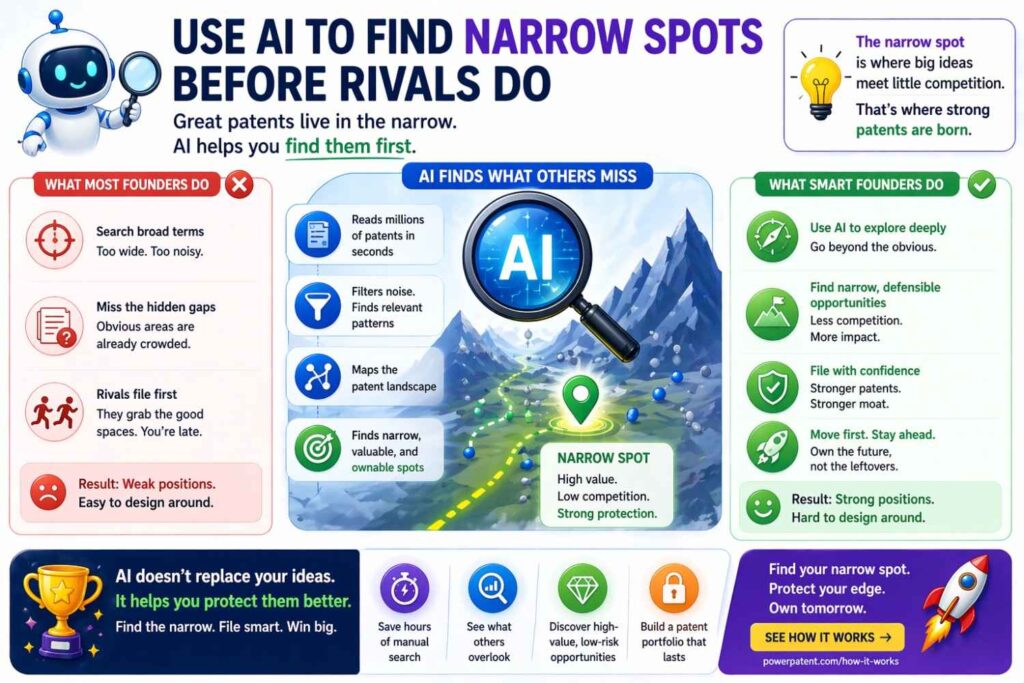
A patent can be weak if it only covers one easy-to-design-around version.
AI can help find those narrow spots before competitors do.
Ask AI to look at the invention and suggest ways a rival might try to avoid the claims while using the same core idea. The answers will not be perfect, but they can start a useful discussion.
Maybe a rival could replace a threshold with a ranking score. Maybe it could use a different feedback signal. Maybe it could move a step from the server to the device. Maybe it could use a rule engine instead of a model. Maybe it could batch the process instead of running it live.
These are not just legal questions. They are business questions.
If a rival can copy the value while making a tiny change, the patent may not protect enough.
The solution is not to make the claims wildly broad. The solution is to add real support for meaningful variations.
This is where AI can help brainstorm, while the founders and attorney decide what is technically real and worth including.
A strong description should give the company room to claim the core idea in more than one form.
Create a red-team review before filing
Many startups review a patent draft only to see whether it is accurate.
That is not enough.
Before filing, use AI to support a red-team review.
A red-team review asks harder questions. Where is the draft vague? Where does it overclaim? Where does it fail to teach the step? Where does it depend on a magic word like “AI,” “smart,” or “optimized”? Where would an examiner likely push back? Where might a competitor argue that the claim is not supported?
AI can help generate this challenge list quickly.
Then the team can fix the real issues.
This kind of review is valuable because it changes the mindset. The goal is not to admire the draft. The goal is to stress-test it.
For a business, this is risk control.
It is usually cheaper to improve the draft before filing than to fight avoidable problems later.
Keep a human decision record
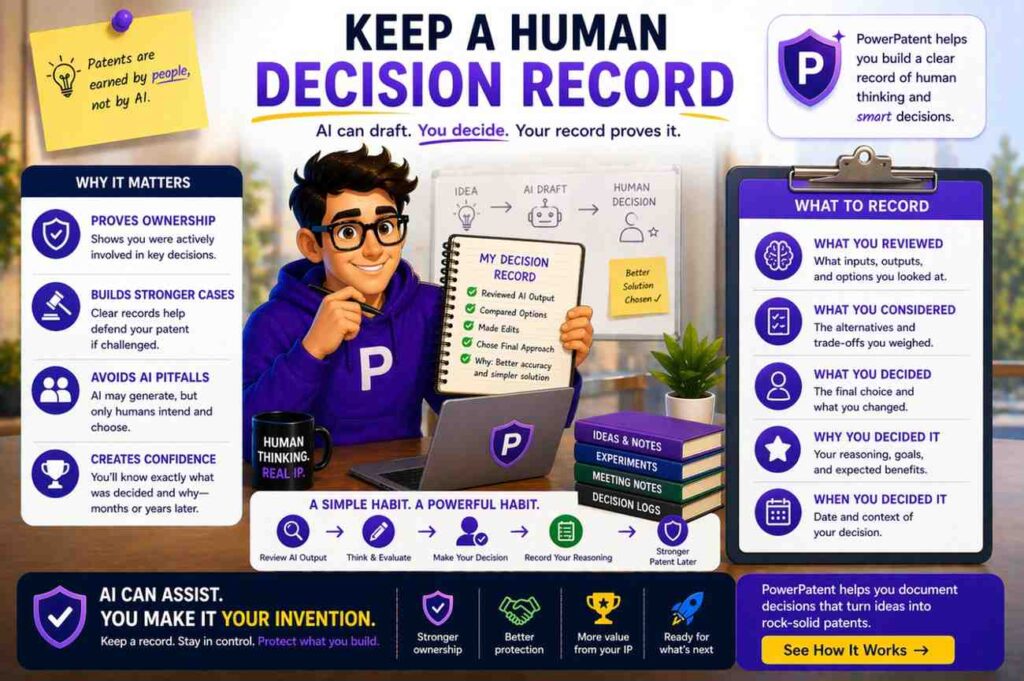
When AI helps with patent drafting, businesses should keep track of important human choices.
Who confirmed the technical facts? Who decided which examples were real? Who reviewed the claim support? Who approved the final technical description?
This does not need to be heavy or slow.
A simple decision record can help. It can say that the inventors reviewed the technical content, identified the core features, removed unsupported AI-generated text, and approved the final draft for attorney review.
This is good discipline.
It also keeps AI in the right role.
AI assists. Humans decide.
That is especially important for companies that want a clean, repeatable IP process as they grow.
Make the patent process part of product operations
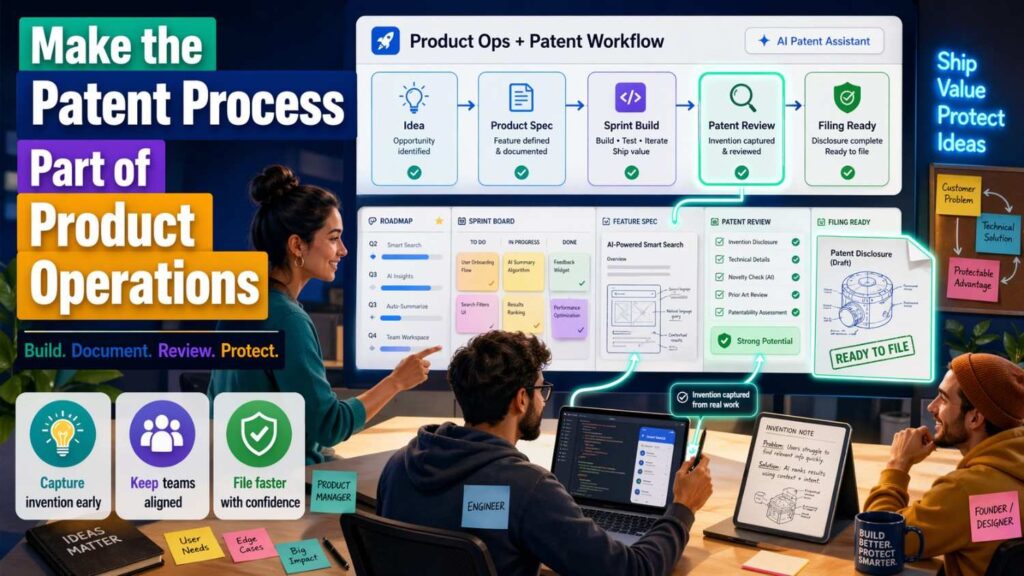
The strongest companies do not treat patents as a one-time legal task.
They make patent capture part of product operations.
AI can help by fitting patent work into the rhythm of the business.
When a product spec is approved, AI can help flag possible invention points. When a model release goes live, AI can summarize what changed. When a customer asks for a hard new feature, AI can help capture the technical solution. When a major bug is fixed in a new way, AI can record why that fix may matter.
This does not mean every change becomes a patent.
It means the company stops losing valuable ideas.
For deep tech startups, this can be a major advantage. The best inventions are often born during hard product work, not during formal patent meetings.
AI can help catch those moments while they are fresh.
Then founders and attorneys can decide what is worth filing.
That is how patent strategy becomes part of company building instead of a last-minute scramble.
The best AI patent workflow is fast, but not loose
Speed matters.
Startups cannot wait months to protect every key idea. They need a process that keeps up with product work, fundraising, and customer growth.
But speed without quality is not enough.
The right AI patent workflow should help the team move faster while making the description more specific, more accurate, and more useful.
That means AI should help collect invention details, challenge vague text, map claims to support, compare the draft to the roadmap, prepare better inventor questions, and spot design-around risks.
Then real people should make the final calls.
The inventors confirm the facts. The business team confirms the strategy. The attorney confirms the patent strength.
That is how AI can make Section 112 stronger.
Not by replacing judgment.
By giving the team better raw material, better questions, and better checks before filing.
That is also why PowerPatent’s model is so useful for founders. It gives teams the speed of smart software while keeping real attorney oversight in the loop, so the patent process feels lighter without becoming careless. You can see how it works here: https://powerpatent.com/how-it-works
Why timing matters
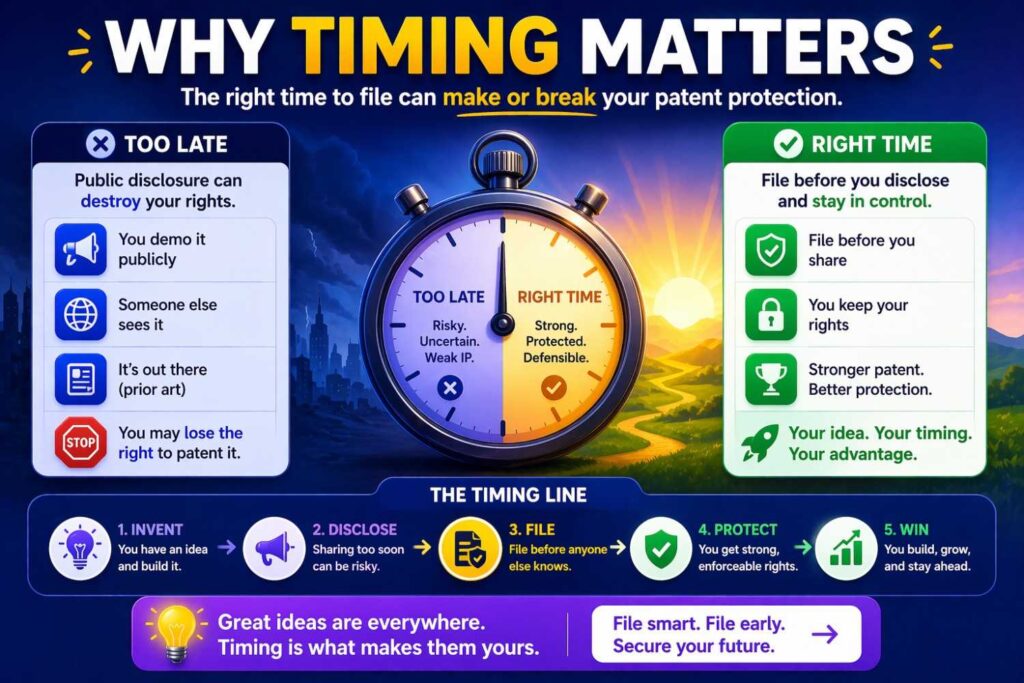
Startups move fast.
You ship. You demo. You pitch. You publish. You talk to customers. You hire. You raise money.
All of that can affect patent strategy.
If your patent draft has Section 112 gaps, you may not be able to fix those gaps later by adding new technical matter to the same filing. That means the first filing can shape what you are able to claim.
This is why “file something quick and fix it later” can be risky.
A fast filing is good only if it captures the invention with enough detail.
For AI-assisted drafts, speed should not mean thin support.
A better goal is fast and grounded.
That means using tools that help collect detail quickly, generate a draft quickly, and get attorney review before filing.
For founders, this can be the difference between a patent process that slows the company down and one that supports the company while it keeps moving.
The founder’s role in a stronger patent
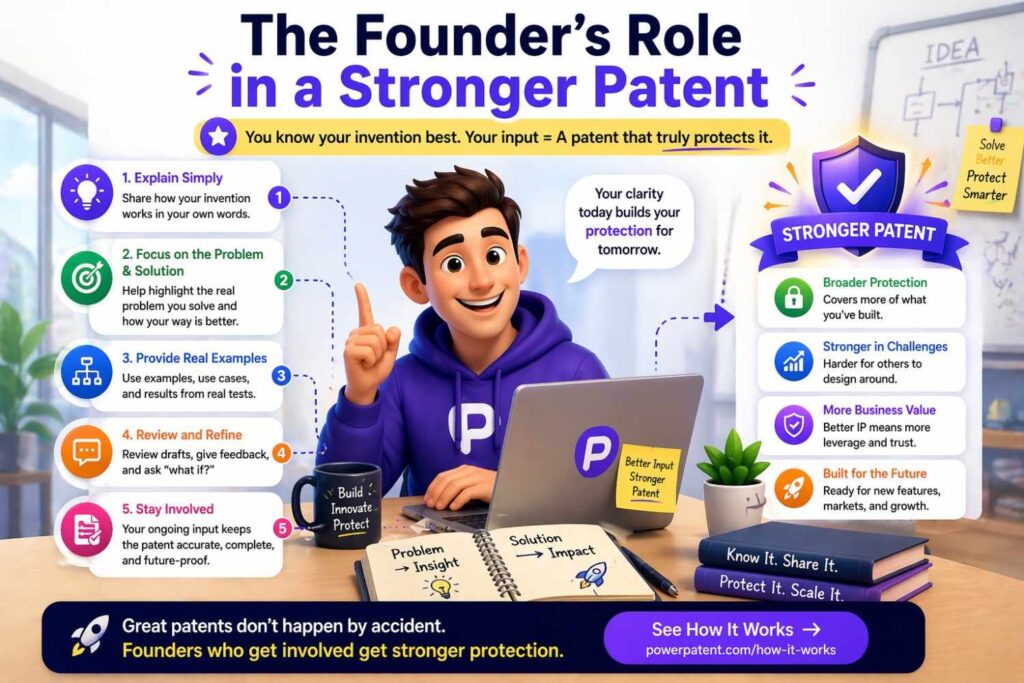
Founders sometimes think patents are something they hand off.
They send a short idea to a lawyer, then wait.
That can lead to weak drafts because the most important details stay in the founder’s head or the engineering team’s code.
A stronger approach is more active, but not harder.
The founder’s role is to explain the invention in plain words.
What did you build?
Why did it matter?
What was hard?
What is different from the normal way?
What steps make it work?
What else could be changed while keeping the core idea?
These answers give the patent team the raw material they need.
The attorney’s role is then to turn that material into a filing that supports useful claims.
AI can help in between by pulling structure from the raw material and making the first draft less painful.
That is the right division of labor.
Founders bring the truth.
AI helps shape the draft.
Attorneys protect the strength.
Own the “why,” not just the “what”
Many founders describe what the product does.
Fewer explain why it had to be built that way.
That “why” is often where the invention lives.
Maybe the obvious approach failed. Maybe it was too slow. Maybe it broke at scale. Maybe it created risk. Maybe it cost too much. Maybe it needed data you could not get.
When founders clearly explain why the old way failed, the patent becomes stronger.
It shows that the new approach is not random. It solves a real technical problem.
A simple habit helps here.
Before drafting, write a short note: “We tried X, it failed because Y, so we built Z.”
That one line often leads to better patent support than a full page of generic description.
Be the source of truth for edge cases
Engineers know edge cases.
But founders often understand why those edge cases matter.
Edge cases are gold for patents because they show depth.
They show the system does not just work in perfect conditions.
For example, what happens when input data is missing? What happens when the model is unsure? What happens when two signals conflict? What happens when a user behaves in a strange way? What happens when the system is under load?
Founders should bring these cases into the draft.
AI will not invent the right edge cases on its own.
When included, these details can support broader claims and stronger enablement.
Translate product wins into technical steps
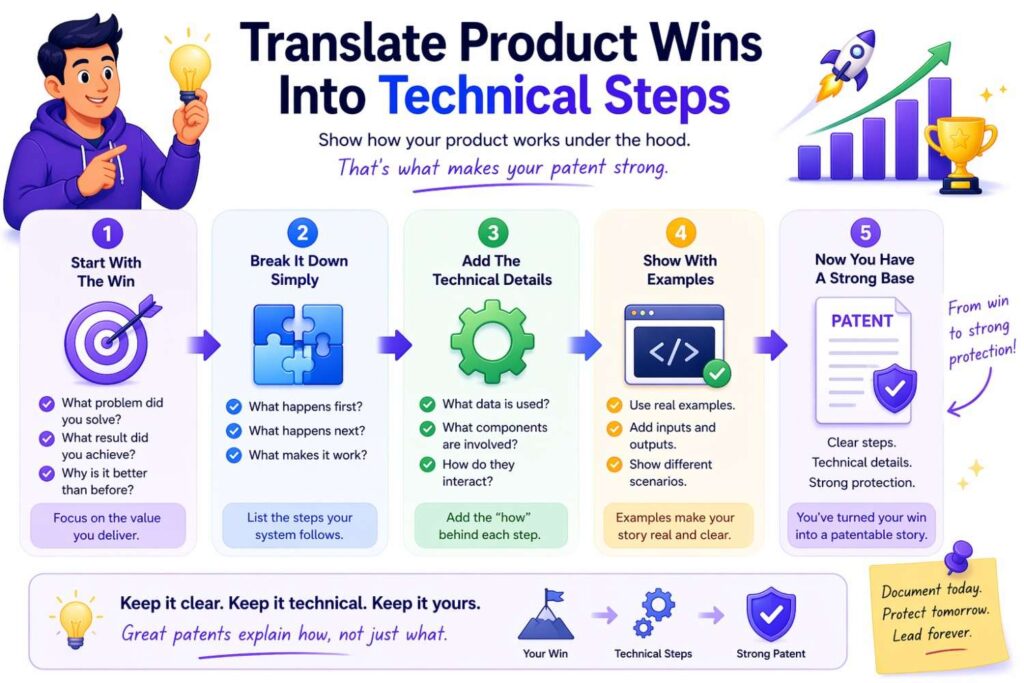
Founders often talk in outcomes.
“We reduced churn.”
“We improved conversion.”
“We cut cost.”
Those are great for the business.
But a patent needs the technical path behind the win.
Founders should help translate each major product win into the step that caused it.
If conversion improved, what changed in the system? If cost dropped, what process was removed or optimized? If accuracy improved, what filter, rule, or model change made that happen?
This translation step is critical.
Without it, the patent may describe success but not the invention.
Decide what should be broad and what should be precise
Not every part of the invention needs the same level of detail.
Some parts should be flexible.
Some parts should be very clear.
Founders are in the best position to guide this.
Ask: what is the core idea we want to protect across many versions?
That part should be described in a way that supports variation.
Then ask: what exact step makes this work today?
That part should be described with clarity.
This balance helps avoid two common problems: being too narrow to matter or too vague to be allowed.
AI alone does not make this call well. It needs founder input.
Stay involved during claim shaping
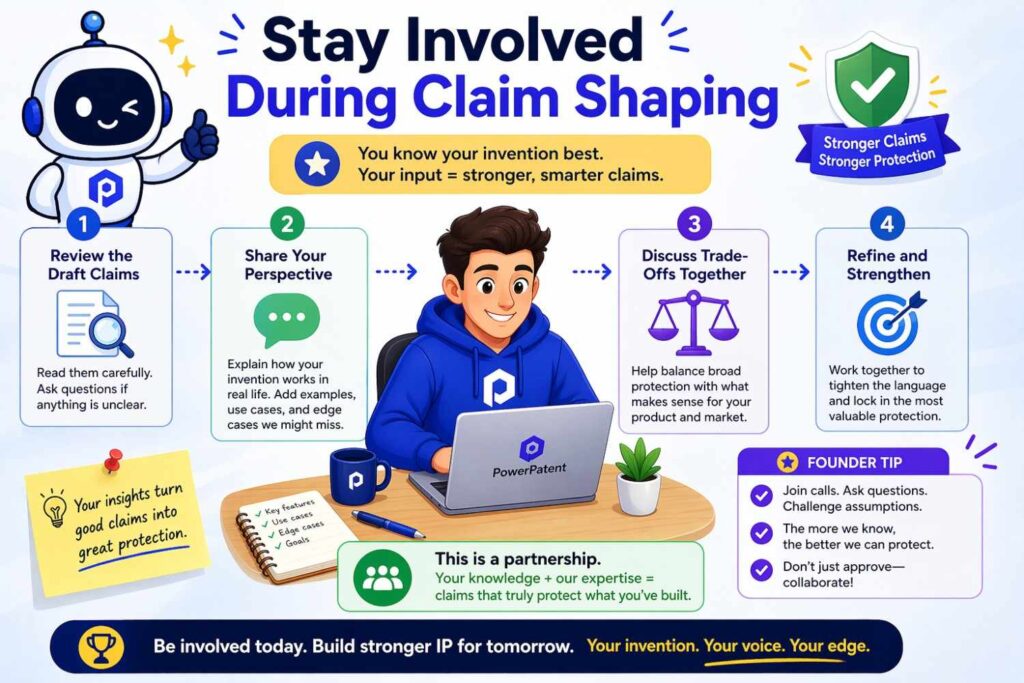
Claims define the value of the patent.
Some founders step away once the draft is written.
That is a mistake.
Founders should stay involved when claims are shaped.
They should ask simple but powerful questions.
Does this claim cover how we actually win?
Does it miss a key variation?
Does it include something we do not really use?
Would a competitor be able to work around this easily?
This is not about legal language.
It is about business protection.
A short founder review at this stage can change the strength of the patent in a big way.
Bring real examples from customers and use cases
Founders often have the clearest view of how the product is used in the real world.
Those use cases can make the patent much stronger.
Instead of abstract examples, founders can provide real scenarios.
What does a user input? What does the system return? What action is taken next? What goes wrong if the system fails? What improves when the invention is used?
These grounded examples help the description feel real and complete.
They also help support broader claims because they show the invention working in practice.
Protect future direction without guessing
Founders think ahead.
They know where the product is going.
That vision is useful for patent drafting, but it must be used with care.
Include future versions only if they are technically grounded.
If the team has a clear plan to expand to new data types, new environments, or new workflows, that can be reflected in the description.
But do not include ideas that are only guesses.
A good rule is simple: if the team can explain how it would build it, it may belong in the patent. If not, leave it out or keep it high level.
This keeps the filing strong without overreaching.
Create a quick internal review loop
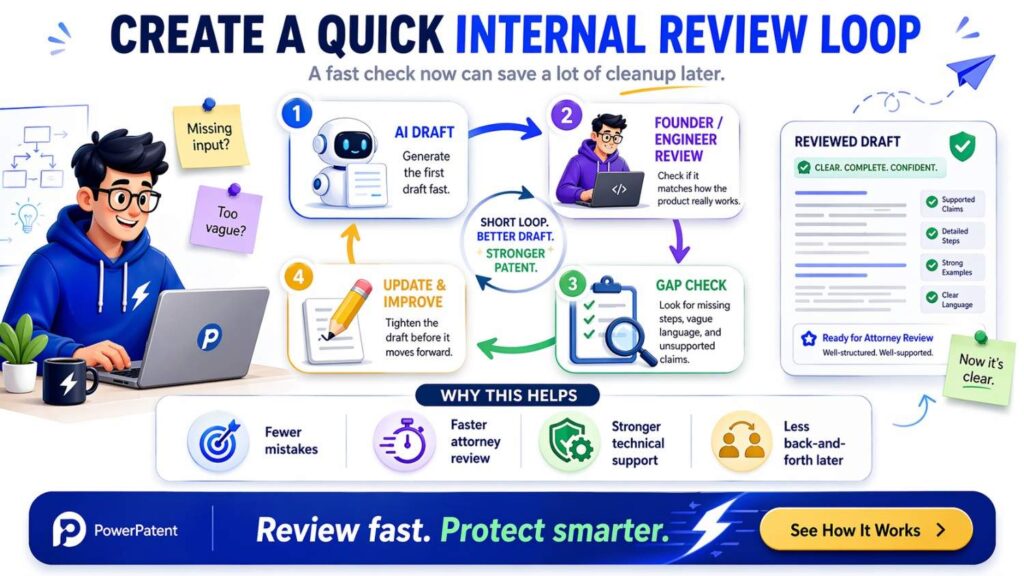
Founders can improve patent quality with a short internal loop.
It does not need to be formal.
Have one engineer review for technical truth. Have one product lead review for real-world flow. Have the founder review for core idea and business value.
Each person looks at the same draft with a different lens.
This catches gaps fast.
AI can help organize feedback, but the insight comes from the team.
Keep speed, but do not skip thinking
Startups need speed.
But skipping thinking is not the same as moving fast.
A founder’s job is to make sure the invention is clearly understood before filing.
That does not require long documents.
It requires clear thinking.
Five minutes of sharp explanation can be more valuable than pages of vague text.
AI can help capture that explanation.
Attorneys can help shape it.
But the clarity must come from the founder.
The founder advantage
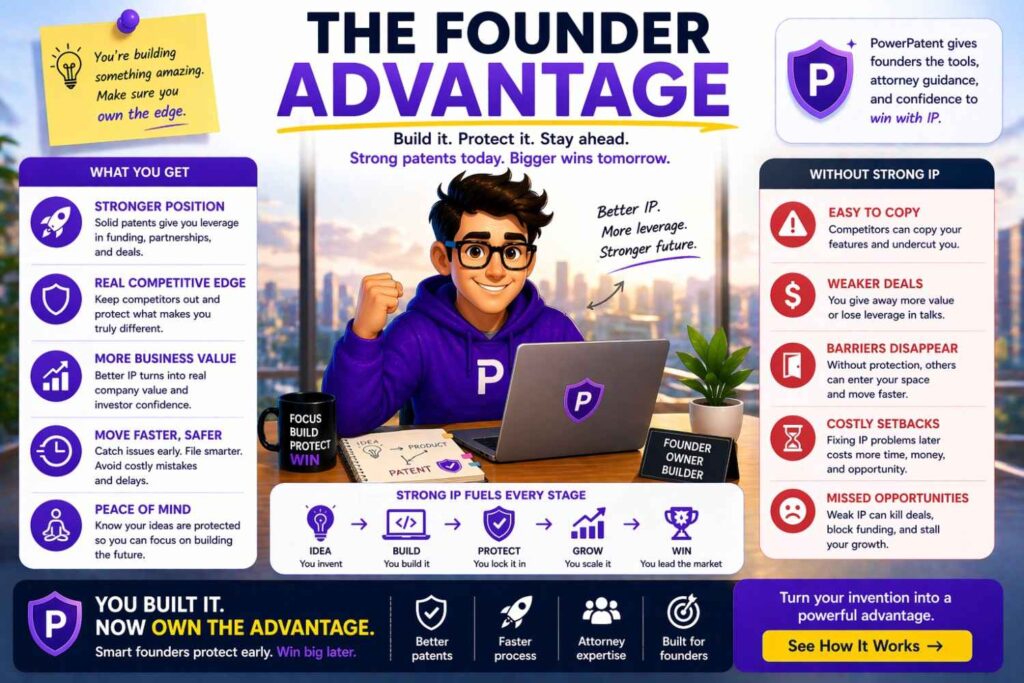
No one understands the invention like the founder.
Not the AI.
Not the attorney.
That is an advantage.
When founders stay involved in the right way, patents become more than paperwork.
They become a clear record of what makes the company special.
That is what gives patents real value.
And that is exactly what PowerPatent is designed to support: founders staying in control, AI making the process easier, and attorneys making sure the result is strong. You can see how it works here: https://powerpatent.com/how-it-works
Final thoughts
AI-written patent descriptions can be a huge help, but they need care.
The main risk is not bad grammar. It is missing support.
A draft can sound complete while failing to show the real invention. It can use broad words without enough detail. It can claim more than it teaches. It can hide the key step inside buzzwords. It can add facts that are not true.
Section 112 is where those problems show up.
The fix is not to avoid AI. The fix is to use AI the right way.
Start with the real invention. Feed the system real technical material. Use drawings. Explain the “how.” Add real examples. Define soft terms. Check every claim against the description. Get attorney review before filing.
That is how founders can move fast without filing weak patents.
And that is exactly the kind of process PowerPatent is built to support: smart software, real attorney oversight, and a faster path from invention to strong patent filing.
Explore how PowerPatent works here: https://powerpatent.com/how-it-works