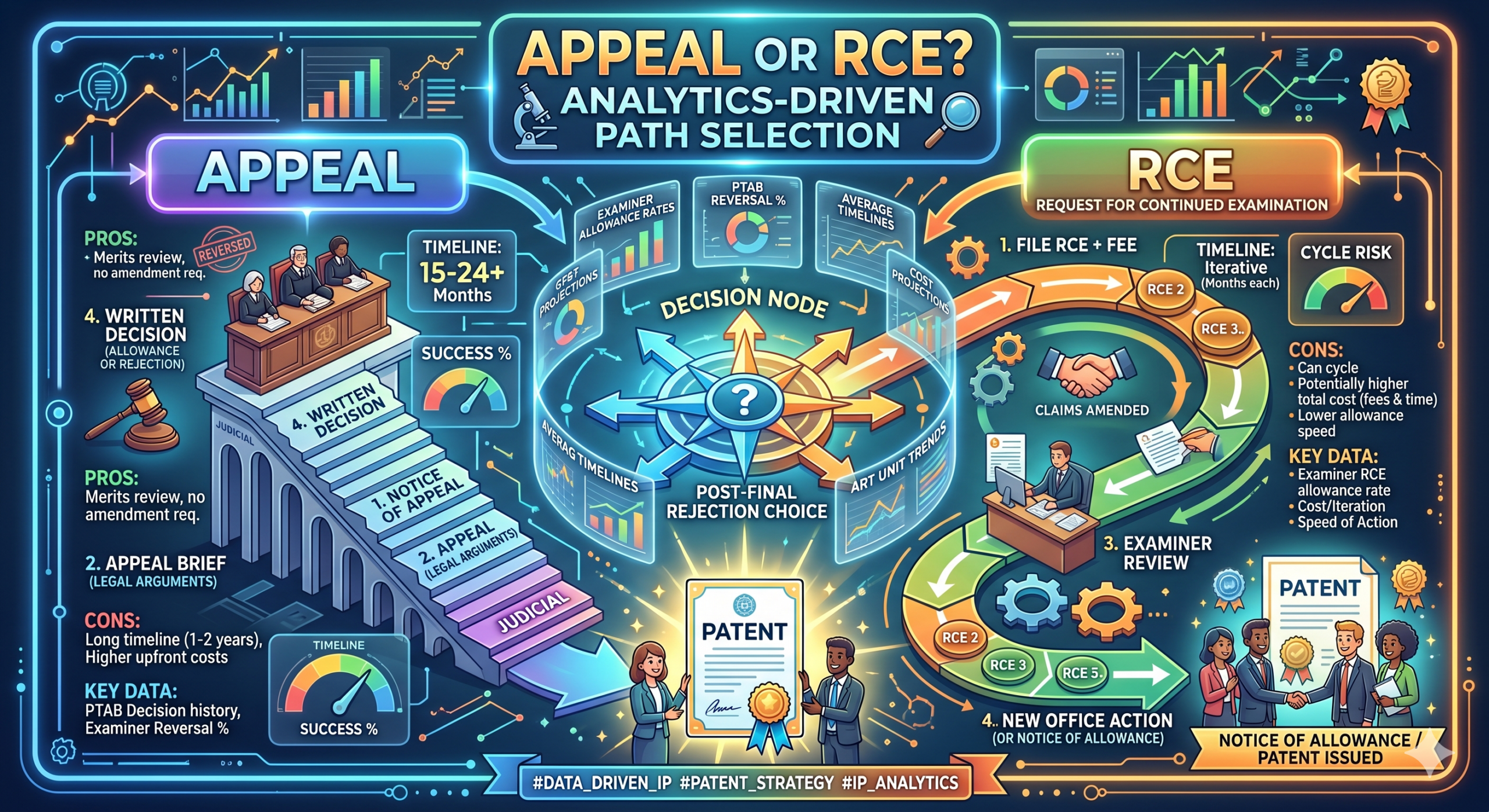
A patent case can stall for many reasons. The examiner may say no again. The claims may feel close, but not close enough. Your team may feel stuck between two paths: file an appeal or keep going with an RCE.
The real question is not “appeal or RCE,” but “what is blocking allowance?”
Before you pick a path, you need to name the real problem. This sounds simple, but it is where many patent teams lose time. They treat every final rejection the same.
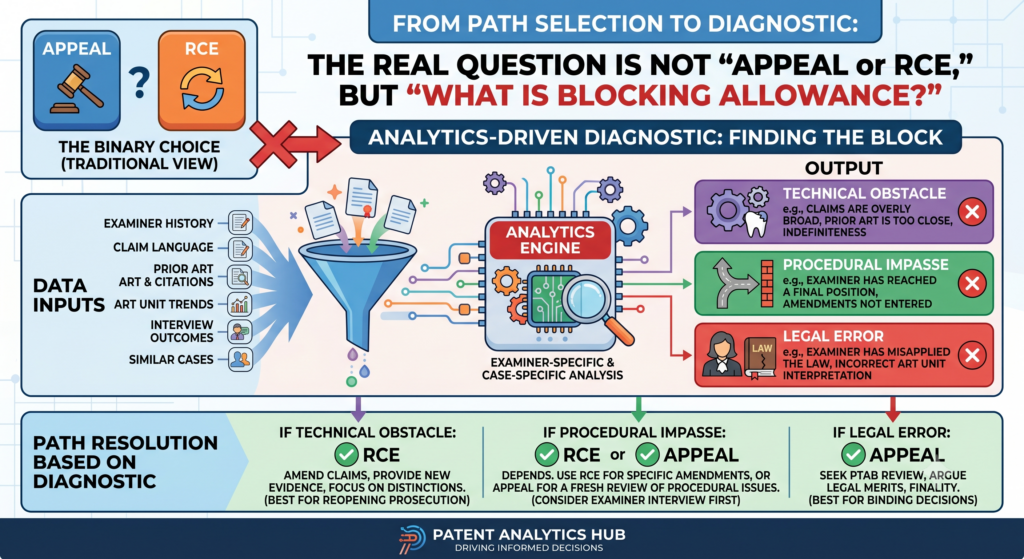
They see the word “final,” feel pressure, and rush into the next filing step. That is risky because the right move depends on why the case is stuck.
An RCE is often useful when the claims still need work. It gives you another round with the examiner. You can amend the claims, add sharper points, and guide the case toward allowance.
An appeal is different. It is a way to say, “We believe the examiner is wrong, and we want another group to review it.”
Both paths can be smart. Both paths can also be wasteful when used at the wrong time.
The first job is to separate claim problems from examiner problems
A claim problem means the case may still need better wording. Maybe the claim is too broad. Maybe the main feature is hidden.
Maybe the invention is strong, but the claim does not show the difference clearly enough. In that case, an RCE may be the faster and cleaner path.
An examiner problem means the claims may already be in good shape, but the examiner is not giving fair weight to the words. Maybe the examiner is stretching the prior art too far.
Maybe the rejection skips a key claim part. Maybe the logic does not hold up. In that case, appeal may be worth serious thought.
The cleanest path starts with a plain-English issue map
Before you decide, write down the rejection in simple words. Do not start with legal terms. Start with the story. What does the examiner say the old reference shows? What does your claim actually require? Where do those two things fail to match?
This issue map should be so clear that a founder, engineer, or product lead can understand it without a law degree.
That matters because the best patent choices are business choices too. Your patent path should protect the product, the roadmap, and the company’s future value.
PowerPatent is built for this kind of clear thinking. It helps founders and teams work with smart software and real patent attorney review, so the path is not based on guesswork. You can see how that process works here: https://powerpatent.com/how-it-works
A final rejection does not always mean the case is in bad shape
Many founders hear “final rejection” and think the case is almost dead. That is not true. A final rejection often means the examiner is done with the current round.
It does not always mean the invention is weak. It does not always mean your claim has no value.
The key is to look at what changed from the last office action to the final one. Did the examiner give a better reason? Did the examiner bring in stronger art? Did the examiner simply repeat the same point?
Did your last amendment move the case closer to allowance, or did it create a new issue?
The history of the case often tells you more than the current rejection
A single office action is only one snapshot. The full record tells the real story. You want to see whether the examiner has been consistent.
You want to see whether each response has narrowed the gap. You want to know whether the case is moving forward or just spinning.
If each round has made the claims cleaner, an RCE may make sense because one more careful move could finish the job.
If each round has led to the same weak rejection, appeal may be stronger because the record may already show the examiner’s error.
This is where analytics turn a stressful call into a more grounded call. You are no longer asking, “What do we feel like doing?” You are asking, “What does the record show?”
How examiner data changes the appeal-versus-RCE decision
Every examiner has patterns. Some examiners allow cases after one more response. Some rarely change course after final rejection.
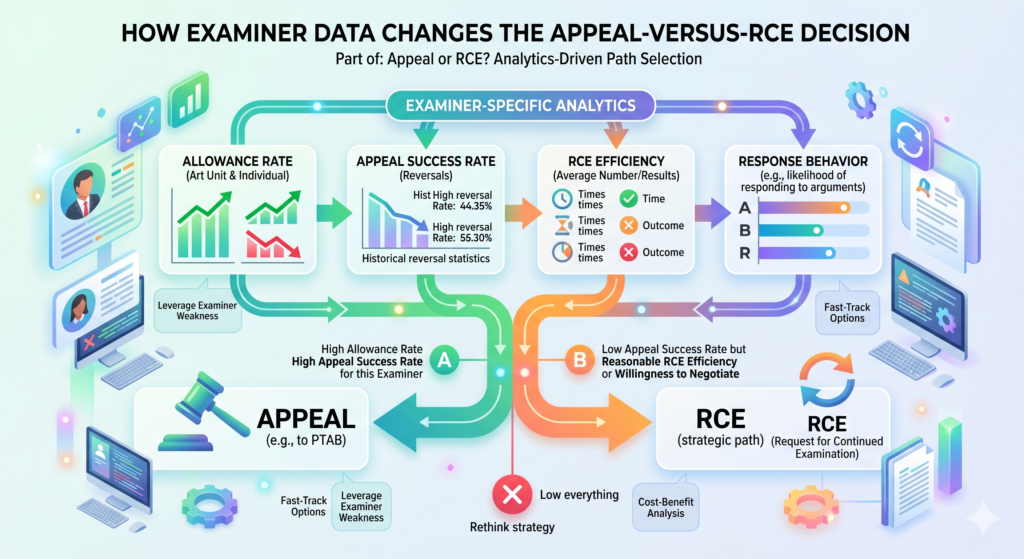
Some are open to interviews. Some are much more likely to reopen prosecution after an appeal brief. Some work fast. Some move slowly.
This does not mean the examiner is good or bad. It means each examiner has a work style. If you ignore that style, you are flying blind. If you study it, you can choose a path with more control.
The same rejection can call for different moves with different examiners
Imagine two cases with very similar facts. In both cases, the examiner has made a weak rejection. In the first case, the examiner often allows cases after clear amendments and a direct interview.
In the second case, the examiner almost never allows after final and often holds the same position until appeal.
For the first case, an RCE may be wise if you can make a focused change that keeps the patent valuable.
For the second case, an appeal may be the better pressure point if the claims are already strong and the rejection is not well supported.
That is why data matters. It helps you avoid using the same playbook for every case.
Examiner behavior should shape timing, cost, and claim strategy
When you look at examiner analytics, you are not trying to predict the future with perfect force. You are trying to reduce blind spots. You want to know whether another round is likely to help.
You want to know whether appeal tends to move the case. You want to know whether the examiner often allows after a pre-appeal review, after an appeal brief, or after reopening prosecution.
This can save a startup from spending money in the wrong place. A founder does not have unlimited budget for endless patent back-and-forth.
Every patent dollar competes with hiring, product work, sales, and runway. The goal is not to spend less at all costs. The goal is to spend with intent.
PowerPatent helps teams make these decisions with a modern workflow that keeps the founder informed and the legal work focused.
That matters because the best patent plan is not just technically correct. It also fits the company’s stage, budget, and speed. Learn more here: https://powerpatent.com/how-it-works
Art unit data adds another layer of truth
The examiner matters, but the art unit matters too. An art unit is the group inside the patent office that handles a certain type of technology.
Some art units are harder than others. Some move faster. Some have a higher allowance rate. Some tend to require more rounds before a case is allowed.
For deep tech startups, this can be very important. Cases involving software, AI, data systems, biotech tools, robotics, chips, and complex platforms may land in areas where the review is more careful.
That does not mean you should avoid filing. It means you should be more strategic.
The art unit can show whether friction is normal or unusual
If your case is in a tough art unit, one or two hard rejections may not be a sign that the invention is weak.
It may simply be part of the path. In that setting, an RCE might be expected if the claims still need to be shaped around the examiner’s view.
But if the case has already gone through several rounds and the rejection is still based on a thin reading, appeal may become more attractive.
The data helps you see whether the case is stuck because of normal friction or because the examiner’s position is unlikely to change without outside review.
This is the practical heart of analytics-driven path selection. You do not let one number decide the case. You use several signals together. You look at the examiner.
You look at the art unit. You look at the claim history. You look at the business need. Then you choose the path that gives the patent the best chance to matter.
When an RCE is the smarter move
An RCE can be a strong move when there is still useful room to improve the claims. The key word is useful.
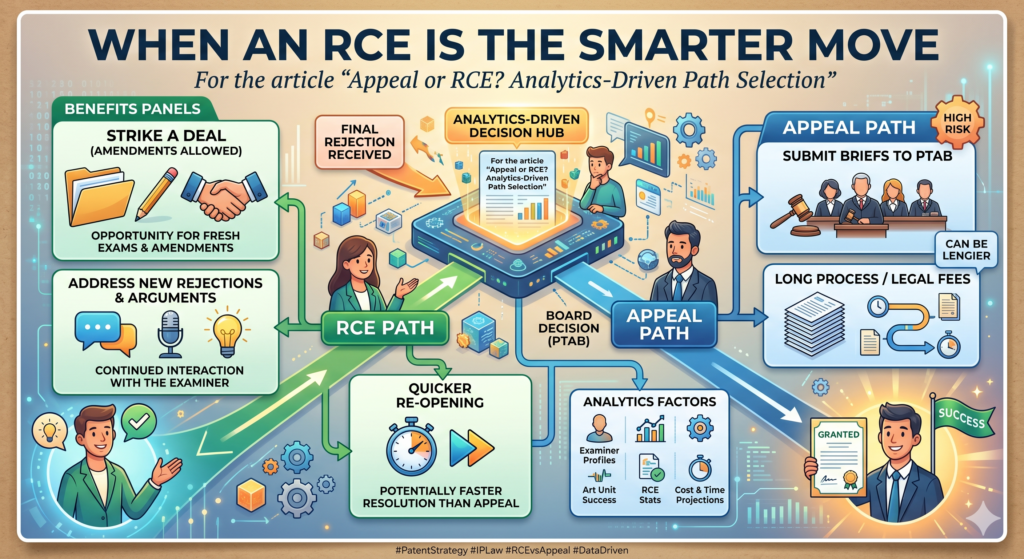
You do not want to file an RCE just to keep the case alive. You want to file it because the next round has a clear purpose.
A weak RCE says, “Let’s try again and hope.” A strong RCE says, “Here is the claim change, here is why it matters, and here is how it moves the case closer to allowance without giving away too much value.”
An RCE works best when the next amendment can protect the business
Sometimes the examiner has found prior art that is close, but not fatal. It may show part of the system, but not the full flow. It may show one model step, but not how your platform uses it in the real product.
It may show a general idea, but not the specific control logic, data pipeline, feedback loop, or hardware setup that makes your invention different.
In that case, an amendment can help. The trick is to amend with care. You do not want to add small details that are easy for a competitor to design around.
You want to add the feature that matters to the product and is hard for others to copy.
The best RCE strategy protects the core, not the decoration
Founders often think a narrower claim is always worse. That is not always true. A narrow claim that covers the real product can be far more useful than a broad claim that never gets allowed or is too vague to defend.
The question is not, “Can we make the claim broader?” The better question is, “Can we make the claim strong enough to get allowed while still covering the thing that gives us an edge?”
This is where input from engineers matters. The patent team should understand what the product actually does, what competitors are likely to copy, and what parts of the system are hard to build. If the next amendment captures that value, an RCE can be a smart step.
PowerPatent makes this easier by helping turn technical detail into clear patent strategy with software plus attorney oversight.
That gives founders more control and fewer blind guesses. See the process here: https://powerpatent.com/how-it-works
An RCE also makes sense when the examiner has shown a path to allowance
Sometimes an examiner will hint at what would make the case allowable. That hint may come in an interview.
It may show up in the wording of the rejection. It may appear when the examiner focuses on one missing feature and spends less time on other points.
When that happens, an RCE can be useful because the next response can meet the examiner where the case now stands.
This does not mean you should accept every suggestion. It means you should study whether the suggested path still protects the invention in a meaningful way.
A good examiner interview can turn an RCE into a focused close
Before filing an RCE, it often helps to speak with the examiner when that option is available. The goal is not to argue for the sake of arguing. The goal is to learn what is truly blocking the case.
A strong interview can answer the questions that do not always appear clearly in writing. Is the examiner mainly worried about one claim term?
Is there a specific feature that the examiner thinks is missing? Would a certain amendment likely place the case in better shape?
When the answers are useful, an RCE can become a focused close instead of another slow loop. That is the difference between prosecution that drifts and prosecution that moves with purpose.
When appeal becomes the better business choice
Appeal starts to make sense when the claims are in good shape and the examiner’s rejection still does not line up with the facts.
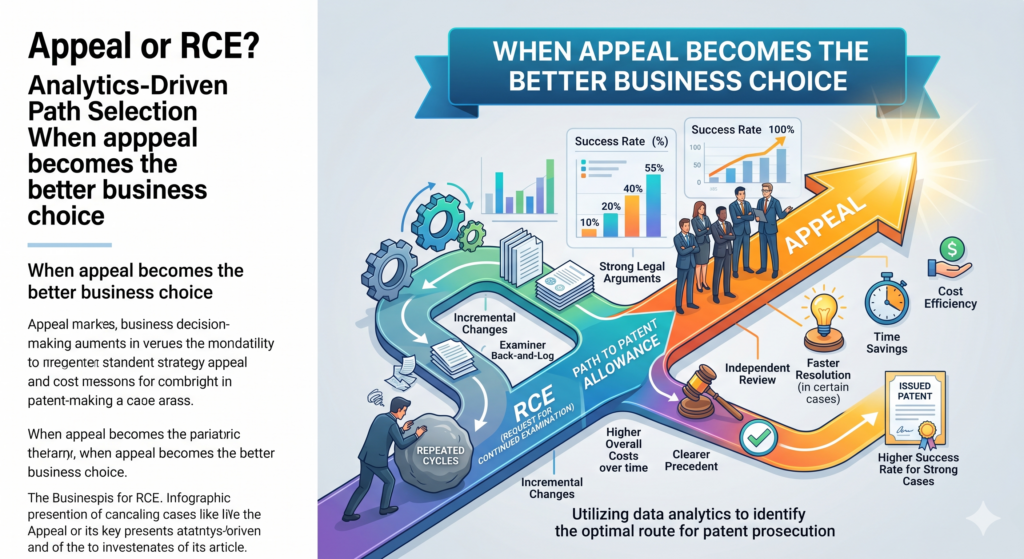
At that point, more amendments may do harm. You may give up claim scope without solving the real problem. You may spend more money only to face the same position again.
Appeal is not about being stubborn. It is about knowing when the record is strong enough to ask for review.
Appeal is strongest when the dispute is clear and simple
The best appeal issues are usually clean. The claim says one thing. The reference does not show it. The examiner says it does, but the record does not support that reading. That is the kind of issue that can be explained clearly.
If the appeal argument takes many pages just to make sense, the case may not be ready. If the key point can be stated in plain words, appeal becomes more attractive.
A strong appeal should sound clear even to a non-lawyer
Here is a simple test. Ask someone on the product team to read the core argument. If they can understand why the examiner is wrong, that is a good sign. If they get lost, the issue may need more work.
This does not mean appeal arguments should be casual. They still need to be careful and well supported.
But the heart of the argument should be clean. The best patent arguments often have a simple center.
For a startup, this matters because appeal can take time. You do not want to appeal a messy case just because you are tired of the examiner. You want to appeal when the facts, the claim language, and the business goal all support it.
Why appeal can save scope when another RCE would only shrink the claim
A patent is not just a paper win. It is a business tool. If the claim becomes so narrow that a competitor can avoid it with a small change, the patent may not help much.
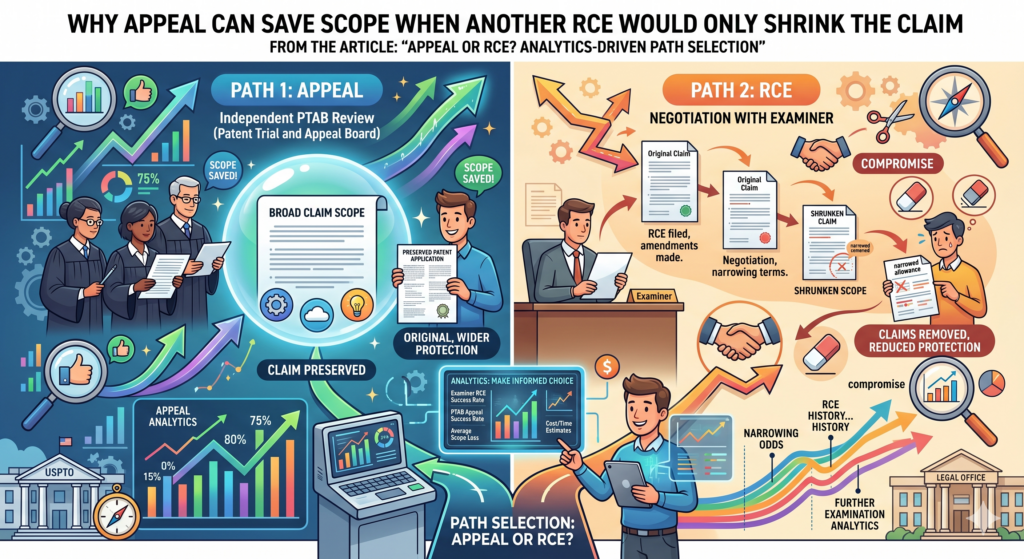
That is why another RCE can be risky when the only path forward is to keep adding small details that do not matter to the real invention.
Appeal can protect claim scope when the examiner is asking for changes that should not be needed. This is especially true when your claim already has the key feature that separates your invention from the old technology.
You should not amend just to make the rejection go away
It can feel tempting to keep adding words until the examiner says yes. That may feel like progress, but it can quietly weaken the patent. A rushed amendment may get allowance, but it may also leave your company with a claim that does not block much.
A better approach is to ask what each added word does for the business. Does it protect the product? Does it cover the system your team is actually building?
Does it stop a likely copycat? Does it match the part of the invention that investors, partners, or buyers would care about?
The best claim changes should make the patent stronger, not just smaller
A good amendment makes the claim clearer and harder to attack. A bad amendment only makes the claim longer. That difference matters.
For example, if your invention is an AI system that improves model output using a special feedback loop, adding that feedback loop may strengthen the claim.
But adding a random dashboard screen, a generic storage step, or a narrow data format may not help much if those parts are not central to the product.
This is why founders should not treat patent work as a side task that only lawyers handle in the background.
Your engineering insight matters. Your roadmap matters. Your market matters. A strong patent path connects all three.
PowerPatent helps bring those pieces together by pairing smart tools with real attorney oversight, so your patent decisions are tied to what you are actually building. You can see how that works here: https://powerpatent.com/how-it-works
Appeal can be the right move when the record is already strong
The record is the story of the case. It includes the claims, the rejections, your replies, the references, and the examiner’s reasons. If that story already shows a clear gap in the rejection, appeal may be the cleanest way forward.
This often happens when the examiner keeps relying on the same weak reading of the same reference. You explain the gap. The examiner repeats the rejection.
You clarify the claim. The examiner still says no. At some point, another RCE may only give the same issue more time to repeat itself.
A strong record makes appeal less like a gamble and more like a planned move
Appeal works best when the key issue has already been built into the record. That means the examiner has had a fair chance to respond. It also means your side has clearly explained why the rejection does not fit.
This is not about making the record long. It is about making it clear. You want the appeal body to see the problem quickly.
The claim requires a specific thing. The old reference does not teach that thing. The examiner’s reasoning skips that gap.
When the record is clean, appeal can help protect the claim from needless narrowing. That can be the better long-term business move, even if it feels slower in the short term.
The analytics signals that should guide the decision before money is spent
Analytics should not replace judgment. They should improve it. The goal is not to let a dashboard make the decision for you. The goal is to bring the right facts into the room before you spend more money.
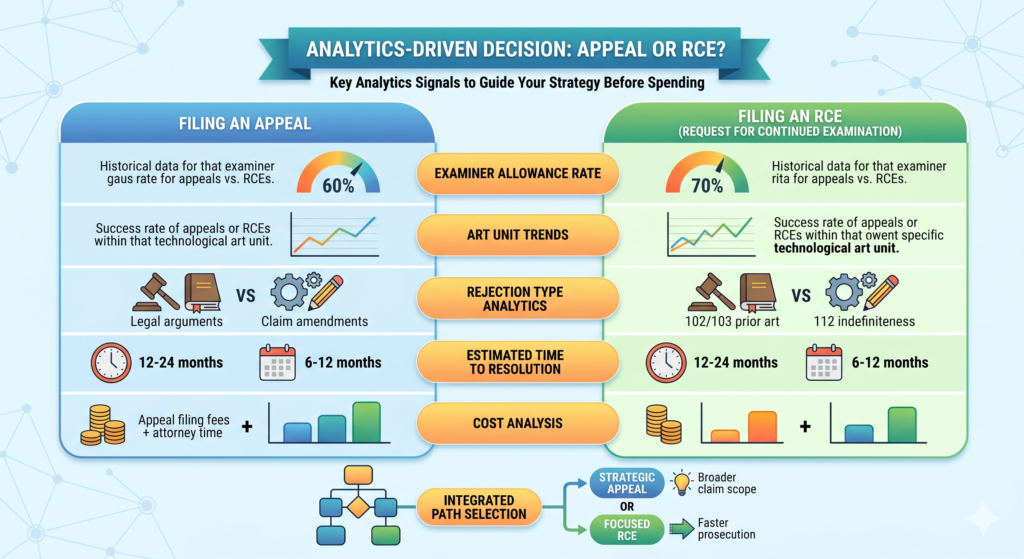
For a startup, this is huge. Patent work should support company goals, not drain focus. When you use data well, you can make each filing step more intentional.
The first signal is the examiner’s allowance pattern after final rejection
Some examiners are open to movement after final rejection. Some are not. That pattern should matter. If an examiner often allows after an RCE, and your claim has room for a strong amendment, the RCE path may be practical.
But if the examiner rarely allows after another round, you should be careful. Filing an RCE with no strong new plan may only extend the same fight.
In that case, appeal may create better pressure and force a more careful look at the issue.
Examiner data should be read with context, not fear
A low allowance pattern does not mean your case is doomed. A high allowance pattern does not mean your case is easy. The data gives you context, not a promise.
You still need to look at the facts of the case. Are the claims strong? Is the prior art close? Did the examiner misunderstand the invention?
Is there a clean amendment available? Does the company need this patent allowed quickly for funding, a product launch, or partner talks?
Analytics are most useful when they help you ask sharper questions. They do not remove the need for strategy. They make strategy better.
The second signal is how often appeal changes the outcome
Some cases move after a pre-appeal request. Some move after an appeal brief. Some reopen when the examiner sees that the issue will get reviewed more closely. Some go all the way to a decision.
This matters because appeal is not one single event. It can create several points where the case may shift.
If the data shows that cases before a certain examiner often reopen or get allowed after appeal steps, that can change the cost picture.
Appeal value is not only measured by winning at the final stage
Founders often think appeal means waiting for a full appeal decision. That can happen, but it is not the only possible result.
Sometimes the pressure of a clear appeal argument causes the office to take another look before the case reaches the final board decision.
That means the value of appeal can come earlier than expected. It can force the issue into a cleaner review.
It can show that the rejection is weak. It can make the examiner address the real claim language instead of repeating a broad reading.
This is why appeal should not be viewed only as a last resort. In the right case, it is a smart tool for moving the file out of a loop.
The claim history tells you whether the case is moving or stuck
A patent case has motion. Sometimes that motion is healthy. Sometimes it only looks busy. The difference is important.
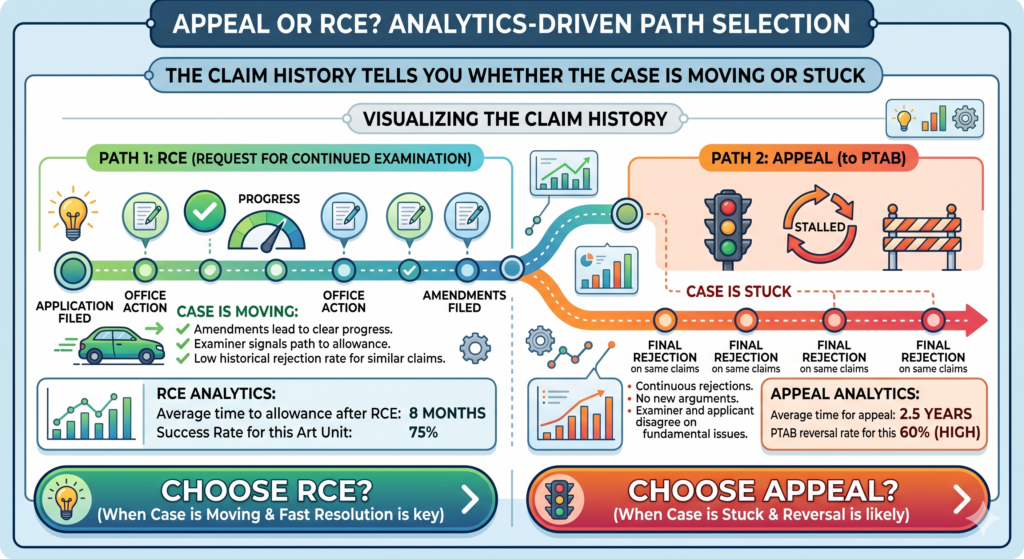
If every response has made the issue clearer and the examiner has narrowed the dispute, the case may be moving.
If every response leads back to the same broad rejection, the case may be stuck. An analytics-driven review looks at that motion before choosing RCE or appeal.
A moving case usually has a smaller dispute each round
A healthy case often starts broad and then becomes more focused. The first rejection may raise many issues.
Your response may clear some of them. The next rejection may focus on fewer points. The examiner may shift to a more specific reference or a more precise reading.
That kind of movement can support an RCE because the next step may finish the job. It shows that prosecution is not just repeating. It is closing in on the allowable claim.
A good RCE should have a clear finish line
Before filing an RCE, ask what allowance might look like. Not in vague terms, but in real claim terms. What exact feature will likely carry the claim? What wording will make the difference clear? What part of the invention will remain protected?
If no one can answer that, the RCE may be too loose. It may become another round of hope.
A focused RCE should feel like a controlled move. The team should know why the amendment matters, why the claim still has value, and why the examiner may respond differently this time.
PowerPatent helps founders avoid vague patent work by creating a clearer bridge between the invention, the claims, and the business goal. That helps teams move faster and protect smarter. Learn more here: https://powerpatent.com/how-it-works
A stuck case often repeats the same core fight
A stuck case feels different. The examiner keeps saying the same thing. Your replies keep pointing to the same gap. The rejection may use new words, but the real issue does not change.
This is where teams need to be honest. If the next RCE will only restate the same argument, it may not be worth it. If the only new amendment would cut into the heart of the invention, that may be a warning sign.
Repetition is one of the clearest signs that appeal should be considered
When the record repeats, appeal becomes more attractive. Not because appeal is easy, but because the current path is not working.
The key is to make sure the appeal issue is clean. If the examiner’s position is wrong, show it in simple terms. If the reference lacks a claim feature, make that gap plain. If the examiner combined references in a way that does not make sense, explain why the combination fails.
A strong appeal is not loud. It is disciplined. It takes the record and points to the missing piece.
Cost should be measured against business value, not just filing fees
Founders are right to care about cost. Patent budgets matter. But the cheapest next step is not always the best next step. A low-cost move can become expensive if it delays the case, weakens the claim, or creates another dead end.
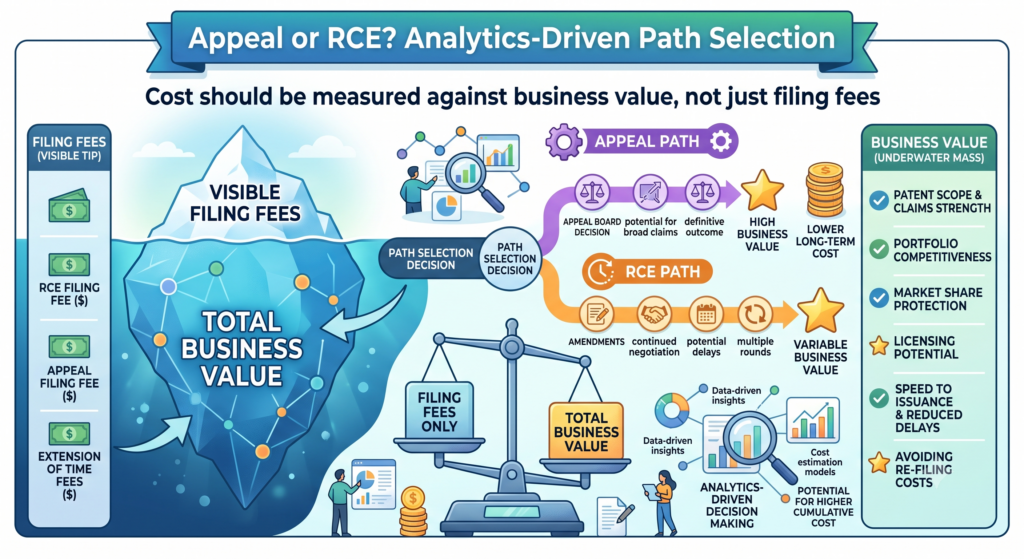
The better question is not, “Which option costs less today?” The better question is, “Which option gives this patent the best chance to protect the business at a smart total cost?”
An RCE may look cheaper but cost more if it creates another loop
An RCE can be efficient when it has a clear plan. But without that plan, it can become a cycle. File the RCE. Make a small change. Get another rejection. Try again. Each round adds cost, time, and team fatigue.
For a startup, that delay can matter. The company may need issued claims for investor confidence. It may need protection before a major launch. It may need a stronger patent position before a partnership or sale.
Total cost includes delay, lost scope, and missed leverage
A patent that issues too late may miss a key business moment. A patent that issues with weak claims may not create much leverage. A patent that stays pending with no clear path can drain attention.
That is why cost should be viewed as a full business picture. Fees matter, but so does timing. So does claim strength. So does the value of getting out of a loop.
Appeal may cost more upfront in some cases, but it can be the smarter spend if it protects scope and forces review of a weak rejection.
RCE may be the smarter spend if one more focused amendment can get the case allowed without giving up the core invention.
The right decision depends on what this patent needs to do
Not every patent has the same role. Some patents protect the core product. Some support a future roadmap.
Some help with fundraising. Some create a fence around a platform. Some are meant to make copycats think twice.
The appeal-or-RCE decision should match that role. A core patent may deserve a stronger fight to keep broad and meaningful claims. A smaller support patent may justify a faster path if the narrowed claim still has value.
Patent strategy should follow company strategy
Your patent plan should not live in a separate world from your business plan. If your team is moving fast, your IP process needs to keep up.
If your roadmap is changing, your claims need to reflect the parts that will still matter. If investors are asking about protection, your patent path should show clear intent.
This is exactly why modern patent work needs more than old email threads and slow back-and-forth. Founders need visibility.
Engineers need a simple way to share the real invention. Attorneys need the right technical detail at the right time.
PowerPatent brings these parts into one smarter process, with AI-powered tools and attorney review working together. Startups can see how it works here: https://powerpatent.com/how-it-works
Pre-appeal review can be a smart middle path when the error is plain
Pre-appeal review can help when the examiner’s rejection has a clear problem and you want that problem reviewed before going deeper into a full appeal.

It is not right for every case, but it can be useful when the issue is narrow and easy to explain.
Think of it as a focused checkpoint. You are not trying to tell the whole story of the invention. You are pointing to a clear mistake in the rejection and asking for another look.
Pre-appeal works best when the rejection misses a key claim part
The strongest pre-appeal request usually centers on one simple point. The claim requires a certain feature, step, structure, or connection.
The reference does not show it. The examiner says it does, but the support is weak or missing.
This is different from a case where the argument depends on many small points. If the issue takes too much setup, full appeal may be better. If the issue is clean, pre-appeal may save time and cost.
The best pre-appeal argument should be sharp enough to understand fast
A pre-appeal request should not read like a long debate. It should read like a clear signal. The goal is to make the reviewer see the gap without digging through a maze.
For example, if your claim requires a model to adjust a live control action based on a closed feedback signal, and the reference only shows a static report after the fact, that gap matters.
You do not need to make the story huge. You need to show that the examiner’s cited art does not match the claim.
This is where simple writing wins. The clearer the issue, the harder it is to ignore. A clean argument can sometimes move the case without the full weight of an appeal brief.
Pre-appeal can also test whether appeal pressure will change the case
A pre-appeal step can reveal how firm the office is about the rejection. If the case reopens, that may show the rejection had a weakness. If the case moves forward to appeal, you may have learned that the issue will need a fuller brief.
Either way, it gives you information. For a startup, that can be valuable because each next step should be chosen with eyes open.
A weak pre-appeal request can waste a good chance
Pre-appeal is not a place to throw every complaint into the record. It should not be used just because the team is frustrated. It should be used when the mistake is clear enough to explain in a tight, direct way.
If the argument is more about claim meaning, technical context, or why a combination of references does not make sense, full appeal may be stronger. If the claim still needs meaningful changes, an RCE may still be better.
The point is to match the tool to the problem. That is the heart of analytics-driven path selection.
PowerPatent helps founders and teams make those choices with clearer data, better invention capture, and real attorney oversight. See how the process works here: https://powerpatent.com/how-it-works
A decision matrix helps founders avoid emotional patent choices
Patent prosecution can feel personal because the invention is personal. Your team spent months or years building something hard.
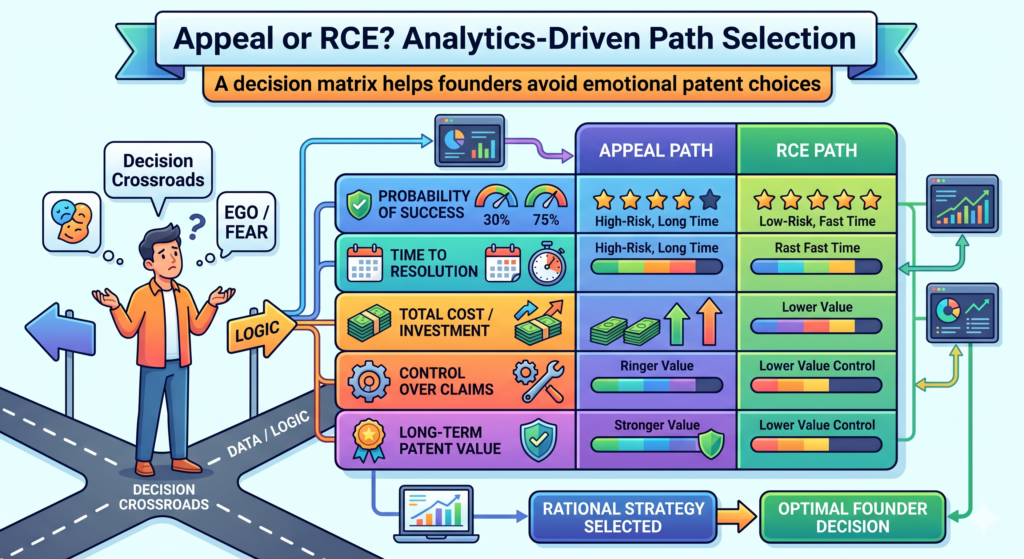
When the examiner rejects it, the response can feel like a fight. But the appeal-or-RCE choice should not be made from anger, fear, or fatigue.
A decision matrix helps turn emotion into structure. It does not need to be complex. It simply forces the team to compare the main factors before spending more money.
The matrix should start with claim value and claim readiness
The first question is whether the current claims are worth defending. If the claims still cover the core product, the real technical edge, or a future product path, they may be worth a stronger fight.
If the claims are already far from the business, an appeal may not be the best use of budget.
The second question is whether the claims are ready. A claim may be valuable but still unclear. It may need better wording.
It may need a feature that was always part of the invention but was not yet claimed well. In that case, an RCE may help.
A valuable claim that is ready may deserve appeal
When a claim is both important and ready, appeal becomes more serious. You are no longer trying to fix the claim. You are trying to fix the review of the claim.
That is a key difference. Many teams keep amending because it feels active. But if the claim already says what it needs to say, more amendments may only make it weaker. The better move may be to stand on the record and ask for review.
This is where founders should slow down just enough to protect the bigger prize.
A patent that covers the main invention can shape investor talks, partner deals, and competitive pressure. Giving away claim scope too early can hurt more than a longer appeal path.
The matrix should also include examiner behavior and art unit patterns
The next layer is data. You want to know how this examiner tends to act after final rejection, after RCEs, and after appeal steps. You also want to know how the art unit tends to handle similar cases.
This does not make the decision automatic. It makes the decision less blind. If the examiner often allows after a focused RCE, and you have a strong amendment ready, that matters.
If the examiner rarely moves after repeated argument, and the record is clean, that matters too.
Data should guide the meeting before the filing is chosen
A good decision meeting should not begin with, “What do we usually do?” It should begin with, “What does this case need?” That question changes everything.
The team should look at the claim, the rejection, the examiner history, the business goal, and the likely next outcome. The founder should understand the tradeoff in simple terms. The attorney should explain the legal path without hiding the business effect.
This is one reason PowerPatent’s approach fits technical startups. The software helps organize the invention and prosecution facts, while real attorneys guide the hard calls.
That gives founders a clearer view of the path instead of a stack of confusing emails. Learn more here: https://powerpatent.com/how-it-works
The startup roadmap should shape the appeal-or-RCE call
A patent case does not live alone. It sits inside the company’s bigger plan.
That plan may include product launches, fundraising, customer pilots, enterprise sales, hiring, partnerships, or a future acquisition. The right patent move should support those goals.
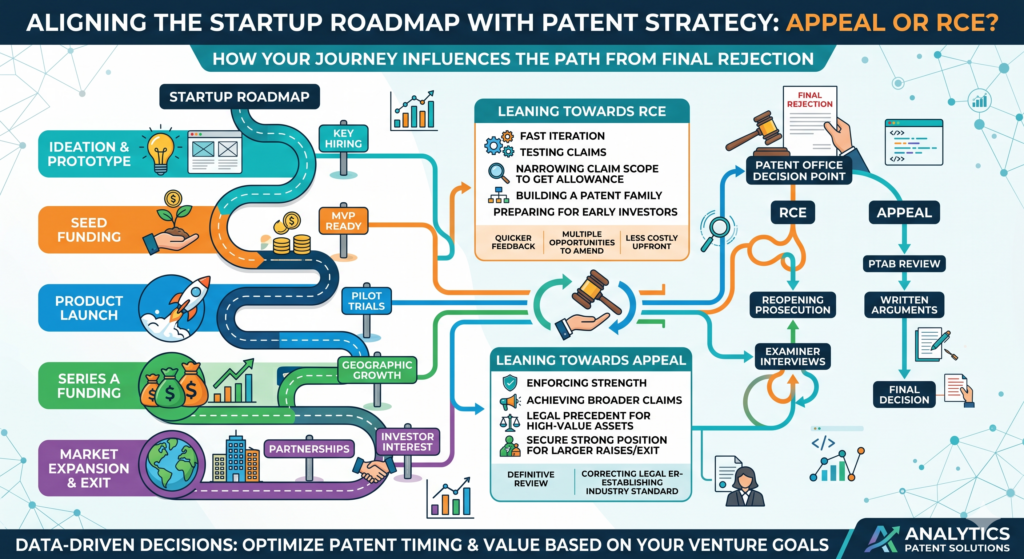
This is why the same legal situation may call for different choices at different companies. A large company may have time to wait. A seed-stage startup may need a strong story before the next raise.
A deep tech team may need claims that map closely to its platform because the patent is part of the company’s moat.
Speed matters, but speed alone is not strategy
Many founders want the fastest path to an issued patent. That makes sense. An issued patent can feel more concrete than a pending application. It may help in investor meetings and customer talks.
But speed can become dangerous if it comes at the cost of claim strength. A fast patent with narrow claims may not protect the company in a meaningful way.
A slower path may be better if it preserves the part of the invention that competitors would want to copy.
The best path balances timing with protection
The real question is not whether speed matters. It does. The question is what kind of speed helps the company.
Fast allowance is useful when the allowed claim still covers something important. Fast allowance is less useful when the claim has been trimmed down to a small detail.
For example, if your startup is building a robotics system, the valuable claim may not be a generic sensor reading. It may be the way the robot uses sensor data to make a safer or faster decision in real time.
If an RCE can preserve that idea and get the case allowed, it may be smart. If the examiner wants to cut the claim down to a small hardware layout that competitors can avoid, appeal may be worth a harder look.
This is why founders should stay involved at the strategy level. You do not need to handle the legal drafting yourself. But you should know what business value the patent is protecting.
Fundraising and investor timing can change the weight of each path
Patent decisions often become more urgent near a funding round. Investors may ask what has been filed, what has been allowed, and how the company protects its core technology.
A pending application can still be valuable, but an allowed or issued patent may carry more weight in some talks.
That does not mean you should rush into weak claims just to show a patent number.
Smart investors can see the difference between paper protection and real protection. They want to know whether the IP lines up with the product and the market.
A clear patent story can matter as much as the filing status
Founders should be able to explain the patent strategy in plain words. The story should say what the company invented, why it is hard to copy, what has been filed, and how the current prosecution path supports the business.
If the team chooses RCE, the story should explain that the next amendment is aimed at claims that still matter.
If the team chooses appeal, the story should explain that the company is defending important claim scope because the rejection does not match the invention.
That kind of clarity builds confidence. It shows that the company is not just filing patents to check a box. It is building a serious protection plan around real technology.
PowerPatent helps founders create that kind of clear patent story with smart software and attorney-backed guidance.
It gives technical teams a better way to turn their work into protection without getting buried in slow, old-school process. See how it works here: https://powerpatent.com/how-it-works
The strength of the prior art should control how hard you fight
The prior art is the old material the examiner uses against your claims. It may be an older patent, a paper, a product manual, or another public source. Before choosing appeal or RCE, you need to ask how strong that old material really is.
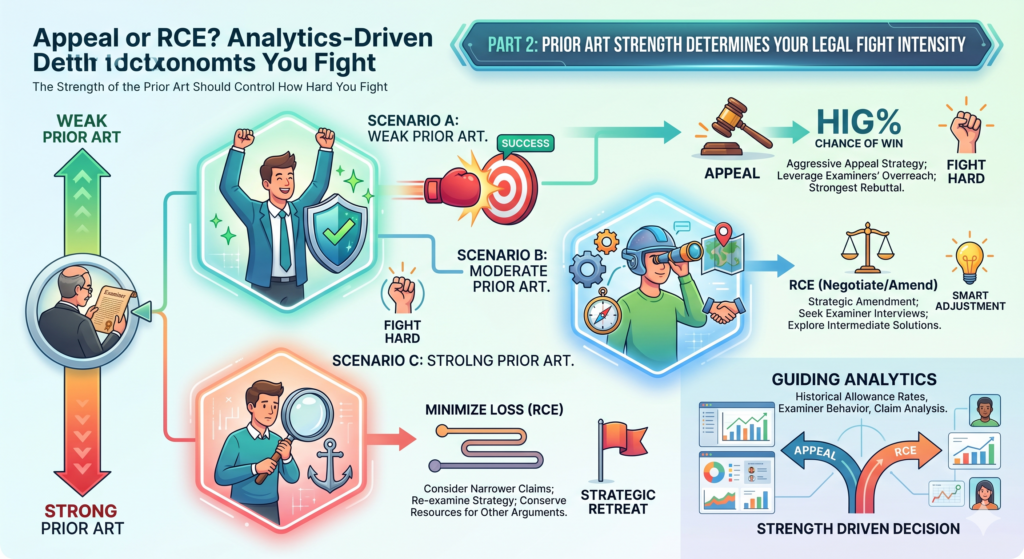
A weak reference may use similar words but teach a different idea.
A strong reference may sit very close to your invention and leave less room to argue. This difference should shape the whole path.
A close reference may call for a careful RCE instead of a fight over weak ground
Sometimes the examiner finds art that is not perfect, but still close enough to matter. In that case, appeal may not be the best first move.
If the old reference shows most of your claim, and your real invention sits in a more specific technical feature, then the smart move may be to amend toward that feature.
This is not giving up. It is choosing the claim that can survive.
Strong patents are often built by claiming the real edge with care
The best claim is not always the broadest claim you can imagine. The best claim is the one that protects the real edge of the product and can stand up under review. If the prior art is close, the claim needs to draw a clean line.
For example, a startup may build a new AI tool that improves how a system ranks data. The old art may show ranking in a general way.
The real edge may be how the system updates the ranking based on live signals from a user action, device state, or model result.
If that live update is the hard part and the valuable part, an RCE may help put that feature at the center of the claim.
A focused RCE can turn a broad but shaky claim into a strong asset. The goal is not to make the claim smaller for no reason. The goal is to make it harder to attack and harder to design around.
A weak reference may make appeal the cleaner path
Other times, the examiner’s reference is simply not enough. The words may look close at first glance, but the actual teaching does not match the claim.
The examiner may be reading too much into the reference. The rejection may rely on a stretch.
In that setting, another amendment can send the wrong message. It may suggest the claim needed fixing when the real issue was the examiner’s reading.
Do not use amendment to cure a rejection that was never sound
If the old art does not show the claim, the team should think carefully before narrowing. You may still amend for clarity, but you should not give away claim scope just because the examiner keeps repeating a weak point.
This is where appeal can be a stronger business move. It protects the claim from needless cuts. It also makes the dispute cleaner.
The appeal argument can say, in plain terms, that the cited reference does not teach what the claim requires.
PowerPatent helps teams review these choices with the right mix of technical detail, software support, and attorney judgment.
That matters because prior art review is not just a legal step. It is a product strategy step. You can explore the workflow here: https://powerpatent.com/how-it-works
The quality of the claim language can make or break either path
A claim can describe a great invention and still fail if the words are not clear. This is why the appeal-or-RCE decision must include a hard look at claim language. Before you argue that the examiner is wrong, make sure the claim says what you need it to say.
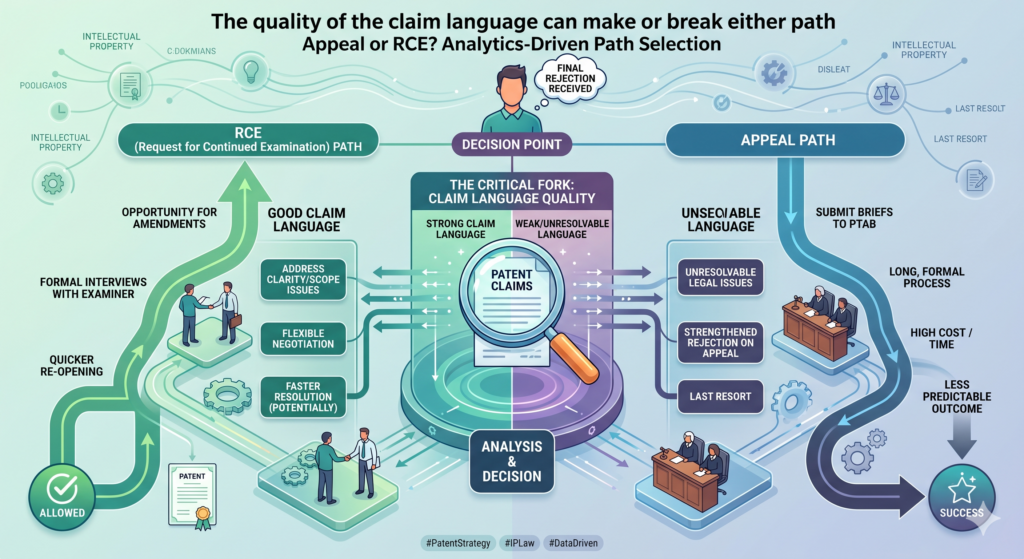
Clear claims give appeal more power. Clear claims also make RCE amendments more useful. Loose claims make both paths harder.
A claim should make the point of novelty easy to see
The point of novelty is the part that makes your invention different. You do not need to call it by a fancy name.
You just need to know what it is. If that point is buried deep in a long claim, the examiner may miss it or treat it as less important.
A strong claim brings the key idea into focus. It shows the action, the system part, the timing, or the technical link that makes the invention different from the old way.
The claim should tell the invention story without wasting words
Good claim language is not about adding more words. It is about using the right words. A claim should not read like a product brochure.
It should not try to describe every feature. It should name the parts that matter and connect them in a way that protects the real invention.
For an engineer, this often means showing the technical flow. What data comes in? What change happens? What decision is made?
What output is produced? What result is improved? If those parts matter, they should not be hidden.
When the claim language is sharp, you can make better choices. If the examiner rejects the claim despite a clear technical difference, appeal becomes stronger.
If the claim still does not show the difference well, an RCE may be the safer path.
Vague words can turn a good invention into a hard prosecution
Vague claim words create room for confusion. The examiner may read them broadly. The prior art may seem closer than it really is. The case may drift into arguments that do not help the business.
This is common when teams rush the drafting stage or when the invention changes after filing. It is also common when the claim uses broad labels instead of showing how the system actually works.
Fixing unclear words may be more valuable than arguing over them
When the claim is unclear, appeal can be risky. The appeal body may not see the invention the way your team sees it. They will read the claim as written, not as imagined.
In that case, an RCE can be useful if it lets you clean up the claim and place the key technical point in better shape.
This can be the right move when the amendment does not hurt the business value.
PowerPatent is designed to help founders capture invention details early and turn them into stronger patent filings.
The goal is to reduce confusion later and give each case a better chance from the start. See how PowerPatent helps here: https://powerpatent.com/how-it-works
Interviews can reveal whether the examiner is open to movement
An examiner interview can be one of the most useful steps before choosing appeal or RCE. It gives the team a chance to test the issue in a direct conversation.
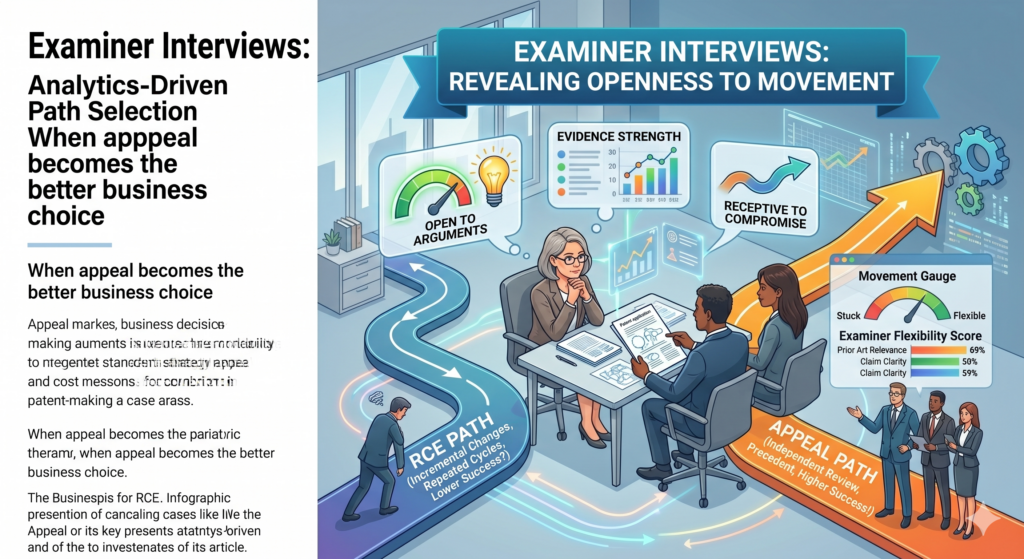
It can show whether the examiner is open to a focused amendment or whether the examiner is fixed on a position.
The point of an interview is not to win a debate in the moment. The point is to learn what path has the best chance.
A good interview should be planned around one or two real issues
A weak interview tries to cover everything. A strong interview focuses on the point that matters most.
The team should enter the call knowing what claim feature is at stake, what the examiner has cited, and what possible path would still protect the invention.
If the examiner responds with a clear path that keeps the claim valuable, an RCE may make sense.
If the examiner repeats the same weak reading and does not engage with the claim language, appeal may become more attractive.
The best interview question is often simple and direct
A useful question may sound like this in plain English: “What part of the reference shows this exact claim feature?” Another useful question may be: “Would the claim be in better shape if it made this technical link clearer?”
These questions are not tricks. They help reveal the real block. If the examiner can point to a real issue, you can work with it. If the examiner cannot, you may have a stronger reason to appeal.
Founders do not always need to attend the interview, but the business goal should be known before it happens.
The attorney should know what scope matters, what changes are acceptable, and what features must not be traded away.
Interview notes should feed directly into the path decision
After the interview, the team should not simply say, “That went well” or “That went badly.” They should turn the call into a decision. Did the examiner identify a clear problem?
Did the examiner suggest allowable subject matter? Did the examiner misunderstand the technology? Did the examiner show that more argument will not help?
Those answers matter because they turn a vague feeling into a real prosecution plan.
A strong interview can stop waste before it starts
If the interview shows a clean path to allowance, an RCE may save time. If the interview shows that the examiner is not likely to move, appeal may save scope and reduce further loops.
This is exactly the kind of decision that benefits from both analytics and human judgment. Data shows patterns.
The interview shows live case behavior. The attorney ties both to the patent law path. The founder ties both to the business goal.
PowerPatent brings these moving parts into a more modern process, so teams can act with more confidence and less confusion. You can see how it works here: https://powerpatent.com/how-it-works
The worst choice is the one made without a clear theory
An appeal or RCE should never be filed just because it is the next available step. It should be filed because the team has a clear theory.

That theory should explain why the case is stuck, why the chosen path is likely to help, and how the move protects the business.
Without that theory, both appeal and RCE can become expensive guesses.
A clear RCE theory says what will change and why it will matter
If the team chooses RCE, the reason should be specific. The next amendment should have a clear role.
The response should explain the technical difference in a way that the examiner can understand. The team should know why this round is not just a repeat of the last round.
A strong RCE theory may say that the claim will be changed to focus on the live feedback loop, the new control step, the device-level structure, the training process, or another feature that truly separates the invention.
RCE should feel like a planned step, not an open-ended extension
Before filing, ask whether the next response has a real endpoint. The case may not be guaranteed to allow, but the plan should be clear.
The team should know what claim scope it is trying to protect and what business value that scope carries.
If no one can explain the plan in plain words, pause. The RCE may still be needed, but the strategy is not ready.
A good RCE is not just more time. It is a better shot.
A clear appeal theory says what error should be reviewed
If the team chooses appeal, the theory should be just as clear. The appeal should not be a long complaint. It should point to the examiner’s error and show why the claim is patentable over the cited art.
The best appeal theory is simple enough to explain to a founder and strong enough to defend in the record.
Appeal should be used to protect value, not to express frustration
Appeal is not a protest button. It is a tool. It should be used when the claims matter, the record is ready, and the examiner’s position is not well supported.
That kind of appeal can protect claim scope that an RCE might slowly erode. It can also create a better review path when the case is stuck in a loop.
This is where smart patent strategy becomes a real company advantage. The founder who knows when to amend and when to fight can protect more value with less waste.
PowerPatent helps founders make these calls with software that brings order to the process and real attorneys who guide the legal judgment. Learn more here: https://powerpatent.com/how-it-works
A good analytics review should turn messy case history into a clear next move
By the time a case reaches the appeal-or-RCE choice, the file can feel messy. There may be several office actions, several claim versions, interview notes, old references, new references, and long arguments that no founder wants to read twice.

This is exactly why analytics matter. They help turn that mess into a simple decision.
The goal is not to make the case feel more complex. The goal is to make it easier to see what is really happening. A good review should answer a few plain questions. Is the examiner moving?
Are the claims getting better? Is the rejection getting stronger or weaker? Is the same issue coming back again and again? Is there still a useful amendment left, or would more changes only hurt the patent?
The best analytics review starts with the story of the case
A patent file is not just a stack of papers. It is a story. The examiner says the invention is already known. Your team says it is not. The claims change. The examiner reacts. The gap gets smaller, or it does not.
When you look at that story in order, the right path often becomes much clearer. You can see whether the examiner has been open to reason.
You can see whether your last response made the case stronger. You can see whether the current rejection is built on solid ground or thin ground.
This is where many teams make a mistake. They focus only on the latest office action. That is like watching the last five minutes of a movie and trying to explain the plot.
The latest rejection matters, but the full history tells you whether an RCE is likely to move the case or whether appeal is now the cleaner path.
The review should end with a plain recommendation, not a cloud of options
A good analytics review should not leave the founder more confused. It should not end with vague language like “both options have risk.” Of course they do. The real job is to explain which risk is worth taking and why.
If the recommendation is RCE, the team should know what claim change will be made, why that change still protects the product, and what outcome is expected.
If the recommendation is appeal, the team should know what examiner error will be challenged, why the record is ready, and what business value is being defended.
This is the kind of simple, direct decision support founders need. PowerPatent helps bring this clarity to the patent process with smart software and real attorney oversight, so teams do not have to choose blindly.
You can see how it works here: https://powerpatent.com/how-it-works
The right answer may be different across the same startup’s patent portfolio
A startup may have several patent cases moving at once. One may cover the core product. One may cover a future feature.

One may protect a data pipeline. One may cover hardware, training methods, user flows, or backend control logic. Each case has a different job.
This means the appeal-or-RCE choice should not be made in isolation. A case that deserves appeal in one part of the portfolio may deserve a quick RCE in another.
The question is not only, “Can we win?” The deeper question is, “What does this patent need to do for the company?”
Core patents deserve more care because they carry more business weight
A core patent protects the thing that makes the company hard to copy. It may cover the main system, the key model workflow, the unique device design, or the technical process that creates the company’s edge.
When this kind of case is at stake, claim scope matters a lot.
If the examiner is wrong and the claim still covers the real invention, appeal may be worth the time and cost. Giving up too much scope in a core case can weaken the company’s moat.
A quick allowance may feel good, but if the allowed claim misses the heart of the product, the win may be shallow.
For a core case, the team should be more willing to ask hard questions. Are we protecting the feature competitors would copy?
Are we keeping enough claim scope to matter in five years? Are we building an asset that investors, partners, or acquirers will respect?
Support patents may call for a faster and more practical route
Not every case has to carry the full weight of the company. Some patents are support pieces.
They may cover improvements, backup features, alternate designs, or parts of a larger platform. These cases still matter, but the best strategy may be different.
For a support case, an RCE may be a smart move if it gets a useful claim allowed without wasting budget.
The claim does not need to cover the whole business to be valuable. It may still add depth to the portfolio, make copying harder, or support a larger patent family.
The key is to know the role of the case before choosing the path. A strong patent portfolio is not built by treating every file the same.
It is built by knowing which cases deserve a harder fight and which cases should move forward with clean, practical claims.
PowerPatent gives startups a better way to manage this bigger picture, so patent choices are tied to real company goals instead of random filing habits. See how PowerPatent supports founders here: https://powerpatent.com/how-it-works
Timing should be judged by business moments, not only patent office speed
Time matters in patent work, but not all delay is equal. A three-month delay before a funding round may matter a lot.
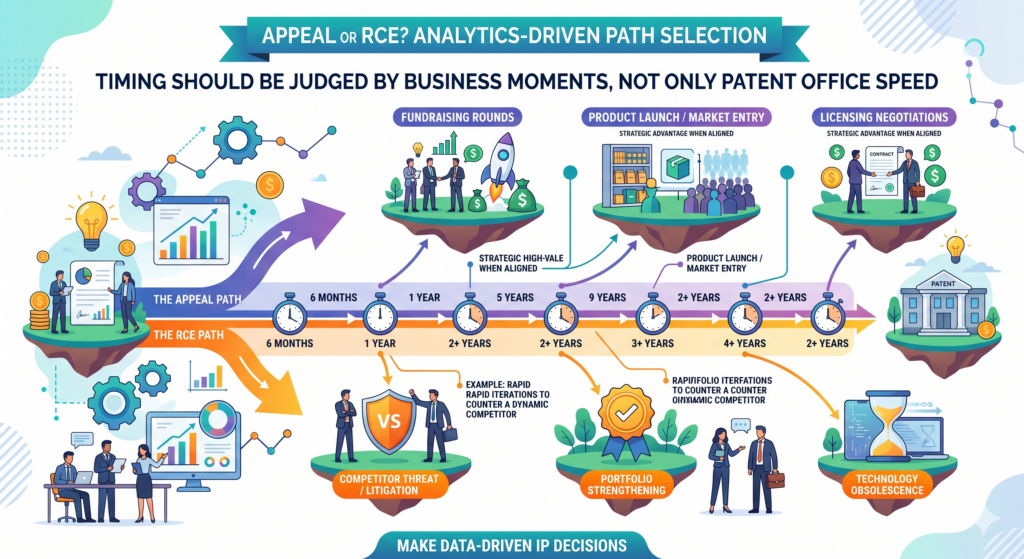
A longer appeal in a core case may be worth it if it protects claim scope that could shape the company’s future. The right time choice depends on the business moment.
Founders should look at the calendar with care. Is the company raising money soon? Is a product launch coming? Is a competitor moving close? Is a partner asking for proof of protection?
Is there a planned sale, license, or enterprise deal? These moments can change the weight of appeal versus RCE.
RCE can help when the company needs forward movement and the claims can still stay strong
If a case has a clear amendment path and the company needs progress, an RCE can be a strong choice. It can keep the case moving with a practical plan. It may help reach allowance faster than a full appeal path, especially if the examiner has shown a real path forward.
But this only works if the claim remains useful. Speed is not a win if it buys a weak patent. The team should still ask whether the amended claim maps to the product and whether it would matter to a competitor.
A fast RCE should not be a panic move. It should be a focused move that fits the company’s timing and keeps the patent valuable.
Appeal can be worth the time when the claim protects a major business edge
Appeal may take longer, but sometimes the wait is justified. If the claim covers a major part of the technology and the rejection is weak, defending that claim may be the smarter long-term move.
This is especially true when the claim could matter in future investor review, licensing talks, or competitive pressure. A stronger claim may create more value than a faster but narrower allowance.
The business question is simple. Would losing this scope hurt the company later? If the answer is yes, appeal should be taken seriously.
This is where founders benefit from clear guidance. You should not have to decode complex patent steps alone. PowerPatent helps teams understand the tradeoffs in plain language, with smart tools and attorney review working together. Learn more here: https://powerpatent.com/how-it-works
PowerPatent helps founders make the path choice with more control and less stress
The appeal-or-RCE decision can feel heavy because it mixes law, engineering, money, and timing.

Old patent processes often make this worse. Founders get long emails, dense legal wording, unclear options, and little insight into what the next move really means.
That is not good enough for modern startups. Deep tech teams need patent work that moves at startup speed. They need to protect hard technical work without losing weeks to confusion.
They need real attorney judgment, but they also need software that makes the process clearer, faster, and easier to manage.
Smart software helps organize the facts before the legal call is made
Good patent strategy starts with good information. What did the examiner say? What claim feature is at issue? What does the old art actually show? What has worked with this examiner before? What amendment options remain? What does the business need right now?
Software can help bring these facts together. It can help teams avoid missed details, scattered notes, and repeated work.
It can make the file easier to understand. It can help founders see the decision in business terms, not just legal terms.
But software alone is not enough. Patent decisions still need judgment. They need someone who can read the record, understand the technology, and guide the path with care.
Attorney oversight turns data into a real strategy
PowerPatent combines smart tools with real patent attorney oversight. That mix matters. The software helps make the process cleaner and more visible.
The attorney review helps make sure the path is sound, the claims matter, and the filing step fits the company’s goals.
This is especially important when deciding between appeal and RCE. Data can show patterns. It can point to risks.
It can reveal whether a case is moving or stuck. But the final choice still needs human judgment tied to the invention and the business.
That is the future of patent work for startups. Not slow. Not confusing. Not built around endless back-and-forth. Built around clarity, speed, and protection that founders can actually understand.
If your team is facing a hard patent decision, PowerPatent can help you turn the file into a clear path forward. Explore how it works here: https://powerpatent.com/how-it-works
The best path is chosen before the response is drafted
Many teams pick a path too late. They start writing a response, then realize they are really arguing the same point again.
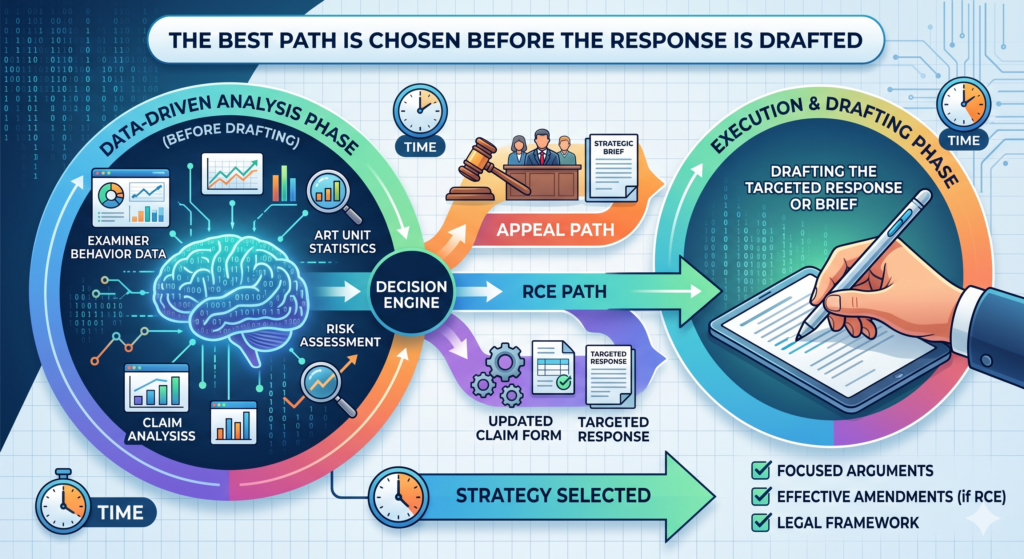
Or they begin preparing an appeal, then notice the claim still has a wording problem that could have been fixed through an RCE. That wastes time.
The better move is to decide the path before drafting begins. The team should first agree on the reason for the next step.
Only then should the response, amendment, pre-appeal request, or appeal brief be built around that reason.
The strategy should come before the paperwork
Paperwork is not strategy. Filing something is not progress by itself. Progress means the case is moving toward a patent that protects something the company cares about.
Before an RCE, the team should know the exact claim change it wants to make and why that change matters.
Before an appeal, the team should know the exact examiner error it wants reviewed and why the claim is worth defending.
This sounds basic, but it prevents a lot of wasted work. Without a clear strategy, the response can become a long document that says many things but moves nothing. With a clear strategy, every sentence has a job.
A strong response should have one main purpose
The next filing should not try to do too much. If the purpose is to amend, then the filing should make the amendment easy to understand.
If the purpose is to appeal, then the filing should make the examiner’s error clear. If the purpose is to set up a future appeal, then the record should be built with care.
This is where founders should ask for plain language. You should be able to understand the main purpose of the filing without reading ten pages.
You do not need every legal detail, but you do need to know what the move is meant to do.
PowerPatent helps make this easier by turning patent work into a clearer process.
Founders can stay close to the key decisions while real patent attorneys handle the legal work with the right context. You can see how that works here: https://powerpatent.com/how-it-works
Conclusion:
Appeal and RCE are not legal chores. They are business choices. The right path depends on the claim, the examiner, the prior art, the case history, and what the patent must do for your startup. When data shows a clear amendment can lead to useful protection, RCE may be smart.
When the claim is ready and the rejection is wrong, appeal may protect more value. Do not guess. Use analytics, clear strategy, and real attorney guidance. PowerPatent helps founders make these calls with confidence: https://powerpatent.com/how-it-works