A patent draft is not something you want to “mostly get right.” One small missing detail can weaken the whole filing. A vague sentence can leave room for copycats. A skipped step can make your invention look smaller than it really is.
Your patent draft should protect the real invention, not just describe the product
A strong patent draft does more than explain what you built. It protects the core idea behind it. That is where many early drafts fall short.
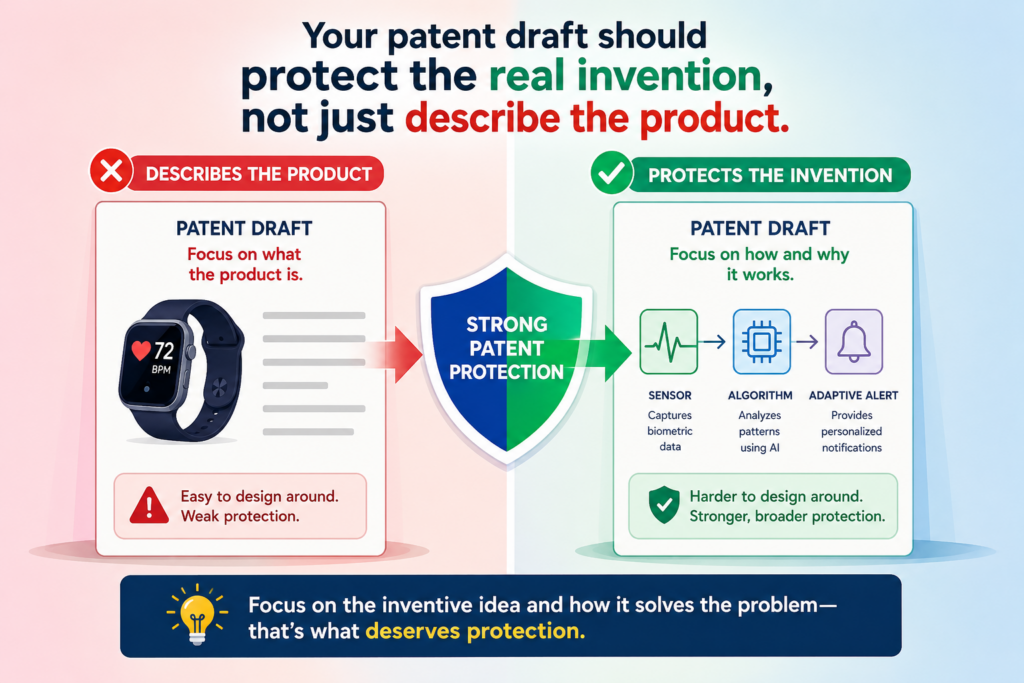
They talk too much about the current product and not enough about the deeper system, method, model, workflow, or technical step that makes the invention valuable.
For a founder, this matters a lot. Your product will change. Your code will change. Your user flow will change. Your model may get better.
Your patent draft should not be trapped inside one version of the product you have today. It should cover the thing that gives your company an edge.
The first review question is simple: what is the invention really doing?
Before you check wording, drawings, or claim style, step back and ask what problem the invention solves.
Then ask what technical move solves that problem. This sounds basic, but it is often the fastest way to find weak spots in a draft.
A draft may say the invention is “an AI platform for document review.” That is too broad to be useful by itself. A better review digs into how the platform works.
Maybe it breaks a draft into sections, finds missing support, checks claim terms against the description, flags drawing mismatches, and suggests fixes before filing. That is closer to the real invention.
A useful draft review starts by separating features from the core idea
Features are what users see. The core idea is what makes the system work. A feature might be a dashboard, a score, a warning message, or a review button. The invention may be the hidden process behind those features.
When you review your patent draft, look for places where the draft only describes the surface. Then add the deeper logic. What inputs are used? What steps happen?
What rules are applied? What output is created? What changes because of that output? These are the details that can turn a nice product summary into a stronger patent draft.
This is also where PowerPatent can help founders move with more control. The platform helps turn technical work into a clearer patent story, while real patent attorneys stay involved to guide the process. You can see the workflow here: https://powerpatent.com/how-it-works
The biggest patent draft errors often hide in the claims
The claims are the part of the patent draft that define what you are trying to protect. They are not just a summary.
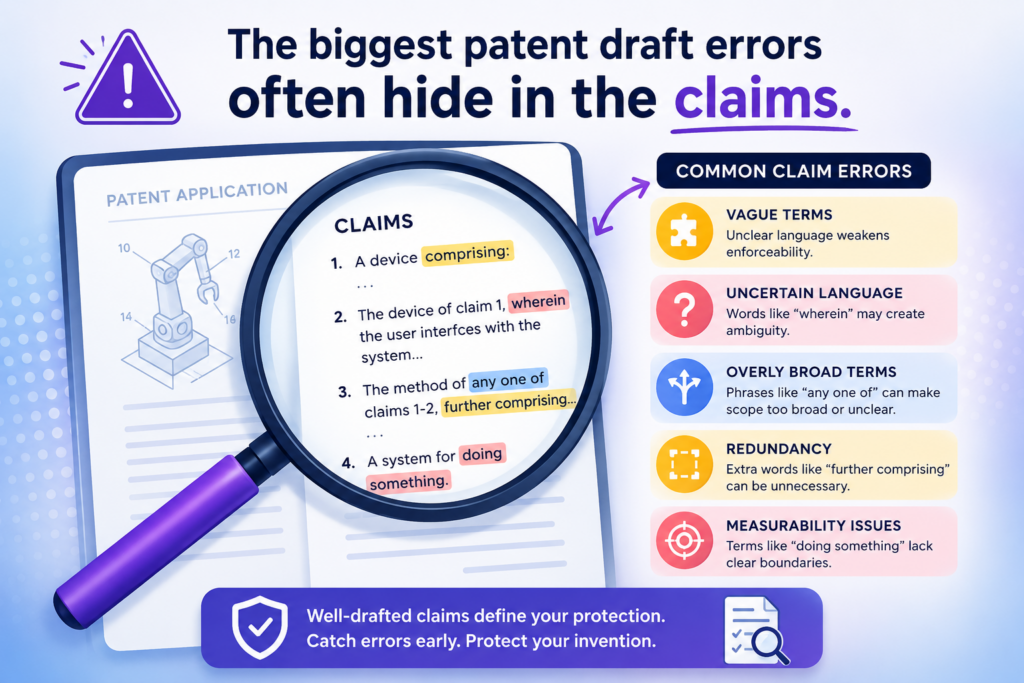
They are the fence around the invention. If the fence is too narrow, competitors may step around it. If the fence is too vague, it may not hold up well.
This is why claim review is one of the most important parts of AI patent draft review. A draft can have a great title, a clear background, and detailed examples, but still fail because the claims do not match the real value of the invention.
Claims should match the technical advantage, not just the product name
A common mistake is writing claims that sound like marketing. They may say the invention “improves review speed” or “creates better patent drafts.”
Those may be true benefits, but the claims need to focus on how the system gets there.
A better claim points to the steps that create the result. For example, the system may compare claim terms with the detailed description, detect terms that lack support, map drawing labels to written parts, and create a review report before filing. That kind of wording gives the draft something real to stand on.
A claim review should test every key word for support
Every important word in a claim should be backed up somewhere in the draft. If a claim says the system “scores risk,” the draft should explain what risk means, how the score is created, what data is used, and how the score helps the user.
If the claim says the system “generates a filing-ready draft,” the draft should explain what checks are done before that output is produced.
This is where AI can be very useful. AI can help scan for terms that appear in the claims but do not appear clearly in the description. It can spot uneven wording. It can flag terms that may need more detail.
But AI alone should not be the final judge. A real patent attorney should still review the draft because claim scope is too important to leave to software alone.
That is the power of using smart software with attorney oversight. You get speed without giving up judgment. PowerPatent is built around that mix, and founders can learn more here: https://powerpatent.com/how-it-works
The description must teach the invention clearly enough to support strong protection
The detailed description is where your draft explains how the invention works. This part should not feel like a vague product page. It should teach the invention in a way that gives the claims support.
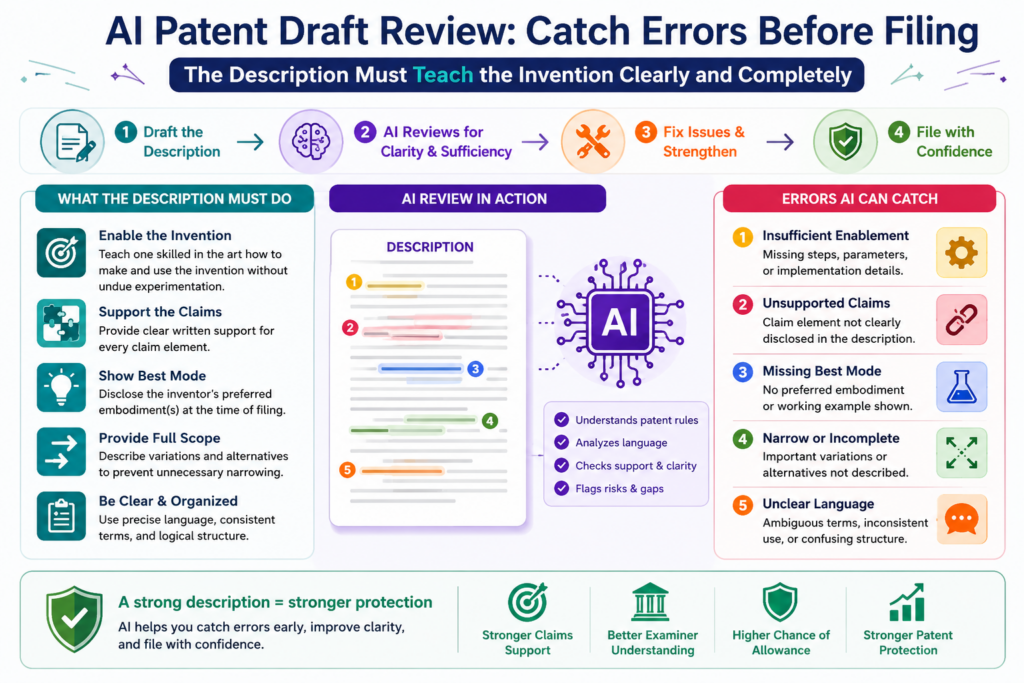
A weak description creates problems later. You may discover that the claims use words the description never explains. You may find that a key step is missing.
You may realize that the draft only shows one narrow example, even though the invention could work in many ways. These gaps can limit what you can safely claim.
A good description explains the system from input to output
When reviewing the description, follow the invention like a path. Start with the input. What data, signal, document, user action, sensor reading, model output, or system event begins the process? Then look at what happens next.
What does the system check, change, compare, rank, train, detect, or create? Finally, look at the output. What does the invention produce, and why does that output matter?
This path should be easy to follow. A reader should not have to guess what happens between steps. If the draft jumps from “the system receives data” to “the system improves the result,” it likely needs more detail.
The useful invention is usually in the middle, where the system makes choices and applies logic.
The description should include more than one way to practice the invention
A strong draft often explains variations. This does not mean stuffing the draft with random ideas. It means showing that the invention is not locked into one exact setup.
For example, an AI patent draft review tool might work with patent claims, technical notes, code comments, model cards, drawings, invention disclosure forms, or prior drafts.
It may run checks before attorney review, during drafting, or right before filing. It may flag errors with a score, a plain-language note, a marked-up draft, or a task list.
These variations help the draft cover the invention with more room. They also make the draft more useful later, because your product may grow in ways you cannot fully predict today.
Founders should pay close attention here. Many startup patent drafts are written too close to the current build. That can feel safe, but it may leave future versions exposed.
PowerPatent helps technical teams capture the invention behind the product, not just the product screen that exists today. The process is shown here: https://powerpatent.com/how-it-works
The draft should remove unclear words before they become filing problems
Unclear words are quiet risks. They may not look dangerous during drafting, but they can create trouble later.
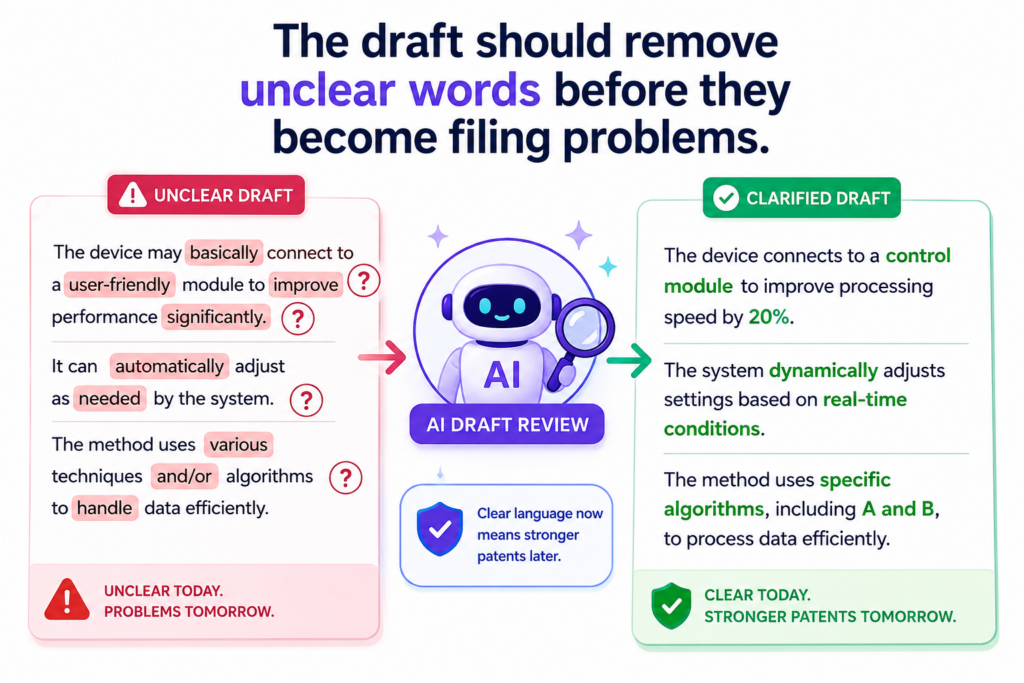
Words like “smart,” “fast,” “secure,” “better,” “optimized,” and “advanced” may sound good in a pitch deck. In a patent draft, they often need more support.
This does not mean you can never use benefit words. It means the draft should explain what those words mean in technical terms.
A patent draft should not simply say the invention is faster. It should explain what step saves time, what work is avoided, what process is changed, or what result is produced with fewer actions.
AI review can help find vague language, but humans must fix the meaning
AI tools are good at spotting patterns. They can find soft words, repeated terms, missing labels, and parts of the draft that sound thin.
This is helpful because founders and engineers often read their own work too quickly. They know what they mean, so they do not notice what the draft fails to say.
But spotting vague language is only the first step. The real work is replacing vague language with clear technical detail. Instead of saying “the system intelligently reviews the draft,” explain what the system checks.
Instead of saying “the platform reduces errors,” explain which errors it detects and what action happens after detection.
Strong wording turns a claim from a promise into a process
A promise says what the invention hopes to achieve. A process explains how it gets there. Patent drafts need process language. That is why review should focus on verbs.
Look for action words in the draft. Does the system receive, compare, map, train, detect, rank, store, update, send, display, or generate something? Those words help show real steps.
They also make the draft easier to review because each step can be checked for support.
For example, “the system improves filing quality” is a promise. “The system compares each claim term with matching passages in the description and flags unsupported terms before filing” is a process.
The second version is stronger because it tells the reader what happens.
This is the kind of cleanup that can save time before filing. It also helps your attorney review the invention faster because the draft is clearer from the start.
PowerPatent was built to help founders get to that clearer draft with less back-and-forth and better oversight. Learn how it works here: https://powerpatent.com/how-it-works
A strong review checks whether the drawings and written text tell the same story
Drawings are not just decoration in a patent draft. They help explain the invention. If the drawings and text do not match, the draft can feel messy or incomplete.
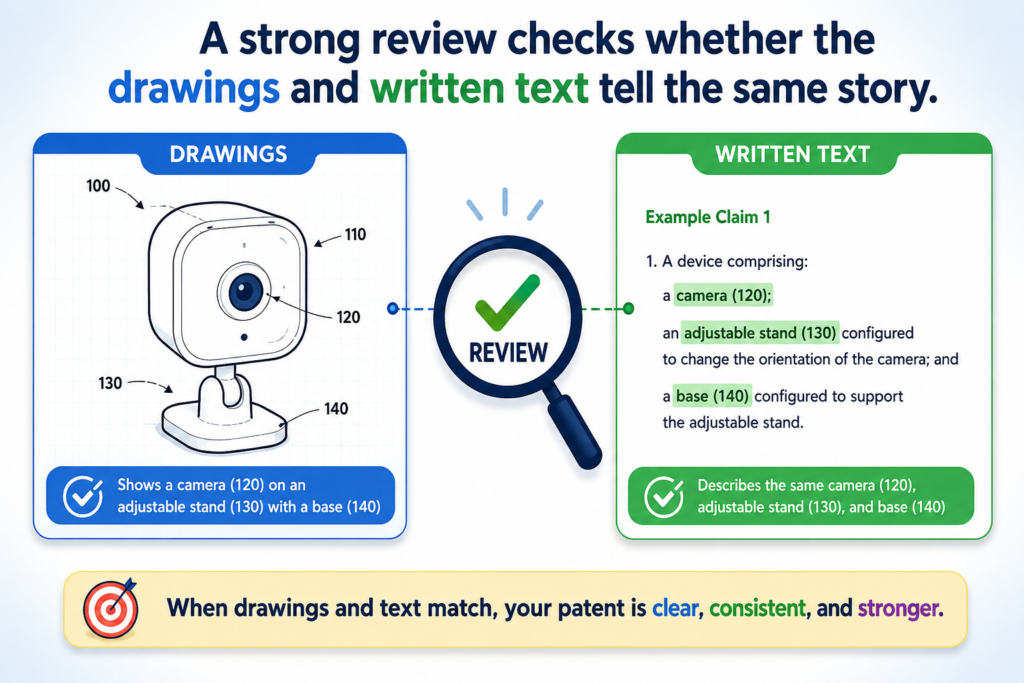
Worse, a mismatch can make an important part of the invention harder to understand.
This is one of the most common places where errors slip through. The written draft may mention a module that is missing from the drawing. The drawing may show a step that the text never explains.
A label may be used in one figure and forgotten in another. These small issues can create confusion at the exact moment when the draft needs to be clear.
Every drawing label should have a home in the description
During review, each figure should be checked against the written text. If the drawing includes a review engine, claim parser, scoring module, database, interface, or output report, the description should explain each one.
The explanation does not have to be long, but it should be clear enough to show what the part does and how it connects to the invention.
This is especially important for software and AI inventions. A box in a diagram may look simple, but it can hide a lot of technical value.
If the box represents a model, a rules engine, a training pipeline, a validation step, or a ranking system, the draft should say so.
Flowcharts need careful review because missing steps can narrow the story
Flowcharts are useful because they show the order of operations. They also expose gaps. If a flowchart jumps from receiving a patent draft to generating a final review report, the review should ask what happened in between.
A better flowchart may show parsing the draft, identifying claim terms, checking description support, comparing figure labels, detecting inconsistent terms, and creating a risk output.
Each step adds clarity. Each step also gives the draft more support.
This does not mean every possible step must be shown in one drawing. It means the drawings should help the reader understand the invention, not force the reader to guess.
A good AI patent draft review should test drawings and text together, because they work as one story.
Before filing, the draft should be tested against real copycat behavior
A patent draft should not only describe your invention. It should help protect you from the ways others may copy it.
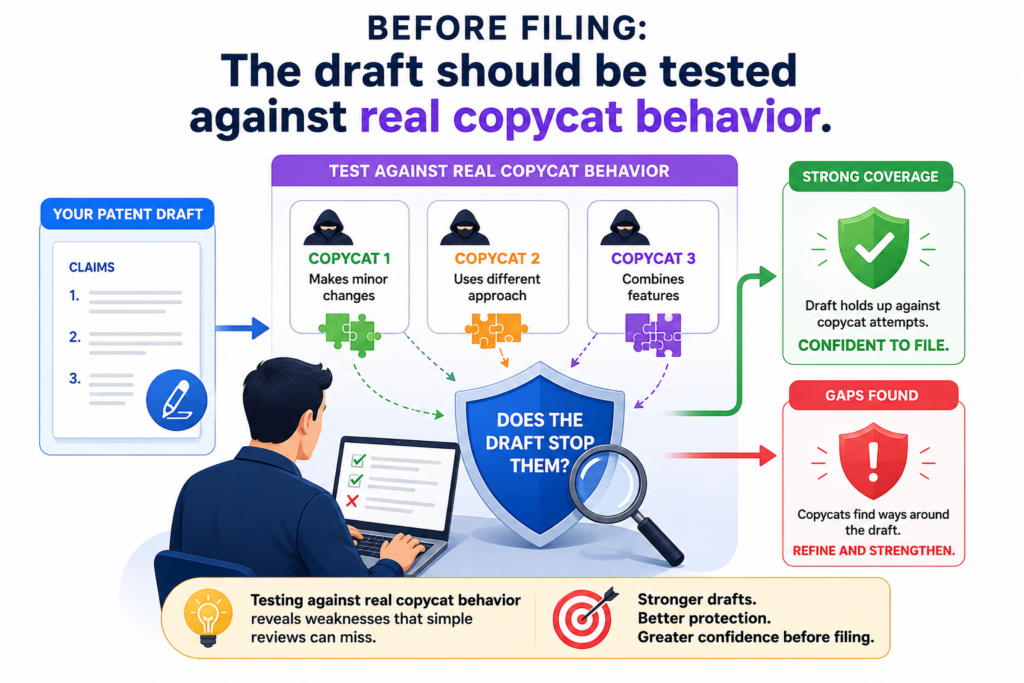
That is why one powerful review method is to ask how a competitor might work around the draft.
This is not about fear. It is about clear thinking. If someone wanted to build a similar tool, what part would they copy? Would they copy the review engine? The model pipeline? The claim support check?
The way the system flags risk? The way attorney review is built into the workflow? These questions help show whether the draft protects the real value.
Workaround testing helps you find claims that are too narrow
A claim may sound strong until you test it. For example, a claim may require a specific interface, a specific report format, or a specific sequence of steps.
If a competitor can avoid one detail and still copy the main idea, the claim may be too narrow.
This is where draft review should be practical. Read the claim and ask whether the invention still works if one part changes. Could the system use a different type of model? Could it create a warning instead of a score?
Could it review draft sections in a different order? Could it run inside a patent platform instead of a separate tool?
A filing draft should protect the business value, not just the demo
Startups often file too close to the demo because that is what feels real. But the business value may be broader than the demo.
The review should look at what customers will pay for, what competitors may copy, and what technical system makes the product hard to replace.
For AI patent draft review, the value may not be one screen. It may be the full loop: collecting invention details, creating draft content, checking for errors, routing issues to attorney review, and improving the filing package before submission.
That is the kind of story a stronger patent draft should capture. It should protect the engine, not just the paint on the car.
PowerPatent helps founders think through this earlier, so the draft is not just filed fast but filed with more confidence.
See how PowerPatent helps turn technical work into stronger patents here: https://powerpatent.com/how-it-works
The review should prove that every claim has enough support in the draft
A patent claim should never feel like it came out of nowhere. Each claim needs roots in the rest of the draft.
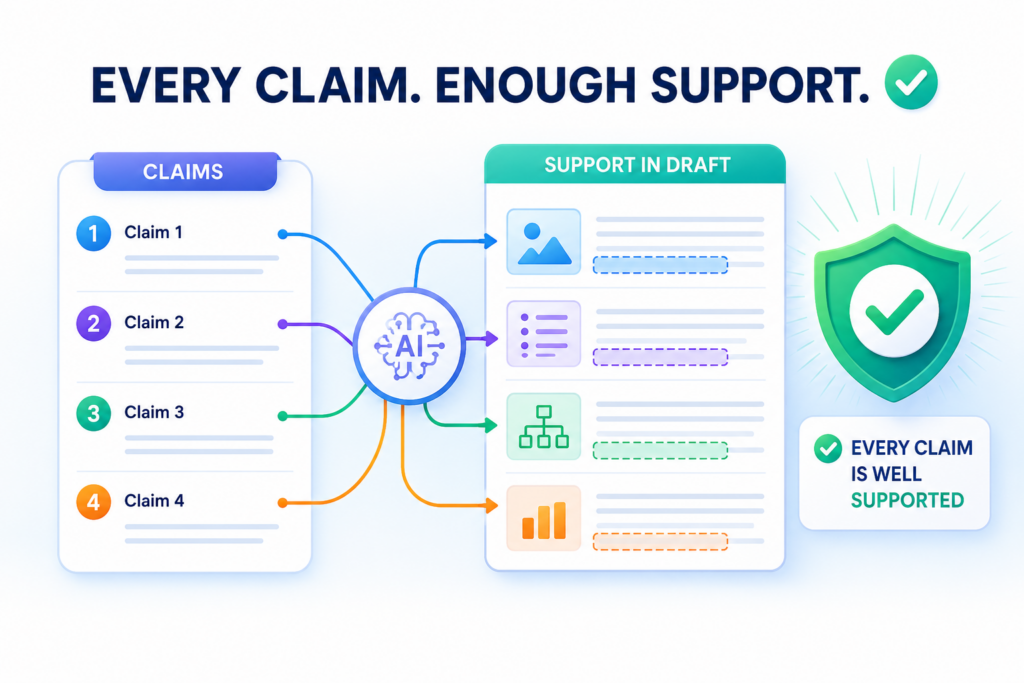
If the claim says the invention does something, the description should explain how it does that thing. If the claim names a part, the drawings or written text should make that part clear.
This is one of the most useful checks before filing. It is also one of the easiest checks to miss when a team is moving fast.
Founders often focus on whether the draft “sounds right.” But a stronger question is whether each claim is fully backed by the draft.
Claim support is what helps the draft hold together when it matters
Think of the patent draft like a bridge. The claims are the top of the bridge. The description, drawings, examples, and technical details are the supports under it.
If the supports are weak, the bridge may look fine from far away, but it may not carry much weight.
When you review a draft, take one claim at a time. Read every key term. Then look for that same idea in the detailed description. Do not only look for the exact same word.
Look for a clear explanation of the concept. The draft should show what the part is, what it does, how it connects to other parts, and why it helps solve the problem.
A support check should find both missing terms and thin explanations
A missing term is easy to spot. The claim says “review confidence score,” but the description never explains a score. That is a clear gap. A thin explanation is more subtle.
The description may mention the score once, but never explain how it is created, what inputs it uses, or how the system responds to it.
Thin support can be dangerous because it creates a false sense of safety. The draft looks like it covered the idea, but it did not teach it well. Before filing, the review should turn thin spots into useful detail.
For an AI patent draft review tool, this may mean explaining how the system finds claim terms, checks the description, compares drawing labels, detects missing steps, and sends flagged issues for attorney review.
The more clearly the draft teaches the invention, the easier it is to trust the filing package.
PowerPatent helps founders build this kind of support into the process instead of trying to fix it at the last minute.
The goal is simple: move fast, but do not file blind. You can see how the platform works here: https://powerpatent.com/how-it-works
The draft should make the AI role clear without overclaiming what the AI can do
AI can be part of an invention, but the draft must explain the AI in plain, real terms. It should not use the word “AI” as a magic label.
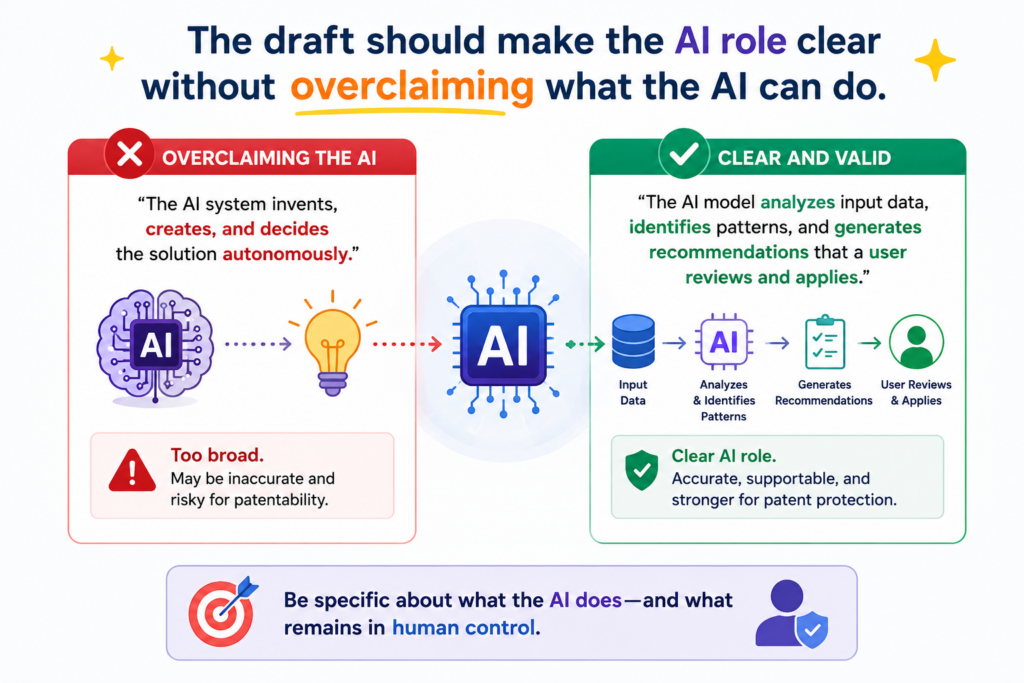
A patent draft should show what the AI receives, what it looks for, what output it creates, and how that output is used.
This matters because many weak drafts treat AI like a black box. They say the system uses AI to review a patent draft, but they do not explain what the AI review includes. That is not enough for a strong filing. The draft needs to show the work.
A good AI section explains the data, the model, and the result
When reviewing an AI patent draft, look for the data first. What does the system use as input?
It may use an invention note, a claim set, a written description, drawings, user comments, code files, model outputs, or attorney edits. The draft should not leave this vague.
Next, look at what the AI does with that input. Does it classify text? Does it find missing support? Does it compare terms?
Does it rank risk? Does it suggest changes? Does it learn from past review results? Each action should be described in simple but useful terms.
Then look at the output. The output may be a warning, a markup, a score, a draft change, a report, or a task for attorney review. The draft should explain how that output improves the process before filing.
The best AI patent draft review does not pretend software replaces judgment
This point is important. AI can help find issues faster, but AI should not be framed as the only safeguard.
For patent work, human review still matters. A real patent attorney can judge claim scope, strategy, risk, and filing choices in ways software alone should not handle.
That is why the best story is not “AI does everything.” The stronger story is that smart software finds issues early and attorney oversight helps guide the final draft. This makes the process faster without making it careless.
PowerPatent is built around that balance. Founders can use modern tools to move with speed, while real patent attorneys stay involved where judgment matters.
That combination can help teams avoid weak filings, missed details, and slow back-and-forth. Learn more here: https://powerpatent.com/how-it-works
The review should catch terms that change meaning across the draft
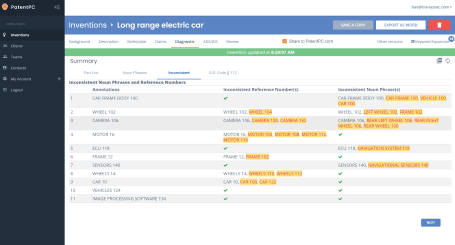
One quiet problem in patent drafts is word drift. This happens when the draft uses different words for the same thing, or uses the same word to mean different things. It may seem small, but it can make the invention harder to understand.
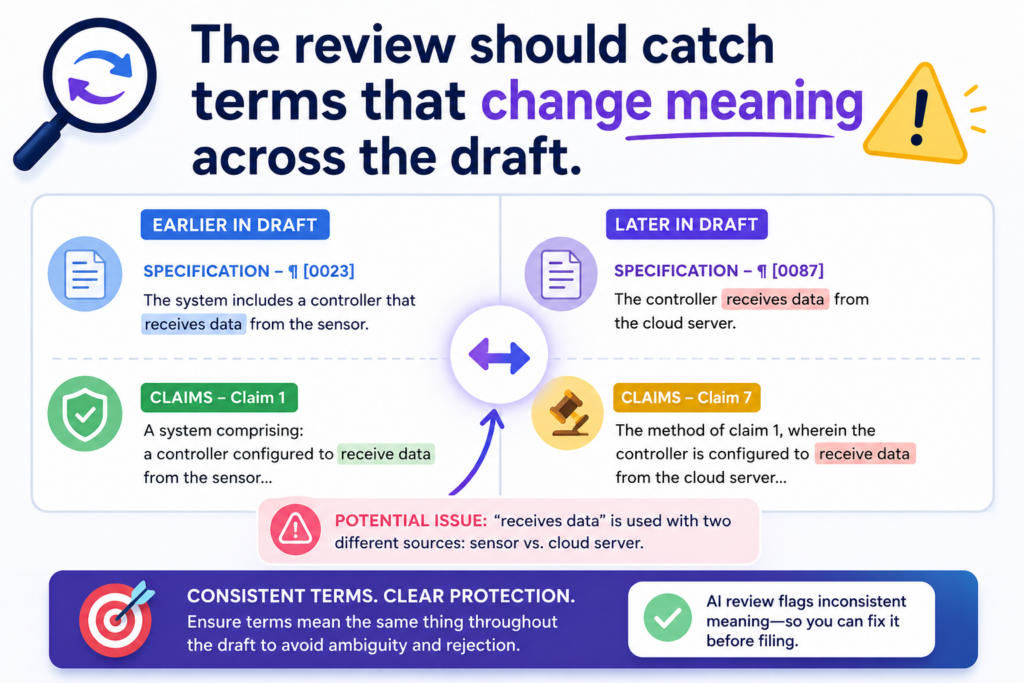
For example, a draft may use “review module,” “analysis engine,” “draft checker,” and “validation system” for what appears to be the same part. That may be fine if each one is different.
But if they all mean the same thing, the draft may confuse the reader. Clear words help the draft feel tighter and more reliable.
Consistent terms make the invention easier to protect
During review, pick the main parts of the invention and track how they are named. If the system has a claim parser, call it that throughout the draft unless there is a reason to use a different term.
If the draft uses a support checker, a risk scoring module, or an attorney review interface, keep those names steady.
This does not mean the draft must sound robotic. It means key technical parts should not change names by accident.
A founder may not care whether the draft says “engine” or “module,” but those words can matter when someone later reads the filing closely.
AI can quickly flag term drift before it becomes a bigger issue
This is one place where AI review is very helpful. AI can scan the full draft and find terms that may refer to the same part.
It can also find claim words that do not match the description, drawing labels that are named differently, and steps that appear in one place but not another.
But again, AI should not make the final call alone. Sometimes different terms are used on purpose because the parts are different. A review tool can flag the issue, but a person should decide whether the wording needs to change.
A good pre-filing review does not try to make the draft pretty. It tries to make the draft clear.
Clear terms make it easier to understand the invention, easier to review the claims, and easier to avoid mistakes before filing. That is the kind of practical cleanup that saves founders real time.
The review should test whether the draft covers future versions of the product
Your first product version is not your final product. That is true for almost every startup.
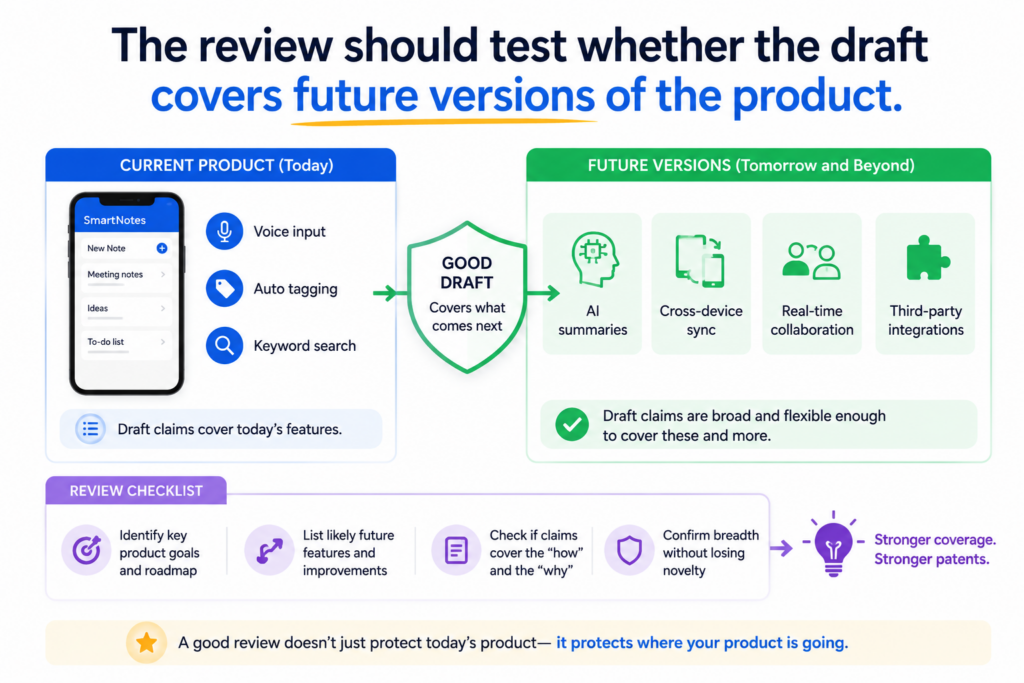
You may change the interface, shift the workflow, improve the model, add new inputs, support new use cases, or move into a different market. Your patent draft should be written with that growth in mind.
This does not mean guessing wildly. It means protecting the invention in a way that is not trapped inside today’s build. If the draft only covers one narrow version, you may regret it later when your own product changes.
A future-proof review looks for needless limits in the draft
Needless limits are details that do not need to be required. For example, the draft may say the review report is shown on a web dashboard.
But what if the system later sends the report by email, exports it into a patent drafting tool, or displays it inside a project workspace? If the dashboard is not central to the invention, the draft should not make it sound required everywhere.
The same issue can happen with AI models. A draft may focus on one model type, one training method, one data source, or one review order.
If those details are only examples, the draft should say so in a clear way. The invention may be broader than that one setup.
Strong drafts explain examples without getting stuck inside them
Examples are useful. They make the invention real. But examples should not become accidental limits. A good review asks whether each example is framed as one way to do the invention, not the only way.
For AI patent draft review, the system might review claims first in one version. In another version, it may start with drawings. In another, it may first read an invention disclosure and then compare it with the draft.
The core idea may still be the same: catching filing errors before submission by checking the draft against technical and legal review signals.
This kind of thinking matters for founders because the company’s value may grow faster than the first draft. A stronger filing should leave room for that growth.
PowerPatent helps teams capture the core invention while still moving quickly, so they are not stuck choosing between speed and quality. See how it works here: https://powerpatent.com/how-it-works
The draft should explain why the invention is technically useful
A patent draft should not read like a sales page. But it still needs to show why the invention matters. The key is to explain the value in technical terms, not hype.
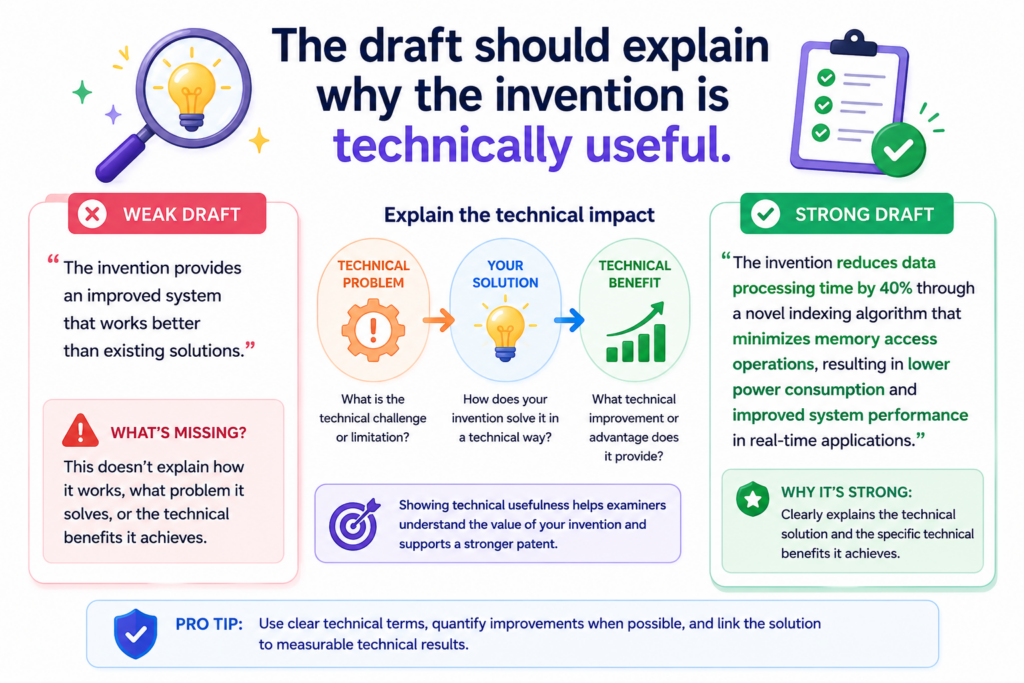
Saying “the invention is powerful” does not help much. Saying “the system detects unsupported claim terms before filing by comparing each claim term against the written description” is far better. It shows a real technical action and a useful result.
The review should connect each benefit to a concrete step
When reviewing the draft, look at every benefit statement. If the draft says the invention reduces filing errors, ask which errors it reduces.
If it says the invention improves draft quality, ask what quality check is performed. If it says the system saves time, ask which manual step is shortened or avoided.
This keeps the draft grounded. It also makes the invention easier to understand for people who were not in the room when the product was built. A good draft should not depend on hidden context. It should stand on its own.
Technical usefulness should sound clear, not inflated
Founders sometimes feel pressure to make the invention sound bigger by using fancy words. That usually makes the draft worse. Simple, exact language is stronger.
For example, the draft could explain that the system helps detect missing support, mismatched drawing labels, unclear claim terms, inconsistent part names, and incomplete process steps before filing. That is plain language, but it is also useful. It shows real checks that matter.
This is where AI review and attorney review can work well together. AI can help surface the issues. The attorney can help decide which ones matter most and how they should be handled before filing.
That mix helps the founder avoid two bad paths: filing a weak draft too fast or getting stuck in a slow process with no clear control.
PowerPatent gives founders a smarter path. It helps turn technical ideas into stronger patent filings with software speed and attorney care. You can explore the process here: https://powerpatent.com/how-it-works
The review should check whether the draft explains the problem in a useful way
A patent draft does not need a long story about the market. It does not need to sound dramatic. But it should explain the problem clearly enough so the invention makes sense. When the problem is vague, the solution can feel vague too.
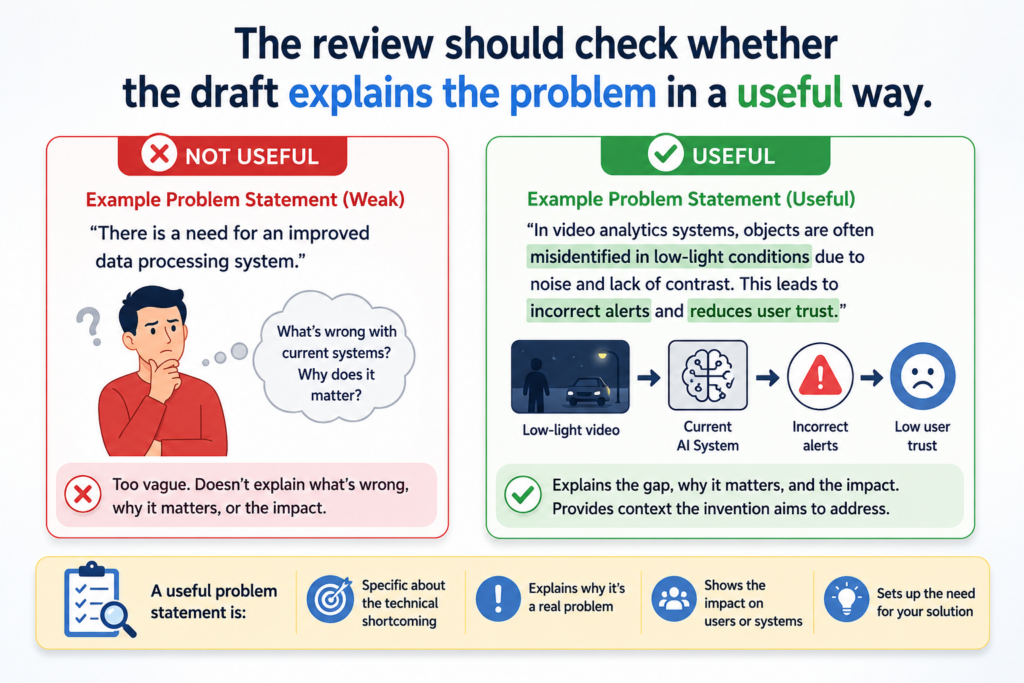
For AI patent draft review, the problem is not just that patent drafting is slow. The deeper problem is that many errors are hard to see before filing.
A draft may look clean on the surface while still missing claim support, using uneven terms, skipping key process steps, or showing drawings that do not match the text.
The problem section should point to real draft failures, not broad pain
A weak draft may say that patent filing is complex and expensive. That may be true, but it is too general. A stronger draft explains the kind of errors that happen during drafting and why they matter.
For example, a startup team may describe an AI invention in detail but forget to tie that detail to the claims. Or the claims may use terms that never appear in the description.
Or the drawings may show a system part that the text never explains. These are real pre-filing problems. They give the invention a clear reason to exist.
When you review the draft, ask whether the problem helps the reader understand why the invention is needed. The problem should lead naturally into the solution. It should not feel like a pasted-in background section.
A clear problem makes the technical solution easier to trust
When the problem is clear, the invention becomes easier to follow. The reader can see why the system checks claim terms, compares draft sections, flags missing details, and routes certain issues for attorney review. The review steps no longer feel random. They feel tied to a real need.
This also helps the founder. A clear problem statement forces the team to explain what the invention actually improves.
That can reveal missing details before filing. It can also help the attorney understand the point of the invention faster.
PowerPatent helps founders build this clarity into the patent process without slowing everything down. The goal is not to make patent work feel bigger than it is.
The goal is to make the invention clear, complete, and ready for real review. See how the process works here: https://powerpatent.com/how-it-works
The review should find places where the draft assumes too much knowledge
Founders and engineers often know their invention so well that they skip steps without noticing.
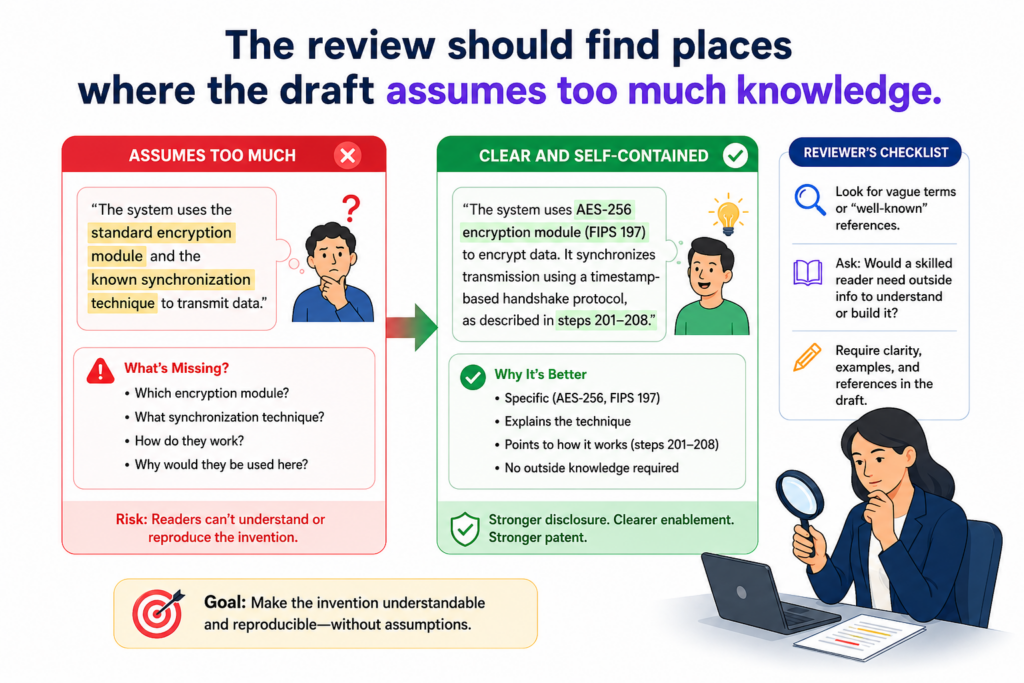
They may write “the model validates the output” and assume everyone knows what that means. But a patent draft should not depend on what is inside the founder’s head.
This is a common draft problem. The team understands the system. The attorney may understand it after a call. But the written draft still needs to teach the invention on its own.
A useful review reads the draft like an informed outsider
One of the best ways to review a patent draft is to read it as if you did not build the product.
Ask what each part does. Ask where each input comes from. Ask what happens when the system finds a problem. Ask what changes after the output is created.
If the answer is not in the draft, that is a gap. The fix is not to make the draft longer for no reason. The fix is to add the missing link.
For example, if the draft says the system “detects unsupported claims,” it should explain how that detection works at a useful level. Does it compare claim terms to text passages?
Does it look for missing definitions? Does it check whether each claimed step appears in the description? Does it flag claim language that has no matching example? These details matter.
The best review questions are simple and direct
A founder does not need to become a patent expert to find many of these gaps. Simple questions work very well.
What goes in? What happens next? What does the system check? What does it create? Who sees the result? What action happens after the result?
These questions can expose missing logic fast. They also make the draft more useful for attorney review because the attorney is no longer forced to guess how the system works.
This is one reason PowerPatent is helpful for technical teams. It gives founders a better way to turn engineering work into patent-ready material, while real attorneys help shape the final filing.
That means less confusion, fewer blind spots, and a faster path from invention to protection. Learn more here: https://powerpatent.com/how-it-works
The review should make sure the examples are doing real work
Examples are not filler. In a strong patent draft, examples help support the claims and explain how the invention can be used. They make the invention easier to understand and harder to misread.
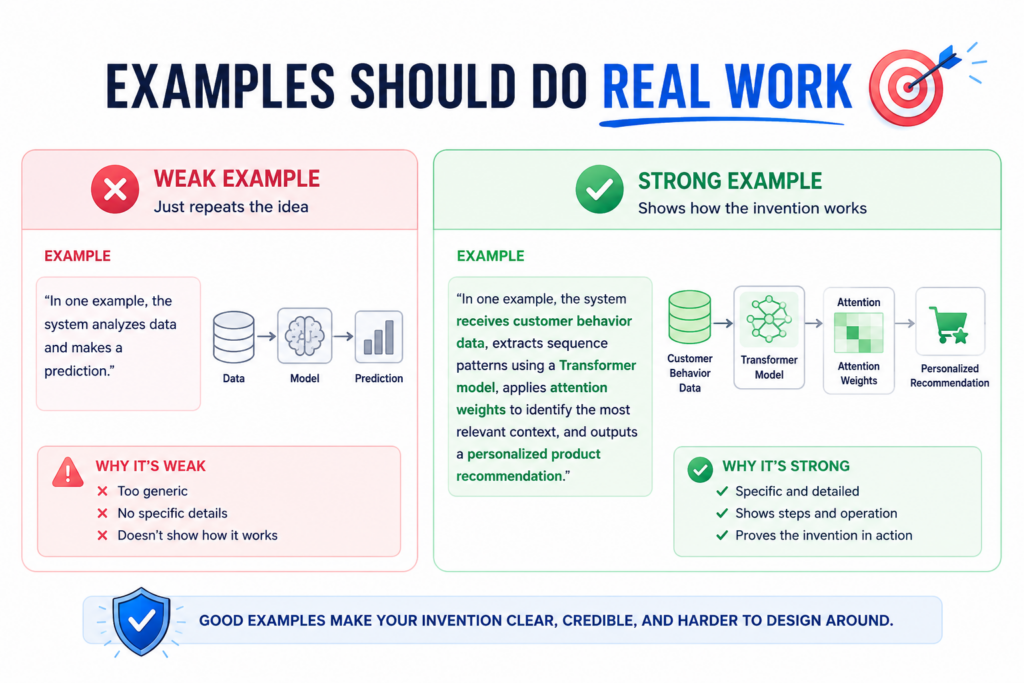
But not all examples are useful. Some examples only repeat the main idea without adding detail.
Others are too narrow and make the invention look smaller than it is. A good review checks whether each example adds real value.
A strong example shows the invention in action
For an AI patent draft review tool, a useful example might show a draft being checked before filing.
The system receives a claim set and a written description. It identifies claim terms that need support. It compares those terms against the description.
It finds that one claim term has no clear match. It creates a warning and shows the user where support may be missing. Then the issue is sent for attorney review or fixed before filing.
That example is useful because it shows a full path. It does not simply say the tool checks the draft. It shows what the tool checks, what it finds, and what happens next.
When reviewing your own draft, look at each example and ask whether it teaches something new. If an example only repeats the claim in softer words, it may need more detail.
Examples should cover meaningful variations without turning into a long catalog
The best examples show different angles of the invention. One example may focus on claim support.
Another may focus on drawing label mismatches. Another may focus on inconsistent terms. Another may show how AI flags risk and an attorney makes the final decision.
This does not mean the draft should list every possible use case. Too many shallow examples can make the draft harder to read. The goal is to choose examples that protect the core invention and show useful variations.
For founders, examples are a good place to capture the future of the product. You may not have built every version yet, but you may know where the invention can go. A smart draft can explain those paths in a grounded way.
PowerPatent helps founders capture these details while the invention is still fresh.
That matters because the best examples often come from the people building the technology, not from someone guessing after the fact. See how PowerPatent helps here: https://powerpatent.com/how-it-works
The review should check whether the draft handles human review the right way
AI can catch many draft issues, but patent filing still needs human judgment. A strong patent draft should explain the role of human review clearly when that role is part of the invention or workflow.
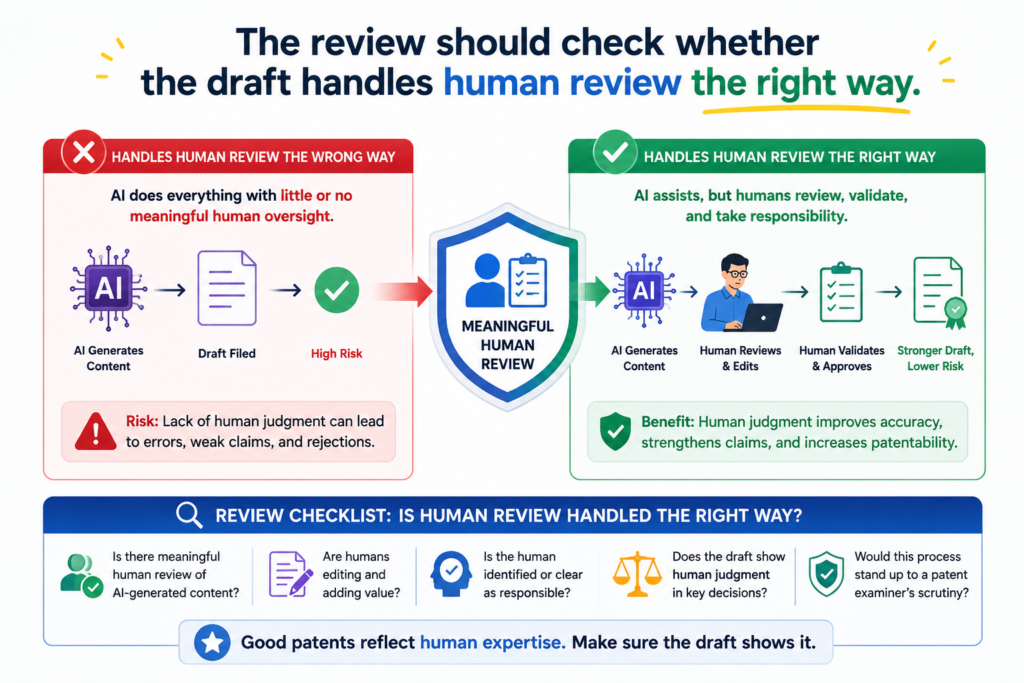
This is especially important when the invention involves AI review before filing.
The draft should not make the system sound careless by suggesting that software alone decides everything. It should explain how the system helps people make better decisions faster.
Attorney oversight can be part of a stronger and safer workflow
In many patent workflows, AI is most helpful when it finds issues early. It can flag unclear claim terms, missing support, mismatched drawing labels, and possible gaps in the description.
Then a trained reviewer or attorney can decide what should be changed before filing.
That handoff is important. The draft should explain how flagged issues are shown, stored, ranked, routed, or resolved. It should make clear whether the AI output is a suggestion, a warning, a score, a task, or a draft edit.
This kind of detail helps avoid confusion. It also makes the invention feel more real because it shows how the system works in practice.
A good workflow explains what happens after an issue is found
Many drafts explain detection but forget resolution. They say the system finds an error, then move on. That leaves a gap. What happens after the error is found?
Maybe the system highlights the missing support. Maybe it suggests where the support should be added.
Maybe it creates a task for attorney review. Maybe it blocks final filing until a key issue is cleared. Maybe it stores a review history so the team can see what changed.
These details matter because the value is not only in finding the issue. The value is in helping the team fix the issue before filing. That is where founders save time and avoid avoidable mistakes.
PowerPatent is built on this practical view. Smart software helps speed up the work, and real patent attorneys help guide the final result.
Founders do not have to choose between moving fast and getting thoughtful review. They can start here: https://powerpatent.com/how-it-works
The review should remove anything that sounds impressive but says nothing
Patent drafts should be clear, not flashy. When a draft uses big words without clear meaning, it becomes weaker. Fancy language can hide missing detail. It can also make the invention harder to understand.
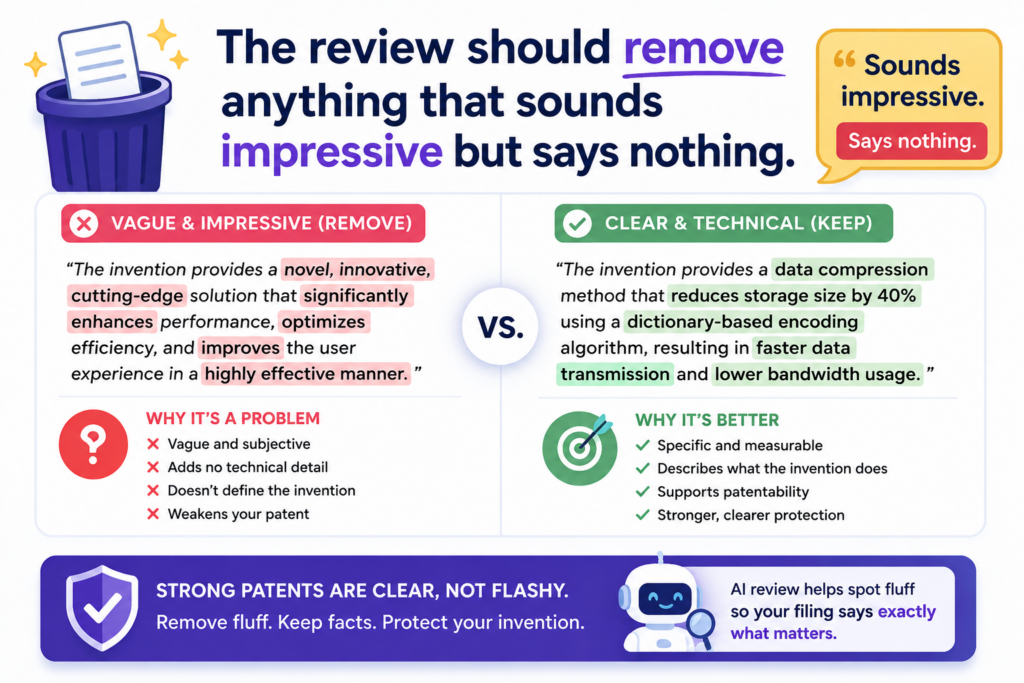
This is a serious issue in AI-related drafts. People often use phrases like “intelligent automation,” “advanced optimization,” “smart analysis,” or “next-generation review.” These phrases may sound strong, but they do not explain the invention.
Strong patent language is plain, exact, and tied to action
A better draft says what the system does. It receives a draft. It parses the claims. It identifies key terms.
It checks those terms against the description. It compares figure labels with written parts. It flags gaps. It creates a report. It sends selected issues for attorney review.
That kind of language is not flashy, but it is useful. It gives the draft structure. It helps the reader follow the invention. It also makes it easier to check whether the claims have support.
When reviewing the draft, look for sentences that sound good but do not teach anything. Then replace them with real steps, real inputs, real outputs, and real checks.
The cleanup should make the draft easier to file, not just easier to read
This is not only a writing exercise. Clear words can reduce confusion during review. They can help the attorney spot the key invention faster.
They can help the team see whether the claims match the product. They can also reveal missing pieces before filing.
For a startup, that matters. Every extra round of confusion costs time. Every weak draft increases risk. Every unclear term makes the filing less useful than it could be.
PowerPatent helps founders avoid that slow, messy path. It gives technical teams a way to move from invention to draft to attorney-guided filing with more speed and less guesswork. To see how it works, visit https://powerpatent.com/how-it-works
The review should check whether the draft explains the invention from more than one angle
A strong patent draft should not explain the invention in only one way. It should help the reader understand the system as a whole, the method it follows, the parts it uses, and the result it creates.
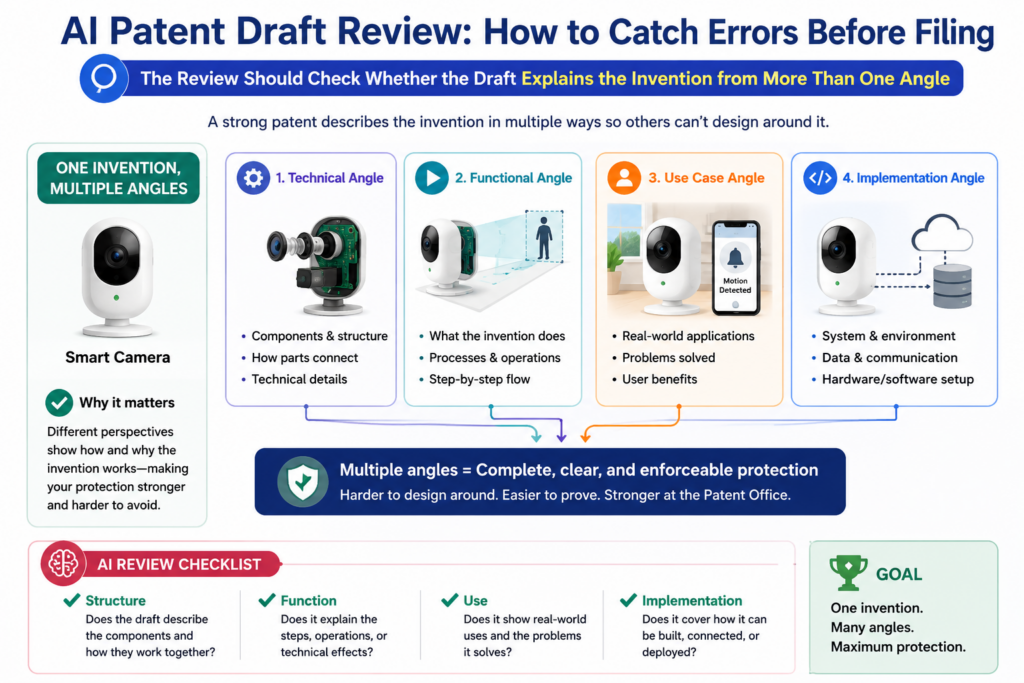
When the draft only explains one angle, it may leave useful protection on the table.
This is a common issue with startup patent drafts. The team may describe the product as a system because that is how the product is built.
But the real invention may also be a method, a workflow, a data process, or a way of using AI to catch errors before filing. If the draft misses those angles, the claims may be too narrow.
The same invention may need system, method, and workflow support
For AI patent draft review, the system angle may describe servers, models, databases, user screens, and review engines.
The method angle may describe the steps of receiving a draft, checking claims, comparing sections, flagging issues, and creating a report.
The workflow angle may describe how a founder, engineer, AI tool, and patent attorney work together before filing.
Each angle can add useful support. The system shows what parts are involved. The method shows what happens.
The workflow shows how the output helps real people make better filing decisions.
When reviewing the draft, look for missing angles. If the draft only talks about a user interface, it may need more detail about the hidden process.
If it only talks about AI scoring, it may need more detail about what happens after the score is shown. If it only talks about attorney review, it may need more detail about how software prepares the draft for that review.
A multi-angle review helps protect the invention beyond one product screen
Founders should care about this because product screens change fast. A patent draft that depends too much on one screen may not age well.
The same invention may later run inside a different tool, appear in a different dashboard, or work behind the scenes with no visible screen at all.
A strong review asks whether the draft would still make sense if the interface changed. It asks whether the method is clear without the exact product layout.
It asks whether the system can be understood even if the company later changes its tech stack.
This is where PowerPatent can help teams avoid filing a draft that is too tied to the first build.
The platform helps founders turn technical ideas into clearer filing material, while real patent attorneys help shape the final result. See how it works here: https://powerpatent.com/how-it-works
The review should make sure the claims are not trying to cover too many unrelated ideas
A patent draft can be weak because it says too little. It can also be weak because it tries to say too much at once.
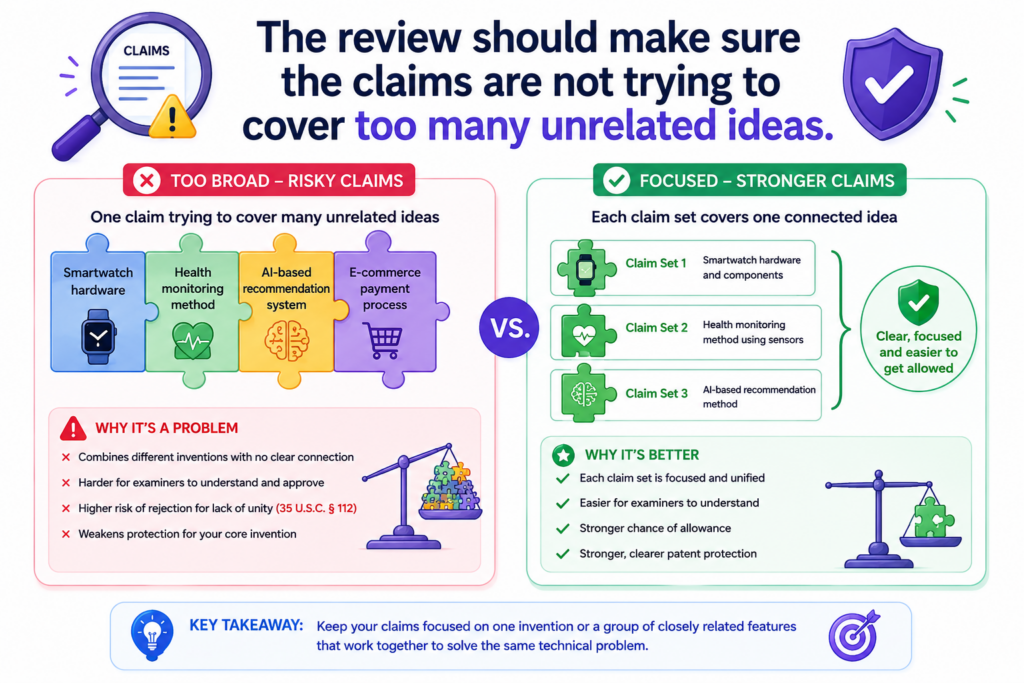
When the draft mixes many inventions together without a clear center, the claims can feel scattered. That makes review harder and can create confusion before filing.
Founders often do this because their product has many good ideas. That is understandable.
A startup product may include data intake, AI review, claim checking, attorney routing, customer dashboards, risk scoring, version control, and filing support. But not every useful feature is always the same invention.
A focused draft gives the main invention a stronger path
The review should ask what the main invention is in this filing. For example, is the main invention an AI engine that finds patent draft errors?
Is it a workflow that routes draft risks to attorney review? Is it a system that checks claim support against the detailed description? Is it a way to compare drawings with text before filing?
Any of these may be valuable. But the draft should not blur them together so much that none of them feels clear. A good patent draft can include related parts, but it should still have a strong center.
This does not mean cutting out every extra idea. It means organizing the draft so the main idea leads, and the related ideas support it.
The claims should not feel like a pile of features. They should feel like a clear protection plan.
A scattered claim set can hide the strongest invention in the middle
One sign of a scattered draft is that the most important idea appears only once, buried deep in the description.
Another sign is that the claims jump between different goals without showing how they connect. Another is that the draft reads like a full product manual instead of a focused invention story.
During review, look for the sentence that best explains the invention.
Then check whether the claims, drawings, examples, and description all support that same idea. If they do not, the draft may need to be tightened before filing.
PowerPatent helps founders keep this focus while still moving quickly. You can capture the full technical story, then work with attorney oversight to shape it into a stronger filing.
That is much better than filing a loose draft just because the team is in a rush. Learn more here: https://powerpatent.com/how-it-works
The review should check whether the draft has enough detail about data handling
Many AI inventions rise or fall on data. What data comes in? How is it cleaned? How is it split? How is it checked?
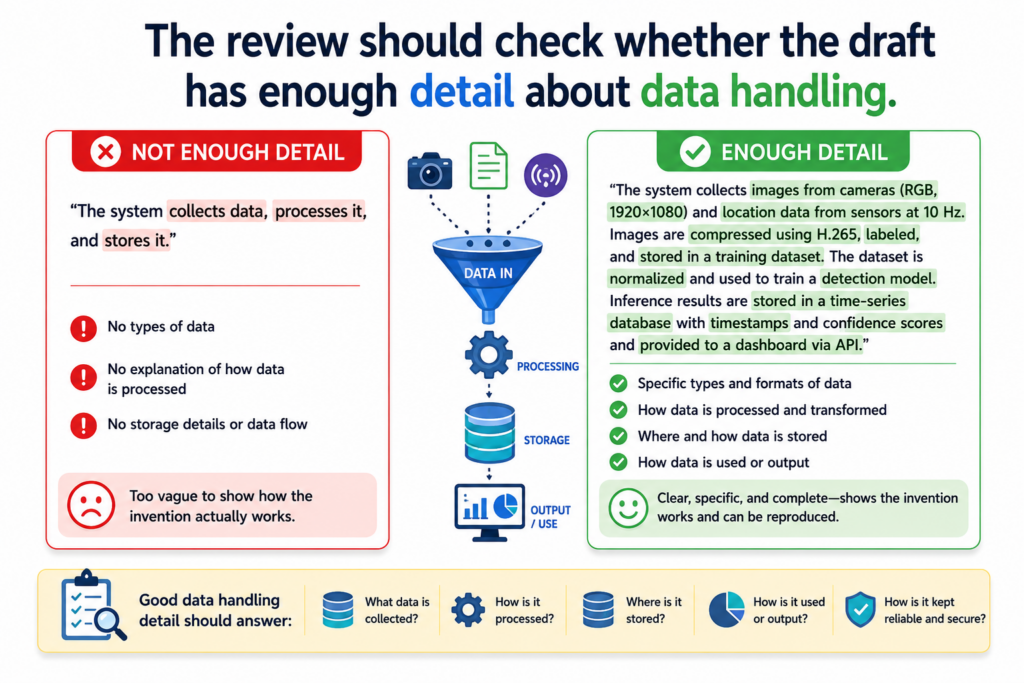
How is it used by the model or review engine? What data comes out? If the patent draft skips these details, the AI part may feel thin.
This is very important for AI patent draft review. The invention may depend on comparing different kinds of text, such as claims, descriptions, figure labels, prior drafts, attorney comments, invention notes, and filing checklists.
If the draft does not explain these inputs clearly, the review process may feel vague.
Data details help show how the AI review actually works
A good draft should explain the draft content the system receives and how that content is handled. For example, the system may break the patent draft into sections.
It may identify claims, claim terms, drawing labels, reference numbers, headings, and examples.
It may map terms from one section to another. It may store review results with a draft version. It may compare a newer draft with an older one.
These details make the invention more real. They show that the AI review is not just a broad idea. It is a set of steps that uses specific information to catch specific issues.
When reviewing the draft, ask whether the data path is visible. A reader should be able to follow the data from intake to output.
The draft does not need to reveal private code or trade secrets, but it should explain the process well enough to support the invention.
Missing data details can make strong technology look weak on paper
A startup may have a powerful AI system, but the patent draft may not show it. This often happens when the draft says “the system analyzes the draft” without explaining what analysis means. That phrase may feel fine during a quick read, but it is not enough.
A stronger version explains that the system identifies claim terms, searches for matching support in the description, checks whether each drawing label appears in the text, detects inconsistent names for the same part, and ranks issues based on filing risk. That is still simple language, but it gives the draft real technical weight.
PowerPatent is made for this kind of founder problem. Engineers have the details, but those details need to be captured in a patent-friendly way.
Smart software helps pull the story together, and real attorney oversight helps make it filing-ready. See the process here: https://powerpatent.com/how-it-works
The review should test whether the draft can survive product changes after filing
A patent draft is filed at one point in time, but your company keeps moving. That creates a real risk.
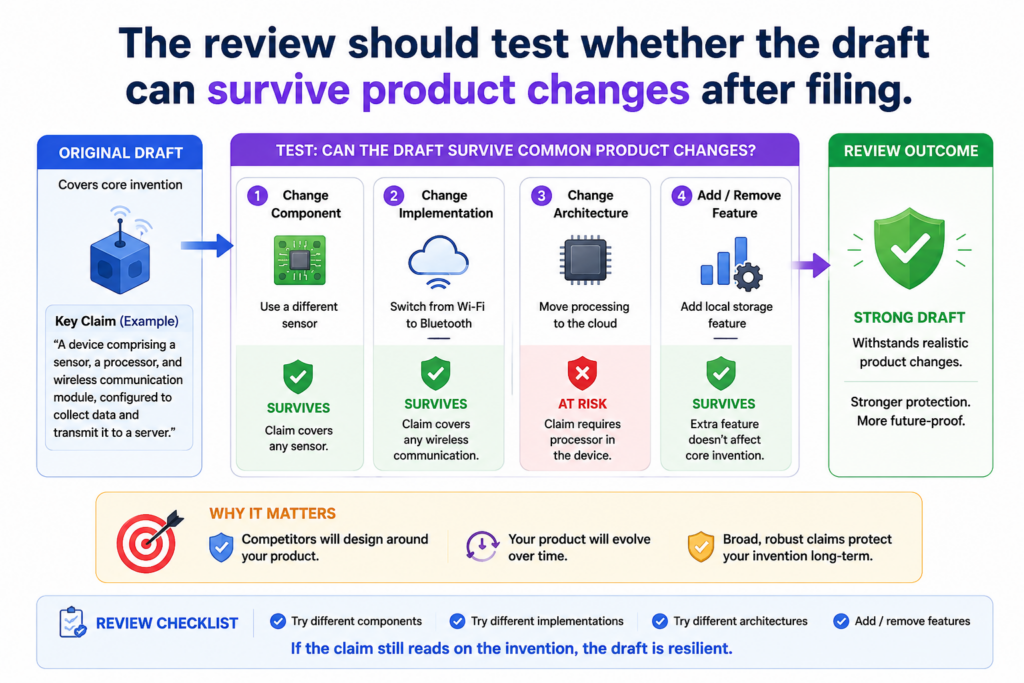
If the draft only protects the exact version you had on filing day, it may become less useful as the product grows.
This is why pre-filing review should include a product-change test. The goal is to see whether the draft protects the invention when normal startup changes happen. You may change the user flow.
You may change the model. You may change the way review reports are shown. You may add new checks. You may shift from one customer type to another.
A product-change test looks for words that lock the invention too tightly
Some limits are needed. Others are accidental. The review should separate the two.
For example, if the invention truly requires comparing claim terms to the written description, that step may belong in the draft.
But if the invention does not require a certain button color, dashboard layout, report name, or file format, those details should not appear as if they are required parts of the invention.
This also applies to timing. The draft may say review happens after the full patent draft is complete. But maybe the same invention can review each section as it is written.
Maybe it can run before attorney review, during attorney review, or right before filing. If those versions are useful, the draft should leave room for them.
The best time to catch needless limits is before filing, not after
Once a draft is filed, you cannot simply add new matter to that same filing. That is why pre-filing review matters so much.
This is the moment to catch narrow wording, missing variations, and product details that do not belong in the core protection.
Founders should not treat this as a legal chore. It is a business check. You are asking whether the filing still protects the part of the product that will matter six months, one year, or two years from now.
PowerPatent helps founders run a smarter process before filing. The platform helps turn technical details into a clearer draft, while real patent attorneys help spot the kinds of issues that can matter later. Explore how it works here: https://powerpatent.com/how-it-works
Conclusion
AI patent draft review helps founders catch weak claims, missing details, unclear words, drawing gaps, and support issues before they become filing problems. The point is not to make patents feel harder. It is to make the draft stronger while your team keeps building.
When smart software reviews the draft early and real patent attorneys guide the final work, you get speed without guessing and protection without chaos. That is the better path for deep tech teams that need to move fast and protect what matters. See how PowerPatent helps here: https://powerpatent.com/how-it-works