A patent application should tell the real story of an invention. It should explain what is new, why it matters, and how it works. But too often, strong ideas get buried under copied language, generic text, and filler that sounds official but says very little.
How boilerplate sneaks into patent applications before anyone notices
Boilerplate usually does not enter a patent application with bad intent. It often comes in because people are moving fast. A founder is trying to ship a product.
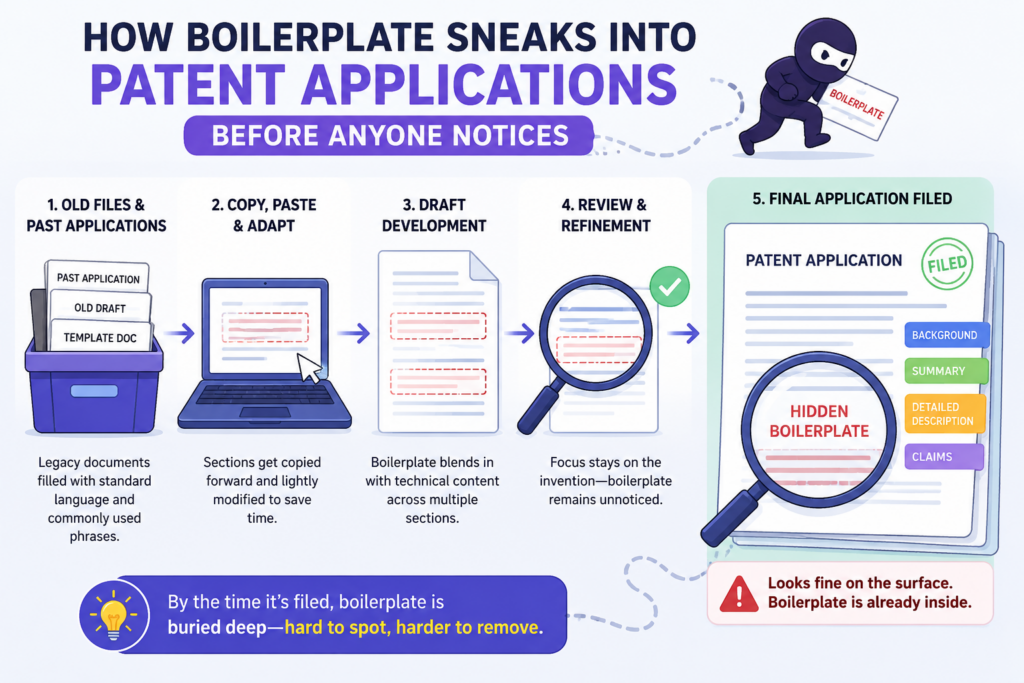
An engineer is trying to explain a hard system in plain words. A draft may start from an old form, a past filing, or a common template.
At first, that feels helpful. It gives the page shape. It saves time. It makes the document look like a patent application before the real work is done.
The danger is that boilerplate can stay in the draft after it has stopped being useful. It can sit there like dust in the corners.
It may not look harmful, but it can weaken the filing because it does not say enough about the actual invention.
A patent application should be built around the real thing your team made. It should show the special parts.
It should explain the steps, the system, the flow, the data, the model, the control logic, or the hardware in a way that makes the invention clear.
When boilerplate takes over, the draft can sound broad but feel empty. It may say the invention “may include a processor” or “may be implemented by software” without explaining what the software actually does.
It may describe a network, a server, a device, or a user interface in a way that could fit almost any product. That kind of text does not help a founder protect the edge of the business. It only fills space.
Why copied patent language feels safe but can hide weak spots
Many patent drafts include phrases that have been used for years. These phrases can feel safe because they sound formal.
They may sound like the language that belongs in a patent. But sounding like a patent is not the same as protecting an invention.
The real job of the application is not to impress someone with heavy words. The real job is to explain what was built in enough detail so the filing can support strong protection later.
That means the application should be tied to real design choices. It should explain what problem the team saw, what path they chose, and why that path matters.
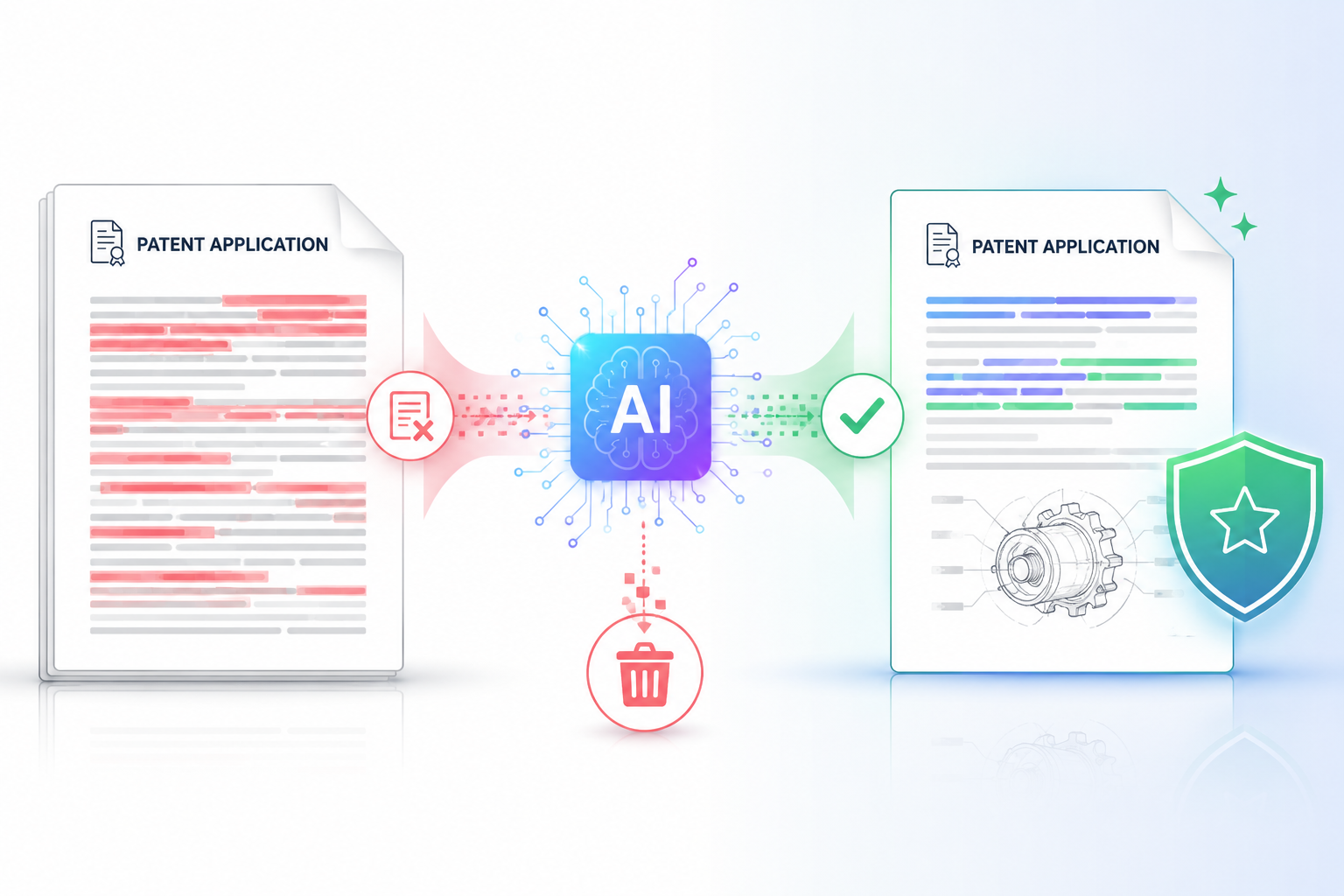
This is where AI can help in a very practical way. AI can review a draft and mark sections that look too generic.
It can compare one part of the draft against the rest of the application and ask a simple question: does this text connect to the actual invention, or could it belong in thousands of other filings?
That question is powerful because it forces the team to move from vague text to useful text.
How AI can separate useful standard text from empty filler
Not all repeated language is bad. Some standard text can help with structure.
Some parts of a patent application may need common phrases to explain the setting, the computing environment, or the possible forms of the invention.
The issue is not whether the words are common. The issue is whether the words do real work.
AI can help sort this out by looking for text that has no clear link to the invention. For example, if a section talks about generic servers but never explains how the server handles the new method, that section may need work.
If a paragraph says the system can use “machine learning” but never names the model inputs, outputs, training flow, or use case, AI can flag that as thin.
If the draft says a feature is “improved” but does not explain what changed, how it changed, or what result it creates, the language needs more detail.
This does not mean AI should replace human judgment. Patent work still needs attorney review. But AI can act like an early warning system.
It can catch dull, copied, or vague language before it gets baked into the final draft. That saves time because the team can focus review on the parts that matter most.
PowerPatent is built around that kind of smarter workflow. It helps founders and technical teams move faster while still getting real attorney oversight.
Instead of turning your invention into a flat template, the goal is to capture the living details of what you built. You can see the process here: https://powerpatent.com/how-it-works.
Why founders should care about boilerplate before filing
For a startup, a weak patent application is not just a paperwork problem. It can become a business problem. Investors may ask what is actually protected. A future partner may want to know whether the filing covers the real product.
A competitor may study the patent later and look for gaps. If the filing is packed with broad filler but light on real invention details, those gaps can become costly.
The best time to fix boilerplate is before filing, not after. Before filing, the team can still add detail, sharpen examples, and explain the invention in a stronger way.
After filing, there are limits on what can be added. That is why early detection matters so much.
AI helps because it can scan large drafts quickly and find patterns humans may miss when they are tired or rushed. It can point to repeated blocks.
It can show where a paragraph sounds disconnected from the rest of the invention. It can highlight claims that do not match the description. It can help the founder see where the draft needs more of the real story.
The key is simple. A patent application should not just sound complete. It should be complete in the places that matter.
Boilerplate can make a draft look finished too early. AI helps slow that mistake down, so the final filing is clearer, sharper, and more useful.
What AI should look for when checking a patent draft for boilerplate
A strong AI review does not just search for copied words. That is too narrow. Boilerplate can appear even when the exact words are not copied.
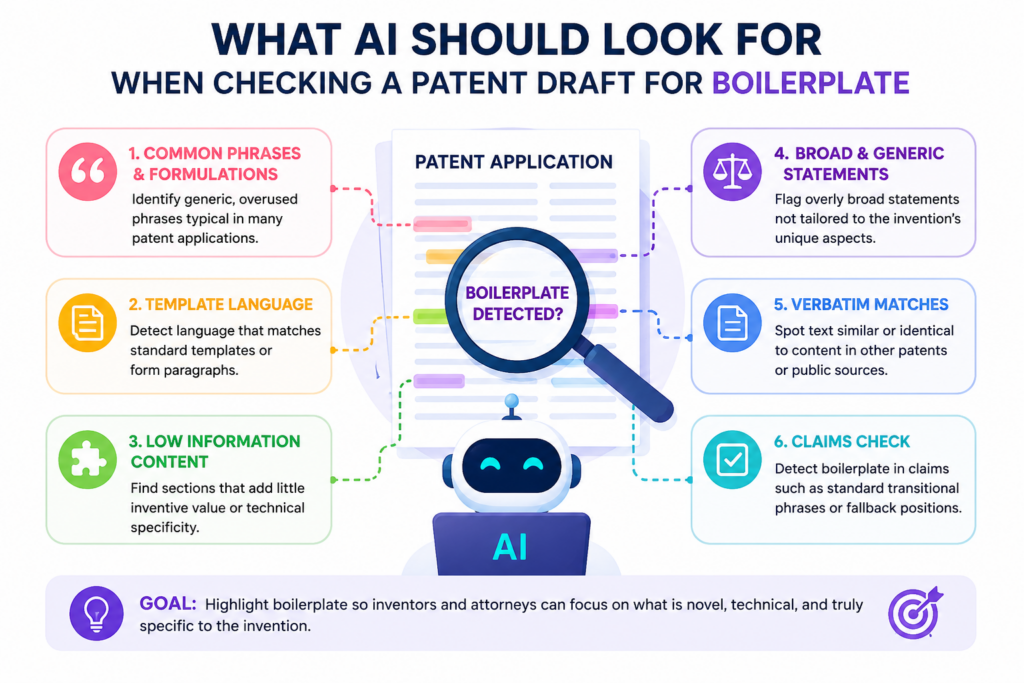
It can show up as vague claims, empty feature lists, broad statements, missing examples, and sections that sound like they were written for any invention in the same field.
A good AI system should read the patent draft with context. It should ask whether each part of the document helps explain the invention.
It should check whether the same idea is repeated without adding new value.
It should notice when a paragraph uses official-sounding words but gives no clear action, part, step, signal, data field, model layer, sensor input, control rule, or output.
This matters a lot for software, AI, robotics, chips, medical devices, clean energy tools, and other deep tech inventions. These inventions often have many moving parts.
A generic draft can miss the very thing that makes the work special. If the application only says that a model receives data and gives an output, it may fail to capture the real method.
The important part may be how the data is cleaned, how the model is trained, how the system handles edge cases, how the output is used, or how the product improves over time.
The first signal is language that could fit almost any invention
One of the easiest ways to spot boilerplate is to ask whether the paragraph could be pasted into a different patent application without much change. If the answer is yes, the text may be too generic.
For example, many drafts include long sections about computers, processors, memory, networks, displays, sensors, databases, and mobile devices. Some of that may be needed.
But if the invention is a new way to detect defects in battery cells, the draft must explain how the system handles image data, what features it extracts, how it makes a decision, and how that decision changes the manufacturing process. A general paragraph about processors will not do that job.
AI can flag this by scoring how closely each section matches the core invention. It can compare the background, summary, drawings, detailed description, and claims.
If a section uses many broad words but few invention-specific terms, that is a warning. If a paragraph talks about “one or more modules” but never says what the modules do in this invention, that is another warning.
Why invention-specific detail is the cure for boilerplate
The cure is not to make the patent longer. The cure is to make the patent more specific in the right places. A short, clear paragraph that explains a real technical step is often more useful than a long block of filler.
AI can guide the writer toward better questions. What does the system receive? What does it change? What does it compare? What does it store? What rule does it apply?
What happens when the input is noisy? What happens when the model is unsure? What part of the process is faster, safer, cheaper, more accurate, or more stable?
These are simple questions, but they pull real substance out of the invention. They help the draft move from “the system may process data” to “the system groups sensor readings by time window, removes readings that fall outside a confidence range, and sends a corrected signal to the control unit.”
That second kind of text gives the application more body. It teaches. It explains. It supports the story.
The second signal is repetition that does not add meaning
Some repetition in a patent application is normal. The claims, summary, and detailed description may cover the same idea in different ways.
But empty repetition is different. Empty repetition says the same thing again and again without adding detail.
AI is useful here because it can map repeated ideas across the draft. It can show when three sections all say the system improves accuracy, but none of them explain how.
It can find cases where a feature appears in the claims but is barely explained in the detailed description. It can also find the reverse problem, where the detailed description includes a strong feature that never appears in the claims.
This type of review is very helpful for startup teams because the draft often grows in pieces. One person writes the technical notes.
Another person adds examples. Another person edits the claims. Over time, the document can become uneven. AI can help bring it back into alignment.
How AI can turn a messy draft into a cleaner review map
A good AI review can create a simple map of the draft. It can show which features are well supported, which ones need more detail, and which sections look like standard filler. That map gives the founder and attorney a better way to work together.
Instead of saying, “Please review the whole draft,” the team can focus on the highest-risk parts. They can look at the boilerplate-heavy sections first. They can add real examples where the text is thin.
They can make sure the claims are backed by the description. They can remove parts that create noise or confusion.
This is where PowerPatent can help founders save time without cutting corners.
The platform is designed to help technical teams capture what they built, organize the invention, and work with real patent attorneys who can review the work with legal care.
That mix matters. AI can flag issues quickly, but attorney oversight helps make sure the final filing is strong and ready for the real world. Learn more here: https://powerpatent.com/how-it-works.
How AI helps founders replace boilerplate with real invention detail
Finding boilerplate is only half the job. The bigger win is turning weak text into strong text. This is where AI becomes more than a checker.

It becomes a guide that helps founders explain their invention in a clearer, more complete way.
Many founders struggle to describe their own work because the invention feels obvious to them. Engineers often skip steps because they live inside the system every day.
They may say, “The model ranks the results,” but they may not explain what the model looks at, how the rank is made, how ties are handled, how bad inputs are filtered, or how the result changes what the user sees. Those details may be the heart of the invention.
AI can help pull those details out. It can read a thin section and suggest the kinds of facts that are missing. It can ask for examples.
It can point out where the reader may not understand the flow. It can help turn internal notes, code comments, product specs, diagrams, and test results into clearer draft material.
Strong patent writing starts with the actual workflow
One of the best ways to remove boilerplate is to describe the real workflow. Not the broad dream of the invention. Not a generic product category. The actual workflow.
For a software invention, that may mean the path from input to output. For an AI invention, it may mean the data pipeline, model process, training method, ranking logic, feedback loop, or safety check.
For a hardware invention, it may mean how parts are arranged, how signals move, how heat is handled, how force is spread, or how a part changes state.
For a medical device, it may mean the steps that guide sensing, control, alerting, or treatment.
AI can help founders stay close to that workflow. It can flag sentences that float too far above the invention. It can ask where the draft needs a concrete example.
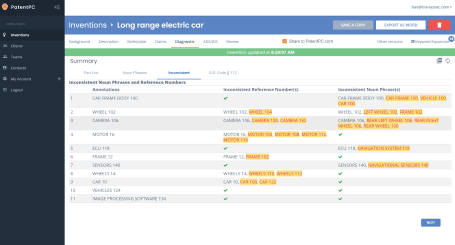
It can show where a term appears before it is explained. It can point out when the same feature is called by different names, which can create confusion.
Why examples make the filing stronger and easier to read
Examples are one of the simplest ways to fight boilerplate. A good example makes the invention feel real. It gives the reader a path to follow.
It can show how the system acts in a normal case, a hard case, or an edge case.
For instance, instead of saying a system “detects abnormal behavior,” the draft can explain what data is observed, what counts as abnormal, what threshold is used, what happens when the threshold is crossed, and how the system responds. This does not need to be complex. It just needs to be clear.
AI can help by finding places where the draft makes a claim but gives no example. It can suggest adding a sample input, sample output, sample device state, sample user action, or sample system response.
These examples help the attorney understand the invention better. They also help the application support broader and smarter protection.
AI can help keep the founder’s voice in the invention record
One hidden problem with boilerplate is that it can erase the founder’s real insight.
The final draft may sound formal, but it may lose the reason the invention exists. That is a shame because the founder’s insight often explains why the invention is valuable.
A founder may know that the old way fails when data is sparse. An engineer may know that a sensor drifts after long use.
A product team may know that users ignore alerts unless the system ranks them in a certain way. These are not small points. They can shape the invention.
AI can help capture those points by reviewing source material and finding useful invention clues. It can look at technical notes and ask which details should be reflected in the application.
It can compare the draft against the product description and find missing features. It can help turn plain engineering thoughts into clear patent language without burying them under stale wording.
How teams can use AI without losing attorney judgment
The best workflow is not AI alone. It is AI plus human review. For founders, that is the safe path.
AI is excellent at finding patterns, gaps, repeated text, and vague sections. Attorneys are needed to judge scope, strategy, filing risks, and claim support.
A practical workflow starts with a draft based on the real invention. Then AI scans it for boilerplate, weak support, repeated language, unclear terms, and missing examples. The founder or engineer adds detail where needed.
Then an attorney reviews the improved draft with more context and less noise.
This gives the attorney better material to work with and gives the founder more confidence that the application is not just a template with a few new words.
PowerPatent is built for this kind of founder-friendly process. It helps teams move from raw invention material to a stronger filing path with smart software and real attorney oversight.
That means you can protect what you are building without getting trapped in slow, old-school back-and-forth. See how PowerPatent works here: https://powerpatent.com/how-it-works
How AI finds weak claim support before it becomes a filing problem
Claims are the sharp edge of a patent application. They define what the inventor is trying to protect. But claims do not stand alone. They need support in the rest of the application.
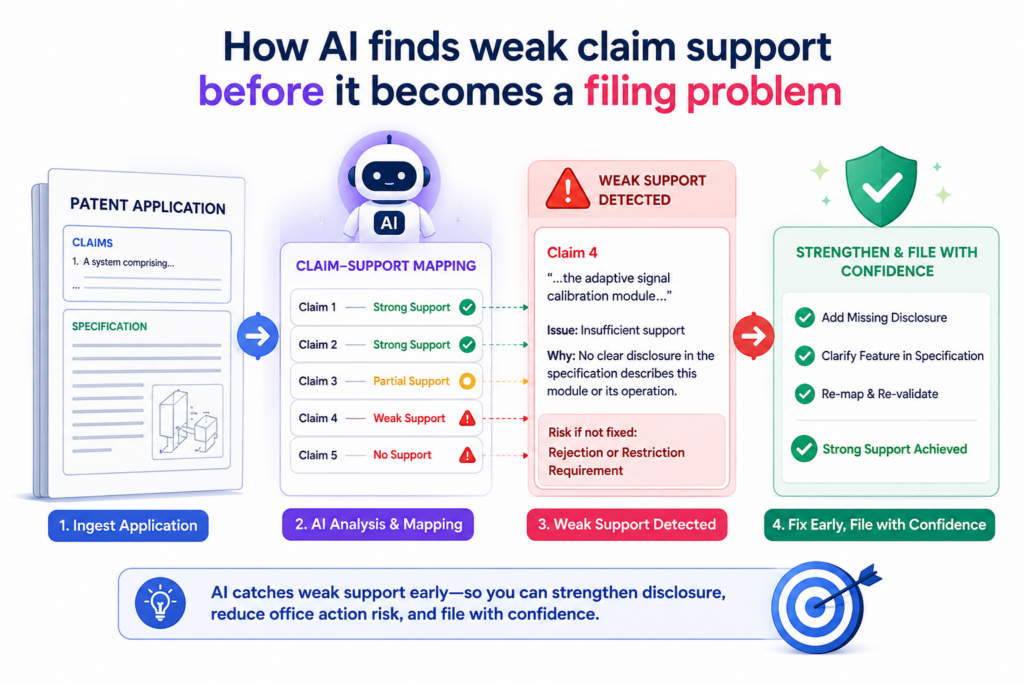
If the claims say the system does something, the detailed description should explain how that thing works. If the claims include a special step, the draft should give enough detail to show that step is truly part of the invention.
Boilerplate often creates trouble here because it can make the application look full while leaving the claims under-supported.
A draft may have many pages, but the important claim language may only be backed by a few vague lines.
That is risky. A long application is not always a strong application. A strong application is one where the key ideas are explained with care.
AI can help by checking the claims against the full draft. It can look for each claimed feature and ask whether that feature is described in a clear, useful way.
It can also find claim words that do not appear in the detailed description, or appear only in generic form. This gives the team a chance to fix weak spots before filing.
Why claim language must connect to real invention details
A common problem in patent drafts is the gap between the claims and the description. The claims may sound strong, but the body of the application may not explain the same ideas with enough depth.
That can happen when claim language is added late, when a template is reused, or when the draft is written from a high-level product pitch instead of the real technical work.
For example, a claim might say that an AI system “generates a confidence score based on a weighted set of features.”
That sounds useful. But the application should explain what those features may be, how the weights are chosen, how the confidence score is used, and what the system does when the score is low. Without that detail, the claim may feel like a promise without a clear base.
AI can flag this kind of gap. It can mark claim terms that are not explained later. It can show whether a claimed step appears in the summary, drawings, and detailed description.
It can also find places where the draft uses different words for the same idea, which can make the application harder to follow.
How AI can create a support map for every important claim feature
One of the most useful AI tasks is building a support map. This means the AI links each key claim feature to the parts of the draft that explain it.
If the claim mentions a training step, the support map should point to the section that explains that training step.
If the claim mentions a sensor state, the support map should point to the part that explains how that sensor state is detected or used.
This is not just a neat review tool. It changes the quality of the work. When founders see the support map, they can tell where the application is strong and where it is thin.
They can add examples. They can explain the missing flow. They can share code notes, diagrams, test data, or system logic with the attorney.
The support map also helps avoid wasted review time. Instead of reading the draft in a slow, blind way, the team can focus on the highest-risk claim features first.
This is especially helpful when a startup has many inventions, fast product changes, and limited time.
Why boilerplate can make claims look broader than they really are
Boilerplate often gives a false sense of safety. It may say that many variations are possible. It may say that the invention can be used in many systems.
It may list many devices, networks, and forms. But broad words do not always create broad protection. The application still needs to teach the invention in a clear way.
AI can help test whether broad claim language is backed by real examples. If a claim covers several use cases, does the draft describe more than one use case?
If the claim covers different types of input data, does the draft explain how the system handles them? If the claim covers both cloud and local processing, does the draft explain what changes between those setups?
These are simple checks, but they can prevent painful gaps. They help the team avoid filing an application that looks wide on the surface but has weak roots underneath.
How PowerPatent helps founders avoid claim support gaps
PowerPatent helps founders work through these issues in a faster, clearer way. The platform helps organize the invention, surface the technical details, and support attorney review with better source material.
That means the final draft is not just a legal shell. It is tied to the real thing your team built.
This matters because founders should not have to choose between speed and quality. A rushed filing can miss key details. A slow filing can hold back the business.
The right process gives you both speed and care. You can see how PowerPatent helps with that here: https://powerpatent.com/how-it-works.
How AI reviews the background section without letting it become filler
The background section is often where boilerplate grows fastest. It is easy to write a few broad lines about the field, the market, and old systems. It is also easy to overdo it.
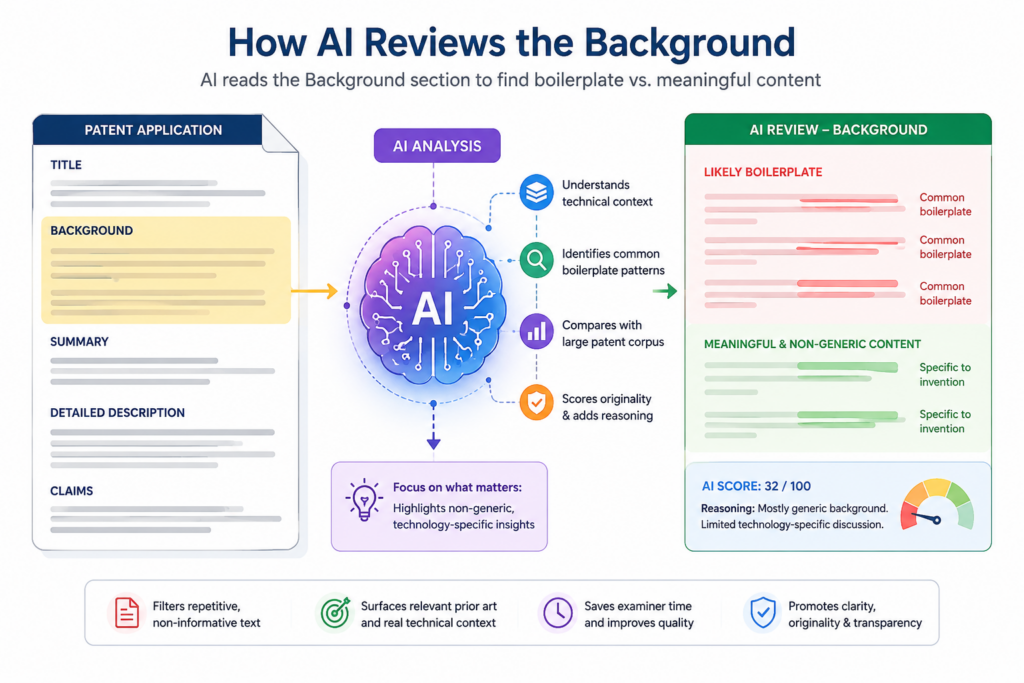
A background section should set up the problem, but it should not turn into a long history lesson or a pile of generic complaints.
A useful background section explains the real problem that led to the invention. It should help the reader understand why the old way was not enough.
It should point toward the need for the new solution without giving away too much or making careless statements. This is a place where careful writing matters.
AI can help by reviewing the background for vague claims, copied industry language, and statements that do not connect to the invention. It can also spot background text that sounds dramatic but does not say much.
Phrases like “existing systems are inefficient” or “current solutions fail to meet user needs” may be true, but they are weak unless the draft explains what kind of inefficiency exists and why it matters.
The background should frame the problem, not fill the page
A strong background section should be short enough to stay focused and clear enough to be useful. It does not need to describe every known product in the field.
It does not need to make the invention sound like it solved every problem in the market. It only needs to set the stage for the technical advance.
For a founder, this is where AI can be very helpful. The AI can ask whether the background points to the same problem solved by the invention.
If the invention improves model accuracy under noisy data, the background should mention the challenge of noisy data.
If the invention reduces power use in an edge device, the background should discuss power limits in edge settings. If the invention improves robotic grasping, the background should explain why old grasping methods struggle in certain cases.
When the background talks about a different problem than the invention solves, the whole application can feel loose. AI can catch that mismatch early.
It can compare the problem stated in the background with the features described in the summary, claims, and detailed description. If they do not line up, the draft needs work.
Why a clean problem statement makes the invention easier to protect
The problem statement is one of the most important parts of the patent story. It helps show why the invention exists.
It also gives shape to the technical choices that follow. When the problem is clear, the solution feels stronger.
For example, a weak problem statement might say that “data processing systems are slow.”
A better version might explain that certain real-time systems slow down when they receive uneven data from several sensors, because old methods wait for all sensor streams to sync before making a control decision.
That is much more useful. It gives the reader a real technical issue to understand.
AI can guide writers toward that level of clarity. It can point out when the background uses broad words but avoids concrete causes.
It can ask what part of the old process fails, when it fails, and what result that failure causes. It can also help the founder avoid making the background too narrow or too sweeping.
AI helps remove market fluff from technical filings
Startup teams often think in market terms. That is normal. They talk about users, growth, pain points, product gaps, and customer needs.
Those ideas matter for the business, but a patent application needs technical detail. If the background reads like a pitch deck, it may not help the filing.
AI can detect this by spotting language that sounds more like marketing than invention support.
Words about disruption, seamless experience, unmatched value, or next-generation platforms may be useful on a website, but they do little inside a patent draft unless they are tied to a technical feature.
That does not mean the draft should be cold or hard to read. It means the draft should focus on how the invention works. AI can help translate market pain into technical problems.
A customer complaint like “the dashboard is too slow” can become a technical issue about data refresh timing, query load, cache rules, or model update steps. That kind of shift makes the application stronger.
How PowerPatent helps turn founder insight into filing-ready detail
PowerPatent is designed for founders who know their product but do not want to get stuck in patent busywork.
The platform helps draw out the details that matter, while real attorneys help shape those details into a better filing. That is the difference between dumping text into a template and building a patent application around the actual invention.
This is especially helpful when your team is moving fast. You may have code, designs, model notes, test logs, customer feedback, and product specs spread across different places.
PowerPatent helps bring the useful pieces together so the patent process feels less like a blank page and more like a guided path. You can explore the workflow here: https://powerpatent.com/how-it-works.
How AI checks the detailed description for vague invention language
The detailed description is where the patent application should become real. This is the section that explains the invention with enough care for a reader to understand the system, method, process, device, or design. If the detailed description is thin, the whole application can suffer.
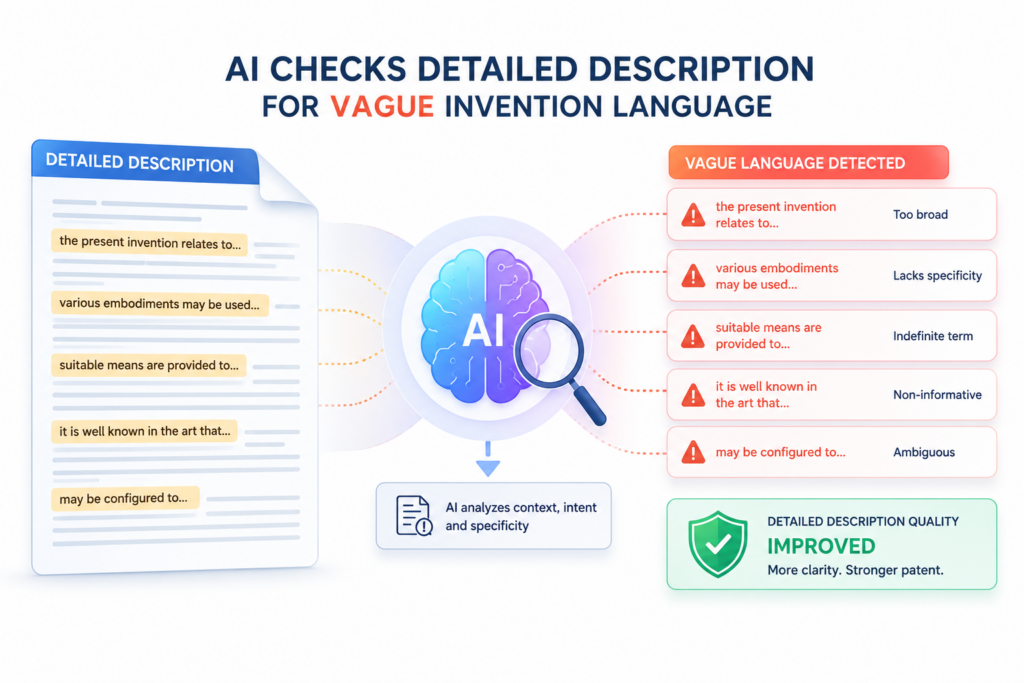
This is also where boilerplate can do the most damage. A draft may include long passages about standard computers, common networks, generic storage devices, and broad software modules.
But if the true invention is an AI process, a control loop, a special data structure, a model training method, or a hardware arrangement, the detailed description must spend real time there.
AI can review the detailed description by checking whether each major feature is explained in action. It can look for verbs that show what the system actually does.
It can spot sentences that name a part but never explain its role. It can flag phrases like “configured to perform processing” when the processing is not described.
The best detailed descriptions show movement, not just parts
A useful patent draft does not only name parts. It shows how those parts work together. That means the detailed description should explain movement. Data moves. Signals move.
Commands move. Heat moves. Force moves. A user action creates a system response. A sensor input changes a control state. A model output changes a device setting. That flow is where the invention often lives.
AI can help by finding static sections that only list components. For example, a paragraph may say the system includes a processor, a memory, a sensor, a model, and an output unit. That may be true, but it does not teach much.
A stronger paragraph would explain how the sensor sends a reading, how the memory stores a baseline, how the processor compares the reading to the baseline, how the model adjusts the result, and how the output unit triggers a response.
This kind of detail does not need to be hard to read. In fact, simple wording often works best. The goal is to make the invention clear without burying it under heavy language.
Why AI should flag nouns without clear actions
One smart way to detect boilerplate is to find nouns that have no action. If the draft names a “module,” “engine,” “interface,” “database,” or “model,” the next question is simple: what does it do?
AI can scan for these nouns and check whether nearby text explains their job. A “ranking engine” should rank something based on stated inputs.
A “training module” should train something using stated data or rules. A “control unit” should control a device, signal, flow, state, or output. If the draft only names the part and moves on, the section may be too shallow.
This is a very practical review step. It helps founders see where they are assuming too much. Engineers often think the function is obvious because they built it.
But the patent application should not depend on what is obvious to the internal team. It should explain enough for someone outside the team to understand the invention.
AI can find missing edge cases that make the invention stronger
Many inventions are most interesting at the edges. The normal case may be easy. The hard case may reveal the real value. A model may work well on clean data, but the invention may shine when the data is noisy.
A robot may work on flat objects, but the invention may matter when the object is soft, wet, tilted, or moving.
A security tool may work during normal traffic, but the invention may be special because it detects strange behavior without slowing the system.
AI can review the detailed description and look for missing edge cases. It can ask whether the draft explains what happens when inputs are missing, delayed, wrong, incomplete, or uncertain.
It can look for fallback steps, confidence checks, retry logic, alternate paths, and safety actions.
These details often make the filing more useful. They show that the invention is not just a broad idea. It is a real system that handles real-world messiness.
How PowerPatent helps teams capture the details that matter most
PowerPatent helps founders and engineers avoid the empty-draft problem. Instead of relying on generic language, the process helps surface the real invention details early.
Then real attorney oversight helps shape those details into a stronger filing strategy.
This gives founders more control. You can move faster, but you do not have to file blind. You can bring in the technical truth of what your team built and avoid letting boilerplate water it down.
That is a smarter way to protect your work, especially when your product is changing quickly and your market is moving fast.
To see how PowerPatent helps technical teams turn real inventions into stronger patent filings, visit https://powerpatent.com/how-it-works
How AI spots boilerplate in AI and machine learning patent applications
AI and machine learning inventions are easy to describe badly. That may sound harsh, but it is true. Many patent drafts in this space use the same broad words again and again.
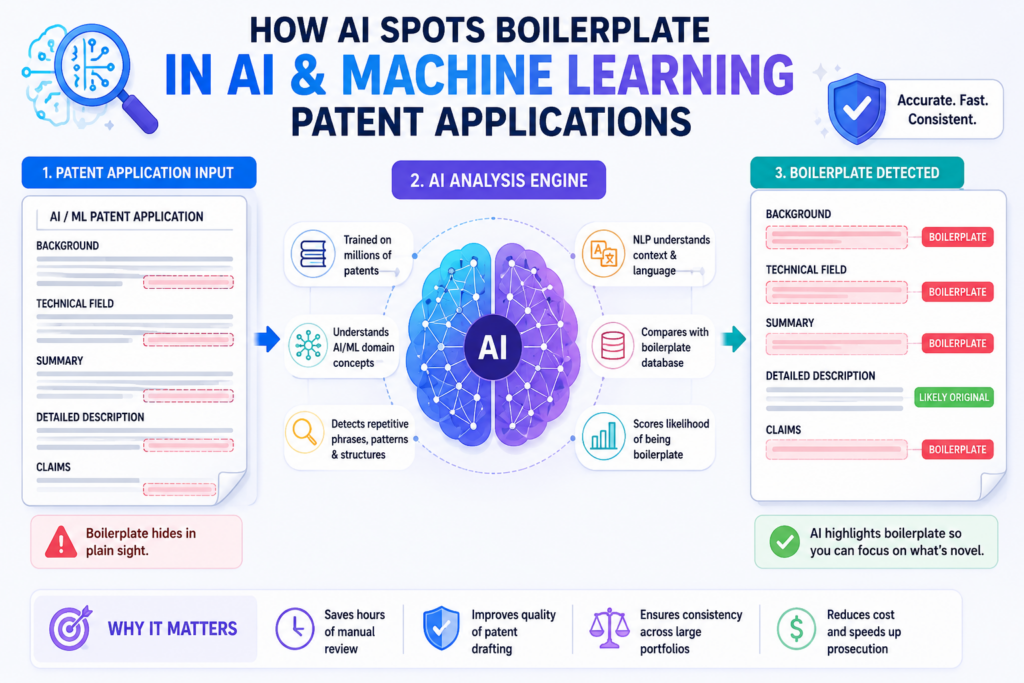
They talk about models, training data, inputs, outputs, neural networks, classifiers, scores, rankings, and predictions. Those words may be correct, but they are not enough by themselves.
A real AI invention usually lives in the details. It may live in how data is selected. It may live in how labels are made. It may live in how a model is trained on limited data.
It may live in how the system deals with drift, noise, bias, delay, missing values, or strange edge cases.
It may live in how the output is used by another system. If the draft only says that a model receives data and generates a prediction, the heart of the invention may be missing.
This is why boilerplate detection is so important for AI patent applications. A weak draft can make a real technical advance sound like a common idea. That is a painful mistake for a startup.
Your team may have spent months building a smart system, but the filing may read like a generic machine learning template. AI review can help stop that from happening.
Why generic model language can weaken the invention story
A common weak sentence in AI patent drafts sounds like this: the system uses a machine learning model to process input data and generate an output. That sentence may be true, but it does not teach much.
Almost every AI system does some version of that. The real question is what makes this model, this data path, this training method, or this use of the output different.
AI can scan a patent draft and flag places where model language is too broad. It can look for terms like “trained model,” “prediction,” “score,” “classification,” and “feature vector,” then check whether the draft explains how those things are created or used.
If the model is named but not described, the draft needs more work. If the data is mentioned but not explained, the draft needs more detail. If the result is stated but the system response is missing, the invention story is not complete.
Good AI patent writing does not need to drown the reader in math. It needs to explain the practical steps. What data comes in? What is done to it? What is removed, changed, grouped, weighted, ranked, or compared?
What does the model produce? What does the system do next? When the draft answers those questions, the invention becomes much easier to understand.
How AI can push the draft from model labels to model behavior
Model labels are not enough. Saying “neural network,” “classifier,” or “transformer model” may describe a tool, but it does not explain the invention.
The stronger draft explains behavior. It shows what the model does inside the system and why that behavior matters.
AI can help by asking for missing behavior. If a draft says the model identifies a risk level, the AI can flag that the draft should explain what signals feed the model, how the risk level is used, and what happens at different levels.
If a draft says the model improves accuracy, the AI can point out that accuracy should be tied to a real method, such as better filtering, smarter weighting, improved training samples, or a feedback loop.
This is practical because founders often know these details but do not write them down in the first draft. The details may be hidden in code, comments, design docs, Slack threads, test logs, or product specs.
AI can help draw attention to what is missing so the team can add the right facts before attorney review.
Why training data details often matter more than founders expect
For many AI inventions, the training data is not just background. It may be part of the invention.
The way data is gathered, cleaned, labeled, balanced, updated, split, or checked may be the reason the system works better than older methods.
Boilerplate often skips this. It may say the model is trained using training data, but it may not explain where the data comes from, how bad samples are handled, how labels are made, or how the model changes over time. That leaves a thin record. It also makes the invention look less real.
AI can review the draft for missing training details. It can find places where the application says “training data” without explaining the data.
It can flag missing steps between raw data and model output. It can also find claims that mention model training when the detailed description barely explains training at all.
How PowerPatent helps AI founders protect what actually makes the model valuable
For AI startups, the patent value often sits in the workflow around the model, not just the model name.
That workflow may include data rules, feedback loops, guardrails, user signals, deployment steps, or ways to handle messy real-world inputs. Those pieces need to be captured clearly.
PowerPatent helps technical founders turn those details into a stronger patent process. The platform helps pull out the real invention, organize the technical story, and support review by real patent attorneys.
That way, your filing does not become a thin AI template. It becomes a clearer record of what your team built and why it matters.
You can see how PowerPatent helps AI and deep tech teams move from invention notes to better filings here: https://powerpatent.com/how-it-works.
How AI finds boilerplate in software patent applications without killing useful structure
Software patent applications often need structure. They may need sections about servers, clients, databases, APIs, user devices, cloud systems, memory, processors, and network links.
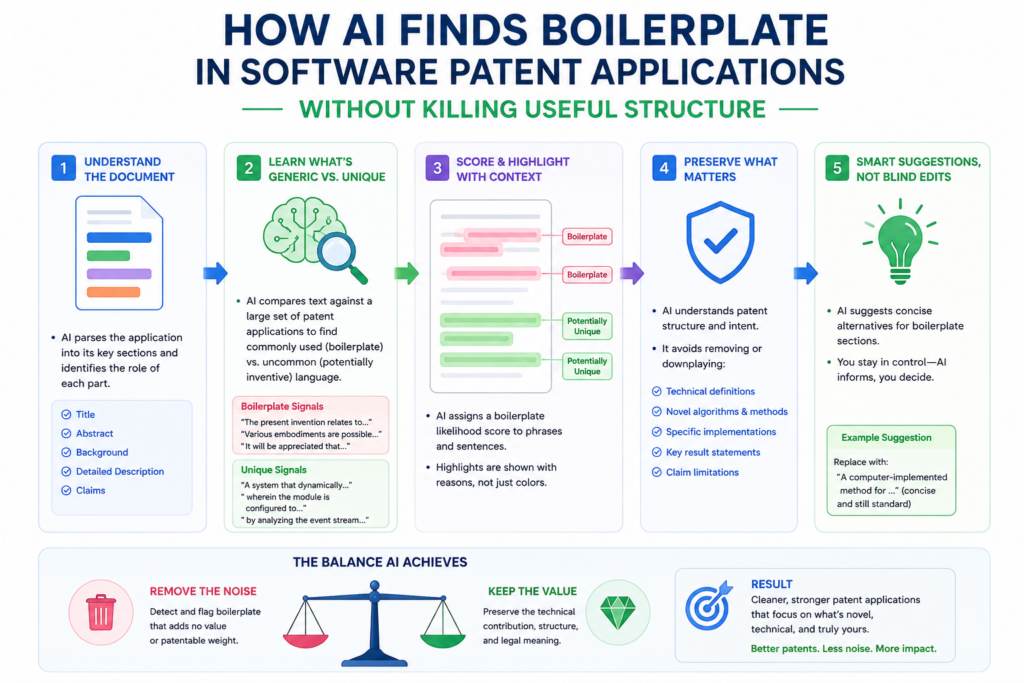
Some of that language can be useful. The problem starts when the structure becomes the main content instead of the invention.
A software invention is rarely protected well by saying that a processor runs instructions stored in memory. That may be part of the setup, but it is not the point. The point is what the software does in a new way.
It may be a faster routing method, a safer login flow, a better data sync process, a smarter search method, a new compression step, a special alert rule, or a unique way to coordinate many services.
AI can help separate useful structure from dead weight. It can spot sections that only describe normal computing parts and do not tie those parts to the invention.
It can also flag places where the draft describes the product at a high level but does not explain the technical flow.
Why software filings should describe the real system path
A strong software patent draft should follow the path of the system. It should show what happens when a user, device, service, or other system sends an input.
It should explain how the software receives that input, what it does with it, what rules it applies, what data it reads or writes, what result it creates, and how that result changes the next step.
This is where AI review can be very useful. It can check whether the draft has enough action. If the text says a module “manages data,” the AI can flag that as vague.
What data? What kind of management? Is the data sorted, merged, encrypted, scored, cleaned, matched, stored, sent, or blocked? The more clearly the draft answers these questions, the less it feels like boilerplate.
AI can also catch missing links in the system path. A draft may explain the input and output but skip the middle.
It may say a request is received and a response is generated, but not explain the steps that create the response. That missing middle is often where the invention lives.
How AI helps founders explain software without turning the draft into code
A patent application does not need to include the full codebase. It should not read like raw source code. But it should describe the logic clearly enough that the invention can be understood.
AI can help find the right level of detail. It can turn code comments, product notes, and architecture docs into plain explanations.
It can help identify the parts of the software flow that are most tied to the invention. It can also flag when the draft becomes too abstract.
For example, a weak draft might say the system “matches users with resources.” A stronger draft might explain that the system receives a user request, extracts a set of need signals, compares those signals to resource tags, adjusts the match score based on time, location, and past outcomes, then returns a ranked set of resources. That is still simple. But now the reader can see the system working.
Why boilerplate can hide the best software claim ideas
Sometimes the best claim ideas are buried inside technical notes, not inside the first patent draft.
A founder may describe the invention as a broad product feature, while the real patentable idea is a backend rule, a data flow, a retry method, a conflict check, or a state change.
Boilerplate makes this worse because it fills the draft with familiar words and leaves less room for discovery.
AI can compare the draft with source materials and find missing technical ideas. It can look for special terms in product specs that do not appear in the patent draft.
It can spot repeated engineering choices that may deserve attention. It can also help the attorney see which parts of the software system are not just normal implementation.
This does not mean every technical detail should become a claim. That choice needs strategy. But it does mean the team should not let strong ideas disappear because the first draft leaned too hard on generic software language.
How PowerPatent helps software teams move quickly without filing a thin template
Software startups move fast. The product changes. The roadmap shifts. The team learns from users. A slow patent process can feel painful. But a rushed template can be just as dangerous.
PowerPatent helps by giving founders a better way to capture invention detail without getting trapped in old-school delays. Smart software helps organize the technical story.
Real attorneys help review and shape the filing. The goal is not just to file something. The goal is to file something that reflects the real invention and supports the company’s future.
For software founders who want speed, control, and stronger protection, PowerPatent makes the process easier to start and easier to manage. Learn more here: https://powerpatent.com/how-it-works.
How AI detects vague drawings and figure descriptions in patent applications
Drawings can make a patent application much easier to understand. They help show parts, flows, screens, devices, systems, and steps.
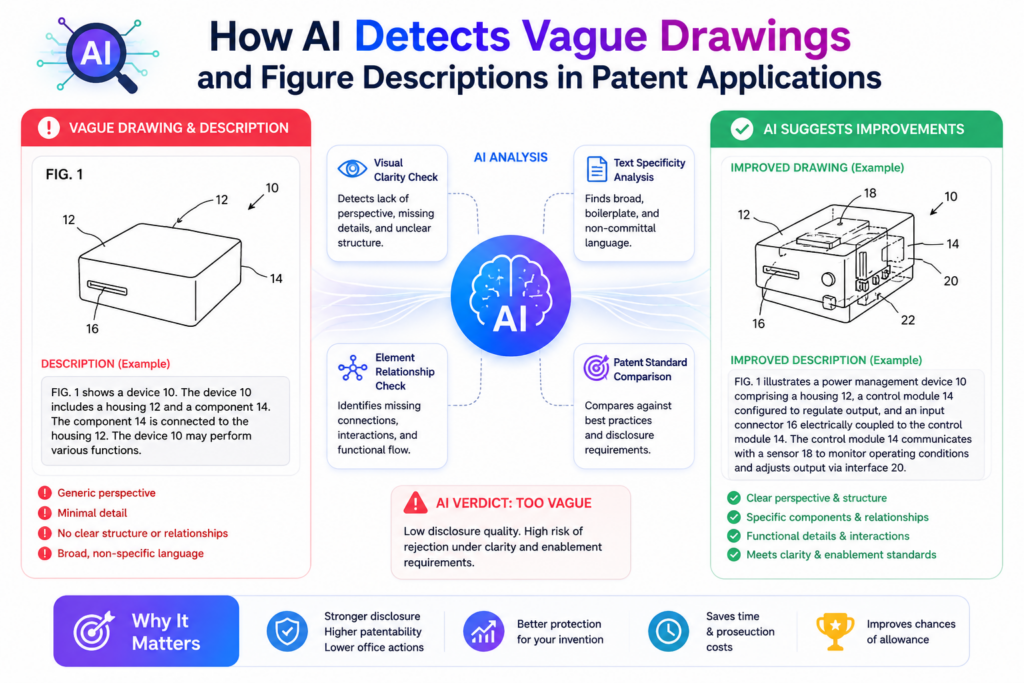
But drawings can also become boilerplate when they are too generic. A block diagram with a processor, memory, network, and user device may look official, but it may not show the invention clearly.
Figure descriptions can have the same problem. They may say that a figure shows an example system, an example method, or an example user interface, but they may not explain what is actually important in the figure. When that happens, the drawing becomes decoration instead of support.
AI can help review both the drawings and the text around them. It can check whether each figure is tied to a real feature in the claims and detailed description.
It can flag figures that look generic. It can also spot labels that are never explained or steps that appear in a figure but not in the written text.
Why every drawing should earn its place in the application
A drawing should help the reader understand the invention faster. It should make a hard idea easier to see. It does not have to be beautiful. It does not have to look like a product screenshot. It just needs to serve the patent story.
AI can help ask a simple question about each figure: what does this drawing teach? If the figure teaches nothing specific, it may need to be changed. If the figure shows a key workflow, the text should explain that workflow.
If the figure shows a system layout, the text should explain how the parts interact. If the figure shows a user interface, the text should explain what user action matters and what system response follows.
This review is important because patent teams often reuse common figure formats. A system diagram may come from a past filing. A method flow may follow a standard pattern.
That may save time, but it can also miss the invention. AI can compare figure labels and steps against the rest of the draft to see whether the drawing is truly aligned.
How AI can find mismatches between figures, claims, and the description
A strong patent application should feel connected. The figures, claims, summary, and detailed description should support each other. When they drift apart, the draft becomes weaker.
AI can spot these mismatches. It can find a claim feature that has no figure support. It can find a figure step that is not described in the text.
It can find a label used in one figure but named differently in another section. It can also find cases where a figure shows too many generic parts and too few invention-specific parts.
For example, if the claims focus on a special data filtering step, the figures should ideally show where that filtering step happens in the system or method.
If the claims focus on a feedback loop, the drawings should help the reader see that loop. If the drawings only show a generic cloud system, they may not be doing enough.
How AI improves figure descriptions without adding fluff
Figure descriptions should be clear and useful. They should not repeat the same empty phrase for every drawing.
A weak set of figure descriptions may say “Figure 1 shows an example system,” “Figure 2 shows an example method,” and “Figure 3 shows another example method,” without explaining why those figures matter.
AI can help make these descriptions stronger. It can suggest a clearer link between the figure and the invention.
It can identify the key action shown in the figure. It can help make sure that important labels are explained the same way across the application.
The goal is not to make the figure descriptions long. The goal is to make them meaningful. A short paragraph that explains the role of a figure is often better than a long generic passage.
How PowerPatent helps founders build a patent story that is easier to review
Good patent drawings and descriptions make the whole application easier to review. They help founders, engineers, and attorneys stay aligned. They also reduce confusion when the invention has many parts.
PowerPatent helps teams bring the invention story together, from technical details to draft review to attorney oversight.
Instead of letting generic diagrams and canned text carry the filing, PowerPatent helps founders focus on what is actually new and worth protecting.
See how PowerPatent helps startups turn real technical work into stronger patent filings here: https://powerpatent.com/how-it-works.
How AI checks whether boilerplate is hiding the real technical advance
A patent application can name the invention and still miss the invention. That sounds strange, but it happens often.
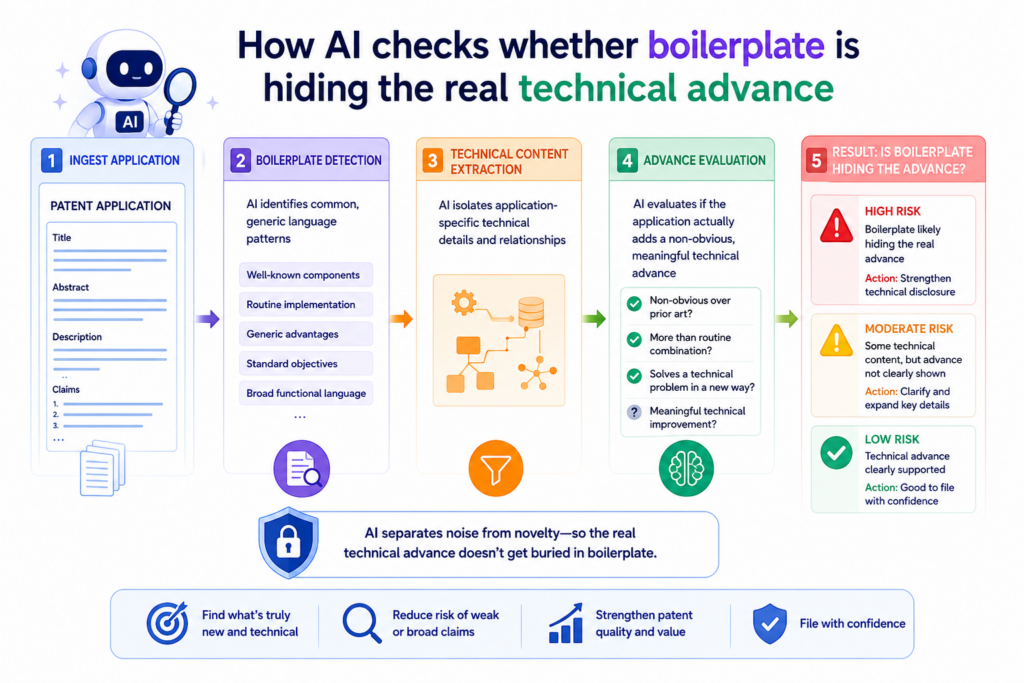
The draft may talk about the product, the platform, the device, or the system, yet never clearly point to the technical advance that makes the work worth protecting.
Boilerplate makes this worse because it fills the page with safe words while the real advance stays quiet.
For a founder, the real technical advance is often not the full product. It may be one part of the product. It may be a small but powerful step that makes the system faster, more stable, more accurate, easier to scale, or harder to copy.
It may be the way the system handles bad input. It may be the way data moves between services. It may be the way a model learns from feedback. It may be the way a device changes state at the right time.
AI can help by reading the draft and asking whether the application clearly shows that advance. If the draft spends ten pages on generic system parts but only three sentences on the special logic, the balance is wrong.
If the claims mention the special logic but the description does not teach it well, the draft needs more work. If the title, summary, and figures point in different directions, the invention story needs to be tightened.
The technical advance should be easy to find without guessing
A strong patent draft should make the invention clear enough that a skilled reader does not have to hunt for it.
The reader should be able to understand the main technical point from the summary, see it supported in the drawings, and then follow it in the detailed description. The claims should then protect that point in a smart way.
AI can help test this flow. It can look at the draft and identify the main ideas that appear most often. Then it can compare those ideas to the claims.
If the most repeated ideas are generic, while the claimed invention appears only lightly, that is a warning sign. It may mean the draft is built around boilerplate instead of the real invention.
A useful AI review can also check whether the application explains cause and effect. It is not enough to say the invention improves performance.
The draft should explain what feature causes the improvement. Does the system reduce delay by skipping a sync step?
Does it improve accuracy by weighting fresh data more heavily? Does it reduce power use by changing when sensors wake up? That cause-and-effect link helps turn a broad claim into a real technical story.
Why founders should ask what changed inside the system
One of the best ways to uncover the real invention is to ask what changed inside the system. Not what the product does for users. Not what the market wants. What changed in the technical design?
Maybe the old process used one model, and the new process uses two models that check each other. Maybe the old system stored full records, and the new system stores compact state summaries.
Maybe the old device waited for a full signal set, and the new device acts when a confidence level is high enough. These changes matter because they can show what the invention actually is.
AI can guide this thinking by comparing the draft against technical notes, system diagrams, and product specs. It can look for places where the team describes a change in workflow, architecture, data handling, or device behavior.
Then it can check whether those changes appear in the patent draft. If they do not, the draft may be missing its strongest material.
Boilerplate often hides when the draft talks about benefits without mechanisms
Benefits are important, but they are not enough. A patent application can say that an invention is faster, safer, smarter, cheaper, or more accurate.
But if the draft does not explain how the invention creates that result, the benefit language can become filler.
AI can flag benefit words that are not tied to mechanisms. If the draft says “improved speed,” the AI can ask where the speed gain comes from.
If it says “reduced error,” the AI can ask what error is reduced and what step reduces it. If it says “enhanced security,” the AI can ask what threat is handled and what technical action handles it.
This kind of review is very useful because founders often describe their product in benefit terms. That is natural. Customers care about benefits. Investors care about benefits.
But patents need the bridge between the benefit and the technical work. AI helps build that bridge by forcing the draft to explain the mechanism.
How PowerPatent helps keep the invention story sharp
PowerPatent helps founders move beyond broad product language and capture the technical heart of what they built.
The process is designed to help teams organize real invention details and work with real patent attorneys who can shape those details into a stronger filing.
That matters because a patent should not be a fancy wrapper around a vague idea. It should be a clear record of the invention. It should help your startup protect the work that gives you an edge.
PowerPatent gives founders a faster and more guided way to get there, without handing the process over to stale templates. Learn how it works here: https://powerpatent.com/how-it-works.
How AI helps clean up inconsistent terms across a patent draft
Patent applications can become messy when the same thing is called by different names. A draft may call one part a “scoring module” in one section, a “ranking engine” in another section, and a “decision unit” in the claims.
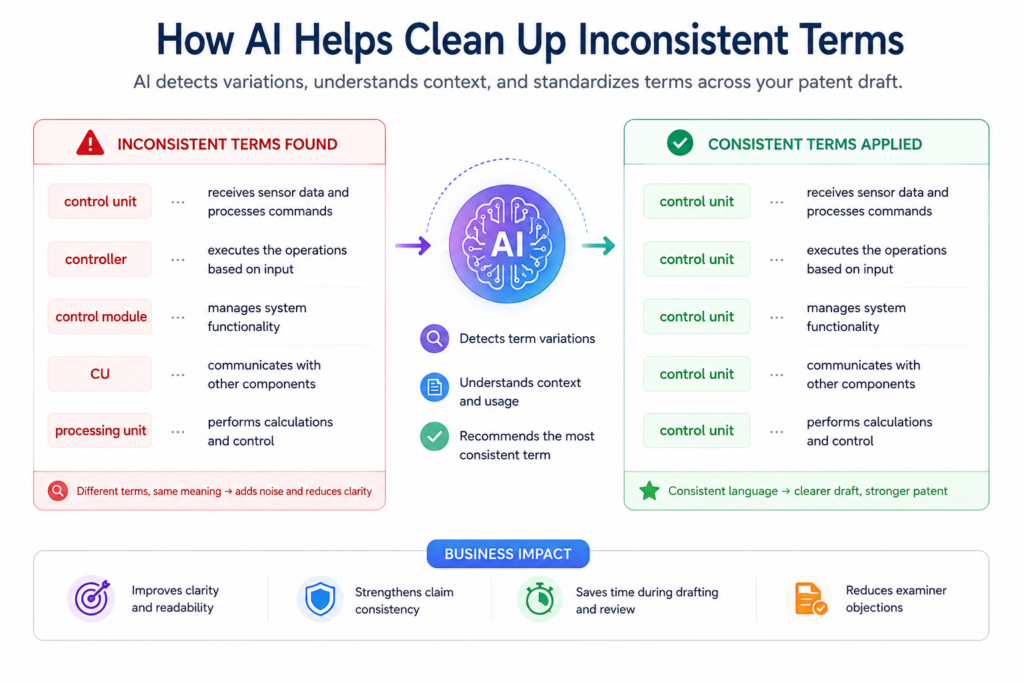
Sometimes these names mean the same thing. Sometimes they mean different things. If the draft does not make that clear, the reader may get confused.
This kind of inconsistency is one of the easiest problems for AI to catch. It can scan the full draft and build a term map.
It can show where each term appears, how it is used, and whether the same feature is named in different ways. This is much faster than asking a human reviewer to track every term by memory.
Inconsistent terms often come from the way patent drafts are built. A founder may describe the invention one way. An engineer may use internal product names. A prior template may use older words.
A claims draft may introduce a new term for strategy reasons. None of this is unusual. But before filing, the application should feel clean and steady. The same feature should not look like three different features by accident.
Clean terms help the reader trust the invention story
When terms are consistent, the draft becomes easier to read. The reader can follow the system from the summary to the drawings to the detailed description to the claims.
That makes the invention feel more solid. It also reduces the risk that important details get lost because the wording keeps changing.
AI can check whether key terms are introduced before they are used. It can flag a term that appears in the claims but not in the detailed description.
It can spot a drawing label that uses one name while the text uses another. It can also detect when a term is too generic to be helpful.
For example, “module” is often used in patent drafts. That is not always bad. But if every important part is called a module, the draft can become hard to follow.
A “data cleaning module,” “feature extraction module,” and “risk scoring module” may be clear if each one has a defined job. But if the draft later calls them a “processing module,” “analysis module,” and “output module,” the story starts to blur.
Why AI should check both meaning and wording
A simple word search is not enough. Two terms may use different words but mean the same thing.
Or they may use the same word but mean different things in different places. A useful AI system should look at meaning, not just matching text.
For instance, a “confidence score” and a “reliability value” may refer to the same output. If so, the draft should either use one term or explain the relationship.
On the other hand, a “score” may refer to a risk score in one section and a match score in another. If those are different, the draft should make that clear.
AI can help by grouping related terms and showing possible overlaps. Then the founder and attorney can decide how to clean the language.
The goal is not to make every sentence sound the same. The goal is to remove accidental confusion while keeping the draft broad enough to support good protection.
Inconsistent terms can make boilerplate harder to see
Term confusion can hide boilerplate because it makes the draft look more detailed than it really is. If the same generic feature is named several different ways, the application may appear richer than it is.
But once the terms are grouped, the reviewer may see that several paragraphs are repeating the same thin idea.
AI can uncover this by reducing the draft to its core concepts. It can show that five different sections all talk about the same broad processing step without adding new detail.
It can also show when a real technical feature only appears once and needs more support.
This is a powerful way to improve the draft because it helps the team separate noise from substance.
Once the noise is removed, the weak spots become easier to see. The team can then add detail where it matters most.
How PowerPatent helps founders keep patent drafts organized from the start
PowerPatent helps teams avoid this messy cleanup by guiding the invention capture process early.
When key terms, features, workflows, and examples are gathered in a clearer way from the start, the draft is less likely to become a patchwork of old wording and new ideas.
The platform helps founders keep control of the process while still getting attorney oversight. That combination is important.
AI can find term issues quickly, but real patent attorneys help decide how those terms should be used for stronger protection.
See how PowerPatent brings software and attorney review together here: https://powerpatent.com/how-it-works.
How AI detects boilerplate in summaries and abstracts without losing clarity
The summary and abstract are short sections, but they matter. They set the tone for the application.
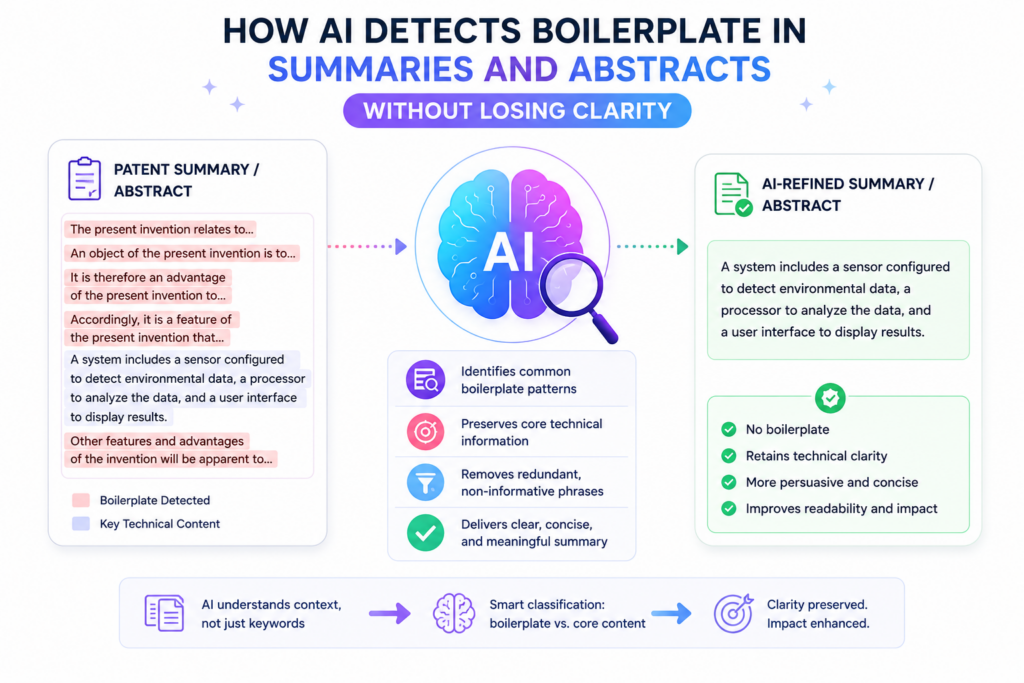
They give the reader the first clear view of the invention. When these sections are full of boilerplate, the whole draft can start on weak ground.
A common mistake is to make the summary too broad. It may say the invention relates to systems and methods for processing data, generating outputs, and improving performance.
That sounds like a patent, but it does not say much. It could describe thousands of inventions. The summary should give a clear sense of the actual technical idea without becoming too narrow or too long.
AI can help review the summary and abstract by checking whether they reflect the real invention described later.
If the summary says the invention is about one feature, but the detailed description focuses on another, the draft needs alignment.
If the abstract is packed with generic words and does not name the key process, it needs to be sharpened.
A good summary should open the door to the invention
The summary should not try to explain every detail. It should open the door. It should tell the reader what kind of invention this is, what main technical action it performs, and what result it may provide. It should do this in simple, direct language.
AI can check whether the summary includes a clear actor, action, and result. The actor may be a system, device, model, controller, or method.
The action may be receiving data, filtering signals, training a model, adjusting a state, ranking items, controlling a machine, or generating an alert.
The result may be faster response, better detection, lower power use, improved matching, or safer control.
When one of these pieces is missing, the summary may feel hollow. For example, “A system improves data processing using machine learning” is weak. It names a broad system and a broad benefit, but it does not explain the action.
A stronger version would explain that the system groups incoming data by event type, applies a model selected based on the event type, and changes a response rule based on a confidence value. That is still simple, but it gives the reader something real.
Why the abstract should be plain but not empty
The abstract should be short and clear. It should not be a sales pitch. It should not be a pile of legal-sounding phrases. It should give a compact view of the invention.
AI can flag abstract language that is too thin. If the abstract uses broad terms like “processing,” “analyzing,” “optimizing,” or “managing” without explaining the core step, it may need more detail.
If it repeats the title without adding anything useful, it may be too weak. If it names too many parts without showing the flow, it may be hard to read.
A strong abstract often reads like a simple technical snapshot. It tells what the system receives, what it does, and what it provides.
It avoids hype. It avoids empty claims. It gives just enough detail to help the reader understand the invention quickly.
AI can compare the summary against the claims to find missed focus
The summary should align with the claims. It does not need to copy the claims. In fact, it should not feel like a stiff claim rewrite. But it should point to the same invention.
If the claims focus on a feedback loop, the summary should mention that loop. If the claims focus on a special ranking step, the summary should not only talk about a generic recommendation system.
AI can compare the summary, abstract, and claims to find these missed focus points. It can show when the summary leaves out a claimed feature that appears central.
It can also show when the summary highlights a feature that is not claimed at all. Both issues can create confusion.
This kind of check helps founders and attorneys make the application feel more unified. The reader should not feel like each section was written by a different person with a different idea of what matters.
How PowerPatent helps make the first read stronger
The first read of a patent application should not feel vague. It should give a clear path into the invention.
PowerPatent helps founders get there by using smart tools to organize the invention and real attorney oversight to shape the filing.
For a startup, that matters because your patent application may later be read by investors, partners, competitors, examiners, and future buyers.
A clear filing does not just help the legal process. It helps show that your team knows what it built and took care to protect it.
To see how PowerPatent helps founders file better patents with more speed and confidence, visit https://powerpatent.com/how-it-works.
Conclusion
Boilerplate can make a patent application look complete while quietly leaving the real invention exposed. AI helps founders catch that risk early by finding vague text, repeated language, weak claim support, missing examples, and sections that do not explain what was actually built.
But the best results come from AI plus real attorney oversight, not AI alone. That is where PowerPatent gives startups a faster, clearer path. You can turn code, models, product ideas, and technical notes into stronger patent filings without slowing down your team. See how PowerPatent works here: https://powerpatent.com/how-it-works