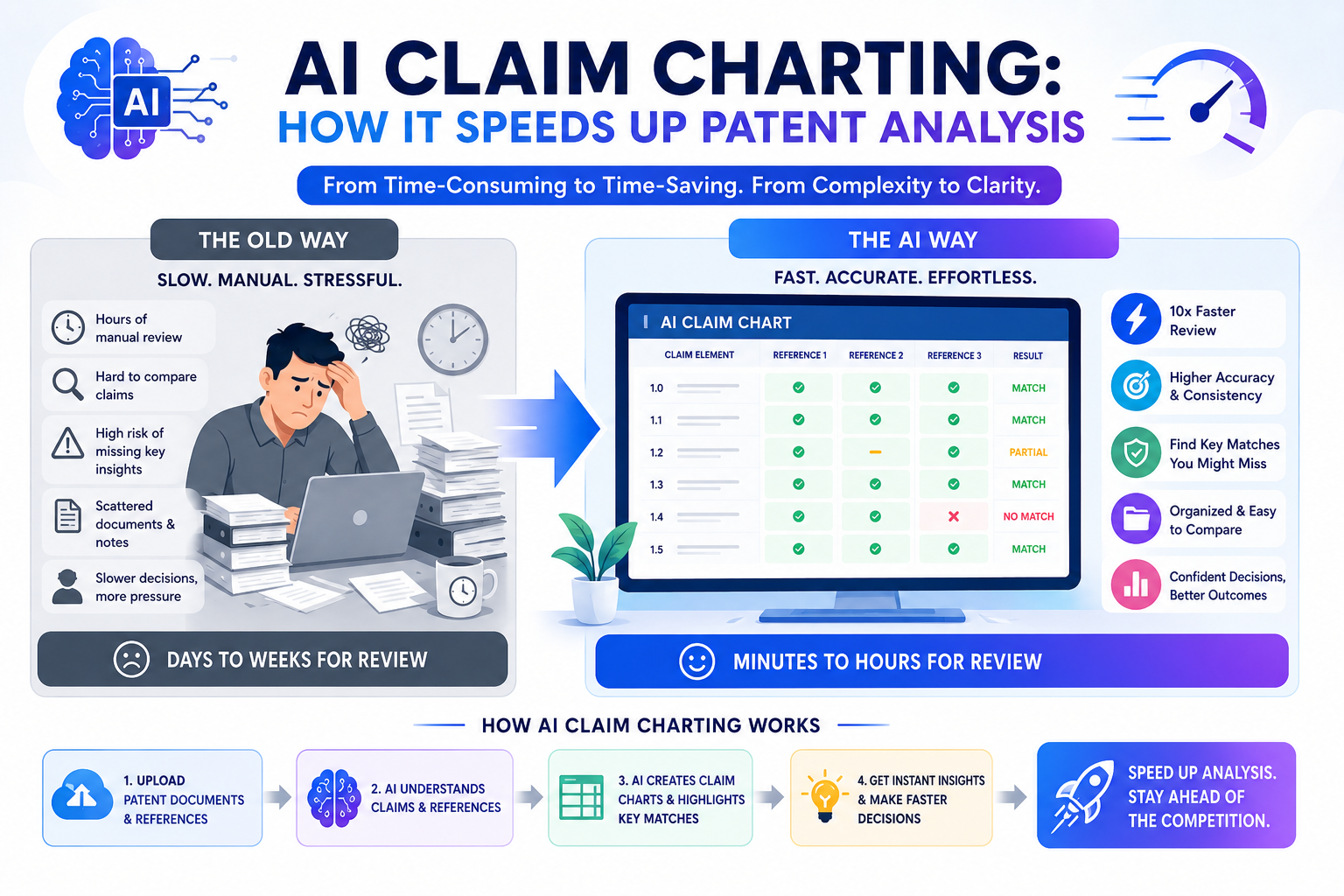
Patent work can feel slow because every word matters. One small detail can change what an invention covers, what a competitor may be using, or what a startup can safely protect. That is why claim charting is so important. It helps teams compare patent claims against products, code, systems, papers, or other patents in a clear way.
AI claim charting turns a slow patent review into a faster decision process
A claim chart is one of the most useful tools in patent analysis. It shows how each part of a patent claim lines up with real proof.
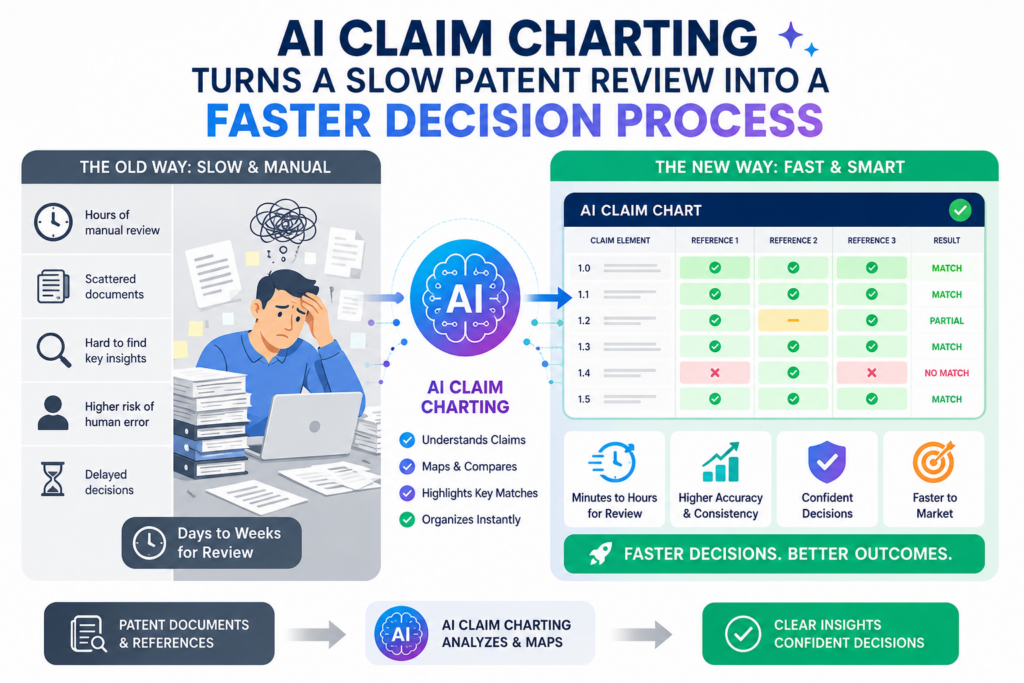
That proof may come from a product page, a technical paper, source code, a system diagram, a user guide, a standard, or another patent. When the chart is done well, it gives a clear view of what the claim says and where the proof may be found.
The problem is that claim charting often takes a long time. A person has to read the claim, break it into small parts, search for support, copy the right proof, explain the match, and check the work again.
For a founder or engineer, this can feel too slow, especially when a big product choice or funding event is coming up.
AI claim charting helps speed up this work. It does not make the hard choices for the team. It helps sort the work, find likely matches, and show where more review is needed.
AI helps break claims into parts that are easier to review
A patent claim can look like one long sentence, but it usually holds many smaller ideas inside it. Each small idea matters. In a software patent, one part may describe receiving data.
Another part may describe training a model. Another may describe sending an output to a user device. In a hardware patent, one part may describe a sensor, another part may describe a circuit, and another may describe how parts connect.
A human reviewer must see each of these parts clearly. That first step can take real time, because patent claims are not written the way engineers talk. They are written in a careful way, with words that may feel stiff or strange.
AI can help by splitting the claim into smaller pieces. It can point out where one idea ends and another begins. This makes the chart easier to start. It also helps the team avoid missing a key part.
The best charts start with clean claim breakdowns
A clean breakdown is the base of the whole chart. When the claim parts are messy, the rest of the work becomes messy too.
A weak chart may mix two ideas into one row, skip a limit, or compare the wrong proof to the wrong claim part. That can lead to bad calls.
AI can reduce this risk by giving the reviewer a first draft that is easier to inspect. The reviewer can then adjust the parts, rename them in plain words, and check that nothing important was lost.
This matters because claim charting is not just about filling rows. It is about clear thinking. When each part of the claim has its own place, the team can see what is strong, what is weak, and what needs more support.
For a startup, this can save time at the exact moment when time is scarce. A founder may need to know whether a new product idea is worth protecting.
An engineering lead may need to show why a core system is different from older work. A product team may need to understand where a competitor may be close. AI claim charting helps those teams get to the first useful view faster.
AI helps connect claim language to real technical proof
After a claim is broken down, the next step is finding proof. This is where claim charting can become slow.
The proof may be spread across many files, web pages, papers, manuals, or product screens. Sometimes the same idea is described in different words.
A patent may say “receiving an input signal,” while a product document says “the device captures sensor data.” A person can see that these may be connected, but finding that match by hand takes work.
AI is useful because it can search across text and look for meaning, not just exact words. It can suggest passages that may match a claim part even when the words are not the same. This is a major speed gain.
It can also help pull out the parts that matter most. Instead of asking a person to read a long manual from start to finish, AI can point to sections that may discuss the needed feature. The person still reviews the match, but the first pass is faster.
Fast matching helps teams focus on judgment, not hunting
The value of AI claim charting is not only speed. It also changes how people spend their time. Without AI, much of the work is hunting. The reviewer searches, scans, copies, checks, and searches again.
With AI, the reviewer can spend more time on judgment. Does the proof really match the claim? Is the match direct or weak? Is there missing detail? Is there a better source?
That kind of thinking is where human skill matters most.
This is why PowerPatent is built around both smart software and real attorney oversight. Software can move fast.
Attorneys can help review the work with care. For founders, that mix can make the patent process feel less like a maze and more like a guided path. You can see how that works here: https://powerpatent.com/how-it-works
AI claim charting gives founders faster answers before they spend too much time or money
Startups move fast, but patent work can force hard pauses. Before filing a patent, sending a warning letter, reviewing a competitor, or buying a patent asset, the team needs to understand what the claims actually cover. That is where claim charts help.

The old way can be painful. A founder may wait days or weeks for an early view. During that time, the product keeps changing.
Investors ask questions. Engineers keep building. The business cannot stop just because patent review is slow.
AI claim charting gives the team a faster first look. It can help answer simple but important questions sooner.
What does this claim cover? Where is the proof? What parts look strong? What parts need more work? What parts are missing support?
Early claim charts help teams spot risk before it grows
One of the best uses of claim charting is early risk review. A startup may be building a product in a crowded space.
Maybe the product uses AI models, chips, robotics, clean energy systems, medical devices, security tools, or advanced data pipelines. These areas often have many patents.
A founder does not need every answer on day one. But they do need to know whether there is a clear issue that should be handled early.
A rough but useful AI-assisted chart can show where a claim may come close to a product feature. It can also show where the proof is thin.
That early view can guide the next step. The team may decide to design around a feature. They may decide to file their own patent.
They may ask for deeper attorney review. They may also find that the concern is smaller than expected.
Fast review can prevent late surprises
Patent issues become more painful when they show up late. A late issue may appear during fundraising, diligence, a partnership, a product launch, or an exit. At that point, the team has less room to move. They may have already spent months building one path.
AI claim charting helps by pulling key questions forward. It lets the team look at claim risk while there is still time to make smart changes.
This is especially useful for technical founders. They often understand the product better than anyone, but they may not know how to read a patent claim. AI can turn the claim into smaller parts and connect those parts to product facts.
Then the founder can give better input. They can say, “Yes, our system does that,” or “No, our model works in a different way,” or “That feature is on the roadmap, but not live yet.”
That kind of feedback is gold. It makes the review more accurate. It also keeps the founder in control.
AI claim charting can help decide what to patent next
Claim charting is not only for looking at other patents. It can also help a startup understand its own invention. When a team is deciding what to file, it needs to know which parts of the system are truly important.
It needs to know what features competitors may want to copy. It also needs to know what details support the strongest patent claims.
AI can help map product features to possible claim ideas. It can review notes, diagrams, product specs, and technical write-ups. It can then help show which parts of the invention may deserve more focus.
This helps founders avoid a common mistake. They may file a patent that describes the product in a broad way but misses the real edge.
The real edge might be a training method, a data flow, a chip layout, a timing step, a control rule, or a special way of handling errors. These details can be easy to miss when the team is rushing.
Better charts can lead to better patent strategy
When a startup sees how claim parts map to real technical features, it can make stronger choices. It can decide which features to protect first.
It can decide which claims may be too narrow. It can also decide where more proof or detail is needed before filing.
This is where PowerPatent can help. The platform is made for founders and engineers who want to protect what they are building without slowing down the company.
It combines smart AI tools with real attorney review, so the work moves faster but still gets checked by people who know what to look for. Learn how the process works here: https://powerpatent.com/how-it-works
AI claim charting reduces the drag of manual patent review
Manual claim charting can feel like sorting a giant box of puzzle pieces with no picture on the lid. The patent claim is one piece. Product documents are another. Technical papers are another.
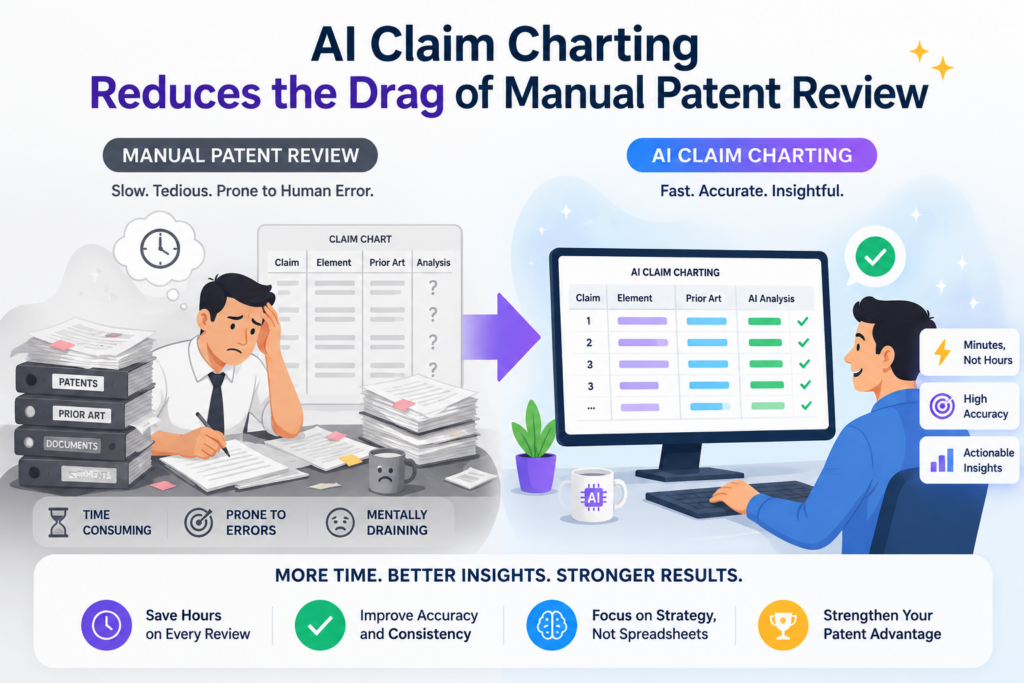
Code, diagrams, and screenshots may also matter. The reviewer has to connect these pieces in a way that is clear and fair.
This is careful work. It should not be rushed. But it also should not be slower than it needs to be. Many parts of the process are repetitive. AI can help with those parts so people can spend more energy on the hard calls.
Manual charting takes time because every match needs context
A claim chart is not useful if it only copies text into a table. It must explain why the proof matters. A good chart shows the claim part, the matching proof, and the reason the proof supports the match.
This is where context matters. A product page may say that a system “uses machine learning.” That may not be enough to match a claim that requires a specific training step.
A user guide may show a feature, but not the hidden process behind it. A code comment may describe a function, but the actual logic may be different.
AI can help collect possible support, but the team still needs to judge the quality of the match. That balance is important. Speed helps, but accuracy matters more.
AI works best when it helps people ask sharper questions
The best use of AI is not blind trust. The best use is guided review. AI can show possible matches. Then the reviewer can ask better questions.
Does this passage prove the whole claim part, or only part of it? Does this source describe a live product or just a planned feature? Is the evidence public, private, old, or current? Does the proof show how the system works, or only what the user sees?
These questions turn a basic chart into a useful chart. They also help avoid weak claims, weak arguments, and weak decisions.
For startups, this can be the difference between a chart that sits in a folder and a chart that helps the business move. A useful chart can guide filing plans, investor talks, product design, and competitor review.
AI helps turn scattered inputs into a cleaner work product
Founders and engineers do not always have perfect invention records. Ideas may be spread across Slack threads, Git commits, product specs, notebooks, pitch decks, lab notes, and emails. That makes patent review harder.
AI can help organize these inputs. It can group related facts, pull out technical steps, and connect them to claim ideas. It can also help find gaps.
For example, the system may show that a claim part has strong support in a design doc but no clear support in a product demo. Or it may show that the product has a feature that is not yet described in the patent draft.
This helps the team clean up the record before it becomes a problem.
Cleaner inputs help attorneys review faster and better
Attorney time is most valuable when it is spent on strategy, not sorting messy files. When AI helps prepare the first layer of the chart, the attorney can review the stronger points, question the weak points, and help shape the next move.
That does not mean AI replaces attorney work. It means AI clears the path so attorney work can focus on the parts that matter most.
This is a core reason PowerPatent exists. Founders should not have to choose between speed and care. They should be able to move fast while still getting real oversight.
That is the better way to protect deep tech work without turning the process into a long, painful delay. See the founder-friendly process here: https://powerpatent.com/how-it-works
AI claim charting makes patent analysis easier for technical teams to understand
Patent claims are not written like product notes. They do not read like code comments, engineering tickets, or design docs.
They often use long wording because each part of the claim needs to be clear in a legal setting. That can make the claim hard for a founder or engineer to read, even when the invention itself is something they understand deeply.
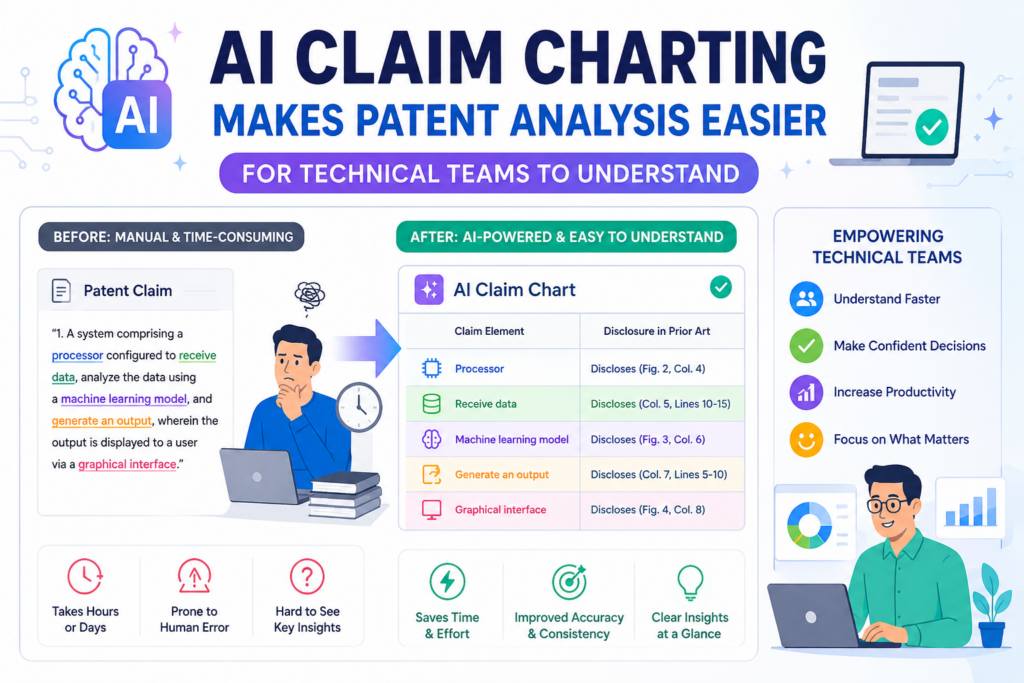
AI claim charting helps close that gap. It can turn dense claim language into smaller, clearer parts. It can show what each part seems to ask for.
It can also connect those parts to normal product facts, such as how data moves, how a model works, how a device responds, or how users interact with a system.
That makes the process more useful for the people who know the technology best.
Instead of leaving patent review only to legal teams, founders and engineers can take part in the review with more confidence.
AI can translate claim language into product language
A strong patent review often needs input from both sides. The patent side understands claim scope and risk.
The technical side understands how the system really works. The problem is that these two sides often speak in different ways.
A patent claim may describe “generating an output based on a trained model.” An engineer may describe the same thing as “the model scores the input and sends a result to the app.” These may point to the same technical action, but the words look different.
AI can help bridge that language gap. It can suggest plain-English meanings for claim parts.
It can also show how those parts may match product features. This gives the technical team a faster way to confirm, correct, or reject the chart.
Simple wording helps teams give better feedback
When claim charting stays locked in patent wording, the technical team may stay quiet. They may not know what part of the claim matters.
They may also assume the legal team already understands the product in full, which is often not true.
Clearer wording brings better feedback. A founder can say, “That is not how our system works.” An engineer can say, “The model does that, but only after a different step.”
A product lead can say, “That feature was removed before launch.” Each comment can change the chart in an important way.
This is where AI claim charting becomes more than a speed tool. It becomes a teamwork tool. It helps people with different roles look at the same problem and move toward the same answer.
For startups, this is powerful. The team does not have months to sit in long review cycles. They need a clear way to share what they know, fix wrong assumptions, and make smart choices quickly.
That is also why PowerPatent combines smart software with real attorney oversight, so founders can move fast while still getting careful review. You can see how it works here: https://powerpatent.com/how-it-works
Better shared understanding leads to stronger patent choices
A claim chart is not only a table. It is a thinking tool. When the chart is clear, it helps the team understand the invention, the proof, the risk, and the next move.
For example, a startup may find that a patent claim looks broad at first but depends on one narrow step. If the product does not use that step, the risk may be lower.
Or the team may find the opposite. A claim that looked harmless may have one part that matches a core product feature very closely.
AI can help surface these points faster. It can show likely matches and weak spots early, so the team can spend more time discussing what the findings mean.
Clear charts help leaders make faster calls
Founders often need to make patent choices before everything is perfect.
They may need to decide whether to file now, wait, change the product, talk to counsel, respond to diligence, or review a competitor more deeply. A clear chart gives them a better base for those choices.
This does not mean the chart gives a final answer by itself. It means the chart makes the question easier to see. That is often half the battle.
When the chart shows that three claim parts have strong proof and one part has weak proof, the next step becomes clear. The team can look for more evidence.
They can ask an engineer to explain that part. They can have an attorney review the match. They can also decide the issue is not worth more time.
That kind of speed matters. Patent work should protect the business, not freeze it. AI claim charting helps keep the work moving without making the team guess in the dark.
AI claim charting helps teams find gaps before those gaps become expensive
One of the most useful things a claim chart can do is show what is missing. Many people think claim charting is only about finding matches. That is only part of the job.
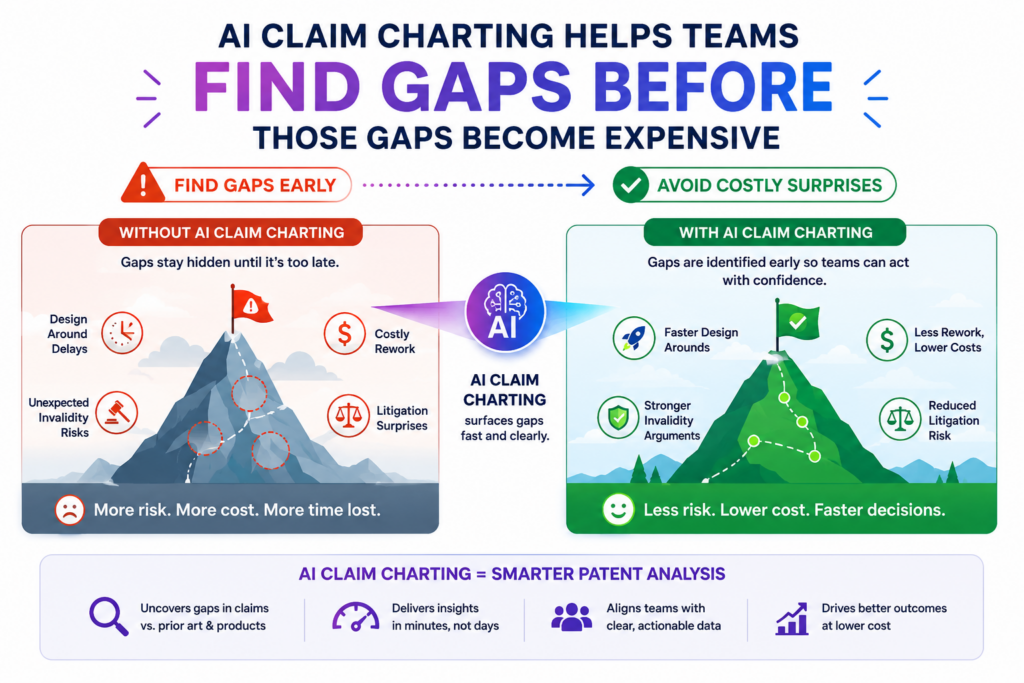
A good chart also shows where support is weak, where facts are unclear, and where the team needs more detail.
This is critical in patent analysis because weak spots can create bad outcomes. A team may think a claim is strong, only to find that one part has no clear support.
A startup may think a product is safe, only to find that a hidden process matches a claim more closely than expected. A founder may think their patent draft covers the full invention, only to learn that the best feature is not described well enough.
AI can help find these gaps sooner.
Missing evidence is often the real problem in patent review
A claim chart can only be as strong as the proof behind it. If a chart says a product has a feature, the chart should point to something that supports that statement.
That support might be a screenshot, a code section, a product guide, a test result, a public page, or a technical document.
When evidence is missing, the team may still have a hunch. But a hunch is not enough for serious patent work. The team needs facts.
AI can scan the available material and show where proof appears to exist. More importantly, it can show where proof does not appear to exist. This helps the team avoid false confidence.
Gap spotting makes the next action easier
A missing proof point should not cause panic. It should create a clear next step. Maybe the team needs to ask an engineer for a better explanation. Maybe they need to pull a document from a product folder.
Maybe they need to capture a demo screen. Maybe they need to update the invention notes before filing.
AI claim charting helps because it makes these gaps visible early. Instead of waiting until the end of the review, the team can see weak areas while there is still time to fix them.
This is especially helpful for fast-moving startups. Product details change quickly. A feature may be renamed. A model may be updated. A workflow may be replaced.
If the patent record does not keep up, the team may later struggle to show what was invented and why it mattered.
A clean AI-assisted chart can help keep the story straight. It can show which claim ideas are backed by strong facts and which ones need more care.
AI can flag claim parts that need human review
Not every claim part is equal. Some parts are easy to match. Others need careful thought. A claim part that says “receiving data” may be simple.
A claim part that describes a special training method, timing rule, or control process may need deeper review.
AI can help flag parts that look uncertain. It can show low-confidence matches, mixed evidence, or unclear wording. This helps attorneys, founders, and engineers know where to focus.
This saves time because the team does not spend the same amount of energy on every row. Simple rows can be checked quickly. Hard rows can get the attention they deserve.
Human review is still the quality gate
AI can speed up the process, but human review is still essential. A tool may suggest that a product feature matches a claim part, but a trained person needs to decide whether that match is strong, weak, or wrong. In many cases, the difference turns on small details.
For example, a claim may require that one step happens before another step. If the product does the same steps in a different order, that may matter.
A claim may require that a model is trained in a certain way. If the product uses a different method, that may matter too.
This is why founders should be careful with any tool that promises push-button patent answers. The better model is AI plus real review.
PowerPatent is built around that idea. It gives founders a faster way to move through patent work while keeping attorney oversight in the loop. You can learn more here: https://powerpatent.com/how-it-works
AI claim charting can improve patent due diligence without slowing the deal
Patent due diligence can create stress for a startup. It often shows up during a funding round, acquisition talk, partnership deal, or major customer review.
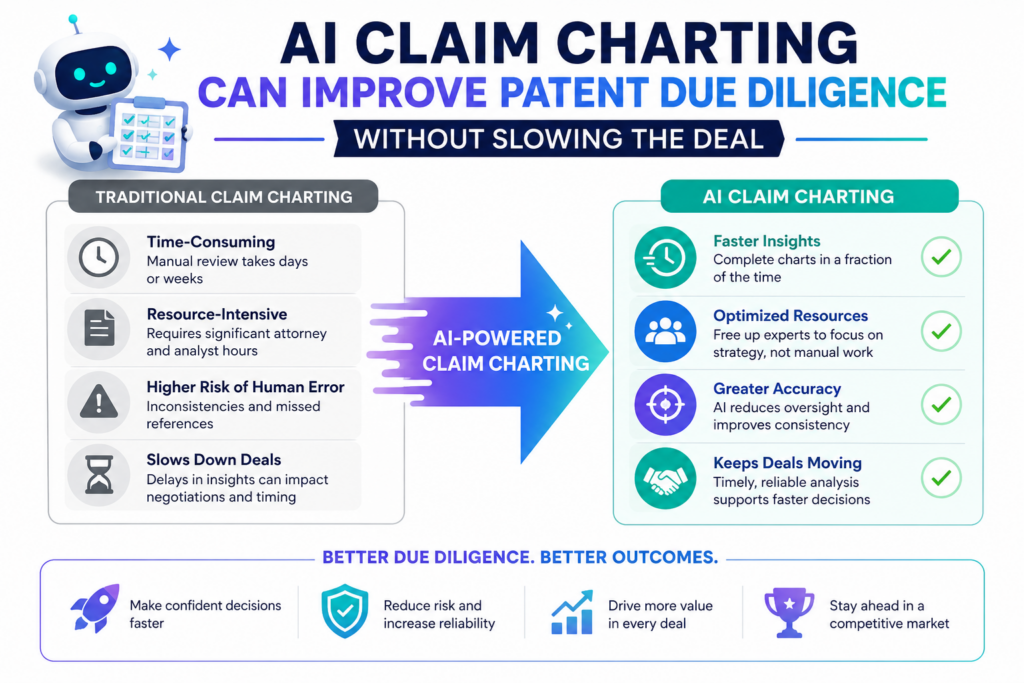
At that moment, the company may need to explain what it owns, what it has filed, how its technology is protected, and whether any outside patents create risk.
Claim charts can help answer those questions. They can show how a startup’s patent claims connect to its product.
They can also show how outside patent claims may relate to what the company is building. The challenge is that diligence often moves fast. The team may not have weeks to build every chart by hand.
AI claim charting can help prepare a faster, cleaner view.
Faster diligence starts with organized claim evidence
Investors and buyers want confidence. They want to know that the startup’s patents are not just paperwork. They want to see that the claims connect to real technology and real business value.
A claim chart can help tell that story. It can show that the patent is tied to the product, the core system, or a hard technical edge. It can also help show why the patent matters in the market.
AI can help gather and organize this evidence. It can map claim parts to product documents, invention notes, diagrams, demos, and technical files. This gives the team a better starting point before outside review begins.
Good charts make the patent story easier to trust
A strong patent story is not built with vague claims like “we have AI patents” or “our system is protected.” Serious readers want detail. They want to see what the patent covers and why it matters.
A clean claim chart helps make that story concrete. It can show that the claims are tied to a real feature, not just a broad idea. It can also show that the company understands its own patent position.
This matters because trust is built through clarity. When a founder can explain the link between the invention, the product, and the patent claim in simple words, the conversation becomes much stronger.
AI claim charting helps prepare that clarity faster. It gives the team a structured view, so they are not trying to answer diligence questions from memory.
AI claim charting helps founders prepare before questions arrive
The best time to prepare for diligence is before the deal starts. Once a funding round or acquisition process begins, the founder’s time gets pulled in many directions. Patent questions can become one more heavy task on an already full plate.
AI claim charting can help founders prepare early. The team can build rough charts for key patents, key product features, and known competitor areas. Then, when diligence questions arrive, they are not starting from zero.
This does not mean every chart has to be perfect on day one. It means the team has a working base that can be reviewed, refined, and shared with the right people.
Preparation gives founders more control
Control matters in patent work. When a founder has no clear chart, they may feel forced to react to every question. When they have a clear chart, they can lead the conversation.
They can explain which patents cover which parts of the product. They can show which claims support the core technology.
They can point out where filings are still pending or where new filings may be needed. They can also work with counsel to handle sensitive details in the right way.
AI claim charting supports this by making the first draft faster and less painful. It helps turn scattered knowledge into a usable record.
PowerPatent helps founders do this in a way that fits startup speed. The platform helps turn technical work into patent-ready material, with smart software and real attorney oversight behind the process.
For founders who want strong protection without losing weeks in back-and-forth, the next step is simple: https://powerpatent.com/how-it-works
AI claim charting helps compare patents against products with less guesswork
A big part of patent analysis is comparison. The team needs to compare what a claim says against what a product does.
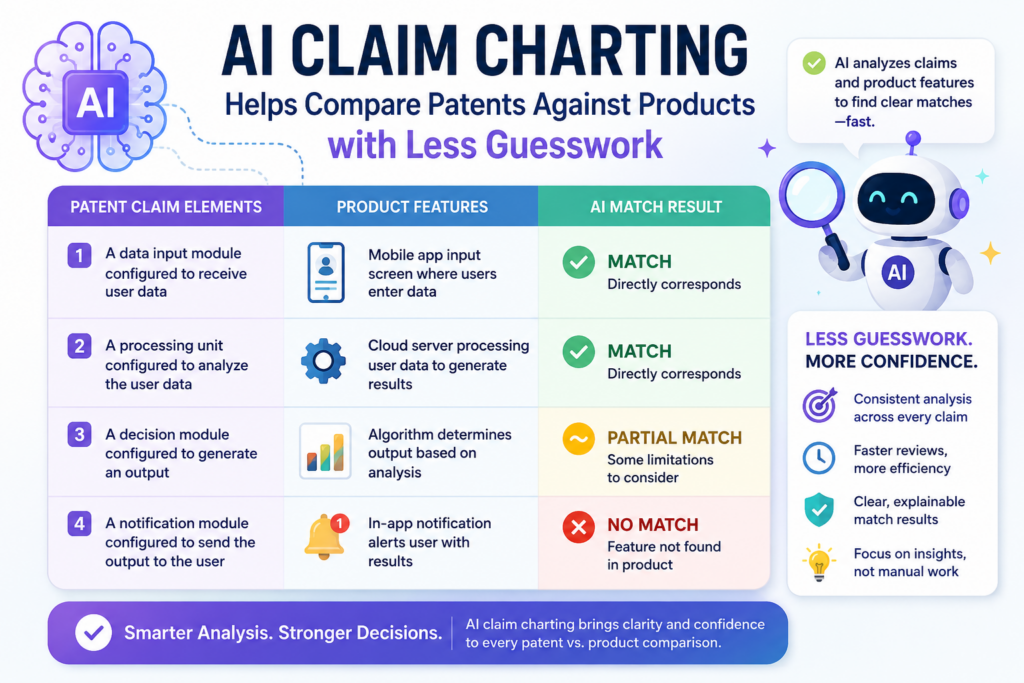
That product may be your own system, a competitor’s platform, a public tool, an open-source project, a research system, or a device in the market.
This sounds simple until the work begins. Product facts are often messy. Public pages may use broad marketing words.
Technical docs may hide key details in long sections. Code may use names that do not match patent terms. Even screenshots can be hard to map to claim language.
AI claim charting helps reduce the guesswork. It can pull likely product facts into one place, compare them to claim parts, and show where the match looks strong or weak.
The result is not a final answer by itself, but it gives the team a sharper starting point.
AI can help match claims to real product behavior
A patent claim often describes what a system does step by step. A product may do those same steps, but the proof may appear in different places.
One step may be shown in a user guide. Another may be found in a developer doc. Another may only be clear from a demo, a paper, or a system diagram.
AI can help bring those pieces together. It can search across many sources and suggest where each claim part may be supported.
This saves time because the reviewer no longer has to hunt through every page by hand before they can begin thinking.
This is especially useful when the product is complex. AI systems, robotics tools, cloud software, chip systems, and medical devices often have layers.
The user sees one thing, while the real work happens behind the scenes. AI can help connect visible product features to deeper technical descriptions when those descriptions are available.
Strong product comparisons need proof, not loose claims
A chart should not say, “This product probably does this,” unless the team is clear that more review is needed.
Good claim charting is built on proof. The proof may not be perfect at first, but the chart should make the strength of each match clear.
AI can help by showing the source behind each possible match. That source can then be checked by a person. The reviewer can decide whether the evidence is direct, partial, weak, or not useful.
This keeps the team honest. It also stops the chart from becoming a wish list. A good chart should help the business make clear choices. It should not make a weak match look stronger than it is.
For founders, this matters when reviewing competitors or partners. You may need to know whether a product appears close to your patent claims.
You may also need to know whether your own product may be close to someone else’s claims. AI claim charting helps you get that first view faster, so you can bring the right questions to counsel sooner.
AI can help show where product facts are unclear
Sometimes the chart does not fail because there is no match. It fails because the facts are not clear. A public page may say the product uses AI, but it may not say how the model is trained.
A manual may show that data is collected, but it may not show whether the data is processed in the way the claim requires.
AI can help mark these unclear areas. Instead of forcing the reviewer to make a hard call too early, the chart can show that more proof is needed.
That is useful because unclear areas often drive the next step. The team may need a deeper technical review. They may need to look at source code. They may need to review a standard.
They may need to test the product. They may need an attorney to decide how much the gap matters.
Unclear areas are not dead ends when the chart is well built
A weak or unclear match is still useful if it is labeled the right way. It tells the team where to spend time next. It also prevents false comfort.
This is one of the biggest benefits of AI claim charting. It does not only speed up the happy path. It also helps show where the path gets rough. That lets founders and engineers act sooner.
PowerPatent is built for this kind of practical patent work. It helps technical teams move from raw invention details to stronger patent decisions, while real attorneys help review the work.
For startup teams that need speed and care, that mix can make patent work feel much more manageable. See how it works here: https://powerpatent.com/how-it-works
AI claim charting helps patent teams review more material without getting buried
Patent analysis often gets hard because there is too much material. One patent may have many claims. One product may have many manuals, pages, specs, and code files.
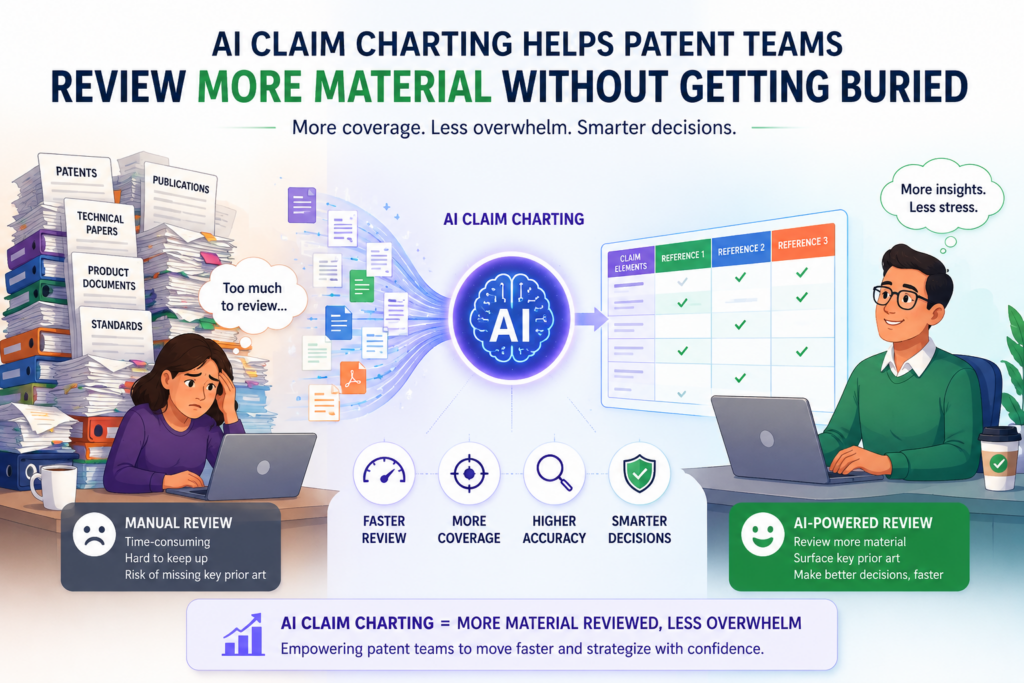
One market area may include hundreds of patents and papers. A person can review all of that by hand, but it may take too long for a startup timeline.
AI claim charting helps by doing the first pass faster. It can scan large sets of text, group related details, and point the reviewer toward the most likely matches.
This does not remove the need for careful review. It helps the team avoid getting buried before the real work begins.
For a founder, this can be the difference between “we do not have time to check this” and “we have enough of a first view to make a smart next move.”
AI helps sort large patent sets into useful groups
When a startup looks at a crowded patent space, the first question is often not about one single claim. The first question is broader.
Which patents matter most? Which claims are closest to our product? Which patents look weak, old, narrow, or unrelated? Which ones deserve deeper review?
AI can help sort the pile. It can group patents by topic, feature, method, product area, or technical problem.
It can help show which patents talk about the same kind of system and which ones are far away from the startup’s work.
This early sorting is valuable because not every patent deserves the same attention. A team should spend more time on patents that appear close to the product and less time on patents that only share broad words.
Smart sorting protects focus and reduces waste
Focus is a startup advantage. A small team cannot afford to spend days reading patents that do not matter. It also cannot afford to ignore a patent that may create real risk.
AI claim charting helps protect focus by putting the closest material near the top of the review. Then the team can decide where human review is needed.
This is not about cutting corners. It is about using time well. A patent attorney should not have to spend high-value time sorting noise if software can help prepare the first view.
An engineer should not have to read ten long patents when only two have claim parts that may relate to the product.
When AI helps with the first sort, people can spend more time on the hard questions. That is where better decisions happen.
AI helps review long documents without missing key details
Long documents are a major pain in patent analysis. A technical manual may be hundreds of pages. A product guide may use different names for the same feature.
A research paper may place the most important detail in a small paragraph. A standard may hide key steps in dense sections.
AI can help scan those documents and find parts that may relate to each claim element.
It can point to the page, section, or passage that appears relevant. The reviewer can then inspect that evidence and decide whether it belongs in the chart.
This makes the work faster and more complete. It also lowers the chance that a key detail is missed just because it was buried in a long source.
The best results come from AI review plus human checking
AI can help find what may matter. Humans still need to decide what does matter. That is the right split.
A person can see context, edge cases, and meaning that a tool may miss. A person can tell whether a passage is about the same product version, whether a diagram really shows the claimed feature, or whether the wording is too vague to support the chart.
This is why founders should use AI claim charting as a speed layer, not as a blind answer machine. The goal is not to replace careful thinking. The goal is to get to careful thinking faster.
PowerPatent follows this same idea. The platform uses smart software to help founders move faster, while real patent attorneys help bring judgment and review into the process.
That is how startups can protect serious inventions without getting trapped in slow, old patent workflows. Learn more here: https://powerpatent.com/how-it-works
AI claim charting makes prior art review faster and more useful
Prior art review is one of the hardest parts of patent work. A team needs to understand what already exists before it can make smart choices about a new filing, a claim strategy, or a risk review.

The problem is that prior art can be spread across patents, papers, product pages, old manuals, open-source projects, videos, standards, and technical posts.
A normal search may find a lot of results, but not all of them matter. The real question is sharper. Does any earlier source show the same claim parts? Does it show all of them together?
Does it explain the key step in enough detail? AI claim charting helps answer these questions faster by turning search results into a structured comparison.
AI can help compare new claim ideas against older material
When a startup has a new invention, the team may know it is useful, but it may not know how new it is.
The invention may improve speed, cost, accuracy, safety, data use, chip power, model control, or system design. To protect it well, the team needs to see how it differs from what came before.
AI can help by taking a draft claim or feature description and comparing it to older references.
It can point to places where older material appears to show similar steps. It can also show where the older material seems to stop short.
This saves time because the team can get a faster view of the landscape. Instead of reading every old patent from start to finish, the team can focus on the closest references first.
The most useful prior art charts show both overlap and difference
A weak prior art review only says, “This reference is related.” That is not enough. Many things can be related without being a real problem. A better chart shows which claim parts are found in the older source and which parts are missing.
That matters because a patent claim often stands or falls on the details. One source may show receiving data. Another may show training a model. A third may show sending a result.
But if no single source shows the full claimed method in the same way, that difference may matter.
AI claim charting can help make this clearer. It can line up the old source against each claim part and show where the fit looks strong, partial, or absent. Then the human reviewer can decide how much that difference matters.
For founders, this can be very useful before filing. It helps the team avoid spending time on weak claim ideas.
It also helps find the real inventive edge, which may be smaller but much more valuable than the team first thought.
AI helps founders refine patent claims before filing
Many startup patents begin with a product story. The founder explains what the system does and why it matters. That story is important, but patent claims need more than a story. They need clear technical boundaries.
AI claim charting can help turn the product story into stronger claim thinking. It can compare early claim ideas against known material and show where the language may be too broad, too narrow, or too close to older work.
This helps the team shape better claims before too much time is spent. It can also help attorneys ask better questions. Instead of starting from a blank page, they can see which parts of the invention appear most unique and which parts need more detail.
Early charting can lead to cleaner patent filings
A clean filing starts with clear invention details. When AI claim charting helps show where the invention differs from old material, the team can put more focus on those differences in the patent draft.
This can make the filing stronger. It can also reduce painful back-and-forth later. If the first draft misses the real edge, the team may need many rounds of revision.
If the claims are built around the true technical difference from the start, the work can move with more purpose.
That is one reason PowerPatent is built for technical founders. It helps turn real engineering work into patent-ready material faster, with smart software and attorney oversight working together.
See how PowerPatent helps founders protect what they are building here: https://powerpatent.com/how-it-works
AI claim charting helps teams prepare stronger office action responses
After a patent application is filed, the patent office may push back. This is normal.
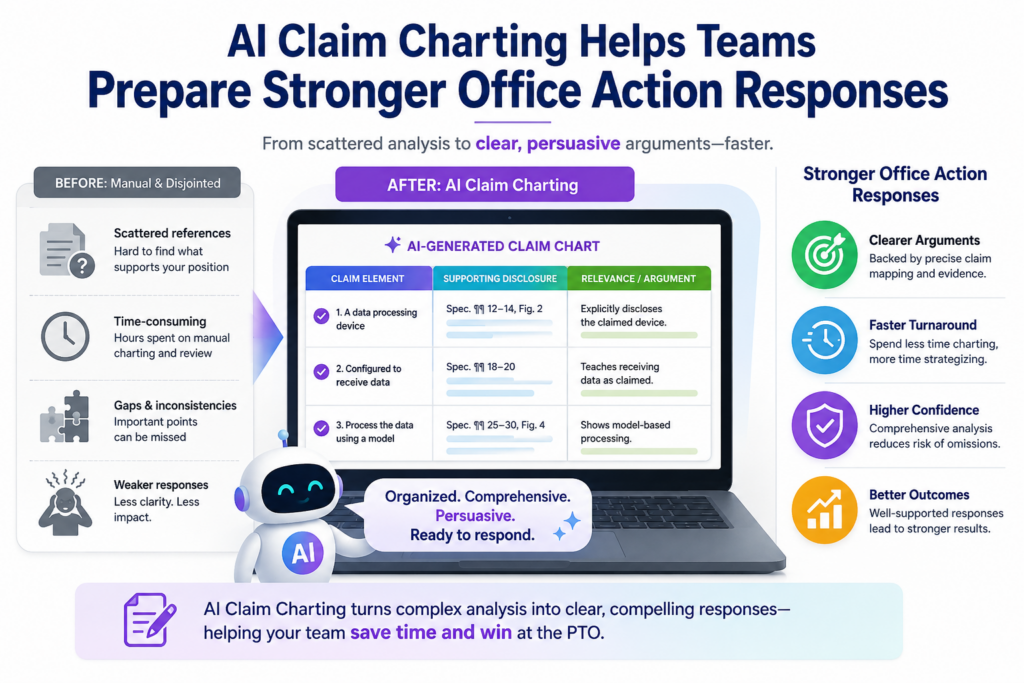
The examiner may cite older patents or papers and say that the claimed invention is not new enough or not different enough. The team then needs to respond in a clear and careful way.
Claim charting is very useful here. The team can chart the pending claims against the examiner’s references and see what each reference actually teaches.
This helps show where the examiner may be right, where the examiner may have missed a detail, and where the claims may need changes.
AI can speed up this process by helping review the cited references, pulling likely matching passages, and showing how they line up with each claim part.
AI can help organize examiner references quickly
Office action review can be stressful because the documents are often dense. The examiner may cite several references. Each reference may have long text, many figures, and technical language that is not easy to scan quickly.
AI can help organize this material. It can break the claim into parts, scan the cited references, and suggest where the examiner’s points may come from.
It can also help show whether a reference truly supports the examiner’s reading or only touches the idea in a loose way.
This gives the team a faster starting point. It does not replace attorney judgment. It helps the attorney and founder get to the real issue sooner.
Faster review helps teams avoid rushed responses
A rushed response can create problems. If the team does not fully understand the cited reference, it may argue the wrong point. It may also narrow the claims more than needed. That can reduce the value of the patent.
AI claim charting helps slow down the right part of the process while speeding up the busywork.
The tool can help gather and organize the evidence quickly. Then the attorney can spend more time deciding the best response.
This is important because the response is not just about getting a patent allowed. It is about getting a patent that still matters. A fast allowance is not helpful if the final claims are too narrow to protect the business.
AI can help find the real difference between the claim and the reference
The strongest response often depends on one clear difference. The older reference may show many parts of the claim, but not the key part. Or it may show the parts in a different order.
Or it may solve a different problem. Or it may use a different kind of data, model, sensor, circuit, or control step.
AI can help find these possible differences faster. It can compare each claim part to each reference and show where the match appears weak. That gives the team a place to focus.
The founder or engineer can then help explain the technical difference in plain words. The attorney can shape that into a proper response.
The founder’s technical input can make the response much stronger
Founders often think office actions are only for attorneys. But technical input can be very important. The attorney may understand the claim and the law, but the founder may understand the invention’s real edge better than anyone.
AI claim charting helps bring that founder input into the process. When the chart shows a possible gap, the founder can explain whether the gap is real.
They can point to a design choice, a model behavior, a hardware limit, a data rule, or a performance gain that makes the invention different.
This can lead to better responses and better claims.
PowerPatent is made for this kind of teamwork. It helps founders stay involved without forcing them to become patent experts.
The software helps move the work forward, while real attorneys guide the process and review the details. Learn how it works here: https://powerpatent.com/how-it-works
AI claim charting helps teams review competitor patents with more speed and less stress
Competitor patent review can feel uncomfortable, but it is often very useful. A startup does not need to be afraid of every patent in its space.
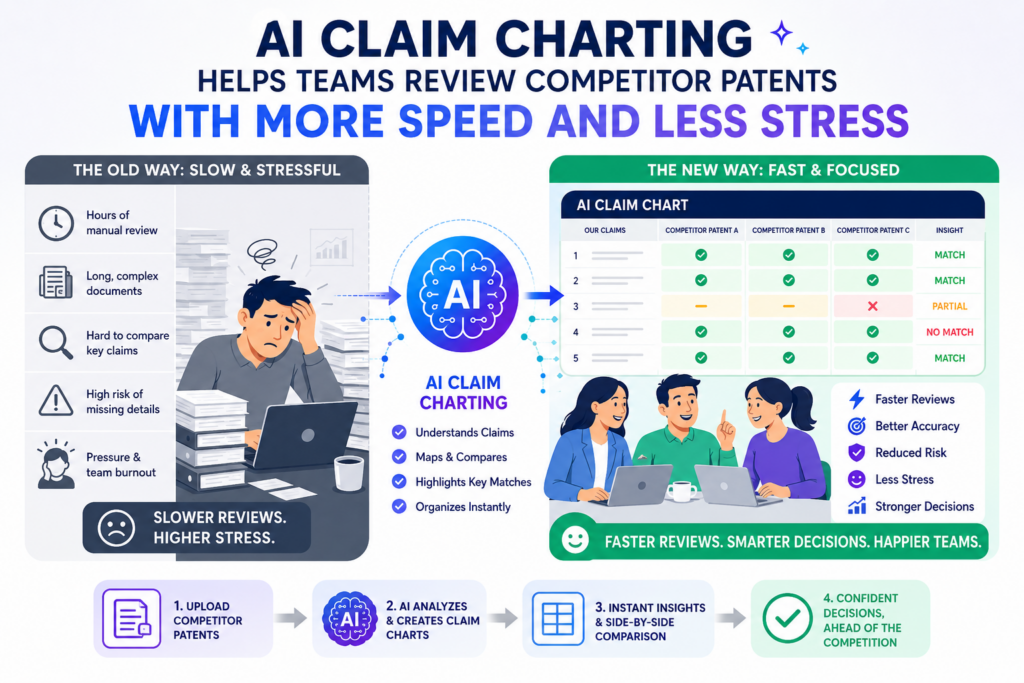
At the same time, it should not ignore patents that may touch the product it is building. The smart path is to review the closest patents early, understand what they claim, and decide what action makes sense.
AI claim charting makes this process easier to start. It helps turn a competitor patent from a wall of hard text into a set of claim parts that can be compared against real product facts.
This helps the team see what matters, what does not, and what needs deeper review from an attorney.
AI can help separate broad fear from real patent risk
Many founders see a competitor patent and worry right away.
That reaction is normal. Patent documents look serious, and the wording can feel broad. But a patent is not judged by the title, the summary, or the drawings alone. The claims are what matter most.
AI claim charting helps the team focus on those claims. It can break the claims into parts and help compare those parts to what the startup’s product actually does. This is much better than making decisions based on fear or guesswork.
A patent may sound close at first, but the claim may require a step the startup does not use.
It may require a certain type of hardware, a certain data flow, or a certain model update. Those details can change the whole view.
A calm chart gives founders a better starting point
A clear chart helps turn worry into action. Instead of asking, “Is this patent a problem?” the team can ask a better question. Which claim parts match our product, and which ones do not?
That question is much easier to answer. It also gives the attorney a better base for review.
The founder can bring a chart that shows the patent claim, the product facts, the possible matches, and the unclear areas. That saves time and makes the discussion more useful.
This matters because founders need to protect their focus. A patent concern can become a huge distraction if it is not handled well.
AI claim charting helps put the concern into a structured form so the team can make a smart next move.
Competitor charts can also reveal white space
Reviewing competitor patents is not only about risk. It can also show opportunity. When a startup charts competitor claims, it may see what those patents do not cover. It may find a technical path that is open, under-protected, or better suited to the startup’s product.
That can shape the startup’s own patent strategy. The team may decide to file around a new method, a better workflow, a more efficient system, or a stronger technical result.
In this way, claim charting can help the company defend itself and build a stronger patent position at the same time.
AI can speed this up by helping compare many competitor claims across the same product area. It can help show patterns, gaps, and repeated claim themes. The team can then focus on the places where its own work is most different.
White space can become a stronger filing plan
A good filing plan is not based on copying what others have done. It is based on knowing where the startup’s real edge sits. Competitor claim charts can help reveal that edge.
For example, a competitor may have claims around collecting data, but not around a new way to clean that data before model training.
Another may have claims around a device sensor, but not around the control logic that makes the device safer. Another may cover a user-facing workflow, but not the hidden system that improves speed.
These gaps may become strong filing areas. They may also help the founder explain the invention more clearly to investors, partners, and future buyers.
PowerPatent helps founders move through this kind of thinking with smart software and real attorney oversight.
The goal is not to bury the team in patent work. The goal is to help them protect the parts of the business that truly matter. See how PowerPatent works here: https://powerpatent.com/how-it-works
AI claim charting helps make invention capture more complete
Many strong patent filings begin before the patent draft. They begin with good invention capture.
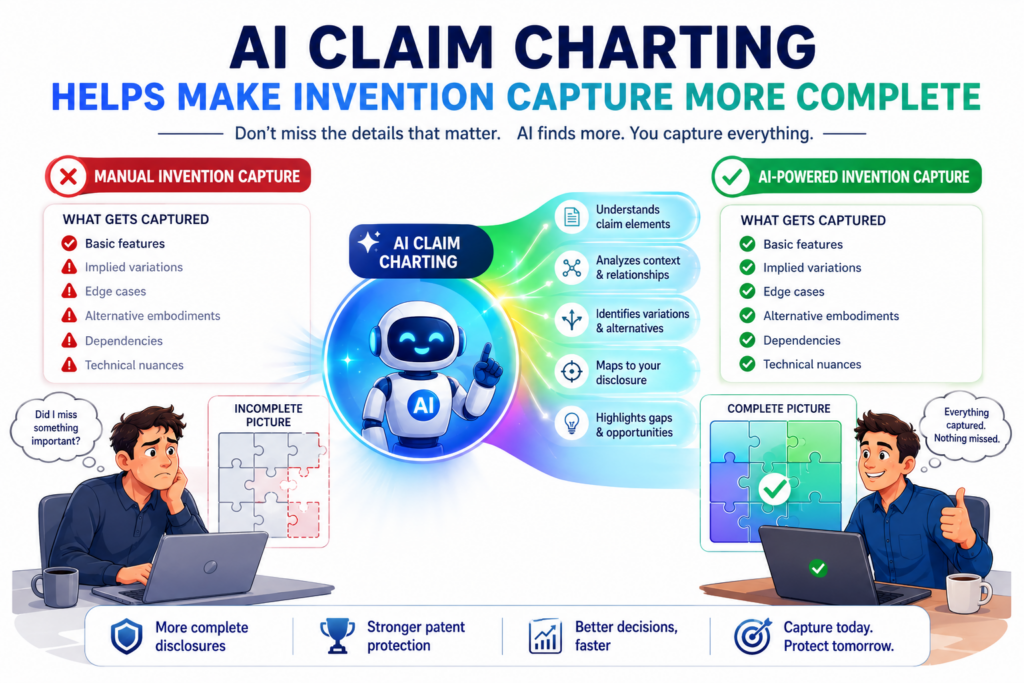
This means the team records what was built, why it matters, how it works, and what makes it different. If this step is weak, the later patent work can become harder.
AI claim charting can help improve invention capture because it shows what details are needed to support strong claims.
When the chart has gaps, the team can see what still needs to be explained. When a claim idea has strong support, the team can see which facts should be preserved.
This is especially helpful for deep tech startups, where the most valuable part of the invention may be hidden inside the system.
The best detail may sit in model behavior, control logic, chip design, test data, or a backend process that users never see.
AI can help founders turn rough notes into clearer invention records
Founders and engineers often write invention notes in a rushed way. That makes sense. They are busy building.
Their notes may say what the product does, but not why the approach is new or how each step works. Later, when the team tries to file a patent, those missing details can slow things down.
AI can help by reviewing rough notes and showing what claim parts they may support. It can also show what is missing. Maybe the notes explain the input and the output, but not the middle step.
Maybe they explain the model but not the training data. Maybe they describe a device feature but not how the device changes behavior in response to a signal.
That kind of feedback makes invention capture more practical. The team does not need to become patent experts. They only need to answer better questions.
Better records make the attorney review much more useful
When invention records are clear, attorney review becomes sharper. The attorney can focus on claim strategy instead of trying to guess how the invention works.
They can ask better follow-up questions and help shape the filing around the strongest technical points.
This saves time for everyone. It also helps avoid weak filings that sound broad but lack the detail needed to support meaningful claims.
For startups, this is a major advantage. Patent work is often delayed because the raw technical story is not ready. AI claim charting can help prepare that story earlier, while the invention is still fresh in the team’s mind.
AI can help protect features that may be easy to overlook
Not every valuable invention looks dramatic. Sometimes the most important part is a small process that makes the system faster, safer, cheaper, or more reliable.
Engineers may see that process as “just how we made it work,” but that detail may be very important for patent protection.
AI claim charting can help spot these overlooked features. By mapping possible claim ideas to technical records, it can show where the team has something specific and useful.
It may reveal that a small design choice solves a hard problem in a way that competitors would want to copy.
This is where patent work becomes more strategic. The team is not just filing because it built something. It is filing because it knows which parts of the system create an edge.
Small technical details can become large business assets
A startup’s value often lives in details. A model pipeline may perform better because of one data step. A robotics system may be safer because of one control rule.
A chip may use less power because of one layout choice. A medical device may work better because of one timing process.
If those details are not captured, they may be lost. If they are captured well, they can become part of a stronger patent filing.
PowerPatent is built to help founders capture those details before they slip away. It gives technical teams a faster path from invention notes to patent-ready material, with attorney oversight to help keep the work grounded and useful. Learn how PowerPatent helps startups protect their best work here: https://powerpatent.com/how-it-works
AI claim charting helps teams turn product changes into stronger patent updates
A startup product is never frozen. The first version changes. The model gets better. The workflow is cleaned up. The hardware is made smaller. The backend is rebuilt.
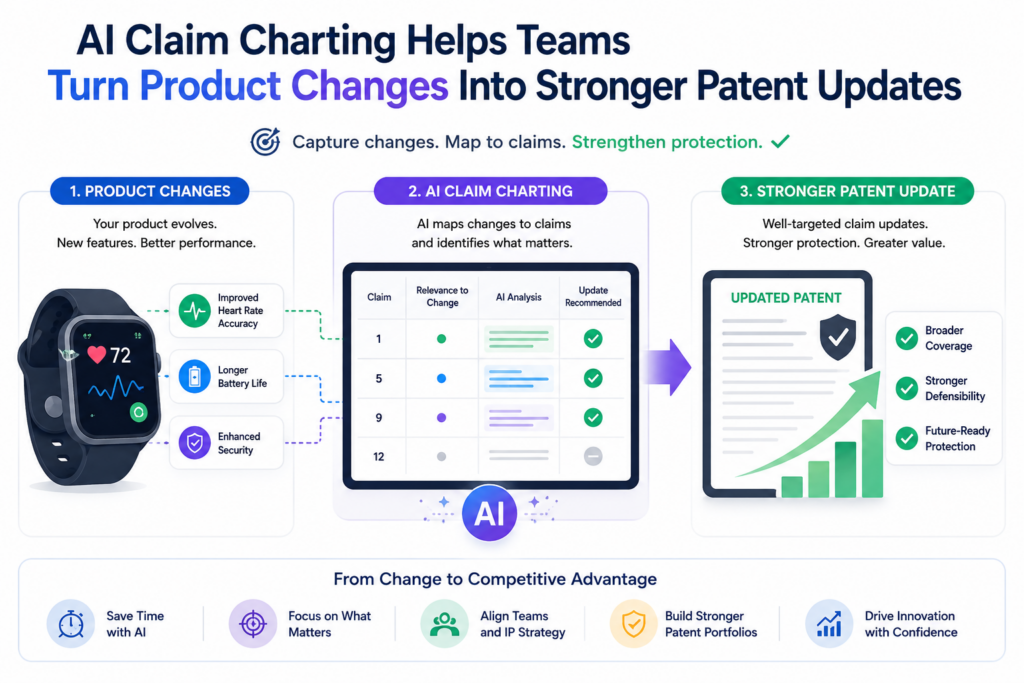
The user flow is simplified. The team may start with one idea and end up with a much stronger system after months of testing.
That is normal. But it creates a patent problem. If the patent work does not keep up with the product, the protection may fall behind the real invention.
A filing may cover the old version but miss the part that now makes the product special.
AI claim charting can help close that gap. It can compare older patent material against newer product notes, specs, code summaries, and design changes. This helps the team see what is already covered, what may need more detail, and what may deserve a new filing.
AI can help compare old filings against new product features
When a startup improves its product, the team should ask a simple question: does our patent plan still match what we are building now?
This question is easy to forget because everyone is busy shipping. But it can make a big difference later.
AI claim charting can help by mapping existing claim language to the current product. If a claim part still lines up well, that is useful to know.
If a new feature has no clear match, that may be a sign that the patent plan needs an update.
This is especially important when a new feature becomes central to the business. A small feature may grow into the main reason customers buy the product.
A backend process may become the reason the system works better than competitors. A new model step may become the real technical edge.
Product drift can create patent gaps if no one is watching
Product drift happens when the product moves in one direction and the patent record stays in another.
This does not happen because anyone is careless. It happens because startups move fast and patent work often sits outside the daily build cycle.
AI claim charting helps make this easier to catch. It can show where the claim story and product story no longer match. That gives the team a chance to act before the gap becomes costly.
For example, a startup may have filed around a first model pipeline. Later, the team builds a better pipeline with a new filtering step, a new feedback loop, or a new way to reduce errors.
If that new step creates the real advantage, the team should not assume the old filing covers it well.
A clear AI-assisted chart can show the difference. Then the founder can work with counsel to decide whether to file a new application, add more support, or adjust the strategy.
AI claim charting can help keep patent work tied to business value
Not every product change needs a patent update. Some changes are small. Some are easy for others to copy but not worth much. Some are useful but not central to the business. The team needs to know which changes matter.
AI claim charting helps by making the link between claims, features, and value easier to see.
When a new feature maps to a key customer benefit, performance gain, or market edge, the team can treat it with more care. When a feature is minor, the team can avoid wasting time.
This keeps patent work practical. The goal is not to patent every idea. The goal is to protect the parts that help the company win.
Strong patent updates start with timely review
Timing matters. If the team waits too long, key details may be forgotten. Engineers may move on.
Documents may be scattered. The reason behind a design choice may become unclear. That can make later patent work slower and weaker.
AI claim charting helps make review more regular. The team can use it when major product changes happen, when a new release is planned, when a funding round is coming, or when a competitor starts moving closer.
This is the kind of patent workflow startups need. It should be fast enough to fit the company’s pace, but careful enough to protect what matters.
PowerPatent helps founders do this with software that supports speed and real attorney oversight that adds judgment. See how PowerPatent helps technical teams protect fast-moving inventions here: https://powerpatent.com/how-it-works
AI claim charting helps founders explain patent value to investors and partners
Investors and partners do not want vague patent talk. They want to understand what the company has, why it matters, and how it supports the business.

A founder who says, “We have patents pending,” may get a polite nod. A founder who can explain how the claims connect to the core product is much more convincing.
AI claim charting can help founders prepare for that conversation. It turns patent claims into a clearer story.
It shows how the invention maps to the product. It also helps explain why the protected feature may be hard, useful, and tied to market value.
This does not mean founders should share sensitive details with everyone. It means they should understand their own patent position well enough to speak with confidence.
A clear chart helps turn patents into a business story
A patent is not valuable just because it exists. It becomes valuable when it protects something the business cares about.
That may be a core model, a sensor system, a data process, a chip design, a control method, a medical workflow, or a technical way to reduce cost.
A claim chart helps show that link. It can connect each claim part to the product feature it supports. It can also show why that feature matters to customers or to the company’s edge.
AI makes this easier by helping prepare the first version of that map. The founder can then work with counsel to decide what can be shared and how to say it in a safe, clear way.
Investors trust clear thinking more than big claims
Big claims can sound exciting, but clear thinking builds more trust. A founder does not need to pretend the company owns an entire market.
They need to show that the company knows what it has built and has taken smart steps to protect it.
AI claim charting helps founders speak with more precision. Instead of saying, “Our AI is patented,” the founder can say, in simple terms, that the patent work is focused on a specific system improvement, a key model workflow, or a technical method that supports the product’s advantage.
That kind of message is stronger because it feels real. It also makes the founder look prepared.
For deep tech startups, this can matter a lot. Investors often need to understand why the product is not easy to copy.
A clean patent story can help support that point. It will not replace traction, team strength, or product quality, but it can add confidence when the technology is a major part of the company’s value.
AI claim charting can help prepare for partner and customer questions
Large partners and customers may also ask about patents. They may want to know whether the startup owns its core technology.
They may want to understand whether the product depends on outside rights. They may want to know if the company has a plan to protect future improvements.
A clear claim chart can help the startup prepare for those questions. It gives the team an internal view of what the patents cover, what is still pending, and what may need more work.
This is not about turning every sales call into a legal talk. It is about being ready when serious questions come up.
A founder who understands the patent position can answer with calm confidence and bring in counsel when needed.
Better preparation can make hard conversations easier
Patent questions can feel scary when the team is not ready. They feel much easier when the team has already done the thinking. AI claim charting helps by creating a working map before the pressure starts.
That map can show which claims relate to which product features. It can show where evidence is strong. It can show where more review is needed. It can also help the team decide what to file next.
PowerPatent is built to help founders create this kind of clarity without dragging them through a slow, old process. The platform helps turn technical work into stronger patent material, backed by real attorney oversight.
For founders who want to move fast and still protect the company, this is the smarter path. Learn more here: https://powerpatent.com/how-it-works
AI claim charting helps teams make better build, buy, or partner choices
Patent analysis is not only for lawyers. It can shape real business choices. A startup may need to decide whether to build a feature in-house, license a tool, partner with another company, or avoid a path that looks risky.
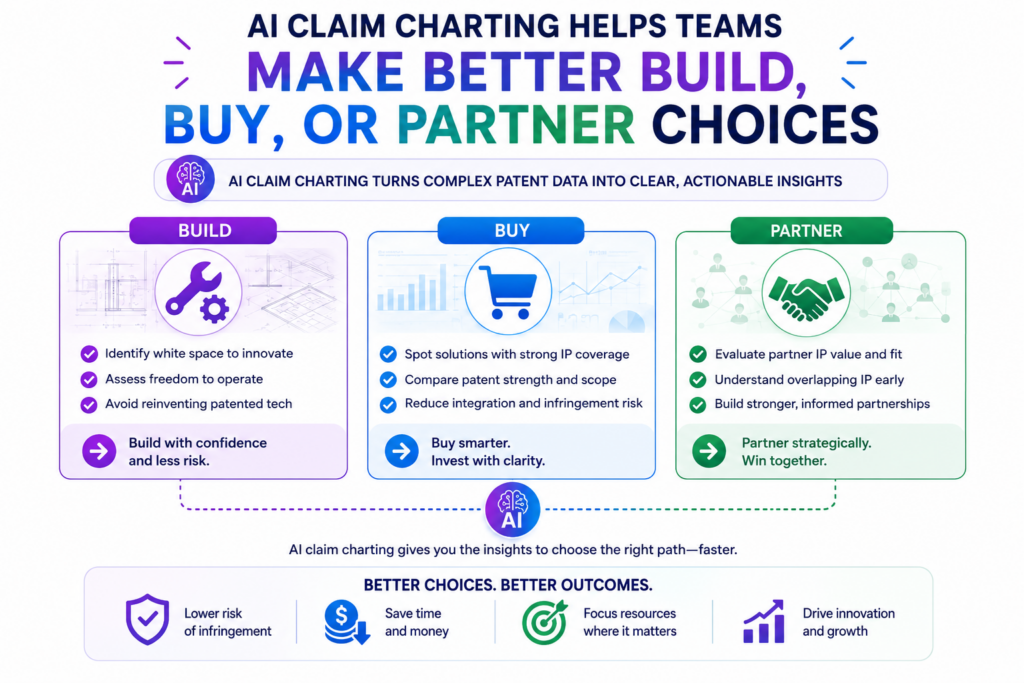
These choices are often made under pressure, and the team may not have perfect information.
AI claim charting helps bring more order to that decision. It can show how a patent claim lines up with a planned product feature, a vendor tool, or a partner system. That helps the team see where there may be overlap and where more review is needed.
The goal is not to scare founders away from building. The goal is to help them build with clearer eyes.
AI claim charting can support product planning before code is written
Many patent issues are easier to handle before the team builds too much. If a feature is only on the roadmap, the company still has room to shape it. The team can change the design, focus on a different technical path, or file its own patent around a better approach.
AI claim charting can help at this early stage by comparing planned features against known claim language.
The product team can see whether a planned workflow appears close to an existing claim. The engineering team can also see where a design choice may create distance.
This is useful because small technical choices can have large patent effects. A system may avoid one risk by changing how data is processed, when a model is updated, or where a control step happens.
Early charting helps teams design with more confidence
When patent review happens too late, the team may feel trapped. They may have already built the feature, trained the model, signed customers, or made promises to investors. At that point, changing direction can be costly.
Early AI claim charting gives the team more room. It helps founders ask better questions before the cost gets too high.
Does the claim require a step we do not need? Can we solve the same user problem in a different way? Is our approach actually better and worth protecting?
This kind of review can support smarter product planning. It does not slow the team down when done well. It helps the team avoid wasted work and protect the paths that matter.
For startups, this can be a big advantage. Speed is not just moving fast. Speed is moving fast in the right direction.
PowerPatent helps founders do that by combining smart software with real attorney oversight, so patent work can support the build process instead of blocking it. Learn more here: https://powerpatent.com/how-it-works
AI claim charting can help review vendor and partner technology
Startups often use outside tools. They may use cloud services, AI models, data tools, chip vendors, sensors, developer platforms, or third-party software. These tools can help the company move faster, but they can also raise patent questions.
A claim chart can help the team understand whether a vendor or partner technology is close to a claim area that matters.
It can also help show which parts of the system are owned by the startup and which parts come from someone else.
AI makes this easier by helping compare technical descriptions across many sources. It can read product docs, public pages, integration guides, and internal notes, then suggest where claim parts may line up.
Clear vendor review helps protect future leverage
A startup should know what part of the product creates its edge. If the most valuable piece depends fully on a vendor, that can affect strategy.
If the startup adds a unique layer on top of a vendor tool, that layer may be worth protecting.
AI claim charting can help make this clearer. It can show where the outside tool stops and where the startup’s own invention begins. That line can matter for patent filings, investor talks, and future deals.
The key is to review early, before the company becomes too dependent on one path. With a clean chart and attorney guidance, founders can make better build, buy, or partner choices without getting pulled into endless legal review.
AI claim charting helps startups protect AI inventions that change fast
AI products change quickly. A model may be replaced. A prompt flow may be redesigned. A data pipeline may be rebuilt.
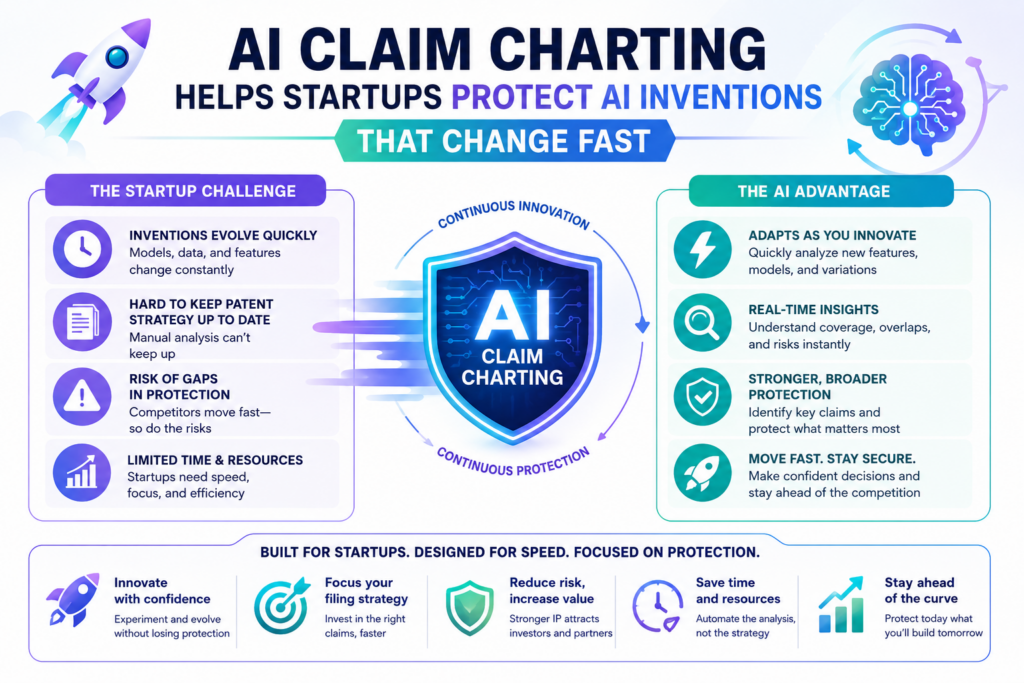
A feedback loop may be added after customer use. What looked like the main invention in January may not be the main invention by June.
This makes patent work harder. The team needs to protect the real technical edge, but that edge may keep moving as the product improves. AI claim charting can help by showing how each version of the system maps to the patent story.
Instead of treating the patent filing as a one-time event, the startup can treat it as part of the product cycle.
AI claim charting can track changes in model workflows
Many AI inventions are not just about the model itself. The real value may come from how the system gets data, cleans data, chooses prompts, routes tasks, checks outputs, handles errors, updates memory, or uses human feedback.
These steps can change often. If the team does not track them, the patent plan may miss the best parts of the invention.
AI claim charting can help by comparing claim ideas against current technical records. It can show whether the claim still matches the workflow.
It can also show when a new step has become important enough to review for patent protection.
AI patents often live in the workflow, not the buzzword
A weak AI patent story says, “We use AI to do this.” A stronger patent story explains the specific technical way the system works. It shows the steps, the data flow, the model behavior, and the result.
AI claim charting helps find and explain those steps. It can turn a fast-moving AI workflow into a clearer map.
Then the team can decide which parts are old, which parts are common, and which parts may be new enough and important enough to protect.
This matters because competitors may also use AI. The startup’s edge is usually not that it uses AI at all. The edge is how it uses AI to solve a hard problem in a better way.
PowerPatent helps founders capture that edge before it gets lost in product changes. The platform is built for technical teams that need to move fast, but still want strong patent protection with real attorney review. See how it works here: https://powerpatent.com/how-it-works
AI claim charting helps show what makes an AI system different
In AI, small design choices can matter. Two products may both use large models, but one may handle private data in a safer way. One may reduce false results with a special check.
One may use feedback to improve output quality. One may combine model output with rules, sensors, or domain data in a new way.
AI claim charting can help surface these differences. It can compare the startup’s system against older references, competitor products, and internal claim ideas. This helps the team see which features are truly common and which ones may be special.
That is important because strong patent work starts with clear difference. The team must know what makes the invention stand apart.
Clear difference leads to clearer claims
When the difference is clear, the patent work gets easier. The attorney can focus the claims around the real technical edge.
The founder can explain why that edge matters. The engineering team can provide better support.
AI claim charting helps create that clarity faster. It gives the team a structured way to compare what they built against what already exists and what others appear to be doing.
For fast-moving AI startups, this can prevent wasted filings. It can also help protect the parts of the system that create real business value.
That is the whole point. A patent should not be a trophy. It should be a useful asset that supports the company’s growth.
AI claim charting helps make patent analysis more consistent across the whole team
Patent analysis can become messy when different people review the same claim in different ways. One person may break a claim into three parts. Another may break the same claim into seven parts.
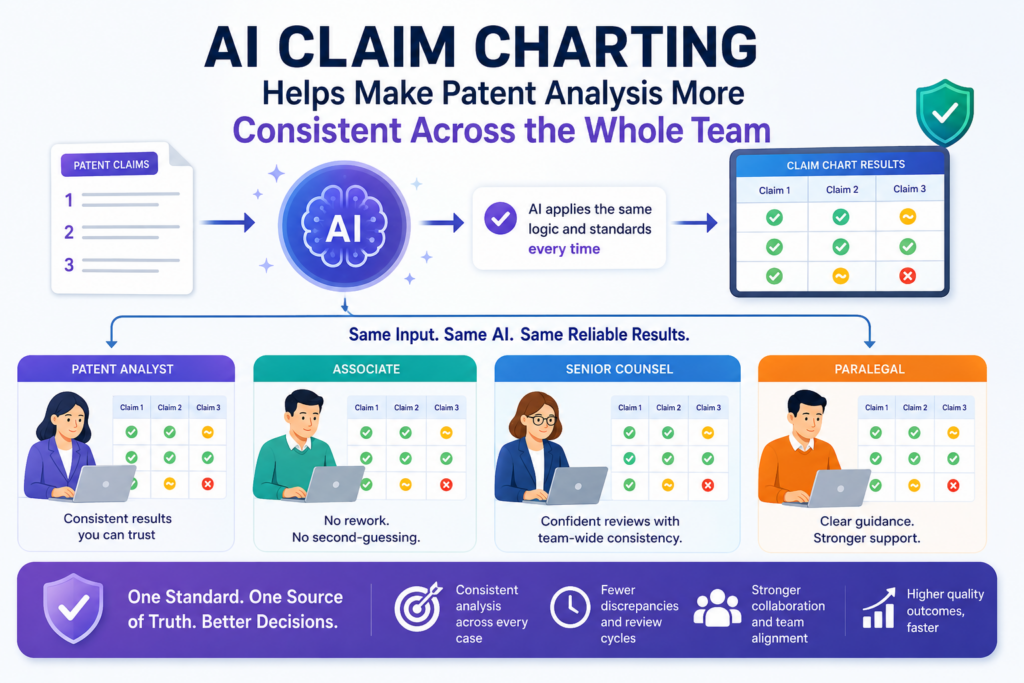
One reviewer may call a match strong, while another may call it weak. This can create confusion, especially when the team is moving fast.
AI claim charting can help create a more consistent starting point. It can use the same structure across many claims, many patents, and many product reviews.
That does not mean every output is perfect. It means the team begins from a more organized base instead of a blank page every time.
Consistency matters because patent work often builds on earlier work. A chart made today may support a filing decision next month, a funding review next quarter, or a product review next year. If the chart is clear and structured, it becomes easier to reuse, update, and trust.
AI can help standardize how claims are broken down and reviewed
A strong claim chart starts with a clear split of the claim language. Each part should be small enough to review, but not so small that the chart becomes hard to read. This balance is not always easy.
AI can help by using a steady method for claim breakdowns. It can separate steps, parts, features, and conditions in a way that makes review easier. Then a human reviewer can adjust the chart where needed.
This is useful for startups because many people may touch the patent work. A founder may review the business value.
An engineer may confirm how the system works. An attorney may review the claim scope. A product lead may confirm whether a feature is live, planned, or removed.
A shared chart structure helps everyone speak the same language
When the chart has a clear structure, team feedback becomes easier. People can point to the same row and discuss the same claim part. This reduces confusion and saves time.
For example, an engineer can say that row three is wrong because the product does not perform that step in the claimed order.
A founder can say row five maps to a feature that customers care about most. An attorney can say row seven needs better evidence before it can support a strong view.
This kind of shared review makes the chart more useful. It also helps teams avoid long meetings where people talk past each other.
PowerPatent is built for this kind of collaboration. It helps founders, engineers, and patent professionals work from a clearer base, using software to speed up the process and real attorney oversight to keep the work grounded.
You can learn how that process works here: https://powerpatent.com/how-it-works
AI can help reduce repeated work across patent projects
Patent teams often repeat the same tasks. They review the same product documents. They compare similar claim language. They search for the same technical proof. They explain the same system features again and again.
AI claim charting can reduce that repeat work. Once a product feature has been mapped to evidence, that information can help future charts.
Once a claim term has been explained in plain words, that explanation can help the next review. Once a key technical document has been linked to an invention, the team can use it again when it fits.
This makes the patent process feel less like starting over each time.
Reusable chart work helps startups move faster over time
The first chart may take effort, even with AI. But each good chart can make the next one easier. The team builds a clearer record of the technology, the evidence, the claim ideas, and the product story.
Over time, this creates a patent knowledge base. The team can see which features have been protected, which features need more work, and which claim ideas connect to the strongest business value.
For startups, this is valuable because the company keeps learning. The product changes. The market changes.
Competitors move. A reusable claim chart system helps the patent work keep up with that pace.
The result is not just faster charting. It is better memory. The company can remember why certain patent choices were made and what evidence supported those choices. That makes future decisions cleaner and less stressful.
AI claim charting helps founders avoid weak patents that look good on paper
A weak patent can look impressive at first. It may have a long title, technical drawings, and many pages of detail.
But if the claims do not protect the real edge of the business, the patent may not help much when it matters.
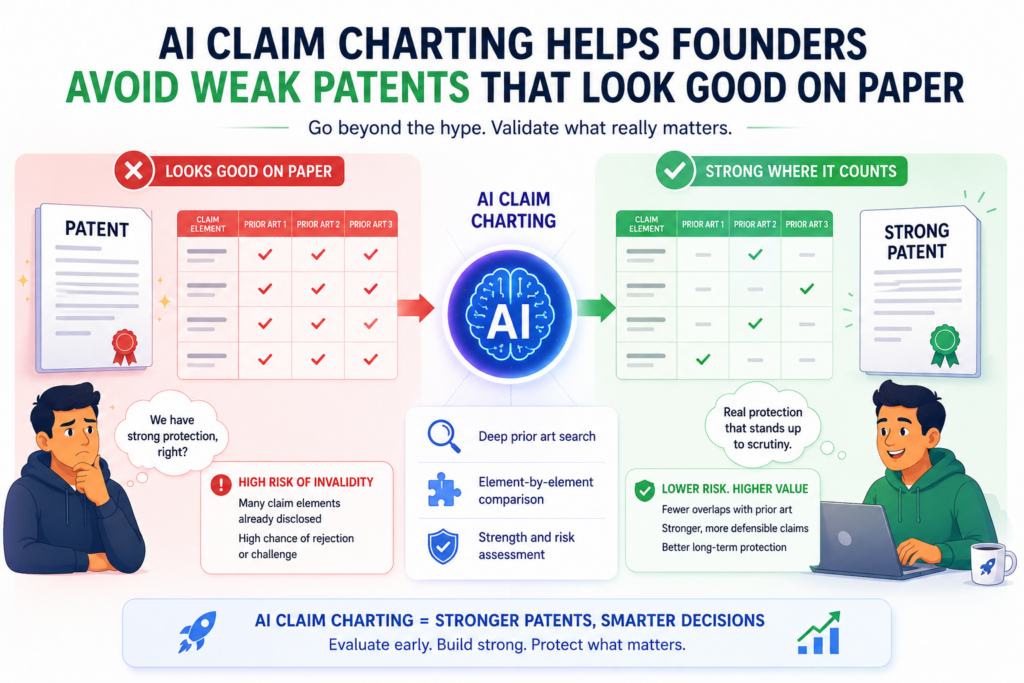
This is one of the biggest risks for startups. A company may spend time and money filing patents that do not map well to the product, do not cover what competitors may copy, or do not include the details that make the invention valuable.
AI claim charting can help reduce that risk. It can show whether the claim language actually connects to the product and the technical advantage.
It can also show where the claims are too thin, too narrow, or not tied to the strongest part of the invention.
AI can help test whether claims match the real product advantage
Before filing, a team should ask whether the claim covers something that matters. Does it cover a feature customers care about?
Does it protect a hard technical step? Does it map to the part of the system that creates speed, accuracy, safety, cost savings, or better performance?
AI claim charting helps by comparing draft claim ideas to the product. If the claim only maps to a surface-level feature, the team may need to dig deeper. If the claim maps to a core technical process, that may be a better sign.
This helps founders think more clearly about patent value. The goal is not just to file something. The goal is to file around the parts of the invention that support the business.
A claim that misses the core feature may not do enough
A patent can be detailed and still miss the point. For example, an AI startup may file around a user interface when the real edge is a data handling method.
A robotics startup may focus on the visible hardware when the real value is a control loop. A chip startup may describe the device at a high level but miss the layout choice that lowers power use.
AI claim charting can help catch this early. By mapping claim ideas to technical proof and business value, the team can see whether the claims are aimed at the right target.
This is where attorney oversight matters. AI can show patterns and gaps, but a skilled patent professional can help decide how to shape claims that are useful, supported, and aligned with the company’s goals.
PowerPatent brings these pieces together for founders who do not want weak, slow, or confusing patent work.
The platform helps turn real technical work into stronger patent filings with smart software and real attorney review. See how PowerPatent helps here: https://powerpatent.com/how-it-works
AI can help avoid filing claims that are too vague to be useful
Some patent ideas sound strong because they use broad words. But broad words alone do not create strong protection.
If the claim is too vague, it may be hard to defend. If the patent does not explain the technical details well, the claims may not hold up the way the founder expects.
AI claim charting can help by showing whether the claim has real support in the invention record.
If a claim part cannot be tied to a clear technical detail, that is a warning sign. The team may need to add more explanation, capture more proof, or rethink the claim.
This makes the filing process more disciplined. The team is not guessing. It is checking whether the claim language is backed by real facts.
Strong patents are built from clear technical truth
The best patents are not built from hype. They are built from clear technical truth. They explain what the system does, how it does it, and why that approach matters.
AI claim charting helps founders get closer to that truth faster. It can show what is supported, what is missing, and what needs a sharper explanation.
It can also help the team avoid the trap of filing something that sounds broad but does not protect the real invention.
For startup founders, this is the heart of good patent strategy. You do not need more paperwork. You need protection that matches the work you are actually doing.
AI claim charting helps make that possible by speeding up review while keeping the focus on real evidence and real business value.
AI claim charting helps teams move faster without lowering the quality of review
Speed is only helpful when it does not create new risk. A fast but careless claim chart can lead to bad decisions.

It may make a weak match look strong. It may miss a key claim part. It may use the wrong evidence. It may give a founder false comfort when deeper review is needed.
The real value of AI claim charting is not speed alone. The value is better speed. It helps the team reach the right review points faster, while still leaving room for human judgment.
That is the balance startups need. They cannot wait forever, but they also cannot afford to make patent choices based on sloppy work.
AI can move the work forward by handling the first pass. People can then check the chart, improve the reasoning, and decide what the results mean for the business.
AI can handle the first draft while people handle the final judgment
A first draft of a claim chart often takes a lot of time. The reviewer has to split the claim, search sources, copy proof, and build the structure. Much of that work is important, but it is also slow and repetitive.
AI can make that first draft faster. It can suggest claim parts, find possible support, and place evidence in the right rows. This gives the team something useful to review much sooner.
The final call still belongs to people. A founder may know the product history. An engineer may know how the system really works.
A patent attorney may know how the claim should be read and where the risks sit. AI helps these people get to the judgment step faster.
Faster first drafts can improve the whole review cycle
When the first draft arrives sooner, the team has more time to improve it. That matters. A rushed manual chart may use up most of the available time before anyone has a chance to think deeply.
AI changes that flow. The team can spend less time building the chart from nothing and more time asking better questions.
Is this evidence strong enough? Does this claim part need more detail? Is the product feature still current? Does the draft claim protect the most valuable part of the system?
This is how AI claim charting can improve quality, not just speed. It gives people more room to do the work that requires judgment.
PowerPatent follows this same idea. It helps founders move faster with smart software, while real patent attorneys help review and guide the work.
That is the kind of patent process startups need when they are building fast and cannot afford costly mistakes. You can see how it works here: https://powerpatent.com/how-it-works
AI can help keep review quality steady even when work volume grows
As a startup grows, patent work can increase quickly. More products, more features, more filings, more competitor patents, more diligence requests, and more investor questions can all arrive at once. If the team relies only on manual review, the process may slow down or become uneven.
AI claim charting helps keep the work more steady. It can apply the same review structure across many matters.
It can help the team avoid missing common steps. It can also make it easier to compare charts across different patents or products.
This does not remove the need for review. It makes review easier to manage.
Consistent review helps founders make cleaner decisions
Founders need clear information, not a pile of mixed notes. If one chart is detailed and another is vague, it becomes hard to compare risk, strength, or value. A consistent claim charting process helps leaders see patterns.
They can see which patents are closest to the product. They can see which claims are backed by strong evidence.
They can see where the company needs more invention capture. They can see which product areas may deserve new filings.
This kind of clarity helps a startup act with more control. It turns patent work from a slow side project into a useful business tool.
AI claim charting helps founders know when to act and when to pause
Good patent analysis should lead to action. A claim chart is not useful if it only creates more confusion. It should help the team decide what to do next.
That next step may be filing a patent, updating a draft, reviewing a competitor, asking an engineer for more detail, changing a product path, or getting deeper attorney review.
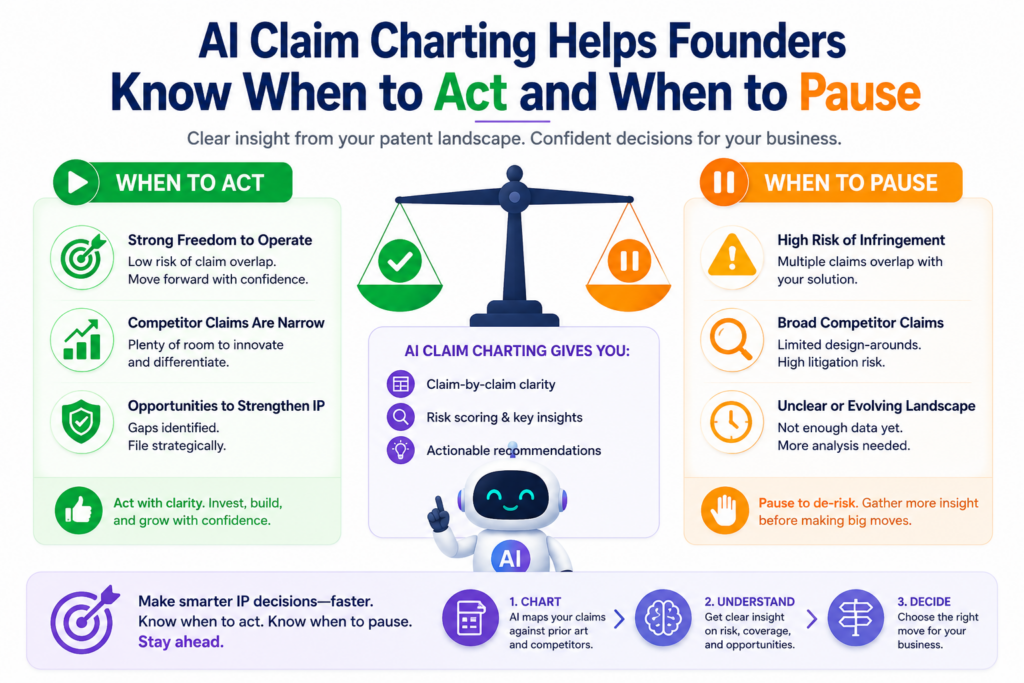
AI claim charting helps by making the next step easier to see. It shows where evidence is strong, where facts are missing, and where claim language may need more care.
It helps founders avoid two common mistakes: acting too soon with weak information or waiting too long because the work feels too hard.
The right chart gives the team enough clarity to move.
AI can help turn patent findings into clear next steps
A chart should not end with a vague feeling. It should point toward a practical action. If a claim part has no support, the next step may be to gather more technical detail.
If a competitor claim appears close to a planned feature, the next step may be attorney review. If a new product feature is not covered by current filings, the next step may be a new invention disclosure.
AI can help surface these next steps faster. It can show the gaps, the close matches, and the unclear areas in a way that is easier for the team to act on.
This is helpful because founders are busy. They do not need a perfect academic report. They need a clear view that helps them protect the business.
A useful chart should create motion, not more noise
Patent work can become noisy when there is too much information and no clear path. A founder may get a long memo, many documents, and no simple answer about what to do next. That is frustrating.
AI claim charting can reduce that noise by creating structure. The team can see which parts of the claim matter most. They can see which evidence supports each part. They can see where human review should focus.
That structure creates motion. The founder can move from concern to action. The attorney can move from rough facts to strategy. The engineer can move from confusion to useful input.
This is the kind of practical patent support PowerPatent is built to provide. The goal is to help founders protect what they are building without pulling them away from building it. Learn more here: https://powerpatent.com/how-it-works
AI can also show when the team should slow down for deeper review
Speed matters, but some moments call for care. If a chart shows a very close match to a competitor patent, the team should not rush past it.
If a claim gap affects a key filing, the team should not ignore it. If a due diligence question touches the company’s core technology, the team should slow down and review it properly.
AI can help identify those moments. It can flag uncertainty, weak evidence, or close overlap. That does not give a final answer, but it helps the team know where not to guess.
This is just as valuable as speeding up easy work. AI claim charting helps the team move fast when the path is clear and slow down when the stakes are high.
Smart speed means knowing where judgment matters most
The best patent process is not fast everywhere. It is fast where the work is routine and careful where the decision is important.
AI helps with that split. It can speed up reading, sorting, matching, and drafting. People can focus on claim meaning, product truth, business impact, and legal strategy.
For founders, that is a better way to work. It keeps patent analysis from becoming a drag, but it also avoids the trap of treating serious patent questions like simple search results.
PowerPatent gives startups this kind of balanced path. Smart software helps organize and speed up the work.
Real patent attorneys help review the details and guide the strategy. That gives founders more confidence, more control, and a clearer way to protect what they are building.
Conclusion
AI claim charting does not make patent analysis magic. It makes it faster, clearer, and easier to act on. For founders, that means less time digging through dense claims and more time seeing what matters: where the proof is strong, where the gaps are, and what should happen next.
The best results come when AI does the heavy lifting and real experts check the work. That is the smarter path for startups that need strong IP without slowing down. PowerPatent helps you move that way with smart software and attorney oversight. See how it works: https://powerpatent.com/how-it-works